furiosus
Hydrogenase that Interacts with Pyruvate
Ferredoxin Oxidoreductase
R. Christopher Hopkins., Junsong Sun.¤a, Francis E. Jenney, Jr.¤b
, Sanjeev K. Chandrayan, Patrick M. McTernan, Michael W. W. Adams*
Department of Biochemistry and Molecular Biology, University of Georgia, Athens, Georgia, United States of America
Abstract
Hydrogen gas is an attractive alternative fuel as it is carbon neutral and has higher energy content per unit mass than fossil fuels. The biological enzyme responsible for utilizing molecular hydrogen is hydrogenase, a heteromeric metalloenzyme requiring a complex maturation process to assemble its O2-sensitive dinuclear-catalytic site containing nickel and iron atoms. To facilitate their utility in applied processes, it is essential that tools are available to engineer hydrogenases to tailor catalytic activity and electron carrier specificity, and decrease oxygen sensitivity using standard molecular biology techniques. As a model system we are using hydrogen-producingPyrococcus furiosus, which grows optimally at 100uC. We have taken advantage of a recently developed genetic system that allows markerless chromosomal integrations via homologous recombination. We have combined a new gene marker system with a highly-expressed constitutive promoter to enable high-level homologous expression of an engineered form of the cytoplasmic NADP-dependent hydrogenase (SHI) ofP. furiosus.In a step towards obtaining ‘minimal’ hydrogenases, we have successfully produced the heterodimeric form of SHI that contains only two of the four subunits found in the native heterotetrameric enzyme. The heterodimeric form is highly active (150 units mg21 in H
2 production using the artificial electron donor methyl viologen) and thermostable (t1/2,0.5 hour at 90uC). Moreover, the heterodimer does not use NADPH and instead can directly utilize reductant supplied by pyruvate ferredoxin oxidoreductase fromP. furiosus. The SHI heterodimer and POR therefore represent a two-enzyme system that oxidizes pyruvate and produces H2in vitrowithout the need for an intermediate electron carrier.
Citation:Hopkins RC, Sun J, Jenney FE Jr, Chandrayan SK, McTernan PM, et al. (2011) Homologous Expression of a Subcomplex ofPyrococcus furiosus Hydrogenase that Interacts with Pyruvate Ferredoxin Oxidoreductase. PLoS ONE 6(10): e26569. doi:10.1371/journal.pone.0026569
Editor:Lennart Randau, Max-Planck-Institute for Terrestrial Microbiology, Germany
ReceivedJune 15, 2011;AcceptedSeptember 29, 2011;PublishedOctober 24, 2011
Copyright:ß2011 Hopkins et al. This is an open-access article distributed under the terms of the Creative Commons Attribution License, which permits unrestricted use, distribution, and reproduction in any medium, provided the original author and source are credited.
Funding:This research was supported by grants (DE-FG05-95ER20175 and DE-FG02-306 05ER15710) from the Chemical Sciences, Geosciences and Biosciences Division, Office of 307 Basic Energy Sciences, Office of Science, U.S. Department of Energy (http://science.energy.gov/bes/csgb/). The funders had no role in study design, data collection and analysis, decision to publish, or preparation of the manuscript.
Competing Interests:The authors have declared that no competing interests exist.
* E-mail: [email protected]
.These authors contributed equally to this work.
¤a Current address: Shanghai Advanced Research Institute, Chinese Academy of Sciences, Shanghai, China
¤b Current address: Georgia Campus-Philadelphia College of Osteopathic Medicine, Suwanee, Georgia, United States of America
Introduction
The supply of cost-effective fossil fuels is finite, and for decades a major focus of research has been renewable energy generation [1]. Energy sources of the future must be abundant and carbon neutral with minimal impact on the environment. Driven by powerful new molecular biology tools, biofuel research has dramatically increased in the past decade, however, significant effort is still necessary to develop an economically viable, sustainable, and renewable energy supply [2,3,4]. As an energy carrier, hydrogen is attractive as it is non-toxic and has three times the energy of gasoline per unit mass [5]. Currently hydrogen is produced by steam reforming of natural gas or electrolysis of water, both of which are either non-renewable or inefficient on a large scale [5,6,7]. For sustainable and renewable production of hydrogen an abundant source of energy, such as sunlight, must be utilized. Photobiological production of hydrogen is an appealing solution
but many problems remain in coupling oxygenic photosynthesis with the enzymatic production of hydrogen [3].
The ability to metabolize hydrogen is distributed across all three domains of life and is catalyzed by the hydrogenase enzymes [8]. Regardless of their source, these enzymes are usually highly regulated on the transcriptional level, require a complicatedin vivo
hydrogenases are ubiquitous in bacteria and archaea and function physiologically in both hydrogen oxidation and evolution [8]. They are much more resistant to molecular oxygen, and as such may be better targets for engineering, notwithstanding their lower catalytic turnover rates as compared to FeFe hydroenases (5–10%) [10,14]. In order to link these enzymes to energetic biological processes, and exploit their ability to generate molecular hydrogen, it will be necessary to tailor catalytic activity, further reduce oxygen sensitivity, and even change coenzyme specificity.
2H+
+2e2«H2 (1)
As a model organism we are investigating the hyperthermo-philic archaeaonPyrococcus furiosus(Pf), an obligate anaerobe that ferments simple and complex sugars to produce organic acids, CO2, and (in the absence of elemental sulfur) H2[15].Pfhas three
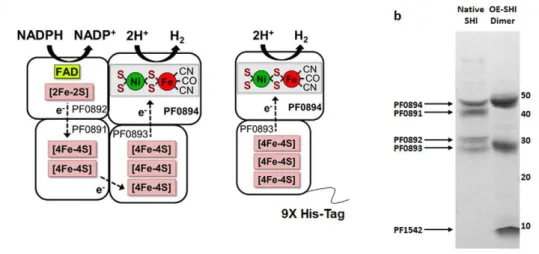
operons that encode NiFe hydrogenases; two cytoplasmic enzymes consisting of four subunits and a membrane bound hydrogenase (MBH) with 14 putative subunits [16,17]. The two soluble enzymes, soluble hydrogenase I (SHI) and soluble hydrogenase II (SHII), utilize NAD(P)(H) as the physiological electron carrier [18,19]. Pf SHI is a heterotetrameric enzyme consisting of the typical large (LSU PF0894) and small (SSU PF0893) subunits along with two additional subunits predicted to contain FeS clusters (PF0891) and a flavin in the form of FAD (PF0892) (Figure 1a).PfSHI is a remarkably stable enzyme having a t1/2at
90uC of approximately 12 hours and t1/2after exposure to air of
about 6 hours [18].
Recently, a genetic system was developed for Pfallowing the markerless disruption or integration of genes onto the chromo-some [20]. This system marks a significant turning point in the ability to usePfas a model organism. A host strain (COM1) was generated via the deletion of pyrF (orotidine 59-monophosphate decarboxylase) which allows subsequent gene knockouts and marker excision. Using this strategy, knockout mutants of each of the two cytoplasmic hydrogenases,shIbcda(soluble hydrogenase I), and shIIbcda (soluble hydrogenase II) were constructed [20]. Expanding on this technique we utilize here a marked knock-in strategy to introduce an expression cassette into thePf chromo-some for homologous overexpression. To drive transcription of
recombinant genes inPfthe promoter region of the gene encoding the S-layer protein (PF1399) was chosen. Based on microarray data ([21]) PF1399 is a high level, constitutively-expressed gene whose promoter will allow universal expression regardless of growth condition.
As a first step towards the production of ‘minimal’ hydroge-nases, the goal of this work was to engineer a form of SHI that contained only two (LSU and SSU) rather than four subunits. This has been reported for the enzyme from someRalsoniaspecies but this was achieved by dissociation of the native tetrameric hydrogenase using electrophoresis and not by genetic manipula-tion [22]. In addimanipula-tion, we wished to take advantage of a new auxotrophic marker system for manipulating chromosomal DNA in the related organism Thermococcus kodakarensis [23,24]. It was shown that the deletion of an essential gene pdaD (TK0149 arginine decarboxylase) could be complemented with addition of the polyamine precursor agmatine, a metabolite not found in complex growth media. Based on this work, we have devised a simple method of integrating genes of interest onto the chromosome ofPfusing agmatine prototrophy as a marker and report herein on the expression and characterization of an active, stable heterodimeric subcomplex ofPfSHI.
Results
A Pf strain overexpressing the dimeric hydrogenase was constructed using an agmatine selection approach. It was recently reported that agmatine is essential for the growth of the hyperthermophilic archaeaonThermococcus kodakarensis[23], a close relative ofPfthat grows at a lower temperature (Topt85uC versus
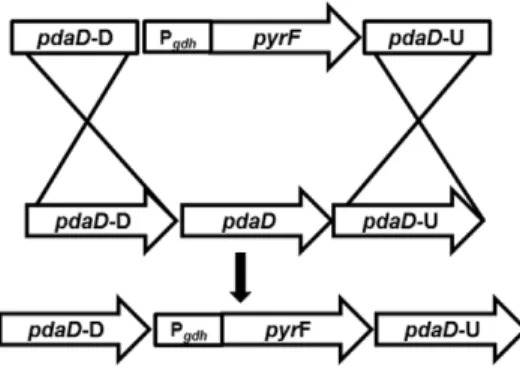
100uC forPf). Agmatine is derived from the decarboxylation of arginine and is a precursor for polyamine synthesis. In addition, it was recently discovered to be an essential conjugate of tRNAIlefor AUA decoding in archaea [25]. Disruption ofPf pdaD (PF1623 arginine decarboxylase) with the Pgdh pyrF cassette (Figure 2)
exhibited auxotrophy for agmatine and this allowed selection in the complex media used forPfas yeast extract and casein both lack agmatine. This departure from defined media in growing and selection of Pf genetic mutants greatly simplifies the process of transformation.
Figure 1. Pyrococcus furiosus heterotetrameric and dimeric soluble hydrogenase I. (a) Model of predicted cofactor contents of the heterotetrameric form ofPfSHI (taken without modification from Sun et al. [10]) and of the heterodimeric form of SHI that was produced (PF0893-PF0894) in this study that lacks PF0891 and PF0892. In the dimeric form, PF0893 is modified with an N-terminal His9tag. The abbreviations used are:
CO, carbonyl ligand; CN, cyanide ligand; FAD, flavin adenine dinucleotide; NADP, nicotinamide adenine dinucleotide phosphate. (b) SDS-PAGE of purified heterotetrameric (left lane) and heterodimeric form of SHI (right lane) with molecular masses indicated in kDa.
A plasmid pSPF300 was designed to allow simple integrations on thePfchromosome at thepdaDlocus and includes a multiple cloning site after the Pslp promoter for cloning of genes for
homologous (or heterologous) expression inPf. To investigate ifPf
SHI can exist as a dimeric enzyme, the LSU and SSU (PF0893-0894) were cloned into the homologous recombination plasmid pSPF300 with the addition of an N-terminal His9-tag (on PF0893)
generating plasmid pSPF302 (Figure 3). Linearized pSPF302 was successfully used to transform Pf and integrate the Pslp shIda
overexpression construct onto thePfchromosome (Table 1).
Pf cells harboring the Pslp shIda overexpression construct (Pf
strain PslpDimer) were used for purification. The overexpressed
(OE-SHI) dimer was purified to homogeneity (Figure 1b) with a final specific activity of 106 U mg21 (MV-linked hydrogen evolution) (Table 2), which is comparable to that obtained with the heterotetrameric enzyme [18]. Although only two subunits are expected from the purified enzyme complex, a persistent contaminant of approximately 8 kDa could not be separated from OE-SHI Dimer (Figure 1b). MALDI-TOF/TOF analysis
revealed this to be PF1542, a gene annotated as snRNP (small nuclear ribonucleoprotein) that functions to mediate RNA-RNA interactions [26]. Size exclusion analysis of OE-SHI Dimer using a calibrated Superdex S200 column indicated the complex migrated at an apparent Mrof 88,000 daltons, in agreement with the trimer
weight of PF0893-0894 and PF1542 (Table 3). As shown in Table 3, the OE-SHI Dimer was much less thermostable and more sensitive to oxygen exposure. As expected in the absence of the FAD-containing subunit PF0892, the OE-SHI Dimer was unable to evolve hydrogen from NADPH. Surprisingly, however, the OE-SHI Dimer was able to accept electrons from pyruvate via POR (Table 3). It has been previously reported that nativePfSHI cannot accept electrons from Fdredusing the POR-linked electron
transfer system [27] and this was confirmed for our native SHI enzyme used in this study. Usually electrons derived from pyruvate are transferred from POR to the membrane bound hydrogenase via the cytoplasmic redox protein Fd [28]. In thein vitroassay OE-SHI Dimer was able to accept electrons directly from POR and the presence of Fd had no significant effect on activity. Native SHI is predicted to contain one [2Fe-2S] and five [4Fe-4S] clusters in addition to the NiFe active site (23 Fe total) while OE-SHI Dimer should only contain three 4Fe4S and the NiFe site (13 Fe total; Figure 1a). Accordingly, metal analysis showed that native SHI has a nickel to iron ratio of 1:25 while the OE-SHI Dimer ratio is 1:10 (Table 3).
Discussion
The recent development of a genetic system inPf[20] enables the deletion and homologous expression of genes, together with the tagging of proteins to facilitate purification. Moreover, the initial method using thepyrFdeletion strain was limited by the use of defined media, as the standard complex media contain contaminating uracil (which overcomes the selection). The construction of the pSPF300 homologous recombination vector for integration at thepdaD locus provides a simple method for manipulating genes inPfeven in rich media. The pSPF300 vector includes the 1 kb regions for recombination, pdaD with native promoter (as marker), a high level, constitutive promoter (Pslp) for
the gene of interest, and a multiple cloning site containing four unique restriction sites. For routine overexpression of genes inPf
the agmatine auxotrophy based marker system and pSPF300 recombination vector provides a facile selection method.
Utilizing the pdaDmarker system an N-terminal His9dimeric
version (PF0893-PF0894) of the heterotetrameric SHI (PF0891-PF0894) was cloned onto the chromosome ofPfto generate strain PslpDimer (Figure 3) in a strain (DSHI) lacking the native enzyme.
TheDSHI deletion strain has already been characterized [20] and this was chosen as the parent strain since it might not be possible to introduce a dimeric SHI intoPfif the native SHI operon is still intact. Based on microarray data the promoter (Pslp) for the gene
Figure 2.pdaD disruption with Pgdh pyrF.The 1kbupstream and downstream regions for thepdaDlocus (PF1399) were cloned around the PgdhpyrFcassette [20]. Using previously described transformation
methods thePfchromosome was disrupted atpdaDgenerating a uracil prototroph and agmatine auxotroph [20].
doi:10.1371/journal.pone.0026569.g002
Figure 3. OE-SHI Dimer recombination plasmid and PslpDimer
strain.Plasmid pSPF302 was constructed for the integration of Pslp shIdaonto thePf chromosome at thepdaDlocus. After homologous recombination Pslp Dimer strain contains the dimeric SHI construct
under control of the constitutive promoter Pslpand thepdaDwith its
native promoter.
doi:10.1371/journal.pone.0026569.g003
Table 1.
Strain Genotype
Originating
Strain Source
DSM Wild Type DSM3638 15
DSHI DpyrFDshIbcda COM1 20 DSHIDpdaD DshIbcdaDpdaD::pyrF DSHI This study
PslpDimer DshIbcdaPslpshIda DSHIDpdaD This study
(PF1399) encoding the highly expressed S-layer protein was used to drive transcription of a minimal form of the SHI enzyme. A phenotype was not observed for the PslpDimer strain but this is not
surprising as other hydrogenase deficient mutants of Pf also exhibited no obvious phenotype [20]. OE-SHI Dimer was able to accept electrons directly from PORin vitroand the possibility exist that the dimeric could short-circuit the path of electrons from POR to the membrane bound hydrogenase. Since this would bypass the creation of a proton motive force and the conservation of energy during metabolism one would expect a severe retardation of growth. Pslp Dimer exhibited similar growth to
wild-type Pfand it appearsin vivo the flow of electrons remains unchanged.
OE-SHI Dimer was purified to near homogeneity utilizing a two-step ion-exchange and nickel sepharose 6 purification protocol (Figure 1b; Table 2). The persistent contamination of OE-SHI Dimer with PF1542 was unexpected as they do not share any similarity in predicted function. A subsequent size exclusion column was also unable to separate the proteins but the complex migrated at the expected Mrfor a heterotrimer (Table 3). This
suggests that OE-SHI Dimer and PF1542 form a stable complex but the reason for this association is not known. In combination with the N-terminal His tag and high constitutive expression, this protocol greatly simplifies purification and provides a superior yield of enzyme. For comparison, the original report of SHI purification [18] reported 11 mgs of pure enzyme obtained from 450 gPfcells; OE-SHI Dimer was purified from 330 g cells for a final yield of 53 mgs, a more than ten-fold increase in yield.
The OE-SHI Dimer was markedly less stable than native SHI, but this is not unexpected as the absence of two partner subunits of the normally heterotetrameric enzyme would destabilize the complex. Although the heterodimeric enzyme appears less stable than native SHI after exposure to air and incubation at 90uC (under the same conditions of buffer and protein concentration, Table 3), the enzyme is still very robust as compared to mesophilic hydrogenases. The activity of the purified dimer with the redox dye MV was comparable to that of native SHI. As expected the
OE-SHI Dimer lacked the ability to accept electrons from NADPH since the FAD-containing subunit PF0892 (and FeS-cluster containing subunit PF0891) are absent. Surprisingly, however, the OE-SHI Dimer was able to accept electrons directly from pyruvate ferredoxin oxidoreductase (POR), a reaction that native SHI cannot catalyze, and yet interestingly OE-SHI dimer cannot accept electrons from ferredoxin, the physiological electron acceptor of POR. Hence we have engineered a form of SHI that by chance directly interacts with native POR. This results in a two enzyme system that oxidizes pyruvate and produces H2without
the need for an intermediate electron carrier, such as ferredoxin or NAD(P). As shown in Figure 4, POR contains thiamine pyrophosphate and three [4Fe-4S] clusters and oxidizes pyruvate to acetyl CoA [29]. Presumably there is direct electron transfer between the iron-sulfur clusters of the two enzymes (Figure 4).
One of the goals in engineering hydrogenases is to change coenzyme specificity, and this was achieved in this case by simply deleting two subunits. Activities with physiological-relevant electron carriers such as NADPH are usually much less than that measured with the artificial electron donor MV, as is evident with native SHI (Table 3). Consequently, while the OE-SHI Dimer and the native SHI had comparable MV-linked hydrogen evolution activities, the OE-SHI Dimer exhibited only five-fold less activity with a physiological electron donor, in this case the enzyme POR, compared to native SHI and its true physiological partner, NADPH (Table 3). The expression of an active, dimeric form of SHI from Pf is a critical step towards engineering minimal hydrogenases. In conjunction with the genetic tools now available, the hydrogenase ofPfprovides a robust model system for further engineering enzymes that will have utility in biohydrogen generating systems.
Table 2.
Step Total Units (mmol min21) Total Protein (mg) Specific Activity (U mg21) Yield (%) Purification (-fold)
Cytoplasm 15300 5110 3 100 1
DEAE Sepharose 14660 2740 5 96 2
Nickel Sepharose 6 5560 53 106 36 35
doi:10.1371/journal.pone.0026569.t002
Table 3.
Property Native SHI [12] OE-SHI Dimer
Activity, MV-Linked (U mg21) 163 145
Activity, NADPH-linked (U mg21) 1 0
Activity, POR-linked (U mg21) 0 0.2
Metal Content (Ni:Fe) 1:25 1:10
Apparent Mr(Daltons) 155,000 88,000
Stability at 90uC (t1/2, hr) 30 0.5
Stability in air (23uC, t1/2, hr) 25 4
doi:10.1371/journal.pone.0026569.t003
Figure 4. Model of the pyruvate-oxidizing, hydrogen produc-ing POR-SHI Dimer system.The abbreviations are: POR, pyruvate ferredoxin oxidoreductase; SHI Dimer, heterodimeric form of SHI (PF0894+PF0893). TPP represents thiamine pyrophosphate.
Materials and Methods
Molecular biology techniques were performed as previously described [30].Pfstrains used in this study are listed in Table 1.
Pyrococcus furiosus (DSM 3638) was cultured on liquid and solid support medium as previously described [20] with the addition of 4 mM agmatine (Sigma Chemical, St. Louis, MO) as necessary for genetic selections.
PfstrainDSHI [20] was used as the parent for this study. For markerless deletion ofpdaD(PF1623, arginine decarboxylase) 1 kb DNA flanking regions upstream and downstream of PF1623 were cloned around the Pgdh pyrF cassette (Figure 2) obtained from
plasmid pGLW021 [20] using overlapping PCR. Transformation and selection of knockoutPfstrains were performed as previously described [20] to generate strainDSHIDpdaD.
For homologous overexpression of genes in Pf a promoter region (200 bp upstream PF1399) was selected based on micro-array data to drive transcription. Across a wide range of conditions ([21]), PF1399 is constitutively expressed at a high level. Strains with disruptedpdaD were selected with defined medium lacking uracil and supplemented with 4 mM agmatine. For simple integrations on the Pfchromosome using agmatine prototrophy as a marker the plasmid pSPF300 was constructed. An NspI fragment was deleted from plasmid pSET152 removing the integrase gene to generate pSET-NS. From this pSPF101 was constructed by inserting the Pgdh pyrF cassette into PstI/NheI
digested pSET-NS, which removes the OriT region, to produce pSPF101. The 200 bp upstream region from PF1399 (Pslp,
promoter region for S Layer Protein) and a multiple cloning site were inserted into SacII/SphI digested pSPF101 to generate pSPF102. A 1.1 kb upstream region of PF1623 was cloned into
Sal/NheI pSPF102 making pSPF107. A 1.83 kb fragment contain-ing intact PF1623 operon (0.73 kb) and 1.1 kb of its downstream regionwas amplified by PCR and cloned intoAscI/SphI digested pSPF107 generating pSPF300. To construct a homologous recombination vector for the expression of dimeric hydrogenase, a cassette with 9X His tagged PF0893-0894 fused behind Pslpwas
first produced by overlap PCR, SacII/KpnI treated PCR product was then ligated with same enzymes treated pSPF300 to make pSPF302 (Figure 3). Transformation ofPfstrainDSHI with AscI/ PmeI linearized pSPF302 was performed and recombinant strains selected as previously described [20] to generate strain PslpDimer
(Figure 3).
NativePfSHI enzyme was purified from wild type P. furiosus
DSM3638 as previously described [16].Pfstrain PslpDimer was
grown in a 600L fermenter essentially as previously described [31] with the addition of 10mM uracil. Harvested cells were flash frozen in liquid nitrogen and stored at 280uC. All purification steps were performed using strict anaerobic technique under an atmosphere of argon. Cell-free lysate was prepared from the Pslp
Dimer strain (330 g, wet weight) and DEAE (Diethylaminoethyl) anion exchange chromatography (GE Healthcare, Piscataway, NJ) performed as previously described [16]. Fractions eluting from DEAE anion exchange chromatography containing hydrogenase activity were pooled and loaded onto a 5 mL Ni Sepharose 6 Fast Flow column (GE Healthcare) equilibrated in 50 mM sodium phosphate, 300 mM sodium chloride, 2 mM dithiothreitol, pH 8.0 (Buffer A). A linear 20 column volume gradient of 0-500 mM imidazole in buffer A was applied to the column and resulting fractions were analyzed for hydrogenase activity (Table 2). Apparent Mr was measured using a calibrated Superdex S200
sizing column (GE Healthcare).
Hydrogenase activity was routinely determined by H2evolution
from methyl viologen (MV) (1 mM) reduced by sodium dithionite (10 mM) at 80uC as described previously [16], except the buffer was 100 mM EPPS, pH 8.4. One unit of hydrogenase specific activity is defined as 1mmole of H2evolved min21mg21. For a
physiologically relevant assay, methyl viologen and sodium dithionite were replaced by NADPH (1 mM) as described [16]. To investigate altered coenzyme specificity, physiological hydro-gen evolution assays were performed as previously described [27]. Oxygen sensitivity assays were performed by exposing samples to air at 25uC. Thermal stability assays were measured by anaerobic incubation of the hydrogenase samples at 90uC. Residual enzyme activities were measured using the MV-linked H2-evolution assay.
Metal content of enzyme samples was measured as previously described [12].
Author Contributions
Conceived and designed the experiments: RCH JS FEJ MWA. Performed the experiments: RCH JS SKC PM. Analyzed the data: RCH JS SKC PM FEJ MWA. Contributed reagents/materials/analysis tools: RCH JS SKC PM. Wrote the paper: RCH JS FEJ MWA.
References
1. Dorian JP, Franssen HT, Simbeck DR (2006) Global challenges in energy. Energy Policy 34: 1984–1991.
2. Wackett LP (2010) Engineering microbes to produce biofuels. Curr Opin Biotechnol In Press.
3. McKinlay JB, Harwood CS (2010) Photobiological production of hydrogen gas as a biofuel. Curr Opin Biotechnol 21: 244–251.
4. Pfromm PH, Amanor-Boadu V, Nelson R (2010) Sustainability of algae derived biodiesel: A mass balance approach. Bioresour Technol 102: 1185–1193. 5. Sigfusson TI (2007) Pathways to hydrogen as an energy carrier. Philos
Transact A Math Phys Eng Sci 365: 1025–1042.
6. Armstrong FA, Belsey NA, Cracknell JA, Goldet G, Parkin A, et al. (2009) Dynamic electrochemical investigations of hydrogen oxidation and production by enzymes and implications for future technology. Chem Soc Rev 38: 36–51. 7. Edwards PP, Kuznetsov VL, David WI (2007) Hydrogen energy. Philos
Transact A Math Phys Eng Sci 365: 1043–1056.
8. Vignais PM, Billoud B (2007) Occurrence, classification, and biological function of hydrogenases: an overview. Chem Rev 107: 4206–4272.
9. Vignais PM, Colbeau A (2004) Molecular biology of microbial hydrogenases. Curr Issues Mol Biol 6: 159–188.
10. Fontecilla-Camps JC, Volbeda A, Cavazza C, Nicolet Y (2007) Structure/ function relationships of [NiFe]- and [FeFe]-hydrogenases. Chem Rev 107: 4273–4303.
11. Stephenson M, Stickland LH (1931) Hydrogenase: a bacterial enzyme activating molecular hydrogen: The properties of the enzyme. Biochem J 25: 205–214.
12. Sun J, Hopkins RC, Jenney FE, McTernan PM, Adams MW (2010) Heterologous expression and maturation of an NADP-dependent [NiFe]-hydrogenase: a key enzyme in biofuel production. PLoS One 5: e10526. 13. King PW, Posewitz MC, Ghirardi ML, Seibert M (2006) Functional studies of
[FeFe] hydrogenase maturation in an Escherichia coli biosynthetic system. J Bacteriol 188: 2163–2172.
14. Vincent KA, Parkin A, Armstrong FA (2007) Investigating and exploiting the electrocatalytic properties of hydrogenases. Chem Rev 107: 4366–4413. 15. Fiala G, Stetter KO (1986)Pyrococcus furiosussp. nov. represents a novel genus of
marine heterotrophic archaebacteria growing optimally at 100C. Arch Microbiol 145: 56–61.
16. Ma K, Adams MW (2001) Hydrogenases I and II fromPyrococcus furiosus. Methods Enzymol 331: 208–216.
17. Sapra R, Verhagen MF, Adams MW (2000) Purification and characterization of a membrane-bound hydrogenase from the hyperthermophilic archaeon
Pyrococcus furiosus. J Bacteriol 182: 3423–3428.
18. Bryant FO, Adams MW (1989) Characterization of hydrogenase from the hyperthermophilic archaebacterium, Pyrococcus furiosus. J Biol Chem 264: 5070–5079.
19. Ma K, Weiss R, Adams MW (2000) Characterization of hydrogenase II from the hyperthermophilic archaeonPyrococcus furiosusand assessment of its role in sulfur reduction. J Bacteriol 182: 1864–1871.
20. Lipscomb GL, Stirrett K, Schut GJ, Yang F, Jenney FE, Jr., et al. (2011) Natural competence in the hyperthermophilic archaeon Pyrococcus furiosus
encoding the two cytoplasmic hydrogenases. Appl and Environ Microbiol 77: 2232–2238.
21. Schut GJ, Brehm SD, Datta S, Adams MW (2003) Whole-genome DNA microarray analysis of a hyperthermophile and an archaeon:Pyrococcus furiosus
grown on carbohydrates or peptides. J Bacteriol 185: 3935–3947.
22. Grzeszik C, Ross K, Schneider K, Reh M, Schlegel HG (1997) Location, catalytic activity, and subunit composition of NAD-reducing hydrogenases of someAlcaligenes strains and Rhodococcus opacus MR22. Arch Microbiol 167: 172–176.
23. Fukuda W, Morimoto N, Imanaka T, Fujiwara S (2008) Agmatine is essential for the cell growth ofThermococcus kodakaraensis. FEMS Microbiol Lett 287: 113–120. 24. Santangelo TJ, Cubonova L, Reeve JN (2010)Thermococcus kodakarensisgenetics: TK1827-encoded beta-glycosidase, new positive-selection protocol, and targeted and repetitive deletion technology. Appl Environ Microbiol 76: 1044–1052. 25. Ikeuchi Y, Kimura S, Numata T, Nakamura D, Yokogawa T, et al. (2010)
Agmatine-conjugated cytidine in a tRNA anticodon is essential for AUA decoding in archaea. Nat Chem Biol 6: 277–282.
26. Thore S, Mayer C, Sauter C, Weeks S, Suck D (2003) Crystal structures of the
Pyrococcus abyssiSm core and its complex with RNA. Common features of RNA binding in archaea and eukarya. J Biol Chem 278: 1239–1247.
27. Silva PJ, van den Ban EC, Wassink H, Haaker H, de Castro B, et al. (2000) Enzymes of hydrogen metabolism inPyrococcus furiosus. Eur J Biochem 267: 6541–6551.
28. Sapra R, Bagramyan K, Adams MW (2003) A simple energy-conserving system: proton reduction coupled to proton translocation. Proc Natl Acad Sci 100: 7545–7550.
29. Charon MH, Volbeda A, Chabriere E, Pieulle L, Fontecilla-Camps JC (1999) Structure and electron transfer mechanism of pyruvate:ferredoxin oxidoreduc-tase. Curr Opin Struct Biol 9: 663–669.
30. Sambrook J, Russell DW (2001) Molecular Cloning: A Laboratory Manual. Cold Spring Harbor, NY: Cold Spring Harbor Laboratory Press. 2100 p. 31. Verhagen MF, Menon AL, Schut GJ, Adams MW (2001)Pyrococcus furiosus: