*e-mail: [email protected]
1. Introduction
With greater attention being placed on the sustainability of development of materials in recent times, the focus is on developing smart structures, which can combine contemporary materials science with information technology. A typical smart system comprises of a manifestation of functional materials that can offer performance in multiple dimensions. To this class of materials belong the Heusler alloys, which provide an attractive area of research due to their ferromagnetic and martensitic phase transformations because of which they exhibit multiferroic behavior. Since their discovery in 1903, when Heusler1 reported an unexpectedly high degree of ferromagnetism in alloys comprising of an s-p element added to the Cu-Mn system, the Heusler alloys became important. After years of experimentation, it was found that a typical Heusler compound has a face centered cubic (FCC) structure which comprises, essentially, of an ordered combination of two binary B2 compounds, XY and XZ, forming the L21 structure, (Figure 1a). Both compounds are derived from the CsCl type crystal structure. It appears that the ability of compounds to form B2 structure can be correlated with their ability to form new Heusler alloys. Alloys with a structure essentially similar to the Heusler alloys that consist of an unoccupied sublattice (out of the four present) have also been discovered (C1b structure). These classes of compounds are often referred to as half- or semi- Heusler
alloys (Figure 1b). Extensive experimentation has conirmed that most of the Heusler compounds order ferromagnetically in stoichiometric composition2,3.
Heusler alloys have attracted attention for many decades due to their different interesting physical properties. They exhibit ferromagnetic and shape memory effect simultaneously, have been given more importance due to their potential application for making devices. A class of such alloys with general formula X2YZ (X = Ni, Co;Y= Mn;Z = Sn, Ga, In) has become a subject of intense study because of the effects like magnetic shape memory, magnetocaloric properties, half-metallic behavior and exchange bias4-7. The NiMnGa alloy exhibits magnetic ield induced strain recovery by the
mechanism of martensite variant reorientation and best-known ferromagnetic shape memory alloy8. Crystallographic structure of these alloys can be constructed from an arrangement of four interpenetrating FCC sub-lattices, shifted towards body diagonal and the chemical disorder within these sub-lattices causes drastic changes in the physical properties9. These alloys are known to exhibit irst order diffusionless-phase
transformations10. Such a phase transformation involves an abrupt change in physical properties including the lattice parameters11. Properties of the material that are heavily inluenced by such changes, including the magnetization,
may be assumed to give rise to diverse properties, in general, and electromagnetic properties, in particular, for different phases12,13. The effect of Co doping on the magnetic entropy Kanpur-208016, India
cDepartment of Materials Science and NanoEngineering, Rice University, Houston-77005, USA dDepartment of Physics, Vikramajeet Singh Sanatan Dharma, College, Kanpur-208002, India
eDepartment of Metallurgical Engineering, Indian Institute of Technology, Banaras Hindu University,
Varanasi-221 005, India
Received: September 17, 2014; Revised: September 7, 2015
The present work describes the synthesis and characterization of Ni45Fe5Mn40Sn10 Heusler alloys. The constituent pure metals were melted in radio frequency induction furnace to form the alloy and then cooled it quickly. The as-cast alloy was annealed at 850 °C for 24 h in vacuum and cooled in two different conditions i.e. self-cooling at room temperature in air and sudden cooling at liquid nitrogen temperature (quenched). The X-ray diffraction, scanning and transmission electron microscopic
techniques have been used for structural/microstructural characterization as well as chemical analysis
of the material. The effect of annealing and subsequent cooling in two different conditions has been described and discussed in the context of evolution of B2 and orthorhombic martensite with lattice parameter a= 0.65 nm, b=0.59 nm and c=0.56 nm.
changes in Ni44−xFexMn45Sn11 alloys has been studied and a martensitic phase transformation was observed with Co addition14. It has been reported that the NiCoMnSn shows a strongly ferromagnetic austenite phase and a non-ferromagnetic martensite phase15,16. The transformation-induced strains with and without applied magnetic ield and magnetostriction
loops at different temperatures have been measured for polycrystalline ferromagnetic and metamagnetic NiMnGa, Ni Fe(Co)Ga and NiMnSn shape memory Heusler alloys17. A magnetic ield oriented growth of martensitic variants
during the martensitic transformation in NiMnGa sample was observed, however this effect was not pronounced in the other two alloys. Such a phase transformation seems to be an interesting area of research, dedicated towards developing energy conversion and storage devices.
The present work deals with the synthesis of Ni45Fe5Mn40Sn10 Heusler alloys and their structural and microstructural
characterization. The effect of slow and rapid cooling of
the annealed sample in context of phase evolution has been addressed.
2. Experimental Details
All the metallic ingredients used in this study are commercially available. High purity Ni (99.99%), Fe(99.99%) and Mn (99.98%) were obtained from Sigma Aldrich and Sn (99.96%) from Alfa Aesar. Alloy ingot of Ni45Fe5Mn40 Sn10 (this is known optimum composition) was prepared by radio frequency induction melting of the constituent elements corresponding to the requisite stoichiometric mixture in a
silica tube under argon atmosphere. Water was lown in the
outer jacket of the melting system to avoid the interaction of the melt with Si and SiO2 (quartz) tube. The ingot was melted several times to ensure homogeneous mixing. The ingots were annealed for 24 hours in vacuum at 850°C and the as-annealed samples were then allowed to cool down under two different conditions: (i) samples were rapidly quenched
(RQ) into liquid nitrogen and (ii) samples were coolled slowly
by furnace cooling. The structural characterization was carried out by X-ray diffraction in relection mode using the X’Pert
PRO PANanalytical diffractometer equipped with graphite
monochromator with CuKα radiation (λ= 0.15402 nm) in the Bragg-Brentano coniguration. The device was operated
at the voltage and current of 40 kV and 40 mA respectively. The diffraction parameters, scan step time (in seconds) and
step size (2θ°), were taken as 1.500 and 0.0200 respectively.
The structural morphology of all the samples were
analyzed using scanning electron microscopy (SEM) (FEI:
QUANTA 200) operated at 25 kV. Detailed microstrutural investigation was performed through transmission electron microscopy (TEM) in a FEI: TECNAI-20G2 equipped with single tilt sample stage, operated at 200KV. The chemical composition analysis was done by energy dispersive X-ray (EDX) analysis attached to the TEM.
3. Results and Discussion
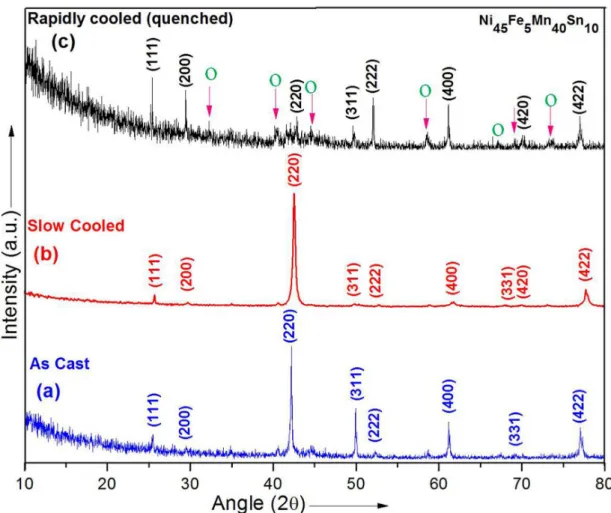
Figure 2a shows the XRD pattern of as-cast Ni45Fe5Mn40Sn10
alloy which conirms the presence of only single phase
of FCC structure with a lattice parameter: a=0.608 nm. Figure 2b, c shows the XRD patterns of Ni45Fe5Mn40Sn10 alloys annealed for 24 hours in vacuum at 850 °C and cooled down under two different conditions i.e. cooled in air and RQ in liquid nitrogen. The presence of a maximum intensity peak of (220) along with the other peaks in the XRD pattern reveals that the crystal structure of these two annealed alloys broadening are nearly similar to that of as-cast alloy. The annealed alloys exihibited extra peaks (marked by arrow) this suggests the appearance of another peak on annealing. However, the intensity of (200) peak in the annealed alloys is more prominent compared to the as-cast alloy. When compared with the XRD results of other NiMn-based alloys18, it showed that the Ni
orthorhombic martensite with lattice parameter a= 0.65 nm, b=0.59 nm and c=0.56 nm (Figure 2b, c).
The SEM micrographs of Ni45Fe5Mn40Sn10 alloys are shown in Figure 3. The as-cast alloy (Figure 3a) exhibits a typical martensite microstructure, consisting of self-accommodating martensite plates, which is also present in the annealed and subsequently furnace-cooled alloys (Figure 3b). It is clear that two morphologies: one with a bright contrast and the other one with a grey contrast, indicate that composition segregation exists in the as cast alloy. However, in the as annealed and subsequently the furnace-cooled sample, as shown in Figure 3b, the difference of contrast caused by segregation is not observed. Instead, the grey strips
with different sizes are identiied as the martensite plates
with different orientations. The SEM image depicted in Figure 3c shows the effect of annealing and subsequent RQ treatment on microstructure, the homogeneous grains with sharp grain boundary are observed and it is clear that the chemical homogeneity is greatly improved in the annealed and subsequently RQ alloy.
Further characterization of the as-cast as well as annealed
samples was carried out through TEM. Figure 4 shows the TEM microstructure and the corresponding selected area
diffraction (SAD) pattern of the Ni45Fe5Mn40Sn10 alloys i.e. as-cast in Figure 4a, b, furnace cooled Figure 4c, d and annealed subsequently RQ Figure 4e, f alloys, respectively. All the micrographs Figure 4a, c, d, show submicron sized grains
in the range of 100-200 nm. A signiicant microstructural
variation has been observed in annealed and subsequently RQ Figure 4d. The SAD pattern analysis of the alloys
conirms the formation of FCC Heusler phase, however both
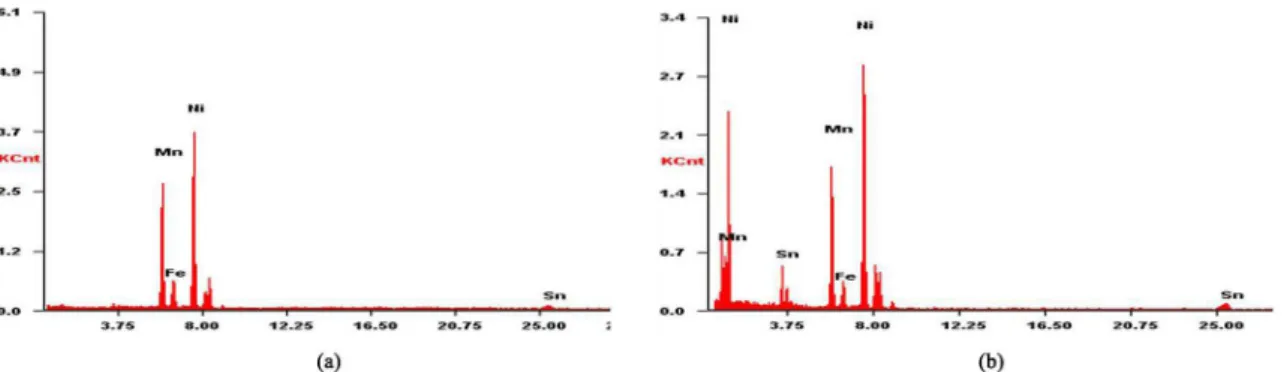
the annealed alloys show the polycrystalline ring pattern Figure 4d, f. This result is consistent with the XRD result, which also reveals the formation of FCC phases with lattice parameter a=0.608 nm. For the composition determination, a quantitative Energy dispersive X-ray analysis (EDX) linked with TEM was performed. Figure 5a, b present EDX spectra of the Ni45Fe5Mn40Sn10 annealed and subsequently RQ alloy from region A and B of Figure 4e respectively. Based on the EDX quantitative analysis, the compositions of the alloys (in at %) have been found to be Ni45.2Fe4.8Mn39.6Sn10.4, which are in close agreement to the stoichiometric proportions of nominal compositions. Within the limit of delectability of EDX, no discernible evidence of oxygen was detected in the annealed alloy.
Figure 5. (a and b) Energy dispersive spectra of the annealed and subsequently RQ alloy from region A and B of Figure 4e respectively.
Figure 3. SEM micrograph of (a) as cast, (b) annealed & subsequently furnace cooled and (c) annealed & subsequently rapidly cooled Ni45Fe5Mn40Sn10 alloys.
Figure 4. TEM microstructure and the corresponding selected area diffraction (SAD) pattern of the Ni45Fe5Mn40Sn10 alloys i.e. as-cast
References
1. Heusler F. Über magnetische Manganlegierungen. Deutsche Physikalische Gesellschaft. 1903; 12:219.
2. Potter HH. The X-ray structure and magnetic properties of single crystals of Heusler alloy. Proceedings of the Physical Society. 1929; 41:135.
3. Bradley AJ and Rodgers JW. The crystal structure of the heusler alloys. Proceedings of the Royal Society of London. Series A, Mathematical and Physical Sciences. 1934; 144(852):340-359. http://dx.doi.org/10.1098/rspa.1934.0053.
4. Kainuma R, Imano Y, Ito W, Sutou Y, Morito H, Okamoto S, et al. Magnetic-field-induced shape recovery by reverse phase transformation. Nature. 2006; 439(7079):957-960. http:// dx.doi.org/10.1038/nature04493. PMid:16495995.
5. Krenke T, Duman E, Acet M, Wassermann EF, Moya X, Manosa L, et al. Inverse magnetocaloric effect in ferromagnetic Ni-Mn-Sn alloys. Nature Materials. 2005; 4(6):450-454. http://dx.doi. org/10.1038/nmat1395. PMid:15895096.
6. Sakuraba Y, Hattori M, Oogane M, Ando Y, Kato H, Sakuma A, et al. Giant tunneling magnetoresistance in Co2MnSi/Al–O/
Co2MnSi magnetic tunnel junctions. Applied Physics Letters.
2006; 88(19):192508. http://dx.doi.org/10.1063/1.2202724.
7. Wang BM, Liu Y, Ren P, Xia B, Ruan KB, Yi JB, et al. Large
exchange bias after zero-field cooling from an unmagnetized
state. Physical Review Letters. 2011; 106(7):077203. http:// dx.doi.org/10.1103/PhysRevLett.106.077203. PMid:21405539.
8. Wuttig M, Liu L, Tsuchiya K and James RD. Occurrence of ferromagnetic shape memory alloys (invited). Journal of Applied Physics. 2000; 87(9):4707-4711. http://dx.doi. org/10.1063/1.373135.
9. Brown PJ, Kanomata T, Neumann K, Neumann KU, Ouladdiaf B, Sheikh A, et al. Atomic and magnetic order in the shape memory alloy Mn2NiGa. Journal of Physics Condensed
Matter. 2010; 22(50):506001. http://dx.doi.org/10.1088/0953-8984/22/50/506001. PMid:21406811.
10. Bhattacharya K and James RD. Applied physics. The material is the machine. Science. 2005; 307(5706):53-54. http://dx.doi. org/10.1126/science.1100892. PMid:15637259.
11. Spaldin NA and Fiebig M. The renaissance of magnetoelectric multiferroics. Science. 2005; 309(5733):391-392. http://dx.doi. org/10.1126/science.1113357. PMid:16020720.
12. Ramesh R and Spaldin NA. Multiferroics: progress and prospects in thin films. Nature Materials. 2007; 6(1):21-29. http://dx.doi. org/10.1038/nmat1805. PMid:17199122.
13. James RD and Zhang Z. The interplay of magnetism and structure in functional materials. Springer Series in Materials Science. 2005; 79(1):159-175.
14. Liu HS, Zhang CL, Han ZD, Xuan HC, Wang DH and Du YW. The effect of Co doping on the magnetic entropy changes in Ni44−xCoxMn45Sn11 alloys. Journal of Alloys and Compounds. 2009;
467(1-2):27-30. http://dx.doi.org/10.1016/j.jallcom.2007.11.137.
15. Srivastava V, Chen X, James R D. Hysteresis and unusual magnetic properties in the singular Heusler alloy. Applied Physics Letters. 2010;97(1):014101-014103.
16. Srivastava V, Song Y, Bhatti K and James RD. The direct conversion of heat to electricity using multiferroic alloys. Advanced Energy Materials. 2011; 1(1):97-104. http://dx.doi. org/10.1002/aenm.201000048.
17. Chernenko VA, Barandiarán JM, L’vov VA, Gutiérrez J,
Lázpita P, Orue I. Temperature dependent magnetostrains in
polycrystalline magnetic shape memory Heusler alloys. Journal of Alloys and Compounds. 2013; 577(Suppl 1):S305-S308.