48 EALR, V.11, nº 1, p. 48-79, Jan-Abr, 2020
Economic Analysis of Law Review
Incremental Learned Hand Standard, Degrees of Negligence and
Allocation of Damages: a Comparative Tort Law and Economics Approach
Padrão de mão aprendida incremental, graus de negligência e alocação de danos: uma lei comparativa de responsabilidade civil e abordagem econômica
Eugênio Battesini1
Advocacia-Geral da União - AGU
1 E-mail: [email protected].
2 The central argument of this paper was first defended in the doctoral thesis Direito e Economia, Novos Horizontes no Estudo da Responsabilidade Civil
no Brasil (Law and Economics, New Horizons in the Study of Tort Law in Brazil), published in January 2011 (Battesini, 2011, p. 249-273).
Preliminary version of this paper was presented at the XV Latin American and Iberian Association of Law and Economics Conference - ALACDE, Bogotá, August 2011, at the IV Brazilian Congress of Law and Economics - ABDE, Curitiba, October 2011, and at the VII Annual Conference of the Italian Society of Law & Economics - SIDE/ISLE, Turin, December 2011, and is available at SSRN eLibrary, January 2012 (https://papers.ssrn.com/sol3/papers.cfm?abstract_id= 1988935).
RESUMO
O padrão incremental da Mão Aprendida é reconhecido como a principal contribuição da literatura jurídica e econômica para a prática jurídica, como um critério objetivo de avaliação de negligência. Tradicionalmente, a gradação da negligência tem sido um fator considerado pela tecnologia jurídica para alocar os danos. No entanto, um dos principais problemas da prática jurídica reside no estabelecimento de critérios objetivos de avaliação quantitativa da redução ou aumento da relação indemnização-dano, tendo em conta o grau de negligência do lesado e da vítima. Com isso, é
possível usar o padrão incremental da Mão Aprendida como critério de graduação da negligência para alocar os danos? Utilizando os fundamentos
teóricos da literatura jurídica e econômica em conjunto com a classificação jurídica tradicional da negligência em grave, ordinária e leve, e considerando o sistema de responsabilidade civil brasileiro como base analítica, o artigo mostra que a resposta é positiva. A ideia básica é que o padrão incremental da
Mão Aprendida é um algoritmo que pode ser empregado na prática jurídica para sistematizar a alocação de danos, realizando, de acordo com o grau
de negligência do lesado e da vítima, a indenização total ou o desacoplamento de a indenização pelos danos, agilizando a aplicação de institutos jurídicos como negligência comparativa, danos punitivos e redução equitativa da indenização (equidade).
ABSTRACT
The incremental Learned Hand standard is recognized as the main contribution of the law and economics literature to legal practice, as an objective criterion of negligence assessment. Traditionally, negligence gradation has been a factor considered by legal technology to allocate the damages. However, one of the main problems in legal practice lies in the establishment of objective criteria for quantitative assessment of the reduction or increase in the indemnity-damage ratio, considering the degree of negligence of the injurer and of the victim. Withal, is
it possible to use the incremental Learned Hand standard as criterion of negligence graduation in order to allocate the damages? Using the theoretical
foundations of law and economics literature in conjunction with the traditional legal classification of negligence into severe, ordinary and slight, and considering the Brazilian tort system as analytical basis, the paper shows that the answer is positive. The
basic idea is that the incremental Learned Hand standard is an algorithm which can be employed in legal practice to systematize the allocation of damages, performing, according to the degree of
negligence of the injurer and of the victim, the full compensation or the decouple of the indemnity from the damages, streamlining the application of legal institutes such as comparative negligence, punitive damages, and equitable reduction of compensation (fairness)2.
Palavras-chave: Direito e Economia. Lei
comparativa. Direito Penal. Padrão de mão aprendida incremental. Negligência. Danos. Brasil.
Keywords: Law and Economics. Comparative Law.
Tort Law. Incremental Learned Hand Standard. Negligence. Damages. Brazil.
1. Introduction
he incremental Learned Hand standard is recognized as an important criterion of negligence (fault) assessment. Gilles records the fact that cost-benefit considerations have been a central factor in determining negligence, drawing a witty analogy: an "invisible Hand Formula" applied in an intuitive fashion is preferable to any "Hand Formula", and a methodically applied "visible Hand Formula" is better still (1994, p. 815 e 823; 2001, p. 1054). Feldman and Kim point out that the opinion of Judge Learned Hand in the case of United States v. Carrol Towing Co. is "canonized" as the first instance of cost-benefit analysis being applied to law, drawing a symbolic analogy with "the opening notes in Beethoven's 5th symphony" (2002, p. 1). Going further, Landes and Posner draw attention to the fact that the importance of the incremental Learned Hand standard goes beyond the area of culpability, qualifying it as an “algorithm which can be employed for deciding tort questions generally” (1983, p. 111).
Traditionally, negligence gradation, the extent to which the conduct of the injurer and of the victim fall short of the standard of care expected of the reasonable man or of the bonus pater
familias, has been a factor considered by legal technology to allocate the damages. Synthesizing the
results of the comparative study carried out by the European Centre of Tort and Insurance Law, Widmer records that the majority of legal systems perform some sort of negligence gradation, that is the distinction between "gross as opposed to slight negligence, sometimes passing through some stages of 'medium' or 'simple' negligence and attaining the lowest degrees of almost imperceptible fault (culpa levissima)", emphasizing that the degrees of negligence play a role in determining the amount of indemnification to be paid, without prejudice to the principle of “all or nothing" followed by most systems (2005, p. 353). However, one of the main problems of legal theory lies in the establishment of objective criteria for quantitative assessment of the reduction or increase in the indemnity-damage ratio, considering the degree of negligence of the injurer and of the victim.
Using a comparative tort law and economics approach, the present study develops the
working hypothesis that it is possible to apply the incremental Learned Hand standard as criterion of negligence graduation in order to allocate the damages. The basic idea is that the incremental Learned Hand
standard is an algorithm which can be employed in legal practice to systematize the allocation of damages, performing, according to the degree of negligence of the injurer and of the victim, the full compensation or the decouple of the indemnity from the damages, streamlining the application of legal institutes such as comparative negligence, punitive damages, and equitable reduction of compensation (fairness).
The paper is structured into four parts. The first part presents the incremental Learned Hand standard, exploring its potential of application as a criterion of negligence assessment and demonstrating its compatibility with legal theory in the context of both the civil and common law traditions. The second part explores the potential of application of the incremental Learned Hand standard as a criterion of negligence gradation, demonstrating that it can be used in conjunction with the traditional legal classification of negligence into severe, ordinary and slight in order to allocate the damages. Considering the Brazilian tort system as analytical basis (articles 944 and 945 of the 2002 Civil Code), the third part applies the incremental Learned Hand standard as a criterion of negligence gradation, performing the systematization of the quantitative assessment of the reduction (comparative negligence and fairness) or increase (punitive damages) in the indemnity-damage ratio. The fourth part makes considerations about allocative efficiency of the use of the incremental Learned Hand standard as a criterion of negligence gradation, considering the main statements of the law and economics literature: the allocation of damages; the option between contributory and comparative negligence; and the option between negligence and strict liability. In addition, the fourth part makes considerations about the costs of application and the
50 EALR, V.11, nº 1, p. 48-79, Jan-Abr, 2020 accuracy in the application of the incremental Learned Hand standard as a criterion of negligence gradation.
The conclusion performs a synthesis of the ideas developed, demonstrating that the working hypothesis has been confirmed. Additionally, the conclusion points out that: the paper is a contribution to the tort law and economics literature, given that the explicit use of the incremental Learned Hand standard as criterion of negligence graduation in order to allocate the damages, performing, according to the degree of negligence of the injurer and of the victim, the full compensation or the decouple of the indemnity from the damages, is an additional step towards promoting allocative efficiency in tort law; the paper is a contribution to the traditional tort law literature, especially the brazilian one, given that the model proposed works as a kind of proportionality principle, a logarithmic table, whereby the damages are simply allocated according to each party’s contribution to the loss, measured taking into account their degree of negligence, increasing the predictability of judicial decisions and streamlining the application of legal institutes such as comparative negligence, punitive damages, and the equitable reduction of compensation (fairness), and; the paper is a contribution to the comparative law and economics literature, given that, as a study case, it demonstrates that the theoretical foundations of law and economics, crystallized in the incremental Learned Hand standard, can be integrated into the Brazilian tort law.
2. Incremental Learned Hand Standard And Negligence
Legal theory is traditionally based around the concept of negligence (fault), category that has been further elevated to the status of central defining principle. Synthesizing the results of the comparative study carried out by the European Centre of Tort and Insurance Law, Widmer (2005, p. 332) points out that "the role of fault as a prerequisite of tort is, for the great majority of the analyzed systems, described as essential and decisive", that "fault is often considered as the fundamental and in a certain sense socially and ethically pre-eminent principle of responsibility". Considering the full scope of torts in various countries, Widmer goes on to note that fault is the "the core of tortious and contractual liability" (Koziol - Austrian Report); "the cornerstone of tort liability in Israel" (Gilead - Israeli Report); "the primary (though not the exclusive) criterion for liability in tort" (Schwartz and Green - United States Report); "the principal rule of Swedish tort law" (Dufwa - Swedish Report); "some would go so far as to say that fault is always necessary" (Rogers - English Report); or it is at least admitted that historically “fault played a predominant role in the law of torts" (Galand-Carval - French Report).
The basic idea inherent to the concept of negligence is that of misconduct, of failure to adopt appropriate precautionary measures, of not taking the possible and necessary preliminary steps to avoid causing damage to others, of lack of diligence in the observance of the duty of care imposed by the law. Schäfer and Ott perceptively note that, according to the principle of negligence, the person responsible for the damage will be the one who has caused it through deficient behavior, that is, through "erroneous control of his or her own behavior" (1991, p. 221), emphasizing that, "the basic idea of negligence is that a person is held liable for damage caused by an activity if, and only if, it is the result of breaching a due level of care” (2004, p. 134).
Considering the methodological level, the act of comparing concrete behavior with abstract behavior must necessarily call for the establishment of objective criteria for the definition of the lawfulness or otherwise of behavior, and for the setting of objective guidelines for behavior which will make it possible to specifically define the level of care required for social intercourse in order to avoid the creation of damage.
In the search for criteria to define the lawfulness or otherwise of behavior, legal theory turns to notions as: the adoption of the due level of care, the care taken by a prudent man in the same situation, the behavior of a reasonable person, the behavior of the average, standard or normal man, and the conduct of the ideal man. Performing comparative analysis, Dam (2006, p. 193) emphasizes that: "the general negligence test in the legal systems involves a comparison of the conduct of the tortfeasor with that of the reasonable man or of the bonus pater familiae", and that, "where there is a divergence, because the defendant’s conduct did not meet this standard of care, negligence can be established". The methodological convergence in legal theory is also highlighted by Schreiber (2009, p. 35-36) who notes that the idea of fault as a deviation in conduct, assessed in the abstract, appears to be the most widely accepted in the majority of legal systems: the abstract model of behavior employed in civil law systems is the "Roman parameter of the bonus pater familias, understood as the average man, the standard man, the prudent individual"; and, "it is not substantially different from the methodology adopted in common law systems, where the so-called reasonable man is invoked as an abstract parameter of behavior".
Monitoring of the level of diligence and the establishment of an objective criterion making it possible to assess whether the individual behavior is compatible with a pre-established standard of precaution are concerns also expressed by law and economics. The valuation of the importance of the level of situational risk on the one hand and of the efforts necessary for its elimination on the other hand represent the keynote of the economic theory of negligence. The agreement between legal and economic concepts is highlighted by Schäfer and Ott (1991, p. 222), who point out that "liability for fault is determined, as much from the economic point of view as from the legal one, by monitoring of the level of diligence", it being the case that, through liability, "material incentives are adjusted to adapt the expense of avoiding damage to the stated demands for diligence required to escape the lien for the costs of the damage".
The convergence of legal and economic doctrine on tort law for negligence is also emphasized by Grady (1989, p. 143), for whom the “traditional legal theory and the traditional economic theory of negligence are notably similar", given that for both, "a degree of precaution lesser than the due amount of care has a literal meaning: courts compare the effective level of precaution taken by the defendant with the due level of precaution". It can be seen, then, that the central connection between the legal and the economic theories of negligence lies in the function of monitoring the level of diligence in conduct, lies in the establishment of parameters allowing for the determination of the level of precaution demanded in the execution of activities which carry a risk of accident. In other words, the connection between the legal and the economic theories of negligence lies in the establishment of an analytical standard for the regulation of legal practice when comparing the behavior of different individuals and assessing negligence in harmful behavior.
A significant attempt to establish an objective criterion for assessing negligence was made by Judge Learned Hand in the case United States v. Carroll Towing Company3. One of the
3 The case United States v. Carroll Towing Company arose from a situation in New York Bay, in which a small
transport barge named Anna C, property of the Conners Company, loaded with wheat flour which had been purchased by the U.S. government, sank with the total loss of vessel and cargo after coming free of the pier to which she had been moored together with other boats of the same type, coming into collision with a freighter whose propeller caused damage to her structure, ultimately leading to her sinking. It was found that, while the
Anna C had been adequately moored to the pier, she had come free as a result of abrupt movements made by a
tugboat named Carroll, belonging to the Carroll Towing Company, which was attempting to take in tow a neighboring barge. The company which owned the Anna C, as well as the U.S. government, sued the company owning the tugboat, holding it responsible for the sinking. In his judgment of the case, Judge Learned Hand found the Carroll Towing Company responsible for the costs arising from the Anna C drifting free of her moorings, but not for all the costs of the sinking, which were divided between the parties involved, on the
52 EALR, V.11, nº 1, p. 48-79, Jan-Abr, 2020 questions to be decided in the contest brought to trial was whether there had been contributing negligence on the part of the Conners Company, owner of one of the vessels involved, in leaving their barge moored to the pier in New York Bay without anyone on board, in view of the subsequent breaking of the moorings and the collision with another vessel. In his appraisal of the case, Judge Learned Hand declared that "there is no general rule to determine when the absence of a bargee or other attendant will make the owner of the barge liable for injuries to other vessels if she breaks away from her moorings", considering that "the owner's duty, as in other similar situations, to provide against resulting injuries is a function of three variables: (1) the probability that she will break away; (2) the gravity of the resulting injury, if she does; (3) the burden of adequate precautions". Using the notation P for the probability of injury, L for the injury and B for the burden of care, Judge Hand stated that "liability depends upon whether B is less than L multiplied by P", (B < P.L).
The importance of the Hand formula as a criterion for assessing negligence is emphasized by jurists such as Owen (2005, p. 71), Abraham (2002, p. 60) and Hylton (2016, p. 118). The Hand formula, according to Owen, has the advantage of “expresses algebraically the common sense idea that people may fairly be required to contemplate the possible consequences of important actions before so acting”. The main contribution made by the Hand formula, states Abraham, is “unpacks the general notion of reasonable behavior in three components: the probability that a particular act or omission will cause harm; the magnitude of the warm if it occurs; and the value of the interest that must be foregone or sacrificed in order to reduce the risk of harm”. The Hand formula, Hylton highlights, “is an instructive algorithm used in applying the reasonable person test”, which “tell us the key factors that should be considered in a negligence determination and precisely how they should be considered”.
Law and economics literature also highlights the importance of the Hand formula as a criterion for assessing negligence. The advantage of the Hand formula as originally formulated, Schäfer and Ott (2004, p. 136) note, consists in making explicit the existence of "a particular amount of precaution that is economically reasonable and is dependent upon the probability or the risk of damage", which in fact is "quite in accord with legal reasoning". For Hirsch (1999, p. 143) the philosophy underlined by the Hand formula can be synthesized in the following way: "a reasonable man, before taking any action, weighs the costs and benefits of that action", so that the apparatus inherent to such an institution creates incentives for individuals to weigh their actions from the point of view of the social welfare".
Developing the line of reasoning proposed by the Judge Hand, Landes and Posner (1981, p. 885; 1987, p. 87) emphasize that the original formulation of the Hand formula offers a fundamental insight into the field of negligence. However, it does not accurately reflect the way in which questions of attributing liability are actually resolved, given that "the court ask, what additional care inputs should the defendant have used to avoid this accident, given the existing level of care?". In investigating a particular accident, continue Landes and Posner, the focus is upon the specific precautionary measures which should have been adopted in order to avoid it, inviting a "marginal analysis", the application of a “economic standard of negligence", which
grounds that he also considered the Conners Company to be at fault by virtue of failing to maintain at least one crew member aboard the Anna C, which certainly would have prevented the accident. Given that the bargee had been absent for 21 hours and that at the time and place of the accident occurring vessels in the bay were constantly being jarred by the tide, Judge Learned Hand considered that the company had not observed "due care" such as lay within a "reasonable expectation" that the vessel might come free of its moorings, giving the opinion that "it would be fair to demand that the Conners Company maintain a bargee on board during daily working hours" and, this not being done, that it was possible to conclude the existence of negligent behavior (Circuit Court of Appeals, Second Circuit, 1947. 159 F. 2d. 169). See also: Epstein (2004, p. 175-176), Gonçalves (2001, p. 148), and, Diamond, Levine and Madden (2007, p. 59-66).
allows for the comparison of the incremental variations in the costs of prevention and in the resulting benefits in terms of reduction of the expected damage.
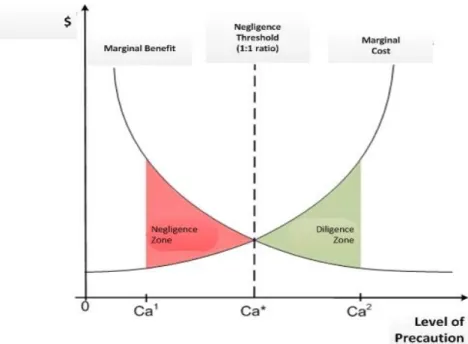
Marginal analysis of negligence or the incremental Learned Hand standard, as usually indicated in the law and economics literature, shows that the efficient level of precaution is achieved when the increment in cost of taking precaution is equal to the variation of the expected loss multiplied by the probability of the damaging event, that is, when each monetary unit spent on prevention reduces by one monetary unit the loss expected as a result of the accident (a 1:1 ratio). Considering figure 1, it follows that the intersection of the curves representing marginal costs and marginal expected benefits (marginal reduction of expected losses), a point corresponding to X* (a 1:1 ratio – the negligence threshold) represents the efficient level of precaution, while the area to the left of point X*, for example, point X1 (the marginal cost/marginal benefit ratio being equal to 0.25 – a 1:4 ratio) indicates the adoption of a less than efficient level of precaution, showing the existence of negligent behavior, and the area to the right of point X*, for example, point X2 (marginal cost/marginal benefit ratio being equal to 4 – a 4:1 ratio) indicates the adoption of a more than efficient level of precaution, showing the existence of diligent behavior.
Figure 1 - Graphical representation of the incremental Learned Hand standard as criterion for negligence assessment. Adapted from Veljanovski (2006, p. 104).
Level of precaution in physical units; cost of accidents in monetary units.
The advantage of the incremental Learned Hand standard as criterion for negligence assessment, Posner (2007, p. 168) emphasizes, consists in allowing for the measurement of small increments in security, which is shown to be fundamental in as much as “it will usually be difficult for courts to get information on other than small changes in the safety precautions taken by the injurer”. In reality, with judges considering whether it would have been possible for the injurer to adopt additional preventative measures which could have substantially reduced the risk of accidents, the application of the incremental Learned Hand standard as criterion for negligence assessment has been, explicitly or implicitly, put into effect, whether in countries with a common law tradition or in countries with a civil law tradition.
54 EALR, V.11, nº 1, p. 48-79, Jan-Abr, 2020 Under common law, Abraham (2002, p. 61) emphasizes that in the United States the incremental Learned Hand standard has decisively influenced legal practice, “the substance of the negligence calculus has been embodied in the Restatement (Second) of Torts §§ 291-293 (1965), and in the current Draft Restatement (Third) of Torts: Liability for Physical Harm (Basic Principles), both which are compilations of Tort Law rules prepared by American Law Institute”.
In the English common law tradition, Gilles (2001, p. 7) notes that “cost-benefit balancing is now a major (but not dominant) feature of English negligence law”, emphasizing that “English judges use cost-benefit balancing intuitively and qualitatively, without attempting to make the evaluative dimension of balancing rigorous or even explicit”.
In the context of the German civil law tradition, Schäfer and Ott (1991, p. 222; 2004, p. 150-160) note that, “even though in German law the incremental Learned Hand standard has not been applied explicitly, the fundamental idea of this formula is not foreign, and can be observed in many judicial decisions”, in as much as, although courts do not perform a “classical utilitarian calculus” in order to assess negligence in conduct, they nevertheless act in “accord with a criterion of efficiency which is closely identified with the procedure in one stage of the Hand formula”.
In Switzerland, the application of the incremental Learned Hand standard is analyzed by Hammer and Duss, p. 203), who point out that “a look at Swiss tort law has shown that economic considerations have already made their presence felt in the determination of due care, since reference has been made both in doctrine and legal rulings to the costs of avoidance, the magnitude of the potential loss and the probability of harm”. Recalling that “the Swiss Federal Supreme Court makes use of cost-benefit considerations, for instance, to determine the hypothetical behavior of a reasonable average person when ruling on fault-based liability”.
In the French civil law tradition, the possibility of applying the incremental Learned Hand standard as a criterion for characterizing negligence has been studied by Faure (2001, p. 170), for whom: “it is certainly possible to incorporate the economic notion of fault (through weighing marginal costs versus marginal benefits) into article 1382 of the French Civil Code”, as even if an “explicit comparison” of costs of precaution versus the expected damage, as was the case in the well-known American Learned Hand case can not be found in French case law, French judges nevertheless seem “implicitly” to make use of the logic of economics.
In Netherlands, the application of the incremental Learned Hand standard is emphasized by De Mot, Canta and Gangapersadsing (2004, p. 14), who point out that “the elements of the Hand formula clearly play a significant role when judges in Netherlands determine whether an injurer has been negligent”, recalling that in the famous Kelderluik case the “High Council summed up the three elements of the formula explicitly and considered them as building-bricks of negligence”.
Considering the Brazilian context, Battesini (2011, p. 220-227) notes that the idea that tort law fulfils an important social function of accident prevention, along with the perception that negligence rule acts as a control mechanism for the individual conduct, allows for the incorporation of the economic notion of negligence into the legal technology, through consideration of the cost/benefit relation, in applying the article 927, in combination with article 186, of the 2002 Brazilian Civil Code. Even if there are no legal precedents making an explicit comparison between the cost of precaution in relation to the benefits of avoiding situational risk, Brazilian judges nevertheless seem, in an intuitive fashion, in their implementation of the standard of precaution represented by the “bonus pater familiae”, to make use of the logic of economics, drawing upon the incremental Learned Hand standard.
Such facts show the importance of the incremental Learned Hand standard as instrument for negligence assessment. Moreover, the incremental Learned Hand standard constitutes an useful instrument to aid legal technology in addressing another relevant question, that of negligence gradation in order to allocate the damages, the next topic for analysis.
2.1. Incremental Learned Hand Standard And Degrees Of Negligence
As demonstrated, negligence plays a key role in the imputation of liability. Beyond that, the notion of negligence performs an important function in another tort law matter, the
allocation of damages. Traditionally the degrees of negligence4 have been a factor considered by
legal technology to determine the compensation5. Synthesizing the results of the comparative
study carried out by the European Centre of Tort and Insurance Law, Widmer (2005, p. 353) records that the majority of legal systems perform some sort of negligence gradation, that is the distinction between "gross as opposed to slight negligence, sometimes passing through some stages of 'medium' or 'simple' negligence and attaining the lowest degrees of almost imperceptible fault (culpa levissima)", emphasizing that the degrees of negligence play a role in determining the amount of indemnification to be paid, without prejudice to the principle of “all or nothing" followed by most systems.
Traditional is the tripartite classification of degrees of negligence in severe or gross, ordinary or medium and slight or minimum (culpa lata, culpa levis and culpa levissima). In general lines, the negligence is considered severe when “there is extreme negligence on the part of the agent”, when a person acts with “gross lack of caution”, not foreseeing that which is predictable by the average man. The negligence is considered ordinary when “there is lack of ordinary diligence”, when “the harm can be avoided with ordinary attention”, such as can be demanded of the average man in the concrete circumstances in which the damage occurred. The negligence is considered slight when “the fault is avoidable through an extraordinary level of attention”, when “the fault is committed in account of preventative conduct which goes beyond the average standard” (Diniz, 2009, p. 44; and Andrade 2009, p. 265-267).
However, differently from what occurs with the concept of negligence stricto sensu, in legal theory there is no uniformity in the use of the traditional tripartite classification of degrees of negligence in severe, ordinary and slight. As highlighted by the European Centre of Tort and Insurance Law, “in some systems the amount of compensation, or at least of damages for pain and suffering can be adapted to the degree of fault” (Widmer, 2005, p. 354). Actually, in some
4 The idea that the negligence can be classified according to its gravity is not new, in fact it goes back to Roman
law and to medieval glossers. As highlighted Serpa Lopes: “With regard to the intensity of the negligence, in terms of their severity, it is indisputable fact to find in the Roman sources the expressions culpa lata, culpa
latior, magna culpa dolo proxima, culpa levis, culpa levior and only once culpa levíssima. Hence the reason why
the glossers, dominated by the constant idea of classifying, did not hesitate, under the impulse of this systematizing tendency, in establishing categories and estimated degrees of negligence... then came the
communis opinio of the tripartition in culpa lata, culpa levis and culpa levissima” (1995, p. 344).
5 The two main systems of distribution of damages in tort law are: the system of the gravity of negligence, very
common in countries of French civil law tradition, in which the damages must be distributed among the agents who contributed to the damage in proportion to the gravity of each one negligence (on the subject, with emphasis on the French, Italian, Portuguese and Brazilian systems, see Cahali, 1980, p. 141-162); and, the system of causation, very common in countries of German civil law tradition, in which the damages must be distributed among the agents who contributed to the damage according to the causal efficacy for the production of the damage (Cruz, 2005, p. 325). In countries of common law tradition, especially in United States, the debate about the distribution of damages is diffuse, gravitating around causality and negligence, in particular through the dichotomy contributory negligence and comparative negligence (subject matter of extensive literature in law and economics - see part three of the paper). In United States, as Hylton highlights: “it appears that courts fix fault percentages by trying to determine, after finding that both plaintiff and defendant were negligent, the degree to which each party’s negligence contributed to the cause of the injury” (2016, p. 171).
56 EALR, V.11, nº 1, p. 48-79, Jan-Abr, 2020 legal systems the slight level of the negligence of the injurer is one of the elements used for the equitable reduction of compensation (fairness), as is the case of Brazil, Portugal and Switzerland (Calixto, 2008, 304-305; Widmer, 2005, p. 354). On the other hand, in some legal systems the severe level of negligence of the injurer is one of the elements used to determine the value of damages for pain and suffering, as is the case of Brazil, Portugal, Germany, Switzerland and Italy
(Andrade, 2009, 156-161; Widmer, 2005, p. 354), or to determine the value of punitive damages6,
as is the case of Canada and New Zealand (Andrade, 2009, p. 184-212; Gotanda, 2004, p. 391-444).
Furthermore, in most legal systems some kind of negligence gradation is used in the application of the rule of comparative negligence, as a form of apportionment of the loss between the injurer and of the victim. As highlighted by the European Centre of Tort and Insurance Law, “in the definitive apportionment of compensation between several liable persons (including the victim), different degrees of concurring faults can be taken into account” (Widmer, 2005, p. 355). In reality, the use of negligence gradation in the application of the pure comparative negligence, a form of apportionment of the loss in accordance with the relative negligence of the injurer and of the victim, is a common practice in countries of civil law tradition, as is the case of Germany, Austria, France, Italy, Portugal and Brazil7 (Calixto, 2008, p.
327-328; Widmer, 2005, p. 355). On the other hand, in countries like United States8 the degrees
of negligence, at least, are considered in the application of a modified form of comparative negligence, as is the slight/gross formula (Epstein, 1999, p. 214-215).
In methodological terms, notwithstanding the recognition that traditional tripartite classification of degrees of negligence in severe, ordinary and slight should be performed considering the extent to which the conduct of the part fall short of the standard of care expected of the reasonable man or bonus pater familiae, the great difficulty of legal theory is the quantification of the degree of reduction/increase of the indemnity-damage ratio. Legal theory
6About punitive damages in civil law and common law tradition, Andrade (2009, p. 203 and 210) notes that,
“although they have acquired a special status in the United States of America, punitive damages are employed to a greater or lesser extent in the great number of countries which make up the common law system, from which the practice derives its origins. In such countries, there is firm agreement that tort law, at the same time as seeking reparation or compensation for damages, must also fulfill punitive and preventative purposes. Yet in those countries which have become part of the family of civil law there is also strong resistance to the idea of introducing a sum to be charged by way of punishment within the ambit of tort law. In cases of moral damage, not a few voices have been raised in support of the punitive and preventative purposes of indemnification. But as a discrete concept punitive damages remain, as a rule, foreign to the legislations of such countries”. The author goes on to draw attention to the experiment carried out by the Canadian province of Quebec, which, in issuing its New Civil Code, effective from 1 January 1994, expressly introduced the notion of punitive damages in the article 1621.
7 Highlighting the influence of French legal theory Pereira and Cruz describe the Brazilian context: “without
renouncing the principle of the unity of fault... authors, especially in French doctrine, distinguish between what they have called severe, ordinary and slight fault” (1998, p. 71); “propagated by Lalau, Demogue e Colin y Capitant, among other authors, the system that takes into account the gravity of negligence to allocate the losses between the responsible for the damage represents an evolution in terms of justice and equity… this is the system of distribution of the prejudice that is currently consecrated in Brazilian jurisprudence” (2005, p. 327-329).
8 In United States, as Epstein points out that: “the more modern position of comparative negligence rejects the
strict all-or-nothing approach characteristic of common law contributory negligence… Today at least 46 states have some form of comparative negligence, albeit in several different forms… The simplest form of negligence is the pure comparative negligence, which apportions the loss in accordance with the relative fault of the two parties in question. This system is adopted in 13 states… A second group of states adopt comparative negligence in its modified form, in which P must show that her negligence is below a fixed threshold before she may recover any damages at all… A third form of comparative negligence… hearkens back to the slight/gross distinction and allows P to recover when her negligence is slight relative to D’s” (1999, p. 211-212).
usually relies on a mathematical procedure9, with the selection of percentages of
reduction/increase according to the degree of negligence of the injurer and of the victim. As highlighted by the European Centre of Tort and Insurance Law, “in all compared countries, contributory negligence may result in a reduction – even to extend of an exclusion – of damages which would have been awarded had the claimant not contributed to the harm”. Moreover, “the normal apportionment procedure is therefore first to fix the victim’s full damage and then to reduce it in proportion to the victim’s contribution”. A procedure which “regularly leads to a certain percentage by which the original amount of the damages is reduced”, so that “the apportionment of the damage between the victim and the tortfeasor may also result either in full compensation or, on the contrary, in the denial of any damage,” but, “in most cases a reduction within the range of 10-90% and, more often, within the range of 25-75% will be the final outcome”, although “smaller fractions than steps of 5 or 10% are very rarely used” (Magnus and Martín-Casals, 2004, p. 259-260 and 282-283).
However, as Epstein points out, “the problem of finding percentages plagues all comparative negligence systems”. Even the “selection of percentages of fault does not admit mathematical precision… it is no easy task to transform these gross categories of casual contribution into the exact percentages needed to administer any comparative negligence system”. One possibility, Epstein highlights, “is to apportion fault by the degree that each party deviates from the optimal standard of care” (1999, p. 215). As it is possible to infer from the manifestation of Epstein, once again the connection between the legal and economic theories of tort can be made with the aid of the incremental Learned Hand standard.
In law and economics literature, the idea that the allocation of damages between the injurer and the victim can be made considering each party’s deviation from optimal standard of
care is not new. In a sense, it is implicit in Landes and Posner10, who draw attention to the fact
that the importance of the Hand formula goes beyond the area of culpability, qualifying it as an “algorithm” which can be employed for deciding tort questions generally (1981, p. 884-892; 1983, p. 111). Besides, as explicitly suggested by Rubinfeld, “the allocation of damages between the injurer and the victim can be made directly by looking at the extent to which each party deviates from some relatively high level of care and the marginal value that the trier of fact places on those deviations”. (1987, p. 378). In a game-theoretic approach, Baird, Gertner and Picker underline that it is possible “specify a sharing rule in a comparative negligence regime… a party who fails to exercise due care should bear the liability in proportion to the amount that the party failed to spend on due care relative to the amount both parties fell short of exercising due care” (1994, p. 29). More recently, Dari-Mattiacci and Hendriks (2013, p. 1-2 and 8) defend the
9 Focusing upon graduation of the comparative negligence in Brazilian tort system, Pereira emphasizes that “the
greatest problem is in determining proportionality”, in “quantitatively assessing to what extent indemnification may be reduced considering the corresponding level of fault”, pointing out that “the ideal solution is to specify in mathematical terms the extent of the victim’s contribution to the damaging effect” (1998, p. 83 and 299).
10 The use of the Hand formula in the application of contributory negligence and comparative negligence is
considered by Landes and Posner: “because the legal standards of negligence and contributory negligence are the same, we can infer that Judge Hand would have applied his formula to victims as well as injurers in any case where contributory negligence was alleged… in nineteenth-century tort cases there is considerable talk of the ‘degrees’ of negligence – slight, ordinary, and gross. These were (and to some extent still are) used in other tort contexts” (1981, p. 885 and 888). However, the authors do not develop the idea of applying the Hand formula in conjunction with the traditional tripartite classification of degrees of negligence in severe, ordinary and slight. This fact is probably related to Landes and Posner preference for the contributory negligence, in relation to the application of comparative negligence, in particular with respect to higher administrative costs of comparative negligence: “the degrees of negligence add nothing in a joint-car case – except administrative costs when deterrence fails and a court must decide liability… the degrees-of-negligence approach to the problem of different victim and injurer costs of avoiding accidents soon fell into disfavor, but other defenses to contributory negligence proved more durable and seem more sensible” (1981, p. 888).
58 EALR, V.11, nº 1, p. 48-79, Jan-Abr, 2020 efficiency of comparative negligence with the apportion of loss according to the parties’ relative departures from due care:
Comparative negligence is both the most common rule in the United States and in Europe and a rule that law and economics scholarship has had enormous difficulties justifying… The efficiency of comparative negligence poses a persistent puzzle to law and economics scholarship… the actual apportionment of damages between two negligent parties is a question that rarely emerges in digested opinions and has not been resolved by scholarship… we propose a novel theory that explains why comparative negligence is more efficient than its all-or-nothing alternatives (simple and contributory negligence) and makes an efficiency case for a particular sharing of the loss between negligent parties proportionally to relative fault – that is, the parties’ relative departures from due care.
Going further, the idea of applying the incremental Learned Hand standard as criterion of negligence graduation, in conjunction with the traditional tripartite classification of degrees of negligence in severe, ordinary and slight, with the aim of allocate the damages between the injurer and the victim, was proposed by Battesini (2011, p. 255-257), as follows in figure 2.
Figure 2 – Geometric representation of the incremental Learned Hand standard as criterion for negligence gradation.
Level of precaution in physical units, cost of accidents in monetary units.
Considering figure 2, the intersection of the curves representing marginal costs of precaution and marginal benefits (reduction in the expected marginal losses), the point corresponding to X*, a marginal cost/benefit ratio equal to 1 (a 1:1 ratio), represents the efficient level of precaution. The area to the right of point X*, a marginal cost/benefit ratio equal or superior to 1, indicates the diligence zone. The area to the left of point X*, a marginal cost/benefit ratio lower than 1, indicates the negligence zone. According to the traditional legal classification of severe, ordinary and slight negligence, the negligence zone can be divided into three areas. The first area, indicating the existence of slight negligence, covers the section situated between point X* and point X1, demarcated, for hypothetical purposes, by the marginal cost/benefit ratios 0.99 (a 1:1.01 ratio) and 0.4 (a 1:2.5 ratio) respectively. The second area,
indicating the existence of ordinary negligence, covers the section situated between point X1 and point X2, demarcated, for hypothetical purposes, by the marginal cost/benefit ratios 0.39 (a 1:2.51 ratio) and 0.13 (a 1:7.5 ratio) respectively. The third area, indicating the existence of severe negligence, covers the section situated to the left of point X2, indicated, for hypothetical purposes, by a marginal cost/benefit ratio of less than 0.13 (a 1:7.5 ratio).
It can be concluded that the incremental Learned Hand standard, aside from being an important instrument in negligence assessment, also is a useful tool for the gradation of the negligence of the injurer and the victim, an important factor when considering the question of allocation of damages. Brazilian tort system particularly provides a stable basis to systematize the allocation of damages, as will be seen in the following section.
3. Allocation Of Damages, Evidences From Brazilian Tort System
Focusing on the Brazilian tort system11, the general framework of allocation of damages,
and the connection with the negligence graduation, is established by the articles 944 and 945 of the 2002 Brazilian Civil Code12. Along general lines, the basic rule of symmetry between
indemnity and damage (I = D) is stated in the heading of article 944 of the 2002 Civil Code, which expressly establishes that “[i]ndemnification is determined by the extent of damage”. In addition, Brazilian positive law contains normative arrangements expressly establishing exceptions to the rule of symmetry: the sole paragraph of article 944 of the 2002 Civil Code, concerning reduction of indemnity-damage ratio as a result of the level of negligence of the injurer (I < D); and, the article 945 of the 2002 Civil Code, concerning reduction of indemnity-damage ratio as a result of concurrent negligence (comparative negligence) of the victim (I < D). Elucidative is the explanation made by Tartuce, establishing the connection between the articles 944 and 945 of the 2002 Brazilian Civil Code and the traditional tripartite classification of degrees of negligence in severe, ordinary and slight (2011, p. 591-592):
The two rules, articles 944 and 945 of codification are complementary... comes into the picture the classic division of fault according to their degree, which dates back to Roman law, theme widely debated by Brazilian classic civilists, who have dedicated themselves to the study of civil liability, as is the case of Alvino Lima and Aguiar Dias. From the compilation of Justinian can be taken the classification of fault according to their degree, which, for a long time, has been serving as a parameter for determining the indemnity quantum. The articles 944 and 945 of the actual Brazilian Civil Code, in a certain sense, did resurface, with even greater amplitude, the study of this division. Initially, in the severe or grave fault, there is a gross imprudence or negligence; … the ordinary or medium fault is the intermediary negligence; ... finally, there is the slight fault or in the slightest degree possible.
Concerning the reduction of the indemnity-damage ratio as a result of concurrent negligence of the victim, the article 945 specifies that “if the victim has knowingly contributed to the harmful event, the indemnity paid to the victim will be set in such away as to reflect the extent of the victim’s culpability compared to that of the author of the damage”. The idea is that the “severity [of the victim’s] fault” can be linked to the qualification of his or her conduct as
11 For an overview of the Brazilian tort system, see Battesini, Eltz and Santolim, 2016.
12 BRAZIL. Law no. 10.406 of 10 January 2002. Civil Code. Article 944. Indemnification is determined by the
extent of damage. Sole paragraph. If an excessive disproportion exists between the severity of the fault and the damage, the judge may reduce the indemnity correspondingly. Article 945. If the victim has knowingly contributed to the harmful event, indemnity paid to the victim will be set in such a way as to reflect the extent of the victim's culpability compared to that of the author of the damage.
60 EALR, V.11, nº 1, p. 48-79, Jan-Abr, 2020 arising from severe, ordinary and slight negligence, by comparing the actual conduct of the victim with the standard of the reasonable man, that is, by considering the extent to which the level of precaution actually taken falls short of the efficient level of precaution, considering the incremental Learned Hand standard. It is thus justifiable to reduce the indemnity-damage ratio correspondingly: by an amount between zero and 25% (table 1, column 4, line 2) in cases where the victim incurs slight negligence (table 1, columns 1 and 2, line 2; figure 2); by an amount between 25% and 50% (table 1, column 4, line 3) in cases where the victim incurs ordinary negligence (table 1, columns 1 and 2, line 3; figure 2), and by an amount between 50% and 75% (table 1, column 4, line 4) in cases where the victim incurs severe negligence (table 1, columns 1 and 2, line 4; figure 2).
Table 1 – Negligence gradation and reduction/increase of the amount of indemnity in relation to damage, considering individual involvement of injurer and victim, in light of the 2002 Brazilian Civil Code.
Negligence gradation
Ratio of marginal cost to marginal benefit Injurer’s involvement – reduction/increase of indemnity amount (sole §, article 944, BCC/2002) Victim’s involvement – reduction of indemnity amount (article 945, BCC/2002) slight negligence from 0.99 to 0.4 from (1:1.01) to (1:2.5) reduction between 0 and 25% reduction between 0 and 25% ordinary negligence from 0.39 a 0.13 from (1:2.51) to (1:7.5)
zero reduction between
25 and 50% severe negligence below 0.13 below (1:7.5) increase between 0 and 25% reduction between 50 and 75%
Regarding reduction of the indemnity-damage ratio as a result of the level negligence on the part of the injurer, the single paragraph of article 944 specifies that, “[i]f an excessive disproportion exists between the severity of the fault and the damage, the judge may reduce the indemnity correspondingly”. The idea of “excessive disproportion between the severity of the fault and the damage” can be interpreted as the production of significant damage as a result of conduct on the part of the injurer which is qualified as arising from slight negligence (table 1, columns 1 and 2, line 2; figure 2), conduct in which the level of precaution actually taken approximates to the efficient level of precaution, considering the incremental Learned Hand standard. Thus, to the extent that the preventative conduct of the injurer does not perceptibly differ from that of the reasonable man, it is justifiable to reduce the indemnity-damage ratio correspondingly – for hypothetical purposes, by between zero and 25% (table 1, column 3, line 2). The reduction of the ratio of indemnity to damage may, considering the magnitude of the damage done, be greater than 25% where called for by judicial appraisal, though this is not justifiable in cases where the injurer happens to incur ordinary fault (table 1, columns 1, 2 and 3, line 3) or severe fault (table 1, columns 1, 2 and 3, line 4), in as much as the preventative conduct taken differs perceptibly from that of the reasonable man, straying from the efficient level of precaution.
One controversial question in Brazilian legal system concerns the exception to the rule of symmetry which takes the form of increasing the ratio of indemnity to damage as a result of negligence of the injurer, the punitive damages. On a priori analysis, is possible to say that, as
happens in the vast majority of legal systems with a civil law tradition, in view of the absence of legal support, the concept of punitive indemnification is not admitted in Brazilian tort system. According to this line of reasoning, if the legislator, in advancing the recent change to the Civil Code, had wished to take the innovative step of establishing the institution of punitive damages in Brazil, he would have done so expressly, adding – it may be hypothesized – a second paragraph to article 944 of the 2002 Civil Code. An alternate view is that it is possibility to apply punitive damages in Brazilian legal system deriving authority directly from Brazilian Federal
Constitution13. As Andrade (2009, p. 236-237) argues:
Independently of any legal provision, the punitive indemnification of moral damage is applicable in our legislation, because it draws its authority directly from constitutional principle. Its logical and legal basis is the principle of human dignity, established in article 1, clause III, of the Federal Constitution. The application of this special type of sanction also constitutes a logical corollary to the constitutional recognition of personality rights and of the right to indemnification of moral damage, included in article 5, clauses V and X, of the Brazilian Constitution.
Considering the context outlined, and admitting the possibility of applying punitive damage claims through extensive interpretation of the sole paragraph of article 944 of the 2002 Civil Code in light of constitutional principles, there is justification for increasing the indemnity-damage ratio when the conduct of the injurer differs perceptibly from that of the reasonable man, in other words, when the actual level of precaution taken by the injurer significantly falls short of the efficient level of precaution, considering the incremental Learned Hand standard. Thus, considering the stated definition of severe negligence of the injurer (table 1, columns 1 and 2, line 4; figure 2), there is justification for a hypothetical increase of between zero and 25% in the ratio of indemnity to damage (table 1, column 3, line 4). The increase in the indemnity-damage ratio may be greater than 25% where called for by judicial appraisal, though this is not justifiable in cases where the injurer happens to incur ordinary negligence (table 1, columns 1 and 2, line 3; figure 2) or, most importantly, should the injurer incur slight negligence (table 1, columns 1 and 2, line 2; figure 2), a case in which the conduct of the injurer does not differ perceptibly from that of the reasonable man and approximates to the efficient level of precaution.
The idea of a “confrontation” between the severity of negligence of victim and injurer respectively, with the ultimate aim of determining the amount of indemnity to be paid, inscribed in article 945 of the 2002 Civil Code, necessarily raises for analysis the further question of joint involvement of injurer and victim in producing damage. Here, considering the degree of negligence of victim and injurer, measured with the aid of incremental Learned Hand standard, it is possible to identify twelve individual combinations for estimating the indemnity-damage ratio, detailed in table 2.
13BRAZIL. Federal Constitution of 5 October 1988. Article 1. The Federative Republic of Brazil, formed by the
indissoluble union of the states and municipalities and of the Federal District, is a legal democratic state and is founded on: III - the dignity of the human person. Article 5. All persons are equal before the law, without any distinction whatsoever, Brazilians and foreigners residing in the country being ensured of inviolability of the right to life, to liberty, to equality, to security and to property, on the following terms: Clause V – the right of reply is ensured, in proportion to the offense, as well as compensation for property or moral damages or for damages to the image; Clause X – the privacy, private life, honor and image of persons are inviolable, and the right to compensation for property or moral damages resulting from their violation is ensured.
62 EALR, V.11, nº 1, p. 48-79, Jan-Abr, 2020 Table 2 – Negligence gradation and reduction/increase of the amount of indemnity in relation to damage, considering joint involvement of injurer and victim, in light of the 2002 Brazilian Civil Code.
Injurer negligence, reduction or increase in indemnity amount (sole § of article 944, BCC 2002)
Victim negligence and reduction in indemnity amount (article 945, BCC 2002)
Indemnity-damage ratio
Severe (zero to 25% increase) Absent (zero) 100% to 125% Severe (zero to 25% increase) Slight (zero to 25% reduction) 75% to 125% Severe (zero to 25% increase) Ordinary (25% to 50% reduction) 50% to 100% Severe (zero to 25% increase) Severe (50% to 75% reduction) 25% to 75%
Ordinary (zero) Absent (zero) 100%
Ordinary (zero) Slight (zero to 25% reduction) 75% to 100% Ordinary (zero) Ordinary (25% to 50% reduction) 50% to 75% Ordinary (zero) Severe (50% to 75% reduction) 25% to 50% Slight (zero to 25% reduction) Absent (zero) 75% to 100% Slight (zero to 25% reduction) Slight (zero to 25% reduction) 50% to 75% Slight (zero to 25% reduction) Ordinary (25% to 50% reduction) 25% to 50% Slight (zero to 25% reduction) Severe (50% to 75% reduction) zero to 25%
Supposing that the injurer incurs in severe negligence (table 2, column 1, lines 2 and 5), it can be seen that: if the victim does not incur in negligence (table 2, column 2, line 2), the amount of indemnity will vary between 100% and 125% of the value of the damage (table 2, column 3, line 2); if the victim incurs in slight negligence (table 2, column 2, line 3), the amount of indemnity will vary between 75% and 125% of the value of the damage (table 2, column 3, line 3); if the victim incurs in ordinary negligence (table 2, column 2, line 4), the amount of indemnity will vary between 50% and 100% of the value of the damage (table 2, column 3, line 4); and, if the victim incurs in severe negligence (table 2, column 2, line 5), the amount of indemnity will vary between 25% and 75% of the value of the damage (table 2, column 3, line 5).
Supposing that the injurer incurs in ordinary negligence (table 2, column 1, lines 6 and 9), it can be seen that: if the victim does not incur in negligence (table 2, column 2, line 6), the amount of indemnity will be 100% of the value of the damage (table 2, column 3, line 6); if the victim incurs in slight negligence (table 2, column 2, line 7), the amount of indemnity will vary between 75% and 100% of the value of the damage (table 2, column 3, line 7); if the victim incurs in ordinary negligence (table 2, column 2, line 8), the amount of indemnity will vary between 50% and 75% of the value of the damage (table 2, column 3, line 8); and, if the victim incurs in severe negligence (table 2, column 2, line 9), the amount of indemnity will vary between 25% and 50% of the value of the damage (table 2, column 3, line 9).
Supposing that the injurer incurs in slight negligence (table 2, column 1, lines 10 and 13), it can be seen that: if the victim does not incur in negligence (table 2, column 2, line 10), the amount of indemnity will vary between 75% and 100% of the value of the damage (table 2, column 3, line 10); if the victim incurs in slight negligence (table 2, column 2, line 11), the
amount of indemnity will vary between 50% and 75% of the value of the damage (table 2, column 3, line 11); if the victim incurs in ordinary negligence (table 2, column 2, line 12), the amount of indemnity will vary between 25% and 50% of the value of the damage (table 2, column 3, line 12); and, if the victim incurs in severe negligence (table 2, column 2, line 13), the amount of indemnity will vary between zero and 25% of the value of the damage (table 2, column 3, line 13).
One relevant question concerns the application of the degrees of negligence of victim and injurer, measured with the aid of incremental Learned Hand standard, for estimating the indemnity-damage ratio in cases of strict liability14. Considering strict liability combined with a
severe negligence of the injurer, there is a strong argument to increase the indemnity-damage ratio, following the patterns set forth in tables 1 and 2, in accordance with the model described in the sole paragraph of article 944, through extensive interpretation in light of the elementary constitutional principles. As Andrade (2009, p. 270-271) highlights: “punitive damages will be applicable even in cases where strict liability has been shown, if the offender can be proven guilty of severe fault, or fraud.”
Considering strict liability combined with a slight negligence of the injurer, or with a slight, ordinary or severe negligence of the victim, there is a strong argument to reduce the indemnity-damage ratio, following the patterns set forth in tables 1 and 2, in accordance with the models respectively described in the sole paragraph of article 944 and in article 945 of the 2002 Civil Code. As Coelho (2005, p. 401 and 403) highlights: concerning the application of the sole paragraph of article 944 of the 2002 Civil Code, “performing a corresponding reduction is appropriate in any instance of accountability in which there has been a low degree of fault on the part of the debtor... even in instances of objective accountability, it is appropriate to assess the degree of diligence and zeal on the part of the debtor concerning matters affecting the security of his or her activity”; and, concerning the application of article 945 of the 2002 Civil Code, “proportional reduction in instances of concurrent fault is also an appropriate measure in any instance of accountability... in law there is no distinction authorizing the interpreter to consider it inapplicable, for example, to strict liability... as much in negligence as in strict liability, if the creditor has knowingly contributed to the occurrence of prejudice, he or she will only be entitled to partial indemnity, and must bear a part of the value of the damage corresponding to the proportionate degree of his or her fault”.
Evidenced, in light of the Brazilian tort system, that the incremental Learned Hand standard as a criterion of negligence gradation contributes to the systematization of the quantitative assessment of the reduction or increase in the indemnity-damage ratio, the last step is to analyze the allocative efficiency, subject of the next section.
4. Considerations About Allocative Efficiency
An overview of the state of the art of the literature of tort law and economics is fundamental to analyze the efficiency properties, in inducing care and minimizing the costs of accidents, of the use of the incremental Learned Hand standard as a criterion of negligence gradation. Three topics are relevant for this purpose: the allocation of damages; the option between contributory and comparative negligence; and, the option between negligence and strict liability. In addition, it is necessary to make considerations about the costs of application and the
64 EALR, V.11, nº 1, p. 48-79, Jan-Abr, 2020 accuracy in the application of the incremental Learned Hand standard as a criterion of negligence gradation.
The legal notion of damage15 is associated with prejudice caused to the victim, it supposes
that “the victim is negatively affected in respect of a situation from which he or she was benefiting, harmed in respect of an advantage which he or she was enjoying” (Pereira, 1998, p. 38). The economic notion of damage is similar to the legal one, “harm has a simple economic interpretation, a downward shift in the victim’s utility or profit function” (Cooter and Ulen, 2008, p. 326). Whether from the legal or economic viewpoint, the basic idea inherent to the concept of
damage is tied up with the concept of indemnification, restitution or compensation16 allowing the
victim to return to his or her situation prior to the damage taking place, or to be compensated through a modification of the prior situation17. In other words, the basic idea inherent to the
concept of damage is linked to the indemnification of the victim with the aim of correcting the external effects of the act committed by the injurer – internalize the negative externalities18.
As general starting point, the indemnity must be proportional to the damage. This is the basic principle embedded in the classical legal rule of symmetry between indemnity and damage (I = D). This is the economic rationality inherent to the postulate of full compensation.
In unilateral accident settings, where only the injurer can influence the accident risks, as Visscher points out, “damages should fully compensate the victim for his losses, because only then will the injurer internalize the negative externalities that he has caused” (2009, p. 156). The allocative efficiency of full compensation/symmetry between indemnity and damage is highlighted by Shavell: “injurers will act optimally if damages equal actual harm”, given that “the condition that expected payments equal expected harm is exactly the assumption on which the arguments about optimality of parties’ behavior under liability rules has been based” (2004, p. 236).
However, in some situations of unilateral accident settings (also of bilateral accident settings), it is economically rational to perform the decouple of the indemnity from the damages. In this sense, emblematic are the punitive damages (I > D). The economic justification for
15 In the formal definition of Direito and Cavalieri Filho: “damage is the removal or reduction of a legal good of
whatever nature, whether it be a patrimonial good or one integral to the victim’s own personality, such as his or her honor, image, freedom, etc.” (2004, p. 93).
16 With regard to terminology, an illuminating explanation is provided by Andrade: “Indemnify, restore and
repair are terms used more or less interchangeably in doctrine. And permutations of this kind are in fact allowed for by lexicons in the case of such words. The conceptualization of each of these words contains allusions to the others... Each item of vocabulary carries with it, to a greater or lesser degree, the notion of restoring a former state. The essential meaning of indemnification or reparation would thus be that of re-establishing or reconstituting a former situation which would still exist had the damaging event not taken place” (2009, p. 140).
17 The predominantly pecuniary nature of the indemnity is highlighted by Schäfer e Ott: “In practice, the
attribution of responsibility of damages presupposes that damages can be assessed and calculated”, which in turn “presupposes that it is possible to isolate the damages and attach either a monetary value to them or to restore the status quo ante”. In cases where it is not possible to determine the monetary amount required to make the victim indifferent between a state of affairs in which the losses exist and one in which they do not, “the solution is to find an amount of money that would at least bring some additional utility to the victim” (2004, p. 131 e 247).
18 In general lines, as Visscher points out: “In engaging in activities, people create externalities, that is, a
probability that others will suffer losses as a result of this activity. Tort law is regarded as an instrument that can provide behavioral incentives to the actors, so they internalize these externalities. In other words, due to the threat of being held liable, actors incorporate the possible losses of their decision on how much care to take, and how often to engage in the activity. By taking more care and/or by reducing his activity level, the actor can lower the probability of an accident, and thereby the expected accident losses. Optimal care and optimal activity are taken when the marginal costs of taking more care or further reducing the activity level equal the marginal benefits thereof in the sense of a reduction in the expected accident losses” (2009, p. 153-154).