UNIVERSIDADE DE LISBOA FACULDADE DE CI ˆENCIAS DEPARTAMENTO DE INFORM ´ATICA
VULNERABILITIES DETECTION AT RUNTIME AND
CONTINUOUS AUDITING
MESTRADO EM SEGURANC
¸ A INFORM ´
ATICA
Bruno Oct´avio Horta Lourenc¸o
Dissertac¸˜ao orientada por:
Prof. Doutora Ib´eria Vit´oria de Sousa Medeiros
e co-orientado pelo Prof. Doutor Nuno Fuentecilla Maia Ferreira Neves
Acknowledgments
First I would like to express my gratitude to Professor Ib´eria Medeiros for guiding this project by the relevant advice and observations that have been given, and for always being available to help and contribute to this project success.
To Professor Nuno Neves, for his co-orientation, I thank the availability and trust provided unconditionally, which contributed decisively to my success.
A huge thanks to my family, and especially to my wife Cristina and daughter Alice, who form a strong foundation to reach my goals through love, strength, patience, support, determination, and encouragement.
Finally, I would like to thank my parents who gave me support and availability that greatly contributed to this work.
This work was partially supported by the national funds through Fundac¸˜ao para a Ciˆencia e a Tecnologia (FCT) with reference to PTDC/CCI-INF/29058/2017, project SEAL, and LASIGE Research Unit (UIDB/00408/2020).
I dedicate this work to the love of my life, my wife Cristina, a companion of all hours, who contributed decisively to the conclusion of this dissertation, with always pertinent suggestions. To my daughter Alice, who gave a special meaning to my existence and has given me great moments and happiness.
Resumo
Na atualidade, a integrac¸˜ao de funcionalidade e seguranc¸a em aplicac¸˜oes ´e um desafio. Existe a noc¸˜ao de que a seguranc¸a ´e um processo pesado, requer conhecimento e con-some o tempo dos programadores, contrastando desta forma com a vis˜ao relativa `a funci-onalidade. Independentemente destes desafios, ´e importante que as organizac¸˜oes tratem da seguranc¸a nos seus processos ´ageis, pois os ativos cr´ıticos da organizac¸˜ao devem ser protegidos contra potenciais ataques. Uma forma de evitar que os ataques tenham su-cesso passa por integrar ferramentas que possam ajudar a identificar vulnerabilidades de seguranc¸a durante a fase de desenvolvimento das aplicac¸˜oes e sugerir m´etodos para a sua correc¸˜ao.
Segundo o Instituto Gartner, mais de 75% dos problemas com seguranc¸a na Internet s˜ao devidos a vulnerabilidades explor´aveis a partir das Aplicac¸˜oes Web (Web Apps). A maior parte das Web Apps s˜ao naturalmente vulner´aveis devido `as tecnologias adotadas na sua concepc¸˜ao, `a forma como s˜ao desenhadas e desenvolvidas, e ao uso de v´arios objetos e recursos, al´em da integrac¸˜ao de outros sistemas. Frequentemente observa-se que s˜ao priorizados os aspetos funcionais que atendem a ´area de neg´ocios, enquanto os requisitos de seguranc¸a ficam em segundo plano.
Os ataques a Web Apps podem causar problemas de variados n´ıveis de impacto, como por exemplo: interrupc¸˜ao ou queda de desempenho do servic¸o; acesso n˜ao autorizado a dados confidenciais e estrat´egicos; roubo de informac¸˜ao e clientes; fraudes e modificac¸˜ao de dados no fluxo das operac¸˜oes; perdas financeiras diretas e indiretas; preju´ızos `a ima-gem da marca da empresa; perda da lealdade dos clientes e gastos extraordin´arios com incidentes de seguranc¸a. Os riscos de ataques mais comuns s˜ao genericamente conheci-dos e podem ser previstos com antecedˆencia, pois s˜ao listaconheci-dos pela Open Web Application Security Project(OWASP), e dentre eles, trˆes dos principais s˜ao: SQL Injection (SQLi); Cross-Site Scripting(XSS); Broken Authentication e Session Management. Os ataques mais graves s˜ao aqueles que, quando realizados sobre vulnerabilidades da Web App, n˜ao ser˜ao detetados de imediato e resultam no acesso a dados sigilosos do neg´ocio, da infra-estrutura, ou de clientes, e que podem ser posteriormente organizados para realizar um ataque de impacto mais relevante, ou uma fraude. Neste contexto, um novo paradigma surge no que se refere `a auditoria em ambientes web.
O conceito de Auditoria Cont´ınua (AC) emerge como uma nova soluc¸˜ao de auditoria que responde a novas necessidades, sendo um tema recente que tem sido objeto de pesqui-sas e aposta de organizac¸˜oes. O modelo tradicional de auditoria, baseado em an´alises pon-tuais e descont´ınuas, torna-se cada vez mais inadequado `a dinˆamica atual da informac¸˜ao e aos sistemas que a gerem. Atualizac¸˜oes constantes de aplicac¸˜oes e as alterac¸˜oes nas configurac¸˜oes do sistema podem introduzir vulnerabilidades e deixar uma organizac¸˜ao suscet´ıvel a ataques. Portanto, para manter os dados seguros, os sistemas e dispositivos devem ser verificados continuamente para identificar e relatar vulnerabilidades `a medida que s˜ao descobertas. Este conceito traduz-se numa enorme mudanc¸a na filosofia tradici-onal da auditoria para um paradigma de AC que torna poss´ıvel uma intervenc¸˜ao e ac¸˜ao corretiva mais cedo. Desta forma, ´e necess´ario que as organizac¸˜oes adotem uma metodo-logia que permita aos auditores independentes, fornecer garantias por meio de relat´orios sobre a ocorrˆencia de eventos ao longo da vida do sistema. Esses eventos, quando moni-torizados em tempo real, permitem desvios a serem detetados e relatados para aumentar a velocidade e a efic´acia da resposta pelos elementos respons´aveis pela tomada de decis˜ao. As organizac¸˜oes est˜ao sujeitas a v´arios tipos de auditorias que tˆem diferentes finalida-des, como a qualidade, o ambiente, a operac¸˜ao ou a gest˜ao. Estes processos seguem um per´ıodo de tempo para validar e analisar o que j´a foi feito e o estado atual da organizac¸˜ao. Na seguranc¸a da informac¸˜ao, a AC visa garantir a monitorizac¸˜ao em tempo real do sistema e o risco dos ativos da empresa. Para al´em disso, permite avaliar o n´ıvel de seguranc¸a atual do sistema, monitorizar o sistema em tempo real, aumentando a eficiˆencia da descoberta e mitigac¸˜ao de vulnerabilidades. Os testes de intrus˜ao, s˜ao geralmente um complemento para a AC. Num processo cont´ınuo em que n˜ao existe esse comportamento invasivo, as an´alises de vulnerabilidades s˜ao realizadas com o aux´ılio de ferramentas autom´aticas ao longo do tempo para observar e monitorizar o estado do sistema e as ac¸˜oes corretivas as serem tomadas.
O objetivo desta tese ´e propor uma abordagem e desenvolver uma ferramenta que permitir´a detetar ataques do tipo Injection Attacks (IA) ou Cross-Site Request Forgery (CSRF) em Web Apps, no caso de estas estarem a recorrer ao mecanismo Cross-Origin Resource Sharing(CORS). Para efetuar a detec¸˜ao de IA, a ferramenta ter´a a capacidade de analisar os links externos que s˜ao passados no atributo href a que uma Web App se liga, com o intuito de verificar se estes est˜ao comprometidos. Para a detec¸˜ao de CORS a ferramenta analisar´a todos os links internos passados no atributo src para verificar se estes invocam m´etodos XMLHttpRequest utilizados para chamadas de CORS. Estes dois tipos de ataques est˜ao sempre associados, contribuindo para um IA bem-sucedido. O IA ´e uma classe de ataques que depende da injec¸˜ao de dados numa Web App, causando a execuc¸˜ao ou interpretac¸˜ao de dados mal-intencionados de maneira inesperada. Exem-plos de ataques desta classe incluem SQLi, HTML Injection, XSS, Header Injection, Log Injectione Full Path Disclosure. Estes s˜ao os ataques mais comuns e bem-sucedidos na
Internet devido aos seus numerosos tipos, grande superf´ıcie de ataque e complexidade necess´aria para os proteger.
O CORS ´e um mecanismo do browser que permite o acesso controlado a recursos localizados fora de um determinado dom´ınio. Ele estende e adiciona flexibilidade `a Same Origin Policy(SOP). No entanto, este mecanismo tamb´em oferece potencial para ataques baseados em v´arios dom´ınios, se a pol´ıtica de CORS de um site estiver mal configurada ou implementada. O CORS n˜ao pretende ser uma protec¸˜ao contra ataques de Cross-Request como o CSRF.
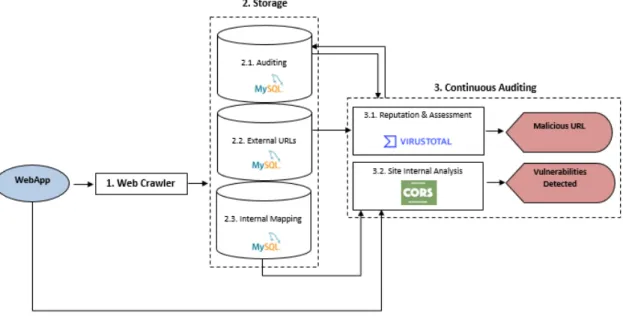
Tendo em conta o anteriormente descrito relativamente a IA e CORS, a ferramenta desenvolvida permite a detec¸˜ao de vulnerabilidades em Web Apps em AC. O foco funda-mental est´a nos links externos e internos da Web App. Corre num servidor web, disponi-bilizando este servic¸o aos utilizadores na internet, permitindo analisar ligac¸˜oes externas e internas de uma determinada Web App. Para as ligac¸˜oes externas ir´a detetar evidˆencias de IA, atribuindo uma classificac¸˜ao de benigno ou maligno `as ligac¸˜oes externas identificadas. Para os links internos, verifica se existem chamadas de Cross-Origin mais especificamente CORS. Desta forma um utilizador poder´a submeter o URL da sua Web App que ir´a ser analisado pela ferramenta Vulnerabilities Detector at Runtime and Continuous Auditing (VuDRuCA) que recorre a um mecanismo de AC.
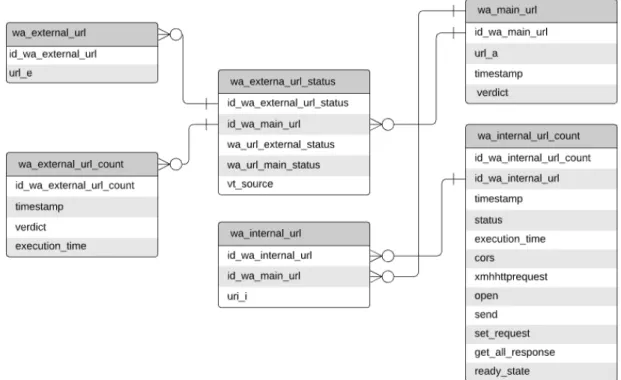
A ferramenta VuDRuCA emprega t´ecnicas de crawling para navegar nas p´aginas da Web Appe obter a informac¸˜ao pretendida. Utiliza ainda a API do Virus Total para analisar URLs, identificando conte´udo malicioso detet´avel por antiv´ırus e scanners de Web Apps. Como backend a ferramenta utiliza uma base de dados relacional que armazena todos os dados recolhidos para que estes possam ser analisados, contribuindo para a apresentac¸˜ao de indicadores.
Na fase de avaliac¸˜ao a ferramenta foi testada utilizando uma amostragem de 100 URLs de Web App que recorrem `a tecnologia AJAX. Para estes foram contabilizados o n´umero de sites externos e internos da Web App. Ap´os uma primeira an´alise foram escolhidos 30 Web Apps para categorizac¸˜ao, medic¸˜ao dos tempos de execuc¸˜ao para detec¸˜ao de links externos e internos e v´arias outras m´etricas relativas aos tempos de execuc¸˜ao. Finalmente para testar o motor de AC foram selecionados 10 URL de Web Apps que na sua maioria recorrem a CORS. Nestas 10 Web Apps foi identificada a tecnologia de Content Manamg-ment System(CMS) utilizada. O m´odulo de AC, efetuou ainda uma an´alise durante um per´ıodo de 5 dias, com intervalos de 24h, para validar se existia a introduc¸˜ao de novos links externos ou se algum destes estava comprometido. Relativamente aos links internos foi validado se existiam novos links internos e se estes recorriam a CORS.
Palavras-chave: vulnerabilidades, aplicac¸˜oes web, auditoria cont´ınua, auditoria est´atica de c´odigo, seguranc¸a de software.
Abstract
Nowadays integrating applications agility and security is an extremely challenging pro-cess. There is the notion that security is a heavy process, requiring knowledge and con-suming time of the development teams. On the other hand, the acquisition of Web Ap-plications (Web Apps) is often achieved through contracted services because companies do not have the necessary software developers. Taking this fact into account, the risk of obtaining a product implemented by poorly qualified developers is a reality.
The main objective of this thesis is to propose a solution and develop a tool that will detect some forms of Injection Attacks (IA) or Cross-Site Request Forgery (CSRF) attacks in Web Apps. The latter is due to the fact that Web Apps sometimes employ Cross-Origin Resource Sharing (CORS). Some statistics demonstrate that these attacks are some of the most common security risks in Web Apps. IA is a class of attacks that relies on inputting data into a Web App to make it execute or interpret malicious information unexpectedly. Examples of attacks in this class include SQL Injection (SQLi), Header Injection, Log Injection, and Full Path Disclosure.
CORS is used by browsers to allow controlled access to resources located outside a given domain. It extends and adds flexibility to the Same Origin Policy (SOP). However, this mechanism also offers the potential for Cross-Domain based attacks if a site’s CORS policy is misconfigured. CORS is not intended to be a protection against Cross-Request attacks like the CSRF.
The developed tool, called VuDRuCA, allows the detection of vulnerabilities associ-ated with IA and CORS in Web Apps. It runs on a web server, providing this service to users on the internet, allowing them to analyse external and internal links of a particular Web App. For the external links, it will detect evidence of IA, assigning a benign or a malign classification to the identified external links. For internal links, there is a check for Cross-Origin calls, specifically CORS.
VuDRuCA uses crawling techniques to navigate through the pages of the Web App and obtain the desired information. It also uses the Virus Total API, which is a free online service that parses URLs, enabling the discovery of malicious content detectable by antivirus and website scanners. As a backend, it uses a relational database to store the collected data so that it can be retrieved and analysed, reporting the presence of security indicators.
Keywords: vulnerabilities, web applications, continuous auditing, static code auditing, software security.
Contents
List of Figures xvii
1 Introduction 1
1.1 Motivation . . . 1
1.2 Objectives . . . 3
1.3 Contribution . . . 3
1.4 Thesis Structure . . . 3
2 Context and Related Work 5 2.1 Vulnerabilities . . . 5 2.1.1 Injection . . . 7 2.1.2 Cross-Site Scripting . . . 8 2.2 Static Analysis . . . 11 2.3 Fuzzing . . . 13 2.4 Symbolic Execution . . . 14 2.5 Oracles . . . 16
3 Vulnerabilities Detection at Run Time and Continuous Auditing 19 3.1 Continuous Auditing for Detecting Vulnerabilities . . . 19
3.2 CORS Exploitation . . . 21
3.2.1 Summary of SOP and CORS . . . 25
3.3 Architecture to Support CORS Detection . . . 26
3.4 Main Modules . . . 27 3.4.1 Web Crawler . . . 27 3.4.2 Storage . . . 28 3.4.3 Continuous Auditing . . . 29 4 Implementation of VuDRuCA 31 4.1 Main Modules . . . 31
4.2 Main Engine Routines . . . 32
4.3 Continuous Auditing Engine Routines . . . 35
4.4 Example of Execution and Detection Case . . . 38 xiii
5 Evaluation 41
5.1 AJAX Use-Case Characterization . . . 41
5.2 Experimental Phases . . . 42
5.2.1 First Phase: 100 Web Apps . . . 42
5.2.2 Second Phase: 30 Web Apps . . . 44
5.2.3 Third Phase: 10 Web Apps for CA . . . 47
6 Conclusion 51 6.1 Future Work . . . 52
Bibliography 57
List of Figures
2.1 An example of the steps to perform an SQLi attack. . . 8
2.2 SQLi vulnerability formed in phpmyadmin. . . 8
2.3 An example of the steps to perform XSS reflected [10]. . . 9
2.4 An example of the steps to perform a XSS stored attack [10]. . . 10
2.5 A DOM XSS vulnerabilty in previous versions of the phpmyadmin tool. . 11
3.1 Tempered origin URL under REQUEST [1]. . . 23
3.2 Response from the REQUEST [1]. . . 24
3.3 Vulnerabilities Detection at Runtime and CA architecture. . . 27
3.4 Storage database model. . . 28
4.1 VuDRuCa modules routines. . . 33
4.2 VuDRuCA CA for main Web App URL routine. . . 33
4.3 VuDRuCA CA for external Web App links routine. . . 34
4.4 VuDRuCA CA for internal Web App links routine. . . 34
4.5 Main interface. . . 39
4.6 Rep. and Ass. submodule results for the https://www. greenanysite.com/. . 39
4.7 Site CORS internal analysis result for the https://www. greenanysite.com/. 39 4.8 Task Scheduler routine. . . 40
Chapter 1
Introduction
Nowadays, the web is the most relevant and powerful platform for all new software appli-cations. As a result, new Web Applications (Web Apps) are constantly being developed, making the security of such applications become increasingly important. In parallel, the number of reported Web Apps vulnerabilities grows every year, whether they are pub-lished in specialized databases (e.g., Common Vulnerabilities and Exposures (CVE)) or discovered internally in the organizations. These vulnerabilities can pose a serious risk of exploitation and may result in system compromise, information leaks, or denial of service. But more serious than this is that vulnerabilities in Web Apps can prove costly for orga-nizations. These costs may include direct financial losses, increases in required technical support and tarnished image and brand.
The Open Web Application Security Project (OWASP) is an example of an open com-munity that is dedicated to enabling organizations to develop, purchase, and maintain applications that can be trusted. The OWASP Top Ten lists the 10 most dangerous cur-rent Web Apps security flaws, along with effective methods of dealing with them [8]. Project members include a variety of security experts from around the world who share their knowledge of vulnerabilities, threats, attacks, and countermeasures. But the main issue is, how should software engineers develop secure Web Apps? Different develop-ers have divdevelop-erse opinions regarding which language, framework, or vulnerability-finding tool tends to yield more secure software. For example, the choice of the programming language has an important influence on the security of the Web Apps as the offered con-structs may facilitate or prevent certain classes of attacks. In any case, as it is always possible to introduce bugs in the applications, it is necessary to select the most effective testing methods. This could help to reduce risk and allocate resources more appropriately.
1.1
Motivation
Web Apps are increasingly used to provide services available on the Web. As they are developed and integrate various technologies, new types of vulnerabilities have been
Chapter 1. Introduction 2
served. Also, the number of languages that are used to develop Web Apps can open novel attack vectors for malicious actors and new vulnerabilities.
Currently, 25.7% of the vulnerabilities in CVE are classified as either SQL Injections (SQLi) or Cross-Site Scripting (XSS) [43], occurring most of the time in Web Apps. Briefly, SQLi makes it possible to rewrite a query made by a Web App to a database, which could create unexpected behavior and result in either data loss or disclosure (e.g., by leaking user names and associated passwords). In contrast, a XSS vulnerability allows attackers to inject malicious code into the client part of the Web App and thereby change the behavior of the code executing in the browser, potentially leaking authorization and/or private information.
Another challenge is related to the fact that HTML5 is an emerging stack for next-generation applications. It is enhancing browser capabilities and enabling the execution of Rich Internet Applications in the context of modern browser architectures. Interestingly HTML5 can run on mobile devices making it even more complicated. HTML5 supports a combination of various components like XMLHttpRequest (XHR), Document Object Model (DOM), Cross-Origin Resource Sharing (CORS) and enhanced HTML/Browser rendering. It also brings several new mechanisms to the browser which were not seen be-fore, like local storage, web SQL, WebSocket, web workers, enhanced XHR and DOM-based XPATH to name a few. Consequently, HTML5 has an enhanced attack surface and points of exploitation for attackers. By leveraging these new mechanisms, malicious actors can craft stealth attacks and silent exploits which are hard to detect and have a sig-nificant impact [6].
In this way, it is increasingly important to have tools that identify vulnerabilities in different languages of web programming before an application is put into production or even when it is already deployed. We consider that Continuous Auditing (CA) is a must-have, which will allow continuous monitoring of the systems and assessing the risks to the company’s assets, increasing the efficiency of vulnerability discovery and mitigation. The main objective of this dissertation is to propose a solution and develop a tool named VuDRuCA (Vulnerabilities Detector at Runtime and Continuous Auditing) allow-ing the detection of vulnerabilities in a Web App in CA. It enables the discovery of vul-nerabilities associated with Injection Attacks (IA) and the CORS mechanisms. The tool runs on a web server, providing this service to users, allowing the analysis of the external and internal links of a particular Web App. For the external links, it will detect evidences of IA, assigning a classification of benign or malignant to the identified external links. For the internal links, it checks for Cross-Origin calls, related to CORS. This way, a user can submit his Web App URL that will be analised by VuDRuCA.
Chapter 1. Introduction 3
1.2
Objectives
This thesis has two objectives. The first objective is to study ways to identify and de-tect possible indicators of compromise in Web Apps and verify if those are using Cross-Domain requests. For that purpose, we will present a methodology to analyse client-side code returned to the user, performing an HTML and JavaScript (JS) continuous code anal-ysis to detect possible compromised Web Apps or Cross-Domain calls.
The second is to develop a solution and its implementation in a tool for using the CA approach. The tool will use crawling techniques and a commercial external entity called Virus Total (VT) to analyse the external links. For the internal links, the tool will use an internal routine to find CORS calls used to send XHR that is mostly implemented in JavaScript programming language. It is used to send HTTP or HTTPS requests directly to a web server and load the server’s response data directly back into the script.
1.3
Contribution
The main contributions of the thesis are:
• A study of web vulnerabilities, especially the ones associated with CORS; in addi-tion, CA is considered to understand how to monitor a Web App over a time period; • An architecture to continuously audit Web Apps, analysing their external links for malware related problems and internal links against CORS. The VuDRuCA tool implements the architecture;
• Carry out an assessment of the developed tool, namely capturing execution times for site analysis alone or through continuous auditing; the number of external links detected per application as well as their classification; the number of internal links per Web App and invoked CORS calls.
1.4
Thesis Structure
This thesis is organized as follows:
• Chapter 2 briefly explains some relevant concepts and provides a fundamental con-text for the work;
• Chapter 3 presents the proposed architecture, describing the main components as well;
• Chapter 4 discusses the current implementation of the tool VuDRuCA, explaining in more detail each module;
Chapter 1. Introduction 4
• Chapter 5 evaluates and validates the tool;
• Finally, Chapter 6 provides conclusions of the developed research and discusses future work that can be built upon the base architecture.
Chapter 2
Context and Related Work
This chapter describes a few classes of web vulnerabilities and presents and discusses some related work that is relevant in this context. The chapter is structured in the follow-ing sections:
• Section 2.1 looks into several vulnerability classes that are referenced by OWASP as some of the most critical for Web App;
• Section 2.2 details various tools and techniques used in static analysis;
• Section 2.3 looks into fuzzing techniques and fuzzers that implement each tech-nique;
• Section 2.4 reports some knowledge about symbolic execution; • Section 2.5 exposes related work about oracles.
2.1
Vulnerabilities
In a general way, security vulnerabilities are bugs that were accidentally introduced dur-ing software development. It is important to refer that not all bugs are vulnerabilities, only those that might be exploited or used to compromise the system can be considered a vulnerability. The Microsoft Security Response Center (MSRC) defines a security vulner-ability as a weakness in a product that could allow an attacker to compromise the integrity, availability, or confidentiality of that product [40].
• Integrity refers to the trustworthiness of a resource. An attacker that exploits a weakness to modify data silently and without authorization is compromising the integrity of a product;
• Availability refers to the possibility to access a resource. An attacker that exploits a weakness in a product, denying appropriate user access to it, is compromising the availability;
Chapter 2. Context and Related Work 6
• Confidentiality refers to limiting access to information in a resource in order to avoid disclosure to unauthorized parties. An attacker that exploits a weakness in a product to access non-public information is compromising the confidentiality of that product.
For our work, the fundamental reference for Web App vulnerabilities is the ”OWASP Top 10 - The Ten Most Critical Web Applications Security Risks” [8]. In Section 3.2, we will focus on a special class of vulnerabilities that are becoming more relevant as it is exposed to the increasing use of different technologies and programming languages in Web Apps.
Before we talk about classes of vulnerabilities, we will address the types of client and server-side attacks. Attacks targeted at individual client computers are called client-side attacks. These are usually directed at web browsers and instant-messaging applications. Client-sideattacks are a major font for attackers today. As network administrators and software developers fortify the perimeter, attackers need to find a way to make the victims open the door for them to get into the network.
These attacks target vulnerabilities in client applications that interact with a malicious server or process malicious data. Here, the client initiates the connection that could result in an attack. To achieve this, hacker entices users to click a link, open a document, or somehow get to a website controlled by a malicious entity. If a user does not interact with a server, there is no risk because the client does not process any potentially harmful data sent from the server. A typical example of a client-side attack is a malicious web page targeting a specific browser vulnerability that would give the malicious server complete control over the client system. Saxena et al. [48] explains that the complexity of the client-side components of Web Apps has exploded with the increase in popularity of web 2.0 applications. Nowadays, traditional desktop applications, such as document viewers, presentation tools and chat applications are commonly available as online JavaScript (JS) applications. The authors present the term client-side validation (CSV) vulnerabilities as new vulnerability class. A typical Web 2.0 application has two parts: a server-side component and a client-side component. The server-side component processes the user’s request and generates an HTML response that is sent back to the browser. The client-side code of the Web App, typically written in JS, receives the HTML response from the server. The client-side component executes in the web browser and is responsible for processing input data and dynamically updating the view of the web.
CSV vulnerabilities belong to the general class of input validation vulnerabilities but are different from traditional web vulnerabilities like SQL injection (SQLi) and Cross-Site Scripting (XSS) (see later parts of the section). For example, one type of CSV vul-nerability involves data that enters the application through the browser’s cross-window communication abstractions and is processed completely by JS code, without ever being sent back to the webserver. Another type occurs when a Web App sanitizes input data
be-Chapter 2. Context and Related Work 7
fore embedding it in its initial HTML response but does not sanitize the data completely and allows for its use in the JS component.
In a server-side attack, an attacker submits a malicious input that gets executed on the server. This malicious input could be submitted in many different ways, including web form elements and URL parameters. Since the malicious input needs to be crafted and submitted in a manner that forces the back-end applications on the server to process it, the attacker usually needs to gain an understanding of the back-end applications. This knowledge can be gained for instance by using an information disclosure attack. In any case, depending on the kind of back-end applications, the type of attacks also vary.
In the rest of this section, we will explain two classes of vulnerabilities that are par-ticularly relevant for our work.
2.1.1
Injection
Injection flaws, such as SQL, NoSQL, OS, and LDAP injection, occur when untrusted data is sent to an interpreter as part of a command or query. In this case, we are dealing with a server-side attack. The attacker’s hostile data can trick the interpreter into executing unintended commands or accessing data without proper authorization.
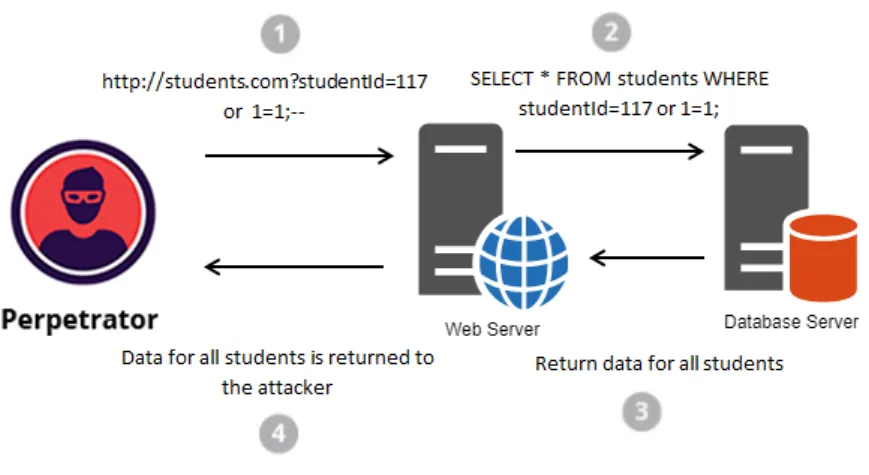
SQL injection (SQLi) is one of the most dangerous vulnerabilities that a Web App can be prone to. When a user’s input is being passed unvalidated and unsanitized as part of an SQL query that means that the attacker can manipulate the query itself and force it to return different data than what it was supposed to return [8]. Figure 2.1 shows how to carry out an SQLi attack. The attacker inserts a SQL command or conditional logic into the input field, such as a student ID number of 117 OR 1=1;-- then, the resulting query is sent to the database (steps 1 and 2). Normally the query would search the student’s table for the matching ID sent with the injected code. With the attacker, the predicate is always true because ID OR 1=1; executes to true independently of the value of ID. As a result, the database will return all data from the student’s table back to the attacker (steps 3 and 4).
Another example of an SQLi is shown in Figure 2.2, which is a vulnerability that existed in previous versions of the tool phpmyadmin. Due to missing validation of the user-provided parameters (represented in Figure 2.2 as the variable $scale), it was pos-sible to inject SQL code that would run with the privileges of the user control. This gives read and write access to the configuration tables of the database, and possibly read access to some other table for which the tool has the necessary privileges. The vulnerability was fixed by adding a numeric validation check to the $scale variable.
Chapter 2. Context and Related Work 8
Figure 2.1: An example of the steps to perform an SQLi attack.
Figure 2.2: SQLi vulnerability formed in phpmyadmin.
2.1.2
Cross-Site Scripting
Cross-Site Scripting, commonly abbreviated to XSS, refers to a client-side attack where an attacker uses a Web App to send malicious code, generally in the form of a JS script, to a different end-user. Since the browser of the user thinks the script came from a trusted source, the malicious script can access cookies, session tokens, or other sensitive infor-mation retained by the browser and used with that site [2]. Matthew et al. [29] refer that XSS vulnerabilities are difficult to prevent because it is tricky for Web Apps to anticipate the client-side semantics. An XSS attack occurs when:
• Data is inserted in a Web App through an untrusted source (most frequently a web request);
• Data is included in dynamic content that is sent to a user browser without being validated for malicious content.
The malicious content sent to the web browser often takes the form of a segment of JS, but may also include HTML, Flash, or any other type of code that the browser may execute.
Chapter 2. Context and Related Work 9
The variety of attacks based on XSS is almost limitless, but they commonly include trans-mitting private data, like cookies or other session information, to the attacker, redirecting the victim to web content controlled by the attacker, or performing other malicious oper-ations on the user’s machine under the guise of the vulnerable site. Since the malicious content runs with the same privilege as the trusted content from the web server, it can steal the victim’s private data or take unauthorized actions on the user’s behalf.
To prevent XSS vulnerabilities, all the untrusted content from users in web pages must be sanitized. However, proper sanitization is very challenging. One could let the server sanitize the untrusted content before delivering it to the browser. However, when a browser interprets certain content differently from what the server intends, attackers can take advantage of this discrepancy, as exemplified in the Samyworm [11], one of the fastest spreading browser worms to date. Alternatively, one could let the client sanitize untrusted content. However, without the server’s help, the client cannot distinguish between trusted and untrusted content in the web pages.
There are three main categories of XSS attacks: reflected, stored and DOM.
With reflected XSS, the malicious script is not retrieved from storage but is instead reflected the user browser by the server. When a user is tricked into clicking on a malicious link, the injected code is included in the request that goes to the vulnerable web site, which sends the attack back to the user’s browser. The browser will execute the script as the source is considered trusted.
As an example, in Figure 2.3, the perpetrator embeds a malicious script into a hy-perlink, enabling the viewing of user session cookies. The link is sent to the victim via email to fool her to click on it. The script is executed by the Web App and reflected back to the victim’s browser. Lastly, the browser sends the session cookies to the perpetrator, enabling access to the victim’s private data.
Chapter 2. Context and Related Work 10
XSS stored are based on the same principle of reflection of attacker-supplied data. The difference is that in these cases the vulnerable website stores the malicious script permanently and reflects/sends that data to any user accessing it. In this way, the same scripts, that are used to exploit XSS vulnerabilities by reflection can be used to exploit XSS vulnerabilities by storage. The victim retrieves the script from the server when it requests the stored information.
As an example, in Figure 2.4 we can see that the perpetrator discovers a website having a vulnerability that enables the script injection. The perpetrator injects a malicious script that steals each visitor’s session cookies. This stealthy approach involves using JS to create a new, albeit broken, image that points to a cookie catching script. For each visit to the website, the malicious cookie catching script is activated. Finally, the visitor’s session cookie is sent to the perpetrator.
Figure 2.4: An example of the steps to perform a XSS stored attack [10].
XSS DOMis an attack wherein the attack payload is executed as a result of modifying the DOM “environment” in the victim’s browser, so that the client-side code runs in an “unexpected” manner. That is, the page itself does not change, but the client-side code contained in the page executes differently due to the malicious modifications that have occurred in the DOM environment. This differs from the stored and reflected XSS attacks, wherein the attack payload is placed in the response page due to a server-side flaw.
An example of code vulnerable to a XSS DOM is shown in Figure 2.5, based on a vulnerability that existed in previous versions of the phpmyadmin tool. The vulnerability was exploited by using specially crafted MySQL table comments that included a mali-cious script. An example of a malimali-cious script would be an AJAX call that sends the contents of document.cookie to a website that the attacker controls. The attacker could then use the session cookie to log in as the victim. Later on, the development team fixed the vulnerability by applying the htmlspecialchars() sanitization function to line 2.
Chapter 2. Context and Related Work 11
Figure 2.5: A DOM XSS vulnerabilty in previous versions of the phpmyadmin tool.
2.2
Static Analysis
One way to deal with security vulnerabilities is to wait until the bugs are exploited by an attacker, then produce a patch that one hopes fixes the problem without introducing new flaws, and whine when system administrators do not install patches quickly enough [27]. Not surprisingly, this approach has proven largely ineffective.
The solutions for reducing software flaw damage can be grouped into two categories: • Mitigate the damage that flaws can cause.
• Eliminate flaws before the software is deployed.
For the first category, there are techniques that limit security risks from software bugs, which include modifying program binaries to insert runtime checks or running applica-tions in restricted environments that limit the harm they may do. The second category is related to techniques to detect and correct software flaws. They include human code reviews, testing, and static analysis. Functional testing is typically ineffective for finding security vulnerabilities.
Tosin et al. [45] states that developers do not code with the mindset of an attacker because they care more about delivering functionalities. Common coding mistakes and inadvertent programming errors are weaknesses that often evolve into exploitable vul-nerabilities. The reality is that about 70-percent of reported attacks are performed at the application layer rather than the network layer [30]. Integrating Static Analysis Tools (SAT) could be envisaged to help developers program defensively.
Static analysis techniques analyse the source code directly. Thus, using static analysis lets us make claims about all possible program executions rather than just a particular test-case execution. From a security viewpoint, this is a significant advantage. There is a range of static analysis techniques, offering tradeoffs between the required effort and analysis complexity. At the low-effort end are standard compilers, which perform type the checking and other simple program analyses. At the other extreme are full program verifiers that attempt to prove complex properties about programs. They typically require a complete formal specification and use automated theorem provers. These techniques
Chapter 2. Context and Related Work 12
have been effective but are almost always too expensive and cumbersome to use on normal programs.
There are works that apply a lightweight form of analysis. Gustavo et al. [32] de-scribe Splint, a tool that performs an analysis similar to those done by a compiler. Hence, they are efficient and scalable, and they can detect a wide range of implementation flaws by exploiting annotations added to the program the focus in not, however, looking for vulnerabilities.
Historically, static analysis tools were used to prove the absence of bugs inside a pro-gram, and they were particularly effective in specific application domains [32]. Typically, a predefined set of rules is used to find vulnerabilities, such as searching for the use of insecure library functions, buffer overflows or insufficient input data validation. One ex-ample of a basic static code analysis tool is flawfinder [5]. Flawfinder examines C and C++ source code and reports possible security weaknesses sorted by risk level. It does this by checking the code for potentially dangerous functions like strcpy(), which does an unbounded copy of a string from a source to a destination. The function does not check whether the destination buffer is big enough to store the source, which can easily lead to a buffer overflow if the programmer did not validate this beforehand.
Tools like flawfinder do not actually check for validation and leave it up to the user to verify. It is not hard to imagine that this leads to numerous false positives, which can be a little disheartening to the programmer who has to check each reported potential vulnerability manually. To provide better results, many tools employ a technique called taint checking as part of the static analysis. The main idea behind taint checking is that any variable that can be modified (either directly or indirectly) by input coming from an external user has to be considered tainted, as it has the potential to contain malicious data. Variables that are derived from tainted variables become tainted as well. Static code analyzers use taint checking by finding potentially vulnerable functions (so-called sinks) and then trace back their parameters to see if they were tainted. If a parameter is a constant variable set by the programmer, the analyzer will not report it. If the tool believes that the variable could be modified by the external user, it will list it as a potential vulnerability [40].
RIPS is used for the automated detection of security vulnerabilities in PHP appli-cations [9]. It tokenizes the code (lexical analysis) based on a PHP tokenizer exten-sion and performs semantic analysis to build a program model. It performs backward-directed inter-procedural taint analysis of sensitive sinks, based on previously analyzed variable assignments. Its strength is the ability to scan PHP applications very fast for PHP-specific vulnerabilities. It supports the detection of 15 different vulnerability types, including XSS, SQLi, Local File Inclusion (LFI), and others. However, experimental studies demonstrate that RIPS generates a high number of false positives because it does not use an abstract syntax tree or control flow graph, and lacks support for object-oriented
Chapter 2. Context and Related Work 13
code.
WAP is another static analysis and data mining tool for the detection and correction of input validation vulnerabilities in Web App written in PHP [13]. WAP detects and corrects several classes of vulnerabilities, including SQLi and XSS among others. This tool does taint analysis to track malicious inputs inserted at entry points ($ GET, $ POST arrays) and to verify if they reach some sensitive sink (PHP functions that can be exploited by malicious input). After the detection, the tool uses data mining to confirm if the vulnera-bilities are real or false positives. In the end, the real vulneravulnera-bilities are corrected with the insertion of the fixes (small pieces of code) in the programs.
SATs play an important role to ensure the product meets the quality requirements. SATs exercise application source code and check for violations. The reality is that to date the vast majority of critical vulnerabilities are found by manual analysis of code by security experts. Despite this, different studies have investigated why developers do not use SAT to find bugs or how developers interact with such tools when diagnosing poten-tial security vulnerabilities. Findings show that false positives and the way warnings are presented are barriers to use. Similarly, deep interaction by developers with the tool’s results can create challenges of cognitively demanding tasks that could threaten the use of such tools [50]. Baca et al. [18] evaluated the use of a commercial static analysis tool to improve security in industrial settings. They found that, although the tool reported some relevant warnings, it was hard for developers to classify them. In addition, developers corrected false positive warnings, which created vulnerabilities in previously safe code. Hofer et al. [33] have used some other metrics to guide tools’ selection such as instal-lation, configuration, support, reports, errors found, and whether the tools can handle a whole project rather than parsing single files. Other researchers have also performed inde-pendent quantitative evaluations of static analysis tools with regard to their performance to detect security weaknesses [45].
2.3
Fuzzing
Fuzzingis one of the most effective approaches to find vulnerabilities in large software. The technique consists in feeding the target application with unexpected inputs to look for abnormal program termination. The crucial step in fuzzing is to choose relevant un-expected inputs, likely to reveal potential vulnerabilities [36].
Fuzzing was first introduced by Miller on a project to promote the reliability of Unix systems [36]. In this project, Miller confirmed that when arbitrary input values were delivered to the program under test, they created an exception and the program was shut down. This experience evolved into the fuzzing concept, which injects random values into the software with the expectation of bringing the execution to an expected state.
Chapter 2. Context and Related Work 14
inputs are generated. Dumb fuzzing is the simplest form of fuzzing technology because input values are produced with random data. This approach, however, has difficulty to find inputs that go beyond the initial validation layer of the software, and therefore code coverage is restricted.
Smart fuzzing generates appropriate values for the input format of the target through software analysis and error generation. However, there is a disadvantage in that it re-quires specialized knowledge to analyze the target software, and it may take a long time to generate a suitable model for the software. Fuzzing mutation is a test technique for modifying input data samples to make novel test cases that are tried in the target software [36]. Recently, an evolutionary technique has been introduced that generates a new input based on feedback on the response of the target software [36].
George et. al [39] examined 32 recently published works on fuzz testing and studied their experimental evaluations. They suggest a procedure that should be followed by any researcher that develops a new fuzzer algorithm (call it A). The researcher should empirically demonstrate that A provides an advantage over the status quo, namely:
• Choose a compelling baseline fuzzer B to compare against; • Get a sample of target programs for the benchmark suite;
• Select a performance metric to measure A and B when they are run on the bench-mark suite; ideally, this metric is the number of bugs identified by crashing inputs; • Choose a meaningful set of configuration parameters, e.g., the seed file (or files) to
start fuzzing with, and the duration of an experiment.
They found that none of the fuzz testing evaluations that were considered carried out all of the above steps properly (though some got close). This is bad news in theory, and after carrying out more than 50000 CPU hours of experiments, they believe it is bad news in practice too.
2.4
Symbolic Execution
Symbolic executionis a technique that explores feasible paths in the program by setting inputs to symbolic values rather than a real value [36]. It was first proposed in King’s paper in 1975 [37]. This test technique was developed to verify if a specific condition in the software could be violated by the input values.
The technique can be divided into offline symbolic execution and online symbolic exe-cution. Offline symbolic execution chooses only one path in the program to create a new input value by resolving the path predicate [31]. The program must be processed from the beginning to explore other paths, and so there are disadvantages because it causes overhead due to re-execution.
Chapter 2. Context and Related Work 15
Online symbolic execution replicates states and computes novel path predicates at every point where the symbolic executor encounters a branch statement. There is no overhead associated with re-execution with the online method, but the downside is that it requires the storage of all status information and the simultaneous processing of multiple symbolic paths, leading to significant resource consumption.
In order to solve this problem, a hybrid form of symbolic execution was suggested. The hybrid symbolic execution saves state information as in online symbolic execution whenever a branch statement is executed and proceeds until memory is exhausted [22]. When there is no more space to save, there is a switch to the offline symbolic execution and a path search is performed.
In recent years, the concolic execution has been proposed, which is a method of test-ing by substituttest-ing an actual value (Concrete Value) in particular symbolic variable, and testing with a mixture of concrete and symbolic values. This technique is a technique of generates a new input value by solving a path expression branching statements. The reason for executing with that is constructed based on the actual value is that if the sym-bolic executor encounters a difficult problem (and it takes a long time or does not solve the problem) then the test could no longer be performed. However, if the actual value is substituted, a deeper path search becomes possible.
Abeer et al. [17] pursue an automated exploit generation approach in Web App. Given an application, the goal is to automatically construct a sequence of malicious HTTP re-quest inputs that direct an application’s execution to a vulnerable sink. The starting point to the approach is static analysis: the creation of models of the Web App behavior along its paths that are based on symbolic execution. From here, there are two scalability chal-lenges that must be overcome to make the exploit finding successful. The first one in-volves path selection: what are the paths that one must explore to make opportunistic exploit generation successful? The approach makes the observation that it is possible to prioritize the traversal of the paths by using their constraint solving costs, such that one we efficiently identifies paths that lead to a successful exploit. The second issue is about persistent database states: how to deal with database queries that may be present along the paths that are explored. This issue becomes particularly important in the context of second-order attack creation, where a vulnerable query, say, is exploited to store some data that is subsequently read from a (second) exploit sink.
Cristian et al. [20] presented KLEE, a symbolic execution tool capable of auto-matically generating tests that achieve high coverage on a diverse set of complex and environmentally-intensive programs. When KLEE runs a program, it tries to explore ev-ery possible path. This is done by executing the program symbolically, i.e., tracking all constraints on inputs marked symbolic as each instruction is run. When a conditional that depends on a symbolic input is encountered, a constraint solver is used to determine which direction the path will follow. In some cases execution is not constrained to follow
Chapter 2. Context and Related Work 16
a single path, the condition can be true or false depending on the input, and the execution conceptually forks. When this happens, KLEE clones the current process and follows both paths, adding the appropriate constraint to the path conditions of each process.
Torben et al. [34] present THAPS a vulnerability scanner for Web Apps written in PHP. THAPS is fundamentally a taint analysis tool based on the symbolic execution of PHP. It is in the symbolic execution engine that vulnerabilities are detected and where reports are generated, containing details of each (potential) bug. To identify vulnerabil-ities, the taint analysis identifies where user input is able to enter the application, called a source, and how it is propagated through the application. If the tainted data reaches critical points of the application, where it is able to alter the outcome of the application, it has reached a sink. Every time tainted data reaches a sink without being properly sani-tized first, a vulnerability is reported. To simulate all the possible outcomes the analysis might need to store several (many) values for the same variable because of assignments inside different code branches. Whenever there are multiple values a simulation has to be performed on each of these. THAPS stores the values in a variable storage, which also records what branch of the code the value belongs to.
2.5
Oracles
A test oracle, or just oracle, is a mechanism for determining whether a test has passed or failed. One of the most effective ways to produce test oracles is to use a model of the target software and generate complete tests, including both input data and expected results, directly from the model. The model, in this case, is exactly what the name implies: it incorporates the most important aspects of the target, but not every detail (if it did include all details, it would be equivalent to the system itself) [7].
The most common form of oracles is proxy servers. A proxy can be placed between a service and a client in order to monitor what kind of traffic is going through. Divya et al. [44] present FlowWatcher, an HTTP proxy that mitigates data disclosure vulnerabilities in unmodified Web Apps. FlowWatcher monitors HTTP traffic and shadows part of an ap-plication’s access control state based on a rule-based specification of the user-data-access (UDA) policy. The UDA policy states the intended data ownership and how it changes based on observed HTTP requests. FlowWatcher detects violations of the UDA policy by tracking data items that are likely to be unique across HTTP requests and responses of different users.
Anyi et al. [41] propose an SQL Proxy-based Blocker (SQLProb). SQLProb harnesses the effectiveness and adaptivity of genetic algorithms to dynamically detect and extract users’ inputs for undesirable SQL control sequences. Compared to state-of-the-art pro-tection mechanisms, this method does not require any code changes on either the client, the web-server or the back-end database. Rather, the system uses a proxy that seamlessly
Chapter 2. Context and Related Work 17
integrates with existing operational environments offering protection to front-end web servers and back-end databases.
Iberia et al. [42] proposed a way to detect and block attacks at runtime without pro-grammer intervention inside a database. They call this approach SElf-Protecting daTabases preventIng attacks(SEPTIC). The paper focus is on the two main categories of attacks re-lated to databases: SQLi attacks, which continue to be among those with the highest risk and for which new variants continue to appear, and stored injection attacks, which also involve SQL queries. For SQLi, they propose detecting attacks essentially by comparing queries with query models that were previously learned in an earlier training phase. For stored injection, they propose having plugins to deal with specific attacks before data is inserted in the database.
Chapter 3
Vulnerabilities Detection at Run Time
and Continuous Auditing
This chapter focusses on the detection of Cross-Origin Resource Sharing (CORS) vulner-abilities. It proposes an architecture for a new vulnerability detection tool along with the key concepts and modules it relies on. The architecture resorts to crawling techniques to find links (external and internal) in the Web App and analyses them to check for possible dangerous strings related to CORS. The analysis is targeted to web pages produced/re-turned by the Web App and is performed at run time, allowing for Continuous Auditing (CA). The chapter is organized as follows: Section 3.1 provides an overview of CA. Sec-tion 3.2 describes the implicaSec-tions of CORS in modern Web Apps and the problems they may bring. Section 3.3 offers, respectively, an overview of the architecture, and a more detailed look into each module that composes the architecture.
3.1
Continuous Auditing for Detecting Vulnerabilities
Organizations are subject to various types of audits for different purposes, such as quality, environmental, operational or management. These processes follow a well defined time schedule to validate and analyse what has already been done and the current state of the organization. However, the competitive demands for organizations and, consequently, the need for innovation, promoted changes in the way web audit is done. CA assists the audi-tor in developing his or her opinion since it enables the evaluation of the relevant events that are observed in real-time, using automated and continuous processes. According to Camargo [21], CA is related to:
produces results [. . . ] within a short period of time after the occurrence of a relevant event, i.e., it performs process control tests continuous] [. . . ] [using] technology tools, [. . . ] [allowing] identify nonconformities, trends, and risk indicators
Silva [52] observed that the execution of CA is based on the date surrounding a given 19
Chapter 3. Vulnerabilities Detection at Run Time and Continuous Auditing 20
event, and whenever possible in real-time. The data supporting the analysis should be reliable, assisting auditors and managers in decision-making and also facilitating early detection of fraudulent reports.
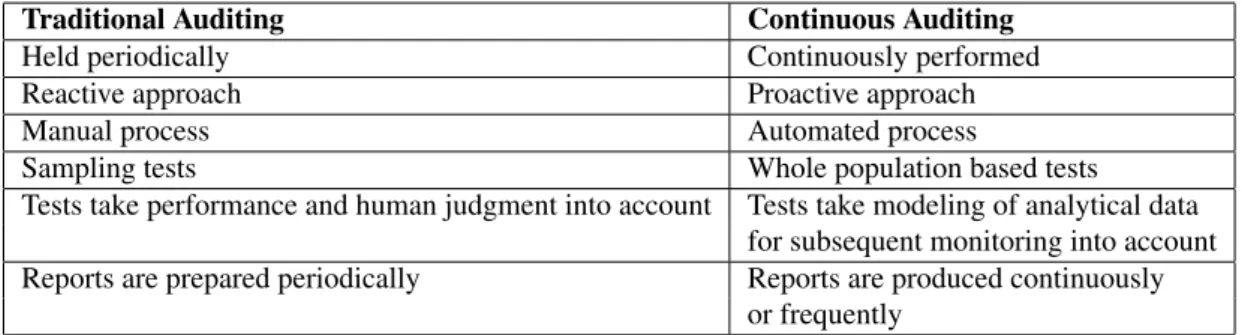
According to Costa [24], to conceive a CA comprehensive approach, there is the need to achieve resource optimization and rationalization through continuous and integrated types of audit, through which the same entity is subject. Here, CA contributes not only to the traditional monitoring tasks but also to the efficiency of an entity. Table 3.1 shows the fundamental differences between a Traditional Audit (TA) and a CA.
Traditional Auditing Continuous Auditing
Held periodically Continuously performed
Reactive approach Proactive approach
Manual process Automated process
Sampling tests Whole population based tests
Tests take performance and human judgment into account Tests take modeling of analytical data for subsequent monitoring into account Reports are prepared periodically Reports are produced continuously
or frequently
Table 3.1: Traditional Auditing vs Continuous Auditing.
In the context of security, the concept of CA emerges as a novel audit paradigm likely to respond to new needs of a very dynamic environment where novel software is contin-uously developed and integrated into production systems. The traditional model of audit-ing, based on punctual and discontinuous analyses, becomes increasingly inadequate to the current dynamics of information and the systems that manage it. The application of updates and changes to the system configurations can introduce vulnerabilities and leave an organization susceptible to attacks. Therefore, to keep the data secure, one should check systems and devices continuously to detect flaws as they are discovered and re-ported to the organizations [12].
Pinto et al. [46] mention that there is a change in the traditional philosophy of “look back” audit to a CA paradigm that makes it possible to take corrective actions earlier. As such, there is a need for organizations to adopt a methodology that allows indepen-dent auditors to track the occurrence of events over the life of the system. These events, when monitored in real-time, allow audit parameter deviations to be found and reported, allowing to increase the speed and effectiveness of the responses by the decision-makers. Continuous security auditing is intended to ensure real-time monitoring of the systems and the risks to the company’s assets, not only to assess the current security level as well as monitor the system in real-time, increasing the efficiency of vulnerability discovery and mitigation. The information monitoring and review influences the risk approach both in terms of methodology and tools based on various tests.
Intrusion tests, for instance, help to identify weaknesses and potential improvements to complement the continuous audit, as they allow the identification of vulnerabilities and
Chapter 3. Vulnerabilities Detection at Run Time and Continuous Auditing 21
with this information simulate the behavior of an attacker. Since it is a highly specialized and technical type of test, it delivers immense value to organizations with the reported information. However, they might be limited in target, time, and radius and sometimes they depend on legal issues. For a continuous process where there is no such intrusive behavior, vulnerability analysis can be carried out with the aid of automatic tools over time to observe system status and take corrective actions to fix identified problems. In our work, we follow this last approach, to continuous monitor Web App while searching for the introduction of new CORS vulnerabilities.
3.2
CORS Exploitation
Web Apps play an important role in most organizations. CORS is a mechanism that uses additional HTTP headers to tell a browser to let a Web App running at one origin (do-main) to have permission to access selected resources from a web server at a different domain. CORS breaks the limitations imposed by the Same-Origin Policy (SOP) of tra-ditional HTML, allowing exchanges between various web servers in different networks. A Web App executes a cross-origin HTTP request when it asks for a resource that has a different origin (domain, protocol, and port) than its own origin. CORS is mainly im-plemented with the XMLHttpRequest (XHR), which is supported nowadays by almost every browser.
According to Chou [23], a webpage can retrieve data from a URL via XHR with-out refreshing its page. XHR also plays a very important role in AJAX applications. With AJAX, the JS creates XHR objects that can make requests and receive responses asynchronously, updating the display as responses are received. For example, consider Google Maps. When someone goes to Google Maps and searches for a location and slides the map, the browser uses AJAX to make calls to the server to retrieve the images that make the map. In this way, the map changes dynamically, but the remainder of the page is static and does not need to be redrawn with each alteration.
Jorg et al. [49] referred that XHR allows a web page to send arbitrary HTTP requests to any web server. This is different from just opening an URL or submitting an HTML form since with XHR the web page has full control over all HTTP headers to address the sort of issue, the CORS standard was developed to enable controlled cross-domain requests to be done:
• In a preflight request, the browser asks for access to a resource in a different domain. It sends an origin header with the source domain (Origin: http://a.com) to the target web server requesting CORS privileges;
• The target web server may answer with an error message (access denied) or with a CORS header (such as Access-Control-Allow-Origin: http://a.com) to grant the access;
Chapter 3. Vulnerabilities Detection at Run Time and Continuous Auditing 22
• Based on the response, the browser proceeds with the execution.
The XHR object has a number of methods and properties. The following are the most used to perform a Cross-Origin request:
• open: Specifies the properties of the request, but does not actually initiate a con-nection.
• send: Creates the connection to this property and specifies the function that should be called when the state changes to ready.
• setRequestHeader: Defines the header value of an HTTP request. It is called af-ter calling the open() method, but before invoking the send() method. If this method is called many times with the same header, the values are added to form a single HTTP request header.
• getAllResponseHeaders: Returns all the response headers, separated by Carriage Return Line Feed (CRLF), as a string, or returns null if no response has been re-ceived yet. If a network error happens then an empty string is returned.
• readyState: The ready state is a property of the XHR object. It enables the scripting code to determine in what state the response from a server is. It has five possible values:
– 0: The request is uninitialized; – 1: The request has been set up; – 2: The request has been sent; – 3: Waiting for response;
– 4: The response has arrived and is complete.
As mentioned before, under the restrictions imposed by the SOP, XHR can only be used to access a URL in the same domain. The restriction was eased when CORS ap-peared. CORS allows developers to send cross-domain requests using similar codes for requests inside the same domain. The concern about using CORS is that it increases the chances of cross-site attacks. A hacker can easily use the features of CORS to launch Cross-Site Request Forgery (CSRF) attacks. Farah et al. [28] describe a CSRF attack as follows: First, the victim user logs into the target website and gains access. The hacker then tricks the victim user, who visits a malicious website, into unknowingly running a malicious script that sents requests through the browser to the target website. Since the hacker script uses the victim’s privileges to transmit the request, it can access the confi-dential data of the victim in the target site. This attack is difficult to identify in the system log as there are no unusual events.
Chapter 3. Vulnerabilities Detection at Run Time and Continuous Auditing 23
Three common vulnerabilities found on CORS are: misconfigured wildcard (*) in the CORS headers; Trusting pre-domain wildcard as origin; and using XSS to make requests to cross-origin sites.
The first vulnerability is related to misconfigurations and incorrect usage of wildcards such as (*), under which domains are allowed to request resources. This is usually set as default, which means that any domain can access resources on the target site. As an example, we can consider the request below that is performed by the browser to the target:
GET/api/userinfo.php Host: www.victim.com Origin: www.victim.com
When the above request is sent by the browser, the following response might be re-ceived:
HTTP/1.0 200 OK
Access-Control-Allow-Origin:*
Access-Control-Allow-Credentials:true
In this example, the Access-Control-Allow-Origin header is configured with a wild-card (*). It means that any domain can access the resources in the target web site.
In Figure 3.1, we can see an example of the exploitation of this sort of vulnerability, where the attacker can fetch user information like Name, User-ID, and Email-ID and send this information to an external server. To achieve this, he modifies the REQUEST Origin to the attacker domain.
Figure 3.1: Tempered origin URL under REQUEST [1].
Since the target site shares information with any site, it can be exploited by us-ing a domain https://testus-ing.aaa.com (see Figure 3.1). The malicious server of domain https://testing.aaa.comembeds in the returned pages to the browsers some exploit code to steal confidential information from the vulnerable application (in www.target.com). When users open https://testing.aaa.com in the browser, the browser retrieves the sensi-tive information and sends it to the attacker server.
The second form of CORS is when a misconfiguration allows information sharing with domain names that are partly validated. For example, consider the following request:
GET/api/userinfo.php Host: provider.com Origin: requester.com
Chapter 3. Vulnerabilities Detection at Run Time and Continuous Auditing 24
And the response to the above request would be:
HTTP/1.0 200 OK
Access-Control-Allow-Origin:requester.com Access-Control-Allow-Credentials:true
Now, imagine that the user browser makes the following request, indicating as Origin a malicious web server:
GET/api/userinfo.php Host: example.com Connection: close
Origin: attackerrequester.com
The unassuming target server would respond with the following answer, allowing requests from an attacker controlled server:
HTTP/1.0 200 OK
Access-Control-Allow-Origin: attackerrequester.com Access-Control-Allow-Credentials: true
The reason why this permission might be given is a possible backend badly configured validation such as the following, which allows any origin to make requests as long as the domain ends with requester.com:
if ($_SERVER[’HTTP_HOST’] == ’*requester.com’) {
//Access data
else{ // unauthorized access} }
In Figure 3.2, the host domain provider.com trusted all origins that ended with host name requester.com such as attackerrequester.com. So, the attacker tempered the origin header to attackerrequester.com and proceeded with the request. This can be exploited
Figure 3.2: Response from the REQUEST [1].
the same way as in the first misconfiguration. The attacker can create a new domain with the name consisting of the whitelisted domain name. Then, he can embed that malicious site with exploits that will fetch sensitive information from the victim’s site.
Chapter 3. Vulnerabilities Detection at Run Time and Continuous Auditing 25
The third form of attack is related to the fact that a usual defense mechanism that de-velopers employ against CORS exploitation is to whitelist domains that frequently request access for information. However, this solution might not be entirely secure because even if one of the subdomains of the whitelisted domain is vulnerable to other exploits such as XSS, it can enable CORS attacks to succeed. The following code shows the configuration in the victim web server that allows subdomains of requester.com to access resources of provider.com:
if ($_SERVER[’HTTP_HOST’] == ’*.requester.com’) {
//Access data
else{ // unauthorized access} }
Lets imagine that users have access to sub.requester.com but not requester.com, and lets assume that sub.requester.com is vulnerable to XSS.
The attacker can exploit provider.com by using a XSS attack. Two applications exist in different domains. The provider CORS application is hosted on provider.com and another application is hosted on pavan.requester.com which is vulnerable to XSS.
Using this vulnerable XSS subdomain, we are able to fetch sensitive information from provider.com. The attacker injects a malicious JS payload in the “Name” parameter of a request to pavan.requester.com. When the page loads, the script gets executed and fetches sensitive information from the provider.com.
3.2.1
Summary of SOP and CORS
Many developers misunderstand the SOP and what CORS brings to the table. There are many badly informed developers stating that SOP prevents cross-site requests, and there-fore avoids CSRF. This is not the case! All that SOP does is prevent a response from being read by another domain (origin). This is irrelevant to whether a CSRF attack is successful or not. The only time SOP comes into play with CSRF is to prevent any token from being read by a different domain.
As a conclusion, what CORS does is relax SOP. It does not increase security, as it simply allows some exceptions to take place. Some browsers with partial CORS support allow cross-site requests. However, they do not allow custom headers to be appended. As we saw in the examples, in CORS supported browsers, the Origin header cannot be set, preventing an attacker from spoofing this information.
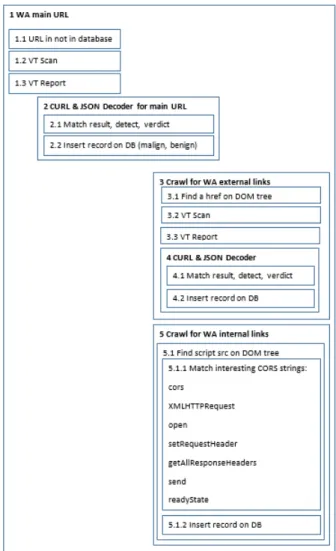
Given the above, our solution to detect CORS is not related to additional HTTP head-ers that CORS uses but instead, our approach crawls the JS code to find interesting strings related to CORS. As mentioned, CORS uses the JS XHR object to make requests for data and providing more interactivity to the web page. The intention is to find functions like open, send, setRequestHeader, getAllResponseHeaders or readyState which represents that the Web App is using CORS.
![Figure 2.3: An example of the steps to perform XSS reflected [10].](https://thumb-eu.123doks.com/thumbv2/123dok_br/15679638.1063361/29.892.212.676.779.1062/figure-example-steps-perform-xss-reflected.webp)
![Figure 2.4: An example of the steps to perform a XSS stored attack [10].](https://thumb-eu.123doks.com/thumbv2/123dok_br/15679638.1063361/30.892.212.678.436.695/figure-example-steps-perform-xss-stored-attack.webp)
![Figure 3.2: Response from the REQUEST [1].](https://thumb-eu.123doks.com/thumbv2/123dok_br/15679638.1063361/44.892.128.760.760.979/figure-response-from-the-request.webp)