Metallurgy and materials
Metalurgia e materiais
Abstract
Process analyses foster opportunities for identifying losses during the produc-tion process and consequently, provide courses of acproduc-tion to enhance the process with operational parameters that are compatible with the targeted results. In this study, a thermochemical model was developed in order to monitor the performance of coke-based blast furnaces, focusing on tools for calculating and graphically displaying pa-rameters that facilitate interpretation of the internal phenomena. To apply the model, a database was prepared based on operational simulations of blast furnaces. The input parameters for the model consisted of the properties and consumption of raw materi-als and the mass and thermal balances of the process. The thermochemical model is based on the calculation of the degree of reduction of the metallic burden in the preparation zone, deined as the omega factor. It was found that the omega factor var-ies signiicantly with the CO/CO2 ratio and %H2 of the top gas. The results obtained by applying this model were coherent, thus validating it as a predictive tool for assessing the sensitivity of the omega factor, which has a major effect on carbon consumption.
Keywords: blast furnace; thermochemical model; speciic carbon consumption; mathematical models; thermal control.
Vitor Maggioni Gasparini
Pesquisador
Universidade Federal de Minas Gerais - UFMG Departamento de Engenharia Metalúrgica Belo Horizonte – Minas Gerais – Brasil
[email protected], [email protected]
Luiz Fernando Andrade de Castro
Professor
Universidade Federal de Minas Gerais - UFMG Departamento de Engenharia Metalúrgica Belo Horizonte – Minas Gerais – Brasil [email protected]
Victor Eric de Souza Moreira
Pesquisador
Instituto Federal de Minas Gerais - IFMG Departamento de Engenharia Metalúrgica Ouro Branco – Minas Gerais - Brasil [email protected]
Alfredo Carlos Bitarães Quintas
Pesquisador
Instituto Federal de Minas Gerais - IFMG Departamento de Engenharia Metalúrgica Ouro Branco – Minas Gerais – Brasil [email protected]
Arthur Oliveira Viana
Pesquisador
Universidade Federal de Ouro Preto – UFOP Departamento de Engenharia de Automação Ouro Preto – Minas Gerais – Brasil
Dimas Henrique Barros Andrade
Pesquisador
Universidade Federal de Minas Gerais - UFMG Departamento de Engenharia Metalúrgica Belo Horizonte – Minas Gerais – Brasil [email protected]
Impact of operational
parameters on fuel
consumption of a blast furnace
http://dx.doi.org/10.1590/0370-44672016700152
1. Introduction
1.1 Importance of controlling fuel consumption in blast furnaces
Because of currentcompetitive-ness in the steel industry, reducing costs with raw materials is essential. Because fuel consumption accounts
for approximately 40 to 60% of the cost of hot metal, developing systems that enhance its control is important for reducing costs, aside from also
1.2 Thermochemical models
Thermochemical models perform extensive calculations based on the mass and thermal balances of the process. This control allows corrections to be made to the process as soon as any deviation begins to occur, signiicantly reducing the risk of abrupt cooling, variations in the quality of the hot metal, and fuel consumption. (Vehec and Zhou, 2011).
In this regard, the system indicates the need to change the fuel rate (loaded
fuel) based on changes in the fuel consumption rate of the blast furnace. In other words, the thermochemical model calculates the amount of carbon consumed at a certain point in time, which may be different from the amount being loaded. To maintain the thermal level of the blast furnace at a constant, the two values should be equal (Jindal et al., 2007).
In addition to the furnace’s
ther-modynamics, these models divide the blast furnace into preparation zone and elaboration zone and consider that the gases enter the preparation zone in ther-modynamic equilibrium with the iron and the wustite. The thermochemical model is based on the degree of reduction of the metallic burden in the preparation zone, making it possible to calculate the omega factor (Jindal et al., 2007; Harvey and Gheribi, 2014).
Preparation zone
The temperatures of the preparation zone are below that at which the solution loss reaction occurs. Thus, if the carbon does not react in this region, it can be treated as a reactor in which the load is dried, pre-heated, and pre-reduced by the ascending gases. The reaction between
the C and CO2 [C(s) + CO2(g)→ 2CO(g)]
is named solution loss. Its main char-acteristics are a high activation energy (temperature > 950°C) and the fact that it is endothermic (Zeng et al., 2010).
The ideal operation of a blast fur-nace is when the following conditions are
present in the preparation zone:
a) Perfect gas-solid thermal exchanges; b) All hematite (Fe2O3) is reduced to wustite (FeO1.05);
c) The gases enter the preparation zone in thermodynamic equilibrium with the iron and wustite.
Elaboration zone
The main characteristic of the elaboration zone is that the carbon re-acts. Therefore, all the thermal charge transferred to it is translated into an increase in speciic carbon consumption (Zeng et al., 2010).
In the elaboration zone, the gases enter the flame temperature through the combustion zone and exit at the temperature at which the solution loss reaction of the carbon ceases to occur (950°C for coke-based
blast furnaces).
The carbon in this zone reacts with the CO2, becomes incorporated with the hot metal, and is burnt in the combus-tion zone, generating the reducing gases at high temperatures.
Omega factor
The omega factor (ω) index measures the performance of the mass transfer in the
blast furnace. This index strongly inluences carbon consumption and indicates the
con-dition of reduction of the metallic burden in the preparation zone (Shen et al., 2015).
ω
= (O/Fe)
goes on to the elaboration zone– 1.05
where: ω = omega factor;
(O/Fe) goes on to the elaboration zone = ratio between oxygen atoms and iron atoms from the
metallic burden that goes on to the elabo-ration zone.If the metal load from the blast furnace consists only of Fe2O3 and this
ox-ide is entirely reduced to wustite (FeO1.05)
in the preparation zone, the omega factor will be equal to:
ω
= 1.05 – 1.05 = 0
ω
= (3/2) – 1.05 = 0.45
(Eq. 1)
(Eq. 2)
(Eq. 3)
Similarly, if the Fe2O3 does not undergo any reduction in the preparation zone, the omega factor will be equal to:
Thus, the omega factor varies from 0 to 0.45, with 0 as the best condition and 0.45 the worst. The omega factor can be calculated through analysis of the
top gas from the blast furnace. Because the CO/CO2 and H2/H2O ratios that enter the preparation zone are known, a com-parison of these values with the ratios
of the top gases allows the extent of the oxide reduction to be evaluated, which thus allows the value of the omega factor to be calculated.
2. Materials and methods
Thermochemical model
The method used for analysis was based on the thermodynamic balances of different regions of the blast furnace.
The thermochemical control pro-posed in this study is based on six distinct types of information: data on the top gases, the load, the blast, the hot metal, the slag,
and the thermal losses. The information on the top gases is the most important (main sensor) in this type of control, because any change in blast furnace process is instantly relected in changes to the temperature and composition of these gases (Torssell et al., 1992).
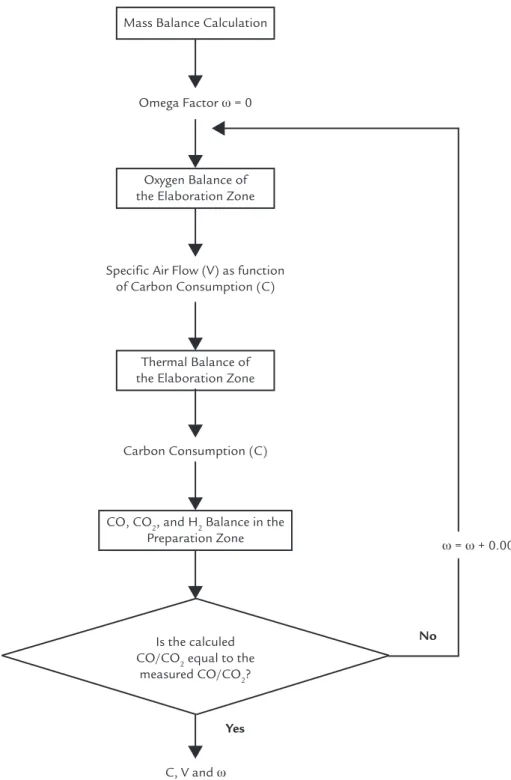
The set of calculations described be-low constitutes the thermochemical model (Castro et al., 2003):
burden originating from the preparation zone (omega factor - ω) and the carbon that is being consumed (C);
• A thermal balance in the elaboration zone allows the amount of heat consumed
(and therefore the carbon consumption), the speciic air volume to be calculated;
• A mass balance in the preparation zone allows the volume and the composi-tion of the top gases to be calculated;
• The calculated ratio CO/CO2 of top gas is compared with the measured results to validate the omega factor.
The lowchart for these calculations is shown in Figure 1.
Figure 1 Calculation scheme of the thermochemical model.
In order to better understand the impact and sensitivity of the process, raw material, hot metal, and slag param-eters, an analysis was performed based on the calculations and results from the thermochemical model for an industrial blast furnace with an internal volume of 3050 m3. The results were analyzed using
the software program Minitab (statistical analysis software). The impact of some variables on carbon consumption is shown in Figure 2. As can be observed, the incli-nation of the line indicates whether the variable in question is directly or inversely proportional to the carbon consumption; the greater the inclination, the greater is
the impact. Thus, the variable with the highest impact is the %CO/%CO2ratio in the top gas, demonstrating the importance of reliable analysis of the gas. It is worth stressing that these results are only valid for the ranges of values of the variables used in the simulation of the thermo-chemical model.
3.1 Analysis of the variables
3. Results and discussion
Omega Factor ω = 0
Specific Air Flow (V) as function of Carbon Consumption (C)
Carbon Consumption (C)
No
Yes
C, V and ω
ω = ω + 0.0001 Mass Balance Calculation
Oxygen Balance of the Elaboration Zone
Thermal Balance of the Elaboration Zone
Is the calculed CO/CO2 equal to the
measured CO/CO2?
Figure 2
Impact of variables vs. carbon consumption.
• Lump ore: increased lump ore consumption results in increased carbon consumption owing to its low reducibility in comparison to sinter and pellet (hema-tite iron ore was used);
• Blast temperature: increased blast temperature results in reduced carbon consumption owing to the greater input of heat in the elaboration zone;
• %CO/%CO2 top gas ratio: this is the variable with the highest inclination of the line, that is, with the greatest impact on carbon consumption. It is related to the use of CO gas in the preparation zone. The lower the %CO/%CO2 ratio, the lower the carbon consumption;
• %H2 top gas: indicates the use of H2 in the preparation zone, but it should not be analyzed alone because of the impact of the coal injection rate on %H2 at the top. In other words, an increase in %H2 may be associated with
an increased injection rate and not with the use of H2 in the elaboration zone. Thus, for a ixed injection rate, increas-ing %H2 of top gas results in increased carbon consumption;
• Slag rate: increased slag rate results in increased carbon consumption owing to the need to warm and melt the slag;
• %Si hot metal: the greater the
%silicon in the hot metal, the higher is the carbon consumption. The %Si is associ-ated with the endothermic reaction of the incorporation of silicon into the hot metal;
• %Mn hot metal: same analysis as silicon; however, the reaction requires less heat and thus the inclination of the line is different;
• Hot metal temperature: the higher the working temperature of the hot metal, the greater is the carbon consumption required to raise the temperature of the metal load to the desired temperature.
The impact on fuel consumption of the parameters calculated through the thermochemical model such as slag rate, %lump ore in the burden, %Si of the hot metal, %Mn of the hot metal, blast temperature, and gaseous yield (Eq. 4) are given in Table 1. The table also presents the results reported by Castro (2002) and Spence et al. (1997) for comparison. The results obtained by Flint (Castro, 2002) originated from a statistical analysis of the results of several blast furnaces in the world, which considers the statistical impact of the variables on fuel consumption. The results presented by Spence were obtained in a specialized blast furnace control system based on mathematical models. An analysis of Table 1 shows that the results of the thermochemical model are consistent with those found in other studies in the literature.
Variable Variation
Fuel Consumption Impact (kg/t)
Thermochemical
Model Flint (Castro, 2002) Spence et al., 1997
Slag rate +10kg/t 1.49 1.50 2.50
%Lump ore +1% 0.52 -
-%Si hot metal +1% 22 20 21
%Mn hot metal +1% 5.10 10.00
-Blast Temp. +10°C -0.99 -1.10 -0.86
Yield top gas +1% -5.71 - -4.60
Table 1
Table of impacts obtained through the thermochemical model vs. studies from the literature (Castro, 2002; Spence et al., 1997). (Eq. 4)
%CO
2%CO + %CO
2=
x 100
3.2 Relationship between the omega factor and fuel consumption
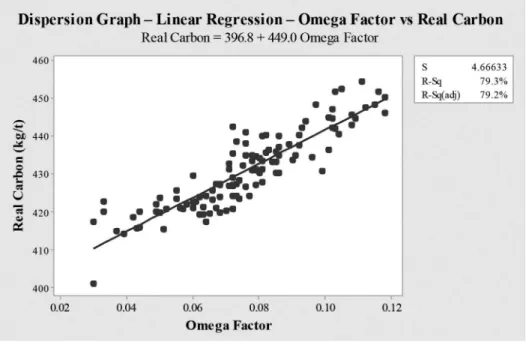
Another important result fromthe thermochemical model is the calculation of the omega factor (ω), which is directly related to carbon
con-sumption. The relationship between the omega factor and real carbon consumption is shown in Figure 3. Note that there is a strong correlation
between the variables (R2 = 79.3%), reinforcing the importance of knowing the omega factor.
Figure 3 Correlation between omega factor and real carbon consumption.
Through an analysis using the re-sults of the thermochemical model and the statistical software program Minitab, an equation to predict the omega factor can
be deined. The use of %H2 in the prepara-tion zone is dificult to calculate because this region contains H2O(g) originating from the evaporation of water from the
raw materials. Thus, an equation was formulated to correlate the %H2 at the top by using the coal injection rate and %H2of the coal (Eq. 5).
where: PCR = pulverized coal rate in kg/t
It is clear that any variation in the H2
content from another source in the process will affect the calculation of the omega fac-tor, such as variation in the injection humid-ity and the entry of water in regions of the blast furnace with suficient temperature
to result in the dissociation of the water. Regression analysis evaluates the relationship between independent variables (predictive variables) and a dependent vari-able (response), providing an equation that describes this relationship.
Table 2 shows the regression
analy-sis (obtained through statistical analyanaly-sis performed by minitab software) with the predictive variables %CO/%CO2 ratio and
%H2coal/%H2top ratio and the response variable omega factor. Evaluating the p value (probability of signiicance) for each predictive variable, significance
Ratio
H
2coal
H
2top
=
%H
2coal
x
PCR
%H
2top
(Eq. 5)can be concluded owing to the p value < 0.05 (95% conidence), as highlighted in Table 2. In relation to the correlation coeficient between the omega factor cal-culated by the regression and the omega
factor from the thermochemical model, an excellent result was obtained, with
R2 = 98.31%. The regression equation to predict the omega factor is highlighted in Table 2. Based on the obtained equation, it
is possible to calculate the omega factor and consequently anticipate actions in thermal control of the blast furnace using the equa-tion with factor omega x consumption of carbon (shown in Figure 3).
4. Conclusions
• Based on the simulations of the thermochemical model, the omega factor was calculated, and it was found that it varies signiicantly with the CO/CO2 ratio
and the %H2 of the top gas. A positive cor-relation was found between the CO/CO2
ratio and the omega factor, whereas a nega-tive correlation was found between the
H2 coal/H2 top ratio and the omega factor. • The omega factor has a major ef-fect on carbon consumption. The relation-ship found was:
Real Carbon Consumption = 396.8 + 449.0 x Omega Factor (R
2= 79.3%)
• The thermochemical model de -veloped for the control of a coke-based blast furnace can be perfectly applied as long as the required information
is reliable, and thus high precision in the top gas analysis (CO, CO2, and H2) is required.
• The omega factor can be cal
-culated based on the %CO/%CO2 data from the top gas and the %H2coal/%H2
top ratio, according to the following equation:
Omega Factor = -0.22071+0.33737
x
%CO
%CO
2- 0.05069
x
%H
2coal
%H
2top
(R
2
= 98.31%)
Acknowledgements
The authors are grateful to the compa-ny Gerdau for the support with the project.
They also thank CAPES-PROEX, CNPq, FAPEMIG, UFOP, UFMG, and IFMG.
References
CASTRO, L. F. A. Development of a process control model for charcoal blast furnaces. Belo Horizonte: Federal University of Minas Gerais - UFMG, 2002, 155 p. (Thesis, Doctorate in Metallurgical Engineering).
CASTRO, L. F. A., TAVARES, R. P. Process control model for blast furnaces.
In: INTERNATIONAL CONFERENCE ON PROCESSING & MANUFAC
-TURING OF ADVANCED MATERIALS, 2003. Madrid. Switzerland: Trans Tech Publications, v. 5, p. 3831-3836, 2003. (Materials Science Forum). HARVEY JP, GHERIBI AE. Process simulation and control optimization of a blast
furnace using classical thermodynamics combined to a direct search algorithm.
Metallurgical and Materials Transactions B, 45B, p. 307–327, 2014.
JINDAL, A., PUJARI, S., SANDILYA, P., GANGULY, S. A. Reduced order ther -mo-chemical model for blast furnace for real time simulation. Computers and Chemical Engineering, v. 31, p. 1484-1485, 2007.
SHEN, Y., GUO, B., CHEW, S., AUSTIN, P., YU, A. Three-dimensional modeling of low and thermo-chemical behavior in a blast furnace. Metallurgical and Materials Transactions B, v. 46B, p. 432-448, Feb. 2015.
SPENCE, A., PRITCHARD, W. Development of expert systems for blast furnace operation and control. In: EUROPEAN COMMISSION. Luxemburgo: Technical Steel Research. 1997. p. 117.
TORSSELL, K., BI, X., WIJK, O. Prediction of the blast furnace process by a mathe -matical model. ISIJ International, v. 32, n. 4, p. 481-488, Jan. 1992.
UJISAWA, Y, NAKANO, K, MATSUKURA, Y, SUNAHARA, K, KOMATSU, S, YAMAMOTO, T. Subjects for achievement of blast furnace operation with low reducing agent rate. ISIJ International. v. 45, n. 10, p. 1379–1385, 2005.
VEHEC. J, ZHOU. C.Q. State-of-the-art blast furnace model for minimization of fuel rates. METEC InSteelCon. Dusseldorf, p. 1-10, 2011. (session 9).
ZENG, J., CHUAN, C., SU, H. Data-driven predictive control for blast furnace iron making process. Computers and Chemical Engineering, Hangzou, China, v. 34, p.1854-1862, 2010.