Steel and concrete bond stress: a contribution to the study
of APULOT tests using concrete with rubber addition
Aderência aço e concreto: uma contribuição ao estudo
do método APULOT usando concreto com borracha
a Pontifícia Universidade Católica de Campinas, Faculdade de Engenharia Civil, Campinas, SP, Brasil.
Abstract
Resumo
The bond stress between steel and concrete is the essential condition to the good behaviour of reinforced concrete structures. To preview the use of concrete with waste incorporation for structural aims, the veriication of its quality control is necessary, whether of compression strength and bond. This paper presents the study results about the viability use of APULOT tests, that is a bond tests, to prevent the compression strength of concrete with rubber addition. The purpose of APULOT tests become study in many laboratories in France and Brazil, where is to estimate the compression strength using the bond stress obtained in tests execute inside of building construction. Also the use of concrete with rubber addition to structural use has been made with safe because this kind of addition makes the concrete compression strength decrease. To study its com -pression strength behavior is also make part of this research. This work aims to contribute with standardization of APULOT tests, and also give conditions to use the concrete with rubber addition in structural elements with more safe.
Keywords: bond stress, compression strength, concrete, rubber.
A aderência entre o concreto e o aço (armadura) é o principal fator do bom desempenho do concreto armado. Para prever a utilização do con -creto com incorporação de resíduos para ins estruturais, a veriicação do controle de qualidade se faz necessária, quer seja de sua resistência à compressão axial quer seja de sua aderência. Este artigo apresenta os resultados do estudo sobre a viabilidade do ensaio de aderência aço --concreto, denominado ensaio APULOT, para estimativa da resistência à compressão axial do concreto com adição de ibras de borracha. A pro -posta do ensaio APULOT, vem sendo estudada em vários laboratórios de pesquisa, na França e no Brasil e consiste em determinar a resistência à compressão axial do concreto, a partir dos resultados da tensão de aderência realizados na obra. A utilização do concreto com incorporação de resíduos de borracha para ins estruturais deve ser feita com cautela, pois comprovadamente a adição de borracha no concreto faz com que a resistência à compressão do mesmo venha a diminuir. Estudar seu comportamento quanto à resistência axial à compressão, além da aderência aço e concreto, também é necessária. Este trabalho visa contribuir com a normalização do ensaio APULOT possibilitando um melhor controle tecnológico em canteiros de obra, assim como veriicar as condições de utilização para ins estruturais do concreto com resíduos de borracha.
Palavras-chave: tensão de aderência, resistência à compressão, concreto, borracha.
A. E. P. G. dE AviLA JAcinThO a
[email protected] L. L. PimEnTEL a
[email protected] m. P. BARBOSA a
[email protected] P. S. P. FOnTAnini a
1. introduction
There are several ways to perform quality control on a reinforced concrete work, such as project management, molds, shoring, and one of the essential aspects for this control lies in monitoring the effectiveness of the concrete material, once the steel has an extre-mely strict control in its manufacture.
In most countries, the current technological control of reinforced concrete works is based almost exclusively on the testing of axial compression strength in concrete specimens, cubic or cylindrical, which are usually casted upon receipt of the concrete at the cons -truction site prior to launching into the molds. This type of test, standardized in Brazil by ABNT NBR 5739:2007 [1] requires appro -priate equipments and trained manpower, available at registered civil engineering laboratories. Only then this strength parameter is obtained to determine the eficiency of structural elements. However, this testing disadvantage is the fact that the laboratories specialized for its implementation are often distant from the construc -tion sites, as well as the need for controlling a number of factors such as molding, storing, capping and specimen loading velocity. Besides these facts, the axial compression strength test is done on a single material, the concrete, ignoring the bond between the steel and the concrete, essential condition for the existence of reinforced concrete. The steel already has a strict control on its manufacture, thus the need for mechanical strength testing is ignored in a work site.
Being aware of the importance and usefulness of the traditional test to determine the compression strength of concrete, a group of researchers led by Professor 3 Michel LORRAIN from INSA - Tou -louse, has been analyzing the possibility of employing a bond test steel – concrete adapted to the construction site to estimate the concrete compression strength, due to experimental drawbacks obtained when performing these traditional tests.
This group has been working on the optimization of a new testing method featured by its simplicity and low cost, based on bond test steel-concrete pull-out- test, recommended by RILEM RC6: 1983 [2].
The method proposed by Lorrain and Barbosa (2008) [3] received the designation of APULOT (Appropriate pull-out test) and since its inception it has been tested in laboratories from various domestic and foreign universities (such as Ilha Solteira UNESP , UFRG, PUC – Campinas, INSA Toulouse, etc.), presenting good results and ade -quate capacity of estimated compression strength. Some tests per -formed on construction sites have also obtained satisfactory results. The advantages of the proposed method relect on the simplicity of its implementation, the reduction of the recommended time to per-form the test, from 28 days to 7 days or even 3 days, besides the possibility of measuring not only strength but also the behavior of steel – concrete bonding, prime factor for the suitable performance of reinforced concrete structures.
This research, in the context presented, aims to contribute to the study of viability of the APULOT bond test as proposal of techno -logical control and safety of reinforced concrete works, operating with a new range of concrete: the concrete with additions of resi-dues. The search for alternative materials such as porcelain from electrical insulators, rubber tires, demolition waste, etc... that can be used in concrete, reducing the use of natural materials extrac-ted from nature, such as river sand (ine aggregate) and crushed rock or boulder (aggregate coarse), has been growing in Brazil and the use of this concrete structural elements must be assessed in all its aspects, including its bonding to the steel bars.
Experimental tests were conducted to determine the compression strength of concrete with the addition of rubber ibers, both in the traditional method according NBR 5735:2007[4], and in the pro -posed new method, obtaining the compression strength from the APULOT test results.
1.1 Explanation
The main point of interest of this study is that the compression strength of the concrete is determining upon the behavior of steel--concrete bond. The hypothesis of the APULOT project is that if the test is conducted under controlled conditions and standardi-zed, this relation becomes even more evident and robust, allowing an estimate of maximum compression strength of bonding. Added to this fact, evaluating the behavior of concrete incorporating resi-dues in the partial or total replacement of conventional aggregates is justiied by the need to review this new type of concrete for struc -tural purposes.
2. The technological control
of reinforced concrete
The quality of a product can be understood as the ability to meet certain requirements under the conditions of use foreseen. Thus, the quality control covers a set of operational techniques and acti -vities undertaken, whose purpose is toensure that the inal product meets the pre-determined standards (Brandão, 1998) [5]. Quality control of a concrete structure is a wide and complex pro -cess, because it covers several variables ranging from planning, control of employee services to issues related with durability and lifespan of the structure.
Among these variables, the part of technological control applied in materials used in civil works, more speciically steel and concrete, is what most straightly interests for this work.
In the decades of 50 and 60, the evolving knowledge of concrete technology has treated concrete strength as a random magnitude, of normal distribution (Gaussian) of values and also as part of the structural variables. Fusco (2011) [6] states that this methodology hasgrown due to the advances in researches on structural calcula-tion under breaking regime and the probability of structural variables. Regarding steel the ABNT NBR 6118:2007 [7] prescribes that the parameters for quality control of the steel bars and wire designed for the reinforcement of concrete structures must meet the spe-ciications of ABNT NBR 7480:2007 [8] .5 For quality control of the concrete designed to structures, the ABNT NBR 6118:2007 [7] states that parameters must meet the speciications of ABNT NBR 12655:2006 [9].
In hardened concrete, the main mechanical properties required by ABNT NBR 6118:2007 [7] are: compression strength (fc), modulus
of elasticity (Ec) and tensile strength (fct).
The only test of steel-concrete bond recommended by Brazilian standards is regulated by ABNTNBR 7477:1982 [10], which deter -mines the coeficient of supericial form coeficient (η) of the bars and steel wires.
According to NBR 6118:2007 [7] for purposes of structural design of reinforced and prestressed concrete, from the compression strength it is possible to determine the modulus of elasticity and the tensile strength and even the bond stress for the anchoring of armors. According to Silva Filho and Helene (2011) [12] although the most recent norms and recommendations worldwide suggest to increase the number of parameters for quality control of con -crete works, it is still traditional in Brazil to establish this control speciically on the compression strength of cylindrical specimens, molded during concreting.
2.1 Relation between steel-concrete bond
with concrete compression strength
According to Fusco (1995) [13] the principle of structural concrete is the mutual action between steel-concrete which must comply with conditions allowing each one of them to reach the limits of their resisting capabilities without harming or being harmed by for -ces acting on one or other separated material. Being concrete a brittle material and of low resistance to tensile, and the steel being ductile and of high tensile strength, one material complements the other, thus forming reinforced or prestressed concrete, provided the condition of adhesion between the materials is met.
In the literature, several types of tests are found of assays for determining the bond stress between the steel bars and concre-te and stress versus displacement curve. One of the most known and used, due to its eficiency, is the pull-out test (POT) which has its recommended guidelines in RILEM RC6: 1983 [2] and ASTM C234: 1996 [14].
A research conducted by Abrams (1913) [15] using pull-out bond tests found the inluence of some variables inherent to the test res -ponse. Among these variables, the effect of mechanical strengths showed, no more than 100 years ago, there is a strong correlation between the compression strength of concrete and the maximum
strength of steel-concrete bond. Later, in 1956, Rush studies [16] demonstrated the form importance in the steel-concrete strength, conirming a clear and strong correlation between the compression strength and the bond stress.
In NBR 6118: 2007 [7], the bond stress (τu) is given by the follo -wing equation:
(1)
L
F
u=
pf
t
Where : τu = Ultimate Bond Stress ; F= pull out force;
φ = bar diameter; L = Anchorage length.
The relationship between the bond stress and concrete compres-sion strength is not explained in this equation. The proposal to re -late the two parameters through a straight line, constructed empiri-cally, was given in Lorrain and Barbosa (2008) [3]
3. APULOT test method
The main point of interest in the topic of this research is that the resistance of reinforced concrete is a key aspect for the bonding behavior. The principal concept of APULOT test is that if the bond test steel-concrete is conducted at controlled and standardized conditions this relationship becomes even more evident and ro-bust, thus allowing the estimation of the concrete compression strength from the maximum bond strength data.
The APULOT test philosophy is to perform the reinforced concre -te quality control from appropria-te s-teel-concre-te bond -testing in the construction site, i.e., ascertain the compliance of the concrete compression strength “in situ” by means of bond strength through
Figure 1 – APULOT test schedule (LORRAIN et al.[7])
Cunha
Zona Aderente Garrafa PETF
Zonas Não Aderentes Macaco Hidraúlico
Curso do Macaco
Cunha
F
Chapas de Apoio Trajetórias deCompressão
Trajetórias de Tração
Derformação do concreto na zona aderente
correlation between these respective strengths, proposed by Lor -rain et al. [17].
The method is based on the principle of the POT (Pull out of a steel bar inserted into a concrete specimen) , however a PET bot -tle is used as mold, with the most homogeneous format possible in anchorage length, and a hydraulic jack, which is an equipment easily found in the working site. Figure 1 presents the APULOT test scheme.
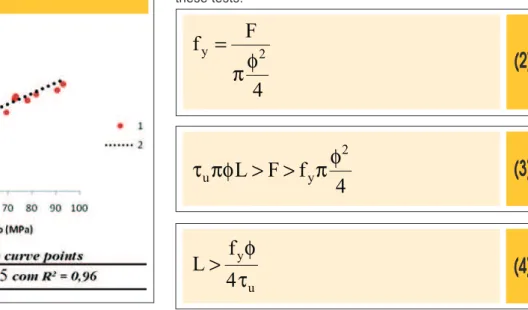
For obtaining the anchorage length (Equation 4) the formulas of ultimate bond stress (Equation 1) and the yield stress of steel (Equation 2) are used. The value for the ultimate bond stress is obtained by the correlation proposed by Lorrain and Barbosa (2008) [3] (Figure 2). It is important to note here that these sug
-gested values of anchorage length in this experimental research are the irst attempts of APULOT test characterization, so these values may be renewed with the advances in researches with these tests.
(2)
4
F
f
y 2f
p
=
(3)
4
f
F
L
y 2u
pf
>
>
p
f
t
(4)
u y4
f
L
t
f
>
Where:fy = Steel yield stress (MPa).
4. Steel and concrete bond stress
with rubber addition
One of the researches conducted in Brazil on steel and concrete bond stress, using concrete with tire rubber residues was made by França (2004) [18] at UNESP of Ilha Solteira. He compared the bond stress obtained in pull out tests between conventional com-pression strength concrete of 35MPa to comcom-pression strength con -crete with rubber residues of 25 MPa for ages of 28 and 90 days. FRANÇA (2004) [18] compared his experimental results with other researchers and concluded that the concrete and rubber can be
Figure 2 – Linear correlation equation
proposed by Lorrain and Barbosa (2008)[3]
Table 1 – Characteristics of rubber
Granulometry (rubber)
Sieve ABNT (# in mm)
Specific
mass weightUnit Cumulative mass retained (%) 6.3 4.8 2.4 1.2 0.6 0.3 0.15 Ground Total 7.65 7.90 12.32 38.10 75.41 91.21 97.91 100.00 100.00 0.40 0.40 0.40 0.40 0.40 0.40 0.40 0.40 0.40 1.45 1.45 1.45 1.45 1.45 1.45 1.45 1.45 1.45
Table 2 – Characteristics of fine aggregate
Fine aggregate granulometry Sieve ABNT
(# in mm)
Specific
used in structures of reinforced concrete, despite the mechanical strengths not reaching very high values. The bond stress curves x bar slide had similar development between the conventional crete and the concrete with rubber, conventional concrete and con-crete with rubber, despite the concon-crete with rubber presenting bond stress with lower values.
Based on the indings from several studies already completed on the mechanical behavior of concrete with rubber Akasaki et al. (2003) [19] observed that the residues called rubber ibers may act as obstacles against crack development, when they intersect micro cracks which appear during the hardening of concrete, pre-venting its progression. Yet Yunping XI et al. (2004) [20] found that the concrete with rubber holds unique features with potential for using in several applications. According to Jacintho et al.(2010) [21] the concrete with rubber can be used in the manufacture of precast loor parts as an alternative for contributing to decrease the disposal of this material in landills and to preserve non-renewable natural resources .
5. materials and experimental program
The materials used in the experimental program of this research are from the Metropolitan Region of Campinas.
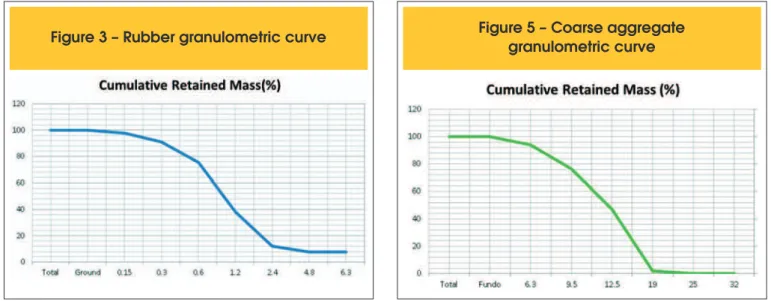
The experimental results regarding the particle size of the aggre -gates (rubber, sand and gravel) are shown in Tables 1, 2 and 3 and in igures 3, 4 and 5.
The rubber used in this study can be seen in Figure 6.
The experimental results of concrete with rubber, that is, their me-chanical properties as well as their composition are presented in this section.
For this research the following materials were used: CP ARI RS ce-ment type; Water from Campinas city water supply system; ine ag -gregate of quartz sand type; coarse ag-gregate: basalt stone; rubber: from scrap shredded tire; additive: multifunctional and steel: CA-50. The following standards have been met: NBR5738 2003 [11] for the molding and hydration of Specimens; NBR5739: 2007 [1] for cylin -drical concrete specimen compression test; NBR7222: 2011 [22] for determining the tensile strength by diametrical compression of cylindrical specimens; NBR12142: 2010 [23] for determining the
Table 3 – Coarse aggregate characteristics
Coarse aggregate granulometry
Specific mass weightUnit
1.59 1.59 1.59 1.59 1.59 1.59 1.59 1.59 2.95
2.95 2.95 2.95 2.95 2.95 2.95 2.95
Sieve ABNT (# in mm)
Cumulative mass retained (%)
32 25 19 12.5
9.5 6.3 Ground
Total
0.00 0.00 1.96 47.06 76.47 94.12 100.00 100.00
Figure 3 – Rubber granulometric curve
Figure 4 – Fine aggregate granulometric curve
lexural tensile strength in prismatic specimens; and NBR8522: 2008 [24] for determining modulus of elasticity test.
Initially, the concrete with rubber was studied in the proportion of 15% and 20%. A conventional concrete was made as a reference for comparing results. The ibers were added to the concrete with reference to the consumption of cement, not replacing anything concerning the reference concrete.
The specimens for testing compression strength, tensile strength by diametrical compression, and modulus of elasticity were cylin -drical specimens of 10cm x 20cm and the specimens used in the tests of lexural tensile strength were prismatic ones measuring 15cm x 15cm x 50cm.
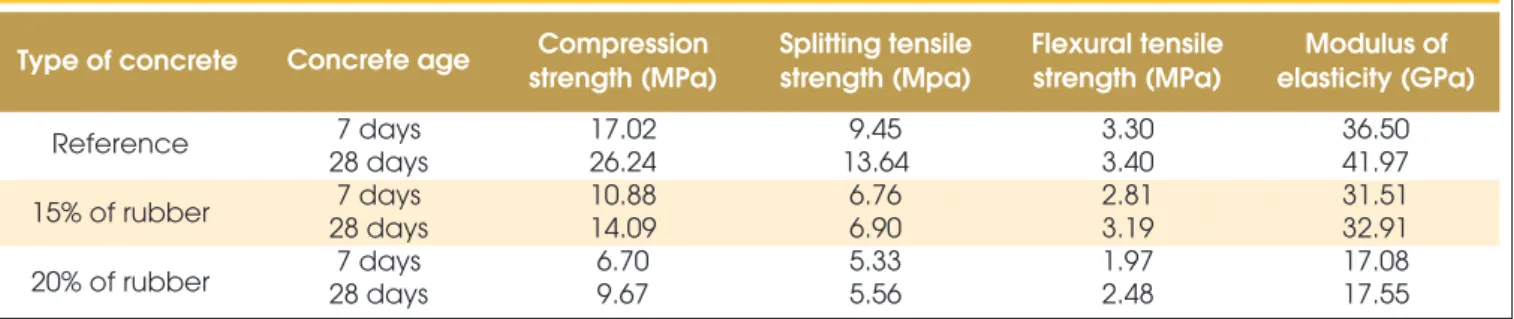
The results obtained from tests for axial compression strength, ten-sile strength by diametrical compression, lexural tenten-sile strength and modulus of elasticity can be seen in Table 4.
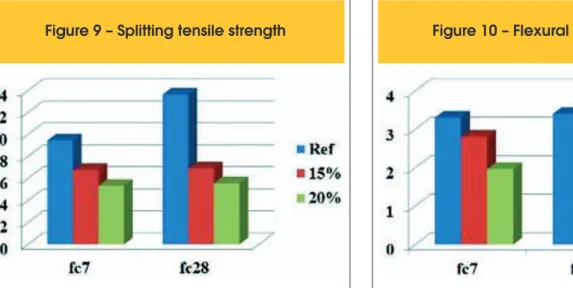
The graphs with average values in the tests cited in Table 4 can be seen in Figures 7-10.
The characteristics of the steel found in this research were: yield stress fy = 583.0 MPa and rupture fu = 708.3 MPa. The diameter of the bars used was 8mm.
5.1 Analysis of results of mechanical
characteristics of concrete
Through the graphs shown in Figures 7 to 10 and the average
Figure 6 – Rubber ground in thin strips
used as addition in concrete
Table 4 – Average results of concrete mechanical strength tests
Type of concrete Concrete age strength (MPa)Compression Splitting tensile strength (Mpa) Flexural tensilestrength (MPa) elasticity (GPa)Modulus of
Reference
15% of rubber
20% of rubber
7 days 28 days
7 days 28 days
7 days 28 days
17.02 26.24 10.88 14.09 6.70 9.67
9.45 13.64
6.76 6.90 5.33 5.56
3.30 3.40 2.81 3.19 1.97 2.48
36.50 41.97 31.51 32.91 17.08 17.55
results presented in Table 4, it is observed a decrease in the values of the resistances and modulus of elasticity of concrete containing rubber when compared with the reference concrete, also observed by França [18] in different proportions from the ones assessed here. Table 5 presents, briely, in percentage, the decrease in the values of concrete strength in this research.
5.2 Pull out tests and procedures
After the initial tests of concrete strength, it was decided to make pullout tests with a percentage of rubber addition at the rate of 10%, for the fall in resistance has been accentuated for the 20% propor-tion of addipropor-tion. Also because the 15% results have not eased this fall. The purpose was to try to get results of bond stress closer to the work performed by Granzotto [25] and by Jacintho et al [21]. This way, four concreting and four castings were made: one for the reference concrete, one for concrete with 10% of rubber addition, one for 15% and one for concrete with 20% rubber addition. After molding, the specimens and PET bottles models were im -mersed in water, in the next day for hydration. One day before each test they were removed from the hydration, in order not to be tested in the saturated condition.
The anchorage length used for bars of 8mm diameter was 11 cm and was calculated using Equation 4, assuming the considerations of Equation 3, however using the steel rupture stress. This stress
was chosen because the features of concrete with rubber have not been fully demonstrated, the bond length should be larger than the conventional one, since the concrete with rubber has less resistan-ce than the usual concrete.
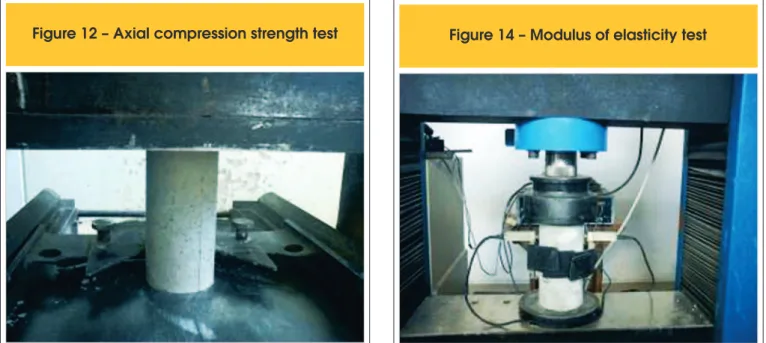
Tests with 7 and 14 days of age were performed to test cylindrical specimens measuring 10x20cm and tests with 14 days of age for models of molded PET bottles. At 7 days results for compressive strength of concrete and modulus of elasticity were obtained. At 14 days the pullout tests of APULOT bars (igure 11) were per -formed and the following mechanical characteristics of concrete were also obtained: compression strength (Figure 12), tensile strength by diametral compression (Figure 13) and modulus of elasticity (Figure 14).
6. Results and partial discussion
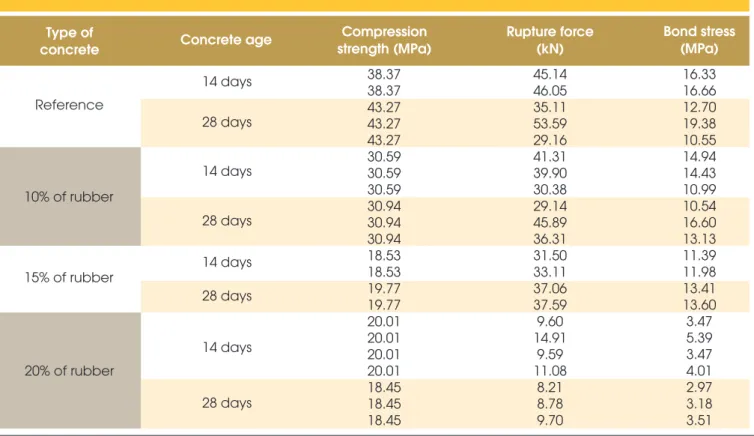
The test results of compression strength, tensile strength by dia -metrical compression and modulus of elasticity can be seen in Ta -ble 6. Ta-ble 7 presents the results of the pullout tests.
For all the tests 8mm diameter bars and 11cm long anchorage were used 5 models were tested for each series of concrete, but some results were discarded for being very discrepant. For the series of reference concrete, a result was discarded, for the series of concre-te added with 10% of rubber, 2 results were discarded and for the series of concrete with 20% rubber the result was not considered.
Figure 9 – Splitting tensile strength
Figure 10 – Flexural tensile strength
Table 5 – Parts of concrete mechanical strength in percentage
Concrete Concrete age strength (MPa)Compression Splitting tensile strength (Mpa) Flexural tensilestrength (MPa) elasticity (GPa)Modulus of
Reference
15%
20%
7 days 28 days
7 days 28 days
7 days 28 days
100% 100% 63.9% 53.7% 39.4% 36.9%
100% 100% 71.5% 50.6% 56.4% 40.8%
100% 100% 85.2% 93.8% 59.7% 72.9%
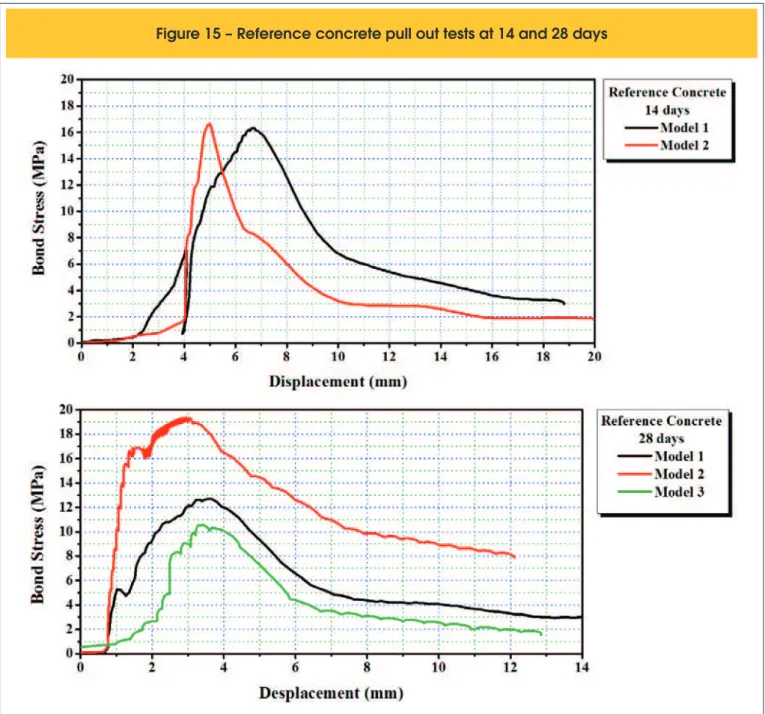
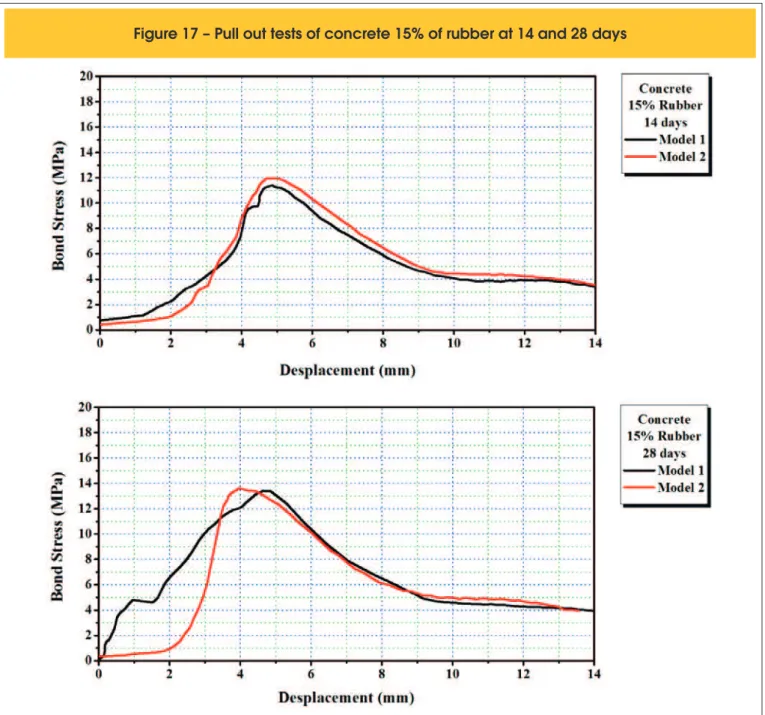
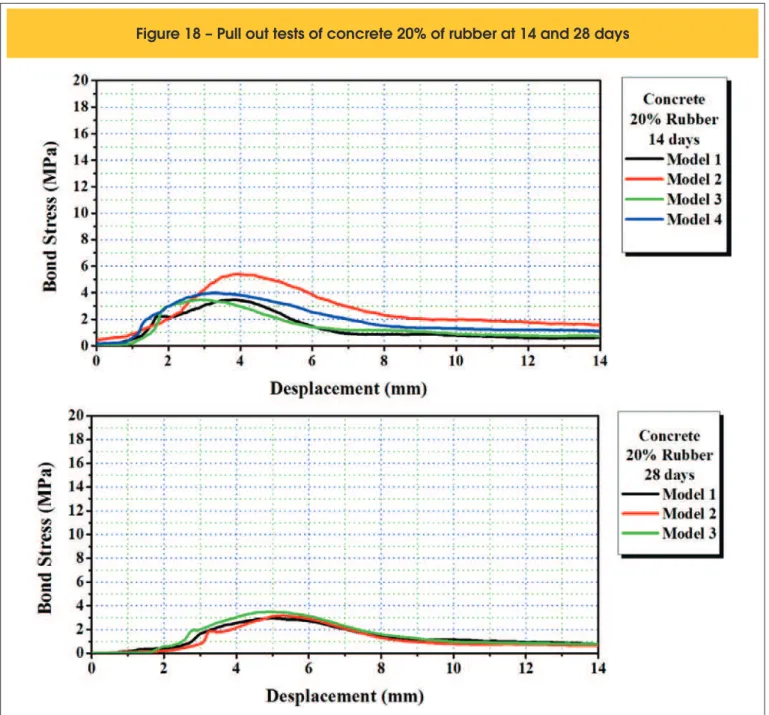
Figures 15-18 show graphs of bond stress X sliding obtained from tests.
Note that the higher the amount of rubber added to concrete, the lo-wer the ultimate bond stress, however the branches of post-stress curves are shown latter with respect to its slope. With the addition of 10% rubber, the loss of ultimate bond stress was not very sharp. This is due to the fact that the concrete with this amount of rubber had no signiicant loss in compression strength. On the contrary, its resistance ended up higher than the reference concrete. Even though the ultimate bond stress was lower than those found for the reference concrete.
Yet for the concrete with 15% rubber addition it is noted that the bond curve approach to the concrete with 10%, with a slight fall.
When the addition of rubber into the concrete was 20%, the com-pression strength was smaller and the bond stress was ranked much lower levels, well below from the concrete with 10% and 15% addition.
In igure 19 it is presented the correlation between the bond stres -ses and the compression strengths obtained in the tests, with a
Figure 11 – Pull out test (APULOT)
Figure 12 – Axial compression strength test
Figure 13 – Splitting tensile strength test
by diametrical compression
Table 6 – Mechanical characteristics of concrete used in the APULOT tests
Type of
concrete Concrete age
Compression
strength (MPa) Splitting tensile strength (Mpa) elasticity (GPa)Modulus of
Reference
10% of rubber
15% of rubber
20% of rubber
7 days 14 days 28 days 7 days 14 days 28 days 7 days 14 days 28 days 7 days 14 days 28 days 37.25 38.37 43.27 26.22 30.59 30.94 19.08 18.53 19.77 18.29 20.01 18.45 – 4.32 3.97 – 3.76 2.77 – 2.80 2.65 – 2.54 2.42 46.78 48.51 47.79 40.93 42.72 43.16 38.10 43.17 42.73 32.61 35.81 33.63
Table 7 – Results of ultimate bond stress obtained in APULOT tests
Type of
concrete Concrete age
Compression
strength (MPa) Rupture force (kN) Bond stress (MPa)
Reference
10% of rubber
15% of rubber
20% of rubber
14 days 28 days 14 days 28 days 14 days 28 days 14 days 28 days 38.37 38.37 43.27 43.27 43.27 30.59 30.59 30.59 30.94 30.94 30.94 18.53 18.53 19.77 19.77 20.01 20.01 20.01 20.01 18.45 18.45 18.45 45.14 46.05 35.11 53.59 29.16 41.31 39.90 30.38 29.14 45.89 36.31 31.50 33.11 37.06 37.59 9.60 14.91 9.59 11.08 8.21 8.78 9.70 16.33 16.66 12.70 19.38 10.55 14.94 14.43 10.99 10.54 16.60 13.13 11.39 11.98 13.41 13.60 3.47 5.39 3.47 4.01 2.97 3.18 3.51
linear interpolation between the points obtained. It can be noted that the results of concrete with addition of 20% rubber are more distant from the other concrete in the graph.
7. conclusions
The analysis of the correlation between the maximum bond stress and compression strength brings to conclusion that the APULOT
bond test is adequate to estimate the compression strength of the concrete at all ages tested. With the analysis of correlations it is possible to conclude that the increase of the maximum bond stress is proportional to increase the compression strength of the concrete.
Another important conclusion was that the addition of the rubber into concrete also causes a decrease in the bond stress.
Therefore the values given for the calculation of the anchorage length for conventional concrete should be reviewed and increa-sed so that when making the structural element using concrete with rubber, it was observed that for little additions into the concre-te it can be performed.
An indication obtained in this research is that the values of this length of anchorage are proportional to the amount of rubber ad-ded to the concrete. Meanwhile, to reach the equation correlating the anchorage length with the amount of rubber added to concre-te, more researches need to be conducted for a wider range of amounts of rubber added to the concrete.
Figure 15 – Reference concrete pull out tests at 14 and 28 days
8. Acknowledgment
The authors thank to the Fundação de Amparo à Pesquisa do Es -tado de São Paulo for the provided inancial aid for this research could be realized.
They also thank to the staff of the Materials of Civil Construction and Structural laboratory, to the students Jonas Luís de Godoy and Ruy José Aun, of Pontiical Catholic University of Campinas for the help in the tests development and execution.
9. References
NBR 5739: Concreto Ensaio de compressão de corpos de prova cilíndricos. Rio de Janeiro, 2007.
[02] COMITÊ EURO-INTERNACIONAL DU BÉTON: RILEM/ CEB/FIB/RC6.Concrete Reinforcement Technology. Paris, Georgi Publishing Company, 1983
[03] LORRAIN, M.; BARBOSA, M.P. Controle de qualidade dos concretos estruturais: Ensaio de aderência aço-concreto. Revista Concreto e Construções. n.51, pp. 52-57. jul, ago, set, 2008.
[04] ASSOCIAÇÃO BRASILEIRA DE NORMAS TÉCNICAS. NBR 5735: Cimento Portland de alto-forno, Rio de janeiro, 2007
[05] BRANDÃO, A.M.S. Qualidade e durabilidade das estru -turas de concreto armado:aspectos relativos ao projeto,
1998. 137f. Dissertação (Mestrado em Engenharia de es -truturas) Escola de Engenharia de São Carlos, São Car -los, 1998.
[06] FUSCO, P.B. , Princípios Básicos para Projeto de Estruturas de Concreto. In: IBRACON - instituto Brasileiro do Concreto. (Org.). CONCRETO: CIÊNCIA E TECNOLOGIA. 1 ed. São Paulo: Ipsis Gráica e Editora, 2011, v. 1, p. 101-126. [07] ASSOCIAÇÃO BRASILEIRA DE NORMAS TÉCNICAS.
Projeto de estruturas de concreto – Procedimento. NBR 6118, Rio de Janeiro, 2007.
NBR 12655: Concreto de cimento Portland - Preparo, controle e recebimento – Procedimento, Rio de Janeiro, 2006.
[10] ASSOCIAÇÃO BRASILEIRA DE NORMAS TÉCNICAS. NBR 7477: Determinação do coeiciente de conformação supericial de barras e ios de aço destinados a armaduras de concreto armado, Rio de Janeiro, 1982.
[11] ASSOCIAÇÃO BRASILEIRA DE NORMAS TÉCNICAS. Concreto – Procedimento para moldagem e cura dos corpos de prova. NBR 5738, Rio de Janeiro, 2008.
[12] SILVA FILHO,L.C.P.; HELENE,P. Análise de estruturas de concreto com problemas de resistência e issuração. In.: ISAIA G.C., Concreto: Ciência e Tecnologia. 1Edição. São Paulo: Editora IBRACON, 2011. vol.2, cap. 32, p 1124-1174.
Figure 17 – Pull out tests of concrete 15% of rubber at 14 and 28 days
[13] FUSCO, P. B. Técnica de armar as estruturas de concreto. São Paulo: PINI, 1995, 265p.
[14] American Standardization for Testing and Materials (ASTM) C 234 91a – Standard test method for comparing concretes on the basis of the bond developed with reinforcing steel. 1996.
[15] ABRAMS, D.A.,“Test of Bond Between Concrete And Steel,”Engineering Experiment Station, Bulletin No. 71, Uni -versity of Illinois, Champaign, 1913.
[17] LORRAIN, M.; BARBOSA, M.P.; ARNAUD M.. Bond test and
on-site structural concrete quality control. 3rd ib Internatio
-nal Congress – 2010. Anais. EUA. 2010.
[18] FRANÇA, V. H. Aderência aço-concreto – uma análise do comportamento do concreto fabricado com resíduos de borracha. Dissertação de Mestrado. UNESP de Ilha Soltei -ra. 2004.
[19] AKASAKI, J. L.; SERNA ROS, P.; REYES, B.; TRIGO, A.
P. M.. Avaliação da Resistência à Flexão do Concreto com Borracha de Pneu com Relação ao Concreto Convencional. In: 45º Congresso Brasileiro do Concreto. Anais. Vitória, E. S., IBRACON, 2003.
[20] YUNPING XI, YUE LI, ZHAOHUI XIE, AND JAE S. LEE. Uti
-lization of solid wastes (waste glass and rubber particles) as
Figure 18 – Pull out tests of concrete 20% of rubber at 14 and 28 days
aggregates in concrete. In: International Workshop on Sustai -nable Development And Concrete Technology. pp.45-54, 2004. [21] JACINTHO, Ana Elisabete P. G. A.; CAMPOS, Wendersen
C.; PIMENTEL, Lia L. Concreto com adição de ibras de bor -racha: um estudo frente às resistências mecânicas. In: 52º Congresso Brasileiro do Concreto, Fortaleza, 2010.
[22] ASSOCIAÇÃO BRASILEIRA DE NORMAS TÉCNICAS. Concreto e argamassa – Determinação da resistência à tra -ção por compressão diametral de corpos de prova cilindri -cos. NBR 7222, Rio de Janeiro, 2011.
[24] ASSOCIAÇÃO BRASILEIRA DE NORMAS TÉCNICAS. Concreto – Determinação do módulo estático de elasticida -de à compressão. NBR 8522, Rio -de Janeiro, 2008
[25] GRANZOTTO, l. Concreto com adições de borracha: uma alternativa ecologicamente viável. Dissertação de Mestrado, Universidade Estadual de Maringá, UEM, 2010.
![Figure 1 – APULOT test schedule (LORRAIN et al.[7])](https://thumb-eu.123doks.com/thumbv2/123dok_br/18860492.417839/3.892.72.830.749.1145/figure-apulot-test-schedule-lorrain-et.webp)