Hydrated cement paste, composed for the most part by calcium silicate hydrate (C-S-H), is a fragile material with low tensile strength. It is also well known that the addition of silica fume to concrete increases its strength and, consequently, makes it more durable, though also more fragile. To produce more ductile C-S-H, one alternative is the synthesis of C-S-H/polymer nanocomposites or hybrids. The intercalation of organic molecules in C-S-H nanostructure and other cement hydrates can promote radical changes in their properties of all magnitudes, producing cement based materials with greater strength that are also more ductile. The main objective of this work was to study the possibility of intercalation of organic compounds within C-S-H nanostructure, aimed at the synthesis of nanocomposites with atypical properties. Thus, C-S-H gels were synthesized with various Ca/Si molar ratios using two synthesis methods (precipitation synthesis and pozzolanic synthesis), with or without the presence of polymers. The effect of poly-diallyldimeth-ylammonium chloride (PDC - used as the basis for superplasticizers for concrete) was evaluated, indicated by the literature as capable of intercalating between the C-S-H lamellae [1-5], and copolymer poly(ethylene-co-vinyl acetate) (EVA), indicated by the literature as a modiier of C-S-H morphology [6,7]. The PDC polymer promoted alterations in C-S-H synthesis nanostructural bonding, inluencing the interlayer distance and the type of bonding in the dreierketten and wollastonite chains. However, this modiication was partial and occurred at rates that require further investigation, since they are prob-ably inluenced by the complex characteristics of formation, both by the type of bond and by the irregular and minimally crystalline formation of C-S-H.
Keywords: C-S-H, nanostructure, polymers.
O cimento hidratado, composto majoritariamente por C-S-H, é um material frágil com baixa resistência à tração. Sabe-se também que a adição de sílica ativa ao concreto torna-o mais resistente e, conseqüentemente, mais durável, mas, em contrapartida, ainda mais frágil. Para tornar o C-S-H mais dúctil, uma alternativa é a fabricação de nanocompósitos ou híbridos C-S-H/polímero. A intercalação de moléculas orgânicas na nanoestrutura do C-S-H e de outros hidratos do cimento pode ocasionar mudanças radicais das propriedades em todas as ordens de grandeza, produzindo produtos cimentícios mais resistentes e também mais dúcteis. O principal objetivo deste trabalho é avaliar a possibilidade de intercalação de compostos orgânicos na nanoestrutura do silicato de cálcio hidratado (C-S-H), principal composto de hidratação do cimento Portland, visando a formação de nanocompósitos com propriedades diferenciadas. Para isso, foram sintetizados géis de C-S-H com varias relações molares Ca/Si a partir de dois métodos (síntese por precipitação e síntese pozolânica); sem e com a presença de polímeros. Foram avaliados os efeitos do poli-cloreto de dialilmetilamonia (PDC-utilizado na fabricação de super -plastiicantes), apontado pela literatura como capaz de se intercalar no espaço interplanar do C-S-H [1,2,3,4,5], e do copolímero acetato de vinila/etileno (EVA), apontado pela literatura como modiicador da morfologia do C-S-H [6,7]. O polímero de PDC propiciou alteração na ligação nanoestrutural do C-S-H de síntese, inluenciando na distância interplanar e no tipo de ligação na região de dreierketten e wollastonita, porém esta modiicação é parcial e em taxas que ainda devem ser investigadas, as quais são provavelmente inluenciadas pelas características complexas de formação - quanto ao tipo de ligação - e pela formação aleatória e pouco cristalina do C-S-H.
Palavras-chave: C-S-H, nanoestrutura, polímeros.
Synthesis of calcium silicate hydrate/polymer complexes
Síntese de complexos de silicato de cálcio hidratado/
polímeros
F. PeliSSer a [email protected]
P. J. P. Gleize b [email protected]
M. PeterSon c
a Programa de Pós-Graduação em Ciência e Engenharia de Materiais - PPGCEM. Universidade do Extremo Sul Catarinense. [email protected]. CEP: 88802225. Criciúma. Brasil;
b Programa de Pós-Graduação em Engenharia Civil. Universidade Federal de Santa Catarina. [email protected]. C.P. 476. Florianópolis. Brasil; c Departamento de Engenharia Química, Universidade do Extremo Sul Catarinense. [email protected]. CEP: 88806000. Criciúma. Brasil.
Received: 22 Oct 2009 • Accepted: 23 Nov 2010 • Available Online: 28 Nov 2011
Abstract
resumo
1. introduction
The aim of nanotechnology is to create new materials and develop new products and processes based on the increasing power of mod-ern technology to observe and manipulate atoms and molecules. Energy saving, environmental protection and reducing the use of scarce raw materials are possible applications of nanotechnology. Portland cement is the most common material used in construction; consequently, cement nanotechnology and its products are of great importance to this industry. Hydrated cement is composed mainly of a calcium silicate hydrate commonly called C-S-H1. During hydration,
C-S-H progressively covers the grains of anhydrous cement and slowly ills the intergranular space, forming complex nanostructures. This hy -drated phase, considered the true ligand of hardened cement paste and is primarily responsible for most of the properties of hardened cement paste [9]. The cohesion of the C-S-H matrix depends on the bonding scheme forces of the intralamellae sheets (interlayer spac-ing), classiied as nanostructures, together with the solid-solid bonds between lamellae stacks (interlamellae) and water adsorbed on the surface, classiied as bonds in the mesostructure [10].
Applying the concepts of nanoscience in cement-based materials could lead to improved control of the microstructure and, for ex -ample, improved cohesion and low, avoiding problems of cracking at early ages, gains in strength at increased velocity, reduced per-meability and the consequent increase the durability of materials
and improvement in cement performance [11].
Most advances in the performance of cement materials achieved in recent decades are due to the optimization of granular stack-ing and, particularly, the reduction of capillary porosity with ratio-nal use of increasingly eficient chemical additives. However, in terms of eficiency, such advances are close to an asymptote, which suggests that further improvement of mechanical proper-ties can only come from modiications of iner material scales. The interest in nanocomposite materials, organic and inorganic, has emerged from this inding. Nature itself has developed a fantas-tic and great diversity of organisms that take advantage of this synergy: including shells, bones and teeth. These materials ex -hibit unique properties in terms of toughness and lexural strength, among other parameters, and ahieve this at extremely low organic levels. Knowledge and the reproduction of strategies associating the organic and inorganic phases used by nature open up diverse perspectives regarding the manufacture of synthetic materials with unusual properties [9].
Consequently, a potential solution to make C-S-H more ductile is the manufacture of C-S-H/polymer nanocomposites. The intercala-tion of organic molecules within the C-S-H nanostructure and other cement hydrates permits potential changes in their properties at all orders of magnitude.
The irst C-S-H/polymer nanocomposites were synthesized by Matsuyama and Young [1-5]. The authors reported the
intercala-tion of polymeric groups of additives for concrete between the in-terlayer of C-S-H. They afirmed that the success of intercalation depends on the nature of the ionic groups (cationic, anionic, neu-tral) of the polymer and the Ca/Si molar ratio of C-S-H. In some of the compounds obtained, the authors veriied signiicant increases in carbon content and the basal distance d002, suggesting the in-corporation of polymeric groups between the interlayer of C-S-H. Thus, they observed that anionic polymers were intercalated in C-S-H with a high Ca/Si (> 1) ratio, while cationic polymers were intercalated in C-S-H with a low Ca/Si (<1) ratio. However, this conclusion is controversial; Popova et al. [12] did not observe in-tercalation, rather the adsorption of polymers in C-S-H. However, the authors used a method of C-S-H synthesis different to that of Matsuyama and Young [2-5]. According to Merlin et al. [10], the polymers are not inserted into the interlayer spaces of C-S-H, but settle on the surface of the gel pores (adsorption). However, so far, the hypothesis proposed by Merlin et al. [10] has not been proven. In this study, calcium silicate hydrates were synthesized in ac-cordance with the recommendations of Matsuyama and Young [2-5] and Gmira [13], in order to evaluate the interaction of poly(diallyldimethylammonium) chloride (PDC) and the copolymer poly(ethylene-co-vinyl acetate) (EVA) on the nanostructure of C-S-H. According to the results reported by Matsuyama and Young [4.5], PDC intercalates in the nanostructure of C-S-H. However, these re-sults were not conirmed in research by Merlin et al. [10], who ob-served a modest expansion in the interlayer distance (0.2 nm for Ca/ Si = 0.9 /PDC) using the precipitation synthesis process and, surpris-ingly, a carbon content of 10% compared to the cement mass, equal to the results of Matsuyama and Young [3-5]. Merlin et al. [10] attribut -ed these results to adsorption of the polymer on the surface of C-S-H. In the case of EVA, the literature indicates that it interacts chemi-cally with cement hydration products, which can modify the nano-structure of C-S-H [6,7].
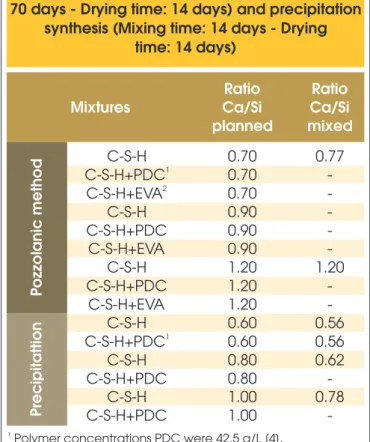
Table 1 – The Ca/Si molar ratio of C-S-H
produced by pozzolanic synthesis (Mixing time:
70 days - Drying time: 14 days) and precipitation
synthesis (Mixing time: 14 days - Drying
time: 14 days)
Mixtures
Ca/Si
Ratio
planned
Ratio
Ca/Si
mixed
0.70
0.77
0.70
-
0.70
-
0.90
-
0.90
-
0.90
-
1.20
1.20
1.20
-
1.20
-
0.60
0.56
0.60
0.56
0.80
0.62
0.80
-
1.00
0.78
1.00
-
C-S-H
1C-S-H+PDC
2C-S-H+EVA
C-S-H
C-S-H+PDC
C-S-H+EVA
C-S-H
C-S-H+PDC
C-S-H+EVA
C-S-H
1C-S-H+PDC
C-S-H
C-S-H+PDC
C-S-H
C-S-H+PDC
Pr
ecipitattion
Pozzolanic method
697
IBRACON Structures and Materials Journal • 2011 • vol. 4 • nº 5
of deionized water. The Ca/Si ratio was a variable controlled and maintained at 0.7, 0.9 and 1.2, according to the mix design shown in Table 1, while maintaining the water/solid ratio constant at 20. After the initial mixing, the material was placed in a water bath with a stirring system and a constant temperature of 60°C for 70 days. The products obtained were iltered and dried in a vacuum oven at a temperature of 60°C for 14 days [13]. Once dried, they were ground in an agate mortar, passed trhough a 75 μm sieve and submitted for analysis. Table 2 shows the main characteristics of materials used.
2.1.2 Precipitation synthesis
Precipitation synthesis of C-S-H consisted of the gradual addition of
2. Materials and methods
2.1 C-S-H synthesis
C-S-H was produced with varying Ca/Si ratios using two methods, precipitation synthesis and pozzolanic synthesis, with and without the presence of PDC and EVA polymers.
2.1.1 Pozzolanic synthesis
The process of C-S-H formation by pozzolanic synthesis [12, 13] is achieved by the reaction of CaO (obtained after calcination of pure CaCO3 for 2 h at 1100°C) with silicic acid in the presence
Table 2 – Characteristics of the materials used in pozzolanic and precipitation synthesis
Composition
CaCO3
Producer
Sigma-aldrich
Mol wt
100.09 g/mol
Density
2.93 g/mL
Total impurities
<0.00005%
Composition
H SiO
2 3Producer
Sigma-aldrich
Particle Size
20mm
Purity
>99.9%
Composition
Ca(NO ) .4H O
3 2 2Producer
Sigma-aldrich
Mol wt
236.15 g/mol
Total impurities
<0,00005%
Composition
Na SiO .9H O
2 3 2Producer
Sigma-aldrich
Mol wt
284.20 g/mol
Properties
SiO = 44-47%
2Composition
(C8H16ClN)n
Producer
Sigma-aldrich
Mol wt
100,000 – 200,000 g/mol
Density
1.04 g/mL
Viscosity
60-80 cP
Protective colloid
Poly(vinyl alcohol)
Content of solids
(thermogravimetric)
99±1%
Content of inorganic
7.63%
Apparent density
1.34 g/cm
3Particle size
11% acima de 250mm
Glass transition
temperature (Tg)
11.2°C
Particle size
1 a 8 mm
Minimum film forming
temperature
Aproximadamente 4°C
Calcium Carbonate
Silicic Acid
Calcium Nitrate Tetrahydrate
Sodium metasilicate nonahydrate
Poly-diallyldimethylammonium chloride-PDC
Poly(ethylene-co-vinyl acetate)
redispersible
polymer powder
-EVA1
Characteristics
of powder
Characteristics of the
particle made from
the powder
1 EVA redispersible polymer powder was used VINNAPAS RE5010N (Wacker) and the characteristics were obtained in SILVA [14] R
with the addition of PDC were produced. The main characteristics of the materials used are presented in Table 2.
2.2 Characterization of the products obtained
To verify polymer intercalation between the interlayer spacing of C-S-H, X-ray diffraction (XRD) and infrared spectroscopy (FT-IR) were used. The ratios of Ca/Si were determined using chemical analysis by X-ray luorescence. Analysis by X-ray diffraction was performed using X-Pert Philips equipment, which operates with CuKa radiation (l = 1.5418 Å) and 30mA and 40kV of power. The scan was performed from 2° to 10° (2q) at intervals of 0.02° and a reading time of 5s. The sample for the infrared spectroscopy assay was prepared by pressing the material into a pellet shape, using a proportion of 95% potassium bromide (KBr) and a calcium nitrate solution (1 mol/L), while stirring, to a solution (0.22
mol/L) of sodium metasilicate with and without the presence of poly-mers (Table 1). The pH was maintained constant (between 13.1 and 13.3) by the addition of NaOH during the precipitation of C-S-H [2-5]. After 14 days at 60°C, the precipitate was iltered and washed with ac-etone and distilled water to remove sodium and nitrate ions and the fraction of the additive that was not incorporated into the C-S-H. Then the precipitate was dried in a vacuum oven at 60°C for 7 days. During this initial drying, small irregular clusters of C-S-H were formed, which were ground in an agate mortar, followed by drying up to 14 days. Once dried, the C-S-H clusters were ground in a micro-mill, with an agate mortar, passed through a 75 μm sieve and submitted for analyses. Mixtures were produced with varying Ca/Si ratios (0.6, 0.8 and 1.0; Table 1) in order to obtain true Ca/Si ratios below 0.8 to facilitate the intercalation of cationic polymers [4,5]. Pure C-S-H and C-S-H
Figure 1 – X-ray diffraction diagram of synthesized
tobermorite: plane [002] (14 Å) around 6.5°
(2
θ
); plane [220] (3.06 Å) around the 30° (2
θ
);
plane [200] (2.81 Å) around 32.5° (2
θ
)
Figure 2 – X-ray diffractogram of C-S-H
produced by pozzolanic synthesis with varying
Ca/Si ratios, with and without poly
(diallyldimethylammonium)chloride (PDC)
0 5 10 15 20 25 30 35 40
0.90 1.20
Int
ens
ity
(a
.u.
)
2 Theta (degree)
0.70 CSH
0.70 CSH/PDC
0.90 CSH
0.90 CSH/PDC
1.20 CSH
1.20 CSH/PDC
0.70
Table 3 – Detection of the peak corresponding to the interlayer space "d" (Å)
of the basal plane [002] of the compounds using X-ray diffraction
Mixtures
Ca/Si molar ratio
0.7
0.9
1.2
o
Interlayer spacing “d” (Å) basal plane [002] 1 -10 (2
θ
)
C-S-H
13.98 (very weak)
13.33 (very weak)
13.79 (weak)
C-S-H*
* Grounded twice.
-
-
14.00 (strong)
C-S-H/PDC
13.99 (very weak)
17.90 (very weak)
12.9 (very weak)
C-S-H/PDC
13.90 (very weak)
not detected
14.03 (weak)
C-S-H/EVA
not detected
13.86 (very weak)
14.04 (weak)
699
IBRACON Structures and Materials Journal • 2011 • vol. 4 • nº 5
5% analysis material. The pressing load for the 13mm diameter pellet was 9 tons. The equipment used was a Shimadzu Privilege model. The analysis was performed by transmittance, at a speed of 0.2 cm/s and a resolution of 4cm-1, with a range of 400 to 4000cm-1.
3. results and discussion
3.1 Pozzolanic synthesis
XRD analysis (Figure 1) veriied the formation of calcium silicate
hydrate in the form of tobermorite 14 Å, with its main peaks: d220, d002 and d200, around 3.06, 14, and 2.81 Å, respectively.
In the majority of cases, the peak corresponding to the basal plane [002] was very weak and poorly deined, as observed in Figure 2 and presented in Table 3, due to the low crystallinity of the product. Table 3 also shows that the degree of milling seems to be a deci-sive factor for detecting the peaks.
Analysis of the results revealed no evidence of the intercalation of PDC or EVA in the basal plane [002] of C-S-H, in disagreement with the results obtained by Matsuyama and Young [4, 5] regarding PDC. An exception occurred concerning PDC for a Ca/Si ratio of 0.9, for which a small peak was observed at around 5° (2q), cor-responding to an interlayer spacing of 17.9 Å. The formation of C-S-H by pozzolanic synthesis is a slower process and may not have been satisfactory; however, in their studies involving nanocompos -ites, Matsuyama and Young [2-5] used the precipitation synthesis process evaluated in the following item.
3.2 Precipitation synthesis
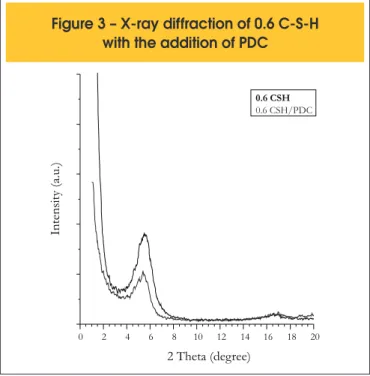
C-S-H was produced with varying Ca/Si ratios that were maintained below 0.8 to facilitate the intercalation of cationic polymers [4,5]. Analysis of the results veriied the formation of calcium silicate hy -drate similar to tobermorite 14 Å (for the basal plane d002), as ob-served in Figures 3, 4 and 5, with a peak at approximately 14 Å. Figure 3 shows that no modiication occurred in the interlayer spacing with the addition of PDC to C-S-H produced with a Ca/ Si molar ratio of 0.8 (0.62 by chemical analysis); thus, showing no evidence of PDC intercalation in the basal plane [002], contradict -ing the results of Matsuyama and Young [4.5].
However, when observing the X-ray diffractogram for C-S-H/PDC with a Ca/Si ratio of 0.8 (0.62 by chemical analysis) (Figure 4), this revealed the
Figure 3 – X-ray diffraction of 0.6 C-S-H
with the addition of PDC
0 2 4 6 8 10 12 14 16 18 20
2 Theta (degree)
Intensity (a.u.)
0.6 CSH 0.6 CSH/PDC
Figure 4 – X-ray diffraction of 0.8/1.0 C-S-H
with the addition of PDC
Intensity (a.u.)
0 2 4 6 8 10 12 14 16 18 20 1.0 C-S-H/PDC
2 Theta (degree) 1.0 CSH 1.0 CSH/PDC 0.8 CSH/PDC
0.8 C-S-H/PDC
Figure 5 – X-ray diffraction C-S-H produced
with the addition of PDC
1 2 3 4 5 6 7 8 9 10
2 Theta (degree)
0.8 CSH
0.8 CSH/PDC
17A
15,3A
formation of tobermorite 14 Å showing a characteristic peak at 6.5°(2q) and another peak at 4.1°(2q), conirming an increase in the interlayer spacing of 21.6 Å. This result coincides with the interlayer spacing ob-served by Matsuyama and Young [4.5], which they veriied for C-S-H synthesis modiied with PDC, showing an interlayer spacing of 21 Å. Carbon content analysis showed an increase of 1.20% for C-S-H without polymer (in agreement with the results of Matsuyama and Young [4], 1.10%) and 2.65% for C-S-H/PDC, indicating partial ixation of the PDC. Considering the quantity of material added and the carbon content of PDC, the maximum carbon concentra-tion possible in C-S-H/PDC could be 18%. The results obtained by Matsuyama and Young [4] presented a carbon content of 10% for C-S-H/PDC, suggesting intercalation of the polymer; whereas the results reported by Merlin et al. [10], who also determined a carbon concentration of 10%, permitted the author to conclude that adsorption of the polymer occurred, since other results (XRD) revealed no alteration in the interlayer spacing.
The results of this study suggest the partial formation of a C-S-H/PDC nanocomposite. A new series of mixtures were prepared and the results revealed a small increase in the interlayer spacing evaluated for C-S-H/PDC of 17 Å (Figure 5), similar to the values obtained by Merlin et al. [10]. For the latter combination the carbon content was determined as 5%.
Considering these results, the formation and the bonding structure of C-S-H should be considered random and irregular, which, ac-cording Pellenq et al. [8], would make polymer intercalation, when it occurs, dificult to achieve consistently.
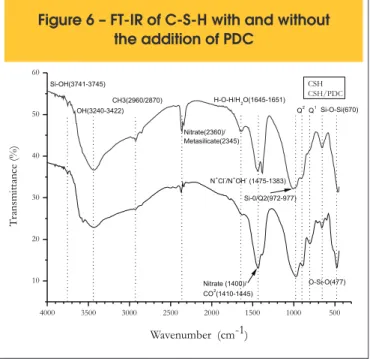
The presence of the polymer was determined by FT-IR analysis, where in PDC is clearly identiied in the bands 2970 cm-1 (CH3)
and 1474/1381 cm-1 (N+Cl-) [4]. Type OH bonds were observed
in C-S-H and C-S-H/PDC at 3433 cm-1 (Figure 6). However, dif
-ferences between C-S-H/PDC and C-S-H were observed in the region between the interlayer in the Si-O-Si-type bonds; i.e., for both C-S-H and C-S-H/PDC, the presence of bonding in Q2-type silicates (where Qn represents the silica tetrahedron and n or 2,
the number of structural units linked together) was veriied in the bands identiied at 972 cm-1 and 895 cm-1 for C-S-H [15] and 998
cm-1 and 902 cm-1 for C-S-H/PDC. The most important difference
was observed in the 802 cm-1 band in C-S-H regarding the Q1-type
bond, which is almost nonexistent in C-S-H/PDC.
According to Matsuyama and Young [4], the Q2/Q1 ratio that
in-dicates the degree of polymerization in the dreierketten region is increased in the presence of polymers. Using nuclear magnetic resonance analysis (29Si NMR), Matsuyama and Young [4] veri-ied the presence of peaks at -79.8 ppm and -85.5 ppm for C-S-H, corresponding to Q1 and Q2-type Si-O, respectively. In the C-S-H/ PDC nanocomposite, absence of a peak for the Q1-type bond was
veriied. This kind of analysis was also performed by Popova et al. [12], who despite having used the pozzolanic synthesis method, ob-served no signiicant differences following the addition of polymers. The set of results presented, XRD and FT-IR, seems to conirm the intercalation of PDC within the interlayer spacing of C-S-H and the formation of a nanocomposite. Analyses conducted using the nanoindentation technique showed a reduction in the mechanical properties of C-S-H/PDC, which, together with images of the mor-phology obtained by transmission electron microscope [16], con-irm the nanostructural alterations of C-S-H/PDC. A micrograph of the nanocomposite produced is presented in Figure 7.
4. Conclusions
The main results concerning the nanostructural alterations of C-S-H modiied with synthetic polymers are presented below:
n The precipitation synthesis process was more eficient for
C-S-H production;
n Observation veriied that the addition of PDC led to partial
mod-iication of the interlayer spacing of C-S-H, which increased from 1.40 nm to 2.16 nm. Although, for the same mixture (C-S-H/PDC), the formation of a phase with an interlayer spacing of 1.4 nm has also been observed, thereby indicating the pres-ence of two phases;
Figure 6 – FT-IR of C-S-H with and without
the addition of PDC
4000 3500 3000 2500 2000 1500 1000 500
10 20 30 40 50 60
Nitrate(2360)/ Metasilicate(2345)
O-Si-O(477) Q1
Q2 Si-O-Si(670)
CH3(2960/2870)
N+Cl-/N+OH- (1475-1383)
H-O-H/H2O(1645-1651)
Si-0/Q2(972-977)
Nitrate (1400)/ CO2(1410-1445)
Si-OH(3741-3745)
OH(3240-3422)
Tr
an
sm
itt
an
ce
(%
)
Wavenumber (cm-1)
CSH CSH/PDC
701
IBRACON Structures and Materials Journal • 2011 • vol. 4 • nº 5
n Using FT-IR analysis, the presence of PDC was observed, as
well as an alteration in the type of Si-O-Si bonding between the interlayer spacing of C-S-H. For C-S-H, Q1 and Q2-type bonds were veriied, while for the compound C-S-H/PDC, only Q2-type bonds were veriied, indicating a higher degree of po -lymerization of the dreierketten chains caused by the polymer and low quantities of free silica in the same region.
The results presented seem to conirm the intercalation of PDC within the interlayer spacing of C-S-H and the formation of a nano-composite. These results contribute to the development of cement/ polymer nanocomposites with distinct characteristics.
5. Acknowledgements
The authors gratefully acknowledge the Conselho Nacional de De
-senvolvimento Cientíico e Tecnológico (CNPq) for providing the
inancial support for this research.
6 references
[01] MATSUYAMA, H.; YOUNG, J.F. The formation of C-S-H/polymer complexes by hydration of reactive β-dicalcium silicate, Concrete Science and Technology, 1, 1999, p. 66-75.(a)
[02] MATSUYAMA, H.; YOUNG, J.F. The formation of C-S-H/polymer complexes with superplasticizing polymers, Concrete Science and Technology, 1, 1999, p. 148-156.(b)
[03] MATSUYAMA, H.; YOUNG, J.F. Synthesis of calcium silicate hydrate/polymer complexes: Part I: Anionic and nonionic polymers, Journal of Materials Research, 14, 1999, p. 3379-3388.(c)
[04] MATSUYAMA, H.; YOUNG, J.F. Synthesis of calcium silicate hydrate/polymer complexes: Part I: Cationic polymers and complex formation with different polymers, Journal of Materials Research, 14, 1999, p. 3389-3396.(d)
[05] MATSUYAMA, H.; YOUNG, J.F. Intercalation of Polymers in Calcium Silicate Hydrate: A New Synthetic Approach to Biocomposites? Chemisty of Materials, 11, p. 1999, p. 16-19.(e)
[06] SILVA, D.A. MONTEIRO, PJM. Hydration evolution of C3S-EVA composites analyzed by soft X-ray microscopy. CEMENT AND CONCRETE RESEARCH Volume: 35 Issue: 2 Pages: 351-357 Published: FEB 2005.
[07] SILVA, D.A. ROMAN, HR. GLEIZE, PJP. Evidences of chemical interaction between EVA and hydrating Portland cement. CEMENT AND CONCRETE RESEARCH Volume: 32 Issue: 9
Pages: 1383-1390 Published: SEP 2002. [08] PELLENQ, R.J.-M., LEQUEUX, N., VAN DAMME,
H. Engineering the bonding scheme in C-S-H: The iono-covalent framework. Cement and Concrete Research, 38, 2008, p. 159-174.
[09] GLEIZE, P. J. P. Nanotecnologia e materiais de construção. In: G.C. Isaia. (Org.). Materiais de Construção Civil e Princípios de Ciência e Engenharia de Materiais. São Paulo - SP: Instituto Brasileiro de Concreto -
IBRACON, 2007, v. 2, p. 1659-1685.
[10] MERLIN, F. LOMBOIS, H. JOLY, S. LEQUEUX, N. HALARY, J. L. VAN DAMME, H. Cement-polymer and clay-polymer nano- and meso-composites: spotting the difference. J. Material Chemistry, v. 12, 2002, p. 3308-3315.
[11] GLEIZE, P. J. P. PELISSER, F. Natureza da coesão do C-S-H e efeito de aditivos orgânicos na sua nanoestrutura. In: 49° Congresso Brasileiro do Concreto, 2007, Bento Gonçalves.
[12] POPOVA, A. GEOFFROY, G. GONNORD, M. F. R. FAUCON, P. GARTNER, E. Interactions between polymeric dispersants and calcium silicate hydrates. J. American Ceramic Society, v. 83, n. 10, 2000, p. 2556-2560.
[13] GMIRA, A., Etude texturale et thermodynamique d’hydrates modèles du ciment, Tese de Doutorado, Universite d’ Orleans, França, 2003.
[14] SILVA, D.A. Efeito dos polímeros HEC e EVA na microestrutura e nas propriedades de pastas de cimento Portland, Tese de doutorado, Curso de Pós-Gradução en Ciência e Engenharia dos Materiais, Univ. Fed. de Sta Catarina, Florianópolis, SC, Brasil, 2001.
[15] MOSTAFA, N. Y.; SHALTOUT, A. A.; OMAR
H.; ABO-EL-ENEIN, S.A. Hydrothermal synthesis and characterization of aluminium and sulfate substituted 1.1 nm tobermorites. Journal of Alloys and
Compounds. 2008, Article in Press.

![Table 1) in order to obtain true Ca/Si ratios below 0.8 to facilitate the intercalation of cationic polymers [4,5]](https://thumb-eu.123doks.com/thumbv2/123dok_br/18859628.417692/4.892.68.439.181.551/table-order-obtain-ratios-facilitate-intercalation-cationic-polymers.webp)