Heat treatment of a direct composite
resin: influence on flexural strength
Abstract: The purpose of this study was to evaluate the lexural strength of a direct composite, for indirect application, that received heat treat-ment, with or without investment. One indirect composite was used for comparison. For determination of the heat treatment temperature, thermogravimetric analysis (TGA) and differential scanning calorim-etry (DSC) were performed, considering the initial weight loss tempera-ture and glass transition temperatempera-ture (Tg). Then, after photoactivation (600 mW/cm² - 40 s), the specimens (10 × 2 × 2 mm) were heat-treated following these conditions: 170ºC for 5, 10 or 15 min, embedded or not embedded in investment. Flexural strength was assessed as a means to evaluate the inluence of different heat treatment periods and investment embedding on mechanical properties. The data were analyzed by ANO-VA and Tukey’s test (α = 0.05). TGA showed an initial weight loss tem-perature of 180ºC and DSC showed a Tg value of 157°C. Heat treatment was conducted in an oven (Flli Manfredi, Italy), after 37°C storage for 48 h. Flexural strength was evaluated after 120 h at 37°C storage. The results showed that different periods and investment embedding present-ed similar statistical values. Nevertheless, the direct composite resin with treatments presented higher values (178.7 MPa) compared to the indi-rect composite resin (146.0 MPa) and the same diindi-rect composite submit-ted to photoactivation only (151.7 MPa). Within the limitations of this study, it could be concluded that the heat treatment increased the lexural strength of the direct composite studied, leading to higher mechanical strength compared to the indirect composite.
Descriptors: Composite resins; Thermic treatment; Tensile strength.
Caroline Lumi Miyazaki(a)
Igor Studart Medeiros(b)
Ivone Lima Santana(c)
Jivaldo do Rosário Matos(d)
Leonardo Eloy Rodrigues Filho(b)
(a) PhD Student; (b)PhD, Professor – Department
of Biomaterials and Oral Biochemistry, School of Dentistry, University of São Paulo, SP, Brazil.
(c) PhD, Professor, School of Dentistry,
University of Maranhão, Brazil.
(d) PhD, Professor, Department of Fundamental
Chemistry, Institute of Chemistry, University of São Paulo, Brazil.
Corresponding author:
Caroline Lumi Miyazaki
Departamento de Biomateriais e Bioquímica Oral da Faculdade de Odontologia da Universidade de São Paulo
Avenida Professor Lineu Prestes, 2227, Cidade Universitária
São Paulo - SP - Brazil CEP: 05508-000
E-mail: [email protected]
Introduction
Direct and indirect composites present equiva-lent composition, but different processing methods. After photoactivation, polymerization can be com-pleted by an additional treatment with light and/or heat, which can be done under controlled environ-mental conditions. Those additional treatments lead to an increase in the degree of conversion, improved mechanical properties, color stability and a reduc-tion of wear.1,2
One disadvantage of indirect commercial com-posites is their cost, mainly because special equip-ment is needed to process them. These devices in-clude ovens and stoves, which associate stroboscope or continuous light, nitrogen or argon pressure and vacuum.1,2
As an alternative for indirect commercial sys-tems, many authors have proposed the use of direct composites associated to heat treatments in a con-ventional sterilization oven, autoclave or porcelain furnace.3-5 After photoactivation, heat treatment can be conducted in conventional devices projected for other applications (sterilization in dry or humid conditions, porcelain sinterization, etc.), which are readily available in the dental ofice. These can be used as an option to improve the mechanical prop-erties of direct composite resins.3,6,7 An advantage would be the low cost. Besides that, this treatment can provide an increase in the degree of conversion, also named as secondary cure or post cure.8
There is no consensus in the literature about the ideal time and/or temperature for direct composite heat treatment after photoactivation. To assess the ideal time × temperature, some aspects must be ob-served: the glass transition temperature (Tg), by dif-ferential scanning calorimetry (DSC), and the initial degradation temperature, by thermogravimetric analysis (TGA).9
The glass transition temperature (Tg) is a designa-tion adapted from the characteristic temperature of glassy materials. It refers to a temperature character-istic of each material, in which there is an increase in the coeficient of linear thermal expansion (CLTE) and a reduction in the viscosity and elastic modulus. This temperature can be used as a reference to de-sign the ideal heat treatment. Above Tg, the second-ary molecular interactions are weakened, which al-lows for molecular relaxation through lateral groups bending / rotation. As a consequence, the degree of conversion has an opportunity to increase, once the trapped radicals are given further opportunity to re-act.8,10-12 The T
g of direct composites varies, among other aspects, as a function of composition (mono-mer blend, iller type and concentration) and cross-link density (which depends on the degree of conver-sion/polymerization, etc.).13 The composites T
g can be observed by an endothermic event in DSC.14 By TGA, it is possible to determine, by mass alteration, the thermal stability / degradation of the material.15
In order to propose a heat treatment methodolo-gy for dental composite resins, a thermal character-ization was previously conducted by TGA and DSC. After that, a safe and eficient temperature (without polymer degradation and above Tg, respectively) was indicated. Different periods for the heat treatment were also investigated, with or without investment coating. The direct composite studied has low cost and the parameter used to verify the inluence of treatments was lexural strength. For comparison, an indirect commercial composite was used.
Material and Methods
The composite resins used in this study are de-scribed in Table 1.
TGA and DSC were used for thermal character-ization of the direct composite. Cylindrical
speci-Material Manufacturer Composition Lot
FillMagic Vigodent S.A. Ind. Com. Bonsucesso, RJ, Brazil
Barium glass (0.5 µm) 80% wt. Organic matrix: bis-GMA, TEGDMA, bis-EMA and UDMA.
123/04
BelleGlass Belle de St. Claire, Orange, CA, USA
Barium-borosilicate glass (0.6 µm) 74% wt and 63% vol. Organic matrix: UDMA.
406066
mens (approximately 15 mg) were accommodated in a thermobalance model TGA-50 (Shimadzu, Tokyo, Japan), in the temperature range of 25 to 900°C, under dynamic nitrogen atmosphere (50 ml/min), heating rate of 10°C/min, using platinum crucibles. For the device calibration, a monohydrate calcium oxalate sample was used, following the standard ASTM 1582 (1993).16
For DSC, cylindrical samples of 3 × 2 mm (height × diameter) (approximately 30 mg) were prepared. DSC curves were obtained in a DSC-50 cell (Shimadzu, Tokyo, Japan), in the temperature range from 25 to 550°C, under dynamic nitrogen atmosphere (100 ml/min), heating rate of 10°C/min, using aluminum crucibles. DSC cell was previously calibrated with an indium standard (Tmelt = 156.6°C) and zinc (Tmelt = 419.5°C) samples, with 99.99% pu-rity. For the heat amount, the ∆Hmelt of metallic in-dium (28.7 J/g) was used.
For both tests, curves were obtained with empty crucibles in the same experimental conditions of the tests (baseline). Those baselines were used to correct the thermoanalytical curves of the samples.
Flexural strength Specimen preparation
The specimens (n = 7) were prepared in a stain-less steel split mould17 (10 × 2 × 2 mm). All proce-dures were carried out by a single operator at con-trolled temperature (23°C) and relative humidity (50%). The mould was positioned on a mylar strip (Labordental Ltda., São Paulo, SP, Brazil), over a glass slab. The composite was inserted into the mould, which was then covered with another mylar strip. A glass slide was gently pressed for excess ma-terial to extrude from the mold. Photoactivation for 40 s, in the upper surface, was accomplished with Optilux 501 (Demetron, Danbury, CT, USA), with a 12 mm diameter tip, in contact with the mylar strip. The device irradiance (600 mW/cm²) was mea-sured by a radiometer (serial #111231, Demetron Research, Danbury, CT, USA). Immediately after specimen preparation, they were stored in lightproof boxes at 37°C (Ética Equip. Cient. S.A., São Paulo, SP, Brazil).
Heat treatment
Direct composite specimens (Fill Magic) were submitted to the experimental heat treatment. For this purpose, after 48 h storage at 37°C, the speci-mens received a heat treatment at 170°C. After the heat treatment, the specimens were stored at 37°C for 120 h. The non treated specimens were stored for 120 h at 37°C.
The experimental heat treatment, for the direct composite, was conducted in a digital oven (Mod. 10060, Flli MANFREDI, Scientiic Apparatus Electronic Devices, SAED, San Secondo di Pinero-lo, TO, Italy), in dry condition at 170°C, for three periods of time (5, 10 and 15 min). Moreover, the investment coating effect on the treated specimens was tested using a stone bonded investment (Cristo-balite, Dentsply, Petrópolis, RJ, Brazil), in relation to the non-coated specimens.
For coating, before the heat treatment, empty match boxes were half-illed with the investment. Specimens were placed on top of the set investment and then covered with another portion of the same material. Specimen separation was facilitated by guiding incisions fabricated in the investment mate-rial.
The indirect composites specimens (BelleGlass, n = 7) were heat-treated according to the manufac-turer’s instructions: after photoactivated, they were treated in a HP unit (SDS Kerr, CA, USA), with a 20 min cycle at 140°C, under nitrogen pressure (5.5 bar).
Flexural strength test
Where σ is the lexural strength (MPa), P is the fracture load, l is the distance between supports (8 mm), w and t are the width and thickness (mm) of the specimen, respectively.
Statistical analysis
The data were analyzed by two-way ANOVA (heating exposure time and investment coating). Tukey’s test was applied for contrast (α = 0.05).
Results
TGA/DSC
A moderate weight loss started around 180°C, for the direct composite. This may have represented an initial degradation. Between 200 and 400°C, weight loss reached 10.6%, becoming 26.3% at 600°C. Above this temperature, the mass tended to stabilize, corresponding to the inorganic fraction of 73.74% wt (Graph 1).
For the direct composite, the glass transition was observed at 157°C. Thereafter, 170°C was de-termined as the heat treatment temperature, as it is above the observed Tg and under the initial degrada-tion temperature.
Flexural strength
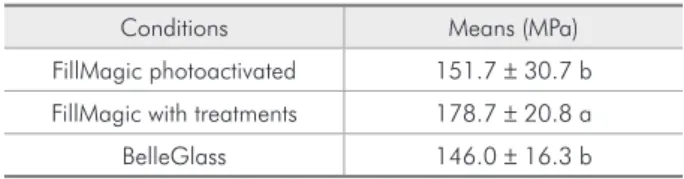
Through statistical analysis, the results showed that neither one of the heat treatments proposed (re-gardless of embedding or not embedding in invest-ment), nor the different periods of time led to signif-icantly different lexural strength values (Table 2).
Discussion
Previously to heat treatment, the maximum tem-perature for heating without damaging the material needs to be determined to avoid weight loss. Thus, TGA was applied, since this test evaluates weight alterations (gain or loss) as a function of tempera-ture and/or time, when a sample is submitted to a program with controlled temperature.15 The results suggested that, in temperatures above 200°C, the composite resin presented a weight loss up to 0.2%. Other authors compared the iller loading in dental composites informed by the manufacturer with the
Table 2 - Flexural strength of the studied composites.
Conditions Means (MPa) FillMagic photoactivated 151.7 ± 30.7 b FillMagic with treatments 178.7 ± 20.8 a BelleGlass 146.0 ± 16.3 b
Same letters represent similar values (p < 0.05).
= 3Pl 2wt2
– 0.198%
– 0.50 0.00 110
100
90
80
60 70
– 1.003% – 10.568%
– 8.649%
– 5.931% – 26.263%
T
G
(%)
D
T
G
(mg/
m
in)
FillMagic (TG) FillMagic (DTG)
0 200 400 600 800
Temp (oC)
Graph 1 - TG/DTG
experimental results obtained by TGA.18,19 In this study, total iller percentage for the direct composite Fill Magic was 73.74% wt, which is not in agree-ment with the values presented by the manufacturer (80% wt).
DSC is a technique that, by energy variation, measures the temperature difference between the sample and a reference, at a temperature controlled program. With this test, a Tg of 157°C for direct composite Fill Magic was observed, which was high-er than the values obtained by most of the previous studies in the literature for other direct composites, which show values ranging from 35 to 186°C. 8,11,13,20-23 This great difference derives from many reasons,
such as different materials (experimental compos-ites with or without iller, commercial composcompos-ites, matrix resin), techniques (DSC, thermo-mechani-cal analysis), atmosphere conditions (air, nitro-gen, vacuum), heating rate, composite resin mass, etc.8,11,13,20-23 T
g can be measured by a vast range of techniques and depends on the degree of conversion. When a bulk density of crosslinking is present, there is a smaller mobility of the polymeric chain section. This fact increases the Tg values.11,22 So, the T
g value found in this research is also a function of the meth-odology employed (photoactivation mode, specimen thickness, etc). Thus, based on the TGA and DSC results, the temperature of 170°C was stipulated for the heat treatment of the composite resins.
To minimize ambient atmosphere effects inside the heat treatment furnace, investment coating was used for some groups. By doing this, it was possible to evaluate eventual differences in heat low during the heat treatment, when the composite resin was involved by a material with lower conductivity. It was also possible to analyze the effect of the con-trolled atmosphere during the procedure (oxygen reduction), as well as a simulation of the conditions applied for indirect composite resins. However, the results indicated that lexural strength values did not differ between the materials embedded or not embedded in investment. This showed that this pro-cedure is not necessary for this parameter.
Notwithstanding, the heat treatment factor was highly signiicant, regardless of the period used. Even with the shorter period without investment
coating (173.5 MPa), an increase in lexural strength was achieved in relation to the composite only pho-toactivated (151.7 MPa). Many studies compared direct composites just photoactivated in relation to direct composites that received heat treatment, by parameters as lexural strength and diametral ten-sile strength.21,23,24 Although results obtained by dif-ferent tests may not be compared, they all followed the same marked trend: the heat treatment improved the evaluated mechanical properties, regardless of the parameter considered.
According to Loza-Herrero et al.6 (1998), heat application, aiming at an increase in the degree of conversion, must be used, ideally, immediately after photoactivation. Higher monomer conversion took place up to 6 h after photoactivation. They also af-irm that there is a reduction in the amount of re-sidual monomers after 6 h, and that, after that peri-od, the heat treatment did not lead to an increase in lexural strength. In the present study, the heat treat-ment was applied only after 48 h of photoactivation, so as to isolate the heat treatment effect from the effect that occurs earlier. However, the temperature for the heat treatment, which was different from that of the former study, was higher than Tg. The objective was to improve properties, not only nec-essarily by an increase in the degree of conversion, but also probably by an increase in stress relaxation (induced during photoactivation).11,25
Bagis, Rueggeberg26 (2000), in another study, submitted specimens to immediate post-cure heat-ing, for 7 min, at the following temperatures: 50, 75, 100 and 123°C. They were compared to specimens only photoactivated. High pressure liquid chroma-tography was used to measure residual monomer leached from the specimens. Post-cure heating at 75°C and above resulted in the lowest amount of re-sidual monomers, without signiicant decrease with an increase in post-cure temperature.26 Post-cure treatment at 100°C leads to a decrease in residual monomers remaining in the polymer (measured by FTIR), but the mechanical properties are not always improved for all composites.3
period of time (5 min) was capable of promoting thermal balance and producing the desired effects of strength increase.
Even without measuring the degree of conver-sion, it can be speculated that the different levels of conversion attained by the different groups might have accounted for differences in lexural strength. Since the heat treatment was conducted above Tg, this would allow for increased radical mobility, en-hancing conversion.9,12 However, stress relaxation brought about by the thermal treatment might also explain why there was an increase in lexural strength. It is important to emphasize that stress re-laxation is time-dependent. Since it depends upon atom or molecule movements, it varies in an expo-nential function with temperature.9
The three-point bending test develops complex stresses (compressive, tensile and shear), similarly to in vivo conditions. Other parameters need to be studied to evaluate the phenomenon, as residual monomers quantiication, leaching, color alteration,
toughness, microhardness, degree of conversion, etc.
Conclusion
The experimental heat treatment employed in this study increased the lexural strength of the di-rect composite Fill Magic, enabling its indidi-rect use with high mechanical strength. Within the limita-tions of this study, the results led to the conclusion that the association of common composites with a simple post-cure heat treatment may be an alterna-tive for current indirect composite systems, although more studies are needed to assess other properties of the composites for this application.
Acknowledgements
This study was partly supported by CAPES (Co-ordination for the Improvement of Higher Educa-tion Personnel). The authors would like to thank Carmem Silva Costa Pfeifer, for her contribution, and Antônio Carlos Lascala, for the technical sup-port.
References
1. Terry DA, Touati B. Clinical considerations for aesthetic lab-oratory-fabricated inlay/onlay restorations: a review. Pract Proced Aesthet Dent. 2001;13(1):51-8.
2. Cesar PF, Miranda Jr WG, Braga RR. Influence of shade and storage time on the flexural strength, flexural modulus, and hardness of composites used for indirect restorations. J Prosthet Dent. 2001;86(3):289-96.
3. Peutzfeldt A, Asmussen E. The effect of postcuring on quantity of remaining double bonds, mechanical properties, and in vitro wear of two resin composites. J Dent. 2000;28(6):447-52.
4. Tanoue N, Matsumura H, Atsuta M. Comparative evaluation of secondary heat treatment and high intensity source for the improvement of properties of prosthetic composites. J Oral Rehabil. 2000;27(4):288-93.
5. Wendt SLJ, Leinfelder KF. The clinical evaluation of heat-treat-ed composite resin inlay. J Am Dent Assoc. 1990;120(2):177-81.
6. Loza-Herrero MA, Rueggeberg FA, Caughman WF, Schuster GS, Lefebvre CA, Gardner FM. Effect of heating delay on conversion and strength of a post-cured resin composite. J Dent Res. 1998;77(2):426-31.
7. Ferracane JL, Condon JR. Post-cure heat treatments for composites: properties and fractography. Dent Mater. 1992 Sep;8(5):290-5.
8. Vaidynathan J, Vaidynathan TK, Wang Y, Viswanadhan T. Thermoanalytical characterization of visible light cure dental composites. J Oral Rehabil. 1992;19(1):49-64.
9. Van Vlack LH. Elements of Materials Science. Reading, Mass: Addison-Wesley; 1964.
10. Eldiwany M, Powers JM, George LA. Mechanical proper-ties of direct and post-cured composites. Am J Dent. 1993 Oct;6(5):222-4.
11. Truffier-Boutry D, Demoustier-Champagne S, Devaux J, Biebuyck JJ, Mestdagh M, Larbanois P et al. A physico-chemi-cal explanation of the post-polymerization shrinkage in dental resins. Dent Mater. 2006 May;22(5):405-12.
12. Odian G. Principles of Polymerization. 4th ed. Hoboken, NJ: Wiley-Interscience; 2004.
13. Jancar J, Wang W, Dibenedetto AT. On the heterogeneous structure of thermally cured Bis-GMA/TEG-DMA resins. J Mater Sci Mater Med. 2000;11(11):675-82.
14. Marti E, Kaisersberger E, Mouklina E. Heat capacity func-tions of polyestyrene in glassy and liquid amourphous state and glass transition DSC and TMDSC study. J Therm Anal Cal. 2006;85:505-25.
16. American Society for Testing and Materials. Standard Practice for calibration of temperature scale for thermogravimetry (ASTM E1582-93). 1993.
17. Witzel MF, Calheiros FC, Goncalves F, Kawano Y, Braga RR. Influence of photoactivation method on conversion, mechani-cal properties, degradation in ethanol and contraction stress of resin-based materials. J Dent. 2005 Oct;33(9):773-9. 18. Sabbagh J, Ryelandt L, Bachérius L, Biebuyck JJ, Vreven J,
Lambrechts P et al. Characterization of the inorganic fraction of resins composites. J Oral Rehabil. 2004;31(11):1090-101. 19. Willems G, Lambrechts P, Braem M, Celis JP, Vanherle
G. A classification of dental composites according to their morphological and mechanical characteristics. Dent Mater. 1992;8(5):310-9.
20. Broer DJ, Mol GN. Temperature effects on the kinetics of photoinitiated polymerization of dimethacrylates. Polymer. 1991;32(4):690-5.
21. Powers JM, Smith LT, Eldiwany M, Ladd GD. Effects of post-curing on mechanical properties of a composite. Am J Dent. 1993;6(5):232-4.
22. Sideridou I, Achilias DS, Kyrikou E. Thermal expansion char-acteristics of light-cured dental resins and resin composites. Biomaterials. 2004 Jul;25(15):3087-97.
23. Wendt Jr SL. The effect of heat used as a secondary cure upon the physical properties of three composite resins. I. Diametral tensile strength, compressive strength, and marginal dimen-sional stability. Quintessence Int. 1987;18(4):265-71. 24. Wendt Jr SL. Time as a factor in the heat curing of composite
resins. Quintessence Int. 1989;20(4):259-63.
25. Trujillo M, Newman SM, Stansburry JW. Use of near-IR to monitor the influence of external heating on dental composite photopolymerization. Dent Mater. 2004;20(8):766-77. 26. Bagis YH, Rueggeberg FA. The effect of post-cure heating on