Delirium na unidade de cuidados intensivos: uma realidade
subdiagnosticada
INTRODUCTION
Delirium can be deined as an acute cerebral dysfunction characterized by transient and luctuating alterations in the state of consciousness, accompanied by cognitive impairment. Delirium frequently afects patients admitted to intensive care units (ICUs). he diagnostic criteria for delirium are multidimensional and vary according to source. According to the Diagnostic and Statistical Manual of Mental Disorders, fourth
edition (DSM-IV-TR),(1) which continues to be the gold standard in the
diagnosis of delirium, the criteria are the following: (1) disturbance of consciousness (for example, reduced awareness of the environment), with a decrease in the ability to direct, focus, maintain or shift attention; (2) impaired cognition (such as memory deiciency, disorientation or speech perturbation) or development of perception perturbation, which is not well explained by established or developing dementia; (3) the disorder develops over a short period of time (usually hours or days) and as a luctuating course during the day; and (4) there is evidence from the medical history, physical exams or laboratory indings that the disturbance is due to direct physiological causes originating from a general medical condition. According to DSM-IV-TR, all of these criteria must be present to diagnose delirium. hese criteria have been used for the last 10 years, but it is important to remember that the manual will be revised and that the new version (DSM-V) should be published in May 2013. Some key points of this review are the substitution of the term “consciousness” with “awareness”; the inclusion of visual-spatial and executive function impairment as key symptoms of delirium; the duration of the delirium will Rita da Silva Baptista Faria1, Rui Paulo Moreno2
1. Medicine Service II, Hospital de Santo André, Centro Hospitalar Leiria-Pombal - EPE - Leiria, Portugal.
2. Neurocritical Intensive Care Unit, Hospital de São José, Centro Hospitalar de Lisboa Central - EPE - Lisboa, Portugal.
Conflicts of Interest: None.
Submitted on 27 February, 2013 Accepted on 8 May, 2013
Corresponding author: Rita da Silva Baptista Faria
Serviço de Medicina II, Hospital de Santo André, CHLP EPE.
Rua das Olhalvas - Pousos 2410-197 - Leiria, Portugal E-mail: [email protected]
Delirium in intensive care: an under-diagnosed
reality
Delirium occurs in up to 80% of patients admitted to intensive care units. Although under-diagnosed, delirium is associated with a signiicant increase in morbidity and mortality in critical patients. Here, we review the main
ABSTRACT
Keywords: Delirium; Intensive Care; Sleep; Central nervous system; Antipsychotics agents
risk factors, clinical manifestations and preventative and therapeutic approaches (pharmacological and non-pharmacological) for this illness.
be considered last; and criteria to be added to evaluate the intensity of the delirium. he replacement of the term “consciousness” with “awareness” is important because it allows one to better distinguish delirium from minor and major neurocognitive alterations, as “consciousness” is too nebulous to deine the symptoms of delirium and “awareness” better captures
the essence of this disturbance.(2) With this set of
alterations, the primary symptoms of delirium, their characteristics and their subtypes can be described in a more precise manner.
Additionally, DSM-V must include the classiication of subsyndromal delirium.
Diagnosed in this manner, delirium is the most common form of acute cerebral dysfunction in the
ICU and afects up to 80% of the patients.(3,4) However,
delirium is frequently undervalued and unrecognized, similar to many other cerebral dysfunctions.
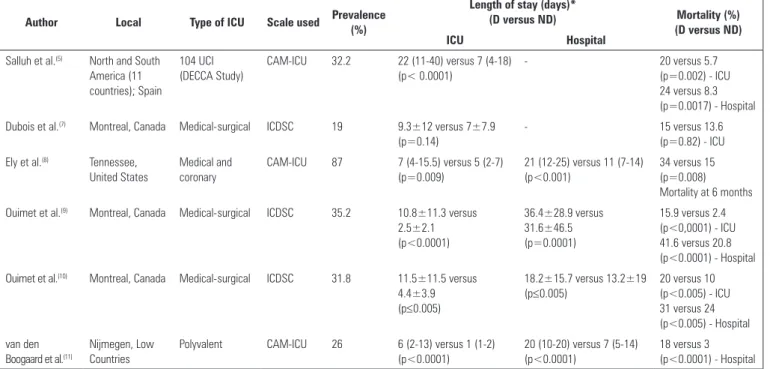
he prevalence obtained in multicenter studies varies between 32.3% and 77%, and the incidence can vary between 45% and 87%. hese rates depend on the composition of the study group and the scale used for the evaluation(5,6) (Table 1).
Every year, a growing number of patients are admitted to ICUs and survive the causative critical disease. However, these patients present with acute
and chronic morbidities in the cognitive, functional and emotional domains, which results in a decrease in the global quality of life.(12,13)
Delirium is also an independent predictor of complications and prognosis, e.g., self-extubation,
removal of catheters, prolonged hospitalization,(7)
increased hospital costs,(14) mortality at 6 months and
1 year(8,15) and long-term cognitive impairment.(16-18)
Due to these factors, the interest, investigation and knowledge about this syndrome have grown progressively in recent years.(19,20)
Classification
he classiication of delirium can be subdivided by course over time and motor subtypes. he terminology, according to the course over time, includes a) prevalent (if it is detected at the time of admission); b) incident (if it emerges during the hospital length of stay); and c) persistent (if the symptoms persist over time).(19)
Pisani et al.(21) reported a persistence of delirium of
up to 10 days after diagnosis in the ICU, but studies outside the context of the ICU show that symptoms can persist up to 1 month.(22-24)
he symptoms of delirium can be grouped as either cognitive or behavioral, with broad interpersonal variability. For this reason, some patients
Table 1 - Comparison between different studies on the prevalence of delirium in intensive care units
Author Local Type of ICU Scale used Prevalence
(%)
Length of stay (days)*
(D versus ND) Mortality (%)
(D versus ND)
ICU Hospital
Salluh et al.(5) North and South America (11 countries); Spain
104 UCI (DECCA Study)
CAM-ICU 32.2 22 (11-40) versus 7 (4-18) (p< 0.0001)
- 20 versus 5.7
(p=0.002) - ICU 24 versus 8.3 (p=0.0017) - Hospital Dubois et al.(7) Montreal, Canada Medical-surgical ICDSC 19 9.3±12 versus 7±7.9
(p=0.14)
- 15 versus 13.6
(p=0.82) - ICU Ely et al.(8) Tennessee,
United States
Medical and coronary
CAM-ICU 87 7 (4-15.5) versus 5 (2-7)
(p=0.009)
21 (12-25) versus 11 (7-14) (p<0.001)
34 versus 15 (p=0.008) Mortality at 6 months Ouimet et al.(9) Montreal, Canada Medical-surgical ICDSC 35.2 10.8±11.3 versus
2.5±2.1 (p<0.0001)
36.4±28.9 versus 31.6±46.5 (p=0.0001)
15.9 versus 2.4 (p<0,0001) - ICU 41.6 versus 20.8 (p<0.0001) - Hospital Ouimet et al.(10) Montreal, Canada Medical-surgical ICDSC 31.8 11.5±11.5 versus
4.4±3.9 (p≤0.005)
18.2±15.7 versus 13.2±19 (p≤0.005)
20 versus 10 (p<0.005) - ICU 31 versus 24 (p<0.005) - Hospital van den
Boogaard et al.(11)
Nijmegen, Low Countries
Polyvalent CAM-ICU 26 6 (2-13) versus 1 (1-2)
(p<0.0001)
20 (10-20) versus 7 (5-14) (p<0.0001)
18 versus 3 (p<0.0001) - Hospital
predominantly manifest psychomotor slowing or even coma, and some present as anxious, disruptive or combative.
he terminology according to motor subtypes includes a) hyperactive delirium (in which there is an increase in the psychomotor activity and agitation, with attempts to remove invasive devices); b) hypoactive delirium (characterized by psychomotor slowing, apathy, lethargy and a decrease in response to external stimuli); and c) mixed delirium (with unpredictable luctuation of symptoms between the irst two subtypes).(25,26)
Additional deinitions are described, which include subsyndromal delirium and delirium superimposed on dementia.
In subsyndromal delirium, patients have one or more of the symptoms, but this does not lead to a clinical diagnosis of delirium according to the criteria of the DSM-IV-TR. his subtype is mainly described outside the context of the ICU, but Ouimet et al. (2007) deined its presence, using the
Intensive Care Delirium Screening Checklist (ICDSC), in a population from an ICU. he ICDSC assigns a score from 0 to 8 points, with a score ≥4 indicating the presence of delirium and a score between 1 and 3 considered subsyndromal delirium. According to these criteria, 33.3% of the patients in the sample studied showed this subtype of delirium. his group of patients had worse prognosis than those without any form of delirium. More speciically, the presence of subsyndromal delirium, compared to the absence of delirium, showed a signiicant association with time spent in the ICU and in the hospital, as well as a greater dependence after discharge. A statistically signiicant efect related to mortality was not observed after adjusting for age, APACHE II score or sedation. herefore, the presence of subsyndromal delirium could be a marker of the seriousness of the illness and
not an independent risk factor in this population.(10)
Delirium superimposed on dementia is deined as an acute alteration in mental state (luctuating course, inattention, disorganized thought or alteration of the state of awareness) in a patient with a diagnosis of dementia. his deinition is obvious but raises some interpretation and diagnosis issues, which explains the large variability in the reported prevalence and relects the risk of aggravating delirium when neuroleptic
drugs are administered.(27)
Risk factors
he attention paid to delirium in the intensive care environment is recent, and therefore, data are still scarce. hese patients present many risk factors, which must be taken into consideration for a multifactor approach.
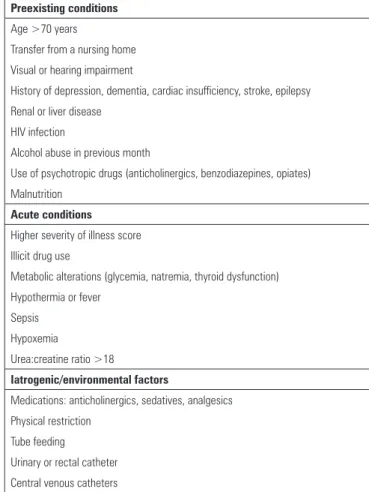
Although they do not have a strong association or deinitive causality, many risk factors have been described for the development of delirium, especially from populations outside of the ICU, and they can be divided into a) preexisting condition of the patient; b) acute condition of the patient; and c) iatrogenic or environmental factors(2,28) (Table 2).
Table 2 - Risk factors for delirium
Preexisting conditions Age >70 years
Transfer from a nursing home Visual or hearing impairment
History of depression, dementia, cardiac insufficiency, stroke, epilepsy Renal or liver disease
HIV infection
Alcohol abuse in previous month
Use of psychotropic drugs (anticholinergics, benzodiazepines, opiates) Malnutrition
Acute conditions Higher severity of illness score Illicit drug use
Metabolic alterations (glycemia, natremia, thyroid dysfunction) Hypothermia or fever
Sepsis Hypoxemia
Urea:creatine ratio >18
Iatrogenic/environmental factors
Medications: anticholinergics, sedatives, analgesics Physical restriction
Tube feeding
Urinary or rectal catheter Central venous catheters
illumination, the absence of clocks, perturbation of the patterns of sleep and wakefulness and the isolation of the patient.
Delirium is common in the state of systemic inlammation. C-reactive protein (CRP) has been widely used to evaluate the degree of inlammation. An association between the level of serum CRP and delirium has been demonstrated in various studies.
(29,30)
Tsuruta et al.(31) demonstrated that mechanical
ventilation, the maximum value of CRP and ICU length of stay are independent factors for the development of delirium.
Despite the identiication of all of these risk factors, the underlying mechanism of delirium is not entirely clear. his knowledge would substantially contribute to the care of the critical patient, through preventive interventions and speciic treatments.
Impact and consequences
Delirium has short- and long-term consequences,
including emotional consequences. Ringdal et al.(32)
observed that during hospitalization in the ICU, delirium was associated with delusional memories;
Roberts et al.(33) reported that ICU patients with
delirium had less factual recall than the group without delirium. However, the emotional impact of delirium is not easy to evaluate. Other clinical consequences, namely those related to mortality, ICU length of stay, hospital length of stay, number of days of mechanical ventilation and incidence of complications related to delirium, are measurable and have been studied extensively. hese results are more relevant because they are directly related to the use of limited resources in ICUs.
Zhang et al.,(34) in a 2012 meta-analysis, compared
16 studies involving 6,410 patients. he results analyzed in the studies were time in the ICU and in the hospital, destination after discharge, duration of mechanical ventilation, mortality, complications and functional capacity. It was observed that delirium was associated with a higher rate of mortality, longer ICU stay (average diference of 7.32 days), longer hospital stay (average diference of 6.53 days), a greater time on mechanical ventilation (average diference of 7.22 days) and a higher probability to be transferred to a support unit after discharge.
van den Boogaard et al.(11) studied the short-term
consequences of delirium, including an analysis of each subtype of delirium. One-fourth of the study sample with a time of hospitalization >1 day and half of the patients with hospitalization >2 days developed delirium. his group had a greater probability of developing short-term complications and a six-fold greater probability of dying, independent of the seriousness of the disease. he mixed subtype was the most common (53%), followed by hypoactive (36%) and hyperactive (11%). Short-term complications, deined by days of mechanical ventilation, rate of reintubation, accidental removal of tubes and catheters, time in the ICU and time in the hospital, were more frequent in the group of patients with delirium, with the highest rate being observed in the patients with the mixed subtype.
Survivors of the ICU have long-term cognitive
consequences.(20) he duration of delirium during
hospitalization in the ICU is independently associated with cognitive impairment after adjustment for various covariables.(35) A questionnaire regarding quality of life
was sent to a sample of 1,291 survivors 18 months after ICU discharge. Despite the lack of statistical signiicance in the quality of life between patients who presented delirium and those who did not, a more pronounced cognitive impairment was found in the
irst group after adjustment for covariables.(36) he
neurocognitive impairment in delirious ICU patients is heterogeneous and frequently involves memory, executive function and attention. his problem also afects the family and the caregivers, as it compromises the capacity of the survivor to return to work, reduces their quality of life and increases medical costs.(37)
hese data are important to clinical practice because they highlight the need to take preventative measures. he high incidence of delirium and the serious associated complications should be suicient to alert healthcare professionals to the need for regular evaluation of delirium in ICU patients.
van den Boogaard et al.(38) developed the irst
category, infection, metabolic acidosis, morphine dose, sedation, urea, urgent admission) in the irst 24 hours of admission. he patients are classiied according to risk: low risk 0-20%; moderate risk >20 to 40%; high risk >40 to 60%; and very high risk >60%. he stratiication of risk in these patients permits the implementation of preventative measures in high-risk or very high-high-risk patients and the use of available resources in an eicient manner. However, the low-risk classiication does not exclude the possibility of developing delirium, especially when dealing with a static model rather than a dynamic model. he development of a dynamic model, using parameters of the Sequential Organ Failure Assessment (SOFA), could improve its predictive value, especially in the low-risk group.
Importance of monitoring
It is important to monitor delirium because it is frequently under-diagnosed (3 to 66% of the cases
of delirium are not diagnosed)(39) and has important
prognostic implications for the patient. Given the high prevalence of delirium in the intensive care environment, current guidelines recommend the daily evaluation of delirium and a multidisciplinary approach.(40)
he monitoring of delirium during hospitalization in the ICU is important not only as an indicator of organ dysfunction but also for the prevention of accidental injuries. hus, delirium monitoring promotes reduction of adverse efects and allows implementation of preventative and therapeutic measures to provide adequate rehabilitation and potentially diminish losses related to quality of life.(41)
he capacity to evaluate delirium in a precise manner is a key component of any systematic strategy adopted to prevent or treat it. Importantly, despite evidence that a multifactor intervention reduces the duration of delirium, the hospitalization time and mortality, no scientiic evidence indicates that a systematic evaluation of delirium alone improves the results.(42)
hus, delirium poses an important question with respect to the safety of the critical patient. he reduction of the incidence of delirium in the ICU must be considered an indicator of quality and a target to be pursued, representing an improvement in the process of providing care to the patient.
Various tools to evaluate delirium have been validated for use in environments outside of the ICU. However, a number of characteristics of the intensive care population restrict the use of these tools, including the diiculty of participation and verbal communication of intubated patients, the reduced or luctuating level of awareness that impedes response to complex questions, clinical instability and the frequent lack of availability of psychiatric professionals. For these reasons, the scale used in this environment must a) have the capacity to evaluate the primary components of delirium (for example, awareness, inattention, disorganized thought and luctuation course); b) must have proven validity and reliability in ICU populations; c) must involve a fast and easy evaluation; and d) should not necessitate the presence of psychiatric professionals.(43)
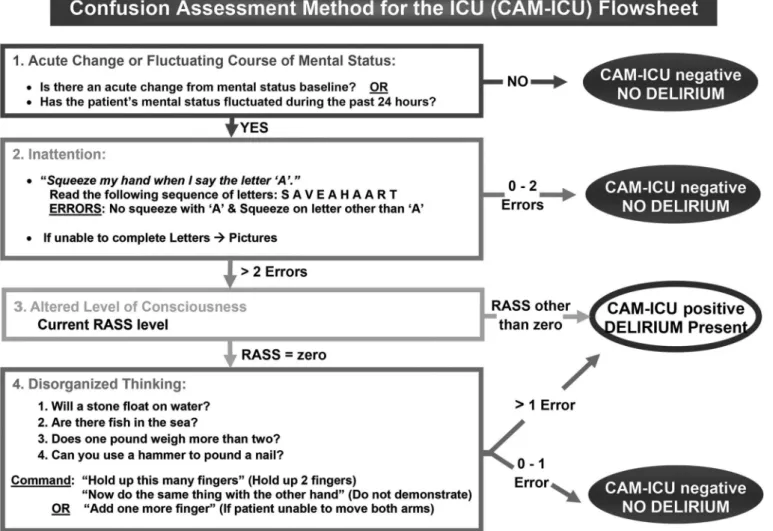
he tools validated for evaluation of delirium in an intensive care environment are the Confusion
Assessment Method-ICU (CAM-ICU)(5) (Figure 1) and
ICDSC.(4) Both scales were translated to Portuguese
(Brazil) by Salluh and Dal-Pizzol and validated by Gusmao-Flores et al.(44)
he Richmond Agitation- Sedation Scale (RASS), which integrates the CAM-ICU evaluation, also has
a validated Portuguese version.(45) he Portuguese and
English versions of CAM-ICU are available at http:// www.mc.vanderbilt.edu/icudelirium/docs/CAM_ ICU_lowsheet_Portugese_B.pdf and http://www. mc.vanderbilt.edu/icudelirium/docs/CAM_ICU_ lowsheet.pdf, respectively; but the Portuguese version of ICDSC has not been published (Figure 1 and Table 3).
Plaschke et al.(46) compared CAM-ICU with
ICDSC and found good agreement between the two tools.
Neto et al. conducted a systematic review and meta-analysis to evaluate the precision of the tools for screening delirium in critical patients. Sixteen studies published between 1966 and 2011 were included. It was found that sensitivity to evaluation of delirium is greater in ICDSC (80.1%) than CAM-ICU (75.5%). In contrast, CAM-ICU had greater speciicity (95.8% versus 74.6%). he authors detected high heterogeneity, which could be explained by the type of patients (neurological versus non-neurological) and by context
Figure 1 - Method of evaluating mental confusion in the ICU (Confusion Assessment in the ICU - CAM-ICU). Available at: http://www.mc.vanderbilt.edu/icudelirium/docs/ CAM_ICU_flowsheet.pdf. ICU - intensive care unit.
Table 3 - Richmond Agitation-Sedation Scale
Points Term Description
+ 4 Combative Overtly combative, violent, immediate danger to staff + 3 Very agitated Pulls or removes tube(s) or catheter(s); verbally aggressive + 2 Agitated Frequent non-purposeful movements; fights ventilator + 1 Restless Anxious, but movements are not aggressive or vigorous
0 Alert and calm
- 1 Drowsy Not fully alert, but has sustained awakening (eye-opening/eye contact) to voice (>10 seconds) - 2 Light sedation Briefly awakens with eye contact to voice (<10 seconds)
- 3 Moderate sedation Movement or eye opening to voice (but no eye contact)
- 4 Intense sedation No response to voice, but movement or eye opening to physical stimulation - 5 Does not wake No response to verbal or physical stimulation
Translated by Nassar Junior AP, Pires Neto RC, de Figueiredo WB, Park M. Validity, reliability and applicability of Portuguese versions of sedation-agitation scales among critically ill patients. Sao Paulo Med J. 2008;126(4):215-9.(45)
In pediatric patients, Smith et al. demonstrated that the Pediatric Confusion Assessment Method for the Intensive Care Unit (pCAM-ICU) has validity and reliability in
terms of identifying delirium in children when compared to the DSM-IV criteria employed by psychiatrists
Is the implementation of a delirium screening tool in an ICU practicable and sustainable? A number of studies including more than 2,000 patients conirm that it is. However, it is important to emphasize that the sustainability of this screening in clinical practice for 3 years was possible because it was accompanied by education strategies (didactic and at the patient bedside) for health care professionals, frequent reminders, quality evaluations and the participation of a multidisciplinary team that valued the role of the evaluation of delirium in daily clinical decisions.(30)
he evidence demonstrates that only when the screening of delirium is integrated into a well-deined protocol with strategies of action are clinical and
economic beneits observed.(49,50)
Prevention
Prevention involves understanding the predisposing and precipitating risk factors and is considered to be the most efective form of reducing the incidence of delirium. Many risk factors are modiiable by relatively easy and inexpensive interventions, such as sedation-limiting benzodiazepines, early mobilization, correction of hydroelectrolytic disturbances, prevention of hypoxia, early suspension of mechanical ventilation and removal of invasive devices. hese interventions, although they reduce the risk of delirium, are not widely used in ICUs
around the world.(51)
In this context, a new concept emerges: “liberation and animation.” he pillars of this approach are comfort and control of pain, the use of the least amount of sedation as possible, proactive strategies of weaning of of mechanical ventilation and the early initiation of occupational therapy. A proposed implementation of this approach is labeled “ABCDE” and consists
of “Awakening and Breathing coordination of daily
sedation and ventilator removal trials; Choice of
analgesic and, if needed, sedatives; Delirium monitoring
and management; Early mobility and exercise.(52)
Scientiic evidence supporting these measures was provided by Schweickert et al., who demonstrated that early exercise and mobilization, through daily physical and occupational therapy, reduce the duration of delirium (median of 2 days versus 4 days in patients
who did not undergo such exercise and mobilization).(53)
With regard to sedation and analgesia, the use of drugs associated with the development of delirium, such
as benzodiazepines (midazolam and lorazepam), must be avoided, in favor of drugs that are associated with a reduction of the prevalence of delirium, such as alfa2-agonists (for example, dexmedetomidine). Various randomized, controlled clinical trials have compared sedation approaches that used benzodiazepines or propofol with those that used dexmedetomidine.
In the MENDS study by Pandharipande et al.,(54)
dexmedetomidine was compared to lorazepam. he group of patients treated with dexmedetomidine had more days free of delirium (7 versus 3). When they compared various subgroups, the patients with sepsis
had a 70% reduction of daily risk of delirium.(55)
Riker et al.(56) observed a reduction of the prevalence
of delirium in a group sedated with dexmedetomidine compared to the group on midazolam (54% versus 76.6%). Strom et al. compared two groups: sedation with daily waking (propofol and a morphine bolus, with daily interruption of sedation) versus only analgesia without sedation (morphine bolus). In the intervention group, decreased mechanical ventilation time was observed during the stay in the ICU and in the hospital. However, hyperactive delirium was greater in patients who only received morphine (20% versus 7%). Additionally, that study did not use any of the scales validated for the ICU, and it did not identify patients with mixed or hypoactive delirium, which are
the more common forms in the ICU.(57)
he study by Mehta et al., which compared two sedation protocols, one with daily interruption of sedation and another without daily interruption, in patients on mechanical ventilation did not show a diference in the rate of delirium between the groups
(53.3% versus 54.1%).(58)
his approach of sedation and analgesia is integrated
in the concept of “conscious sedation target”,(59) in
which the patients must be kept awake whenever possible, even during the critical phases of the illness. However, this strategy has not been widely adopted due to potential risks of removing invasive devices and because healthcare professionals are concerned about the discomfort of the patients and the potential
increase in the workload.(60)
increase in survival.(52)
Inouye et al.(61) indicated other factors that can be
targets of intervention. hey used a sample of patients hospitalized outside of the ICU, which allows us to infer similar results in ICU patients. he interventions that they performed included correcting dehydration and electrolytic disturbances, non-pharmacological measures against sleep deprivation, early mobilization and use of eyeglasses and auditory devices.
Sleep deprivation is a potentially modiiable risk factor. Patients admitted into the ICU have a propensity for a reduced sleep quality, with fragmentation and other sleep disturbances. In healthy people, sleep deprivation causes inattention, luctuation in mental capacity and cognitive dysfunction, characteristics that are also present in patients with delirium. he ICU environment has abundant and strong risk factors for delirium and sleep disturbances, including medications such as benzodiazepines and propofol that impair slow-wave and rapid eye movement sleep, leading to serious sleep fragmentation. he relationship between sleep deprivation and delirium has been studied for many years, leading to the identiication of an association between them, but it has not been possible to establish a clear cause-efect relationship.(62)
In relation to environmental factors, some strategies have been proposed to prevent delirium in the ICU, such as the reduction of noise, minimizing exposure to artiicial light at night, optimization of the ambient temperature, improvement of communication techniques with patients, limitation of social isolation and restriction of mobility.(63)
Eforts at pharmacological prevention of delirium in ICUs have not yet shown conclusive results. With the development of the previously described PRE-DELIRIC predictive model, the early identiication of patients at risk for development of delirium permits the application of preventive measures in these patients. For the high-risk group, this predictive model facilitates speciic pharmacological interventions, although the evidence for the beneit of these measures is not strong.
In 2012, Reade et al. conducted a randomized, double-blind trial that studied the efect of intravenous haloperidol on the prevention of delirium in patients admitted into the ICU after non-cardiac surgery. Haloperidol leads to a reduction in the incidence
of delirium in the irst 7 days after surgery (15.3% versus 23.2%) and a reduction in ICU length of stay (21.3 hours versus 23 hours). Patients administered haloperidol had lower mortality at 28 days, although this efect lacked statistical signiicance.(64)
In 2013, van den Boogaard et al. implemented a policy of prevention of delirium in high-risk patients according to the PRE-DELIRIC model and evaluated their impact on the consequences of delirium. Patients with a predicted risk ≥50% and with a history of alcohol abuse or dementia were identiied and medicated with haloperidol (1 mg iv q8h), according to the designed prophylactic protocol. Prophylaxis with haloperidol resulted in a reduction in the incidence of delirium (65% versus 75%) and an increase in the number of days free of delirium (median of 20 days versus 13 days) in the intervention group compared to the control group. After Cox regression analysis using the presence of sepsis as a covariable, a 20% reduction in relative mortality at 28 days was obtained. he patients in the intervention group had a lower probability of removing tubes and catheters and of being readmitted to the ICU. However, signiicant diferences were not observed in the duration of mechanical ventilation, ICU length of stay, hospital length of stay or incidence of reintubation. Even though this study suggested that the prophylactic treatment of delirium with a low dose of haloperidol had beneicial efects, conirmation of the results is necessary with a randomized, controlled clinical trial.(65)
A randomized, controlled, double-blind clinical trial is underway [Preventing ICU Subsyndromal Delirium Conversion to Delirium With Low Dose IV Haloperidol: A Double-Blind, Placebo-Controlled Pilot Study (ClinicalTrials. gov Identiier:NCT01174290)] with the goal of determining whether haloperidol (1 mg iv q6h) administered to patients with subsyndromal delirium (ICDSC 1-3) prevents the development of clinical delirium (ICDSC≥4).
Treatment
Non-pharmacological measures are important in both the prevention and treatment of delirium and must be strongly encouraged.
used in recent years to treat delirium. However, as described in the 2013 Clinical Practice Guidelines for the Management of Pain, Agitation, and Delirium in
Adult Patients in the Intensive Care Unit, there is no
published evidence that haloperidol reduces the duration of delirium in adult patients in the ICU. Some studies have sought to clarify the role of atypical antipsychotics in the treatment of delirium. A meta-analysis from 2009 (he Cochrane Library)(66) compared only the results
from two studies: one examined the efects on delirium
of risperidone versus haloperidol(67) and the other
olanzapine versus haloperidol.(68) Neither risperidone nor
olanzapine had signiicantly diferent efects on delirium compared to haloperidol, nor were there diferences in the adverse efects of the low dose of haloperidol relative to the atypical antipsychotics studied. In two placebo-controlled studies,(68,69) patients who received haloperidol
or olanzapine showed signiicant improvement in the scales of delirium.
Another atypical, second-generation antipsychotic studied in the treatment of delirium is quetiapine. Devlin et al. compared quetiapine against a placebo in a double-blind, randomized clinical trial with a sample of 36 patients. hese patients were randomized into two branches of pharmacological treatment: quetiapine 50 mg bid versus placebo. All of the patients could receive haloperidol in SOS. In the patients treated with quetiapine, the time until resolution of delirium was less than 3.5 days versus 4.5 days for the placebo group; the need for haloperidol in SOS (3 versus 4 days) and the duration of agitation (6 versus 36 hours) were also lower. he diference in the mortality and complications (QT-long, extrapyramidal symptoms) was not statistically signiicant.(70)
Along with the above-cited recommendations, it must be emphasized that for the patients with delirium not related to alcoholic abstinence or benzodiazepines, dexmedetomidine must be administered as a sedative, instead of benzodiazepines, to reduce the duration of delirium in these patients.
he scientiic evidence in this area is limited, especially because it involves studies with small samples. For this reason, better-designed clinical trials with fewer limitations are needed to deine the best irst-line treatment for delirium.
CONCLUSIONS
Delirium is common in patients admitted to the ICU, is frequently under-diagnosed and inluences the prognosis. he irst step to change this paradigm is to seek, evaluate and identify the causes of delirium in the ICU. It is necessary to implement a protocol of systematic evaluation of the presence of delirium, using a scale validated for use in the ICU (CAM-ICU or ICDSC), with well-deined intervention objectives.
To prevent is better than to treat. For this reason, it is important to identify the risk factors, especially modiiable risk factors, as well as the groups of patients at greater risk of delirium. Prevention consists mainly of non-pharmacological measures, integrating the ABCDE approach without forgetting the unfavorable environment inherent to the ICU and interventions that are inexpensive and easy to perform. Among these non-pharmacological measures, early mobilization has a predominant role and is supported by growing scientiic evidence that it helps prevent delirium in the ICU. Sedation with dexmedetomidine instead of benzodiazepines is also associated with a reduction in the prevalence of delirium. In relation to pharmacological prevention, there appears to be a beneit to haloperidol at a low dose, but the scientiic evidence is still insuicient for that recommendation to be deinitive. he treatment of delirium must be considered a medical emergency. he drug of choice continues to be haloperidol, but some studies suggest that the atypical antipsychotics could play a beneicial role.
REFERENCES
1. American Psychiatric Association. Diagnostic and statistical manual of mental disorders. 4th ed. Washinton, DC: American Psychiatric Association; 2000.
2. Jeste D, Blacker D, Blazer D, Ganguli M, Grant I, Paulsen J, et al. Neurocognitive disorders: a proposal from the DSM-5 Neurocognitive Disorders Work Group. Neurocognitive Criteria Draft, American Psychiatric Association; 2010.
3. Ely EW, Inouye SK, Bernard GR, Gordon S, Francis J, May L, et al. Delirium in mechanically ventilated patients: validity and reliability of the confusion assessment method for the intensive care unit (CAM-ICU). JAMA. 2001;286(21):2703-10.
4. Bergeron N, Dubois MJ, Dumont M, Dial S, Skrobik Y. Intensive Care Delirium Screening Checklist: evaluation of a new screening tool. Intensive Care Med. 2001;27(5):859-64.
5. Salluh JI, Soares M, Teles JM, Ceraso D, Raimondi N, Nava VS, Blasquez P, Ugarte S, Ibanez-Guzman C, Centeno JV, Laca M, Grecco G, Jimenez E, Árias-Rivera S, Duenas C, Rocha MG; Delirium Epidemiology in Critical Care Study Group. Delirium epidemiology in critical care (DECCA): an international study. Crit Care. 2010;14(6):R210.
6. Agarwal V, O’Neill PJ, Cotton BA, Pun BT, Haney S, Thompson J, et al. Prevalence and risk factors for development of delirium in burn intensive care unit patients. J Burn Care Res. 2010;31(5):706-15.
7. Dubois MJ, Bergeron N, Dumont M, Dial S, Skrobik Y. Delirium in an intensive care unit: a study of risk factors. Intensive Care Med. 2001;27(8):1297-304. 8. Ely EW, Shintani A, Truman B, Speroff T, Gordon SM, Harrell FE Jr, et al.
Delirium as a predictor of mortality in mechanically ventilated patients in the intensive care unit. JAMA. 2004;291(14):1753-62.
9. Ouimet S, Kavanagh BP, Gotfried SB, Skrobik Y. Incidence, risk factors and consequences of ICU delirium. Intensive Care Med. 2007;33(1):66-73. 10. Ouimet S, Riker R, Bergeon N, Cossette M, Kavanagh B, Skrobik Y.
Subsyndromal delirium in the ICU: evidence for a disease spectrum. Intensive Care Med. 2007;33(6):1007-13. Erratum in Intensive Care Med. 2007;33(9):1677. Bergeon, Nicolas [corrected to Bergeron, Nicolas]. 11. van der Boogard M, Schoonhoven L, van der Hoeven JG, van Achterberg T,
Pickkers P. Incidence and short-term consequences of delirium in critically ill patients: a prospective observational cohort study. Int J Nurs Stud. 2012;49(7):775-83.
12. Cheung AM, Tansey CM, Tomlinson G, Diaz-Granados N, Matté A, Barr A, et al. Two-year outcomes, health care use, and costs of survivors of acute respiratory distress syndrome. Am J Respir Crit Care Med. 2006;174(5):538-44
13. Angus D, Musthafa AA, Clermonte G, Griffin MF, Linde-Zwirble WT, Dremsizov TT, et al. Quality-adjusted survival in the first year after the acute respiratory distress syndrome. Am J Respir Crit Care Med. 2001;163(6):1389-94. 14. Milbrandt EB, Deppen S, Harrison PL, Shintani AK, Speroff T, Stiles RA, et al.
Costs associated with delirium in mechanically ventilated patients. Crit Care Med. 2004;32(4):955-62.
15. Lin SM, Liu CY, Wang CH, Lin HC, Huang CD, Huang PY, et al. The impact of delirium on the survival of mechanically ventilated patients. Crit Care Med. 2004;32(11):2254-9.
16. Jackson JC, Gordon SM, Girard TD, Thomason JWW, Pun BT, Dunn J, et al. Delirium as a risk factor for long term cognitive impairment in mechanically ventilated ICU survivors. Am J Respir Crit Care Med 2007;175:A22. 17. MacLullich AM, Beaglehole A, Hall RJ, Meagher DJ. Delirium and
long-term cognitive impairment. Int Rev Psychiatry. 2009;21(1):30-42.
18. Hopkins RO, Jackson JC. Short- and long-term cognitive outcomes in intensive care unit survivors. Clin Chest Med. 2009;30(1):143-53, ix. 19. Morandi A, Pandharipande P, Trabucchi M, Rozzini R, Mistraletti G, Trompeo
AC, et al. Understanding international differences in terminology for delirium and other types of acute brain dysfunction in critically ill patients. Intensive Care Med. 2008;34(10):1907-15.
20. Salluh JI, Dal-Pizzol F, Mello PV, Friedman G, Silva E, Teles JM, Lobo SM, Bozza FA, Soares M; Brazilian Research in Intensive Care Network. Delirium recognition and sedation practices in critically ill patients: a survey on the attitudes of 1015 Brazilian critical care physicians. J Crit Care. 2009;24(4):556-62.
21. Pisani MA, Kong SY, Kasl SV, Murphy TE, Araujo KL, Van Ness PH. Days of delirium are associated with 1-year mortality in an older intensive care unit population. Am J Respir Crit Care Med. 2009;180(11):1092-7.
22. O’Keeffe S, Lavan J. The prognostic significance of delirium in older hospital patients. J Am Geriatr Soc. 1997;45(2):174-8.
23. Manos PJ, Wu R. The duration of delirium in medical and postoperative patients referred for psychiatric consultation. Ann Clin Psychiatry. 1997;9(4):219-26.
24. Levkoff SE, Evans DA, Liptzin B, Cleary PD, Lipsitz LA, Wetle TT, et al. Delirium. The occurrence and persistence of symptoms among elderly hospitalized patients. Arch Intern Med. 1992;152(2):334-40
25. Liptzin B, Levkoff SE. An empirical study of delirium subtypes. Br J Psychiatry. 1992;161:843-5.
26. Lipowski ZJ. Transient cognitive disorders (delirium, acute confusional states) in the elderly. Am J Psychiatry. 1983;140(11):1426-36.
27. Fick DM, Kolanowski AM, Waller JL, Inouye SK. Delirium superimposed on dementia in a community-dwelling managed care population: a 3-year retrospective study of occurrence, costs, and utilization. J Gerontol A Biol Sci Med Sci. 2005;60(6):748-53.
28. Devlin JW, Fong JJ, Fraser GL, Riker RR. Delirium assessment in the critically ill. Intensive Care Med. 2007;33(6):929-40. Review.
29. Macdonald A, Adamis D, Treloar A, Martin F. C-Reactive protein levels predict the incidence of delirium and recovery from it. Age Ageing. 2007;36(2):222-5.
30. Lemstra AW, Kalisvaart KJ, Vreeswijk R, van Gool WA, Eikelenboom PE. Pre-operative inflammatory markers and the risk of postoperative delirium in elderly patients. Int J Geriatr Psychiatry. 2008;23(9):943-8.
31. Tsuruta R, Nakahara T, Miyauchi T, Kutsuna S, Ogino Y, Yamamoto T, et al. Prevalence and associated factors for delirium in critically ill patients at a Japanese intensive care unit. Gen Hosp Psychiatry. 2010;32(6):607-11. 32. Ringdal M, Johansson L, Lundberg D, Bergbom I. Delusional memories
from the intensive care unit--experienced by patients with physical trauma. Intensive Crit Care Nurs. 2006;22(6):346-54.
33. Roberts BL, Rickard CM, Rajbhandari D, Reynolds P. Factual memories of ICU: recall at two years post-discharge and comparison with delirium status during ICU admission--a multicentre cohort study. J Clin Nurs. 2007;16(9):1669-77.
RESUMO
Entidade frequente em medicina intensiva, ocorrendo em até 80% dos doentes internados na unidade de cuidados inten-sivos, embora muito subdiagnosticado, o delirium está associado a aumento signiicativo da morbilidade e da mortalidade no
doente crítico. No presente artigo, foram revistos os principais fatores de risco, manifestações clínicas e abordagens preventi-vas e terapêuticas (farmacológicas e não farmacológicas) nessa doença.
34. Zhang Z, Pan L, Ni H. Impact of delirium on clinical outcome in critically ill patients: a meta-analysis. Gen Hosp Psychiatry. 2013;35(2):105-11. 35. Girard TD, Jackson JC, Pandharipande PP, Pun BT, Thompson JL, Shintani AK,
Gordon SM, et al. Delirium as a predictor of long-term cognitive impairment in survivors of critical illness. Crit Care Med. 2010;38(7):1513-20. 36. van den Boogaard M, Schoonhoven L, Evers AW, van der Hoeven JG, van
Achterberg T, Pickkers P. Delirium in critically ill patients: impact on long-term health-related quality of life and cognitive functioning. Crit Care Med. 2012;40(1):112-8.
37. Rothenhäusler HB, Ehrentraut S, Stoll C, Schelling G, Kapfhammer HP. The relationship between cognitive performance and employment and health status in long-term survivors of the acute respiratory distress syndrome: results of an exploratory study. Gen Hosp Psychiatry. 2001;23(2):90-6. 38. van den Boorgaard M, Pickkers P, Slooter AJ, Kuiper MA, Spronk PE, van
der Voort PH, et al. Development and validation of PRE-DELIRIC (PREdiction of DELIRium in ICu patients) delirium prediction model for intensive care patients: observational multicenter study. BMJ. 2012;344:e420.
39. Ely EW, Siegel MD, Inouye SK. Delirium in the intensive care unit: an under-recognized syndrome of organ dysfunction. Semin Respir Crit Care Med. 2001;22(2):115-26.
40. Barr J, Fraser GL, Puntillo K, Ely EW, Gélinas C, Dasta JF, Davidson JE, Devlin JW, Kress JP, Joffe AM, Coursin DB, Herr DL, Tung A, Robinson BR, Fontaine DK, Ramsay MA, Riker RR, Sessler CN, Pun B, Skrobik Y, Jaeschke R; American College of Critical Care Medicine. Clinical practice guidelines for the management of pain, agitation, and delirium in adult patients in the intensive care unit. Crit Care Med. 2013;41(1):263-306.
41. Pitrowsky MT, Shinotsuka CR, Soares M, Lima MA, Salluh JI. Importância da monitorização do delirium na unidade de terapia intensiva. Rev Bras Ter Intensiva. 2010;22(3):274-9.
42. Lundström M, Edlund A, Karlsson S, Brännström B, Bucht G, Gustafson Y. A multifactorial intervention program reduces the duration of delirium, length of hospitalization, and mortality in delirious patients. J Am Geriatr Soc. 2005;53(4):622-8.
43. Pandharipande P, Jackson J, Ely EW. Delirium: acute cognitive dysfunction in the critically ill. Curr Opin Crit Care. 2005;11(4):360-8. 44. Gusmao-Flores D, Salluh JI, Dal-Pizzol F, Ritter C, Tomasi CD, Lima MA,
et al. The validity and reliability of the Portuguese versions of three tools used to diagnose delirium in critically ill patients. Clinics (Sao Paulo). 2011;66(11):1917-22.
45. Nassar Junior AP, Pires Neto RC, de Figueiredo WB, Park M. Validity, reliability and applicability of Portuguese versions of sedation-agitation scales among critically ill patients. Sao Paulo Med J. 2008;126(4):215-9.
46. Plaschke K, von Haken R, Scholz M, Engelhardt R, Brobeil A, Martin E, et al. Comparison of The confusion assessment method for the intensive care unit (CAM-ICU) with the Intensive Care Delirium Screening Checklist (ICDSC) for delirium in critical care patients gives high agreement rate(s). Intensive Care Med. 2008;34(3):431-6. 47. Neto AS, Nassar AP Jr, Cardoso SO, Manetta JA, Pereira VG, Espósito DC,
et al. Delirium screening in critically ill patients: a systematic review and meta-analysis. Crit Care Med. 2012;40(6):1946-51. Review.
48. Smith HA, Boyd J, Fuchs DC, Melvin K, Berry P, Shintani A, et al. Diagnosing delirium in critically ill children: Validity and reliability of the Pediatric Confusion Assessment Method for the Intensive Care Unit. Crit Care Med. 2011;39(1):150-7.
49. Skrobik Y, Ahern S, Leblanc M, Marquis F, Awissi DK, Kavanagh BP. Protocolized intensive care unit management of analgesia, sedation, and delirium improves analgesia and subsyndromal delirium rates. Anesth Analg. 2010;111(2):451-63. Erratum in Anesth Analg. 2012;115(1):169. 50. Awissi DK, Bégin C, Moisan J, Lachaine J, Skrobik Y. I-SAVE study: impact
of sedation, analgesia, and delirium protocols evaluated in the intensive care unit: an economic evaluation. Ann Pharmacother. 2012;46(1):21-8. 51. Patel RP, Gambrell M, Speroff T, Scott TA, Pun BT, Okahashi J, et al. Delirium
and sedation in the intensive care unit: survey of behaviors and attitudes of 1384 healthcare professionals. Crit Care Med. 2009;37(3):825-32. 52. Vasilevskis EE, Ely EW, Speroff T, Pun BT, Boehm L, Dittus RS. Reducing
iatrogenic risks: ICU-acquired delirium and weakness--crossing the quality chasm. Chest. 2010;138(5):1224-33.
53. Schweickert WD, Pohlman MC, Pohlman AS, Nigos C, Pawlik AJ, Esbrook CL, et al. Early physical and occupational therapy in mechanically ventilated, critically ill patients: a randomised controlled trial. Lancet. 2009;373(9678):1874-82.
54. Pandharipande PP, Pun BT, Herr DL, Maze M, Girard TD, Miller RR, et al. Effect of sedation with dexmedetomidine vs lorazepam on acute brain dysfunction in mechanically ventilated patients: The MENDS randomized controlled trial. JAMA. 2007;298(22):2644-53.
55. Pandharipande PP, Sanders RD, Girard TD, McGrane S, Thompson JL, Shintani AK, Herr DL, Maze M, Ely EW; MENDS investigators. Effect of dexmedetomidine versus lorazepam on outcome in patients with sepsis: an a priori-designed analysis of MENDS randomized controlled trial. Crit Care. 2010;14(2):R38. Erratum in: Crit Care. 2011;15(1):402.
56. Riker RR, Shehabi Y, Bokesch PM, Ceraso D, Wisemandle W, Koura F, Whitten P, Margolis BD, Byrne DW, Ely EW, Rocha MG; SEDCOM (Safety and Efficacy of Dexmedetomidine Compared With Midazolam) Study Group. Dexmedetomidine vs midazolam for sedation of critically ill patients: a randomized trial. JAMA. 2009;301(5):489-99.
57. Strom T, Martinussen T, Toft P. A protocol of no sedation for critically ill patients receiving mechanical ventilation: a randomised trial. Lancet. 2010;375(9713):475-80.
58. Mehta S, Burry L, Cook D, Fergusson D, Steinberg M, Granton J, Herridge M, Ferguson N, Devlin J, Tanios M, Dodek P, Fowler R, Burns K, Jacka M, Olafson K, Skrobik Y, Hébert P, Sabri E, Meade M; SLEAP Investigators; Canadian Critical Care Trials Group. Daily sedation interruption in mechanically ventilated critically ill patients cared for with a sedation protocol: a randomized controlled trial. JAMA. 2012;308(19):1985-92. Erratum in JAMA. 2013;309(3):237
59. Cigada M, Corbella D, Mistraletti G, Forster CR, Tommasino C, Morabito A, et al. Conscious sedation in the critically ill ventilated patient. J Crit Care. 2008;23(3):349-53.
60. Guttormson JL, Chlan L, Weinert C, Savik K. Factors influencing nurse sedation practices with mechanically ventilated patients: a U.S. national survey. Intensive Crit Care Nurs. 2010;26(1):44-50.
61. Inouye SK, Bogardus ST Jr, Charpentier PA, Leo-Summers L, Acampora D, Holford TR, et al. A multicomponent intervention to prevent delirium in hospitalized older patients. N Engl J Med. 1999;340(9):669-76.
62. Figueroa-Ramos MI, Arroyo-Novoa CM, Lee KA, Padilla G, Puntillo KA. Sleep and delirium in ICU patients: a review of mechanisms and manifestations. Intensive Care Med. 2009;35(5):781-95.
63. Wenham T, Pittard A. Intensive care unit environment. Contin Educ Anaesth Crit Care Pain. 2009;9(6):178-83.
64. Reade MC. The largest ever trial demonstrating effectiveness of intensive care unit delirium prophylaxis--we must know more! Crit Care Med. 2012;40(8):2540.
65. van den Boogaard M, Schoonhoven L, van Achterberg T, van der Hoeven JG, Pickkers P. Haloperidol prophylaxis in critically ill patients with a high risk for delirium. Crit Care. 2013;17(1):R9. [Epub ahead of print]
66. Siddiqi N, Stockdale R, Britton AM, Holmes J. Interventions for preventing delirium in hospitalised patients. Cochrane Database Syst Rev. 2007;(2):CD005563.
67. Han CS, Kim YK. A double-blind trial of risperidone and haloperidol for the treatment of delirium. Psychosomatics. 2004;45(4):297-301. 68. Hu H, Deng W, Yang H. A prospective random control study: comparison
of olanzapine and haloperidol in senile delirium. Chongging Med J. 2004;8:1234-7.
69. Kalisvaart KJ, de Jonghe JF, Bogaards MJ, Vreeswijk R, Egberts TC, Burger BJ, et al. Haloperidol prophylaxis for elderly hip-surgery patients at risk for delirium: a randomized placebo-controlled study. J Am Geriatr Soc. 2005;53(10):1658-66.