270
Rev Dor. São Paulo, 2016 oct-dec;17(4):270-3
ABSTRACT
BACKGROUND AND OBJECTIVES: he interest on
Ani-mal-Assisted Activity, Education and herapy is growing in Bra-zil. Only in the last decade, Brazilian investigators have started scientiic studies aiming at evaluating the efectiveness of Animal-Assisted Activity, Education and herapy as from international literature references. he methodological option of developing this project in hospital environment comes to meet the increas-ing interest of such institutions in introducincreas-ing animals durincreas-ing the hospitalization period of patients, especially children. he presence of animals seems to produce signiicant socioemotion-al beneits as adjuvant to clinicsocioemotion-al management of hospitsocioemotion-alized patients. his study aimed at evaluating the efects of Animal-Assisted Activity on pain sensation of hospitalized children and adolescents.
METHODS: his is an intervention, quantitative and qualita-tive research. Participated in the study 17 patients aged as from 7 years, hospitalized in the Hospital Infantil Sabará, with pain complaints. Participant co-therapist dogs were Bruce (large size) and Sheep (small size). Pain numerical scale was applied before and after Animal-Assisted Activity, Education and herapy.
RESULTS: here are evidences, in the studied population, that this activity was efective to decrease patients’ self-referred pain, in addition to improving emotional aspects of hospitalization, conirming literature data on the subject.
CONCLUSION: here has been signiicant pain decrease after intervention with dogs, conirming some international studies carried out on the subject.
Keywords: Adolescent, Animal-assisted therapy, Hospitaliza-tion, Hospitalized children, Pain.
Animal-assisted activity and pain sensation in hospitalized children and
adolescents
Atividade assistida por animais e sensação de dor em crianças e adolescentes hospitalizados
Tatiane Ichitani1, Maria Claudia Cunha1
1. Pontifícia Universidade Católica de São Paulo, Faculdade de Ciências Humanas e da Saúde, Programa Estudos Pós-Graduados em Fonoaudiologia, São Paulo, SP, Brasil.
Submitted in May 18, 2016.
Accepted for publication in November 01, 2016.
Conlict of interests: none – Sponsoring sources: Bolsa CNPq.
Correspondence to: Tatiane Ichitani Rua Assungui, 700/191 04131-001 São Paulo, SP, Brasil. E-mail: [email protected]
© Sociedade Brasileira para o Estudo da Dor
RESUMO
JUSTIFICATIVA E OBJETIVOS: Cresce o interesse sobre Atividade, Educação e Terapia Assistida por Animais no Brasil. Somente na última década, pesquisadores brasileiros iniciaram investigações cientíicas com vistas a avaliar a efetividade do tra-balho com Atividade, Educação e Terapia Assistida por Animais, a partir de referências da literatura internacional. A opção me-todológica de desenvolver esse projeto em ambiente hospitalar vem ao encontro do interesse crescente dessas instituições em introduzir os animais durante o período de hospitalização dos pacientes, especialmente as crianças. A presença dos animais parece produzir benefícios sócioemocionais signiicativos como adjuvante ao tratamento clínico de pacientes hospitalizados. O objetivo deste estudo foi avaliar os efeitos da Atividade Assistida por Animais na sensação de dor em crianças e adolescentes hos-pitalizados.
MÉTODOS: Trata-se de pesquisa de intervenção, de natureza quantitativa e qualitativa. Participaram do estudo 17 pacientes a partir de 7 anos de idade, hospitalizados no setor de internação do Hospital Infantil Sabará, com queixa de dor. Os cães cotera-peutas participantes foram Bruce (porte grande) e Sheep (porte pequeno). A escala numérica de dor foi aplicada antes e depois da Atividade, Educação e Terapia Assistida por Animais.
RESULTADOS: Na população estudada, há evidências de que a esta atividade demonstrou eicácia quanto à redução da dor autorreferida pelos pacientes, além de melhorar aspectos emocio-nais sobre a hospitalização, corroborando dados bibliográicos de pesquisas realizadas sobre o tema.
CONCLUSÃO: Houve diminuição signiicativa da sensação de dor após a intervenção com o cão, corroborando com alguns es-tudos internacionais já realizados sobre o tema.
Descritores: Adolescente, Criança hospitalizada, Dor, Hospitali-zação, Terapia assistida por animais.
INTRODUCTION
his study addresses the efect of Animal-Assisted Interven-tion (AAI) and pain sensaInterven-tion, in the context of hospital-ized children and adolescents. here is increasing interest on Animal-Assisted Activity, Education and herapy (AAA, AAE and AAT) in Brazil. However, in some countries such as the United States, Canada and France, animals to help treating people have been already introduced some decades ago. he International Association of Human-Animal Interactions Organizations (IAHAIO) is responsible for supplying
interna-ORIGINAL ARTICLE
271
Animal-assisted activity and pain sensation in hospitalized children and adolescents
Rev Dor. São Paulo, 2016 oct-dec;17(4):270-3
tional leaderships in the advance of the man-animal interaction ield, supporting studies, education and cooperation between its members and other organizations dedicated to the subject. It names and deines AAI as approach with oriented and structured objective which incorporates animals to human health, educa-tion and service areas, aiming at therapeutic beneits. It includes Animal-Assisted herapy, Education and Activity1 (Table 1).
Table 1. Deinition of Animal-Assisted Intervention modalities1
Animal-Assisted Therapy: therapeutic oriented, structured and planned intervention with deined objectives and monitored by he-alth area professionals.
Animal-Assisted Education: intervention with oriented, structured and planned objective and directly linked to education, always mo-nitored by a professor and/or pedagogue1.
Animal-Assisted Activity: informal, however planned, intervention and visit, with educational, motivational and recreational objectives.
Considering that hospitalization is one of the most stressful events for children, generating high levels of anxiety and fear2, the development of this study in hospital environment comes to meet the increasing interest of such institutions in intro-ducing animals during the hospitalization period, especially for children. he presence of animals may bring signiicant socio-emotional beneits as adjuvant to clinical treatment of hospitalized patients3.
here are few studies in this scenario articulating pain and AAI in hospitalized children and adolescents, all with results favoring the use of the technique4-8.
As from these considerations, the objective of this study was deined: to evaluate the efect of AAA on pain intensity of hospitalized children and adolescents.
METHODS
his is an intervention and quantitative study carried out ac-cording to guidelines and rules regulating studies involving hu-man beings of the National Health Council, resolution 196/96. Participated in the study only patients authorized by parents or tutors, according to signature of the Free and Informed Consent Term (FICT). he study was carried out in Hos-pital Infantil Sabará (HIS) in São Paulo/SP, reference center of pediatric assistance, in the hospitalization sector, during October 2014 to April 2015.
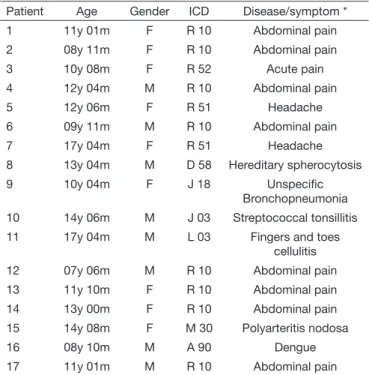
Sample was of convenience, participating in the study 17 hos-pitalized children/adolescents of both genders, aged as from 7 years (Table 2).
Inclusion criteria were children and adolescents hospital-ized in the admission sector (individual rooms), with verbal expression capacity (which justiied established age), with pain complaint associated to any baseline disease, accepting contact with dogs, physical status allowing interaction with animals, preserved cognition, awake and conscious, in condi-tions to answer the questionnaire and ill the scales (even if unable to leave the bed).
Exclusion criteria were patients admitted to isolation, with severe allergy to dogs’ fur and saliva, severely
immunocom-promised, with fear of interacting with dogs and diiculty to orally communicate.
Co-therapist animals
Participated in the study two co-therapist dogs, Bruce, an Old English sheepdog (large size), 8 years old, and Sheep, Shih-tzu (small size), 6 years old, both castrated. Both went through constant evaluations of behavior and health for their own safety and of the subjects. he number of dogs was es-tablished in two so that they could work in shifts, assuring animals’ wellbeing during data collection period.
Procedure
Para garantir a segurança durante a coleta de dados, foram seguidos alguns itens importantes de saúde e comportamento baseado em protocolos internacionais, a saber9:
To assure safety during data collection, some important health and behavior items based in international protocols were followed, namely9:
a) Hands hygiene:
• Hygiene of patient, escort and team hands before and after contact with the animal;
• Hygiene of investigator’s hands before and after each inter-vention with patient;
b) Animal’s temperament:
• Evaluation of animal’s temperament and behavior, checking: reactions to unknown people; reaction to high sound and/or new stimulation; reaction to aggressive voice or threatening gestures; reaction to crowded places; reaction to vigorous and clumsy cuddles; reaction to strong embrace; reaction to other animals; ability to follow conductor’s commands;
• Interrupt visits if the animal has fear or aggressiveness behavior.
Table 2. Patients’ characterization
Patient Age Gender ICD Disease/symptom * 1 11y 01m F R 10 Abdominal pain 2 08y 11m F R 10 Abdominal pain 3 10y 08m F R 52 Acute pain 4 12y 04m M R 10 Abdominal pain 5 12y 06m F R 51 Headache 6 09y 11m M R 10 Abdominal pain 7 17y 04m F R 51 Headache 8 13y 04m M D 58 Hereditary spherocytosis 9 10y 04m F J 18 Unspeciic
Bronchopneumonia 10 14y 06m M J 03 Streptococcal tonsillitis 11 17y 04m M L 03 Fingers and toes
cellulitis 12 07y 06m M R 10 Abdominal pain 13 11y 10m F R 10 Abdominal pain 14 13y 00m F R 10 Abdominal pain 15 14y 08m F M 30 Polyarteritis nodosa 16 08y 10m M A 90 Dengue 17 11y 01m M R 10 Abdominal pain
272
Ichitani T and Cunha MC Rev Dor. São Paulo, 2016 oct-dec;17(4):270-3
c) Animal health:
• Vaccination against rabies, V8 or V10, giardia, canine cough;
• Not allowing animal to visit and put it in observation for one week in case of: vomiting or diarrhea; urinary or fecal incontinence; cough or sneezing of unknown cause; open wound, otitis, skin infection and heat;
• Veterinary monitoring and evaluation performing lees, tickles and parasites control, isolating and treating infested animals;
• Present routine exams speciic for parasites. d) For visits:
• Brush animal’s fur before the visit;
• Bath up to 24 hours before the visit;
• Cut animal’s nails;
• Keep collars and guides clean and odorless;
• Not getting in contact with immunocompromised or iso-lated patients.
Co-therapist dogs were introduced in the HIS environment to be familiar with routine, noises and odors in general. Two weekly introductory visits were performed (one with each dog), lasting 30 minutes, during November 2014. A nurse in charge and cooperator has monitored this procedure to intro-duce the hospitalization sector and most adequate places for dogs circulation.
Two shifts were done per week, one with each dog, in pre-determined days. During the shift, supervisor nurse of the hospitalization sector would visit all loors evaluating patients with regard to pain complaints. After evaluation, those with some pain complaint at that moment were indicated. he use or not of analgesics was deined by hospital’s pain protocol, according to patient’s need and clinical status.
Data collection protocol
Stage 1: person responsible for the patient was invited by the investigator to leave the room to be explained about the proce-dure. After explanations and having been given the authoriza-tion, the investigator would enter the room without the dog.
Stage 2: application of the pain numerical scale with the fol-lowing explanation: “in a scale from zero to 10, were zero means ‘no pain’ and 10 means ‘maximum pain’, tell me the number representing your pain right now”.
Stage 3: AAA session lasting 5 to 10 minutes. Dog’s guide was removed in all interventions considering: low complex-ity of patients; highly controlled environment with regard to noises and circulation of people or equipment; dogs well ex-perienced with AAI, providing safety to all involved parties. Activities were spontaneously chosen by patients. he inves-tigator has interfered the least in this activity, just answering questions which were always about the dogs.
Stage 4: reapplication of the pain scale at the end of the ses-sion, without the presence of the dog.
Statistical analysis
Data descriptive analysis was carried out by means of absolute and relative frequencies, central trend measures (mean and median) and dispersion (standard deviation, minimum and maximum).
For inferential analysis, irst the adherence to normal curve was checked with paired outcome variable Kolmogorov-Smirnov test and since it has presented normality, paired Student t test was applied to evaluate pain scores before and after intervention. Un-paired Student t test was also applied to evaluate the diference between groups with regard to initial pain, to identify possible diferences as compared to the beginning of the study.
Descriptive level of 5% (p<0.05) was adopted for statistical signiicance. Data were tabulated in Excel spreadsheet and analyzed by the program SPSS version 17.0 for Windows. his project was approved by the Ethics Committee, PUC-SP under CAAE 31880314.4.0000.5482, in 04/08/2014.
RESULTS
Studied population characterization (17 patients) is shown in table 3.
Table 3. Number and percentage of hospitalized patients, according to demographic and clinical characteristics
Variables Category n (%)
Gender Female 9 (52.9)
Male 8 (47.1)
Type of disease Acute 15 (88.2) Chronic 2 (11.8)
Analgesics No 9 (52.9)
Yes 8 (47.1)
Receptivity No# 1 (5.9)
Yes 16 (94.1)
Disposition No# 1 (5.9)
Yes 16 (94.1)
Mobility No 8 (47.1)
Yes 9 (52.9)
Escort Mother 13 (76.5)
Father 2 (11.8) Grandfather/grandmother 1 (5.9)
Uncle/Aunt 1 (5.9)
Total 17 (100.0)
# Patient has initially refused the presence of the dog, however has changed his
mind and went through the whole protocol.
here has been balanced distribution of genders. Mean age was 12.1±2.8, median 11.8, varying from 7.5 to 17.4 years of age.
Mean time between drug ingestion and AAA was 129.6 min-utes (SD=78.4), median of 106.5 minmin-utes, minimum of 53 and maximum of 266 minutes.
Most frequent AAA activities were: cuddling, chatting, giving snacks, playing, taking pictures, asking for obedience com-mands.
273
Animal-assisted activity and pain sensation in hospitalized children and adolescents
Rev Dor. São Paulo, 2016 oct-dec;17(4):270-3
Hospitalization time had broadly varied: mean of 3.3±4.6 days, median of 1, varying from less than 24 hours to 16 days. With regard to outcome, there has been statistically sig-niicant diference between moments before and after AAA. Mean pain before intervention was 5.6±2.4 and after AAA it went to 4±3.2, with 1.6 points decrease (p=0.004). To assure such results, analysis was structured according to the use of analgesics and, again, there has been statistically signiicant decrease in pain levels after AAA (Table 4).
DISCUSSION
here are evidences, in the studied population, that AAA was efective to decrease patients’ self-referred pain, conirm-ing literature data of studies carried out on the subject4,5,7. Without AAA children are subject to receive more painkillers, which may bring undesirable side-efects4.
Even not observing decreased pain sensation in some patients, it may be suggested that there is promotion of distraction, pleasure, leisure, welcome and tranquility4. Some studies have not shown signiicant pain sensation decrease, however they suggest that children with sound afective bonds had further decrease, suggesting that afection may be an important vari-able to be investigated and taken into consideration6, in addi-tion to decreasing distress and improving cognitive, physical, social and emotional functions8.
It was observed that most AAA activities were “cuddling” and “chatting”. Such result might be associated to metabolic ef-fects of this type of interaction, since during contact with the animal, there are hormonal changes which may explain pain improvement, namely: endorphine production stimulation10, increased oxytocin, prolactin and dopamine after 5 to 24 min-utes cuddling the animal11,12. In addition, increased oxytocin by means of AAI decreases the level of stress and anxiety, stimu-lating social interactions and intensifying human health13. here may also be physiological factors improvement, such as decreased heart rate, blood pressure, body temperature, breathing level and pupil constriction, signaling relaxation10, indicators associated to decreased pain sensation. Similarly, studies suggest that AAI might lead to distraction/redirection-ing of a problem, possible explanation for pain improvement.
he beneits of AAA for pain sensation observed in this study should be analyzed/evaluated under the perspective that the proposal is not to indicate the intervention as isolated option to manage pain, but rather as complementary therapy14.
CONCLUSION
here has been signiicant pain sensation decrease after inter-vention with dogs, conirming some international studies on the subject, showing the importance of future studies in the area, which are still scarce in Brazil.
REFERENCES
1. IAHAIO. IAHAIO White Paper, 2014. Disponível em: http://www.iahaio.org/new/ ileuploads/4163IAHAIO WHITE PAPER- FINAL - NOV 24-2014.pdf. Acesso em 05/08/2015.
2. Mahat G, Scoloveno M. Comparison of fears and coping strategies reported by Nep-alese school-age children and their parents. J Pediatr Nurs. 2003;18(5):305-13. 3. Morales LJ. Visita terapêutica de mascotas em hospitales. Rev Chil Infect.
2005;22(3):257-63.
4. Sobo EJ, Eng B, Kassity-Krich N. Canine visitation (pet) therapy: pilot data on de-creases in child pain perception.J Holist Nurs. 2006;24(1):51-7.
5. Braun C, Stangler T, Narveson J, Pettingell S. Animal-assisted therapy as a pain relief intervention for children. Complement her Clin Pract. 2009;15(2):105-9. 6. Barker SB, Knisely JS, Schubert CM, Green JD, Ameringer S. he efect of an
an-imal-assisted intervention on anxiety and pain in hospitalized children. Anthrozoos. 2015;28(1):101-12.
7. Calcaterra V, Veggiotti P, Palestrini C, De Giorgis V, Raschetti R, Tumminnelli M, et al. Post-operative beneits of animal-assisted therapy in pediatric surgery: a random-ized study. PLoS-ONE. 2015;10(6):0125813.
8. Vagnoli L, Caprilli S, Vernucci C, Zagni S, Mugnai F, Messeri A. Can presence of a dog reduce pain and distress in children during venipuncture? Pain Manag Nurs. 2015;16(2):89-95.
9. Lefebvre SL, Golab GC, Christensen E, Castrodale L, Aureden K, Bianchowski RN, et al. Guidelines for animal-assisted interventions in heath care facilities. Am J Infect Control. 2008;36(2):78-85.
10. Cole KM, Gawlinski A. Animal-assisted therapy: the human-animal bond. AACN Clin Issues. 2000;11(1):139-49.
11. Odendaal JS, Meintjes RA. Neurophysiological correlates of affiliative behaviour be-tween humans and dogs. Vet J. 2003;165(3):296-301.
12. Handling L, Sandberg EH, Nilsson A, Ejdeback M, Janson A, Uvnas-Moberg K. Short-term interaction between dogs and their owners – efects on oxytocin, cortisol, insulin and heart rate – an exploratory study. Anthrozoos. 2001;24(3):301-15. 13. Beetz A, Uvnäs-Moberg K, Julius H, Kotrschal K. Psychosocial and
psychophysiologi-cal efects of human-animal interactions: the possible role of oxytocin. Front Psychol. 2012;3:234.
14. Marcus DA, Bernstein CD, Constantin JM, Kunkel FA, Breuer P, Hanlon RB. Animal-Assisted herapy at an outpatient pain management clinic. Pain Med. 2012;13(1):45-57.
15. Odendaal JS. Animal-assisted therapy-magic ou medicine?J Psychosom Res. 2000;49(4):275-80.
Table 4. Quantitative pain analysis before and after animal-assisted activity, according to the use of analgesics
Variables Moment n Mean (SD) Median Minimum Maximum p value*
Pain Before 17 5.6 (2.4) 5 2 10 0.004
After 17 4.0 (3.2) 4 0 10
Pain without analgesics Before 9 4.7 (2.4) 4 2 8 0.030
After 9 3.7 (2.6) 4 0 7
Pain with analgesics Before 8 6.6 (2.2) 7 4 10 0.041
After 8 4.4 (3.8) 4.5 0 10