12 artigo 512
ORIGINAL ARTICLE
1- Orthopedic Physician of the Orthopedics and Traumatology Service, Hospital das Clínicas of the UFPE, assistant professor of the Cariri Faculty of Medicine of the Uni-versidade Federal do Ceará, Master’s degree student on the Postgraduate Program in Pathology of the CCS - Recife-PE, Brazil.
2 -Social Assistant at the Hospital das Clínicas of the Universidade Federal de Pernambuco. Postgraduate in Social Policy, Social Rights and Professional Competencies. Master’s degree student on the Postgraduate Program in Social Service at the Universidade Federal de Pernambuco Recife-PE, Brazil.
3 -Social Assistant at the Hospital das Clínicas of the Universidade Federal de Pernambuco. Postgraduate in Family Health Recife-PE, Brazil.
4- Doctorate in Orthopedics and Traumatology from the Universidade Federal de São Paulo, Tenured Professor at the Surgery Department of the Universidade Federal de Pernambuco. Coordinator of the Orthopedics Discipline of the UFPE - Recife-PE, Brazil.
Work carried out at the Orthopedics and Traumatology Service of the Hospital das Clínicas of the Universidade Federal de Pernambuco.
Correspondence: Hospital das Clínicas da UFPE. Av. Professor Moraes Rego, SN. Cidade Universitária, Recife-PE, Brazil. 50670-420 - E-mail: [email protected]
Received for publication: 04/29/2011, accepted for publication: 06/22/2011
qUALITy OF LIFE AND SOCIAL CHARACTERISTICS OF PATIENTS
SUbMITTED TO TOTAL KNEE ARTHROPLASTy
Marcelo Parente Oliveira1, Aurora Marcionila de Assunção Ferreira2, Roberta Xavier Ramos Cordeiro3, Jairo de Andrade Lima4
The authors declare that there was no conflict of interest in conducting this work
This article is available online in Portuguese and English at the websites: www.rbo.org.br and www.scielo.br/rbort
ABSTRACT
Objective: To study the quality of life (QL) and social characteristics of patients submitted to total knee arthro-plasty (TKA). Methods: The Brazilian validated version of the SF-36 Quality of Life Questionnaire was applied during the pre- and postoperative periods to assess the effect of TKA in QL. A semi-structured social question-naire was used for the survey of patients’ socioeconomic profile. Results: Some characteristics were observed in the participants’ socioeconomic parameters, such as the pre-dominance of females, age above sixty years old, family income up to three minimum salaries, patients’ partici-pation in family income, living together with other
co-habitants, educational level up to high school; and living in urban periphery housing. Regarding SF-36, there was a statistically significant rise in corresponding values in postoperative assessment when compared with the pre-operative assessment in all domains. Conclusion: TKA was capable of bringing a significant improvement in quality of life. In terms of social and economic profile of this group of patients submitted to TKA, it was observed that this pro-file was predominantly female, aged over sixty years, with low educational level, and limited economic resources.
Keywords - Arthroplasty, Replacement, Knee;Quality of Life; Social Conditions
INTRODUCTION
Total knee arthroplasty (TKA) is a high-complex-ity procedure in which the aim is to relieve pain and improve function at advanced stages of degenerative joint disease, when conservative measures and other possible surgical options with less morbidity become incapable of providing satisfactory treatment(1-3). At
these stages of the disease, the consequences for the patient’s general health, in its broadest view, result in in compromised quality of life(4-6). Thus, it becomes
fundamentally important to use an interdisciplinary approach towards listening to and guiding such pa-tients, since a successful response to the surgical treat-ment also depends on the patients’ adaptation to the preoperative and postoperative care, and their
aware-ness of the objectives, risks and proposed benefits(1,3).
An interdisciplinary assessment may indicate what conditions would be satisfactory for achieving pos-sible success in the treatment, at the different levels within each specialty(1).
From this perspective, the role of TKA in impro-ving QOL was examined, with a view to assessing the impact of the changes that really might interfere with the “physical, mental and social wellbeing” of pa-tients undergoing this procedure. The aim of the study was not to focus not on the technical issues of TKA, but to consider these parameters within the subjects’ universal characteristics and within the changes that the treatment will establish in their lives, in relation not only to the pain factor and the functional improve-ment of the knee (which have been extensively co-vered in the specialized literature) but also to aspects of the subjects’ family, social and occupational lives.
METHOD
This study was conducted between September 2009 and November 2010, among patients at the Or-thopedics and Traumatology Service of Hospital das Clínicas, Federal University of Pernambuco (HC/ UFPE). Patients with conditions of degenerative joint disease of the knee at an advanced stage who had been assessed by the interdisciplinary team and had received an indication for TKA were included.
Concomitantly, two evaluation instruments were used: the validated Brazilian version of the SF-36 quality-of-life questionnaire(8) and a
semi-struc-tured social questionnaire drawn up by the Social Service of HC/UFPE. The SF-36 QOL assessment instrument was used to analyze the data obtained through the investigation and to evaluate the results. In parallel, the social questionnaire was used with the aim of separately analyzing socioeconomic character-istics within the subjects’ universe of realities. Both of these instruments were applied individually before the surgical procedure, at the time of the patients’ hospital admission. The SF-36 QOL questionnaire was reapplied in the sixth month after the operation.
The SF-36 QOL questionnaire is used to ascertain patients’ physical and mental health. The points given for each question are transformed into scores for eight domains, which can range from 0 to 100, such that 0 is the worst score and 100 is the best score for each domain. The domains analyzed relate to functional capacity, limitations due to physical tors, pain, general state of health, vitality, social fac-tors, emotional factors and mental health.
The aim was to assess all of the patients who un-derwent primary TKA during the study period. Every month, the Orthopedics and Traumatology Service
of HC/UFPE admits around eight patients have this procedure done, which should have produced a total of around 48 procedures during the first six months of this study, when the instruments would be applied pre-operatively. However, because of factors of a struc-tural nature within the institution, it was only possible to select a total of 23 patients. Of these, 17 underwent the proposed surgery; the remaining six patients (who did not undergo surgery), and one of the patients who underwent surgery, only had an initial assessment and therefore did not participate in the second phase of the study, which consisted of applying the QOL evalua-tion instruments in the sixth postoperative month. The reasons for the occurrences relating to the latter seven patients were as follows:
One of the patients who underwent the surgical procedure presented a neurological disease that im-peded the quality-of-life assessment after the surgery. This patient was referred for neurological care and is being followed up;
One patient did not undergo surgery because of a reassessment by the interprofessional team, given that it was observed that the patient was not in a satisfac-tory psychosocial condition to undergo surgery;
Three patients did not undergo the proposed sur-gery after reassessment by the medical team; it was considered that because of certain clinical factors, they should be referred for another type of treatment;
Two patients did not undergo the surgery because, for structural reason relating to the institution, their operations were cancelled twice and the treatment was thus postponed.
The 16 patients who participated in both stages of the study underwent TKA and were interviewed be-fore the operation using both assessment instruments and after the operation using the SF-36 quality-of-life questionnaire.
The data were stored and descriptive statistics were used to produce tables and the other quantitative results that are presented. To evaluate hypotheses, the
Kolmogorov-Smirnov test was used to ascertain wheth-er the distribution was normal; if the data wwheth-ere non-normal, the Wilcoxon nonparametric test was used.
RESULTS
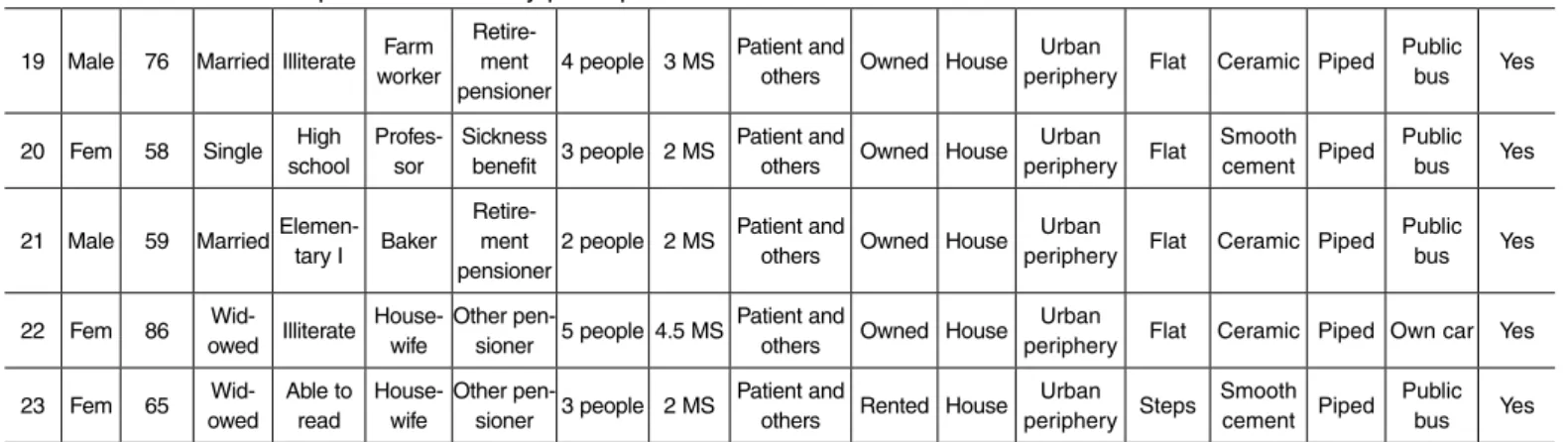
The socioeconomic profile was constructed through identifying the socioeconomic conditions expressed in the social questionnaire, using the total of 23 patients who participated in the study, i.e. even those who did not participate in the second phase. It was observed that out of the 23 patients studied, 17 were female and six were male, with a mean age of 68.4 years (ranging from 58 to 86 years). The questions relating to marital status, schooling level, profession, social security situ-ation, family composition, family income, housing and transportation are detailed in Table 1.
The main descriptive measurements for the vari-ables relating to the SF-36 questionnaire, which was applied before and after the surgery among the 16 patients who participated in both stages of the study, are detailed in Table 2. We observed that in all the domains, there were statistically significant increases in the values from the postoperative assessments, in relation to the preoperative assessments, as demons-trated by the Wilcoxon nonparametric test. This test was chosen because the analyses were on two related samples (before and after) and because the hypothesis of normal distribution of the variables was rejected through the Kolmogorov-Smirnov test, in each of the domains. The p-values resulting from the Wilcoxon test led to rejection of the hypothesis of equality of means, i.e. they showed that there were significant differences between the values of all the domains, which reinforced the analysis that had been done previously.
DISCUSSION
With the development and universalization of modern knee arthroplasty, the introduction of va-rious prosthesis models and the different methods for dealing with surgical technique issues (such as management of the posterior cruciate ligament and the femoropatellar joint), it has become fundamental to develop methods to assess the results. Within this context, the Hospital for Special Surgery Knee Score and the Knee Society Score have become the two systems that are most used(9). Because these systems
deal with TKA through the specific knee surgery re-sults or through the functional result relating directly to the knee, they lack data providing information on the consequences of treatment for the patients’ general health. In an attempt to fill this need, result evaluation systems that take into account the patients’ general
data have been developed. These include the Western Ontario and McMaster Universities Osteoarthritis In-dex (WOMAC)(5,10). Clinical assessments on patients’
state of health often reflect the physician’s perceptions of the disease, frequently without correlations with patients’ own perceptions about their health(11).
In the light of the broader concept of QOL ad-vocated by WHO, namely “individual perception of complete physical, mental and social wellbeing”, the need arises to deal with the results from treatment within this context. Application of assessment sys-tems directed towards objective issues relating to the therapy in question (in this case, TKA) may often provide a false impression of success in the treatment, based on simple improvement of the scores used. The contrary may also be true, i.e. an apparently poor re-sult measured using scores may undervalue the real reach of the treatment for the patient’s general health and QOL. This is particularly true for patients with multijoint degenerative disease, especially in cases of inflammatory arthritis and autoimmune diseases(5,11).
However, when the improvement in QOL is evalua-ted, i.e. what the treatment has effectively provided for improving the patient’s life, the result may be dif-ferent. Although assessment methods like WOMAC may provide information on patients’ general state of health, measurements that are more appropriate for obtaining information of greater completeness on their physical, mental and social status(5).
The positive effect of TKA on QOL has been es-tablished in some studies(5,6,12-15). Jolles and Bogoch(5)
studied QOL after TKA among patients with juvenile rheumatoid arthritis and observed that the instruments commonly used for assessing the results following TKA did not have the capacity to gather information of importance for the patients in the group studied. They then used result assessment systems generated by the patients themselves and, in this manner, were able to quantify the patients’ satisfaction and improve-ment in QOL after TKA, in relation to different as-pects of daily life. In our study, we used the validated Brazilian version of the SF-36 quality-of-life ques-tionnaire(8). It could be seen that there were
ex-Table 1 – Socioeconomic profile of the study participants. Pa-tient Gen-der Age (years) Marital status School-ing Profes-sion Social security situation Family compo-sition Family income (mini-mum sala-ries) Fam-ily income sources Hous-ing status Type of hous-ing Housing location Ac-cess to hous-ing Type of flooring Water supply Trans- porta-tion used Re-ceives help with house-work
1 Fem 63 Married
Elemen-tary I House-wife
Depen-dent 2 people 3 MS
Patient and
others Owned House Urban periphery Flat Ceramic Piped Own car Yes
2 Fem 61 Sepa-rated Elemen-tary I House-wife Depen-dent 3 people 3 MS Only others Rented House Urban periphery Flat Smooth cement Piped Public bus No
3 Fem 63 Wid
-owed Elemen-tary I Domes-tic em-ployee Retire-ment
pensioner2 people 2 MS
Patient and
others Owned House Urban periphery Steps Ceramic Piped
Public bus Yes
4 Fem 68 Married
Elemen-tary I auxiliaryNursing
Retire-ment
pensioner2 people 3.5 MS
Patient and
others Rented House Urban periphery Flat Ceramic Piped Own car Yes
5 Male 63
Living to -gether Elemen-tary II Quality inspec-tor Retire-ment
pensioner3 people 4.5 MS Only others
Owned House Central
urban Flat Ceramic Piped Own car Yes
6 Fem 63 Single schoolHigh Nursing techni -cian
Retire-ment
pensioner1 person 1 MS Only others
Owned House Urban
peripheryMedium slope Ceramic Piped Public bus No
7 Fem 69 Married Able to read Domes-tic em-ployee Retire-ment
pensioner3 people 2 MS
Patient and
others Owned House Urban periphery Flat
Smooth
cement Piped Public bus Yes
8 Fem 73 owedWid- Able to read Seam-stress Retire-ment pensioner
1
per-sona 1 MS Only others Owned House Central urban Steps Coarse cement Piped
Public bus No
9 Fem 73 owedWid- Able to read workerFarm Retire-ment
pensioner2 people 1 MS Only others
Owned House Urban
periphery Flat Ceramic Piped Family car Yes
10 Fem 69 owedWid- Elemen-tary II House-wife Other pen-sioner 3 people 2 MS Patient and others Owned House Urban
periphery Flat Ceramic Piped Public bus Yes
11 Fem 66 owedWid- Able to read House-wife Other pen-sioner 2 people 2 MS Only others Owned House Urban
periphery Flat Ceramic Piped Public bus Yes
12 Fem 79 Single Illiterate Farm worker Retire-ment
pensioner2 people 2 MS Only others
Owned House Urban
periphery Flat Coarse cement Piped Public bus Yes
13 Male 74 Married Able to read
Farm
worker
Retire-ment
pensioner2 people 1.5 MS Only others Owned House Rural Flat
Coarse cement Bucket/well
Cart/ similar Yes
14 Fem 73 Single Elemen-tary I
Attend -ing nurse
Retire-ment
pensioner1 person 3 MS Only others
As
-signed House Central urban Flat Ceramic Piped Family care Yes
15 Fem 76 owedWid- Elemen-tary I House-wife Other pen-sioner 3 people 3 MS Patient and others Owned House Urban
periphery Slight slope Ceramic Piped Public bus Yes
16 Fem 70 owedWid- Illiterate Farm worker Retire-ment
pensioner3 people 3 MS
Patient and
others Rented House Urban periphery Flat
Smooth
cement Piped Public bus Yes
17 Male 69 Married High school Driver
Retire-ment
pensioner2 people 3 MS
Patient and
others Owned House Central urban Flat Ceramic Piped Own car Yes
18 Male 58
Living
to -gether
Elemen-tary I Driver Sickness benefit 5 people 3 MS Patient and others Owned House Urban periphery Flat Ceramic Piped
ample, ranged from zero to 55 before the operation, with a mean of 14.06, and 50% of the patients evalu-ated presented values of up to 15. After the operation, the range was from 15 to 80, with a mean of 59.06, and 50% of the patients evaluated presented values of up to 62.5. In addition, in all the domains, the coeffi-cients of variation after the surgery were smaller than they had been before the surgery, thus indicating that the values before the surgery were more dispersed. Consequently, the preoperative mean was less repre-sentative than the values after the surgery.
In relation to the domain of limitations due to physi-cal factors, the maximum value after the surgery was twice the maximum before the surgery. Half of the patients obtained a score of zero for this domain before the surgery, whereas after the surgery, it in-creased to 62.5. There was also an increase in the mean, from 7.81 to 54.69. However, the domain that had the biggest mean increase was the emotional factors, which had a mean of 22.92 and increased to 70.83. On the other hand, the domain with the
smallest increase was the general state of health, which went from 64.13 to 77.31.
In relation to the socioeconomic profile, it was seen to be important to characterize the social realities of the patients who underwent TKA, thereby coming closer to the locus of their day-to-day activities that included QOL-defining situations, within the minimum perspec-tives that might or might not enable treatment success. This would entail absence of physical limitations and pain and provide reintroduction of the patient’s activi-ties and socialization of his environment. Furthermore, it would provide knowledge of the characteristics of the subjects involved in the study, through correlation of factors that could be considered to be important for the profile of patients who commonly undergo TKA, thus indicating issues that might interfere considerably in the results from treatment. Some studies have indicated that socioeconomic status could strongly influence the treatment of osteoarthrosis(4,16-18). Issues such as depen-dence on social and/or social security benefits or unfa-vorable socioeconomic condition have been implicated
Domain Number of
patients Minimum score Maximum score Median Mean
p-value from Wilcoxon test
Coeficient of variation
Before After Before After Before After Before After Before After Before After
Functional capacity 16 16 0.00 15.00 55.00 80.00 15.00 62.50 14.06 59.06 0.00 1.03 0.30
Limitation due to physical
factors 16 16 0.00 0.00 50.00 100.00 0.00 62.50 7.81 54.69 0.00 2.25 0.63
Pain 16 16 20.00 31.00 61.00 84.00 35.50 62.00 35.44 63.00 0.00 0.38 0.26
General state of health 16 16 30.00 52.00 87.00 92.00 67.00 77.00 64.13 77.31 0.01 0.26 0.15
Vitality 16 16 25.00 35.00 80.00 85.00 62.50 80.00 59.06 77.33 0.01 0.28 0.16
Social factors 16 16 12.50 25.00 87.50 100.00 37.50 87.50 40.63 81.25 0.00 0.48 0.26
Limitation due to emotional
factors 16 16 0.00 0.00 66.67 100.00 33.33 66.67 22.92 70.83 0.00 1.02 0.48
Mental health 16 16 24.00 48.00 96.00 96.00 58.00 88.00 60.75 85.00 0.01 0.36 0.14
19 Male 76 Married Illiterate Farm worker
Retire-ment
pensioner4 people 3 MS
Patient and
others Owned House Urban periphery Flat Ceramic Piped
Public bus Yes
20 Fem 58 Single schoolHigh Professor - Sickness benefit 3 people 2 MS Patient and others Owned House Urban
periphery Flat Smooth cement Piped Public bus Yes
21 Male 59 Married
Elemen-tary I Baker
Retire-ment
pensioner2 people 2 MS
Patient and
others Owned House Urban periphery Flat Ceramic Piped
Public bus Yes
22 Fem 86 owedWid- Illiterate House-wife Other pen-sioner 5 people 4.5 MS Patient and others Owned House Urban
periphery Flat Ceramic Piped Own car Yes
23 Fem 65 owedWid- Able to read House-wife Other pen-sioner 3 people 2 MS Patient and others Rented House Urban periphery Steps Smooth cement Piped Public bus Yes
Table 2 – Descriptive measurements for each domain relating to the SF-36 quality-of-life questionnaire before and after the surgery.
in greater difficulty of access to TKA(16-18). On the
other hand, studies have indicated that the greater the time spent in a waiting list for arthroplasty, the greater the progression of the pain and physical incapacity will be(4). It has also been shown that pain and
physi-cal incapacity before the operation are predictors of a worse result from TKA(19,20).
Among the patients studied, certain general char-acteristics within the universe of the investigated sub-jects could be noted, such as predominance of female gender, age greater than 60 years, family income of up to three minimum salaries, participation of the patient in the source of family income, living together with other members of the family, schooling that did not go beyond high school level and a housing location on the urban periphery. These data were not cross-correlated to identify any associations between these
characteristics and the pre and postoperative QOL parameters. Ackerman et al(4) reported that women
and patients with worse socioeconomic conditions presented worse QOL, but this hypothesis was not tested in our study.
CONCLUSION
Among the patients studied, it was observed that TKA, as a treatment method for degenerative arthro-sis of the knee at advanced stages, was capable of providing a significant improvement in quality of life.
The results from the socioeconomic questionnaire demonstrated the profile of social and economic reali-ties of this group of patients undergoing TKA: pre-dominance of female gender with age greater than 60 years, low schooling level and limited economic resources.
REFERENCES
1. Leme LEG, Kitadai FT, Amatuzzi MM. Artropatias degenerativas do joelho no idoso. In: Amatuzzi MM. Joelho - Articulação central dos membros inferiores. São Paulo: Roca; 2004. p. 469-78.
2. Harkess JW, Daniels AU. Artroplastia - Introdução e visão geral. In: Canale T. Cirurgia ortopédica de Campbell. Tradução e revisão científica de Alexandre David. Barueri: Manole; 2006. p. 223-242.
3. Crockarell JR, Guyton JL. Artroplastia de tornozelo e joelho. In: Canale T. Cirurgia ortopédica de Campbell. Tradução e revisão científica de José FM Alloza, Joice-mar T AJoice-maro e IdeJoice-mar M Palma. Barueri: Manole; 2006. p. 243-313.
4. Ackerman IN, Graves SE, Wicks IP, Bennell KL, Osborne RH. Severely compro-mised quality of life in women and those of lower socioeconomic status waiting for joint replacement surgery. Arthritis Rheum. 2005;53(5):653-8.
5. Jolles BM, Bogoch ER. Quality of life after TKA for patients with juvenile rheu-matoid arthritis. Clin Orthop Relat Res. 2008;466(1):167-78.
6. Horn CC, Oliveira SG. Qualidade de vida pós-artroplastia total de joelho. Rev Bras Ciênc. Envelh Hum. 2005;2(2):57-64.
7. Seidi EMF, Zannon CMLC. Qualidade de Vida e Saúde: aspectos conceituais e metodológicos. Cad. Saúde Pública 2004;20(2):580-8.
8. Miguel EC, Rosário-Campos MC, Mathis MA, Mathis ME, Lopes AC, Diniz JB, et al. Protocolo de Pesquisa do PROTOC. Departamento de Psiquiatria da Fac-uldade de Medicina da Universidade de São Paulo. São Paulo, Versão 2007.
9. Ghanem E, Pawasarat I, Lindsay A, May L, Azzam K, Joshi A, et al. Limitations of the Knee Society Score in evaluating outcomes following revision total knee arthroplasty. J Bone Joint Surg Am. 2010;92(14):2445-51.
10. McConnell S, Kolopack P, Davis AM. The Western Ontario and McMaster Uni-versities Osteoarthritis Index (WOMAC): a review of its utility and measurement properties. Arthritis Rheum. 2001;45(5):453-61.
11. Wright JG, Young NL. The patient-specific index: asking patients what they want. J Bone Joint Surg Am. 1997;79(7):974-83.
12. Räsänen P, Paavolainen P, Sintonen H, Koivisto AM, Blom M, Ryynänen OP, et al. Effectiveness of hip or knee replacement surgery in terms of quality-adjusted life years and costs. Acta Orthop. 2007;78(1):108-15.
13. Rissanen P, Aro S, Slätis P, Sintonen H, Paavolainen P. Health and quality of life before and after hip or knee arthroplasty. J Arthroplasty. 1995;10(2):169-75.
14. Rissanen P, Aro S, Sintonen H, Slätis P, Paavolainen P. Quality of life and functional ability in hip and knee replacements: a prospective study. Qual Life Res. 1996;5(1):56-64.
15. Norman-Taylor FH, Palmer CR, Villar RN. Quality-of-life improvement compared after hip and knee replacement. J Bone Joint Surg Br. 1996;78(1):74-7.
16. Yong PF, Milner PC, Payne JN, Lewis PA, Jennison C. Inequalities in access to knee joint replacements for people in need. Ann Rheum Dis. 2004;63(11):1483-9.
17. Dixon T, Shaw M, Ebrahim S, Dieppe P. Trends in hip and knee joint replace-ment: socioeconomic inequalities and projections of need. Ann Rheum Dis. 2004;63(7):825-30.
18. Hawker GA. The quest for explanations for race/ethnic disparity in rates of use of total joint arthroplasty. J Rheumatol. 2004;31(9):1683-5.
19. Ostendorf M, Buskens E, van Stel H, Schrijvers A, Marting L, Dhert W, et al. Waiting for total hip arthroplasty: avoidable loss in quality time and preventable deterioration. J Arthroplasty. 2004;19(3):302-9.