B
riefC
ommuniCationidiopathic thrombocytopenic purpura in childhood:
a population-based study in Qatar
naima al-mulla,1 abdulbari Bener,2 aliaa amer,3 mohammed abu Laban1 0021-7557/09/85-03/269
Jornal de Pediatria
Copyright © 2009 by Sociedade Brasileira de Pediatria
269
abstract
objective: To ind the pattern of idiopathic thrombocytopenic purpura (ITP) (acute/chronic) and to describe presenting features and clinical characteristics of the disease in children below 14 years of age in a newly developed Arabian society.
method: This retrospective, descriptive study was carried out at the Pediatric Department of the Hamad General Hospital, Hamad Medical Corporation, Qatar. A total of 50 children below 14 years of age who were diagnosed with ITP during the period 2000-2005 were included.
results: Among the studied children (50), 62% were diagnosed with acute ITP and 38% with chronic ITP. Acute ITP was more prevalent in boys (64.5%) when compared with girls (35.5%), whereas for chronic ITP, nearly an equal distribution was found in boys (57.9%) and girls (42.1%). Preceding viral infection was common in both acute (71%) and chronic (63.2%) ITP cases; 68% of the children with ITP showed a platelet count below 20×109/L at the time of presentation. Most of the studied children were treated with intravenous immunoglobulin (74%).
Conclusions: The study revealed a high incidence of ITP among children in Qatar. The study indings are in line with other international reports.
J Pediatr (Rio J). 2009;85(3):269-272: Idiopathic thrombocytopenic purpura, bleeding, steroids, platelet.
1. Department of Pediatrics, Hamad General Hospital, Hamad Medical Corporation, Doha, Qatar.
2. Department of Medical Statistics and Epidemiology, Hamad General Hospital, Hamad Medical Corporation, Doha, Qatar. Evidence for Population Health Unit, School of Epidemiology and Health Sciences, The University of Manchester, Manchester, UK. Laboratory of Medicine and Pathology (Hematology Section), Hamad General Hospital, Hamad Medical Corporation, Doha, Qatar.
3. Department of Pediatrics, Hamad General Hospital, Hamad Medical Corporation, Doha, Qatar.
No conflicts of interest declared concerning the publication of this article.
Suggested citation: Al-Mulla N, Bener A, Amer A, Laban MA. Idiopathic thrombocytopenic purpura in childhood: a population-based study in Qatar. J Pediatr (Rio J). 2009;85(3):269-272.
Manuscript received May 26 2008, accepted for publication Aug 20 2008.
doi:10.2223/JPED.1851 introduction
Idiopathic thrombocytopenic purpura (ITP) in children is usually a self-limiting disorder presenting most commonly with a short history of purpura and bruising in children of
both sexes between 2 and 10 years of age.1 ITP may be
either acute or chronic. The acute form is more common in children aged 2 to 6 years, and between 10 and 20% of children with ITP evolve to the chronic form. ITP does not appear to be related to race, lifestyle, climate or
environmental factors.2
In children, primary acute ITP is idiopathic in nature and typically occurs in young, previously healthy children
following an infectious illness.3 The onset of ITP can take
place at any age, and the disorder affects the overall number of blood platelets rather than their function. So far, no study has been conducted on this topic in Qatar. Therefore, the aim of this study was to ind the pattern of ITP (acute/chronic) and to describe presenting features and clinical characteristics in children below 14 years of age in Qatar.
methods
270 Jornal de Pediatria - Vol. 85, No. 3, 2009
itP
acute (31) Chronic (19)
Variables n (%) n (%) P
Age in years, mean (SE) 4.01 (0.60) 3.52 (0.72)
Age group 0.986
< 1 year 4 (12.9) 2 (10.5)
1-4 years 18 (58.1) 12 (63.2)
5-9 years 7 (22.6) 4 (21.1)
10-14 years 2 (6.5) 1 (5.3)
Sex 0.640
Male 20 (64.5) 11 (57.9)
Female 11 (35.5) 8 (42.1)
Nationality 0.464
Qatari 18 (58.1) 13 (68.4)
Non Qatari 13 (41.9) 6 (31.6)
Season 0.884
Winter 8 (25.8) 6 (31.6)
Spring 6 (19.4) 3 (15.8)
Summer 8 (25.8) 6 (31.6)
Fall 9 (29.0) 4 (21.1)
Family history of ITP 0.564
Yes 6 (19.4) 5 (26.3)
No 25 (80.6) 14 (73.7)
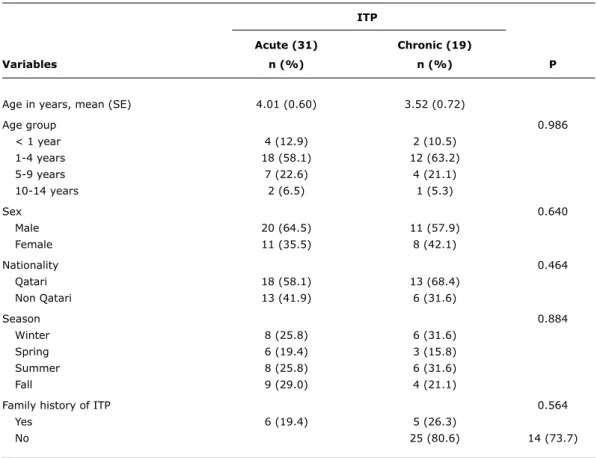
table 1 - Sociodemographic characteristics of children with ITP (n = 50)
ITP = idiopathic thrombocytopenic purpura; SE = standard error. Corporation, Qatar. The target population comprised all children below 14 years of age who were diagnosed with ITP (ICD-10 – D-69.3) and treated at HGH, which is the main pediatric, academic medical institution in Qatar, which handles all cases of pediatric tertiary care. The fact that the Medical Records Department at HGH handles records of both inpatients and outpatients served as a guarantee that all patients with ITP were included in the study sample. A especially designed questionnaire was used to collect sociodemographic and clinical data of the studied children based on their medical records. Information on the drugs prescribed to the patients and treatment outcome was collected from the physicians’ log book.
The diagnosis of ITP was determined based on history and physical examination; a complete blood count revealing isolated thrombocytopenia (platelet
count < 150×109/L), normal hemoglobin concentration,
white blood cell count and peripheral blood smear, and absence of underlying conditions and malignancy cases were also considered as inclusion criteria. Bone marrow aspiration was performed in children presenting with typical features of acute ITP, mainly to rule out other causes of thrombocytopenia. Chronic ITP was arbitrarily
deined as persistent thrombocytopenia for more than 6 months following initial diagnosis.
The study was approved by the Research Ethics Committee at HGH. All investigations were performed in accordance with the ethical standards laid down in the 1964 Declaration of Helsinki.
results
Table 1 shows the sociodemographic characteristics of the sample. Among the children assessed (50), 62% were diagnosed with acute ITP and 38% with chronic ITP. Acute ITP was more prevalent in boys (64.5%) compared to girls (35.5%); for chronic ITP, nearly an equal distribution was found in boys (57.9%) and girls (42.1%). In the comparison of age groups, the highest number of children with ITP was in the 1-4-year group (60%), followed by children in the 5-9-year group (22%).
Table 2 presents the clinical and pathological characteristics of the children studied. Sudden onset of the disease was more associated with acute ITP (83.9%) than with chronic ITP (52.6%). The most common clinical features for acute and chronic ITP were petechia (83.9
Jornal de Pediatria - Vol. 85, No. 3, 2009 271
idiopathic thrombocytopenic purpura
acute (31) Chronic (19)
Variables n (%) n (%) P
Onset 0.017
Abrupt < 1 week 26 (83.9) 10 (52.6)
Gradual > 1 month 5 (16.1) 9 (47.4)
Clinical features
Petechia 26 (83.9) 17 (89.5) 0.579
Bruising 21 (67.7) 12 (63.2) 0.740
Bleeding 12 (38.7) 9 (47.4) 0.547
Viral infection 22 (71.0) 12 (63.2)
Lymphadenopathy 5 (16.1) 0 (0) 0.065
Splenomegaly 1 (3.2) 2 (10.5) –
Hepatomegaly 1 (3.2) 2 (10.5) –
Platelet count 0.0326
< 10×109/L 9 (29.0) 7 (36.8)
10-19×109/L 14 (45.2) 4 (21.1)
20-49×109/L 8 (25.8) 4 (21.1)
50-100×109/L 0 (0) 4 (21.1)
Site of bleeding –
Nasal 9 (29.0) 2 (10.5)
Bloody stools 1 (3.2) 2 (10.2)
Gingival 0 (0) 2 (10.2)
Gastrointestinal tract 1 (3.2) 0 (0)
Gastrourinary tract 0 (0) 1 (5.3)
Nasal and gingival 0 (0) 1 (5.3)
Right inger post trauma 0 (0) 1 (5.3)
No bleeding 20 (64.5) 10 (52.6)
Hemoglobin 0.660
Normal 26 (83.8) 15 (78.9)
Abnormal 5 (16.2) 4 (21.1)
White blood cells 0.028
Normal 27 (87.1) 14 (73.7)
Abnormal 4 (9.7) 5 (15.8)
Peripheral blood smear 0.233
Normal 11 (35.5) 10 (52.6)
Not done 20 (64.5) 9 (47.4)
Mean platelet volume –
Normal 1 (3.2) 1 (5.3)
Abnormal 25 (80.6) 15 (78.9)
Not done 5 (16.1) 3 (15.8)
PT and APTT 0.457
Normal 14 (45.2) 10 (52.6)
Abnormal 17 (54.8) 9 (47.4)
Treatment 0.146
IVIG 19 (61.3) 18 (94.7)
Steroid + IVIG 4 (12.9) 5 (26.3)
Observation alone 4 (12.9) 0 (0)
table 2 - Clinical and pathological characteristics of children with idiopathic thrombocytopenic purpura (n = 50)
APTT = activated partial thromboplastin time; IVIG = intravenous immunoglobulin; PT = prothrombin time. and 89.5%), bruising (67.7 and 63.2%), and bleeding
(38.7 and 47.4%, respectively). Preceding viral infection was common in both acute and chronic ITP (71.0 and 63.2%); 68% of the children showed a platelet count
below 20×109/L at presentation, and 22% suffered from
nasal bleeding. Intravenous immunoglobulin was the treatment most commonly used in children with acute and chronic ITP (74%).
272 Jornal de Pediatria - Vol. 85, No. 3, 2009
Discussion
ITP is a common pediatric hematologic disorder. The
estimated incidence is 2-8 per 100,000 people.4 In this
retrospective study, 50 children with ITP were assessed in a period of 6 years, and a similar annual incidence was observed in 2005, namely, 7.2/100,000.
Among the children assessed (50), 31 (62%) presented acute ITP and 19 chronic ITP (38%). The rate of chronic ITP (38%) found in Qatar was higher than the rate expected for
children below 15 years of age (15 to 20%5). On the other
hand, our results were in accordance with the ones observed in Kuwait, where acute cases were twice as common as
chronic cases, and also with other reports.6
Most children with acute ITP were in the 1-4 year age group (60%). This is comparable with the results reported
by Ahn & Horstman,7 who observed a higher incidence of the
disease in children aged 2 to 4 years. Among the children diagnosed with acute ITP, the disease was more prevalent in boys (64.5%) when compared with girls (35.5%). In Qatar, no signiicant seasonal occurrence was observed.
Even in Kuwait,8 no association was observed between
incidence and season. In contrast with these reports,
another study9 documented that ITP was found mainly in
winter and spring.
Familial predisposition has been reported for cases of ITP,
suggesting a genetic susceptibility.10 However, this aspect
was not observed in the clinical experience of Qatar. Preceding viral infection was common in both acute and chronic ITP cases (71 and 63.2%). The high annual incidence of ITP was probably related to the viral infections children had had during the study period. In addition, 68% of the
studied children showed a platelet count below 20×109/L
at the time of presentation.
ITP treatment differs worldwide in terms of when to initiate the therapy, what treatment to use and whether
hospitalization is needed.11 The treatment strategies
currently available for acute ITP include observation alone, intravenous immunoglobulin, anti-Rh (D) immunoglobulin, and lastly, steroids.12 Most of the children included in
our study were treated with intravenous immunoglobulin (74%).
Conclusion
The study revealed a high incidence of ITP among children in Qatar. No statistical difference was observed in the incidence of ITP in boys and girls. This study also
highlights the situation of ITP in children in Qatar and may help establish national guidelines for the investigation and management of childhood ITP.
acknowledgements
We would like to thank Ms. Sameera Ali and Mr. Antony George for the data collection and analysis, and Mrs. Soji Samson for her assistance in preparing the report.
Correspondence: Abdulbari Bener
Dept. of Medical Statistics and Epidemiology Hamad General Hospital, Hamad Medical Corporation Weill Cornell Medical College
PO Box 3050 – Doha – Qatar Tel.: (974) 439.3765/3766 Fax: (974) 439.3769
E-mail: [email protected], [email protected] references
1. Lilleyman JS. Management of childhood idiopathic thrombocytopenic purpura. Br J Haematol. 1999;105:871-5.
2. Idiopathic thrombocytopenic purpura. In: Springhouse Corporation, editor. Professional guide to diseases. 5th ed. Philadelphia, PA: Lippincott, Williams & Wilkins; 1995. p. 1062.
3. Kühne T, Elinder G, Blanchette VS, Garvey B. Current management issues of childhood and adult immune thrombocytopenic purpura (ITP). Acta Paediatr Suppl. 1998;424:75-81.
4. Butros LJ, Bussel JB. Intracranial hemorrhage in immune thrombocytopenic purpura: a retrospective analysis. J Pediatr Hematol Oncol. 2003;25:660-4.
5. Robb LG, Tiedeman K. Idiopathic thrombocytopenic purpura: predictors of chronic disease. Arch Dis Child. 1990;65:502-6. 6. Lillyman JS. Changing perspectives in childhood thrombocytopenic
purpura. In: Meadow R, editor. Recent advances in paediatrics, v. 8. Edinburgh: Churchill Livingstone; 1986. p. 239-58. 7. Ahn YS, Horstman LL. Idiopathic thrombocytopenia purpura:
pathophysiology and management. Int J Hematol. 2002;76 Suppl 2:123-31.
8. Zaki M, Hassanein AA, Khalil AF. Childhood idiopathic thrombocytopenic purpura: report of 60 cases from Kuwait. J Trop Pediatr. 1990;36:10-3.
9. Mc Millan C. Platelet and vascular disorders. In: Miller D, Baehner R, Mc Millan C, editors. Blood disease of infancy and childhood. St Louis: CV Mosby; 1984. p. 795-806.
10. Rischewski JR, Imbach P, Paulussen M, Kuhne T. Idiopathic thrombocytopenic purpura (ITP): is there a genetic predisposition? Pediatr Blood Cancer. 2006;47:678-80.
11. British Committee for Standards in Haematology General Haematology Task Force. Guidelines for the investigation and management of idiopathic thrombocytopenic purpura in adults, children and in pregnancy. Br J Haematol. 2003;120:574-96. 12. Cines DB, Blanchette VS. Immune thrombocytopenic purpura.N
Engl J Med. 2002;346:995-1008.