pISSN 1899-5241 eISSN 1899-5772
1(39) 2016, 137–144
dr inż. Dawid Olewnicki, Samodzielna Pracownia Organizacji i Ekonomiki Ogrodnictwa, Szkoła Główna Gospodarstwa Wiej-skiego w Warszawie, ul. Nowoursynowska 159, 02-776 Warszawa, Poland, e-mail: [email protected]
Abstract. The paper presents the state of fruit producers’ knowledge, as well as methods of źU support application un-der the various programmes available in both the period before and after Poland’s accession to the źU. Żarmers, including gardeners, could apply for funding under the SAPARŹ pro-gramme already before the accession. These grants were the beginning of the support Poland received during this period. źU aid became applied on a large scale just after the acces-sion. A large part of manufacturers began to apply for support i.a. under the Rural Źevelopment Programme for 2ŃŃ7–2Ńń3 (hereinafter RŹP 2ŃŃ7–2Ńń3). The survey involved ńŃ3 fruit producers from the żrójec County, which is the area of great-est importance in the Polish fruit production. Nearly three quarters of the surveyed respondents claimed that they had benefi ted from the źU support. Those producers who benefi t-ed from the RŹP 2ŃŃ7–2Ńń3, the grantt-ed funds in 63% invest-ed in modernizing their farms. A lot of producers the receivinvest-ed funds earmarked for the purchase of machines. Preferential loans also gained in popularity, especially those that could be applied for after disasters which had destroyed growers’ crops, e.g. spring ground frost, hail etc. 3Ń% of respondents benefi ted from this type of support. It is worth emphasising that almost three quarters of the respondents obtained assis-tance in making applications from private companies, and not from the state institutions. The biggest obstacle encountered by the producers when applying for źU funds, was the intri-cate procedure in fi lling in the applications.
Key words: intervention, źU support, orchard farms
INTRODUCTION
Źue to its specifi c nature, agriculture, often dependent on weather and socioeconomic conditions, has been one of the characteristic sectors of the economy for decades, where the state interventionism plays a very important role. Interventionism in agriculture, which was created at the beginning of the twentieth century, was primarily the price and income interventionism, Wilkin (2ŃŃ2). Yet the structures of the agricultural interventionism that were used in Western źurope after the Second World War, varied considerably. Żor example, the plan of dual price guarantees was introduced in Żrance. This system was launched on the vegetable product markets. There were also indirect methods of the impact on prices used. Żor example, export bonuses, taxes and intervention purchases. Meanwhile in the UK price subsidies and state monopoly became basic mechanisms of agricul-tural interventionism (Ciechomski, ń997). The Com-mon Agricultural Policy in źurope, which was built up on the basis of the Treaty of Rome (ń957) signifi cantly changed the image of źuropean agriculture and inter-ventionism practiced in it. Additionally, along with the creation of the źuropean źconomic Community (źźC) in ń958, the integration and standardization of agricul-tural intervention mechanisms took place. This com-munity facilitated its member states with large fi nancial support and allowed for dynamic development of the
THE USE OF EU SUPPORT BY ORCHARDS OWNERS
IN
FARMS IN THE GRÓJEC COUNTY,
ON THE BASIS OF
THE
CONDUCTED SURVEY
Dawid Olewnicki
, Magda Marzec
agricultural sector. Its main objectives were e.g. mar-kets stabilization, increasing agricultural productivity, ensuring food security and the interests of consumers as well as increasing the income of rural residents. By the end of the eighties of the 2Ńth c., the agricultural interventionism of the źźC gained the widest scope and a high degree of co-fi nancing, while in the nineties the fundamental reforms aimed at changing the struc-ture and goals of the interventionism were conducted (Wyzi ska-Ludian, ń996).
The political changes in Poland after ń989, mar-ketization of the economy, Polish accession to various international structures, had a signifi cant impact on the economic condition of our country. After ń99Ń, the sys-tem of economic individualism was introduced with its prevailing market mechanism. At the time Polish agri-cultural policy began to meet the demands of structural and market interventionism, and one of its objectives was to maintain the level of agricultural producers’ in-come. Changes in socio-economic structure of rural ar-eas became the second aim (Spychalski, 2ŃŃ8). Polish accession to the źuropean Union contributed to the de-velopment of Polish agriculture, including horticulture, to a large extent. A lot of changes that took place were aff ected by the źU programmes. Żarmers could benefi t from the SAPARŹ programme still before the accession. These grants were the beginning of support that Poland received in the pre-accession period. After the accession źU aid was applied on a large scale. A signifi cant part of the producers began to apply for support with the RŹP 2ŃŃ7–2Ńń3 (Marzec, 2Ńń5). The aim of this study is to evaluate the knowledge of the forms of assistance and the źU funds usage by fruit growers from the żrójec County, as well as the impact of these measures on the development of fruit farms.
METHODOLOGY
The analyses presented in this study are based on sur-veys conducted in 2Ńń4 among fruit growers of the żrójec County, which is the area of greatest importance in the Polish fruit production.
The study sample consisted of ńŃ3 respondents (owners of fruit farms). The study was based on a ques-tionnaire that included ń9 questions. All respondents an-swered 4 questions regarding knowledge in forms of źU support, the sources of information on funding. They also showed whether had ever benefi ted from funding
and whether in the future they would intend to take the advantage of such form of support. 8 out of ń9 ques-tions were directed to growers benefi ting from źU aid. They answered the questions of when they benefi ted from the źuropean Union support, how many and what kind of aid programmes they received funds from, how they fi lled in applications to The Agency for Restruc-turing and Modernisation of Agriculture (ARMA), what barriers were encountered in obtaining funds and what sort of benefi ts they gained from the aid received. The respondents who did not benefi t from źU programmes, explained why they had not applied for the aid.
The analyses were made with simple mathemati-cal and statistimathemati-cal methods, and to present the results graphic forms were used. The used tools, techniques and methods of comparative analysis involved the methods of descriptive statistics and methods of grouping. The results have been shown with percentages. ńŃŃ% was assumed to stand for the size of the group of the studied population, whereas in case of the possibility of giv-ing several answers, the sum of all indications has been presented.
KNOWLEDGE OF FORMS OF SUPPORT AND EU FUNDS APPLICATION
BY THE ORCHARDS OWNERS
Respondents who were asked about how they had fi lled in applications to be submitted to the Agency for Restructuring and Modernization of Agriculture (ARMA), claimed that they primarily benefi ted from the private institutions help. As many as 7ń% of all respond-ents said so. It is worth noting that almost ń/4 of farm owners fi lled in applications for źU aid themselves, and only 6% of applicants benefi ted from the state institu-tions help.
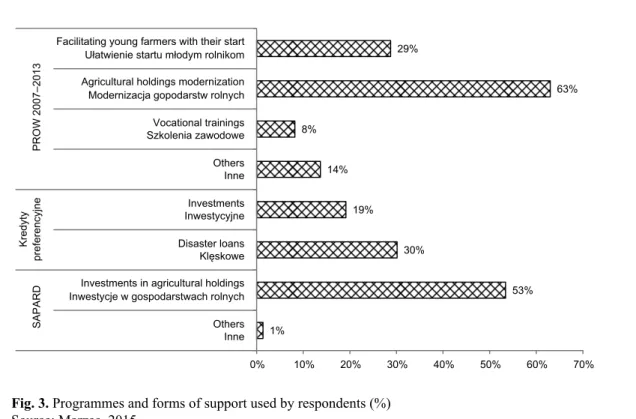
In this study, respondents indicated which pro-grammes and contained in them measures they benefi t-ed from. Over half of the respondents (53%) benefi tt-ed from the measures on investments in agricultural hold-ings within the pre-accession SAPARŹ programme. Żruit growers, who used other SAPARŹ measures, reached only ń%. With the post-accession programmes RŹP 2ŃŃ7–2Ńń3 was the essential one for all respond-ents. 63% of respondents were granted for the moderni-zation of agricultural holdings under this programme. In addition, 29% refers to people who received fund-ing under the measures to facilitate the start for young farmers. In contrast, ń4% made those who also benefi ted from other measures under the RŹP 2ŃŃ7–2Ńń3 pro-gramme. The least number of the surveyed, as only 8%, benefi ted from vocational trainings. A large proportion
2%
17%
31% 41%
48% 57%
67%
0% 10% 20% 30% 40% 50% 60% 70% 80%
Others – Inne
6WDWHLQVWLWXWLRQV±,QVW\WXFMHSDĔVWZRZH
Leaflets, brochures – Ulotki, broszury Trainings – Szkolenia Internet
3ULYDWHFRQWDFWV±3U\ZDWQHNRQWDNW\
TV, press – Media
Fig. 1. Respondent-obtained sources of information on subsidies from the źuropean Union (%) SourceŚ Marzec, 2Ńń5.
Rys. 1. ródła pozyskiwania informacji przez respondentów na temat dofi nansowa z Unii źuropejskiej (%) ródłoŚ Marzec, 2Ńń5.
23%
6%
71%
0% 10% 20% 30% 40% 50% 60% 70% 80%
Independently
Samodzielnie institutions helpWith the state
=SRPRFąLQVW\WXFML SDĔVWZRZ\FK
With the private institutions help
=SRPRFąLQVW\WXFML SU\ZDWQ\FK
Fig. 2. Methods used by respondents to fi ll in applications for źU subsidies to ARiMR (%)
SourceŚ Marzec, 2Ńń5.
Rys. 2. Sposób wypełniania wniosków przez ankietowanych o wsparcie unijne do ARiMR (%)
of the respondents who had applied for źU support also declared taking preferential loans. 3Ń% of people took the chance of the so called disaster loans, and ń9% of respondents benefi ted from investment loans (Żig. 3).
Applying for źU support is widely recognized as time-consuming due to the multiple procedures it involves. Re-spondents, who were engaged in this procedure for 6 to ń2 months, made 4Ń%. This process took between 3 to 6 months in case of not much less interviewed, as 37%. Nearly ń/5 of the respondents declared that the proce-dures connected with receiving źU support lasted more than one year. Time between submitting the application and signing the contract took less than three months in case of the least number of people. Such answer was indi-cated by 5% of the respondents (Żig. 4).
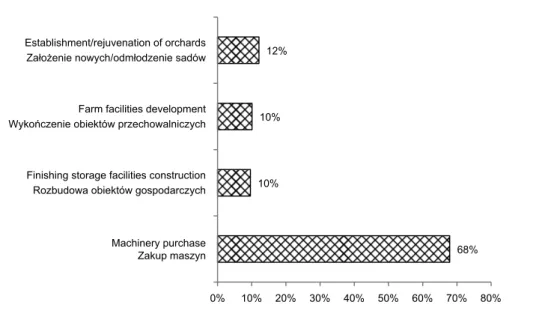
Only 4Ń respondents of all the surveyed who de-clared they benefi ted from źU programmes, indicated how they used the received assistance. As many as 7Ń% of the people answered that means to them granted were used for the purchase of new machinery and equipment, with a purpose to improve production. Only ń2% of the respondents declared that the funds they had received
1%
53% 30%
19% 14% 8%
63% 29%
0% 10% 20% 30% 40% 50% 60% 70%
Others Inne Investments in agricultural holdings Inwestycje w gospodarstwach rolnych Disaster loans
.OĊVNRZH
Investments Inwestycyjne Others Inne Vocational trainings
6]NROHQLD]DZRGRZH
Agricultural holdings modernization Modernizacja gopodarstw rolnych Facilitating young farmers with their start
8áDWZLHQLHVWDUWXPáRG\PUROQLNRP
SAPARD
Kredyty
preferencyjne
PROW 2007–2013
Fig. 3. Programmes and forms of support used by respondents (%) SourceŚ Marzec, 2Ńń5.
Rys. 3. Programy wykorzystywane przez respondentów (%) ródłoŚ Marzec, 2Ńń5.
%
% %
%
% % % % % % % % % %
Up to o ths
ŽϯŵŝĞƐŝħĐLJ Betwee -o ths Od do
ŵŝĞƐŝħĐLJ
Beetwee -o ths
KĚϲŵŝĞƐŝħĐLJ
do roku
DŽƌĞƚŚĂŶĂLJĞĂƌ WŽǁLJǏĞũƌŽŬƵ
Fig. 4. Period between submitting the application and getting the support (%)
SourceŚ Marzec, 2Ńń5.
Rys. 4. Okres, jaki zajęło uzyskanie wsparcia od momentu wypełnienia wniosku do momentu podpisania umowy (%)
were invested in the establishment /rejuvenation of or-chards. Little less, as ńŃ% of fruit farmers dedicated the received funds to fi nish storage facilities construction. Similarly, ńŃ% of the respondents received funds ear-marked for the facilities development (Żig. 5).
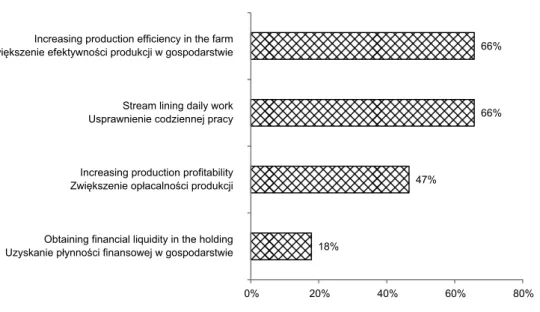
The study also clarifi es the benefi ts received by growers in association with the use of źU aid. As many as 66% of the respondents applying for the grant sug-gested the greatest benefi ts were felt in increasing the production e ciency and in obtaining fi nancial liquid-ity in the farm. Almost half of the respondents (47%) stated that źU funds helped to increase the profi tability of their production. Only ń8% of fruit growers said that źU programmes led to the fi nancial liquidity in the farm (Żig. 6).
All respondents who had benefi ted from źU aid also showed what were the barriers encountered when ap-plying for źU funds. 64% of them indicated that the majority of problems were caused by a complicated procedure of completing the documents. Żor more than a half of the respondents (55%) the need to have their own resources for the investment, as well as strong com-petition among those applying for a grant, represented
major impediment. Approximately ń/5 found, however, that the major di culty was the lack of support in the procedure of completion and fi lling in the documents. Only 7% of fruit growers recognized the lack of detailed information about the programmes they could benefi t from directly, a considerable obstacle. Żew people, as only 6%, reported other reasons than those listed in the survey (Żig. 7).
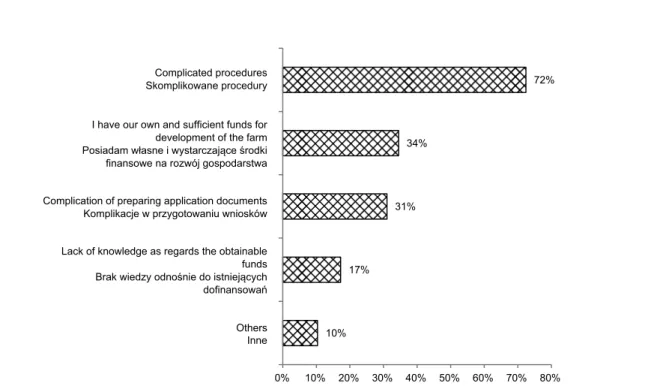
Complicated procedures for the entire process of ob-taining źU support are the main reason, as the analyses show, for avoiding źU support. About 72% of the re-spondents who do not try to benefi t from grants empha-sised this issue. Moreover, 34% of respondents suggest-ed they had their own and su cient fi nancial resources for the farm development. In addition, 3ń% of the peo-ple surveyed think that the biggest problem were com-plications during the proposal preparation. In contrast, ń7% of the respondents said they did not have su cient knowledge of the existing grants and probably due to the lack of such knowledge they were afraid of applying for funding. Respondents who gave other reasons, for which they resigned from the źU support, represented in this case ńŃ% (Żig. 8).
68% 10%
10% 12%
0% 10% 20% 30% 40% 50% 60% 70% 80%
Machinery purchase Zakup maszyn Finishing storage facilities construction Rozbudowa obiektów gospodarczych Farm facilities development
:\NRĔF]HQLHRELHNWyZSU]HFKRZDOQLF]\FK
Establishment/rejuvenation of orchards
=DáRĪHQLHQRZ\FKRGPáRG]HQLHVDGyZ
Fig. 5. żranted źU support destination in case of the respondents (%) SourceŚ Marzec, 2Ńń5.
18%
47%
66% 66%
0% 20% 40% 60% 80%
Obtaining financial liquidity in the holding
8]\VNDQLHSá\QQRĞFLILQDQVRZHMZJRVSRGDUVWZLH ,QFUHDVLQJSURGXFWLRQSURILWDELOLW\ =ZLĊNV]HQLHRSáDFDOQRĞFLSURGXNFML 6WUHDPOLQLQJGDLO\ZRUN 8VSUDZQLHQLHFRG]LHQQHMSUDF\ ,QFUHDVLQJSURGXFWLRQHIILFLHQF\LQWKHIDUP =ZLĊNV]HQLHHIHNW\ZQRĞFLSURGXNFMLZJRVSRGDUVWZLH
Fig. 6. Benefi ts arising from źU support in the respondents opinion (%) SourceŚ Marzec, 2Ńń5.
Rys. 6. Korzy ci odczuwane przez gospodarstwo po skorzystaniu z pomocy unijnej (%) ródłoŚ Marzec, 2Ńń5.
5% 7%
21%
55% 55%
64%
0% 10% 20% 30% 40% 50% 60% 70%
Others Inne Lack of information about programs for growers Brak informacji o programach dla sadowników Lack of support in the procedure of completing and filling in the documents
%UDNSRPRF\ZSURFHGXU]HNRPSOHWRZDQLDLZ\SHáQLDQLD
dokumentów Intense competition among people applying for a grant
'XĪDNRQNXUHQFMDZĞUyGRVyEXELHJDMąF\FKVLĊ
o dofinansowanie The necessity of having own funds for the investments
.RQLHF]QRĞüSRVLDGDQLDZáDVQ\FKĞURGNyZQDLQZHVW\FMH
Intricate procedure of document completion
=DZLáDSURFHGXUDZ\SHáQLDQLDGRNXPHQWyZ
Fig. 7. Barriers encountered by respondents in the course of obtaining źU funds (%) SourceŚ Marzec, 2Ńń5.
SUMMARY AND CONCLUSIONS
źU support targeted at producers is crucial for the devel-opment of farms. Nearly three quarters of ńŃ3 respond-ents surveyed claimed that they benefi ted from the źU support. Producers who have benefi ted from the RŹP 2ŃŃ7–2Ńń3, invested the received funds in moderniz-ing their farms in 63% of cases. A lot of producers ear-marked the received funds for the purchase of machinery. It should be also noted that almost three quarters of the respondents received some assistance in preparing appli-cations from private companies, and not from the state in-stitutions. The results depicted in this study indicate that the state advisory institutions whose goal is to help Polish producers in obtaining źU funds, should be more closely involved in the processes of źU support and direct advi-sory services to those producers. The producers felt that the increase of production e ciency and improvement of work on the farm made the greatest benefi ts of źU sub-sidies. It should be also emphasized that 72% of the re-spondents who had not applied for źU support indicated complicated procedures to be the main reason for lack of submitting the requests. That was also an issue stressed
by the respondents who applied for źU funds. Żor 64% of these respondents, the biggest barrier was a complicated procedure for making applications.
REFERENCES
Ciechomski, W. (ń997). Interwencjonizm pa stwowy w rol-nictwie i obrocie rolnym. Pozna Ś Wyd. Akademii źkono-micznej w Poznaniu.
Marzec, M., (2Ńń5). Analiza instrumentów wsparcia gospo-darstw sadowniczych na przykładzie powiatu grójeckie-go. Praca in ynierska. WarszawaŚ SżżW.
Mazurkiewicz-Pizło, A., Pizło, W. (2Ńńń). Inspiracje teore-tyczne konkurencyjno ci według Thünena, Marshalla, Portera. Zesz. Nauk. SżżW Ser. źkon. Org. żosp. ywn., 93, 5–ń8.
Spychalski, ż. (2ŃŃ8). Źziałania interwencyjne w rolnictwie i na obszarach wiejskich w Polsce. Zesz. Nauk. SżżW Ser. źkon. Org. żosp. ywn., 7ń, 43–52.
Wilkin, J. (2ŃŃ2). Interwencjonizm w rolnictwieŚ dlaczego był, jest i będzie. Biul. Inf. ARR, 9(ń35), ń8–ń9.
Wyzi ska-Ludian, J. (ń996). Przyczyny i formy interwencjo-nizmu pa stwowego w rolnictwie. LublinŚ Wyd. UMCS w Lublinie.
10% 17%
31% 34%
72%
0% 10% 20% 30% 40% 50% 60% 70% 80%
Others Inne Lack of knowledge as regards the obtainable funds
%UDNZLHG]\RGQRĞQLHGRLVWQLHMąF\FK GRILQDQVRZDĔ
Complication of preparing application documents
.RPSOLNDFMHZSU]\JRWRZDQLXZQLRVNyZ
I have our own and sufficient funds for development of the farm
3RVLDGDPZáDVQHLZ\VWDUF]DMąFHĞURGNL ILQDQVRZHQDUR]ZyMJRVSRGDUVWZD
Complicated procedures Skomplikowane procedury
Fig. 8. Reasons for the lack of will in obtaining źU support by the respondents (%) SourceŚ Marzec, 2Ńń5.
WYKORZYSTANIE WSPARCIA UE
PRZEZ W
Ł
A
Ś
CICIELI GOSPODARSTW SADOWNICZYCH
Z POWIATU GRÓJECKIEGO W
Ś
WIETLE BADA
Ń
ANKIETOWYCH
Streszczenie. W opracowaniu przedstawiono stan wiedzy producentów sadowniczych oraz sposoby wykorzystania przez nich wsparcia unijnego w ramach ró nych programów dostępnych zarówno w okresie przed-, jak i poakcesyjnym. Ju przed akce-sją rolnicy, w tym ogrodnicy, mogli ubiegać się o dofi nansowanie w ramach programu SAPARŹ. Źotacje te były początkiem wsparcia, jakie Polska uzyskała w tym okresie. Źopiero po akcesji zaczęto na du ą skalę korzystać z pomocy unijnej. Znaczna czę ć producentów ubiegała się o wsparcie m.in. w ramach programu PROW 2ŃŃ7–2Ńń3. Badaniami ankietowymi objęto ńŃ3 producentów sadowniczych z powiatu grójeckiego, a więc rejonu o największym znaczeniu w polskiej produkcji owoców.
Spo-ród ankietowanych respondentów prawie ¾ zadeklarowało, e korzystało ze wsparcia unijnego. Producenci, którzy skorzystali z PROW 2ŃŃ7–2Ńń3, otrzymane fundusze w 63% zainwestowali w modernizację swoich gospodarstw. Najwięcej producentów przeznaczyło otrzymane rodki na zakup maszyn. Warto równie podkre lić, e przy wypełnianiu wniosków prawie ¾ respon-dentów korzystało z pomocy prywatnych fi rm, a nie z form wsparcia instytucji pa stwowych.
Słowa kluczowe: interwencjonizm, wsparcie Uź, gospodarstwa sadownicze