PEER-REVIEWED ARTICLE
bioresources.com
IDENTIFYING APPROPRIATE CONDITIONS FOR PRODUCING
SPINDLE-LIKE CAUSTICIZING PRECIPITATED CALCIUM
CARBONATE FOR PAPER FILLER APPLICATIONS
Jin Wang,* Peng Wei, Peng Liu, and Wei Sun
Causticizing precipitated calcium carbonate (CPCC) as a by-product of the green liquor causticizing process can be used as paper filler to save resources and reduce costs. In this study, CPCC was prepared with green liquor and quicklime, which were obtained from an alkali recovery line of a paper mill. The factors influencing crystal morphology of CPCC, such as slaking temperature, slaking time, and causticizing time were investigated. The morphology of CPCC was observed and analyzed for optimizing reaction conditions. The following were compared: properties of CPCC obtained in this study, conventional CPCC (white mud) from a paper mill, and commercial PCC as fillers. The results showed that slaking time and causticizing time were important for morphology control. Spindle-like and rod-like CPCC obtained in this study had better drainability and retention, higher paper bulk, opacity, and physical strength compared to conventional CPCC, and had nearly the same performances as commercial PCC.
Keywords: Precipitated calcium carbonate; Causticizing; Slaking; Crystal morphology
Contact information: Tianjin Key Lab of Pulp and Paper, Tianjin University of Science & Technology, Tianjin, 300457, People’s Republic of China; *Corresponding author: [email protected]
INTRODUCTION
Environmental protection and energy saving have been the main drivers for sustainable development of the pulp and paper industry, resulting in more and more paper mills focusing on effective treatment of solid waste (Wang and Zhuang 2004; Li and Wang 2007). Causticizing precipitated calcium carbonate (CPCC) is a PCC manufacturing method that makes use of a causticizing reaction between sodium carbonate and calcium hydroxide in an alkali recovery process of the pulping line. CPCC is a by-product with high pH value, and the traditional treatment of CPCC usually has caused pollution and has been wasteful of resources. It is well known that landfilling and open-air storage is the traditional treatment of CPCC. However, calcining CPCC for recirculation through a rotary lime kiln requires a large investment and high energy consumption, which is not suitable for a non-wood production line because of the serious silica problems (Wang et al. 2009; Yasunori et al. 2008). The use of CPCC products as paper fillers can bring appreciable environment and energy benefits and profits. CPCC is 30 to 50 $/ton lower than commercial PCC, which is very attractive to many pulp and paper mills in China (Li and Wang 2007; Wang et al. 2009). If the properties of CPCC are improved to meet the requirements for fillers in fine paper, then the paper industry could achieve remarkable social and economic benefits (Wang and Yang 2010).
PEER-REVIEWED ARTICLE
bioresources.com
paper with high bulk and opacity (Aoyama 2003). Traditional CPCC mainly exhibits amorphous morphology that is completely different from commercial PCC. The CPCC reaction is similar to that of commercial PCC; therefore it is possible to obtain various morphologies of CPCC through controlling the reaction conditions. In a pure Na2CO3 and
Ca(OH)2 reaction system, different morphologies could be obtained by adjusting the
saturation of the reactant. The presence of NaOH could result in the formation of aragonite PCC, especially when the pH is higher than 13.5 (Kim et al. 2004; Konno et al. 2002; Konno et al. 2003). In the green liquor causticizing process, the reaction system is more complex than a pure Na2CO3 and Ca(OH)2 reaction system. Needle-like
causticizing calcium carbonate (CCC) is prepared by precisely controlling green liquor loading, activity of quicklime, reaction temperature, time, and the composition of the slaking solution; the CCC shows good application performance (Nanri et al. 2008). In China, research work has focused mainly on grinding operation and CO2 treatment of the
CPCC product, and did not involve controlling the reaction process and particle crystal shapes (Li 2002; Wang 2008). This resulted in CPCC having a poorer quality application performance compared to commercial PCC. In the present study, factors influencing spindle-like CPCC were investigated to provide technical support for quality improvement of CPCC in an alkali recovery line.
EXPERIMENTAL
Materials
Conventional CPCC, commercial PCC, softwood bleached kraft pulp (SWBKP), P-RC APMP, and reed bleached pulp (RBKP) were obtained from a mill in Central China. Green liquor and quicklime were obtained from a mill in Northern China. A cationic copolymer of acrylamide (CPAM) and bentonite were obtained from Ciba Specialty Chemicals. AKD was obtained from a chemical mill in Northern China.
Preparation of Causticizing Precipitated Calcium Carbonate
Equipment included a 1-L three-neck flask, with a water heating bath, a thermo-meter for indicating reaction temperature, a stirrer, and a peristaltic pump for feeding the solution. The experiment designed a two-step reaction. In the first step, quicklime was added to the flask, which was filled with partial green liquor and stirred at 100 rpm to achieve slaking process. In the second step, the residual green liquor was added to the flask to achieve the causticizing reaction. In this reaction, the total volume of green liquor was 400 mL and quicklime was 28.9 g (The relative characteristics can be seen in Table 1). When the reaction was finished, the CPCC was washed with deionized water for property analysis.
SEM Observation of Particle Morphology
PEER-REVIEWED ARTICLE
bioresources.com
Handsheet Preparation
The pulp furnish with 0.6% consistency was prepared after SWBKP, RBKP, and P-RC APMP were disintegrated. The filler content was 25%, and 0.25% AKD, 0.03% CPAM, and 0.2% bentonite were added to the furnish. Handsheets with a basis weight of 60 g/m2 were made using a laboratory handsheet machine and dried. The physical testing was then carried out after reconditioning the handsheets at 23 ºC and 50% relative humidity for more than 4 hours. The testing of physical/optical properties and retention was in accordance with GB/T 3332-2004, GB/T 451.1.2-2002, GB/T 451.1.3-2002, GB/T 1543-2005, GB/T 22877-2008, GB/T22898-2008, and ISO 1762-2001. Ten results were obtained for each testing, and the average was reported.
RESULTS AND DISCUSSION
Characteristics of Raw Materials and Preliminary Reaction Conditions
Table 1. Characteristics of Green Liquor and Quicklime
It is well known that the components of green liquor include total alkali, active alkali, and total reducing substances. As shown in Table 1, the total alkali was 95.4 g/L (expressed as NaOH, including Na2CO3, NaOH, and total reducing substances); the
active alkali was 14.0 g/L (expressed as NaOH, including NaOH and total reducing substances); the total reducing substances were 6.6 g/L (expressed as NaOH, mainly Na2S); and CaO content of the quicklime was 78.6%. According to total alkali
concentration and active alkali concentration, the content of Na2CO3 was 81.4 g/L
(expressed as NaOH). While the green liquor volume was stable, Na2CO3 content of the
liquor, CaO, and quicklime needed in the reaction could be determined, according to CaO: Na2CO3 = 1:1. This study was under the following conditions: slaking temperature
of 75 ºC to 90 ºC, slaking time of 10 min to 40 min, causticizing temperature of 98 ºC, causticizing time of 90 to 180 min, and agitation speed of 100 rpm and 200 rpm for slaking and causticizing process, respectively.
Effect of Slaking Temperature on Morphology
The important factors for CPCC morphology control included activity of quicklime, clarification of green liquor, reaction temperature, reaction time, and agitation. Of these factors, the slaking solution was found to be the most important (Kim et al.
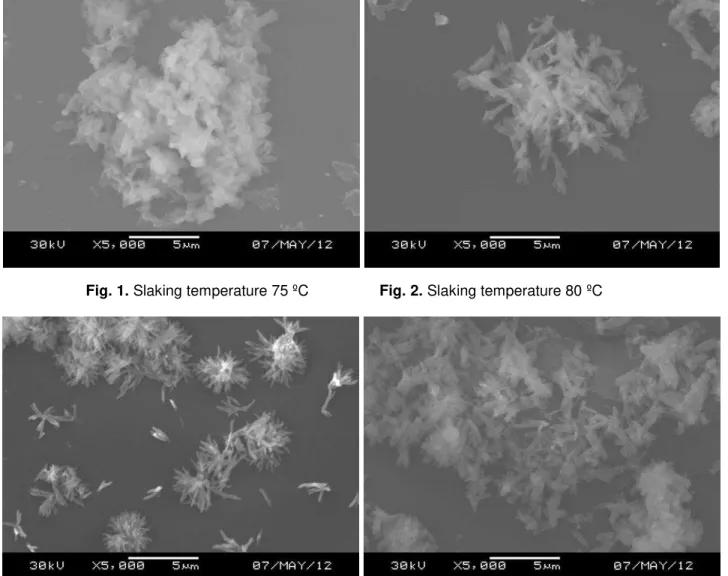
2004; Konno et al. 2002, 2003). Higher temperature could increase slaking process and decrease reaction time. It could be seen that slaking temperature greatly influenced CPCC morphology. While slaking temperature was 75 ºC, rice-like aggregate CPCC was obtained, as shown in Fig. 1. As shown in Figs. 2 and 3, CPCC particles showed spindle-like particles at 80 ºC and 85 ºC, but there were negative effects at 90 ºC (Fig. 4). CPCC
Samples Content
Total alkali 95.4 g/L (expressed as NaOH)
Active alkali 14.0 g/L (expressed as NaOH)
Total reducing substances 6.6 g/L (expressed as NaOH)
PEER-REVIEWED ARTICLE
bioresources.com
had the best spindle morphology and particle homogeneity at 85 ºC. This indicated that a too high or too low temperature was disadvantageous for morphology control.
Fig. 1. Slaking temperature 75 ºC Fig. 2. Slaking temperature 80 ºC
Fig. 3. Slaking temperature 85 ºC Fig. 4. Slaking temperature 90 ºC
Effect of Slaking Time on Morphology
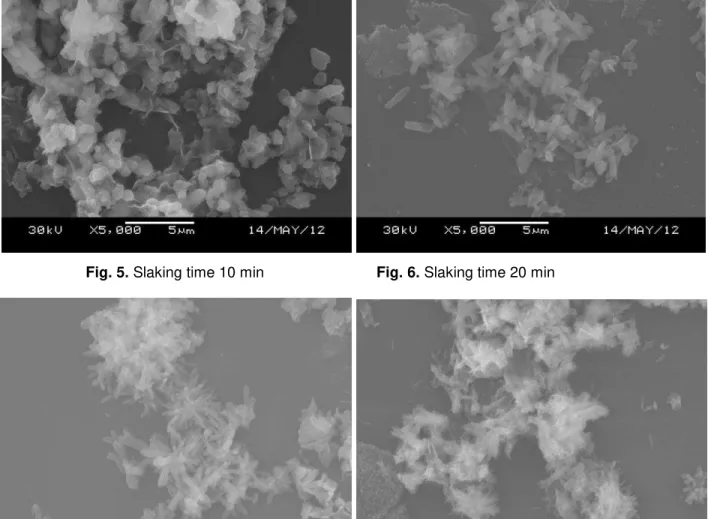
As shown in Figs. 5 to 8, various reaction times were related to different slaking processes and particle shapes. The CPCC product appeared as rice-like, spindle-like, rod-like, and filamentous, and the length to diameter ratio of particles gradually grew with increasing reaction time. At various slaking times, the content and concentration of Ca(OH)2 slurry increased, resulting in different CPCC morphology. While slaking time
was 20 min, spindle-like CPCC was obtained successfully with the best morphology. As it is well known, in the first step reaction (slaking), a partial green liquor was added in the flask for quicklime slaking, and Ca(OH)2 was produced associating with a small amount
of CaCO3 (Nanri et al. 2008). The CaCO3 particles served as crystal nuclei for the second
step (causticizing), and the Ca(OH)2 was the main reactant for causticizing. Various
slaking time indicated different CaCO3 crystal nuclei and properties of Ca(OH)2 solution,
PEER-REVIEWED ARTICLE
bioresources.com
Fig. 5. Slaking time 10 min Fig. 6. Slaking time 20 min
Fig. 7. Slaking time 30 min Fig. 8. Slaking time 40 min
Effect of Causticizing Time on Morphology
The main purpose of an alkaline recovery line is to produce more NaOH and Na2S,
i.e. more white liquor for the pulping line. The production of CPCC must not bring negative influence on that main process, and higher causticizing temperature and longer causticizing time have been widely adopted by paper mills for pursuing higher causticizing degree and alkali recovery rate. For precisely controlling the reaction process, the green liquor was divided into two parts and added in slaking and causticizing operations. During the slaking reaction, a small amount of CaCO3 is produced, and these
CaCO3 particles serve as crystal nuclei in the causticizing process. It could be seen from
PEER-REVIEWED ARTICLE
bioresources.com
Fig. 9. Causticizing time 90 min Fig. 10. Causticizing time 120 min
Fig. 11. Causticizing time 150 min Fig. 12. Causticizing time 180 min
Paper Properties of Various CPCC and Commercial PCC
The CPCC 1#, CPCC 2#, conventional CPCC, and commercial PCC were used as fillers for offset paper, and the furnish was a mixture of SWBKP, RBKP, and P-RC APMP with a ratio of 30%: 30%: 40%, and the filler content of 25% (based on the oven dry weight of paper furnish).
PEER-REVIEWED ARTICLE
bioresources.com
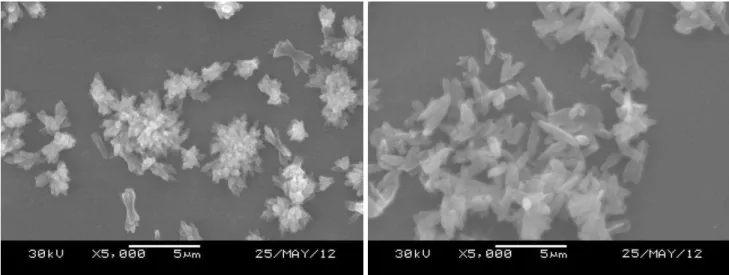
Fig. 13. CPCC 1# (obtained in this study) Fig. 14. CPCC 2# (obtained in this study)
Fig. 15. Conventional CPCC Fig. 16. Commercial PCC
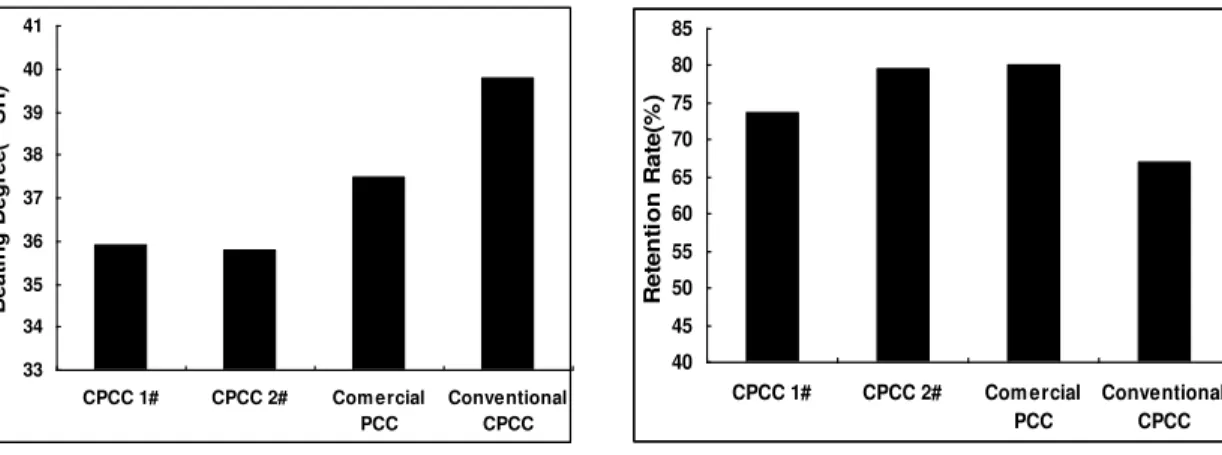
Figure 17 shows that the furnish adding CPCC 1# and CPCC 2# had the best drainability, and beating degree of furnish was 36oSR, which was 1.5oSR lower than that of the furnish adding commercial PCC, and 4oSR lower than that of the furnish adding conventional CPCC. 33 34 35 36 37 38 39 40 41
CPCC 1# CPCC 2# Com ercial PCC Conventional CPCC B e a ti n g D e g re e ( oS R ) 40 45 50 55 60 65 70 75 80 85
CPCC 1# CPCC 2# Com ercial
PCC Conventional CPCC R e te n ti o n R a te (% )
PEER-REVIEWED ARTICLE
bioresources.com
Figure 18 shows that filler retention of CPCC 2# was about 79%, the same as commercial PCC and slightly higher than that of CPCC 1#; however, the retention of conventional CPCC was only 67%.
PCC has been widely used as a filler for fine paper because of its contribution to brightness, stiffness, opacity, and bulk (Passaretti et al. 1993). As shown in Figs. 19 to 22, among the four PCC fillers, the brightness of paper adding commercial PCC was the highest at 87.2% (ISO). CPCC 1# and CPCC 2# exhibited slightly better paper opacity than commercial PCC. CPCC 2# and commercial PCC had the same paper bulk at approximately 2.1 m3/g. The four fillers had similar paper strength, about 3.40 to 3.65 km. The performance of conventional CPCC was inferior to CPCC 1#, CPCC 2#, and commercial PCC. Optimizing different factors was feasible and effective for morphology modification, which could significantly improve the performance of conventional CPCC.
70 71 72 73 74 75 76 77 78
CPCC 1# CPCC 2# Com ercial
PCC conventional CPCC B ri g h tn e s s (% IS O ) 80 81 82 83 84 85 86 87 88 89
CPCC 1# CPCC 2# Com ercial
PCC Conventional CPCC O p a c it y (% )
Fig. 19. Effect of filler on paper brightness Fig. 20. Effect of filler on paper opacity
1.8 1.85 1.9 1.95 2 2.05 2.1 2.15
CPCC 1# CPCC 2# Com ercial
PCC Conventional CPCC B u lk n e s s (m 3/g ) 2 2.4 2.8 3.2 3.6 4
CPCC 1# CPCC 2# Com ercial
PCC Conventional CPCC B re a n k in g L e n g th (k m )
PEER-REVIEWED ARTICLE
bioresources.com
CONCLUSIONS
1. Analysis of green liquor and quicklime characteristics is the first step in preparation of causticizing precipitated calcium carbonate (CPCC). Analysis provides a necessary foundation for controlling the reaction process effectively and economically. It is the key for preparation of spindle-like CPCC by separating and precisely controlling the slaking and causticizing time. However, conventional CPCC is prepared by mixing quicklime and green liquor simultaneously, combining slaking and causticizing reactions.
2. Slaking temperature, slaking time, and causticizing time were found to be important factors influencing CPCC morphology. A slaking temperature of 85 ºC, a slaking time of 20 min, and a causticizing time of 120 min were found to be appropriate parameters for preparation of spindle-like CPCC.
3. CPCC obtained in this study has uniform spindle-like shape, which is significantly different from conventional CPCC. It also has good performance in papermaking, such as furnish drainability, paper opacity, and bulk, with performance nearly same as that of commercial PCC, but much better than the performance of conventional CPCC formed under uncontrolled conditions.
ACKNOWLEDGMENTS
This work was financially supported by the National Natural Science Foundation of China, Grant. No. 31100436 and the National Science Supported Planning Projects of China, Grant. No. 2011BAC11B07.
REFERENCES CITED
Aoyama, M. (2003). “Starting up of onsite PCC plant and experiences of neutralized
paper making,” Japan Tappi J. 57, 121-125.
Kim, J., Ahn, J., Park, H., and Park, C. (2004). “Synthesis peculiarity of the precipitated calcium carbonate polymorphs following variation of supersaturation in Ca(OH)2 and
Na2CO3reaction system,” Geosystem Engineering 7(4), 95-102.
Konno, H., Nanri, Y., and Kitamura M. (2002). “Crystallization of aragonite in the
causticizing reaction,” Powder Technology 123(1), 33-39.
Konno, H., Nanri, Y., and Kitamura, M. (2003). “Effect of NaOH on aragonite
precipitation in batch and continuous crystallization in causticizing reaction,” Powder Technology. 129, 15-21.
Li, W. (2002). “The use of CaCO3 from refined alkali non-wood fiber white slurry as fillers for paper making,” China Pulp & Paper Industry 12, 17-19.
Li, Z., and Wang, Z. (2007). “The preparation of precipitated calcium carbonate from
alkali recovery white sludge,” China Pulp & Paper 1, 60-61.
Nanri, Y., Konno, H., Goto, H., and Takahashi, K. (2008). “A new process to produce high-quality PCC by the causticizing process in a kraft pulp mill,” Tappi J. 5, 19-24. Passaretti, D., Young, D., Michael J., Kevin,S., and Evans, D. (1993). “Application of
PEER-REVIEWED ARTICLE
bioresources.com
Wang, B., and Zhuang, R. (2004). “The practice of refined precipitated calcium carbonate
as filler from alkali wheat straw lime sludge,” Paper and Paper Making S1, 91-92.
Wang, G. (2008). “The practice in production of refined filler calcium carbonate with
lime sludge from alkali recovery,”China Pulp & Paper Industry 29(2), 55-60. Wang, J., Guo, Y., and Liu, C., Yang, A., and Chen, K. (2009). “Properties of white lime
sludge from alkali recovery and production control for quality improvement,” China Pulp & PaperIndustry 30(24), 86-88.
Wang, J., and Yang, A. (2010). “Properties evaluation and application performance of white sludge from alkali recovery,” Paper and Paper Making 11, 51-54.