Differences in the feeding of Rhamdia quelen
(Siluriformes, Heptapteridae) in four distinct lotic systems
Villares Junior, GA.
a* and Goitein R.
aaDepartamento de Zoologia, Instituto de Biociências, Universidade Estadual Paulista – UNESP, C.P. 199, CEP 13506-900, Av. 24-A, 1515, Rio Claro, SP, Brazil
*e-mail: [email protected]
Received: November 07, 2013 – Accepted: March 05, 2014 – Distributed: August 31, 2015
(With 1 figure)
Abstract
The aim of this study was to compare the food composition of Rhamdia quelen in four distinct order rivers. It was
performed at a low part at the basin of the Sorocaba river in systems classified as first (Anastácio stream), second (Nego stream), fifth (Tatuí river) and sixth (Sorocaba river) orders. Collections were performed every month between January and December of 2011. The stomach contents were examined by using the alimentary index (IAi) and compared by the non-parametric method non-metric multidimensional scale ranking (NMDS) with the Spearman rank correlation. A diet difference was observed for individuals of the smaller systems (Anastácio and Nego streams) and the larger ones (Tatui and Sorocaba rivers), represented respectively by allochthonous and autochthonous organisms compounding their
diets. Marginal vegetation and its interaction with the water conditions may respond to these composition differences.
Keywords: Sorocaba river basin, alochthonous items, autochthonous items, opportunist fish, Atlantic. Rain Forest.
Diferenças na alimentação de Rhamdia quelen em quatro diferentes ordens
de sistemas lóticos
Resumo
Este estudo teve como objetivo comparar a alimentação de Rhamdia quelen em quatro diferentes ordens de sistemas
lóticos. O estudo foi realizado em um trecho da parte baixa da bacia do rio Sorocaba, em sistemas de primeira (Anastácio stream), segunda (Nego stream), quinta (Tatuí river) e sexta (Sorocaba river) ordens. As coletas foram realizadas mensalmente entre janeiro a dezembro de 2011. Os conteúdos estomacais foram analisados pelo índice alimentar (IAi) e comparados pelo método de escalonamento multidimencional não-metrico (NMDS), juntamente com a correlação de Spearman. Foi percebida uma diferença na dieta dos indivíduos dos sistemas menores, córregos Anastácio e Nego e os rios maiores, rios Tatuí e Sorocaba. Nos córregos Nego e Anastácio houve maior incidência de itens de origem alóctone na dieta, enquanto que nos rios Tatuí e Sorocaba foi observado o inverso. A diferença nos itens consumidos pode depender da ordem dos sistemas lóticos e da interação entre a vegetação marginal com o sistema aquático.
Palavras-chave: rio Sorocaba, itens alóctones, itens autóctones, oportunista, Mata Atlântica.
1. Introduction
The study of food utilization should play as an opportunity to add an interesting component to discuss theoretical aspects as reference to species replacement by spatial, temporal and trophic composition of niches (Schoener, 1974), and contributes to other purposes for the knowledge about the basic requirements of the species living in a certain community. It also helps for the comprehension about the trophic organization of one natural system and the quantitative evaluation related to biologic mechanisms intervening at the species interactions, such as predation, competition and other aspects (Esteves and Aranha, 1999).
The determination of the natural diet, as well as to get information about other aspects associated to feeding has been pointed out to be essential for the comprehension
about the fish population ecology components, and also
for the other organisms living within the community (Hahn et al., 1997). The acquisition of new data about
food sources used by fishes can help for the understanding
about their behavior (Hahn et al., 1997), and may furnish subsides for the construction of preservation theoretical bases or even for the foundations to create better structures to rearing of some species for economical purposes.
The family Heptateridae represents one of the largest
150 to 200 valid species, distributed from northern Argentina to southern Mexico (Bockmann and Guazzelli, 2003).
Rhamdia quelen (Quoy and Gaimard, 1824) is distributed
from southern Mexico to the River Plate, one of the most
euritópicos neotropical fish, living in small streams, lakes
and larger rivers, dwelling during day light under or beneath wood logs and rocks (Menezes et al., 2007). It seems to be more conspicuous in still waters (Barreto and Aranha, 2005). Its behavior suggests a benthonic way of life and a broad feeding spectrum, by feeding on terrestrial and aquatic
insects, crustaceans, plants and fish (Casatti et al., 2001; Casatti and Castro, 2006). Its behavior suggests it to be an opportunistic benthonic predator, obtaining the food without revolving the substrate. According to Schulz
and Leuchtenberger (2006), the individuals live more frequently at about 2 meters depth and uses to be more active during the morning and at late afternoon, avoiding temperatures under 18°C.
Many references related to parameters about biological information to R. quelen are missing or are quite disperse
at the specific literature (Gomes et al., 2000), as most of such references are directed to pisciculture and rearing
under artificial situations (Gomiero et al., 2007), as the species is considered to be important for pounding in southern Brazil (Behr et al., 1999; Pereira et al., 2006). As references about the natural diet of the species are scarce, mainly by the fact that the species uses to live in many distinct habitats, the main goal of this study is to compare the food use of individuals in four distinct lotic
systems. Comparisons were made among first, second, fifth and sixth order water streams.
2. Material and Methods
Fish and environmental data were obtained from the
Sorocaba river basin, located in São Paulo State, in a subarea known as the superior medium Tietê. The main river within the system is the Sorocaba river and is recognized as part of the subsystem of the Tietê river basin (Smith et al., 2003; Villares Junior and Goitein, 2006; Villares Junior et al., 2011). Three important tributaries
flow to the Sorocaba river: The Sarapuí, Tatuí and Guarapó
rivers. Some other smaller streams and marginal lagoons contribute to the enlargement of the environmental variability (Villares Junior and Goitein, 2006).
The sampling sites are located in four distinct order
streams: Anastácio (first order; 23°19`57``S and 47°47`07``W), Nego (second order; 23°19`52``S and 47°46`50``W), Tatuí (fifth order; 23°19`43``S and 47°46`46``W) and Sorocaba (sixth order; 23°19`09``S 47°46`45``W).
The Anastácio stream`s width is less than one meter
and its mean depth hardly attains one meter. Nego stream is a little wider, as it may reach 2 meters, while its mean
depth varies between 1,5 and 2 m. Tatuí river flows to the
Sorocaba river and attaining at its lower place about 10 and 20 meters with a depth varying between 1 and 3 meters. The Sorocaba river width is quite larger and its width goes to 30 to 50 meters, and depth between 1 and 6 meters.
(Villares Junior and Goitein, 2006; Villares Junior, 2011). The marginal vegetation is relatively in a good preservation state at the study sites.
The sampling devices were used according to the characteristic of the water environmental dimensions. In the
Tatuí and Sorocaba rivers, fish were caught using distinct
gill nets, whose meshes between opposite knots measured 3,0; 4,0; 5,0 cm. At the Nego and Anastacio streams traps and sieves were used as the dimensions limit collections to such devices. Samples were collected every month from January to December 2012. So, 12 samplings were made. Such samples were gathered separately for each of the
three sites, and totalized 12 samplings. The fishing effort
was performed in a 75 m2 area covered with gill nets and
ten traps. After these activities fish were transported in ice
for posterior freezing until handling.
The stomach contents named food items were identified
until the least possible taxonomic level and analyzed using
the alimentary index (IAi) proposed by Kawakami and
Vazzoler (1980). This index is calculated using the expression
IAi = [Fi x Vi/Σ(Fi x Vi)]x 100, where i = feeding item, Fi = frequency of occurrence (%) and Vi = item volume (%). Food items were observed and identified by using
an stereomicroscope.
The IAi data were analyzed by utilizing a non-parametric
non-metric multidimensional scale ranking (NMDS) with
Bray-Curtis similarity matrixes (Clark and Warwick, 2001) to analyze the food items similarity and among the four sites. The comparison statistical analysis was performed
among three sites using Spearman`s rank correlation (5%)
(Fritz, 1974). The statistical analyses were performed using PAST 2.15 Software (Hammer et al., 2001).
3. Results
The specimens of Rhamdia quelen were collecte in a number of 193 individuals, from which 32 were in Nego
stream, 22 in Anastácio stream, 68 in the Tatuí river and
71 in Sorocaba river. The stomach analysis showed the diet of R. quelen to be composed by a diversity of food
items (17 distinct items), both from autochthonous and
allochthonous origin (as show in Table 1).
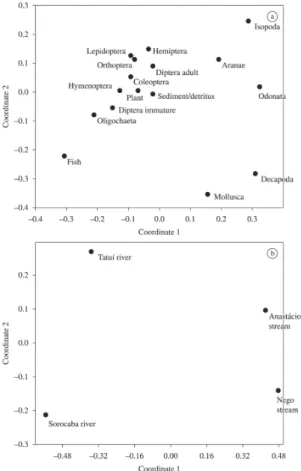
According to the IAi analyses a distinction for the diet
composition of individuals from the Anastácio and Nego
streams and the larger water systems can be perceived
(Figure 1). The smaller stream individuals feed more on
alloctonous items, whereas those from the larger rivers use more autochthonous items as food. The Spearman
correlation analysis (5%) indicated the existence of a strong correlation between the Anastácio and Nego streams and between the Tatuí and Sorocaba rivers (as show in Table 2).
4. Discussion
situation. If a direct influence of the neighbor vegetation may have an influence, as such conditions may play an
important role for aquatic systems and their inhabitants,
and this interface between both systems can be intensified
(Barrela et al., 2001; Rezende and Mazzoni, 2005). At the smaller streams the vegetation bends completely over the water, and this is called as riparian vegetation. Alloctonous organisms may be more frequently furnished to the
aquatic system, and this was confirmed by the presence
of arthropods and terrestrial vegetation.
Some studies concerning lotic systems of low order pointed the conspicuous presence of items for R. quelen whose origin is from the outside. Gomiero et al. (2007) has
identified 19 food items in two rivers of the Atlantic forest
presenting a higher importance within the stomach contents of this species and some vegetal material, suggesting its diet to be omnivorous, but predominantly carnivorous. Casatti
(2002), by studying this species in a first order stream (São Carlos Stream) registered a high consummation of
Araneae, Hymenoptera, some vegetal and Trichoptera and
Table 1. Alimentary índex (IAi) values of Ramdia quelen in Nego and Anastácio streams, and Tatuí and Sorocaba rivers.
Alimentary item Anastácio stream Nego stream Tatuí river Sorocaba river
Autochthonous item
Fish 3.30 2.20 39.60 76.00
Diptera immature 12.50 14.60 12.40 5.70
Decapoda - - - 0.50
Mollusca - - - 2.00
Odonata immature 0.30 - 0.60 0.20
Allochthonous item
Diptera adult 4.60 6.10 0.50 0.50
Orthoptera 8.40 5.70 0.30 0.20
Plant 7.10 11.20 2.30 3.10
Hymenoptera 18.50 13.30 2.30 1.20
Blattaria 6.00 5.70 - 0.20
Oligochaeta 15.40 7.50 32.20 7.20
Coleoptera 9.70 11.20 0.70 0.30
Aranae 0.20 1.50 0.60 0.10
Isopoda 0.20 0,40 0.20
-Hemiptera 3.60 4.50 0.30
-Lepdoptera 6.20 6,00 -
-Sediment/Detritus 2.00 10.52 1.60 2.50
Table 2. Statistical comparison (Spearman rank correlations)
of alimentary index (IAi) of Rhamdia quelen between
sites of study. The significant correlations coefficients (rs) (p < 0.01) are highlighted in bold.
Sorocaba
river Tatuí river
Nego stream
Tatuí river 0.6987 -
-Nego stream 0.3945 0.5722
-Anastácio
stream
0.0278 0.5126 0.8547
Figure 1. Graphic representation of the non metric
multidimensional scaling analysis (NMDS) of the diet of
On the other hand, in larger aquatic systems the species uses to consume in a higher importance autochthonous items. Brasil-Sousa et al. (2009) found in a 6th order
river (Macaé river) a consume based predominantly
on autochthonous items, mainly formed by crustaceans
and fish, and defined R. quelen as a carnivorous species
specialized for crustaceans and fish in higher amount, followed by other items in a lesser importance (53 items).
The elevated incidence of fish remnants within the stomach contents seems to confirm such a tendency of
food intake by the species in this stucy as also happened at
the Corumbá reservoir (GO) (Luz-Agostinho et al., 2006),
the same being confirmed by Gomes et al. (2000) by characterizing the species as omnivorous but highly piscivorous.
The autochthonous origin of the food items when
R. quelen lives is larger systems seems to represent a lesser
influence of the marginal vegetation and may suggest
the species to display an opportunistic behavior, but in
any case the marginal vegetation may play an influence
by furnishing resources to the autochthonous organisms found within the stomach contents of R. quelen (Alvin and Peret, 2004).
The presence of a riparian forest, such as flooding pulses
may be essential for the production and transportation
of nutrients to the freshwater fishes (Agostinho and Zalewski, 1995) and other aquatic organisms, meaning
that rivers are never auto-sufficient, and so depending
on the external resources. Some food items have been abundant in all the analyzed systems, and insects during
their immature stages (Chironomidae larvae and pupae)
use to be the main consumed invertebrate and are in some way also dependent on the external resources (Alvin and Peret, 2004). An important parameter of the external
(terrestrial) influence to maintain the fish an general water
community may be represented by the continuous entrance of the organic matter to the aquatic system, in a clear difference to what happens to the sea (Corbisier et al., 2006), as a food resource to the autochthonous organism living in the rivers, as the aquatic insects also depend on the
flooding situations when such resources are incorporated
to the aquatic medium. (Walker et al., 1990). Aquatic
insects are important items in the diet of fish found in flood plains (Hahn et al., 1997) and its wide distribution in water bodies allows the capture of different species of
neotropical fishes (Alvin and Peret, 2004). This is also stated by Vidotto-Magnoni and Carvalho (2009) who observed Odonata nymphs and Chironomidae pupae as the main food resource for R. quelen at the Nova Avanhandava reservoir
to which fish small crustaceans and vegetal material should
represent only a complementary food.
The food availability has been considered as a primordial factor to characterize the kind of items representing the
feeding of freshwater fishes, who may be seen as the ways
by which on may see what is the most abundant food resource in the water medium (Kahilainen and Lehtonem, 2003). So, it may be difficult to classify the species other to a generalist feeder (Brasil-Sousa et al., 2009).
Such a plasticity may be an expected fact, as the normal instability of the freshwater systems may preserve the species which have developed a means of survival within such lotic systems by adapting to distinct food resources (Lowe-McConnell, 1999), a commonly observed fact
among the neotropical fishes (Gerking, 1994).
In this context we can say that R. quelen behaves as an opportunistic species that exploits the resources available at the environment and the intensity of consumption of food items of allochthonous and autochthonous origin may depend on the order of lotic systems and the kind of interaction between the marginal vegetation and the water system, and it consists mainly by allochthonous items
to the diet of fishes in environments of lower order and
autochthonous items in those living in larger environments.
Acknowledgements
We thank to the friends whose help was very important: André Teixeira da Silva, Leandro Müller Gomiero, Mauricio Cetra and Maria M. Aparecida. We also thank to the Chico
Mendes Institute (SISBIO) for the authorization for fish
collections.
References
AGOSTINHO, AA. and ZALEWSKI, M., 1995. The dependence of fish community structure and dynamics on floodplain and
riparian ecotone zone in Paraná River, Brazil. Hydrobiologia, vol. 303, no. 1-3, p. 141-148. http://dx.doi.org/10.1007/BF00034051.
ALVIN, M C.C. and PERET, A.C., 2004. Food resources sustaining
the fish fauna in a section ot the upper São Francisco River in Três
Marias, MG, Brazil. Revista Brasileira de Biologia = Brazilian Journal of Biology, vol. 64, no. 2, p. 195-202.
BARRELA, W., PETRERE-JÚNIOR, M., SMITH, WS. and MONTAG, LF., 2001. As relações entre as matas ciliares, os
rios e os peixes. In RODRIGUES, R.R. and LEITÃO-FILHO, HF. Matas ciliares: conservação e recuperação. São Paulo: EDUSP. p. 187-207.
BARRETO, AP. and ARANHA, LMR., 2005. Assembleia de peixes
de um riacho da Floresta Atlântica: composição e distribuição espacial (Guaraqueçaba, Paraná, Brasil). Acta Scientiarum, vol. 27, no. 2, p. 153-160.
BEHR, ER., RADÜNZ NETO, J., TRONCO, AP. and FONTANA,
AP., 1999. Influência de diferentes níveis de luminosidade sobre o desenvolvimento de larvas de Jundiá (Rhamdia quelen) (Quoy & Gaimard, 1824)(Pisces: pimelodidae). Acta Scientiarum, vol. 21, no. 2, p. 235-330.
BOCKMANN, F. and GUAZZELLI, AYGM., 2003. Heptapteridae.
In REIS, R.E., KULLANDER, S.O. and FERRARIS, CJ. Check
list of the freshwater fishes of South and Central America. Porto Alegre: EDIPUCRS. p. 406-431.
BRASIL-SOUSA, C., MARQUES, RM. and ALBRECHT, MP., 2009. Segregação alimentar entre duas espécies de Heptapteridae no rio Macaé, RJ. Biota Neotropica, vol. 9, no. 3, p. 31-37.
Francisco southeastern Brazil. Neotropical Ichthyology, vol. 4, no. 2, p. 203-214. http://dx.doi.org/10.1590/S1679-62252006000200006.
CASATTI, L., 2002. Alimentação dos peixes em um riacho do
Parque Estadual Morro do Diabo, bacia do alto rio Paraná, sudeste
do Brasil. Biota Neotropica, vol. 2, no. 2, p. 1-14. http://dx.doi. org/10.1590/S1676-06032002000200012.
CASATTI, L., LANGEANI, F. and CASTRO, RMC., 2001. Peixes de riacho do Parque Estadual Morro do Diabo, bacia do
alto rio Paraná, SP. Biota Neotropica, vol. 1, no. 1-2, p. 1-15. http://dx.doi.org/10.1590/S1676-06032001000100005.
CLARK, KR. and WARWICK, RM., 2001. Change in marine communities: an approach to statistical and interpretation. Plymouth: Plymouth Marine Laboratory. 859 p.
CORBISIER, TN., SOARES, LSH., PETTI, MAV., MUTO, EY., SILVA, MHC., MCCLELLAND, J. and VALIELA, I., 2006. Use of isotopic signature to assess the food web in the tropical shallow marine ecosystem of Southeastern Brazil. Aquatic Ecology, vol. 40, no. 3, p. 381-390. http://dx.doi.org/10.1007/s10452-006-9033-7.
ESTEVES, KE. and ARANHA, JMR., 1999. Ecologia trófica de peixes de riachos. In CARAMASCHI, E.P., MAZZONI, R.
and PERES-NETO, PR. (Eds.). Ecologia de peixes de Riacho.
Rio de Janeiro: PPGE/UFRJ. p. 157-182. Série Oecologia
Brasiliensis, vol. 6.
FRITZ, ES., 1974. Total diet comparison in fishes by spearman rank correlation coeficients. Copeia, vol. 1, no. 1, p. 210-214. http://dx.doi.org/10.2307/1443025.
GERKING, SD., 1994. Feeding ecology of fish. California: Academic Press. 416 p.
GOMES, LC., GOLOMBIESKII, JL., GOMES, ARC. and BALDISSEROTTO, B., 2000. Biologia do Jundiá Rhamdia quelen (Teleostei, Pimelodidae). Ciência Rural, vol. 30, no. 1, p. 179-185. http://dx.doi.org/10.1590/S0103-84782000000100029.
GOMIERO, LM., SOUZA, UP. and BRAGA, FMS., 2007. Reprodução e alimentação de Rhamdia quelen (Quoy & Gaimard,
1824) em rios do Núcleo Santa Virginia, Parque estadual da
Serra do Mar, São Paulo, SP. Biota Neotropica, vol. 7, no. 3, p. 127-133. http://dx.doi.org/10.1590/S1676-06032007000300015.
HAHN, NS., ANDRIAN, IF., FUGI, R. and ALMEIDA, VLL., 1997. Ecologia trófica. In VAZZOLER, A.E.A.M., AGOSTINHO,
A.A. and HAHN, N.S. (Eds). A planície de inundação do alto rio Paraná: aspectos físicos, biológicos e socioeconômicos. Maringá:
EDUEM. p. 209-228.
HAMMER, Ø., HARPER, D A.T. and RYAN, P.D., 2001. PAST: Paleontological Statistics Software Package for education and data analysis. Palaeontologia Electronica, vol. 4, no. 1, p. 1-9. Available from: http://palaeo-electronica.org/2001_1/past/ issue1_01.htm. Access in: 10 Oct. 2013.
KAHILAINEN, K. and LEHTONEM, H., 2003. Piscivory and prey selection of four predator species in a whitefish dominated subarctic lake. Journal of Fish Biology, vol. 63, no. 3, p. 659-672. http://dx.doi.org/10.1046/j.1095-8649.2003.00179.x.
KAWAKAMI, E. and VAZZOLER, G., 1980. Método gráfico e
estimativa de índice alimentar aplicado no estudo de alimentação
de peixes. Boletim do Instituto Oceanográfico, vol. 29, no. 2, p. 205-207. http://dx.doi.org/10.1590/S0373-55241980000200043.
LOWE-MCCONNELL, RHL., 1999. Estudos ecológicos de comunidades de peixes tropicais. São Paulo: EDUSP. 535 p.
LUZ-AGOSTINHO, KDG., BINI, LM., FUGI, R., AGOSTINHO, AA. and JULIO JÚNIOR, HF., 2006. Food spectrum and trophic
structure of the ichthyofauna of Corumbá reservoir, Paraná river
basin, Brazil. Neotropical Ichthyology, vol. 4, no. 1, p. 61-68. http://dx.doi.org/10.1590/S1679-62252006000100005.
MENEZES, NA., WEITZMAN, SH., OYAKAWA, OT., LIMA,
FCT., CASTRO, R M.C. and WEITZMAN, M.J., 2007. Peixes
de água doce da Mata Atlântica. Lista preliminar das espécies e comentários sobre conservação de peixes de água doce neotropicais. São Paulo: MZUSP. 408 p.
PEREIRA, CR., BARCELLOS, LJG., KREUTZ, LC., QUEVEDO, RM., RITTER, F. and SILVA, LB., 2006. Embryonic and larval
development of Jundiá (Rhamdia quelen, Quoy and Gaimard, 1824,
Pisces, TeleosteI), a South American catfish. Revista Brasileira de Biologia = Brazilian Journal of Biology, vol. 66, no. 4, p. 1057-1063. http://dx.doi.org/10.1590/S1519-69842006000600013. PMid:17299942.
REZENDE, CF. and MAZZONI, R., 2005. Seasonal variation
in the input of allochthnous matter in an Atlantic Rain Forest
stream, Ilha Grande-RJ. Acta Limnologica Brasiliensia, vol. 17, no. 2, p. 167-172.
SCHOENER, TW., 1974. Resource partitioning in ecological communities. Science, vol. 185, no. 4145, p. 27-39. http://dx.doi. org/10.1126/science.185.4145.27. PMid:17779277.
SCHULZ, UH. and LEUCHTENBERGER, C., 2006. Activity patterns of South American silver catfish (Rhamdia quelen).
Revista Brasileira de Biologia = Brazilian Journal of Biology, vol. 66, no. 2A, p. 565-574. http://dx.doi.org/10.1590/S1519-69842006000300024. PMid:16862313.
SMITH, WS., PETRERE JÚNIOR, M. and BARRELLA, W., 2003. The fish fauna in tropical rivers: the case of the Sorocaba River basin, São Paulo, Brazil. Revista de Biologia Tropical, vol. 51, no. 3-4, p. 769-782. PMid:15162785.
VIDOTTO-MAGNONI, AP. and CARVALHO, ED., 2009. Aquatic insects as the main food resource of community in a Neotropical reservoir. Neotropical Ichthyology, vol. 7, no. 4, p. 701-708. http://dx.doi.org/10.1590/S1679-62252009000400020.
VILLARES JUNIOR, GA. and GOITEIN, R., 2006. Fish, Sorocaba basin, São Paulo State, Brazil. Check List, vol. 2, no. 3, p. 68-73. http://dx.doi.org/10.15560/2.3.68.
VILLARES JUNIOR, GA., 2011. Fish, Tatuí river basin, state of São Paulo, Brazil. Check List, vol. 7, no. 3, p. 287-289.
VILLARES JUNIOR, GA., GOMIERO, LM. and GOITEIN, R., 2011. Biological aspects of Schizodon nasutus Kner, 1858
(Characiformes, Anostomidae) in the low Sorocaba river basin,
São Paulo state, Brazil. Revista Brasileira de Biologia = Brazilian Journal of Biology, vol. 71, no. 3, p. 763-770. http://dx.doi. org/10.1590/S1519-69842011000400023. PMid:21881802.