Chizuru Minami YokaichiyaI
Wagner dos Santos FigueiredoII
Lilia Blima SchraiberII
I Secretaria Municipal de Saúde de São Paulo. São Paulo, SP, Brasil
II Departamento de Medicina Preventiva. Faculdade de Medicina. Universidade de São Paulo. São Paulo, SP, Brasil Correspondence:
Lilia Blima Schraiber
Faculdade de Medicina USP/Medicina Preventiva
Av. Dr. Arnaldo 455 sala 2245 01246-903 São Paulo, SP, Brasil E-mail: [email protected] Received: 8/8/2006 Reviewed: 2/13/2007 Approved: 7/14/2007
Injecting drug users and
antiretroviral therapy:
perceptions of pharmacy teams
ABSTRACT
OBJECTIVE: To understand the perceptions of pharmacy teams about their role in the healthcare assistance challenges and adherence to antiretroviral therapy by injecting drug users living with HIV/AIDS.
METHODS: Qualitative study through focus groups and thematic discourse analysis of pharmacists, technicians and assistants with more than six months of experience with medication supply, in 15 assisting units for STD/AIDS in the city of São Paulo, in 2002.
RESULTS: Three groups were formed, totaling 29 participants, originating from 12 out of the 15 existing services, and including 12 university level professionals and 17 high-school level professionals. The groups concluded that the pharmacy has an important role in the antiretroviral drug supply, which is refl ected in the treatment adherence, because trust-based relationships can be built up through their procedures. In spite of this, they pointed out that such building-up does not take place through excessively bureaucratic activities. This has negative repercussions for all patients, especially for injecting drug users, considered “diffi cult people”. Such concept sums up their behavior: they are supposed to be confused and incapable to adhere to treatment, and have limited understanding. Staff members, however, affi rm they treat these patients equally. They do not realize that, by this acting, the specifi c needs of injecting drug users may become invisible in the service. There is also the possibility that stigmatizing stereotypes may be created, resulting in yet another barrier to the work on adherence.
CONCLUSIONS: Although the pharmacy is recommended as a potentially favorable place to listen to and form bonds with users, the results show objective and subjective obstacles to render it suitable for the work on adherence.
KEY WORDS: Acquired immunodefi ciency syndrome, drug therapy. Anti-HIV agents, supply & distribution. Anti-retroviral agents, supply & distribution. Substance abuse, Intravenous. Pharmaceutical services, ethics. Patient care team, ethics. Health knowledge, attitudes, practice.
INTRODUCTION
In Brazil, between 1980 and 2005, the use of injecting drugs was responsible for 21.5% of all HIV/AIDS cases among men and 10.5% among women.* The adherence to antiretroviral therapy (ART), to which there is free, universal ac-cess in this country, by injecting drug users (IDU) living with HIV/AIDS is a fundamental issue to control the epidemic.
Experiences with ART therapy suggest that adherence is one of the most important factors for successful outpatient assistance to people living with HIV/AIDS. This adherence is conceived as the complex product of integration of several elements: knowledge, abilities, and acceptance, in addition to favorable factors related to the environment and, above all, to adequate healthcare.*
As shown by Nemes,* several studies point out that the use of drugs by people living with HIV/AIDS is an important factor in non-adherence to ART. They also emphasize that there are no differences in adher-ence between IDUs and other groups, when adjusted to factors such as income, level of education, and psychological or social status, and also to Brazil and several other countries. The authors draw attention to the great importance of quality of medical care and support services suitable for adherence, stressing the need for inclusion practices and better assistance care by the multi-professional staff.
Pharmacy services can play an important role in the promotion of adherence.2 The study on participation of pharmacists in the monitoring of antidepressant use, by Bultman & Svarstad,1 indicates their direct contri-bution to improve mental health patients’ adherence. The World Health Organization (WHO)17 describes the pharmaceutical attention as an effective practice to improve adherence in the case of chronic diseases. Furthermore, the notifi cation of adverse reactions to medications can be a predictor of non-adherence. Ac-cording to Schiller,14 the identifi cation, monitoring and prevention of adverse reactions to ART are components for the effectiveness of assistance, something for which the visibility and direct and ethical act of dealing with IDU patients would be necessary.
Regardless, the social representation involving the IDUs remains linked to the denial of adherence by these patients, which is attributed to the drug use. This representation also serves as basis for possible discrimination against these users, thus generating stigmatizing situations, within assistance or out of it, reducing the chances of these individuals as part of society, and also marginalizing and excluding them.6 In the assistance, such exclusion is expressed as a case “becoming invisible”, a common practice of profes-sionals when patients are concerned, not always IDUs, but involving cases that would require innovative ways of treatment. The reason is that these situations do not fi t into the traditional way of providing assistance. As shown by Schraiber,17 while studying similar situations, these cases are identifi ed as “problematic people”. Thus, transformed by disqualifying representations, these patients begin to be seen as undisciplined, due to their supposedly “disturbing” essence. This causes
profes-sionals to become less motivated to get to know them deeply or to make them “visible” in the assistance.
The present study had as its objective, on the one hand, to understand the perceptions of pharmacy teams con-cerning the objective possibilities of being involved with adherence to ART therapy by people living with HIV/AIDS, and, on the other hand, to understand how these professionals view and deal with IDU patients in order to identify the subjective aspects that interfere with their performance and may represent professional limitations to their engaging in actions to improve ART treatment adherence.
METHODOLOCIAL PROCEDURES
Qualitative study covering perceptions, feelings and values of the population studied,11 based on the focus group technique.3,8
Focus groups with pharmacists were conducted, sepa-rating them from technicians and pharmacy assistants to provide them with more freedom of expression, to avoid polarization among hierarchical groups and to maintain more homogeneous groups in terms of profes-sional performance.
All the pharmacists and pharmacy teams from 15 STD/AIDS assistance units of municipal services in the city of São Paulo and who had more than six months of experience with ART medication supply were invited. The reply paid envelope was the type of invitation used, with the possibility of acceptance or refusal.
The group discussions were led by a moderator and a recorder, especially trained for this purpose and who were not members of the healthcare teams. The activity schedule and manual on the responsibilities of the moderator and recorder of the focus groups were prepared.
The preparation of the schedule and manual were based on four direct observations about the work of the phar-macy, on two typical working days of two selected ser-vices. These observations enabled the fi eld researchers to gain a better understanding of the group dynamics, rules, manners of acting and interacting in pairs and with patients, and the pharmacy language.
One schedule pre-test was conducted with pharmacists who were invited for this activity but did not participate in the subsequent groups, and the fi nal format covered the following:
• defi nition and opinion of professionals about pa-tients considered “diffi cult”, in general terms;
• perception of professionals about IDU;
• perception of professionals about acting towards ART adherence, limitations and strategies, based on their experience in dealing with HIV/AIDS patients.
The sessions were recorded on audio cassettes and, after each session, a report on the discussion, containing the participants’ speech, was prepared.
Thematic analysis was used, taking into consideration the questions listed on the schedule. In accordance with the focus group technique, the results presented express group ideas. When consensus could not be reached, the group divergences were equally analyzed, as well as between groups.
The study was approved by the Research Ethics Com-mittee of the Secretaria Municipal da Saúde de São Paulo – SMS (Municipal Health Department of São Paulo). All participants in this study signed a free informed consent form.
ANALYSIS OF RESULTS
A total of 12 out of the 15 services that were invited accepted to participate in the study. In two services, all pharmacy professionals fi lled out the refusal formulary. The reasons for refusal did not show a relation with the study topics, but were rather due to varied institutional and personal factors.
Three groups of discussion were formed, each group lasting approximately 2 hours and 30 minutes. All
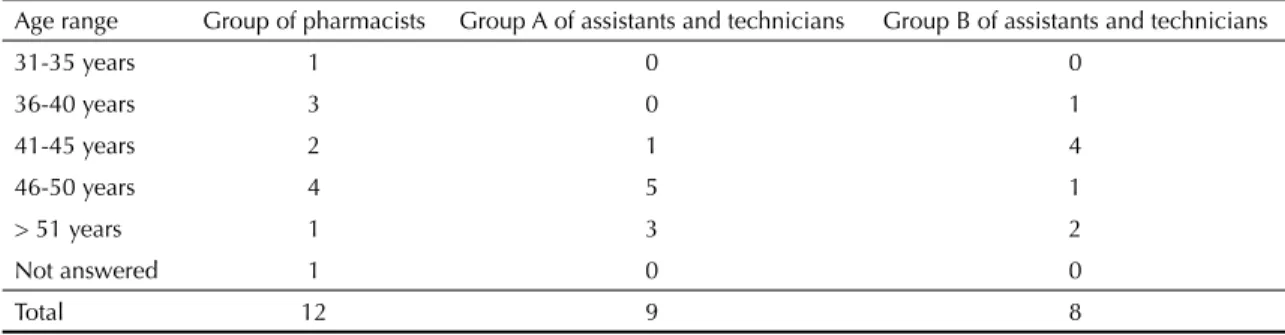
29 participants were grouped as follows: one group of pharmacists with 12 participants, and two groups of technicians and assistants, one with eight and the other with nine participants. They informed their age and length of experience with ART in the pharmacy, according to Tables 1 and 2.
Patients considered diffi cult
Professionals as a whole consider “diffi cult patients” to be people who are confused or, in other words, those who have diffi culties to assimilate and understand orientation about the treatment, and do not accept the disease or reveal it to the family. They also consider diffi cult: the aggressive ones, the depressed ones, and those who have no culture. Among these people are included the illiterates, the homeless, the IDUs, sex workers, transvestites and alcoholics. As an example, while considering the transvestites, they affi rmed, “When they want to cause trouble, they are the worst ones. They make a scene, because sometimes they like this. Whenever they arrive, they want a snack. The share is 20 condoms, but they always want more!”. To which they added, “The biggest problem are the condoms for the homeless. It’s become currency for them: they use drugs and drink with condoms!”.
In one of the groups of assistants the IDUs were con-sidered not to be so diffi cult, in comparison with the transvestites, “They are discreet, calm, and they are few. Five or six at most!”.
Table 1. Distribution of focus group participants, according to group and age range. São Paulo, 2002.
Age range Group of pharmacists Group A of assistants and technicians Group B of assistants and technicians
31-35 years 1 0 0
36-40 years 3 0 1
41-45 years 2 1 4
46-50 years 4 5 1
> 51 years 1 3 2
Not answered 1 0 0
Total 12 9 8
Table 2. Distribution of focus group participants, according to group and length of ART work experience. São Paulo, 2002.
Length of ART
work experience Group of pharmacists Group A of assistants and technicians Group B of assistants and technicians
6 months to 1 year 0 0 1
1-2 years 0 3 1
2-4 years 1 0 0
4-6 years 5 4 5
> 6 years 5 2 1
Not answered 1 0 0
Total 12 9 8
IDU patient turns into the refusal to give additional care, in this case.
According to Schraiber,15 healthcare professionals dedicate themselves to those cases where the diffi cult characterizes technical-scientifi c challenges: the dif-fi cult pathology. In these cases, they overcome even-tual obstacles and try to seek solutions for the patient. Here is presented another diffi cult situation, one that involves the complexity of care and implementation of the proposed assistance program.
Exchange of syringes as special assistance for the IDU
One of the special care actions aimed at IDU patients is constituted by the exchange of syringes, part of the Programa de Redução de Danos (Harm Reduc-tion Program), a set of public health measures that focuses on minimizing the adverse consequences of drug abuse. The exchange of syringes is carried out by specifi c agents. The kits comprise a syringe, disposable needles, antiseptic tissues, a plastic cup, sterile water and condoms, and are made available by the Ministé-rio da Saúde (Ministry of Health). This is an offi cial proposal of the Ministry, assumed by the state of São Paulo (Decree 42927 from 13/03/1998) by means of the Centro de Referência e Treinamento-Aids da Secretaria de Estado da Saúde (AIDS Training and Reference Center of the State Health Department).
However, the focus group participants related that this exchange was not taking place in the pharmacy and none of them participated in the program directly. According to them, the exchange of syringes was performed by professionals from other sections and specifi c agents from the Project.
For some healthcare professionals, the exchange of syringes would be an incentive to drug use. Others mentioned that the program is inadequate, because it can lead to a lack of syringes for other purposes. There were also participants who affi rmed that to perform this activity on top of their routine activities would increase the work of the pharmacies excessively.
Therefore, healthcare professionals seem to disagree with the program implementation in general. Besides, they do not identify themselves as professionals who must belong to it, pointing out that the exchange of syringes should take place in a “specifi c location with easy access”, separate from the pharmacies where they work.
Adherence to treatments and the role of the pharmacy
In all the groups it was affi rmed that the pharmacy has an important role in the adherence to ART medications. However, according to one of the groups, to work in When referring to their professional relationship with
the IDUs, all three groups related that this relationship took place in a “normal” manner, “Everyone is treated equally!”. Thus, they would not be treated differently from the other patients with HIV/AIDS in the service. The general reference was that healthcare professionals could not identify the IDUs only through their inter-personal contact during the pharmacy routine, except if this was registered on the medical record or through the patient’s self-identifi cation.
One group related that the identifi cation of the IDU would only occur when there was a trust-based relation-ship that would enable the patient to refer to himself/ herself as an IDU, thus permitting the clarifi cation of questions about pharmacological interactions between the drugs used by the patient and the ones involved in the ART.
If, on the one hand, accounts pointed to the fact that there was not a reason or a way to discriminate a patient for being an IDU, on the other hand, they were regarded by means of expressions such as, “impatient”, “forgetful about the treatment”, “caring about nothing”, “capable of doing anything if dissatisfi ed“, “not having a regular life”, “not forming bonds” and “not getting attached”. They could also be identifi ed, according to some par-ticipants, by the “red, injected eyes”, “restlessness”, “agitation” and “excessive gesticulation”.
The considerations presented by the focus groups show there is not a clear and common defi nition among the participants about IDUs as regards their condition of patients of the service: at times they are normal, at other times they are impatient or not committed to the assistance; at times they are identifi ed, at other times they are not. Thus, the accounts show this ambiguity of perceptions and values as a marked characteristic, expressed by oftentimes contradictory statements. Acknowledging that all patients living with HIV/AIDS deserve special care, professionals admit that the IDUs are just like other patients and thus deserve the same attention.
order to improve adherence of patients is not supposed to be responsibility of the pharmacy exclusively. In general, in order to expand their participation in this direction, the participants from all groups suggested the following improvements to their work at the pharmacy: to prepare formularies on absent patients for subsequent calls; to fi t the times for administering medication into the patient’s lifestyle; and to control the amount of medication of the patient, clarifying possible side ef-fects. Thus, these professionals believe they can support the communication between patient and doctor. Some affi rmed they feel co-responsible for the treatment of the patients.
All the groups thought that bonds of trust with the patients were formed, the pharmacy being seen as a favorable location to report things that could not be revealed to the doctor. Oftentimes pharmacy profes-sionals referred to the medical consultation being the place where the patient listens, whereas the pharmacy is where he/she wants to speak, something which could enable them to fi nd out whether the patient is adhering to the treatment or not and the reasons why.
Professionals affi rm speaking a great deal with patients about personal aspects, promoting informal conversa-tions; they also control the patient’s visits, and notice that the patient adheres more when his/her family participates.
The pharmacy, generally the last place of assistance of health units, is seen as the fi nal opportunity to clarify remaining questions, thus professionals seek to work in this direction. They also mentioned that, when it comes to patients being attended for the fi rst time in the service, as there is a great deal of technical information and “the patient is tired”, “does not pay attention”, and “wants to leave”, they write some instructions so that the patient can read them later on and keep them.
In some services where there are “adherence groups”, “medication groups” or “patients’ groups”,* despite their not being direct routine participants, profession-als related that posters with the Denominação Comum Brasileira (Brazilian Standardized Nomenclature) of drugs, or pictograms, promote patients’ adherence to the treatment. Some focus group participants said they sporadically participate in the adherence groups.
It is observed, then, that participants appear to be favor-able to expanding their actions, which some actually perform on a more personal rather than institutional ba-sis, representing their individual motivation instead of
a proposal from the organization of the services where they fi nd themselves in, or as motivation passed on from the administration or management of the service.
Limitations and suggestions of changes
Professionals referred to many administrative activities, which occupy most of their working time: bureaucracy and management of medication supply.
All groups pointed out the following as limitations to what they considered to be improvements to their work on the promotion of adherence: lack of medications and other materials; shortage of qualifi ed human resources; impossibility to close the pharmacy to participate in multidisciplinary staff meetings, due to continuous distribution of condoms; no recognition from other professionals and from the institution regarding the work of the pharmacy and its importance, resulting in lack of time; work overload; and unsuitable location to develop educational work in private. Furthermore, participants usually related not knowing whom they should prioritize in the service.
The possibilities for change would depend on: reserved location to guarantee privacy of patients, an adequate amount of medication and enough human resources.
The following actions for adherence were suggested: adaptation of medication times, using clear, accessible language with the patient; use of pictograms; implemen-tation of prescriptions according to the Denominação Comum Brasileira (Brazilian Standardized Nomencla-ture) of drugs;** legible writing; and formation of trust bonds with patients.
One of the groups suggested as an adherence strategy the establishment of a time between the diagnosis of the disease and the beginning of the treatment so that the patient can “assimilate” and “understand” the news before starting the ART treatment. Clarifi cation con-cerning side effects and preparation of posters about the medications and their costs were also pointed out.
As a fi nal group comment regarding limitations and possibilities to improve the pharmacy work, partici-pants were, on the whole, spontaneous to show their satisfaction with the possibility, aroused by the study, to speak about their work routine. They affi rmed not having the time and opportunity to discuss these issues during their usual routine.
Thus, it was observed that, when stimulated to refl ect
* Adherence groups, medication groups and patients’ groups are activities developed by multidisciplinary teams that focus on patients and the improvement of treatment adherence, follow-up and maintenance of the ART therapy.
on their actions, participants made many suggestions, one of them about the opportunity to have moments for such. Still, both their suggestions and criticisms remained within the realm of a more formal and bureau-cratic organization of their performances, not referring to what they considered as regards the peculiarities of the patients, such as the IDUs and what they think of these patients in terms of their being a part of their professional relationships.
FINAL CONSIDERATIONS
Many studies stress the need for a radical change in interactive relations between professionals and pa-tients,7,9,10 which would be essential in the case of IDUs. Malta et al9 point to the importance of communication to minimize barriers to better adherence. Marin et al10 propose a transition from medication-oriented services to patient-oriented services, with professional practice and behavioral changes. Hepler & Strand7 point out that it is not enough to have medication and to supply correctly; it is necessary to direct efforts towards the patient’s social well-being with social responsibility.
Considering the pharmacy teams specifi cally, Mel-chior* shows that the pharmacists from STD/AIDS assistance units in Brazil spend more time on activities related to the medication logistics, instead of this more communicative and interactive dimension. Thus, the supply is not being performed with its full potential in terms of health practice, as better pharmaceutical atten-tion would take into consideraatten-tion the following: “at-titudes, ethical values, differences in behavior, abilities, commitments and co-responsibilities in the prevention of diseases and health promotion and recovery, in a manner that integrates the healthcare staff.”12
The absence of objective working conditions to improve their performance is widely recognized: lack of general conditions, work overload and the mechanization of ac-tivities are their routine perceptions. This study, which assessed the outpatient services for people living with HIV/AIDS on a national basis, shows that 77% of all the 322 STD/AIDS assistance services in Brazil have a pharmacist available and, furthermore, the majority of these professionals do not perform an exclusive activ-ity in the attention to AIDS carriers.** This study also showed that the instructions about medications given to patients are offered by the pharmacist or nurse in merely 21% of services. These data confi rm the precariousness of the pharmacy teams in these services.
Therefore, there is a series of objective factors that pre-vent “pharmaceutical attention” from taking place, as defi ned by the World Health Organization,17 and whose
practice focuses on the patient’s needs. It concerns a direct interaction between the pharmacist and the user, aimed at the improvement of his/her life quality.
Such interaction implies that there are subjective aspects as well, in other words, it involves the concep-tions of its subjects, serving as a reminder of the way the professionals studied are close to IDU patients and how they interact, which makes visible the diffi culties of the patients considered “diffi cult”.
Professionals must perform with technical competence and also with sensitivity and ethical commitment to deal with differences, not to violate the right to privacy, and to decide together which actions are more adequate, including the patient in the co-responsibility of his/her life.14 In this sense, the most easily action recalled by the pharmacy teams studied was the maintenance of a way of proceeding that is equal to all patients, even the IDUs, who are considered “diffi cult”, thus turning them into “normal” patients.
To normalize, in this case, means to merely make people equal, though this still does not solve the assistance inequalities created by the complexities that were not mentioned by the services or the existing attention programs. On the other hand, to conceive them as “dif-fi cult patients” accentuates the stereotype, something that can be stigmatizing.
The stigmatization related to HIV and AIDS has been described as a production and reproduction of social inequalities in the populational group, being accentu-ated among patients considered “problematic”, such as the IDUs, sex workers, homosexuals and transvestites.13 This social exclusion effectively harms prevention, care and adherence efforts.4,16 Fear of rejection may hinder these people from revealing their condition of HIV infec-tion. This can also occur during supply of medicainfec-tion.
The pharmacy could be one other place of assistance that favors reduction in stigma for IDUs living with HIV/AIDS. An open, trust-based and judgment-free relationship may provide the necessary abilities to ef-fi ciently control therapy adherence.* For the WHO,17 adherence is a multidimensional work,17 a dynamic and complex process, simultaneously infl uenced by several factors: the complexity of the therapeutic scheme, the patient’s individual factors, and the relation between patient and service. Patients need support, and health-care professionals need to be qualifi ed to deal with the barriers to adherence.
For the pharmacy teams, such possibilities are already potentially available,5 even though they are based on service reorganization and pharmacy work restructure
so as to include their professionals in multidisciplinary teams of the service as a whole. The pharmacy, seen as a favorable location to listen and to form bonds, should be the focus of changes, abandoning the bureaucratic and mechanical way of performing so it can emphasize
direct pharmaceutical instructions to the patient. Legiti-mization of special attention to and formation of bonds with the IDU patients by these pharmacy professionals still represents an additional step towards objective changes of their work.
1. Bultman DC, Svarstad BL. Effects of pharmacist monitoring on patient satisfaction with antidepressant
medication therapy. J Am Pharm Assoc (Wash)
[periódico na internet].2002 [acesso 09 ago 2004];42(1):36-43. Disponível em: http://www. medscape.com/viewarticle/436594
2. Cantwell-Mcnelis K, James CW. Role of Clinical
Pharmacists in Outpatient HIV Clinics. Am J Health
Syst Pharm [periódico na internet].2002 [acesso em18 mar 2006];59(5):447-52. Disponível em: http://www. medscape.com/viewarticle/429911_print
3. Carlini-Cotrim B. Potencialidades da técnica
qualitativa grupo focal em investigações sobre abuso
de substâncias. Rev Saude Publica.1996;30(3):285-93.
4. Celentano DD, Galai N, Sethi AK, Shah NG, Strathdee SA, Vlahov D, et al. Time to initiating highly active antiretroviral therapy among HIV-infected injection
drug users. AIDS [periódico na internet].2001 [acesso
16 mar 2006];15(13):1707-15. Disponível em: http:// www.aidsonline.com/pt/re/aids/fulltext.00002030-200109070-00015.htm;jsessionid=EdeI1TyYVb6Bhm YjrJIY47qkWqDzZUXWV1tPW8JguoYVwRXuWFM0!-1070481199!-949856145!9001!-1
5. Dray-Spira R, Lert F. Social health inequalities during the course of chronic HIV disease in the era of highly
active antiretroviral therapy. AIDS [periódico na
internet]. 2003 [acesso em 16 mar 2006];17(3):283-90. Disponível em: http://www.aidsonline.com/pt/re/ aids/fulltext.00002030-200302140-00001.htm;jsession id=EdfaBbCA3d4tGa6CogLXEXghcbTzJYC2Yaf1SdN2E Xc7bDOoQASr!-1070481199!-949856145!9001!-1
6. Goffman E. Estigma: Notas sobre a manipulação de uma identidade deteriorada. 4.ed. Rio de Janeiro; LTC; 1988.
7. Hepler CD, Strand LM. Oportunidades y
responsabilidades en la Atención Farmacéutica. Pharm
Care Esp. 1999;1(1):35-47.
8. Krueger RA. Focus Groups. A practical Guide for Applied Research. Thousand Oaks: Sage Publications; 1994.
9. Malta M, Petersen ML, Clair S, Freitas F, Bastos FI. Adherence to antiretroviral therapy: a qualitative study
with physicians from Rio de Janeiro, Brazil. Cad Saude
Publica. 2005;21(5):1424-32.
10. Marin N, Osório-de-Castro CGS, Machado-dos-Santos S, organizadores. Assistência farmacêutica para gerentes municipais. Rio de Janeiro: Organização Pan Americana de Saúde/Organização Mundial da Saúde; 2003.
11. Minayo MCS. O desafi o do conhecimento: pesquisa qualitativa em saúde. 7.ed. São Paulo: Hucitec; 2000.
12. Organização Pan Americana de Saúde/Organização Mundial da Saúde. Consenso Brasileiro de Atenção Farmacêutica: proposta. Atenção Farmacêutica no Brasil: “Trilhando Caminhos”. Brasília; 2002.
13. Parker R, Aggleton P. Estigma, Discriminação e AIDS. Rio de Janeiro: Associação Brasileira Interdisciplinar em AIDS; 2001. [Coleção ABIA: Cidadania e Direitos, 1].
14. Schiller DS. Identifi cation, management, and prevention of adverse effects associated with highly
active antiretroviral therapy. Am J Health Syst
Pharm [periódico na internet].2004 [acesso 16 mar 2006];61(23):2507-2522. Disponível em: http://www. medscape.com/viewarticle/497920_print
15. Schraiber LB. Violência contra as mulheres e políticas de saúde no Brasil: o que podem fazer os serviços de
saúde? Rev USP. 2001;(51):104-13.
16. Wood E, Montaner JS, Bangsberg DR, Tyndall MW, Strathdee SA, O’Shaughnessy MV et al. Expanding access to HIV antiretroviral therapy among marginalized populations in the developed world.
AIDS [periódico na internet].2003[acesso em:18
mar 2006];17(17):2419-27. Disponível em: http://
www.aidsonline.com/pt/re/aids/fulltext.00002030-200311210-00003.htm;jsessionid=EdlsaeISIREgdSh eeWzEK9SCk5PsLC1VHBwlgMOVyM6h93Osgvrr!-1070481199!-949856145!9001!-1
17. World Health Organization. Adherence to long-term therapies: evidence for action. Geneva; 2003.
REFERENCES