1Universidade do Estado do Rio de Janeiro – UERJ, Rio de Janeiro (RJ), Brazil. E-mails: [email protected], [email protected], [email protected],
*Corresponding author.
Manuscript ID: 20160078. Received in: 06/27/2016. Approved in: 10/24/2016. ABSTRACT: he Paraná Basin holds in its stratigraphic record a thick layer of volcanic rocks related to the opening of the Gondwana Supercontinent, which occurred during the Eocretaceous. Based on the interpretation of three two-dimensional (2D) seismic lines in the region of Guareí, East-Central São Paulo state, in the Southeast of Brazil, the subsurface geometries of these volcanic rocks were identi-ied. Since the original seismic resolution quality was low, alternati-ve techniques were utilized to improalternati-ve the seismic imaging, such as isolating maximum and minimum amplitude values by manipula-ting the color scale, and using the root mean square (RMS) attribute and the Amplitude Volume technique (tecVA), which emphasize the seismic signature of igneous rocks in relation to sedimentary layers. he use of such techniques allowed the identiication of diferent geometries of diabase sills and showed a relationship between these intrusive and organic matter maturation of the source rock. KEYWORDS: Geometry of sills; Serra Geral magmatism; Ampli-tude analysis.
RESUMO: A Bacia do Paraná possui em seu registro estratigráico uma espessa camada de rochas vulcânicas relacionadas à abertura do Super-continente Gondwana, ocorrida durante o Eocretáceo. Por meio da inter-pretação de três linhas sísmicas em duas dimensões (2D), localizadas na região de Guareí, centro-leste do estado de São Paulo, Sudeste do Brasil, foram identiicadas as geometrias dessas rochas vulcânicas em subsuper-fície. Como a qualidade da resolução sísmica original era baixa, foram utilizadas técnicas alternativas para melhorar o imageamento sísmico, como o isolamento de valores máximos e mínimos de amplitude pela ma-nipulação da escala de cores, mediante o uso do atributo root meansquare (RMS) e a técnica Volume de Amplitude (tecVA), as quais enfatizaram as rochas ígenas em relação às camadas sedimentares. A utilização dessas técnicas permitiu a identiicação de diferentes tipos de soleiras de dia-básio, além de sua relação com a maturação da matéria orgânica nas rochas geradoras.
PALAVRAS-CHAVE: Geometria de soleiras; Magmatismo Serra Geral; Análise de amplitude.
Analysis of the geometry of diabase
sills of the Serra Geral magmatism, by 2D
seismic interpretation, in Guareí region,
São Paulo, Paraná basin, Brazil
Análise da geometria de soleiras de diabásio do
magmatismo Serra Geral, por interpretação sísmica 2D,
na região de Guareí, São Paulo, Bacia do Paraná, Brasil
Diego Felipe Bezerra da Costa1, Werlem Holanda dos Santos1*,
Sérgio Bergamaschi1, Egberto Pereira1
INTRODUCTION
Regardless of the tectonic context of a sedimentary basin, the presence of magmatic rocks in its stratigraphic record is recurring. It is very important to understand the origin, the structure and the geometry of magmatic intrusions, when trying to assess the economic impact of those occurrences in sedimentary basins with hydrocarbon exploration potential.
In some sedimentary basins, igneous rocks can be classi-ied as elements of the petroleum system, as reservoir rocks and seals, or as forming structural traps which hold the oil. In addition, the heat from magmatic rocks can help in the maturation of the organic matter contained in hydrocarbon source rocks (Magoon & Dow 1994).
Reservoir rocks of magmatic origin occur in several oilields in the Liaohe Basin, China (Chen et al. 1999). In the Neuqén Basin, Argentina, oil and gas are found in the fractures of dia-base sills intruded in the source rocks (Schiuma 1988). In Brazil, the oilields of Badejo and Linguado, located in the southern portion of the Campos Basin, produce oil from fractured basalt.
Diabase dikes and sills, as well as basalt lows, can act as efective sealing rocks, especially when not altered or fractured. Basaltic lows and dikes occur as vertical and lateral seals, respec-tively, in the oil and gas ields of Dapingfang and Huangjindai, Liaohe Basin, China. Diabase sills act as sealing rocks in the Barra Bonita gas ield, Paraná Basin (Eiras & Filho 2003).
Conceição et al. (1993) studied and classiied the struc-tures induced by magmatic intrusions in the Brazilian intra-cratonic basins, on the basis of the igneous bodies, and the structural elements present in the enveloping rock.
In intracratonic basins with low heat flow, such as the Brazilian Paleozoic syneclises, several authors stud-ied how magmatic intrusions helped in the maturation of the organic matter, as Rodrigues et al. (1990) in the Solimões Basin, Rodrigues (1995) in the Parnaíba Basin, Alves & Rodrigues (2002) in the Amazonas Basin, and De Souza et al. (2005) in the Paraná Basin.
Given those prior studies, this work sought to charac-terize the geometry of the diabase sills of the Serra Geral Formation, Early Cretaceous age, which occur in the strati-graphic record of the Paraná Basin, speciically in the region of Guareí, East-Central São Paulo state, in southeastern Brazil, based on patterns observed in two-dimensional (2D) seis-mic lines, since those magmatic rocks may be directly related to the development of the petroleum systems of the basin.
PARANÁ BASIN
he area of study is within the tectonic and stratigraphic context of the Paraná Basin, a Paleozoic syneclise composed of
magmatic and sedimentary rocks with ages from the Ordovician to the Cretaceous (Zalan et al. 1991), which cover the meridional portions of Brazil and part of Paraguay, Argentina and Uruguay, with a total area of approximately 1.4 million km2 (Fig. 1).
According to Milani et al. (2007), the stratigraphic record of the basin is divided into six tectonic sequences separated by interregional unconformities: the Ivaí River (Ordovician-Silurian), Paraná (Devonian), Gondwana I (Carboniferous-Lower Triassic), Gondwana II (Middle to Upper Triassic), Gondwana III (Upper Jurassic-Lower Cretaceous), and Bauru (Upper Cretaceous).
he igneous rocks present in the stratigraphic record of the Paraná Basin are related to the Gondwana Supercontinent rupture (200 Ma), which resulted in the opening of the Atlantic Ocean, at about 120 Ma (Mizusaki & homaz-Filho 2004). his major geodynamic episode was registered in the Paraná Basin during the Early Cretaceous as a mag-matism of tholeiitic and calc-alkaline basalts, with subordi-nate rhyolites and rhyodacites, which characterize the Serra Geral Formation (Peate et al. 1992).
he Serra Geral Formation is constituted by a thick pile of lava lows, which can reach thicknesses of 2.000 m in some regions (Fig. 1). It is characterized by a network of dikes, cutting the entire Paleozoic-Mesozoic sedimentary succes-sion, and multiple diabase sills that intrude into the strati-ication planes of Paleozoic sediments, preferentially along Irati Formation horizons (Mizusaki & homaz-Filho 2004).
Considering the basin scale, several authors (Milani 1997, Milani & Zalán 1999, Araújo et al. 2000, Correa & Pereira 2005) emphasize the heat deriving from the diabase sills directly inlu-enced the maturation of the organic matter present in the shales of Irati Formation. In this way, the main petroleum system of the Parana Basin — Irati–Rio Bonito/Piramboia(!) — is deined as a non-conventional petroleum system, according to Magoon & Dow (1994).
Louti (2011) analyzed biomarker and isotope data on oil samples found in Rio Bonito Formation and associated them to the Assistência Member of Irati Formation. Other authors (Cabral 2006, Seraim 2011, Vital 2012) also ratiied the oil found in the sandstones of Piramboia Formation is related to organic matter generated in the shales of Irati Formation.
56ºW 52ºW
Legend Study area
International boundary
Basement depth
Stratigraphy Age Tectonic Sequences
K
J
T P
C D S
O Bauru
Gondwana III
Gondwana II
Gondwana I
Paraná
Rio Avaí
Basement 34ºS
18ºS
26ºS
200 km N
Figure 1. Location and simpliied geological map of Paraná Basin. Modiied from Zalán (1991).
Considering the local scale context, Araújo et al. (2005) emphasize the main control for trap formation, maturation of organic matter, and migration pathways for oil, is the struc-tural network dominated by NW and NE lineaments that arose during the tectonic episode in the Juro-Cretaceous.
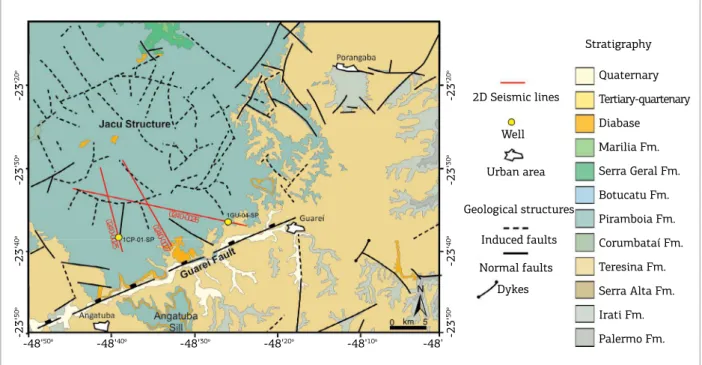
he geologic map of the study area allows the visualization of the main lineaments described by Araújo et al. (2005), con-irming there is a structural control, imposed by faults, in the contact between Piramboia Formation (Triassic) and Teresina Formations (Permian), as well as in Irati Formation, encircled by the younger Teresina and Serra Alta Formations (Fig. 3).
MATERIALS AND METHODS
he data used in this work are located in the township of Guareí, East-Central São Paulo state, in southeastern Brazil. he region was studied in the past due to the occur-rence of oil sands, which led to an interest in seismic sur-veys and exploratory wells in the region. he present project included the interpretation of three 2D post-stack seismic on time domain (0240-0025, 0240-0026 and 0240-0027), from the acquisition 0240_PARANÁ_51 made by Petróleo
Brasileiro S.A. (Petrobras) in 1992, in addition to the analy-sis of two wells (1-GU-4-SP and 1-CP-1-SP), which inter-cept those lines (Fig. 3).
here is no information on the acquisition and process-ing of these lines besides the dates they occurred: 1992 and 2000, respectively. he data does not include any embedded information in its language that could assist interpretation, only the basic parameters to visualize the seismic stack such as number of samples, samples interval in ms for each trace and the navigation ile.
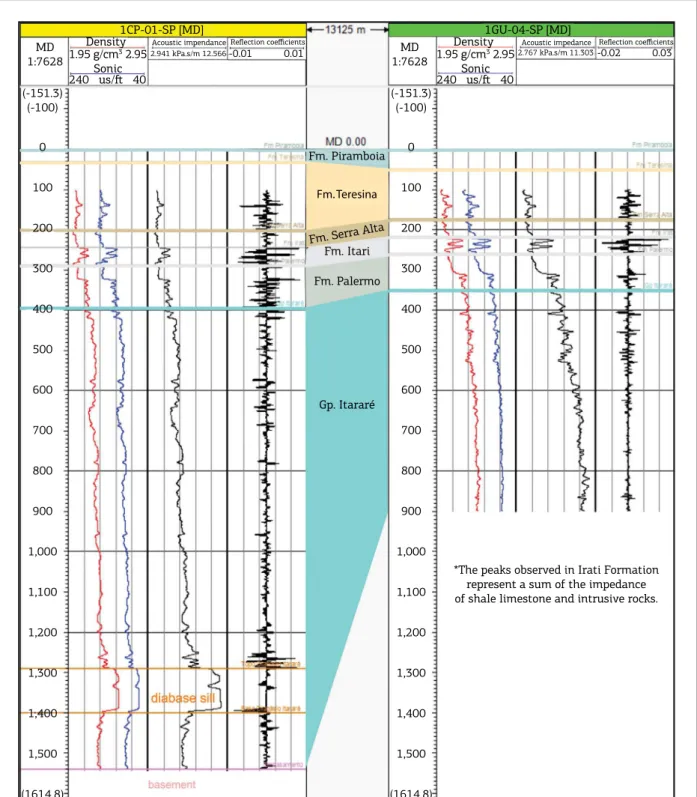
herefore, the phase and polarity of the seismic was established using subsurface features that can generate high amplitude relections (Brown 2011) such as igneous intru-sions in contrast to the enveloping sediment. his relation-ship was observed in the well 1-CP-01-SP, where the tran-sition from the sediments to a diabase sill with 110 m thick shows a decreasing of slowness (sonic log) and increasing of density log. It is also observed in the amplitude of the seis-mic relectors, where the entrance of the sill is relected by a peak in the seismic amplitude (from sediments to igne-ous) while the exit shows the opposite behavior, conigur-ing a trough (Fig. 4).
Araújo et al. (2005) report some troubles with seismic surveys of Paraná Basin, because of the thick volcanic rock packages hamper seismic imaging. hus, the use of ilters, seeking to minimize noise and consequently improve imag-ing, was one of the most important stages of the process-ing adopted in this work. he methodology also involved the calibration of seismic lines with synthetic seismograms
Limestone (intermed iate reservoir)
Diabase dike
Serra Geral
Fm
Botucatu Fm.
Piramboia Fm.
Corumbataí Fm.
Irati Fm.
Palermo Fm. + Rio Bonito Fm.
Itararé Group
Oil contente in the sandstone
8%
7% 6%
5%
2% 3%
Secondary migration
Primary migration
Primary migration
Source rock
Source rock
Figure 2. Oil migration scheme in petroleum system
based on the well logs, extraction of seismic attributes, seis-mic-stratigraphic analysis of the main horizons, and, inally, interpretation of the main faults and diabase sills.
It is important to emphasize that, with a poor seismic resolution, the main ally in interpretation was the condition that the petroleum system is outcropping, which provides direct analogues and subsurface indicators.
he techniques used were: isolation of maximum and minimum amplitude values by manipulating the color chart; the root mean square (RMS) attribute; and the Amplitude Volume technique (tecVA).
he isolation of the maximum (10,000 to 25,000) as well as the minimum (-10,000 to -25,000) absolute amplitudes by choosing green and yellow colors — over a grayscale for low and medium amplitudes —, emphasized great impedance con-trasts associated with igneous bodies in contact with sedimen-tary rocks, as in the works of Porto (2013) and Costa (2015). Even with this approach, the seismic imaging showed many colored points related to noise, so that it was neces-sary to extract RMS attributes, and subsequently use tecVA in order to isolate only the amplitude anomalies with geo-logical signiicance.
he RMS attribute measures the relectivity along a time window using the square root of the sum of the square of amplitudes, divided by the number of samples. As a result, both positive and negative maximum amplitudes are empha-sized in relation to minimum amplitudes.
he RMS is used as input data to extract tecVA, a tech-nique initially used to emphasize faciological variation
and highlight layers. It is calculated empirically using high impedance contrast through the rotation of the zero phase to -90º. As a result, shales signatures are considered back-ground and sandstones, conglomerates, volcanics, intrusives, source rocks, limestones, among others, are the emphasized layers (Bulhões & Amorim 2005).
he output data obtained with the technique comprises amplitude data and the luctuations of the seismic funda-mental frequency (amplitude, frequency and modulated phase). hus, this technique has the potential to show that small luctuations can reveal features such as faults and chan-nels (Bulhões & Amorim 2005). Due to the high density of intrusive rocks in the stratigraphic record of Paraná Basin, these seismic discontinuities can also indicate dikes and sills. Applying this attribute to the data points where the main contrasts are given by the presence of intrusive rocks, the tecVA allowed to identify sills, the pattern of their geometry, their relation with the enveloping rocks, and their association with other structures, such as possibly smaller feeding dikes. he same technique was successfully used by Oreiro et al. (2008) when studying the Upper Cretaceous and Paleogene mag-matism at the border between Campos and Santos Basins.
THEORETICAL FOUNDATIONS
The migration and storage of magma in Earth’s crust represent very important geological processes. Neumann et al. (2003) believe that the understanding of
Stratigraphy
Quaternary
Tertiary-quartenary
Diabase
Marilia Fm.
Serra Geral Fm.
Botucatu Fm.
Piramboia Fm.
Corumbataí Fm.
Teresina Fm.
Serra Alta Fm.
Irati Fm.
Palermo Fm.
-23'
20º
-23'
30º
-23'
40º
-23'
50º
-23'
20º
-23'
30º
-23'
40º
-23'
50º
-48'50º -48'40º -48'30º -48'20º -48'10º -48'
2D Seismic lines
Well
Urban area
Geological structures
Induced faults
Normal faults
Dykes
these processes has important implications in the compre-hension of the evolutionary dynamics of a volcano-sedimen-tary basin. hus, it is necessary to recognize the diferent forms in which magmatism may manifest itself.
Tabular or sheet intrusions, such as dikes, sills and lac-coliths are the most common types of magmatic bodies
included in Earth’s crust. Dikes are vertical to subvertical magma ill along fractures, mainly controlled by magma buoyancy properties at high temperatures. Sills, on the other hand, while also tabular, are predominantly parallel to the bedding of the host rock. Laccoliths, while also parallel to the bedding of the enveloping rock, difer from sills due
*The peaks observed in Irati Formation represent a sum of the impedance of shale limestone and intrusive rocks.
1CP-01-SP [MD] 1GU-04-SP [MD]
MD 1:7628
MD 1:7628 Density
1.95 g/cm3 2.95
Sonic
240 us/ſt 40
Density 1.95 g/cm3 2.95
Sonic
240 us/ſt 40
Acoustic impendance
2.941 kPa.s/m 12.566
Acoustic impedance
2.767 kPa.s/m 11.303
Reflection coefficients
-0.01 0.01
Reflection coefficients
-0.02 0.03
(-151.3) (-100)
0
100
200
300
400
500
600
700
800
900
1,000
1,100
1,200
1,300
1,400
1,500
(1614.8)
(-151.3) (-100)
0
100
200
300
400
500
600
700
800
900
1,000
1,100
1,200
1,300
1,400
1,500
(1614.8) Fm. Piramboia
Fm. Teresina
Fm. Serra Alta
Fm. Itari
Fm. Palermo
Gp. Itararé
to their geometry, since their base is lat and their tops are dome-shaped (Malthe-Sørenssen et al. 2004).
Regarding the seismic imaging of intrusive bodies, sills have a high seismic velocity (Vp ~ 5–7 km/s), and are fre-quently imaged as high amplitude relections when intruded in sedimentary strata (Neumann et al. 2003). Dikes, on the other hand, represent blind points or pitfalls in the seismic image, like the majority of vertical bodies. Since these ver-tical bodies ill fractures, and because they are the means by which sills are fed, seismically mapped vertical discon-tinuities are often associated with dikes in regions marked by intense intrusive igneous.
Among the many parameters that contribute and control the development of a sill, the work of Neumann et al. (2003) compiles interpretations from various authors and lists the following factors: the density of the magma and the pressure applied in relation to the regional stress ield (Anderson 1951); the thickness of the overburden pack-age (Mudge 1968); the presence of wet sediments that interact with the magma, forming barriers and producing water vapor (Mudge 1968); mechanical discontinuities, such as the bedding of sedimentary rocks (Mudge 1968, Gretener 1969); the petrophysical properties contrast between diferent lithological units, inducing horizontal tension between the strata (Gretener 1969); the existence of fractures (Leaman 1975) or faults (Liss et al. 2002); and the level of density inversion between the magma and the host rock (Francis 1982).
Studies at the seismic and ield scale, such as those of Neumann et al. (2003) and Planke et al. (2005), found that the fundamental geometry of a sill is saucer-shaped. his form and some of its sub-classiications were clearly recognized based on the seismic interpretation performed in this work.
Since the Paraná Basin exhibits a large volume of vol-canic rocks, it is common to ind a dense and entangled network of intrusive rocks, such as compound sills and even sill complexes. hus, in order to determine the geom-etry of the sills observed in the present work, the analysis proposed by Hansen et al. (2004), which consider junc-tions of two or more sills forming compound and com-plex sills, was followed.
RESULTS AND DISCUSSION
Line 0240-0025
Line 0240-0025, oriented NNW-SSE, was interpreted using the stratigraphy of the well located along the line (1-CP-01-SP).
Due to the loss of lateral continuity of the relectors and high noise of the seismic data, it was made a seismic well tie extracting three wavelets (multi-wavelet calibra-tion), according the seismic domains. he irst wavelet was extracted between 240–600 ms, which includes the irst relectors of the seismic to the top of Itararé Group. he intermediate wavelet was extracted from 600–940 ms, which includes younger relections of the Itararé Group, which does not show high contrast impedance. Finally, the last wavelet was extracted from 940–1,340 ms, which corresponds to shales and shaly tillites, including 110 m of diabase (registered in the well) near the contact with the basement.
After the seismic well tie, the locations where the larg-est drifts between the input and output interval velocities occurred are related to the proximity of diabase sills in the extraction window.
In this line, important normal faults can be recognized near the Guareí Fault Zone. he increase in the noise level of the seismic signal suggests that there are intrusive rocks associated with the fault zone, and that they may represent as conduits for magmatic activity. he proximity with the Angatuba sill (5 km to the south) and with the Jacu structure contributes to the hypothesis that there is a local preferential spot for magma migration in that fault zone.
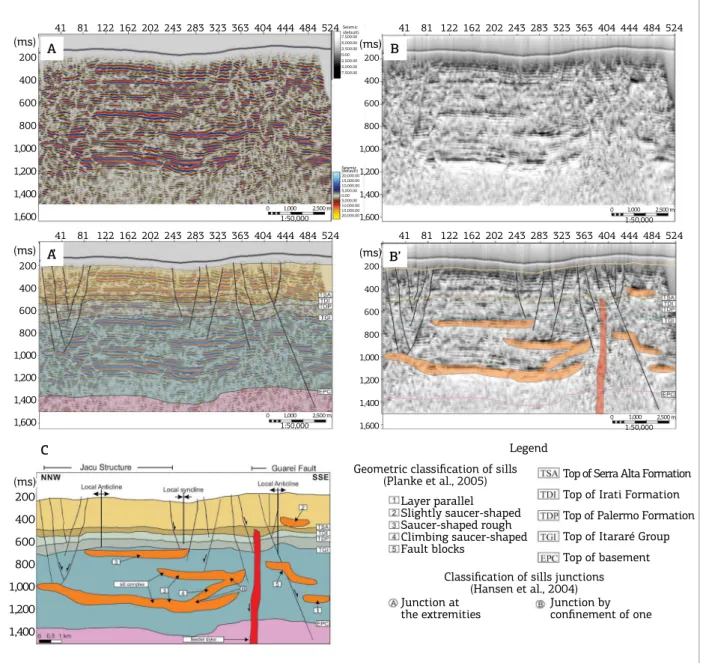
he following sill facies were identiied: smooth layer parallel; saucer-shaped rough; climbing saucer-shaped; and fault block. Among those, the facies fault block stands out in the seismic line, emphasizing the importance of faults in that local context (Fig. 5).
Line 0240-0026
Line 0240-0026, oriented NWW-SEE, was inter-preted using the stratigraphy of the well 1-GU-04-SP, located in the southeast portion of the line. It cuts across the extreme south of the Jacu structure. Based on the analysis of the interpreted geological section (Fig. 6), the presence of local folds can be observed, evidenced by alternating of anticlines and synclines compartmen-talized in faulted blocks.
Sill geometries corresponding to the following seismic facies were recognized in the subsurface: smooth layer par-allel; slightly saucer-shaped; saucer-shaped rough; climbing saucer-shaped; and fault block shape.
Line trace (ms)
Line trace (ms)
Line trace (ms)
(ms)
Line trace (ms) 200
400
600
800
1,000
1,200
1,400
200
400
600
800
1,000
1,200
1,400
1,600
200
400
600
800
1,000
1,200
1,400
200
400
600
800
1,000
1,200
1,400
200
400
600
800
1,000
1,200
1,400
41 81 122 162 202 242 282 322 362 402 443 41 81 122 162 202 242 282 322 362 402 443
41 81 122 162 202 242 282 322 362 402 443 41 81 122 162 202 242 282 322 362 402 443
25,000.00 20,000.00 15,000.00 10,000.00 5,000.00 0.00 5,000.00 10,000.00 15,000.00 20,000.00 25,000.00
10000.00 7500.00 5000.00 2500.00 0.00 -2500.00 -5000.00 -7500.00 -10000.00 Seismic (default)
Seismic (default)
0 1,000 2,500 m
0 1,000 2,500 m
1:50,000
1:50,000
Top of Serra Alta Fm.
Geometric classification
of sills (Planke et al., 2005) Layer parallel Saucer-shaped rough Climbing saucer-shaped Fault blocks
Top of Irati Fm.
Top of Palermo Fm.
Top of Itararé Group
Basement
Figure 5. Seismic interpretation of line 0240-0025. In (A): iltered data without interpretation; in (A’): iltered data with superimposed horizons and mapped faults; in (B): tecVA attribute; in (B’) interpretation of the diabase sills and dikes superimposed on the tecVA attribute; in (C): schematic geological section.
A
C A’
B
B’
Line 0240-0027
Line 0240-0027, oriented NNW-SSE, also cuts across the extreme south of the Jacu structure, and what was hypothesized for line 0240-0026 can be observed in sub-surface (the possibility of the presence of sill complex), in this section. Right below the structure, a sill complex was interpreted, evidenced by two saucer-shaped rough sills and a climbing saucer-shaped sill, connected by a junc-tion of the type coninement of one sill against another. he sills also seem to control the shallower faults and frac-tures that stretch from the strata of Teresina Formation
(relectors above Serra Alta Formation) to the top of the Itararé Group (Fig. 7).
Besides the saucer-shaped rough sill facies and the climbing saucer-shaped sill facies, which join the mapped sill complex, sill facies of smooth layer par-allel, slightly saucer-shaped and of fault block shape were recognized.
(ms) (ms)
200
400
600
800
1,000
1,200
1,400
1,600
200
400
600
800
1,000
1,200
1,400
1,600
(ms) (ms)
200
400
600
800
1,000
1,200
1,400
1,600
(ms)
200
400
600
800
1,000
1,200
1,400
200
400
600
800
1,000
1,200
1,400
1,600
41 81 121 162 202 242 282 323 363 403 444 484 524 564 605 645 685 725 765 805 846 886 41 81 121 162 202 242 282 323 363 403 444 484 524 564 605 645 685 725 765 805 846 886
41 81 121 162 202 242 282 323 363 403 444 484 524 564 605 645 685 725 765 805 846 886 41 81 121 162 202 242 282 323 363 403 444 484 524 564 605 645 685 725 765 805 846 886
Seismic (default) Seismic (default)
20,000.00 15,000.00 10,000.00 0.00 5,000.00 10,000.00 15,000.00
7,500.00 5,000.00 2,500.00 0.00 2,500.00 5,000.00 7,500.00
1:50,000
0 1,000 2,500 m
1:50,000
0 1,000 2,500 m
1:50,000
0 1,000 2,500 m
1:50,000
0 1,000 2,500 m
Top of Serra Alta Formation
Top of Irati Formation
Top of Palermo Formation
Top of Itararé Group
Top of basement Legend
Geometric classification of sills (Planke et al., 2005)
Layer parallel Slightly saucer-shaped Saucer-shaped rough Climbing saucer-shaped Fault blocks
Jacu Structure
Seismic
interpretation
of
Line
0240-0026.
(A):
iltered
data
without
interpretation;
(A
’):
iltered
data
with
horizons
and
mapped
faults;
(B):
tecV
A
attribute;
(B’)
interpretation
of
the
diabase
si
lls
and
dikes
A attribute; (C): schematic geological section.
A B
A’ B’
C
612
Brazilian Journal of Geology
, 46(4): 605-615, December 2016
Geometry of diabase sills in P
he direct contact of the interpreted magmatic features in Figures 5, 6 and 7 with Irati Formation (black shales) would have contributed to the thermal maturation of the organic matter, since it is known that, in normal burial conditions, the source rock did not reach the window of hydrocarbon generation, featuring an unconventional generation model.
CONCLUSIONS
Despite the low signal/noise ratio, the methodology used in the treatment of the original seismic trace satisfactorily allowed the mapping and characterization of the geometries
Figure 7. Seismic interpretation of Line 0240-0027. (A): iltered data without interpretation; (A’): iltered data with superimposed horizons and mapped faults; (B): tecVA attribute; (B’) interpretation of the diabase sills and dikes superimposed on the tecVA attribute; (C): schematic geological section.
(ms) (ms)
(ms)
200
400
600
800
1,000
1,200
1,400
1,600
200
400
600
800
1,000
1,200
1,400
1,600
(ms) (ms)
200
400
600
800
1,000
1,200
1,400
1,600
200
400
600
800
1,000
1,200
1,400
1,600
200
400
600
800
1,000
1,200
1,400
41 81 122 162 202 243 283 323 363 404 444 484 524
41 81 122 162 202 243 283 323 363 404 444 484 524
41 81 122 162 202 243 283 323 363 404 444 484 524
41 81 122 162 202 243 283 323 363 404 444 484 524
20,000.00 15,000.00 10,000.00 5,000.00 0.00 5,000.00 10,000.00 15,000.00 20,000.00 7,500.00 5,000.00 2,500.00 0.00 2,500.00 5,000.00 7,500.00
Seismic (default) Seismic (default)
0 1,000 2,500 m 0 1,000 2,500 m
1:50,000
0 1,000 2,500 m
1:50,000
1:50,000
0 1,000 2,500 m
1:50,000
Top of Serra Alta Formation
Top of Irati Formation
Top of Palermo Formation
Top of Itararé Group
Top of basement Layer parallel
Slightly saucer-shaped Saucer-shaped rough Climbing saucer-shaped Fault blocks
Geometric classification of sills
(Planke et al., 2005)
Classification of sills junctions
(Hansen et al., 2004) Legend
Junction at the extremities
Junction by
confinement of one
A
C A’
B
B’
of the diabase sills, as well as their relation with the envel-oping rocks.
Five sill geometries were recognized in the study area, according to the classiication of Planke et al. (2005): smooth layer parallel; slightly saucer-shaped; saucer-shaped rough; climbing saucer-shaped; and fault block shape. he sills pref-erentially occurred intruding the Itararé Group and the inter-face of Palermo/Irati Formations.
his is corroborated at the well scale, where the 1-CP-01-SP well has a 110-meter-thick sill in the basal package of the Itararé Group, while the sills that intrude Irati and Palermo Formations have a thickness varying from 2 to 9 m (1-GU-04-SP well).
Compound sills and sill complexes formed by the junc-tion of the extremities, or by coninement of one sill against another, were also observed, underscoring the dense and entangled network of sills and dikes, that is common in a magmatic province such as the Paraná Basin.
he seismic interpretation allowed associating the mat-uration of organic matter with igneous intrusions, perform-ing an unconventional petroleum system.
ACKNOWLEDGEMENTS
he authors wish to thank the Banco de Dados de Exploração
e Produção (BDEP), the exploration and production
data-base of the Agência Nacional do Petróleo, Gás Natural e
Biocombustíveis (ANP), and the Brazilian national
regula-tory agency for oil, gas and biofuels, for making available the data; the Faculty of Geology of Universidade do Estado do Rio
de Janeiro (State University of Rio de Janeiro – UERJ); and
especially the Departamento de Estratigraia e Paleontologia
(Stratigraphy and Paleontology Department – DEPA) and geologist Edison José Milani, for his collaboration.
Alves D.B. & Rodrigues R. 2002. Inluência das intrusões ígneas
nos folhelhos devonianos da Bacia do Amazonas. In: II Simpósio
sobre vulcanismo e ambientes associados, Belém (PA). Boletim de
Resumos... Belém.
Anderson E.M. 1951. The dynamics of faulting. Oliver & Boyd,
Endinburg, 2nd edition.
Araújo L.A., Triguis J.A., Cerqueira J.R., Freitas L.C.S. 2000. The atypical Permian petroleum system of the Paraná Basin, Brazil.
In: Mello M.R., Katz B.J. (eds.) Petroleum systems of South Atlantic
margins. American Association of Petroleum Geologists, Memoir,
Tulsa, Oklahoma, 73:377-402.
Araújo C.C., Yamamoto J.K., Rostirolla S.P. 2005. Arenitos asfálticos
na Bacia do Paraná: estudo das ocorrências no Alto Estrutural de
Anhembi. Boletim de Geociências da Petrobras, Rio de Janeiro,
14(1):47-70.
Bulhões E.M., Amorim W.N. 2005. Princípio da SismoCamada
Elementar e sua aplicação à técnica de volume de amplitudes (tecVA). In: Ninth International Congress of the Brazilian Geophysical
Society. Salvador, Brazil.
Brown A.R. 2011. Interpretation of three-dimensional seismic data.
7th edition. American Association of Petroleum Geologists, Memoir
42 and SEG Investigations in Geophysics Series 9.
Cabral C.V. 2006. Análise de biomarcadores nos arenitos asfálticos
da borda leste da Bacia do Paraná. Dissertação de Mestrado, COOPE, Universidade Federal do Rio de Janeiro, Rio de Janeiro.
Chen Z., Yan H., Li J., Zhang G., Zhang Z., Liu B. 1999. Relationship between tertiary volcanic rocks and hydrocarbons in the Liaohe Basin, People’s Republic of China. American Association of Petroleum Geologists, 83(6):1004-1014.
Conceição J.C.J., Zalán P.V., Dayan H. 1993. Deformações em rochas sedimentares induzidas por intrusões magmáticas: classiicação e
mecanismos de intrusão. Boletim de Geociências da Petrobras, Rio
de Janeiro, 7(1/4):57-91.
Correa L.M.S.A. & Pereira E. 2005. Estudo da distribuição das
intrusões mesozóicas e sua relação com os sistemas petrolíferos da
Bacia do Paraná. In: Simpósio de vulcanismo e ambientes associados, Cabo Frio, 1:21-26.
Costa D.F.B. 2015. O papel das intrusões de soleiras e diques
de diabásio na gênese de rotas de migração e armadilhas de hidrocarbonetos, em área de ocorrências de arenitos asfálticos
da Formação Piramboia, região de Guareí-SP, Bacia do Paraná. Dissertação de Mestrado, Universidade do Estado do Rio de Janeiro, Rio de Janeiro.
De Souza I.V.A.F., Mendonça Filho J.G., Menezes T.R. 2005. Avaliação
da inluência térmica das intrusivas ígneas no principal horizonte
potencialmente gerador da Bacia do Paraná: Formação Irati. In: 3.º
Congresso Brasileiro de P&D em Petróleo e Gás. Salvador, Brasil.
Eiras J.F. & Wanderley Filho J.R. 2003. Sistemas petrolíferos
ígneo-sedimentares. In: 2.º Congresso Brasileiro de P&D em Petróleo e Gás. Belém, Brasil.
Francis E.H. 1982. Magma and sediment–I Emplacement mechanism of late Carboniferous tholeiite sills in northern Britain.
Journal of Geological Society, 139:1-20. doi: 10.1144/gsjgs.139.1.00.
Gretener P.E. 1969. On the mechanics of the intrusion of sills.
Journal of Earth, 6(6):1415-1419. doi: 10.1139/e69-143.
Hansen D.M., Cartwright J. A., Thomas D. 2004. 3D seismic analysis of the geometry of igneous sills and sill junctions relationships.
In: Davies R.J., Cartwright J.A., Stewart S.A., Lappin M., Underhil
J.R. (eds.). 3D Seismic technology:application to the exploration of sedimentary basins. Geological Society, London, 29:199-208.
Leaman D.E. 1975. Form, mechanism and control of dolerite
intrusions near Hobart, Tasmania. Journal of the Geological
Society of Australia, 22(2):175-186. doi: http://dx.doi. org/10.1080/00167617508728886.
Liss D., Hutton D.H.W., Owens W.H. 2002. Ropy low structures: A neglected indicator of magma low direction in sills and dikes.
Geology, 30:715-718.
Louti I.S. 2011. Caracterização geológica da ocorrência de óleo na
Formação Rio Bonito associada a um modelo não convencional de geração. Dissertação de Mestrado, Universidade do Estado do Rio de Janeiro. Rio de Janeiro.
Magoon L.B. & Dow W.G. 1994. The petroleum system: from source
to trap. In:American Association of Petroleum Geologists Memoir,
60:3-24.
Malthe-Sørenssen A., Planke S., Svensen H., Jamtveit B. 2004.
Formation of saucer-shaped sills. Geological Society of London,
Special Publications, 234:215-227.
Milani E.J. 1997. Bacia do Paraná: carta estratigráica, com os
principais eventos tectônicos e magmáticos relacionados à sua evolução. Rio de Janeiro, Petrobras, Relatório interno.
Milani E.J., Melo J.H.G., Sousa P.A., Fernandes L.A., França A.B. 2007. Bacia do Paraná. Boletim de Geociências da Petrobras, Rio de Janeiro,
15(2):265-287.
Milano E.J., Zalán P.V. 1999. An outline of the geology and pretoleum systems of the Paleozoic interior basins of South America. Episodes,
22(3):199-205.
Mizusaki A.M.P. & Thomaz-Filho A. 2004. O magmatismo pós-paleozóico no Brasil. In: Mantesso-Neto V., Bartorelli A., Carneiro
J.C., Brito-Neves B.B (eds.) Geologia do continente sul-americano: evolução da obra de Fernando Flávio Marques de Almeida. São Paulo, Beca, p. 281-292.
Mudge M.R. 1968. Depth control of some concordant intrusions.
Geological Society America Bulletin, 79:315-332.
Neumann E.R., Planke S., Malthe-Sørenssen A. 2003. Emplacement mechanism and magma lows in sheet intrusions in sedimentary basins. Sill Emplacement-NFR, Oslo. VBPR Report. p. 1-10.
Oreiro S.G., Cupertino J.A., Szatmari P., Thomaz-Filho A. 2008.
Inluence of pre-salt alignments in post-Aptian magmatism in the
Cabo Frio High and its surroundings, Santos and Campos basins,
SE Brazil: an example of non-plume-related magmatism. Journal
of South American Earth Science, 25(1):116-131. doi: 10.1016/j. jsames.2007.08.006
Peate D.W., Hawkesworth C.J., Mantovani M.S.M. 1992. Chemical stratigraphy of the Paraná lavas (South America): classiication of
magma types and their spatial distribution. Bulletin of Volcanology,
55(1):119-139. doi:10.1007/BF00301125.
Planke S., Rasmussen T., Rey S.S., Myklebust R. 2005. Seismic characteristics and distribution of volcanic intrusions and
hydrothermal vent complexes in the Vøring and Møre basins. In:
Doré A.G. & Vinning B.A. (eds.). Petroleum geology: North-West
Europe and global perspectives. Proceedings of the 6th Petroleum
Geology Conference, London, 833-844.
Porto A.L. 2013. Mapeamento sísmico de intrusões ígneas na porção sudeste da Bacia do Parnaíba e suas implicações para um modelo de sistema petrolífero não convencional. Monograia de Graduação,
Faculdade de Geologia, Universidade do Estado do Rio de Janeiro, Rio de Janeiro.
Rodrigues R., Triguis J.A. , Araújo C.V. 1990. Acumulações de óleo e gás controladas por intrusões de diabásio: Bacia do Solimões,
Amazonas, Brasil. In: II Congresso Latino-Americano de Geoquímica
Orgânica. Resumos... Caracas. p.79-79.
Rodrigues R. 1995. A geoquímica orgânica na Bacia do Parnaíba.
Tese de Doutorado, Instituto de Geociências, Universidade Federal
do Rio Grande do Sul, Porto Alegre, 225p.
Schiuma M.F. 1988. Reservorios de hidrocarburos en rocas ígneas fracturadas. BIP, p.35-45.
Seraim J.G. 2011. Biodegradação dos óleos e sua relação com as fácies sedimentares da região do Anhembi. Dissertação de Mestrado, Universidade do Estado do Rio de Janeiro, Rio de Janeiro.
Thomaz Filho A. 1982. Ocorrência de arenito betuminoso em
Anhembi (SP) – cubagem e condicionamento geológico. In: 32.º
Congresso Brasileiro de Geologia, Salvador. Anais...Salvador: SBG,
5:2344-2348.
Vital I.G.C. 2012. Avaliação da intensidade da biodegradação nos
arenitos impregnados com óleo, Formação Piramboia, Bacia do Paraná. Monograia de Graduação, Universidade do Estado do Rio de
Janeiro, Rio de Janeiro.
Zalán P.V., Wolf S., Conceição J.C.J., Marques A., Astoli M.A.M., Vieira
I.S., Appi V.T., Zanotto O.A. 1991. Tectonics and sedimentation of the
Parana Basin. In: Ulbrich H., Rocha Campos A.C. (eds.). Gondwana
Seven. Proceedings. São Paulo, p. 83-117.