Article
Printed in Brazil - ©2014 Sociedade Brasileira de Química 0103 - 5053 $6.00+0.00
A
*e-mail: [email protected]
Efficient One Pot Synthesis of Xanthene-Triazole-Quinoline/Phenyl Conjugates and
Evaluation of their Antimicrobial Activity
Harjinder Singh,a Bhaskara Nand,a Jayant Sindhu,a Jitender M. Khurana,*,a Chetan Sharmab and Kamal R. Anejab
aDepartment of Chemistry, University of Delhi, 110007 Delhi, India
bDepartment of Microbiology, Kurukshetra University, Kurukshetra, Haryana, India
Novos conjugados xanteno-triazol-quinolina/fenila foram sintetizados via condensação ecologicamente amigável one pot de três componentes, 12-aril-2-hidroxi-tetrahidrobenzo[a]xanteno-11-ona, brometo propargílico e 4-azido-7-cloroquinolina/fenil azida usando polietilenoglicol 400 (PEG-400) como meio de reação, com o intuito de explorar seu efeito no crescimento in vitro de microorganismos que causam infecção microbial. Todos os conjugados xanteno-triazol-quinolina/ fenila sintetizados foram caracterizados e avaliados quanto sua atividade antibacterial e antifungal in vitro. A atividade antimicrobial foi avaliada confrontando nove cepas microbiais. Todos os compostos apresentaram boas atividades Gram positivas antibacterial e antifúngicas. Um dos compostos apresentou a melhor atividade antibacterial e antifúngica. Posteriormente, os modos de ligação deste composto no sítio ativo da enzima topoisomerase II DNA gyrase B foram investigados.
Novel xanthene-triazole-quinoline/phenylconjugates were synthesized by eco-friendly one pot three-component condensation of 12-aryl-2-hydroxy-tetrahydrobenzo[a]xanthene-11-one, propargyl bromide and 4-azido-7-chloroquinoline/phenyl azide using polyethylene glycol (PEG-400) as a reaction medium with an aim to explore their effect on the in vitro growth of microorganisms causing microbial infection. All newly synthesized xanthene-triazole-quinoline/ phenylconjugates were fully characterized and were evaluated for in vitro antibacterial and antifungal activity. Antimicrobial activity was evaluated against nine microbial strains. All compounds showed good Gram positive antibacterial and antifungal activity. One of the compounds showed best antibacterial and antifungal activity. Further, binding mode of this compound at the active site of enzyme topoisomerase II DNA gyrase B has also been investigated.
Keywords: 1,2,3-triazoles, quinolines, benzo[a]xanthenes, antimicrobial activity,
multicomponent reactions, PEG-400
Introduction
During the past few years, the incidence of bacterial and fungal infection has increased to alarming levels because of the resistance to existing drugs and they are collectively a major cause of morbidity and mortality, especially in immunocompromised patients.1 Therefore,
discovery of new classes of antimicrobial agents is crucial to combat multi-drug resistant infections. Benzo[a] xanthene and their derivatives are important heterocyclics with interesting biological activities, such as antibacterial,2
anti-inflammatory,3 antiviral,4 antimalarial,5 and antitumor.6
Some classes of xanthenes have also been used as
antagonists for paralyzing the action of zoxazolamine and in photodynamic therapy. Nitrogen containing heterocycles such as triazoles and quinolines are common structural motifs in pharmacologically important molecules and alkaloids with activities spanning a diverse range of targets. 1,2,3-triazoles have occupied special place in medicinal chemistry due to their numerous biological activities such as anti-fungal,7 anti-bacterial,8 anti-alergic,9 anti-HIV,10,11
anti-tubercular.12,13 The 1,2,3-triazole derivatives can be
easily synthesized using click chemistry through copper catalyzed azide alkyne cycloaddition.14 Quinolines have
been of interest as they possesses useful pharmacological activities such as anti-malarial,15 anti-HIV,16 anti-tumor,17
and anti-bacterial.18 Literature survey reveals that
on combining two or more different bioactive moieties in a single molecule to get the corresponding conjugate/ hybrid molecules.19 These conjugates generally show much
better activity compared to their precursors and can work by the same or different mechanisms of action compared to the precursors.20,21 Thus, more effective antimicrobial
compounds can be designed by joining two or more biologically active heterocyclic systems together in a single molecular framework. Multicomponent reactions combined with the use of environmental friendly reaction medium are valuable tools for the preparation of structurally diverse conjugates/hybrids of drug-like heterocyclic compounds without additional impact on environment.22 As a part of
our continued research for new antimicrobial agents by multicomponent reactions,23 and inspired by the biological
activity of compounds containing benzo[a]xanthene, 1,2,3-triazoles and quinolines as pharmacophores, we designed the potentially bioactive target molecules by combining these pharmacophores in a single molecule as shown in Scheme 1. We attempted the synthesis of conjugates consisting of benzo[a]xanthene, 1,2,3-triazoles and quinolines moieties by condensation of 12-aryl-2-hydroxy-tetrahydrobenzo[a]xanthene-11-one, propargyl bromide and 4-azido-7-chloroquinone/phenyl azide.
We describe herein an efficient one pot three-component synthesis of novel xanthene-triazole- quinoline conjugates namely, 2-((1-(7-chloroquinolin-4-yl)-1H
-1,2,3-triazol-4-yl) methoxy)-12-aryl-8,9,10,12-tetrahydrobenzo[a] xanthen-11-one (1a-1o) and xanthene-triazole-phenyl
conjugate namely, 9,9-dimethyl-12-phenyl-2-((1-phenyl-1H
-1,2,3-triazol-4-yl) methoxy)- 8,9,10,12-tetrahydrobenzo[a] xanthen-11-one(1p) using various
12-aryl-2-hydroxy-8,9,10,12-tetrahydrobenzo[a]xanthene-11-one derivatives, propargyl bromide and 4-azido-7-chloroquinoline/phenyl azide in the presence of 10 mol% CuSO4.5H2O and 20 mol%
sodium ascorbate in polyehtyleneglycol 400 (PEG-400) at 80 °C. All the novel compounds were evaluated for
in vitro antibacterial and antifungal activity. Compound 1a
showed the highest antibacterial and antifungal activity and therefore its mode of binding at the active site of topoisomerase II DNA gyrase B has been investigated.
Result and discussion
Chemistry
Initially, the starting 12-aryl-2-hydroxy-8,9,10,12-tetrahydrobenzo[a]xanthene-11-one derivatives were synthesized by one pot three-component condensation reaction of various aldehydes, 2,7-dihydroxynaphthol and dimedone/ cyclohexane-1,3-dione in the presence of catalytic amount of pTSA in refluxing ethanol.24 4-azido-7-chloroquinoline
was synthesized by reaction of 4,7-dichloroquinoline with sodium azide in dimethylformamide (DMF) at 60 °C as reported in literature.25 We designed the synthesis of
xanthene-triazole-quinoline conjugates via multicomponent reaction of 12-aryl-2-hydroxy-8,9,10,12-tetrahydrobenzo[a] xanthene-11-one, propargyl bromide and 4-azido-7-chloroquinoline. The optimum reaction conditions for this three-component condensation were established using 12-(4-bromophenyl)-2-hydroxy-9,9-dimethyl-8,9,10,12-tetrahydrobenzo[a]xanthene-11-one (1.0 mmol), propargyl bromide (1.2 mmol), and 4-azido-7-chloroquinoline (1.0 mmol) as standard components for model reaction. The model reaction was attempted in different solvents like water, DMF, ethanol, tert-butyl alcohol-H2O (t-BuOH-H2O),
PEG-600, CH2Cl2-H2O and PEG-400 in presence of
catalytic amount of Cu(1), generated in situ from copper
sulphate and sodium ascorbate, and K2CO3 (1.0 eq.) as a
base as shown in Table 1. However, the best results were obtained when the reaction was carried out in PEG-400 as a medium at 80 °C. The reaction was complete in 35 min, yielding 92% of 2-((1-(7-chloroquinolin-4-yl)-1H
-1,2,3-
tetrahydrobenzo[a]xanthen-11-one (1a) after work up (entry 7, Table 1). Reaction was not complete even after 80 min when attempted in water and ethanol (entries 1 and 2, Table 1). The reactions in DMF, t-BuOH-water (1:1),
PEG-600 and CH2Cl2-H2O (1:1) required longer reaction times under identical conditions and gave inferior yields (entries 3-6, Table 1). The reaction in PEG-400 did not have any advantage when attempted at 100 °C. However, the reaction carried out at 60 °C was incomplete even after 80 min (entries 8 and 9, Table 1). The reaction was also attempted using KOH as a base in place of K2CO3, but the reaction required longer reaction time and gave inferior yield of the product (entry 10, Table 1). The reaction employing CuI as catalyst in place of CuSO4.5H2O and sodium ascorbate was incomplete even after 80 min (entry 11, Table 1). Therefore, it can be inferred from Table 1 that condensation of three components using K2CO3 (1 eq.), CuSO4.5H2O (10 mol%) and sodium ascorbate (20 mol%) as catalysts in PEG-400 (5 mL) at 80 °C proved to be the optimum condition for the targeted molecules.
Subsequently, reactions of different 12-aryl-2-hydroxy-8,9,10,12-tetrahydrobenzo[a]xanthene-11-ones
were carried out with propargyl bromide and 4-azido-7-chloroquinoline under above optimized conditions. All the reactions proceeded smoothly and were complete in 40 min, yielding corresponding xanthene- triazole-quinoline conjugates (1b-1o) in high yields (entries 2- 15, Table 2) (Scheme 2). The scope of reaction was further examined by replacing 4-azido-7-chloroquinoline with phenyl azide. Reaction of 12-(4-chlorophenyl)-2-hydroxy-9,9-dimethyl-8,9,10,12-tetrahydrobenzo[a]xanthen-11-one and propargyl bromide with phenyl azide required 50 min for completion and gave the product (1p) in 88% yield (entry 16, Table 2). The structures of all novel compounds (1a-1o) were confirmed by infrared (IR), 1H nuclear magnetic resonance (NMR), 13C NMR, mass spectra and elemental analysis. The 1H NMR spectra of compound 1a showed two singlets for three protons at d0.94and d 1.10, corresponding to two methyl groups. Two methylene protons adjacent to carbonyl group act as AB system and appeared at d 2.24 and d 2.27, while another methylene group of dimedone ring appeared as singlet at d 2.54. The methylene group adjacent to oxygen atom also acts as AB system and appeared at d 5.41 and d 5.30. The one methine proton of benzo[a]xanthene
Table 1. Optimization of reaction conditions for the synthesis of xanthene-triazole-quinoline conjugatesa
S. No. Solvent Base Temperature / °C time / min Yield / %
1 Water K2CO3 80 80 68b
2 Ethanol K2CO3 80 80 45b
3 DMF K2CO3 80 65 85
4 t-BuOH-water (1:1) K2CO3 80 55 87
5 PEG-600 K2CO3 80 40 84
6 CH2Cl2/H2O (1:1) K2CO3 80 45 82
7 PEG-400 K2CO3 80 35 92
8 PEG-400 K2CO3 100 35 91
9 PEG-400 K2CO3 60 80 70b
10 PEG-400 KOH 80 70 84
11 PEG-400 K2CO3 80 80 75b,c
aReactions carried out using 12-(4-bromophenyl)-2-hydroxy-9,9-dimethyl-8,9,10,12-tetrahydrobenzo[a]xanthen-11-one (1.0 eq.), propargyl bromide
(1.2 eq.), 4-azido-7-chloroquinoline (1.0 eq.) in the presence of base (1.0 eq.), CuSO4.5H2O (10 mol%) and Na ascorbate (20 mol%); bincomplete reaction; creaction carried out in the presence of CuI rather than CuSO
4.5H2O and Na ascorbate.
ring appeared at d 5.54 as singlet. The two aromatic protons of the chloroquinoline ring containing nitrogen were observed as two distinct doublets, each integrating one proton at d 9.03 and at d8.22. The one proton of triazole ring appeared at d 7.88 as singlet. The rest of the 12 aromatic protons were seen in the range of d7.86-7.09. In the 13C NMR spectrum of 1a signal at 196.85 accounted for the carbonyl group, while the two methylene carbons, i.e., CH2CMe2 and CH2C=O were observed at d 50.77 and
d 41.34, respectively. The signal due to methylene group of linker (OCH2) was observed at d61.69. Signal for methine carbon of benzo[a]xanthene ring was observed at d 34.57, while the two methyl carbons and the quaternary carbon bearing two methyl groups were observed at d 27.13, 29.26 and 32.24, respectively. The rest of the carbons were seen in the range of d164.02-103.97. Electron spray ionization-high resolution mass spectrometry (ESI-HRMS) of compound 1a, displayed m/z = 693.0106 [M+H]+ corresponding to its molecular formula C38H31ClN4O4. The structure of compound 1d and 1p was further confirmed by single crystal X-ray diffraction. Ortep diagrams of 1d and 1p are shown in Figure 1. The crystallographic data collection and structure refinement details for compound 1d and 1p are summarized in Table 3 and Table 4, respectively.
The plausible reaction mechanism for one pot synthesis of xanthene-triazole-quinoline conjugates is provided in Scheme 3. Initially, the reaction between 12-aryl-2-hydroxy-8,9,10,12-tetrahydrobenzo[a]xanthene-11-one with propargyl bromide in presence of K2CO3 resulted in formation of propargylated-benzo[a]xanthene derivative
(II). This is followed by Huisgen 1,3-dipolar cycloaddition reaction between II and 4-azido-7-chloroquinoline in presence of in situ generated Cu(1) by reaction of
CuSO4.5H2O with sodium ascorbate,26 leading to formation of xanthene-triazole-quinoline conjugates.
We have also carried out the sequential synthesis of 1a in two steps as depicted in Scheme 4 to demonstrate the advantages of multicomponent reactions in the synthesis of target molecules over sequential process. The reaction of 12-(4-bromophenyl)-2-hydroxy-9,9-dimethyl-8,9,10,12-tetrahydrobenzo[a]xanthen-11-one (1.0 mmol) with propargyl bromide (1.2 mmol) in presence of K2CO3 in PEG-400 at 80 °C gave 12-(4-bromophenyl)-9,9-dimethyl-2-(prop-2-ynyloxy)- 8,9,10,12-tetrahydrobenzo[a] xanthen-11-one (3) in 82% yield. Structure of the intermediate 3was confirmed by 1H NMR, 13C NMR and mass spectra. The reaction of 3 was then carried out with 4-azido-7-chloroquinoline in PEG-400 in the presence of CuSO4.5H2O (10 mol%) and sodium ascorbate (20 mol%) and gave the desired product 4 in 89% yield. The overall
Table 2. Synthesis of xanthene-triazole-quinoline conjugates(1a-1p)
S. No. Ar R Product log Pa time / min Yield / %
1 4-BrC6H4 CH3 1a 7.80 35 92
2 4-FC6H4 CH3 1b 7.13 30 90
3 4-NO2C6H4 CH3 1c 7.27 30 91
4 4-CH3O C6H4 CH3 1d 6.84 35 88
5 3,4-(CH3O)2C6H3 CH3 1e 6.72 30 90
6 4-CH3C6H4 CH3 1f 7.46 30 85
7 3-NO2C6H4 CH3 1g 7.16 25 93
8 C6H5 CH3 1h 6.97 35 89
9 4-ClC6H4 CH3 1i 7.53 30 84
10 1-naphthyl CH3 1j 7.97 40 87
11 4-CH3C6H4 H 1k 6.96 30 91
12 1-naphthyl H 1l 7.17 35 85
13 4-BrC6H4 H 1m 7.01 25 92
14 4-(CH3)2CHC6H4 H 1n 7.40 35 90
15 C6H5 H 1o 6.81 35 84
16 4-ClC6H4b CH
3 1p 6.99 50 88
alogP values were calculated using OSIRIS property explorer software; breaction was performed using phenyl azide (1 eq.) instead of 4-azido-7-chloroquinoline.
Figure 1. Ortep diagram of compound 1d and 1p drawn with 30%
sequential reaction required longer reaction time and gave poorer overall sequential reaction yield of 74% compared to the multicomponent process (92%), thereby demonstrating its advantage.
Biological studies
For the evaluation of antibacterial and antifungal activity of all compounds, total nine microbial strains, three Gram positive bacteria [Staphylococcus aureus (MTCC
96), Bacillus subtilis (MTCC 121) and Bacillus cereus
(MTCC 430)]; three Gram negative bacteria [Escherichia coli (MTCC 1652), Pseudomonas aeruginosa (MTCC 741)
and Enterobacter aerogenes (MTCC 111)] and three fungi,
[Aspergillus niger (MTCC 282), Aspergillus flavus (MTCC
277) and Penicillum sp. (MTCC 9062)] were selected.
Standard antibacterial drug, ciprofloxacin and antifungal drug, fluconazole were used as positive controls.
All xanthene-triazole-quinoline/phenyl conjugates (1a-1p) showed good antibacterial activity, against
Gram positive (Staphylococcus aureus, Bacillus subtilis, Bacillus cereus) bacteria. However, none of the compounds
showed activity against Gram negative bacteria as shown in Figure 2. Compounds 1a-1p showed growth of
inhibition zone diameter in the range of 24.6 mm-14.6 mm against Staphylococcus aureus as compared to standard
ciprofloxacin (26.6 mm), 22.6 mm-13.3 mm against
Bacillus subtilis as compared to standard ciprofloxacin
(24.0 mm) and 21.3 mm-14.3 mm against Bacillus cereus as
compared to standard ciprofloxacin (23.0 mm). Compound
1a was found to be most effective antibacterial agent with
growth of inhibition zone diameter of 24.6 mm against
Staphylococcus aureus,22.6 mm against Bacillus subtilis
bacteria and 21.3 mm against Bacillus cereus bacteria.
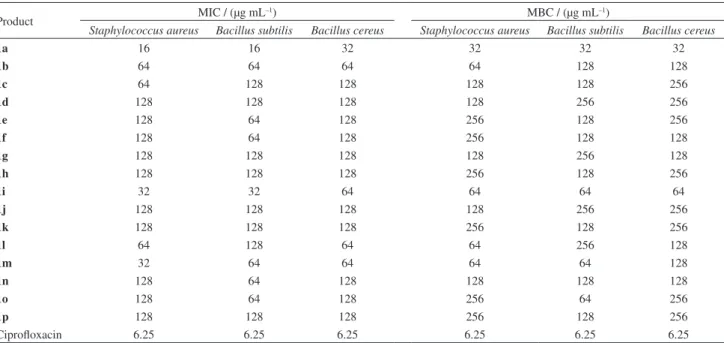
Minimum inhibitory concentration (MIC) and minimum bactericidal concentration (MBC) of all compounds (1a-1p) were measured against Gram
positive bacteria. MIC is the lowest concentration of an antimicrobial compound that inhibits the visible growth of a microorganism after overnight incubation, while MBC is the lowest concentration of antibacterial agent that reduces the viability of the initial bacterial inoculum by ≥ 99.9%. The MIC and MBC values of all compounds are shown in Table 5. All compounds showed MIC values in the range of
Table 3. Crystal data and structure refinement for 1d
Identification code shelxl Empirical formula C38H31ClN4O4 Formula weight 643.20
Temperature 293 K
Wavelength 0.71073 Å
Crystal system Triclinic
Space group P-1
Unit cell dimensions a = 9.8780(10) Å α = 105.339(7)° b = 11.6884(10) Å β = 90.715(7)° c = 14.3841(11) Å γ = 101.896(8)°
Volume 1563.3(3) Å3
Z 2
Density (calculated) 1.366 mg m–3 Absorption coefficient 0.172 mm–1
F(000) 672
Crystal size 0.38 × 0.19 × 0.09 mm3 Theta range for data collection 2.94 to 25.00°
Index ranges –11 ≤ h ≤ 11, –13 ≤ k ≤ 13, –17 ≤ l ≤ 17
Reflections collected 20163
Independent reflections 5500 [R(int) = 0.0914] Completeness to theta = 25.00° 99.8%
Max. and min. transmission 1.00000 and 0.99083 Refinement method Full-matrix least-squares on F2 Data/restraints/parameters 5500/0/424
Goodness-of-fit on F2 1.001
Final R indices [I > 2sigma(I)] R1 = 0.0689, wR2 = 0.0870 R indices (all data) R1 = 0.1632, wR2 = 0.1184 Largest diff. peak and hole 0.210 and –0.228 e.Å–3
Table 4. Crystal data and structure refinement for 1p
Identification code shelxl Empirical formula C34H28ClN3O3 Formula weight 562.90
Temperature 293(2) K
Wavelength 0.71073 Å
Crystal system Triclinic
Space group P-1
Unit cell dimensions a = 10.3161(6) Å α = 74.275(5)° b = 11.3199(7) Å β = 85.032(5)° c = 12.9621(6) Å γ = 76.875(5)°
Volume 1418.46(14) Å3
Z 2
Density (calculated) 1.316 mg m–3 Absorption coefficient 0.175 mm–1
F(000) 588
Crystal size 0.38 × 0.18 × 0.09 mm3 Theta range for data collection 3.25 to 26.00°
Index ranges –12 ≤ h ≤ 12, –13 ≤ k ≤ 13, –15 ≤ l ≤ 15
Reflections collected 20177
Independent reflections 5558 [R(int) = 0.0211] Completeness to theta = 26.00° 99.8%
Max. and min. transmission 0.9844 and 0.9364
Refinement method Full-matrix least-squares on F2 Data/restraints/parameters 5558/0/372
Goodness-of-fit on F2 1.046
16-128 µg mL–1 and MBC in the range of 32-256 µg mL–1 against Staphylococcus aureus, Bacillus subtilis and Bacillus cereus bacteria as compared to standard drug
ciprofloxacin.
The results of antibacterial activity revealed that among all compounds, compound 1a was found to be most potent
antibacterial agent with MIC value of 16 µg mL–1 against Staphylococcus aureus, Bacillus subtilis and 32 µg mL–1
against Bacillus cereus. Compound 1a showed MBC
of 32 µg mL–1 against Staphylococcus aureus, Bacillus subtilis and Bacillus cereus bacteria. The structure activity
relationship (SAR) for compounds (1a-1p) revealed that
compounds (1a, 1b, 1i, and 1m) with halogen substituent
over phenyl ring of xanthene moiety showed higher activity as compared to other compounds. The replacement of halogen atom with nitro or alkyl group results in a decrease
Scheme 3. Plausible reaction mechanism for synthesis of xanthene-triazole-quinoline conjugates.
in the antibacterial activity. The position of substituent over phenyl ring also affects the antibacterial activity of compound. Compound 1c having nitro group at para
position over phenyl ring of xanthene moiety showed MIC 64 µg mL–1 against Staphylococcus aureus, while compound 1g with nitro group at meta position showed
MIC 128 µg mL–1 against Staphylococcus aureus. The presence of chloroquinoline moiety also enhances the antibacterial activity of these compounds as replacing chloroquinoline moiety with phenyl ring (compound 1p) resulted in decrease in the antibacterial activity (Figure 2 and Table 5). All compounds were found to be inactive against Gram negative bacteria (Escherichia coli, Pseudomonas aeruginosa and Enterobacter aerogenes).
The possible reason for inactivity of these compounds against Gram negative bacteria can be explained by the
fact that the susceptibility of microorganisms to a drug depends on the physicochemical characteristics of that drug (hydrophobicity and hydrossolubility) and on the composition of microbial membranes. The outer layer of the outer membrane of Gram negative bacteria is composed of lipopolysaccharide molecules that form a hydrophilic environment providing protection against hydrophobic molecules.27 The synthesized compounds (1a-1p) are highly hydrophobic as indicated by their high log P values as shown in Table 2 which makes them inactive against Gram negative bacteria.
In order to investigate a plausible mechanism of action of the most active compound 1a against bacteria S. aureus, docking studies of 1a into active site of enzyme topoisomerase II DNA gyrase B were performed. Bacterial DNA gyrase is an established and validated target for the development of novel antibacterials.28 The protein ligand complex was constructed based on the X-ray structure of topoisomerase II DNA gyrase with its bound inhibitor ciprofloxacin that is available through the RCSB Protein Data Bank (PDB entry 2XCT). Docking was performed using auto dock 4 program.29 The binding mode of inhibitor
ciprofloxacin at the active site of topoisomerase II DNA gyrase B is shown in Figure 3. Ciprofloxacin formed two hydrogen bonds with Arg-458 and Ser-1084 residues at the active site of enzyme.28
Binding mode of 1a at the active site of topoisomerase
II DNA gyrase B is shown in Figures 4 and 5. Compound
1a binds in a similar fashion as ciprofloxacin at the active
site with binding energy of –5.86 kcal mol–1. Compound
1a formed hydrogen bonds with Ser1084 residue and
Figure 2. Graphical representation of diameter of growth of inhibition
zone (mm)of all compounds (1a-1p).
Table 5.Minimum inhibitory concentration (MIC) and minimum bactericidal concentration (MBC) of all compounds against Gram positive bacteria
Product MIC / (µg mL–1) MBC / (µg mL–1)
Staphylococcus aureus Bacillus subtilis Bacillus cereus Staphylococcus aureus Bacillus subtilis Bacillus cereus
1a 16 16 32 32 32 32
1b 64 64 64 64 128 128
1c 64 128 128 128 128 256
1d 128 128 128 128 256 256
1e 128 64 128 256 128 256
1f 128 64 128 256 128 128
1g 128 128 128 128 256 128
1h 128 128 128 256 128 256
1i 32 32 64 64 64 64
1j 128 128 128 128 256 256
1k 128 128 128 256 128 256
1l 64 128 64 64 256 128
1m 32 64 64 64 64 128
1n 128 64 128 128 128 128
1o 128 64 128 256 64 256
1p 128 128 128 256 128 256
DC13 chain at the active site of enzyme topoisomerase II DNA gyrase B. Compound 1a is surrounded by GLY-1174, ALA-1180, GLY-1178 and VAL-1177 amino acid residues at active site of enzyme topoisomerase II DNA gyrase B. Compound 1a ‘bridges’ the DNA and a transient non-catalytic pocket at the GyrA dimer interface. Because
of formation of this bridge, the active site seems poised to cleave the DNA and results in inhibition of bacterial growth.28
All compounds (1a-1p) were also tested for their
in vitro antifungal activity against three fungal strains,
namely, A. niger, A. flavus and Penicillum sp. The
standard drug fluconazole was used for comparison of the antifungal activity shown by the compounds and results were recorded as a percentage of mycelial growth inhibition and MIC. The results of antifungal activity of all compounds are shown in Table 6. It can be inferred from Table 6 that all the compounds showed good antifungal activity against the three pathogens. From a careful comparison of the results, it is observed that all compounds (1a-1p) showed more than 50% inhibition
of mycelial growth against A. niger, A. flavus and Penicillum sp. in comparison with the standard drug. All
compounds (1a-1p) showed MIC (µg mL–1) values in the
range of 16-128 µg mL–1 against A. niger and in the range
of 32-128 µg mL–1 against A. flavus and Penicillum sp.
species. Compounds (1a, 1b, 1i, and 1m), having a
halogen substituent over phenyl ring of xanthene moiety, showed higher antifungal activity as inferred from Table 4. Compound 1a showed excellent antifungal activity against
all three strains with mycelial growth inhibition of 72.2% against Aspergillus niger, 65.5% against Aspergillus flavus
and57.7% against Penicillum sp. Compound 1a showed
MIC of 16 µg mL–1 against Aspergillus niger as compared
to fluconazole with MIC of 12.5 µg mL–1. Compound 1a
also showed a lowest MIC value (32 µg mL–1) against Aspergillus flavus and Penicillum sp.
Conclusion
In conclusion, we have reported an efficient synthesis of novel xanthene-triazole-quinoline/phenyl conjugates (1a-1p) by one pot three-component condensation of
12-aryl-2-hydroxy-tetrahydrobenzo[a]xanthene-11-ones, propargyl bromide and 4-azido-7-chloroquinoline/ phenyl azide in the presence of K2CO3 as a base and
10 mol% CuSO4.5H2O and 20 mol% sodium ascorbate
in PEG-400 at 80 °C. All newly synthesized compounds were evaluated for antimicrobial activity against nine microbial strains including six bacterial strains and three fungal strains. All compounds exhibited good antibacterial activity and antifungal activity. All compounds showed good Gram positive antibacterial activity and antifungal activity. Compound 1a was found to be most potent
antibacterial and antifungal agent with highest activity among all compounds. Binding mode of compound of
1a at the active site of enzyme topoisomerase II DNA
gyrase B has also been investigated.
Figure3. Binding mode of inhibitor ciprofloxacin at the active site of
enzyme topoisomerase II DNA gyrase B (PDB ID: 2XCT).
Figure. 4. Binding mode of compound 1a at the active site of enzyme
topoisomerase II DNA gyrase B (PDB ID: 2XCT).
Experimental
All chemicals were purchased from Sigma-Aldrich, Spectrochem and were used as received. F254 precoated aluminium plates with silica gel 60 from Merck were used to monitor reaction progress. IR (KBr) spectra were recorded on Perkin Elmer FTIR spectrophotometer and the values are expressed as νmax/cm–1. The NMR (1H and 13C) spectra were recorded on Jeol JNM ECX-400P at 400 MHz and 100 MHz, respectively. The chemical shift values are recorded on d
scale and the coupling constants (J) are in Hertz. The mass
spectra were recorded on an Agilent 6520-QTOF LCMS having ESI source in positive mode. Elemental analyses were recorded on VarioEL III elemental analyzer in CHNS mode. Single crystal X-Ray intensity data was collected on Oxford Diffraction Xcalibur CCD diffractometer with graphite monochromatic Mo Kα radiation (λ = 0.71073 Å) at temperature 298 K.
General procedure for synthesis of 2-((1-(7-chloroquinolin-4-yl/phenyl)-1H -1,2,3-triazol-4-yl)methyleneoxy)-12-aryl-8,9,10,12-tetrahydrobenzo[a]xanthen-11-one (1a-1p)
A mixture of 12-aryl-2-hydroxy-tetrahydrobenzo[a] xanthene-11-one(1 mmol), propargyl bromide (1.0 mmol), and 4-azido-7-chloroquinoline/phenyl azide (1.0 mmol), K2CO3 (1.0 mmol), CuSO4.5H2O (10 mol%), sodium ascorbate (20 mol%) and PEG 400 (5 mL) was placed in a 50 mL round-bottomed flask. The reaction mixture was stirred at 80 °C for appropriate time as mentioned
in Table 2. The progress of the reaction was monitored by thin layer chromatography (TLC) using ethyl acetate: petroleum ether (30:70, v/v) as eluent. After completion of the reaction as indicated by TLC, water (5 mL) was added to the reaction mixture. The precipitate formed was collected by filtration at pump and washed with water. The product obtained, was recrystallized from ethanol to yield the pure product (1a-1p) in high yield (Table 2).
Procedure for synthesis of 12-(4-bromophenyl)-9,9-dimethyl-2-(prop-2-ynyloxy)- 9,10,11,12-tetrahydrobenzo[a] xanthen-11-one (3)
A mixture of 12-(4-bromophenyl)-2-hydroxy-9,9- dimethyl-9,10,11,12-tetrahydrobenzo[a]xanthen-11-one (1 mmol), propargyl bromide (1.0 mmol), K2CO3
(1.0 mmol), and PEG 400 (5 mL) was placed in a 50 mL round-bottomed flask. The reaction mixture was stirred at 60 °C for 30 min. The progress of the reaction was monitored by TLC using ethyl acetate: petroleum ether (20:80, v/v) as eluent. After completion of the reaction as indicated by TLC, water (5 mL) was added to the reaction mixture. The precipitate formed was collected by filtration at pump and washed with water. The product so obtained, was recrystallized from ethanol to yield 3 in
82% yield.
Colorless solid; mp 185-187 °C; IR (KBr) νmax/cm–1
3227, 2962, 2173, 1646, 1221; 1H NMR (CDCl
3, 400 MHz):
d 7.68 (d, 2H, J 9.52, Ar-H), 7.22-7.29 (m, 6H, Ar-H), 7.17
(d, 1H, J 8.8, Ar-H), 7.04-7.07 (dd, 1H, J 6.6 and 2.2, Ar-H), Table 6.Antifungal activity of all compounds (1a-1p)
Product Mycelial growth inhibition / % MIC / (µg mL
–1)
Aspergillus niger Aspergillus flavus Penicillum sp. Aspergillus niger Aspergillus flavus Penicillum sp.
1a 72.2 65.5 57.7 16 32 32
1b 63.3 58.8 55.5 64 64 64
1c 58.8 51.1 53.3 64 128 128
1d 41.1 55.5 50.0 256 64 128
1e 57.7 51.1 48.8 64 128 128
1f 52.2 47.7 44.4 128 128 128
1g 51.1 44.4 45.5 128 128 128
1h 65.5 48.8 43.3 32 128 128
1i 59.1 55.5 51.1 64 64 128
1j 53.3 55.5 48.8 128 128 128
1k 53.3 58.8 55.5 128 64 128
1l 54.4 49.7 51.1 128 128 128
1m 60.7 59.2 55.5 64 64 64
1n 54.4 58.8 52.2 128 64 128
1o 51.1 53.3 47.7 128 128 128
1p 54.4 57.7 55.5 64 64 64
5.53 (s, 1H, CH), 4.66-4.68 (dd, 2H, J 2.2, OCH2 ), 2.58
(s, 2H, CH2), 2.45-2.46 (t, 1H, J 2.2, CH ), 2.20 and 2.31 (AB system, 2H, J 16.1 and 12.48, CHa.HbCO), 1.11 (s, 3H,
CH3), 0.95 (s, 3H, CH3); 13C NMR (CDCl3, 100 MHz): d 196.87, 163.97, 156.42, 148.30, 143.63, 132.43, 131.32, 130.30, 130.08, 128.75, 127.09, 120.06, 117.56, 116.11, 114.88, 113.60, 104.02, 78.01, 75.97, 55.76, 50.83, 41.36, 34.36, 32.22, 29.23, 27.16; HRMS (ESI) m/z, calcd. for
C28H23 BrO3 [M+H]+: 486.0904, found: 487.0912; Anal. calcd. for C28H23 BrO3: C 69.00, H 4.76, found: C 69.07, H 4.80.
Procedure for synthesis of 2-((1-(7-chloroquinolin-4-yl)-1H-1,2,3-triazol-4-yl) methoxy)-12-(4-bromophenyl)-9,9-dimethyl-8,9,10,12-tetrahydrobenzo[a]xanthen-11-one (1a) from 3
A mixture of 12-(4-bromophenyl)-9,9-dimethyl-2- (prop-2-ynyloxy)-9,10,11,12-tetrahydrobenzo[a]xanthen-one (1 mmol), 4-azido-7-chloroquinoline (1.0 mmol), CuSO4.5H2O (10 mol%), sodium ascorbate (20 mol%) and PEG 400 (5 mL) was placed in a 50 mL round-bottomed flask. The reaction mixture was stirred at 80 °C for 45 min. The progress of the reaction was monitored by TLC using ethyl acetate: petroleum ether (30:70, v/v) as eluent. After completion of the reaction as indicated by TLC, water (5 mL) was added to the reaction mixture. The precipitate formed was collected by filtration at pump and washed with water. The product so obtained, was recrystallized from ethanol to yield pure product 1a in 89%yield.
Spectral data for compounds 1a-1p
2-((1-(7-chloroquinolin-4-yl)-1H-1,2,3-triazol-4-yl) methoxy)-12-(4-bromophenyl)-9,9-dimethyl-8,9,10,12-tetrahydrobenzo[a]xanthen-11-one(1a)
Colorless solid; mp 172-176 °C; IR (KBr) ν/cm–1 2957,
1641, 1598, 1375, 1220, 1208; 1H NMR (CDCl
3, 400 MHz)
d9.03 (d, 1H, J 4.4, Ar-H), 8.22 (d, 1H, J 2.2, Ar-H), 7.88
(s, 1H, triazole-H), 7.86 (d, 1H, J 9.52, Ar-H), 7.72 (d,
1H, J 1.48, Ar-H), 7.70 (d, 1H , J 1.48 Hz, Ar-H), 7.45 (d,
1H, J 5.12, Ar-H), 7.32 (s, 1H, Ar-H), 7.21 (m, 6H, Ar-H),
7.12-7.09 (m, 1H, Ar-H), 5.54 (s, 1H, CH), 5.41 and 5.30 (AB system, 2H, J 12.44, OCH2), 2.54 (s, 2H, CH2), 2.27
and 2.24 (AB system, 2H, J 16.12, CHa.HbCO), 1.10 (s, 3H,
CH3), 0.94 (s, 3H, CH3); 13C NMR (CDCl3, 100 MHz):d
196.85, 164.02, 156.86, 151.40, 150.14, 149.56, 148.43, 144.57, 143.60, 140.76, 136.89, 132.49, 131.37, 130.34, 130.18, 129.48, 128.95, 128.80, 127.09, 124.52, 124.46, 120.55, 120.17, 117.45, 116.10, 115.03, 113.60, 103.97, 61.69, 50.77, 41.34, 34.57, 32.24, 29.26, 27.13; HRMS
(ESI) m/z, calcd. for C37H28 BrClN4O3 [M+H]+: 693.0106,
found: 694.0723, 665.0033 [M+H- N2]+; Anal. calcd. for
C37H28 BrClN4O3: C 64.22, H 4.08, N 8.10, found: C 64.25,
H 4.11, N 8.16.
2-((1-(7-chloroquinolin-4-yl)-1H-1,2,3-triazol-4-yl) methoxy)-12-(4-fluorophenyl)-9,9-dimethyl-8,9,10,12-tetrahydrobenzo[a]xanthen-11-one(1b)
Colorless solid; mp 212-216 °C; IR (KBr) ν/cm–1 2961,
1639, 1619, 1560, 1372; 1H NMR (CDCl
3, 400 MHz) d9.03
(d, 1H, J 5.12, Ar-H), 8.22 (d, 1H, J 1.96, Ar-H), 7.89 (s, 1H,
triazole-H), 7.86 (d, 1H, J 8.8, Ar-H), 7.71 (d, 1H, J 3.64,
Ar-H), 7.69 (d, 1H, J 3.68, Ar-H), 7.54-7.51 (m, 1H, Ar-H),
7.43 (d, 1H, J 4.4, Ar-H), 7.33-7.27 (m, 3H, Ar-H), 7.20
(d, 1H, J 8.8, Ar-H), 7.11-7.08 (m,1H, Ar-H), 6.80-6.78
(t, 2H, J 8.8, Ar-H), 5.57 (s, 1H, CH), 5.42 and 5.27 (AB
system, dd, 2H, J 12.44, OCH2), 2.54 (s, 2H, CH2), 2.27
and 2.19 (AB system, dd, 2H, J 16.12, CHa.HbCO), 1.10 (s,
3H, CH3), 0.93 (s, 3H, CH3); 13C NMR (CDCl3, 100 MHz):
d196.93, 163.89, 156.84, 151.36, 150.13, 148.46, 144.60, 140.79, 136.94, 132.53, 130.32, 129.95, 129.87, 129.51, 128.97, 128.71, 128.08, 127.12, 124.50, 124.13, 120.57, 117.42, 116.45, 115.20, 115.04, 114.99, 113.97, 103.97, 61.63, 50.81, 41.24, 34.10, 32.24, 29.13, 26.93; HRMS (ESI) m/z, calcd. for C37H28FClN4O3 [M+H]+: 631.1906,
found: 631.1916, 603.1823 [M+H- N2]+; Anal. calcd. for
C37H28FClN4O3: C 70.42, H 4.47, N 8.88, found: C 71.48,
H 4.52, N 8.92.
2-((1-(7-chloroquinolin-4-yl)-1H-1,2,3-triazol-4-yl) methoxy)-12-(4-nitrophenyl)-9,9-dimethyl-8,9,10,12-tetrahydrobenzo[a]xanthen-11-one(1c)
Colorless solid; mp 267-271 °C; IR (KBr) ν/cm–1 2929,
1648, 1618, 1542, 1376; 1H NMR (CDCl
3, 400 MHz): d
9.03 (d, 1H, J 4.4, Ar-H), 8.23 (d, 1H, J 2.2, Ar-H), 8.02
(d, 2H, Ar-H), 7.99 (s, 1H, triazole-H), 7.89 (d, 2H, J 8.8,
Ar-H), 7.75-7.72 (m, 2H, Ar-H), 7.45 (d, 2H, J 4.4, Ar-H),
7.29 (d, 2H, J 2.2, Ar-H), 7.21 (s, 1H, Ar-H), 7.14-7.11
(m, 1H, Ar-H), 5.70 (s, 1H, CH), 5.39 and 5.27 (AB system, 2H, J 12.44, OCH2 ), 2.57 (s, 2H, CH2), 2.31 and
2.12 (AB system, 2H, J 16.12, CHa.HbCO), 1.11 (s, 3H,
CH3), 0.93 (s, 3H, CH3); 13C NMR (CDCl3, 100 MHz): d
196.72, 164.57, 157.16, 151.70, 151.36, 150.17, 148.49, 146.33, 144.49, 140.70, 136.96, 132.37, 130.48, 129.53, 129.39, 129.29, 129.02, 127.14, 124.60, 124.42, 123.65, 120.48, 117.36, 116.00, 115.22, 115.06, 112.90, 103.77, 61.75, 50.72, 41.37, 35.09, 32.26, 29.26, 27.06; HRMS (ESI) m/z, calcd. for C37H28 ClN5O5 [M+H]+: 658.1832,
found: 630.1796 [M+H- N2]+; Anal. calcd. for C37H28
ClN5O5: C 67.53, H 4.29, N 10.64, found: C 67.60, H
2-((1-(7-chloroquinolin-4-yl)-1H-1,2,3-triazol-4-yl) methoxy)-12-(4-methoxyphenyl)-9,9-dimethyl-8,9,10,12-tetrahydrobenzo[a]xanthen-11-one(1d)
Colorless solid; mp 211-214 °C; IR (KBr) ν/cm–1 2958, 1653, 1641, 1534, 1375; 1H NMR (CDCl
3, 400 MHz): d9.01 (d, 1H, J 4.4, Ar-H), 8.21 (d, 1H, J 1.48, Ar-H), 7.81 (d, 1H, J 8.76, Ar-H), 7.78 (s, 1H, triazole-H), 7.70-7.67 (m, 2H,
Ar-H), 7.50-7.47 (m, 2H, Ar-H), 7.40-7.39 (m, 2H, Ar-H), 7.21-7.18 (m, 2H, Ar-H), 7.09-7.06 (m, 1H, Ar-H), 6.59 (d, 2H, J 8.8, Ar-H), 5.52 (s, 1H, CH), 5.43 and 5.33 (AB system,
2H, J 12.44, OCH2), 2.53 (s, 2H, CH2), 2.28 and 2.23 (AB
system, 2H, J 16.12, CHa.HbCO), 1.09 (s, 3H, CH3), 0.93 (s,
3H, CH3); 13C NMR (CDCl3, 100 MHz): d197.40, 163.60, 157.73, 156.63, 151.36, 150.13, 148.46, 144.58, 140.72, 136.95, 135.88, 132.65, 130.08, 129.45, 129.37, 128.84, 128.24, 127.09, 124.53, 124.45, 120.55, 117.44, 116.74, 116.15, 115.05, 114.23, 113.52, 104.15, 61.22, 54.82, 50.86, 41.11, 33.10, 32.04, 29.05, 27.08; HRMS (ESI) m/z, calcd.
for C38H31 ClN4O4 [M+H]+: 643.2106, found: 615.2069 [M+H- N2]+; Anal. calcd. for C38H31 ClN4O4: C 70.97, H 4.86, N 8.71, found: C 70.92, H 4.87, N 8.69.
2-((1-(7-chloroquinolin-4-yl)-1H -1,2,3-triazol-4-yl)methoxy)- 12-(3,4-dimethoxyphenyl)-9,9-dimethyl-8,9,10,12-tetrahydrobenzo[a]xanthen-11- one(1e)
Colorless solid; mp 223-225 °C; IR (KBr) ν/cm–1 2956, 1685, 1648, 1560, 1374; 1H NMR (CDCl
3, 400 MHz): d 9.04 (d, 1H, J 4.4, Ar-H), 8.21 (s, 1H, Ar-H), 7.85 (s, 1H,
triazole-H), 7.83 (d, 1H, J 8.8, H), 7.71-7.68 (m, 2H,
Ar-H), 7.51-7.48 (m, 1H, Ar-Ar-H), 7.43-7.41 (m, 2H, Ar-Ar-H), 7.19 (d, 1H, 8.8, Ar-H), 7.10-7.07 (m, 1H, Ar-H), 6.93 (s, 1H, Ar-H), 6.79 (d, 1H, J 8.8, Ar-H), 6.56 (d, 1H, J 8.8, Ar-H),
5.53 (s, 1H, CH), 5.43 and 5.32 (AB system, 2H, J 12.44,
OCH2), 3.74 (s, 3H, OCH3), 3.62 (s, 3H, OCH3), 2.54 (s, 2H, CH2), 2.28 and 2.22 (AB system, 2H, J 16.12, CHa.HbCO), 1.10 (s, 3H, CH3), 0.95 (s, 3H, CH3); 13C NMR (CDCl3, 100 MHz) d 197.05, 163.67, 156.60, 151.39, 150.17, 148.63, 148.38, 147.24, 144.60, 140.75, 137.30, 136.87, 132.72, 132.52, 130.23, 129.44, 128.92, 128.48, 127.07, 124.51, 124.46, 120.52, 117.40, 116.82, 116.05, 115.00, 114.21, 111.79, 110.75, 104.18, 61.64, 55.83, 55.55, 50.85, 41.36, 34.50, 32.24, 29.29, 27.07; HRMS (ESI) m/z, calcd.
for C39H33ClN4O5 [M+H]+: 673.2212, found: 645.2146 [M+H- N2]+; Anal. calcd. for C39H33ClN4O5: C 69.59, H 4.94, N 8.32, found: C 69.65, H 4.92, N 8.40.
2-((1-(7-chloroquinolin-4-yl)-1H-1,2,3-triazol-4-yl) methoxy)-12-(4-methylphenyl)-9,9-dimethyl-8,9,10,12-tetrahydrobenzo[a]xanthen-11-one(1f)
Colorless solid; mp 189-193 °C; IR (KBr) ν/cm–1 2958, 1653, 1618, 1534, 1375; 1H NMR (CDCl
3, 400 MHz): d
9.02 (d, 1H, J 5.12, Ar-H), 8.21 (d, 1H, J 2.2, Ar-H), 7.77 (d,
1H, J 2.2, Ar-H), 7.75 (s, 1H, triazole-H), 7.68 (d, 2H, J 8.8,
Ar-H), 7.47-7.41 (m, 3H, Ar-H), 7.21-7.19 (m, 4H, Ar-H), 7.08-7.05 (m, 1H, Ar-H), 6.85 (d, 1H, J 8.8, Ar-H), 5.53 (s,
1H, CH), 5.44 and 5.29 (AB system, 2H, J 12.44, OCH2),
2.54 (s, 2H, CH2), 2.26 and 2.22 (AB system, 2H, J 16.12, CHa.HbCO), 2.0 (s, 3H, CH3), 1.09 (s, 3H, CH3), 0.94 (s, 3H, CH3); 13C NMR (CDCl3, 100 MHz) d196.93, 163.64, 156.34, 150.71, 148.18, 146.5, 145.37, 144.20, 141.73, 137.92, 136.23, 135.65, 133.24, 132.61, 129.94, 128.91, 128.41, 128.34, 127.07, 124.03, 123.52, 121.04, 120.37, 117.39, 117.05, 114.90, 114.30, 104.11, 55.82, 50.89, 41.38, 34.75, 32.26, 29.21, 27.28, 20.95; HRMS (ESI) m/z,
calcd. for C38H31ClN4O3 [M+H]+: 627.2158, found 599.2058 [M+H- N2]+; Anal. calcd. for C38H31 ClN4O3: C 72.78, H 4.98, N 8.93, found: C 72.85, H 4.92, N 8.89.
2-((1-(7-chloroquinolin-4-yl)-1H-1,2,3-triazol-4-yl) methoxy)-12-(3-nitrophenyl)-9,9-dimethyl-8,9,10,12-tetrahydrobenzo[a]xanthen-11-one(1g)
Colorless solid; mp 191-195 °C; IR (KBr) ν/cm–1 2957, 1645, 1602, 1561, 1374; 1H NMR (CDCl
3, 400 MHz): d 9.06 (d, 1H, J 4.4, Ar-H), 8.24 (d, 1H, .J 2.2, Ar-H), 8.17
(d, J = 2.2 Hz, 1H, Ar-H), 8.05 (s, 1H, triazole-H), 7.94 (d,
1H, J 9.52, Ar-H), 7.89-7.82 (m, 2H, Ar-H), 7.76-7.73 (m,
2H, Ar-H), 7.59-7.56 (dd, 1H, J 2.2 and 7.32, Ar-H), 7.48
(d, 1H, J 4.4, Ar-H), 7.38-7.34 (m, 2H, Ar-H), 7.26-7.25
(m, 1H, Ar-H), 7.16-7.13 (m, 1H, Ar-H), 5.72 (s, 1H, CH), 5.42 and 5.28 (AB system, 2H, J 12.44, OCH2), 2.61 (s, 2H,
CH2), 2.31 and 2.26 (AB system, 2H, J 16.84, CHa.HbCO), 1.13 (s, 3H, CH3), 0.96 (s, 3H, CH3); 13C NMR (CDCl3, 100 MHz) d196.83, 164.58, 157.13, 151.36, 150.16, 148.44, 148.35, 146.64, 144.39, 140.78, 136.97, 134.78, 132.29, 130.51, 129.54, 129.31, 129.17, 128.98, 127.15, 124.63, 124.51, 123.24, 121.61, 120.53, 117.40, 116.06, 115.19, 115.15, 113.02, 103.70, 61.62, 50.70, 41.33, 35.08, 32.31, 29.22, 27.15; HRMS (ESI) m/z, calcd. for C37H28
ClN5O5 [M+H]+: 658.1852, found: 630.1801 [M+H- N2]+; Anal. calcd. for C37H28 ClN5O5: C 67.53, H 4.29, N 10.64, found: C 67.60, H 4.30, N 10.69.
2-((1-(7-chloroquinolin-4-yl)-1H -1,2,3-triazol-4-yl)methoxy)-12-phenyl-9,9-dimethyl-8,9,10,12-tetrahydrobenzo[a] xanthen-11-one(1h)
Colorless solid; mp 210-213 °C; IR (KBr) ν/cm–1 2956, 1648, 1618, 1513, 1374; 1H NMR (CDCl
3, 400 MHz): d 9.01 (d, 1H, J 4.4, Ar-H), 8.22 (d, 1H, J 2.2, Ar-H), 7.81
(d, 1H, J 8.8, Ar-H), 7.76 (s, 1H, triazole-H), 7.69 (d, 2H, J 8.8, Ar-H), 7.52-7.49 (m, 1H, Ar-H), 7.41-7.40 (m, 2H,
Ar-H), 7.31 (d, 2H, J 7.32, Ar-H), 7.20 (d, 1H, J 8.8,
5.58 (s, 1H, CH), 5.42 and 5.28 (AB system, 2H, J 12.44,
OCH2), 2.54 (s, 2H, CH2), 2.30 and 2.19 (AB system, 2H,
J 16.84, CHa.HbCO), 1.09 (s, 3H, CH3), 0.92 (s, 3H, CH3);
13C NMR (CDCl
3, 100 MHz) d 196.10, 163.86, 160.23, 156.75, 151.11, 150.20, 148.96, 144.56, 132.56, 131.25, 130.26, 129.49, 128.92, 128.55, 128.42, 128.26, 127.13, 126.23, 124.53, 120.65, 119.36, 117.55, 116.72, 116.11, 114.10, 112.90, 111.20, 103.40, 61.50, 50.84, 41.39, 35.03, 32.25, 29.42, 27.13; HRMS (ESI) m/z, calcd. for C37H29
ClN4O3 [M+H]+: 614.1115, found: 586.1025 [M+H- N2]+; Anal. calcd. for C37H29 ClN4O3: C 72.48, H 4.77, N 9.14, found: C 72.52, H 4.75, N 9.10.
2-((1-(7-chloroquinolin-4-yl)-1H-1,2,3-triazol-4-yl) methoxy)-12-(4-chlorophenyl)-9,9-dimethyl-8,9,10,12-tetrahydrobenzo[a]xanthen-11-one(1i)
Colorless solid; mp 219-224 °C; IR (KBr) ν/cm–1 2958, 1640, 1604, 1560, 1375; 1H NMR (CDCl
3, 400 MHz): d 9.04 (d, 1H, J 4.4, Ar-H), 8.22 (d, 1H, J 2.2, Ar-H), 7.89
(s, 1H, triazole-H), 7.85 (d, 1H, J 8.8, Ar-H), 7.72 (d, 1H, J 2.2, Ar-H), 7.69 (d, 1H, J 1.48, Ar-H), 7.52-7.50 (m, 1H,
Ar-H), 7.43 (d, J = 4.4 Hz,1H, Ar-H), 7.32 (s, 1H, Ar-H),
7.27 (d, 2H, J 8.08, ArH), 7.21 (d, 1H, J 8.75, Ar-H), 7.12
(m, 1H, Ar-H), 7.06 (m, 2H, Ar-H), 5.50 (s, 1H, CH), 5.44 and 5.31 (AB system, 2H, J 12.44, OCH2), 2.54 (s, 2H,
CH2), 2.27 and 2.19 (AB system, 2H, J 16.12, CHa.HbCO), 1.10 (s, 3H, CH3), 0.93 (s, 3H, CH3); 13C NMR (CDCl3, 100 MHz) d 196.87, 164.00, 156.87, 151.39, 150.16, 148.45, 144.59, 143.11, 140.78, 136.91, 132.51, 131.99, 130.34, 129.81, 129.49, 128.97, 128.80, 128.43, 127.11, 124.51, 124.48 120.56, 117.56, 116.18, 116.09, 115.05, 113.68, 103.97, 61.69, 50.79, 41.35, 34.49, 32.25, 29.16, 27.12; HRMS (ESI) m/z, calcd. for C37H28 Cl2N4O3 [M+H]+:
647.1611, found: 619.1596 [M+H- N2]+; Anal. calcd. for C37H28 Cl2N4O3: C 68.63, H 4.36, N 8.65, found: C 68.71, H 4.41, N 8.87.
2-((1-(7-chloroquinolin-4-yl)-1H-1,2,3-triazol-4-yl) methoxy)-12-(naphthalen-1-yl)-9,9-dimethyl-8,9,10,12-tetrahydrobenzo[a]xanthen-11-one(1j)
Colorless solid; mp 161-163 °C; IR (KBr) ν/cm–1 2956, 1647, 1610, 1562, 1375; 1H NMR (CDCl
3, 400 MHz): d 8.91 (d, 1H, J 5.12, Ar-H), 8.18 (d, 1H, J 1.8, Ar-H), 7.74
(d, 1H, J 2.92, Ar-H), 7.70 (d, 1H, J 5.12, Ar-H), 7.68 (s,
1H, triazole-H), 7.57-7.56 (m, 2H, Ar-H), 7.51-7.28 (m, 4H, Ar-H), 7.27 (d, 1H, J 8.8, Ar-H), 7.20-7.10 (m, 5H, Ar-H),
7.05-7.02 (m, 1H, Ar-H), 5.75 (s, 1H, CH), 5.41 and 5.32 (AB system, 2H, J 12.44, OCH2), 2.60 (s, 2H, CH2), 2.26
and 2.20 (AB system, 2H, J 16.12, CHa.HbCO), 1.09 (s,
3H, CH3), 0.80 (s, 3H, CH3); 13C NMR (CDCl3, 100 MHz)
d 196.91, 163.87, 156.55, 151.24, 150.07, 148.46, 144.30,
142.08, 140.44, 136.69, 131.13, 132.66, 131.91, 130.28, 129.32, 128.82, 128.67, 128.01, 127.66, 127.17, 127.13, 127.01, 126.77, 125.81 125.41, 124.43, 124.33, 120.43, 117.75, 116.66, 115.82, 115.10, 113.87, 104.24, 61.42, 50.81, 41.37, 35.19, 32.25, 29.22, 27.15; HRMS (ESI)
m/z, calcd. for C41H31 ClN4O3 [M+H]+: 663.2158, found: 635.2056 [M+H- N2]+; Anal. calcd. for C41H31 ClN4O3: C 74.26, H 4.71, N 8.45, found: C 74.35, H 4.75, N 8.50.
2-((1-(7-chloroquinolin-4-yl)-1H -1,2,3-triazol-4-yl)methoxy)- 12-(4-methylphenyl)-8,9,10,12-tetrahydrobenzo[a]xanthen-11-one(1k)
Colorless solid; mp 210-214 °C; IR (KBr) ν/cm–1 2945, 1639, 1619, 1560, 1376; 1H NMR (CDCl
3, 400 MHz): d 9.03 (d, 1H, J 5.12, Ar-H), 8.2 (d, 1H, J 1.08, Ar-H), 7.74
(d, 2H, J 10.28, Ar-H), 7.70 (s, 1H, triazole-H), 7.67 (s,
1H, Ar-H), 7.47-7.44 (m, 1H, Ar-H), 7.42-7.39 (m, 2H, Ar-H), 7.24-7.19 (m, 3H, Ar-H), 7.05-7.08 (m, 1H, Ar-H), 6.86 (d, 2H, J 8.04, ArH), 5.56 (s, 1H, CH), 5.40 and 5.30
(AB system, 2H, J 12.44, OCH2), 2.74-2.59 (m, 2H, CH2),
2.44-2.30 (m, 2H, CH2), 2.15 (s, 3H, CH3), 2.06-1.91 (m, 2H, CH2); 13C NMR (CDCl3, 100 MHz) d197.11, 165.43, 156.53, 151.33, 150.11, 148.40, 144.49, 142.02, 140.79, 136.91, 135.81, 132.62, 130.21, 129.47, 129.02, 128.90, 128.43, 128.35, 127.09, 124.64, 124.48, 120.55, 117.53, 116.94, 116.07, 115.50, 114.99, 104.24, 61.53, 36.98, 34.59, 27.68, 20.80, 20.13; HRMS (ESI) m/z, calcd. for
C36H27ClN4O3 [M+H]+: 599.1845, found: 571.1796 [M+H- N2]+; Anal. calcd. for C36H27 ClN4O3: C 72.18, H 4.54, N 9.35, found: C 72.28, H 4.60, N 9.38.
2-((1-(7-chloroquinolin-4-yl)-1H -1,2,3-triazol-4-yl)methoxy)- 12-(naphthalen-1-yl)-8,9,10,12-tetrahydrobenzo[a]xanthen-11-one(1l)
Colorless solid; mp 181-185 °C; IR (KBr) ν/cm–1 2943, 1647, 1617, 1565, 1375; 1H NMR (CDCl
3, 400 MHz): d 8.90 (d, 1H, J 4.4, Ar-H), 8.19 (d, 1H, J 2.2, Ar-H), 7.71
(s, 1H, triazole-H), 7.68 (d, 1H, J 8.8, Ar-H), 7.59 (d, 1H, J 8.04, Ar-H), 7.55 (d, 1H, J 8.04, Ar-H), 7.51-7.50 (m,
3H, Ar-H), 7.45-7.37 (m, 4H, Ar-H), 7.25 (d, 1H, J 8.01,
Ar-H), 7.17-7.10 (m, 3H, Ar-H), 7.05-7.02 (m, 1H, Ar-H), 5.77 (s, 1H, CH), 5.43 and 5.30 (AB system, 2H, J 12.44,
OCH2), 2.77-2.62 (m, 2H, CH2), 2.38-2.36 (m, 2H, CH2), 2.05-1.87 (m, 2H, CH2); 13C NMR (CDCl3, 100 MHz) d 197.04, 165.54, 156.54, 151.25, 150.01, 148.53, 144.34, 142.45, 140.51, 136.84, 133.14, 132.63, 131.91,130.28, 129.30, 128.82, 128.67, 128.01, 127.61, 127.18, 127.12, 127.05, 126.88, 125.83, 125.43, 124.39, 124.32, 120.43, 117.74, 116.61, 115.87, 115.19, 115.04, 104.26, 61.39, 36.95, 35.18, 27.72, 20.12; HRMS (ESI) m/z, calcd. for
N2]+; Anal. calcd. for C39H27 ClN4O3: C 73.75, H 4.28, N 8.82, found: C 73.81, H 4.29, N 9.85.
2-((1-(7-chloroquinolin-4-yl)-1H -1,2,3-triazol-4-yl)methoxy)- 12-(4-bromophenyl)-8,9,10,12-tetrahydrobenzo[a]xanthen-11-one(1m)
Colorless solid; mp 211-215 °C; IR (KBr) ν/cm–1 2923, 1647, 1617, 1548, 1388; 1H NMR (CDCl
3, 400 MHz): d 9.02 (d, 1H, J 5.12, Ar-H), 8.21 (d, 1H, J 1.48, Ar-H), 7.88
(s, 1H, triazole-H), 7.83 (d, J = 8.8 Hz, 2H, Ar-H), 7.70
(d, J = 8.8 Hz, 1H, Ar-H), 7.50-7.47 (m,1H, Ar-H), 7.43
(d, 1H, J 4.4, Ar-H), 7.29 (d, 1H, J 2.2, Ar-H), 7.24-7.18
(m, 5H, Ar-H), 7.11-7.08 (m, 1H, Ar-H), 5.56 (s, 1H, CH), 5.42 and 5.29 (AB system, 2H, J 12.44, OCH2), 2.73-2.59
(m, 2H CH2), 2.45-2.31(m, 2H, CH2), 2.06-1.89 (m, 2H, CH2); 13C NMR (CDCl3, 100 MHz) d197.04, 165.69, 156.83, 151.38, 150.12, 148.41, 147.52, 144.52, 143.87, 140.73, 136.85, 132.44, 131.37, 130.31, 130.25, 129.44, 128.91, 128.79, 127.07, 124.53, 124.45, 120.51, 120.17, 117.41, 116.07,114.94, 114.48, 103.99, 61.64, 36.91, 34.49, 27.68, 20.21; HRMS (ESI) m/z, calcd. for C35H24 BrClN4O3
[M+H]+: 663.0793, found: 635.0785 [M+H- N
2]+; Anal. calcd. for C35H24 BrClN4O3: C 63.31, H 3.64, N 8.44, found: C 63.37, H 3.65, N 8.47.
2-((1-(7-chloroquinolin-4-yl)-1H -1,2,3-triazol-4-yl)methoxy)-12-(4-isopropylphenyl)-8,9,10,12-tetrahydrobenzo[a] xanthen-11-one(1n)
Colorless solid; mp 202-206 °C; IR (KBr) ν/cm–1 2957, 1648, 1618, 1545, 1374; 1H NMR (CDCl
3, 400 MHz): d 9.04 (d, 1H, J 4.4, Ar-H), 8.23 (d, 1H, J 1.48, Ar-H), 7.86
(s, 1H, triazole-H), 7.79 (d, 1H, J 8.8, Ar-H), 7.69 (d, 1H, J 8.8, Ar-H), 7.47-7.46 (m, 2H, Ar-H), 7.43 (d, 1H, J 2.2,
Ar-H), 7.21-7.18 (m, 3H, Ar-H), 7.08-7.06 (m, 2H, Ar-H), 6.94 (d, 2H, J 8.04, Ar-H), 5.57 (s, 1H, CH), 5.43 and 5.28
(AB system, 2H, J 12.44, OCH2), 2.76-2.56 (m, 3H, CHCH2),
2.46-2.30 (m, 2H, CH2), 2.06-1.94 (m, 2H, CH2), 1.04 (dd, 6H, J 8.0, CH(CH3)2); 13C NMR (CDCl
3, 100 MHz) d197.19, 165.50, 156.70, 151.36, 150.13, 148.42, 144.59, 142.17, 140.82, 136.92, 132.68, 130.16, 129.49, 128.39, 128.38, 128.25, 127.09, 126.37, 124.66, 124.42, 120.61, 119.29, 117.55, 117.15, 116.21, 115.67, 115.03, 104.48, 61.69, 36.99, 34.73, 30.91, 27.66, 23.76, 20.17; HRMS (ESI) m/z,
calcd. for C38H31ClN4O3 [M+H]+: 627.2158, found: 599.2054 [M+H- N2]+; Anal. calcd. for C38H31ClN4O3: C 72.78, H 4.98, N 8.93, found: C 72.85, H 5.01, N 8.97.
2-((1-(7-chloroquinolin-4-yl)-1H -1,2,3-triazol-4-yl)methoxy)-12-phenyl-8,9,10,12-tetrahydrobenzo[a]xanthen-11-one(1o) Colorless solid; mp 221-225 °C; IR (KBr) ν/cm–1 2925, 1638, 1610, 1550, 1374; 1H NMR (CDCl
3, 400 MHz): d 9.04
(d, 1H, J 4.4 Hz, Ar-H), 8.24 (d, 1H, J 2.2, Ar-H), 7.83 (d,
1H, J 8.8, Ar-H), 7.75 (s, 1H, triazole-H), 7.72 (d, 2H, J 8.8,
Ar-H) 7.53-7.50 (m, 1H, Ar-H), 7.42 (d, 1H, J 5.12, Ar-H),
7.42 (d, 1H, J 2.2, Ar-H), 7.34 (d, 2H, J 6.6, Ar-H), 7.24
(d, 1H, J 8.8, Ar-H), 7.11-7.04 (m, 3H, Ar-H), 6.85 (t, 1H, J 7.32, Ar-H), 5.63 (s, 1H, CH), 5.45 and 5.30 (AB system,
2H, J 12.44, OCH2), 2.76-2.63 (m, 2H, CH2), 2.48-2.32
(m, 2H, CH2), 2.08-1.92 (m, 2H, CH2); 13C NMR (CDCl3, 100 MHz) d 197.06, 165.54, 156.68, 151.32, 150.12, 148.49, 144.90, 144.47, 140.80, 136.91, 132.62, 130.24, 129.47, 128.92, 128.55, 128.48, 128.29, 127.08, 126.23, 124.55, 124.52, 120.61, 117.53, 116.71, 116.13, 115.21, 114.96, 104.08, 61.46, 36.97, 34.96, 27.70, 20.22; HRMS (ESI) m/z,
calcd. for C35H25ClN4O3 [M+H]+: 585.1688, found: 557.1685 [M+H- N2]+; Anal. calcd. for C35H25ClN4O3: C 71.85, H 4.31, N 9.58, found: C 71.92, H 4.34, N 9.60.
12-(4-chlorophenyl)-9,9-dimethyl-2-((1-phenyl-1H -1,2,3-triazol-4-yl)methoxy)-8,9,10,12-dihydro-8H-benzo[a] xanthen-11-one(1p)
Colorless solid; mp 185-187 °C; IR (KBr)
νmax/cm–1: 2922, 1646, 1618, 1560, 1198; 1H NMR (CDCl3, 400 MHz): d 7.93 (s, 1H, triazole-H), 7.67-7.70 (m, 3H, Ar-H), 7.50 (t, 2H, J 7.32, Ar-H), 7.42 (d, 1H, J 7.36Hz,
ArH), 7.20-7.31 (m, 4H, Ar-H), 7.18 (d, 1H, J 8.8,
Ar-H), 7.08 - 7.11(m, 3H, Ar-Ar-H), 5.55 (s, 1H, CAr-H), 5.22 and 5.33 ( AB system, 2H, J 12.44, OCH2), 2.27 and 2.23
(AB system, 2H, J 16.12, CHa.HbCO), 1.10 (s, 3H, CH3),
0.94 (s, 3H, CH3); 13C NMR (CDCl3, 100 MHz) d 196.87, 163.93, 157.10, 148.35, 144.42, 143.09, 137.01, 132.55, 131.98, 130.20, 129.90, 129.76, 128.85, 128.74, 128.42, 127.04, 120.89, 120.62, 117.37, 116.20, 114.84, 113.75, 103.83, 61.89, 50.80, 41.35, 34.48, 32.23, 29.66, 27.11; HRMS (ESI) m/z, calcd. for C34H29N3O3 [M+H]+: 562.9242, found: 534.1856 [M+H- N2]+; Anal. calcd. for C34H29N3O3: C 77.40, H 5.54, N 9.10, found: C 77.45, H 5.58, N 9.09.
Experimental procedure for antibacterial activity
All the plates were incubated at 37 °C for 24 h. Antibacterial activity of each compound was evaluated by measuring the zone of growth inhibition against the test organisms with zone reader (HiAntibiotic zone scale). DMSO was used as a negative control whereas ciprofloxacin was used as positive control. This procedure was performed in three replicate plates for each organism and the mean values of the diameter of inhibition zones ± standard deviations were calculated.
Determination of minimum inhibitory concentration (MIC) of chemical compounds
MIC of the all compounds against bacterial and yeast strains was determined using macrodilution tube method as recommended by the National Committee for Clinical Laboratory Standards (NCCLS).31 In this
method, various test concentrations of newly synthesized compounds were prepared from 128 to 0.25 µg mL–1 in
sterile tubes No. 1-10. 100 µL sterile Mueller Hinton Broth (MHB) was poured in each sterile tube followed by the addition of 200 µL test compound in tube 1. Two fold serial dilutions were carried out from tube 1 to tube 12 and excess broth (100 µL) was discarded from the last tube No. 10. To each tube, 100 µL of standard inoculum (1.5 × 10⁸ cfu mL–1) was added. Turbidity was observed
after incubating the inoculated tubes at 37 °C for 24 h. Ciprofloxacin was used as positive control while DMSO was used as negative control.
Procedure for minimum bactericidal concentration (MBC)
MBC is the lowest concentration of antimicrobial compound that will prevent the growth of an organism after subculture on to antibiotic free media. MBCs were determined by spreading the 100 µL compound from one below MIC and MIC itself. All the tubes were incubated for 24 h at 37 °C. The growth was observed on each plate.32
Experimental procedure for antifungal activity
The antifungal activity all compounds was evaluated by poisoned food technique.32 The molds were grown
on Sabouraud dextrose agar (SDA) at 25 °C for 7 days and used as inocula. The 15 mL of molten SDA (45 °C) was poisoned by the addition of 100 µL volume of each compound reconstituted in the DMSO, poured into a sterile Petri plate and allowed it to solidify at room temperature. The solidified poisoned agar plates were inoculated at the center with fungal plugs (8 mm diameter) obtained from the colony margins and incubated at 25 °C for 7 days. DMSO
was used as the negative control whereas fluconazole was used as the positive control. The experiments were performed in triplicates. Diameter of fungal colonies was measured and expressed as percent mycelial inhibition.
Percent inhibition of myelial growth = (dc – dt) / dc × 100
where dc = average diameter of fungal colony in negative control sets; dt = average diameter fungal colony in experimental sets.
MIC of all compounds was determined by the macrodilution broth method. A two fold serial dilution of compounds was prepared in Sabouraud dextrose broth to achieve a decreasing concentration range of 512 to 1 µg mL–1 in sterile test tubes. Each dilution was
seeded with 100 µL of the standardized fungal inoculums (2 × 10⁵ spores mL–1).The inoculated culture tubes were
incubated at 25 °C for 7 days. A set of tubes containing only broth was kept as control. After incubation, tubes were examined for changes in turbidity as an indicator of growth. The lowest concentration that did not permit any visible growth of a mold was considered as MIC of that compound.
Docking protocol
The automated docking studies were carried out using Auto Dock version 4.0.29 First, AutoGrid component of
the native ligand was embedded. Then automated docking studies were carried out to evaluate the binding free energy of the inhibitors within the macromolecules. The GALS search algorithm (genetic algorithm with local search) was chosen to search for the best conformers. The default parameters were set using the software ADT on PC, which is associated with Auto-Dock 4.0. Results differing by less than 0.5 Å in positional root-mean-square deviation (RMSD) were clustered together and the results of the most favorable free energy of binding were selected as the resultant complex structures.
Supplementary material
Copies of 1H, 13C NMR spectra of all compounds and crystallographic information file (CIF) of compound 1d and 1p can be found as supplementary information, free of charge at http://jbcs.sbq.org.br as PDF file. Crystallographic data (excluding structure factors) for the structure have been deposited with the Cambridge Crystallographic Data Center with CCDC No. 962611 (compound 1d), and 962663 (compound 1p). These data can be obtained free of charge from the CCDC viawww.ccdc.cam.ac.uk/ data_request/cif.
Acknowledgement
H. S. and J. S. thank U. G. C., New Delhi, India for the grant of Senior Research Fellowships.
References
1. Ellis, M.; Mol. Immunol.2002, 38, 947; Mathew, B. P.; Nath, M.; Chem. Med. Chem. 2009, 4, 310.
2. Lall, N.; Hussein, A. A.; Meyer, J. J. M.; Fitoterapia 2006, 77, 230.
3. Hafez, H. N.; Hegab, M. I.; Ahmed-Farag, I. S.; El-Gazzar, A. B. A.; Bioorg. Med. Chem. Lett.2008,18, 4538.
4. Ram, V. J.; Saxena, A. S.; Srivastava, S.; Chandra, S.; Bioorg. Med. Chem. Lett. 2000,10, 2159.
5. Sato, N.; Jitsuoka, M.; Shibata, T.; Hirohashi, T.; Nonoshita, K.; Moriya, M.; Haga, Y. J.; Sakuraba, A.; Ando, M.; Ohe, T.; J. Med. Chem. 2008, 51, 4765.
6. Kamal, A.; Srinivas, O.; Ramulu, P.; Ramesh, G.; Kumar, P. P.; Bioorg. Med. Chem. Lett. 2004, 14, 4107.
7. Nilkanth, G.; Aher, V.; Pore, S.; Nripendra, N.; Kumar, A.; Shukla, P. K.; Sharma, A.; Bhat, M. K.; Bioorg. Med. Chem. Lett. 2009, 19, 759.
8. Wang, X. L.; Wan, K.; Zhou, C. H.; Eur. J. Med. Chem. 2010,
45, 4631.
9. Buckle, D. R.; Outred, D. J.; Rockell, C. J. M.; Smith, H.; Spicer, B. A.; J. Med. Chem. 1983, 26, 251.
10. Whiting, M.; Tripp, J. C.; Lin, Y. C.; Lindstrom, W.; Olson, A. J.; Elder, J. H.; Sharpless, K. B.; Fokin, V. V.; J. Med. Chem.
2006, 4, 7697.
11. Giffin, M. J.; Heaslet, H.; Brik, A.; Lin, Y. C.; Cauvi, G.; Wong, C. H.; McRee, D. E.; Elder, J. H.; Stout, C. D.; Torbett, B. E.; J. Med. Chem. 2008, 51, 6263.
12. Costa, M. S.; Boechat, N.; Rangel, E. A.; Silva, F. D. C. D.; Souza, A. M. T. D.; Rodrigues, C. R.; Castro, H. C.; Neves Junior, I.; Lourenço, M. C. S.; Wardell, S. M. S. V.; Ferreira, V. F.; Bioorg. Med. Chem. 2006, 14, 8644.
13. Patpi, S. R.; Pulipati, L.; Yogeeswari, P.; Sriram, D.; Jain, N.; Sridhar, B.; Murthy, R.; Anjana, D. T.; Kalivendi, S. V.; Kantevar, S.; J. Med. Chem. 2012, 55, 3911.
14. Rostovtsev, V. V.; Green, G. L.; Fokin, V. V.; Sharpless, K. B.; Angew. Chem., Int. Ed. 2002, 41, 2596; Tornøe, C. W.; Christensen, C.; Meldal, M.; J. Org. Chem. 2002, 67, 3057; Meldal, M.; Tornøe, C. W.; Chem. Rev. 2008,108, 2952; Hein, J. E.; Fokin, V. V.; Chem. Soc. Rev. 2010,39, 1302.
15. Insuasty, B.; Montoya, A.; Becerra, D.; Quiroga, J.; Abonia, R.; Robledo, S.; Vélez, I. D.; Upegui, Y.; Nogueras, M.; Cobo, J.; Eur. J. Med. Chem. 2013, 67, 252.
16. Ahmed, N.; Brahmbhatt, K. G.; Sabde, S.; Mitra, D.; Singh, I. P.; Bhutani, K. K.; Bioorg. Med. Chem. 2010, 18, 2872. 17. Atwell, G. J.; Baguley, B. C.; Denny, W. A.; J. Med. Chem.
1989, 32, 396.
18. Desai, N. C.; Rajpara, K. M.; Joshi, V. V.; Bioorg. Med. Chem. Lett. 2012, 22, 6871.
19. Ojima, I.; Acc. Chem. Res. 2008, 41, 2; Morenoa, L.; Cabedo, N.; Boulangé, A.; Párragaa, J.; Galána, A.; Leleu, S.; Sanz, M.; Cortes, D.; Franckc, X.; Eur. J. Med. Chem. 2013,69, 678; Viegas-Jr., C.; Danuello, A. C.; Bolzani, V. S.; Barreiro, E. J.; Fraga, C. A. M.; Curr. Med. Chem. 2007,14, 1829. 20. Tietze, L. F.; Hubertus, P. B.; Chandrasekhar, S.; Angew. Chem.,
Int. Ed. 2003, 42, 3996.
21. Mehta, G.; Singh, V.; Chem. Soc. Rev. 2002, 31, 324. 22. Domling, A.; Chem. Rev. 2006, 106, 17; Ugi, I.; Verner, B.;
Domling, A.; Molecules 2003,8, 53; Zhu, J.; Eur. J. Org. Chem.
2003, 7, 1133; Wasserscheid, P.; Welton, T.; Ionic Liquids in Synthesis, 2nd ed.; Wiley-VCH: Weinheim, 2008.
23. Sindhu, J.; Singh, H.; Khurana, J. M.; Sharma, C.; Aneja, K. R.; Aust. J. Chem. 2013, 66, 710; Singh, H.; Sindhu, J.; Khurana, J. M.; Sharma, C.; Aneja, K. R.; Aust. J. Chem. 2013, 66, 1088; Singh, H.; Sindhu, J.; Khurana, J. M.; J. Iran. Chem. Soc.2013, 10, 883; Singh, H.; Sindhu, J.; Khurana, J. M.; RSC Adv. 2013, 3, 22360; Singh, H.; Sindhu, J.; Khurana, J. M.; Sharma, C.; Aneja, K. R.; RSC Adv. 2014, 4, 5915.
24. Khurana, J. M.; Nand, B.; Sneha; J. Heterocyclic Chem. 2011, 48, 1388.
26. Worrell, B. T.; Malik, J. A.; Fokin, V. V.; Science2013, 340, 457.
27. Almeida, C. G.; Garbois, G. D.; Amaral, L. M.; Diniz, C. C.; Hyaric, M. L.; Biomed. Pharmacother.2010, 64, 287. 28. Bax, B. D.; Chan, P. F.; Eggleston, D. S.; Fosberry, A.; Gentry,
D. R.; Gorrec, F.; Giordano, I.; Hann, M. M.; Hennessy, A.; Hibbs, M.; Huang, J.; Jones, E.; Brown, K. K.; Lewis, C. J.; May, E. W.; Saunders, M. R.; Singh, O.; Spitzfaden, C. E.; Shen, C.; Shillings, A.; Theobald, A. J.; Wohlkonig, A.; Pearson, N. D.; Gwynn, M. N.; Nature2010, 466, 935.
29. Mulakala, C.; Reilly, P. J.; Proteins: Struct., Funct., Genet.
2002, 49, 125.
30. Andrews, J. M.; J. Antimicrob. Chemother. 2001, 48, 5. 31. Aneja, K. R.; Sharma, C.; Joshi, R.; Jundishapur J. Microbiol.
2011, 4, 175.
32. Ahmad, I.; Beg, A. Z.; J. Ethnopharmacol. 2001, 74, 113.
Submitted on: February 12, 2014
Supplementary Information
0103 - 5053 $6.00+0.00S
I
*e-mail: [email protected]
Efficient One Pot Synthesis of Xanthene-Triazole-Quinoline/Phenyl Conjugates and
Evaluation of their Antimicrobial Activity
Harjinder Singh,a Bhaskara Nand,a Jayant Sindhu,a Jitender M. Khurana,*,a
Chetan Sharmab and Kamal R. Anejab
aDepartment of Chemistry, University of Delhi, 110007 Delhi, India bDepartment of Microbiology, Kurukshetra University, Kurukshetra, Haryana, India
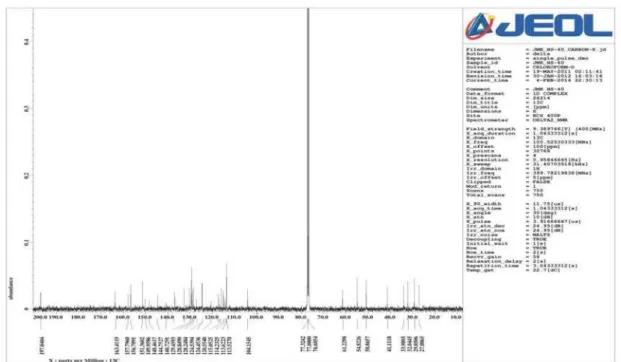
Figure S1. 1H NMR spectrum (CDCl
Figure S2. 13C NMR spectrum (CDCl
3, 100 MHz) of 1a.
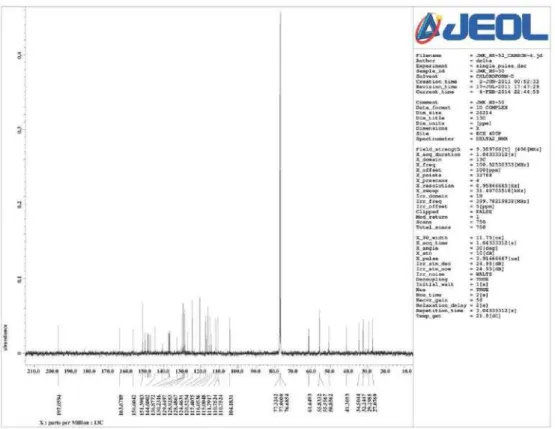
Figure S3. 1H NMR spectrum (CDCl
Figure S4. 13C NMR spectrum (CDCl
3, 100 MHz) of 1b.
Figure S5. 1HNMR spectrum (CDCl
Figure S6. 13C NMR spectrum (CDCl
3, 100 MHz) of 1c.
Figure S7. 1H NMR spectrum (CDCl
Figure S8. 13C NMR spectrum (CDCl
3, 100 MHz) of 1d.
Figure S9. 1H NMR spectrum (CDCl
Figure S10. 13C NMR spectrum (CDCl
3, 100 MHz) of 1e.
Figure S11. 1H NMR spectrum (CDCl
Figure S12. 13C NMR spectrum (CDCl
3, 100 MHz) of 1f.
Figure S13. 1H NMR spectrum (CDCl
Figure S14. 13C NMR spectrum (CDCl
3, 100 MHz) of 1g.
Figure S15. 1H NMR spectrum (CDCl
Figure S16. 13C NMR spectrum (CDCl
3, 100 MHz) of 1h.
Figure S17. 1H NMR spectrum (CDCl
Figure S18. 13C NMR spectrum (CDCl
3, 100 MHz) of 1i.
Figure S19. 1H NMR spectrum (CDCl
Figure S20. 13C NMR spectrum (CDCl
3, 100 MHz) of 1j.
Figure S21. 1H NMR spectrum (CDCl
Figure S22. 13C NMR spectrum (CDCl
3, 100 MHz) of 1k.
Figure S23. 1H NMR spectrum (CDCl
Figure S24. 13C NMR spectrum (CDCl
3, 100 MHz) of 1l.
Figure S25. 1H NMR spectrum (CDCl
Figure S26. 13C NMR spectrum (CDCl
3, 100 MHz) of 1m.
Figure S27. 1H NMR spectrum (CDCl
Figure S28. 13C NMR spectrum (CDCl
3, 100 MHz) of 1n.
Figure S29. 1H NMR spectrum (CDCl
Figure S30. 13C NMR spectrum (CDCl
3, 100 MHz) of 1o.
Figure S31. 1H NMR spectrum (CDCl
Figure S32. 13C NMR spectrum (CDCl