Article
J. Braz. Chem. Soc., Vol. 24, No. 7, 1079-1084, 2013. Printed in Brazil - ©2013 Sociedade Brasileira de Química
0103 - 5053 $6.00+0.00
A
http://dx.doi.org/10.5935/0103-5053.20130142*e-mail: [email protected]
Convenient Solvatochromic Probes for the Determination of Solvent Properties:
β
-Carotene and 2-Chloro-7-nitro-9
H
-fluorene
Omar A. El Seoud,* Paulo A. R. Pires, Carina Loffredo, Muhammad Imran, Paolo D. Pulcini, Michelle F. Corrêa and Rizwana Mustafa
Institute of Chemistry, University of São Paulo, CP 26077, 05513-970 São Paulo-SP, Brazil
Dipolaridade/polarizabilidade do solvente (SDP) tem sido calculada a partir dos espectros de UV-Vis de 2-(N,N-dimetilamino)-7-nitro-9H-fluoreno e 2-fluoro-7-nitro-9H-fluoreno. Com
base em cálculos teóricos (23 solventes) e dados experimentais (56 solventes), revela-se que 2-cloro-7-nitro-9H-fluoreno (disponível comercialmente) pode ser perfeitamente utilizado para
o cálculo dessa propriedade, em vez de 2-fluoro-7-nitro-9H-fluoreno. A divisão de SDP nos seus componentes (dipolaridade (SD) e polarizabilidade (SP) do solvente) requer o uso de um composto sintético poliênico cuja síntese é trabalhosa, envolvendo 15 etapas. Nosso grupo de pesquisa mostrou recentemente que o corante natural β-caroteno pode ser convenientemente utilizado para a determinação de SP, permitindo o cálculo de SD. Utilizando estas sondas solvatocrômicas, SDP, SP e SD foram calculados para uma série de 1-bromoalcanos. Para várias séries homólogas, a dependência de SDP (SD e SP para uma série homóloga) com o número de átomos de carbono nos grupos 1-alquila ou acila foi calculada e discutida.
Solvent dipolarity/polarizability (SDP) has been previously calculated from the UV-Vis spectra of 2-(N,N-dimethylamino)-7-nitro-9H-fluorene and 2-fluoro-7-nitro-9H- fluorene. Based
on theoretical calculations (23 solvents) and experimental data (56 solvents), it is shown that 2-chloro-7-nitro-9H-fluorene (commercially available) can be conveniently employed for the
calculation of this property, instead of its 2-fluoro-7-nitro counterpart. The splitting of SDP into its components (solvent dipolarity (SD) and polarizability (SP)) requires the use of a synthetic polyene compound whose synthesis is laborious, involving 15 steps. Our research group has recently shown that the natural dye β-carotene can be conveniently employed for the determination of SP, allowing the calculation of SD. Using these solvatochromic probes, SDP, SP and SD for a series of 1-bromoalkanes were calculated. For several homologous series, the dependence of solvent SDP (SD and SP for one series) on the number of carbon atoms in the 1-alkyl- or acyl-group was calculated and discussed.
Keywords: solvatochromism, solvent dipolarity/polarizability, solvent dipolarity, solvent polarizability, β-carotene
Introduction
The effects of solvents on chemical phenomena, e.g., reactivity, equilibrium, spectroscopic transitions, are usually discussed in terms of non-specific and specific interactions between the species of interest (reactants, transition states, etc.) and the solvent. A successful approach to address solvent effects is to use a linear combination of the contributing solvent properties, i.e., a solvation free energy relationship, e.g.:
Effect of solvent = RCAcidity (solvent acidity) +
RCBasicity (solvent basicity) + RCDipolarity/Polarizability (solvent dipolarity/polarizability) (1)
where RC stands for regression coefficient. There are several versions of equation 1, e.g., that of Kamlet-Taft-Abboud; equation 2,1-3 where RCs and the solvent descriptors
are termed (a; b; s) and (α; β; π*), respectively (dδ is a correction term for π*); and of Catalán (equation 3),4 where
Effect of solvent = a (α) + b (β) + s (π* + dδ) (2)
Effect of solvent = a (SA) + b (SP) + dp (SDP) (3)
The cavity term has been dropped from equations 1 to 3, because excitation of the probes employed in the present work, vide infra, obeys the Franck-Condon principle.
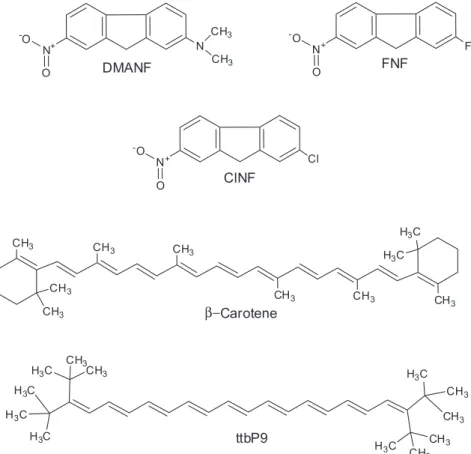
Equations 2 and 3 are applied by studying the phenomenon of interest in a series of solvents, followed by correlating the solvent effect with its descriptors (SA, SB, etc.). The relative importance of solvent acidity, basicity, etc. is deduced from the values of the calculated (standardized) regression coefficients. The solvent descriptors on the right-hand side of equations 2 and 3 are called solvatochromic parameters because their values are determined by using solvatochromic substances, hereafter designated as probes. These are dyes whose spectra, absorption or emission, are especially sensitive to solvent properties.5,6 Figure 1 shows
the molecular structures of the probes of interest to the present work. The pair 2-(N,N
-dimethylamino)-7-nitro-9H-fluorene (DMANF) and 2-fluoro-7-nitro-9H-fluorene
(FNF) are homomorphs (compounds with closely similar molecular structures) and are employed for the calculation of SDP. As shown elsewhere, the polyene (ttbP9) is sensitive only to solvent polarizability; its use allows splitting of SDP into its components (SD and SP).4
The use of some these probes is associated with problems of cost and availability from chemical suppliers. FNF has been discontinued (Aldrich), although custom synthesis is offered; it can be synthesized by nitration of 2-fluoro-9H
-fluorene.7 Relative to the commercially available ClNF,
whose molecular structure is similar to that of FNF, the first choice (custom synthesis) is 10 times more expensive. In addition to the labor involved in the synthesis of FNF from 2-fluoro-9H-fluorene, the cost of the latter is twice that of
ClNF. Therefore, the use of ClNF is an attractive alternative
Scheme 1. Steps of the synthesis of DMANF.
Figure 1. Molecular structures of the probes of interest to the present work: 2-(N,N-dimethylamino)-7-nitro-9H-fluorene (DMANF),
El Seoud et al. 1081 Vol. 24, No. 7, 2013
(less cost, no labor) for the determination of SDP, provided that its solvatochromic behavior is similar to that of FNF. The synthesis of ttbP9 is a major synthetic undertaking, involving 15 steps.8 As recently shown, the natural dye
β-carotene can be conveniently employed instead of ttbP9 for the determination of SP.9
The aim of the present work is to evaluate the use of ClNF instead of FNF for the determination of SDP. Both theoretical calculation (23 solvents) and experimental results (56 solvents) showed excellent linear correlations between the frequencies of maximum absorption of both probes, i.e., ClNF is a convenient alternative probe to FNF. The values of SP, hence SD of a series of 1-bromoalkanes, have been determined by using
β-carotene and DMANF. The dependence of SDP (also
SD and SP of 1-bromoalkanes) on the number of carbon atoms in the alkyl- or acyl chain of the studied liquids was calculated and discussed.
Experimental
Materials and synthesis
The chemicals were purchased from Alfa-Aeser or Aldrich; the solvents were purified as shown elsewhere,10 and
stored over activated type 4 Å molecular sieves. The purity of the solvents was established by comparing the values of their densities (DMA-4500 digital density meter, Anton Paar), and overall empirical polarity, ET(30) in
kcal mol-1, with literature ones.3,11 ClNF (99% pure) was
employed after drying; its elemental analysis calculated for C13H8ClNO2 was found to be (element, %): C, 63.5; H,
3.2; N, 5.7; found: C, 63.4; H, 3.0; N 5.5.
The probe DMANF was synthesized in two steps, as shown in scheme 1.12 First, 2,7-dinitro-9H-fluorene was
partially reduced into 2-amino-7-nitro-9H-fluorene (Pd/C
catalyst; formic acid; triethylamine). The latter compound, after purification by flash column chromatography (CH2Cl2
eluent; yield 45%), was submitted to reductive amination (reaction with paraformaldehyde) to produce DMANF, 91.0% yield. Elemental analysis calculated for C15H14N2O2
was: C, 70.85; H, 5.55; N, 11.02; found: C, 70.56; H, 5.65; N, 10.90. The 1H nuclear magnetic resonance (NMR)
spectral data (Varian Inova-300 NMR spectrometer, CDCl3)
were similar to those published elsewhere.12
UV-Vis absorption spectra
UV-Vis spectroscopic measurements were carried out on a Shimadzu UV-2500 spectrophotometer, equipped with a model 4029 digital thermometer (Control Company),
under the following experimental conditions: each spectrum was recorded at least thrice, at 140 nm min-1; slit width
0.5 nm; sampling interval of 0.2 nm. The instrument was routinely checked for λmax accuracy against the known
peaks of a holmium oxide glass filter (model 666-F1, Hellma Analytics, Müllheim). Maximum wavelength was determined from the first derivative function, calculated by using a commercial software (GRAMS/32 version 5.10, Galactic Industries); the uncertainty in λmax is ± 0.2 nm. All spectra were recorded at 25 ± 0.1 °C using quartz cells of 1 cm path length.
Calculations
Solvent SDP, SP and SD4,9
The value of SDP is calculated from equation 4:
(4)
where ∆∼νmax;probe;solvent is the difference between the wavenumbers of the longest wavelength (i.e., the solvatochromic) transition of the probes ClNF and DMANF in the solvent of interest i.e., (∼νClNF;solvent − ∼νDMANF;solvent);
∆∼νmax;probe;gas is the same difference, but in the gas phase; and
∆∼νmax;probe;DMSO is the corresponding value for (the reference
solvent) DMSO.
The experimentally unattainable ∼νmax;probe;gas (all
indicators are solid) is calculated by extrapolation to zero a plot of ∼νmax;probe;n-alkanesvs. the Lorenz-Lorentz refractive
index function f(n)2 = (n2 − 1)/(n2 + 2) (where n = refractive
index) for a homologous series of linear alkanes. The values of ∼νmax;probe;gas are listed at the top of Table S1 in the Supplementary Information (SI) section; the corresponding one for β-carotene is 24402 cm-1.9
Manipulation of the data of DMANF and β-carotene permits the calculation of SD, as shown by equation 5:
(5)
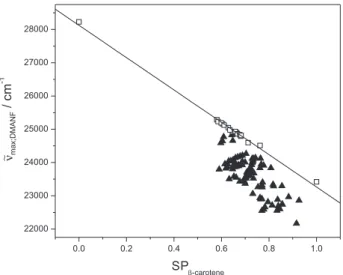
The plot of ∼νmax;DMANF;solventvs. SPβ-carotene;solvent is shown
in Figure 2, in which the solvents can be grouped into two classes. Group A is located on a straight line; the rest (group B) clearly deviates from linearity. Group A includes gas phase plus alkanes, CCl4 and CS2. These are solvents
that influence DMANF only through their polarizability. Group B solvents affect ∼νmax;DMANF through SD and SP,
∼ νο
max;DMANF;solvent = (28134 ± 49) – (4884 ± 75) SPβ-carotene;solvent
(NS = 18; sd = 56.373; r = −0.9981 (6)
where the value ∼νο
max;DMANF;solvent represents the frequency
that DMANF would have if its interaction with the solvents were governed only by SP. Thus, the difference between
∼ νο
max;DMANF;solvent and ∼νmax;DMANF;solvent is proportional to the
dipolarity component of this solvent, i.e., its SD.
For group B solvents, the SD value can be obtained from the following equation:
(7)
where the strongly dipolar DMSO is taken as a reference. Therefore, the calculation of SD involves the following steps: determination of (λmax;DMANF;solvent) of the DMANF charge-transfer band in the solvents of interest, and subsequent calculation of the corresponding frequency (∼νmax;DMANF;solvent); determination of the same
spectral parameters for β-carotene and calculation of the corresponding SPβ-carotene from equation 5; calculation of
∼ νο
max;DMANF;solvent from equation 6; and calculation of SD by
application of equation 7.
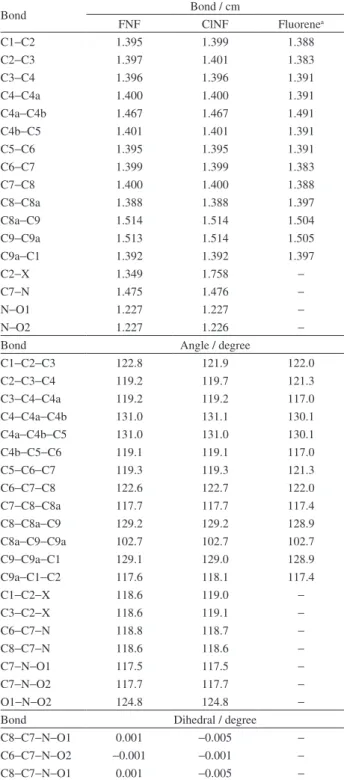
Geometry optimization of the structures of FNF and ClNF FNF and ClNF had their geometries, in the gas phase, optimized in two steps, both using a density functional theory (DFT) calculation that employs B3LYP density functional; 6-311G(d,p) and CC-pVDZ basis sets were employed.
For both probes, the transition energies between the fundamental and excited state were calculated by
time-dependent density functional theory (TD-DFT), using BOP density functional and DH (Dunning/Hay double zeta) basis set with the application of long range correction. Values of frequencies of maximum absorption (∼νmax) of the excited
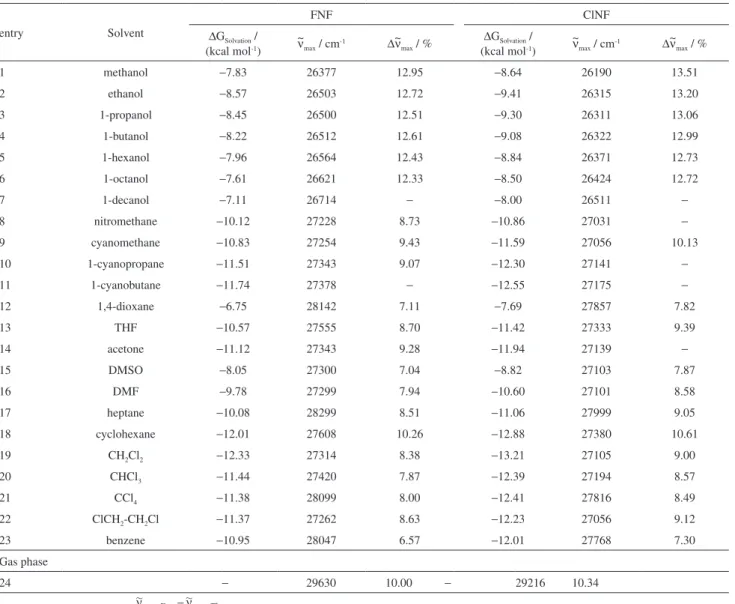
states with the largest oscillator strength are shown in Table S2 in the SI section. Solvent effects were simulated by using the polarizable continuum model (PCM) combined with SMD solvation model. The solvation free energy (∆Gsolvation)
was calculated from the difference between the free energy of the probe (ground state) in the solvent and in the gas phase. All calculations were performed by using the version Oct 1 2010 (R3) of Gamess US program package.13
The quality of geometry optimization of both probes can be shown by the agreement between calculated bond lengths and angles with X-ray data of fluorene (to our knowledge, there are no X-ray data for FNF, ClNF or 7-nitro-9H-fluorene), see Table S3 in the SI section.
Results and Discussion
Can ClNF be reliably employed instead of FNF for the determination of SDP?
In order to answer this question, two strategies were employed: (i) theoretically calculated energies of
solvation and the ∼νmax of both ClNF and FNF for a set of
representative solvents were compared; (ii) the experimental
∼
νmax values for a large set of solvents were compared.
Theoretical calculations
With regard to (i), the following procedure was employed
for each probe: the geometry was optimized in the gas phase; the optimized probes were then solvated in solvents for which parameterized data are available in the employed software package, videsupra. The set chosen covers nonpolar and
weakly polar aliphatic and aromatic hydrocarbons, dipolar aprotic solvents, and aliphatic alcohols. ∆GSolvation and the
values of ν∼max for both probes were calculated; the results are listed in Table S2 in the SI section.
Equations 8 and 9 (NS = number of solvents investigated; sd = standard deviation; r = correlation coefficient) and Figure 3 clearly show that there are excellent correlations between ∆GSolvation and ∼νmax;Theo for both probes in the
different solvents, with slopes of practically, or not far from unity. This indicates that the energies of solvation of the two probes are very similar; hence their solvatochromism responses to the same set of solvents correlate linearly.
∆GSolvation;ClNF;Theo = −0.839 + 1.003 ∆GSolvation;FNF;Theo
(NS = 23; sd = 0.0831; r = 0.9989) (8)
Figure 2. Correlation between ∼νmax;DMANF and SPβ-carotene for different media:
El Seoud et al. 1083 Vol. 24, No. 7, 2013
∼
νmax;ClNF;Theo = 1237 + 0.947 ν∼max;FNF;Theo
(NS = 23; sd = 17.634; r = 0.9995) (9)
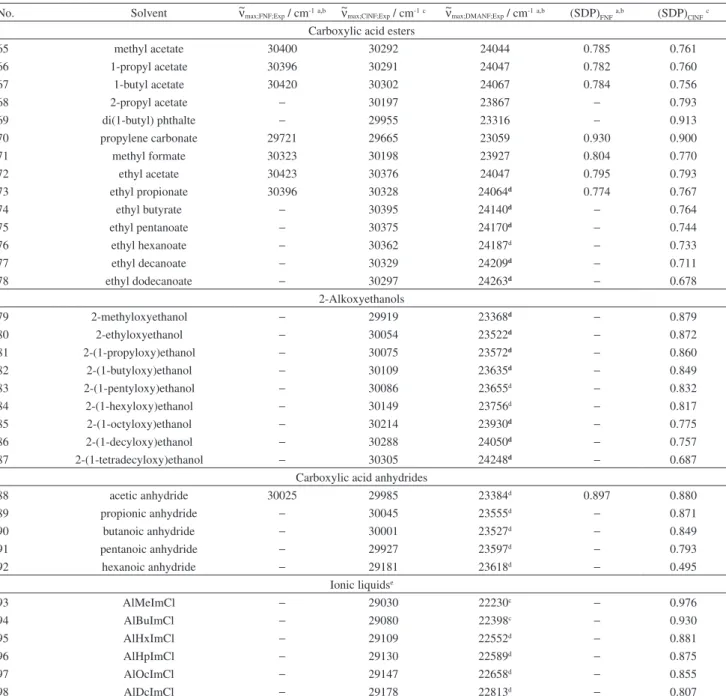
Comparison of the experimental ∼νmax;Exp and the calculated SDP values
The experimental values of ∼νmax;FNF;Exp, ∼νmax;ClNF;Exp and
∼
νmax;DMANF;Exp are listed in Table S1 in the SI section, along
with the corresponding SDP. The equations employed for the calculations of these parameters are given in the Calculations item in the Experimental section.
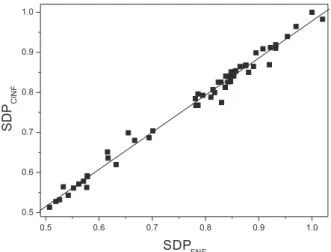
The excellent agreement between the solvatochromic responses of ClNF and FNF is evident from equations 10 and 11 and in Figure 4 (for representative solvents).
∼
νmax;ClNF;Exp = (2671 ± 268) + (0.910 ± 0.001) ∼νmax;FNF;Exp
(NS = 56; sd = 29,395; r = 0.9948) (10)
SDPClNF;Exp = (0.05 ± 0.01) + (0.93 ± 0.01) SDPFNF;Exp
(NS = 56; sd = 0.0149; r = 0.9872) (11)
Both results show that our initial expectation is confirmed, i.e., because of the similar molecular structures, both probes respond similarly to solvent dipolarity/ polarizability, 2-chloro-7-nitro-9H-fluorene (ClNF) is a
convenient probe for the determination of SDP.
After establishing that ClNF can be employed instead of FNF, SDP was determined for a series of 1-bromoalkanes that are extensively employed in the synthesis of ionic liquids with increasing hydrophobic character.14
DMANF and β-carotene were employed as solvatochromic probes in order to determine SD and SP for these liquids, the results are listed in Table 1.
The dependence of SDP of some homologous series (Table S1 in SI) on the number of carbon atoms (Nc) in the alkyl- or acyl group of the compounds are shown below, along with the same dependence of SD and SP for 1-bromoalkanes:
(i)Bromoalkanes:
SDP = 0.914 − 0.057 Nc – 0.005 Nc2 (NS = 6,
sd = 0.017; r = 0.9685) (12)
SD = 0.643 – 0.035 Nc (NS = 6, sd = 0.015,
r = 0.9932) (13)
SP = 0.718 + 0.001 Nc (NS = 6, sd = 0.001,
r = 0.9784) (14)
(ii)Linear-chain alcohols:
SDP = 0.866 – 0.013Nc (NS = 7, sd = 0.003,
r = 0. 9954) (15)
(iii)2-Alkoxyethanols:
SDP = 0.903 – 0.015 Nc (NS = 9, sd = 0.006,
r = 0.9959) (16)
(iv)Ethyl esters of carboxylic acids:
SDP = 0.802 – 0.010 Nc (NS =7, sd = 0.009,
r = 0.9779) (17)
Figure 3. Correlation between theoretically calculated frequencies of maximum absorption, ∼νmax;probe of FNF and ClNF.
Figure 4. Correlation between experimental SDP values of FNF and ClNF.
Table 1. Values of SP and SD for homologue series of 1-bromoalkanesa
entry Compound ∼νmax, β-carotene / cm-1 SD SP
1 1-bromoethane 21750 0.593 0.722
2 1-bromobutane 21741 0.525 0.725
3 1-bromohexane 21734 0.438 0.727
4 1-bromooctane 21724 0.390 0.729
5 1-bromodecane 21715 0.360 0.732
6 1-bromododecane 21703 0.286 0.735
aThe equations employed for the calculations of these parameters are given
(v)Ionic liquids:
SDP = 0.999 – 0.019 Nc (NS = 6, sd = 0.007,
r = 0.9946) (18)
Except for one case (1-bromoalkanes), the dependence of SDP on Nc is linear; for these (linear) plots, the slopes are negative, i.e., the dipolarity/polarizability decreases as a function of increasing chain length of the compound. The reason for the non-linear dependence of SDP on Nc for 1-bromoalkanes is not readily explainable at present; data for several homologous series should be examined. It is relevant however, that the slopes of the SD and SP vs. Nc plots for this series are negative and positive,
respectively. This behavior agrees with chemistry because dipolar interactions are expected to decrease as a function of increasing alkyl-chain length while keeping the dipolar bond (−Cδ+−Brδ-) constant. On the other hand, the
Lorenz-Lorentz refractive index function of this series (a measure of SP) increases as a function of increasing Nc.
Conclusions
The results of theoretical calculations and experimental data clearly lead to the same conclusion: ClNF and FNF respond similarly to solvent dipolarity/polarizability. This similarity, as evidenced by equations 10 and 11, and Figures 3 and 4, argues convincingly that both probes can be employed interchangeably for the calculation of SDP. The commercial availability of ClNF and the green dye
β-carotene at reasonable cost simplify the determination of the solvatochromic parameters, a prerequisite for understanding the effects of solvents on chemical phenomena. For homologous series, the dependence of SDP, SD and SP on their molecular structures is mostly linear, showing that the effects of increasing chain length of the alkyl- or acyl group on these solvent properties are additive.
Supplementary Information
Supplementary Information of this article is available free of charge at http://jbcs.sbq.org.br as a pdf file.
Acknowledgements
We thank FAPESP (São Paulo Research Foundation) for financial support, and the following for research fellowships: Petrobrás SA (C. Loffredo); CNPq (National Council for Scientific and Technological Development) (O. El Seoud); CNPq/TWAS, the Academy of Sciences for the Developing World (M. Imran). We thank C. Guizzo for his help.
References
1. Kamlet, M. J.; Abboud, J.-L. M.; Taft, R. W.; Prog. Phys. Org. Chem.1981, 13, 485.
2. Laurence, C.; Nicolet, P.; Dalati, M. T.; Abboud, J.-L. M.; Notario, R.; J. Phys. Chem.1994, 98, 5807.
3. Reichardt, C.; Welton, T.; Solvents and Solvent Effects in Organic Chemistry, 4th ed.; VCH: Weinheim, 2011.
4. Catalán, J.; J. Phys. Chem. B2009, 113, 5951. 5. El Seoud, O. A.; Pure Appl. Chem.2007, 79, 1135.
6. El Seoud, O. A.; Pure Appl. Chem.2009, 81, 697.
7. Miller, J. A.; Sandin, R. B.; Miller, E. C.; Rusch, H. P.; Cancer Res.1995, 15, 188.
8. Klein, D.; Kiliçkiran, P.; Mlynek, C.; Hopf, H.; Dix, I.; Jones, P. G. A; Chem. Eur. J.2010, 16, 10507.
9. Loffredo, C.; Pires, P. A. R.; Imran, M.; El Seoud, O. A.; Dyes Pigm.2013, 96, 16.
10. Armarego, W. L. F.; Chai, C.; Purification of Laboratory Chemicals, 5th ed.; Elsevier: New York, USA, 2003.
11. Lide, D. R.; CRC Handbook of Chemistry and Physics, 85th ed.; CRC Press: Boca Raton, USA, 2004.
12. Saroja, G.; Pingzhu, Z.; Ernsting, N. P.; Liebscher, J.; J. Org. Chem.2004, 69, 987.
13. Schmidt, M. W.; Baldridge, K. K.; Boatz, J. A.; Elbert, S. T.; Gordon, M. S.; Jensen, J. H.; Koseki, S.; Matsunaga, N.; Nguyen, K. A.; Su, S.; Windus, T. L.; Dupuis, M.; Montgomery, J. A.; J. Comput. Chem.1993, 14, 1347.
14. Pinkert, A.; Marsh, K. N.; Pang, S.; Staiger, M.; Chem. Rev. 2009, 109, 6712.
Submitted: February 18, 2013
Published online: June 7, 2013
Supplementary Information
S
I
J. Braz. Chem. Soc., Vol. 24, No. 7, S1-S5, 2013. Printed in Brazil - ©2013 Sociedade Brasileira de Química 0103 - 5053 $6.00+0.00
*e-mail: [email protected]
Convenient Solvatochromic Probes for the Determination of Solvent Properties:
β
-Carotene and 2-Chloro-7-nitro-9
H
-fluorene
Omar A. El Seoud,* Paulo A. R. Pires, Carina Loffredo, Muhammad Imran, Paolo D. Pulcini, Michelle F. Corrêa and Rizwana Mustafa
Institute of Chemistry, University of São Paulo, CP 26077, 05513-970 São Paulo-SP, Brazil
Figure S1. Numbering of the heavy atoms of the nitrofluorene halo-compounds. X = F or Cl.
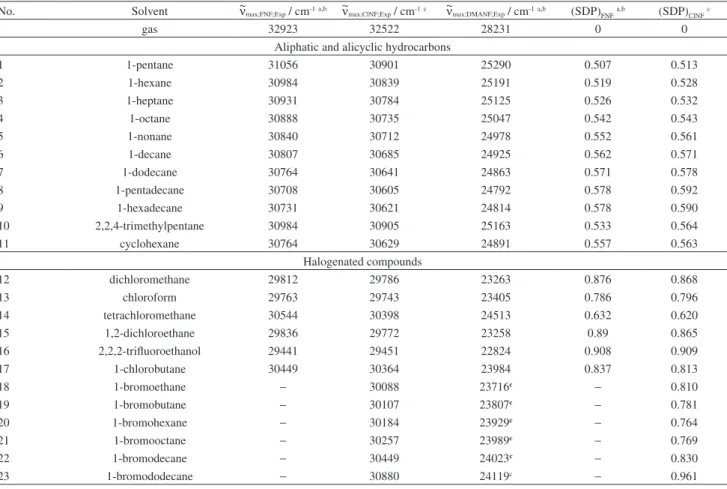
Table S1. Frequencies of the absorption maximum of the longest wavelength transitions, ~ν
max of FNF, ClNF and DMANF, and the corresponding solvent
dipolarity/polarizability (SDP)
No. Solvent ~νmax;FNF;Exp / cm-1a,b ~νmax;ClNF;Exp / cm-1c ~νmax;DMANF;Exp / cm-1a,b (SDP)
FNFa,b (SDP)ClNFc
gas 32923 32522 28231 0 0
Aliphatic and alicyclic hydrocarbons
1 1-pentane 31056 30901 25290 0.507 0.513
2 1-hexane 30984 30839 25191 0.519 0.528
3 1-heptane 30931 30784 25125 0.526 0.532
4 1-octane 30888 30735 25047 0.542 0.543
5 1-nonane 30840 30712 24978 0.552 0.561
6 1-decane 30807 30685 24925 0.562 0.571
7 1-dodecane 30764 30641 24863 0.571 0.578
8 1-pentadecane 30708 30605 24792 0.578 0.592
9 1-hexadecane 30731 30621 24814 0.578 0.590
10 2,2,4-trimethylpentane 30984 30905 25163 0.533 0.564
11 cyclohexane 30764 30629 24891 0.557 0.563
Halogenated compounds
12 dichloromethane 29812 29786 23263 0.876 0.868
13 chloroform 29763 29743 23405 0.786 0.796
14 tetrachloromethane 30544 30398 24513 0.632 0.620
15 1,2-dichloroethane 29836 29772 23258 0.89 0.865
16 2,2,2-trifluoroethanol 29441 29451 22824 0.908 0.909
17 1-chlorobutane 30449 30364 23984 0.837 0.813
18 1-bromoethane − 30088 23716c − 0.810
19 1-bromobutane − 30107 23807c − 0.781
20 1-bromohexane − 30184 23929c − 0.764
21 1-bromooctane − 30257 23989c − 0.769
22 1-bromodecane − 30449 24023c − 0.830
No. Solvent ~νmax;FNF;Exp / cm-1a,b ~νmax;ClNF;Exp / cm-1c ~νmax;DMANF;Exp / cm-1a,b (SDP)
FNFa,b (SDP)ClNFc
Aromatic compounds
24 benzene 30019 29953 23913 0.667 0.680
25 toluene 30028 29988 23947 0.655 0.681
26 xylenes 30120 30065 24123 0.616 0.642
27 anisole 29775 29768 23339 0.823 0.832
28 tetralin 29944 29908 23836 0.668 0.693
29 chlorobenzene 29726 29701 23288 0.824 0.825
30 nitrobenzene 29290 29280 22463 1.008 0.982
Nitriles
31 acetonitrile 30091 30104 23502 0.895 0.899
32 benzonitrile 29417 29398 22693 0.959 0.939
Aliphatic and cyclic ethers
33 1,4-dioxane 30296 30219 24118 0.701 0.704
34 THF 30181 30164 23712 0.838 0.841
35 diethyl ether 30751 30646 24589 0.694 0.687
36 di(1-butyl) ether 30733 30615 24659 0.652 0.648
37 1-butyl methyl ether 30669 30579 24504 0.695 0.694
38 bis (2-methoxyethyl) ether 30051 30029 23547 0.855 0.852
Carboxylic acid amides
39 DMF 29652 29645 22939 0.954 0.939
40 DMAC 29651 29673 22902 0.97 0.965
DMSO and pyridine
41 DMSO 29368 29419 22557 1.000 1.000
42 pyridine 29528 29518 22883 0.922 0.912
Alcohols
43 methanol 30302 30282 23795 0.857 0.854
44 ethanol 30365 30318 23865 0.853 0.841
45 1-propanol 30290 30235 23802 0.847 0.833
46 1-butanol 30338 30253 23873 0.837 0.813
47 1-pentanol 30342 30265 23918 0.817 0.800
48 1-hexanol 30333 30241 23923 0.81 0.788
49 1-octanol 30366 30274 24009 0.785 0.768
50 2-propanol 30315 30304 23825 0.848 0.851
51 2- butanol 30357 30295 23880 0.842 0.826
52 2-methylpropan-2-ol 30403 30369 23955 0.829 0.826
53 3-methylbutan-1-ol 30387 30335 23970 0.814 0.807
54 2-pentanol 30344 30267 23984 0.787 0.775
55 2-hexanol 30402 30368 23916 0.847 0.841
56 2-octanol 30383 30291 24025 0.786 0.768
57 cyclopentanol 30048 30035 23522 0.865 0.864
58 cyclohexanol 30139 30069 23652 0.847 0.827
59 ethylene glycol 29626 29612 22959 0.932 0.919
60 allyl alcohol 29972 29945 23426 0.875 0.867
Miscellaneous compounds
61 hexamethylphospho-triamide 29481 29446 22815 0.932 0.910
62 triethylamine 30823 30750 24824 0.617 0.636
63 acetic acid 30298 30258 23950 0.781 0.785
64 2-butanone 30106 30025 23548 0.881 0.850
El Seoud et al. S3 Vol. 24, No. 7, 2013
No. Solvent ~νmax;FNF;Exp / cm-1a,b ~νmax;ClNF;Exp / cm-1c ~νmax;DMANF;Exp / cm-1a,b (SDP)
FNFa,b (SDP)ClNFc
Carboxylic acid esters
65 methyl acetate 30400 30292 24044 0.785 0.761
66 1-propyl acetate 30396 30291 24047 0.782 0.760
67 1-butyl acetate 30420 30302 24067 0.784 0.756
68 2-propyl acetate − 30197 23867 − 0.793
69 di(1-butyl) phthalte − 29955 23316 − 0.913
70 propylene carbonate 29721 29665 23059 0.930 0.900
71 methyl formate 30323 30198 23927 0.804 0.770
72 ethyl acetate 30423 30376 24047 0.795 0.793
73 ethyl propionate 30396 30328 24064d 0.774 0.767
74 ethyl butyrate − 30395 24140d − 0.764
75 ethyl pentanoate − 30375 24170d − 0.744
76 ethyl hexanoate − 30362 24187d − 0.733
77 ethyl decanoate − 30329 24209d − 0.711
78 ethyl dodecanoate − 30297 24263d − 0.678
2-Alkoxyethanols
79 2-methyloxyethanol − 29919 23368d − 0.879
80 2-ethyloxyethanol − 30054 23522d − 0.872
81 2-(1-propyloxy)ethanol − 30075 23572d − 0.860
82 2-(1-butyloxy)ethanol − 30109 23635d − 0.849
83 2-(1-pentyloxy)ethanol − 30086 23655d − 0.832
84 2-(1-hexyloxy)ethanol − 30149 23756d − 0.817
85 2-(1-octyloxy)ethanol − 30214 23930d − 0.775
86 2-(1-decyloxy)ethanol − 30288 24050d − 0.757
87 2-(1-tetradecyloxy)ethanol − 30305 24248d − 0.687
Carboxylic acid anhydrides
88 acetic anhydride 30025 29985 23384d 0.897 0.880
89 propionic anhydride − 30045 23555d − 0.871
90 butanoic anhydride − 30001 23527d − 0.849
91 pentanoic anhydride − 29927 23597d − 0.793
92 hexanoic anhydride − 29181 23618d − 0.495
Ionic liquidse
93 AlMeImCl − 29030 22230c − 0.976
94 AlBuImCl − 29080 22398c − 0.930
95 AlHxImCl − 29109 22552d − 0.881
96 AlHpImCl − 29130 22589d − 0.875
97 AlOcImCl − 29147 22658d − 0.855
98 AlDcImCl − 29178 22813d − 0.807
aData taken from literature.2bData taken from literature.3cPresent work. dData taken from literature.4eThe acronyms of ionic liquids stand for
1-allyl-3-(1-alkyl)imidazolium chlorides, where Me, Bu, Hx, Hp, Oc, and Dc stand for methyl, 1-butyl, 1-hexyl, 1-heptyl, 1-octyl and 1-decyl, respectively.
Table S2. Theoretically calculated Gibbs free energy of solvation, ∆G
Solvation, and values of the frequency of maximum absorption, ~νmax, for FNF and ClNF
entry Solvent
FNF ClNF
∆G
Solvation /
(kcal mol-1)
~ ν
max / cm-1 ∆~νmax / %
∆G
Solvation /
(kcal mol-1)
~ ν
max / cm-1 ∆~νmax / %
1 methanol −7.83 26377 12.95 −8.64 26190 13.51
2 ethanol −8.57 26503 12.72 −9.41 26315 13.20
3 1-propanol −8.45 26500 12.51 −9.30 26311 13.06
4 1-butanol −8.22 26512 12.61 −9.08 26322 12.99
5 1-hexanol −7.96 26564 12.43 −8.84 26371 12.73
6 1-octanol −7.61 26621 12.33 −8.50 26424 12.72
7 1-decanol −7.11 26714 − −8.00 26511 −
8 nitromethane −10.12 27228 8.73 −10.86 27031 −
9 cyanomethane −10.83 27254 9.43 −11.59 27056 10.13
10 1-cyanopropane −11.51 27343 9.07 −12.30 27141 −
11 1-cyanobutane −11.74 27378 − −12.55 27175 −
12 1,4-dioxane −6.75 28142 7.11 −7.69 27857 7.82
13 THF −10.57 27555 8.70 −11.42 27333 9.39
14 acetone −11.12 27343 9.28 −11.94 27139 −
15 DMSO −8.05 27300 7.04 −8.82 27103 7.87
16 DMF −9.78 27299 7.94 −10.60 27101 8.58
17 heptane −10.08 28299 8.51 −11.06 27999 9.05
18 cyclohexane −12.01 27608 10.26 −12.88 27380 10.61
19 CH2Cl2 −12.33 27314 8.38 −13.21 27105 9.00
20 CHCl3 −11.44 27420 7.87 −12.39 27194 8.57
21 CCl4 −11.38 28099 8.00 −12.41 27816 8.49
22 ClCH2-CH2Cl −11.37 27262 8.63 −12.23 27056 9.12
23 benzene −10.95 28047 6.57 −12.01 27768 7.30
Gas phase
24 − 29630 10.00 − 29216 10.34
For each probe , where Exp. and Theo are experimental and theoretical values, respectively. Values of ~ν
max;Exp are listed
El Seoud et al. S5 Vol. 24, No. 7, 2013
Table S3. Optimized bond lengths, angles and dihedrals of
2-fluoro-7-nitrofluorene (FNF) and 2-chloro-2-fluoro-7-nitrofluorene (ClNF), calculated by DFT using B3LYP/6-311G(d,p) followed by B3LYP/CC-pVDZ and X-ray experimental data of fluorene (see heavy atom numbering in Figure S1). For the three molecules, the ring structure is planar
Bond Bond / cm
FNF ClNF Fluorenea
C1−C2 1.395 1.399 1.388
C2−C3 1.397 1.401 1.383
C3−C4 1.396 1.396 1.391
C4−C4a 1.400 1.400 1.391
C4a−C4b 1.467 1.467 1.491
C4b−C5 1.401 1.401 1.391
C5−C6 1.395 1.395 1.391
C6−C7 1.399 1.399 1.383
C7−C8 1.400 1.400 1.388
C8−C8a 1.388 1.388 1.397
C8a−C9 1.514 1.514 1.504
C9−C9a 1.513 1.514 1.505
C9a−C1 1.392 1.392 1.397
C2−X 1.349 1.758 −
C7−N 1.475 1.476 −
N−O1 1.227 1.227 −
N−O2 1.227 1.226 −
Bond Angle / degree
C1−C2−C3 122.8 121.9 122.0
C2−C3−C4 119.2 119.7 121.3
C3−C4−C4a 119.2 119.2 117.0
C4−C4a−C4b 131.0 131.1 130.1
C4a−C4b−C5 131.0 131.0 130.1
C4b−C5−C6 119.1 119.1 117.0
C5−C6−C7 119.3 119.3 121.3
C6−C7−C8 122.6 122.7 122.0
C7−C8−C8a 117.7 117.7 117.4
C8−C8a−C9 129.2 129.2 128.9
C8a−C9−C9a 102.7 102.7 102.7
C9−C9a−C1 129.1 129.0 128.9
C9a−C1−C2 117.6 118.1 117.4
C1−C2−X 118.6 119.0 −
C3−C2−X 118.6 119.1 −
C6−C7−N 118.8 118.7 −
C8−C7−N 118.6 118.6 −
C7−N−O1 117.5 117.5 −
C7−N−O2 117.7 117.7 −
O1−N−O2 124.8 124.8 −
Bond Dihedral / degree
C8−C7−N−O1 0.001 −0.005 −
C6−C7−N−O2 −0.001 −0.001 −
C8−C7−N−O1 0.001 −0.005 −
aData taken from literature.1
References
1. Belskii, V. K.; Zavodnik, V. E.; Vozzhennikov, V. M.; Acta Crystallogr., Sect.C: Cryst. Struct. Commun.1984, 40, 1210.
2. Catalán, J.; López, V.; Pérez, P.; Martín-Villamil, R.; Rodríguez, J.-G.; Liebigs Ann.1995, 241.
3. Catalán, J.; López, V.; Pérez, P.; Liebigs Ann.1995, 793. 4. Pires, P. A. R.; Imran, M.; Loffredo, C.; Donate, P. M.; Previdi,