
Brazilian Journal of Physics, vol. 37, no. 2B, June, 2007 683
Dynamical Gluon Mass in QCD Processes
M. B. Gay Ducati and W. Sauter
(1) Grupo de Fenomenologia de Part´ıculas de Altas Energias (GFPAE), Instituto de F´ısica, Universidade Federal do Rio Grande do Sul,
Porto Alegre, RS, Brazil
Received on 25 September, 2006
We perform phenomenological applications of modified gluon propagators and running coupling constants in scattering processes in Quantum Chromodynamics (QCD). The modified forms of propagators and running coupling constant are obtained by non-perturbative methods. The processes investigated includes the diffractive ones – proton-proton elastic scattering, light vector meson photo-production and double vector meson produc-tion in gamma-gamma scattering – as well as the pion and kaon meson form factors. The results are compared with experimental data (if available), showing a good agreement with a gluon with dynamical mass but do not indicate the correct gluon propagator functional form.
Keywords: Pomeron; Elastic scattering; Non-perturbative gluons
I. INTRODUCTION
The challenging description of the infrared limit of Quan-tum Chromodynamics (QCD) is a field of investigation with important open questions. In the infrared, we need non-perturbative tools of investigation, as Schwinger-Dyson equa-tions and lattice field theory, to obtain the Green funcequa-tions to avoid the poles found in this kinematic region. For example, the gluon propagator (as well as any Green function) can have a different behavior in the infrared. With direct relation with the Green function, the running coupling constant can have a frozen value when the momentum goes to zero.
The diffractive processes have important contributions from the infrared. This class of high energy processes is de-scribed by the Pomeron exchange. A picture for the Pomeron which includes the non-perturbative effects is the Landshoff-Nachtmann (LN) model [1], where these effects are encoded in the Green functions, modified in the infrared kinematic re-gion. The LN is employed in the description of proton-proton elastic scattering and vector meson photo-production. An-other processes can be described by the use of modified gluon propagators, as for example, the meson form factors.
To obtain the gluon propagator to describe the above processes, some approximations are required. A consequence is that different solutions found in the literature following dif-ferent approximation. Our goal in this work is to compare the distinct solutions of the gluon propagator with the exper-imental data on different processes. These different solutions includes: Cornwall’s solution [2],
D−C1(q2) =£
q2+m2C(q2)¤ bg2ln
Ã
q2+4m2C(q2)
Λ2 QCD
! , (1)
with
mC2(q2) =m2g "
ln Ã
q2+4m2g
Λ2 QCD
! , ln
à 4m2g
Λ2 QCD
! #−12/11 ; (2)
H¨abelet al.solution [3, 4]: DH(q2) =
q2
q4+b4; (3)
Gorbar and Natale solution [5]:
£
DGN(q2)¤− 1
=q2+µ2gΘ(ξ′µ2g−q2) +µ
4 g
q2Θ(q 2
−ξ′µ2g), (4)
whereΘ is the step function, µg=0.61149 GeV and ξ′ = 0.9666797; Aguilar and Natale solution [6]:
DAN(q2) = 1
q2+
M
2(q2),M
2(q2) = m40
q2+m2 0
, (5)
wherem2
0=0.99 GeV2for the QCD scaleΛQCD=335 MeV; Alkofer and collaborators solution [7–10]:
DAL(q2) = ω q2
"
q2 Λ2
QCD+q2 #2κ
³
α(sAL)(q2) ´−γ
, (6)
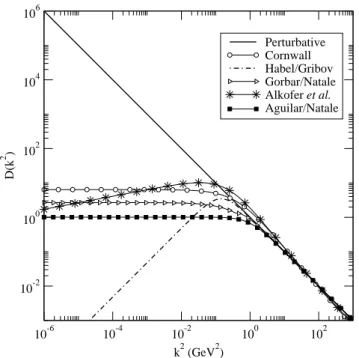
whereω=2.5, ΛQCD=510 MeV,κ≈0.595, γ=−13/22 andα(sAL)(q2)is the running coupling constant (see below). The solutions are displayed in the Fig. 1.
The running coupling have a straight connection with the modified Green functions. The expressions are related with the propagator employed. The analytical expressions are: Cornwall [2, 11],
αs(k2) =4π ,
β0ln Ã
k2+ξm2P(k2)
Λ2 QCD
!
, (7)
whereξ≈4 andmP(k2)is the massive term of the gluon prop-agator; Alkofer expression
α(sAL)(q2) = 1 1+ (q2/Λ2
QCD) "
αs(0) + 4π β0
q2 Λ2
QCD
× Ã
1 ln(q2/Λ2
QCD)
+ 1
1−(q2/Λ2 QCD)
!# ,(8)
684 M. B. Gay Ducati and W. Sauter
10-6 10-4 10-2 100 102
k2 (GeV2) 10-2
100 102 104 106
D(k
2 )
Perturbative Cornwall Habel/Gribov Gorbar/Natale Alkofer et al. Aguilar/Natale
FIG. 1: Distinct modified gluon propagators compared with the per-turbative one. The propagators are indicated in the plot legend.
10-1 100 101 102
k2 (GeV2) 100
101
αs
(k
2 )
Perturbative Cornwall Habel/Gribov Gorbar/Natale Alfoker et al. Aguilar/Natale
10-1 100 101
0.20 0.30 0.40 0.50
ξ=4.0 ξ=5.0
FIG. 2: Comparison between different results for the running pling constant. In the detail, two results of the Cornwall frozen cou-pling with two differentξ’s.
II. ELASTICppSCATTERING
To compare the gluon propagator above with the experi-mental data for the elastic ppscattering, we employ a modi-fied scattering amplitude (based in [12–14]) to include frozen running coupling and Regge trajectory of the soft Pomeron, namely,
A
pp2 (s,t) =8is ³
s s0
´αP(t)−1
R
d2kαs¡q2+k¢
D
¡q2+k¢×αs¡q2−k¢
D
¡q2−k¢ £Gp(q,0)−Gp¡q,k−q2 ¢¤2. (9)
whereαP(t) =α(0) +α′(t)is the (soft) Pomeron trajectory (withα(0) =1.08 and α′(t)≃0.25 GeV−2 [15]), G
p(q,k) is the convolution of proton cross-sections, related with the Dirac form factor of the proton,
Gp(q,0) = F1(q2) (10a)
Gp ³
q,k−q 2 ´
= F1
µ q2+9
¯ ¯ ¯ ¯
k2−q 2
4 ¯ ¯ ¯ ¯ 
. (10b)
The cross section are given by the optical theorem,
σtot=
A
pp2 (s,0) is ,
dσ
dt = |
A
pp2 (s,t)|2
16πs2 (11)
0.0 0.2 0.4 0.6 0.8 1.0
|t| (GeV2) 10-3
10-2 10-1 100 101 102
d
σ
/dt (mb/GeV
2 )
sqrt(s) = 53 GeV Cornwall Habel/Gribov Gorbar/Natale Alkofer et al. Aguilar/Natale
FIG. 3: Results of the modified model, fitting to theppelastic scat-tering data with√s=53 GeV [16] with different gluon propagators and frozen coupling constants.
III. LIGHT MESON DIFFRACTIVE PHOTO-PRODUCTION
Brazilian Journal of Physics, vol. 37, no. 2B, June, 2007 685
the same spirit of the amplitude in the above section, based in Cudell/Royen model [17]. The differential cross section reads
dσ
dt = 1 16π
C
2ζ2(αP(t)−1)f2¡
∆,Q2¢ ·
1+εQ
2
mV2 ¸
, (12)
where ζ = s/s0 with s0 = Q2 + mV2 − t,
C
=(64/√6)gVelmmV√mVfV, ε≈ 1 is the polarization of the photon beam,
f(∆,Q2) = Z d2kα
s(k)αs(k−∆)
D
(k)D
(k−∆)×[F1(t)−
E
2(k,k−∆)][k·(k−∆)] t−m2V−Q2+4k·(k−∆) (13) whereF1(t)is the Dirac proton form factor andE
2(k,k−∆) = F1(k2+ (k−∆)2−k·(k−∆)). The massive parameters are the same as in theppelastic scattering.0,0 0,1 0,2 0,3 0,4 0,5 0,6
|t| (GeV2) 101
102 103 104 105 106
d
σρ
/d
t (nb GeV
-2 )
H1 ZEUS Cornwall Habel/Gribov Gorbar/Natale Alkofer et al. Aguilar/Natale
FIG. 4:ρphoto-production differential cross section, compared with the H1 and ZEUS data [18, 19]
IV. DOUBLEJ/ΨPRODUCTION INγγSCATTERING
The double diffractive production of meson vectors in photon-photon collisions is a clean test for the BFKL Pomeron, due the hard scale provided by the mass of the me-son and/or the large momentum transfer. The experimental possibilities includes CLIC and LHC in the peripheral heavy ion collisions. The scattering amplitude in the Born level (two gluon exchange is [20]
ℑm
A
(0)(s,t) =Z d2kπ [Φ0(k
2,Q2)]2D(k+Q/2)D(k−Q/2))(14)
where the impact transitionγJ/Ψfactor is
Φ0(k2,Q2) =
C
2 √
αemαs(µ2) "
1 ¯ q2−
1 m2J/Ψ/4+k2
# , (15)
with
C
=qc83πmJ/ΨfJ/Ψ, qc= 23, fJ/Ψ=0.38 GeV, ¯q2= m2J/Ψ+Q42,µ2=k2+Q2/4+ (mJ/Ψ/2)2. Improvements andapplications are made in [21, 22] with the inclusion of full BFKL amplitude and applications in other processes.
0.0 1.0 2.0 3.0 4.0 5.0 6.0 7.0 8.0 9.0 10.0
|t| (GeV2)
10-2
10-1
100
d
σ
/dt (pb/GeV
2)
s0 = 0.0 GeV2
s0 = 0.1 GeV2
s0 = 0.6 GeV2
χ and µg (no texto)
Cornwall Cornwall (variante)
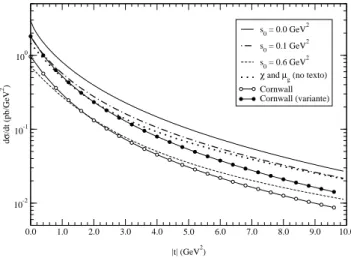
FIG. 5: Differential cross section for γγ→J/ψJ/ψ using Gor-bar/Natabe, Cornwall gluon propagators.
V. MESON FORM FACTORS
The meson form factors measure the hadron charge distrib-ution, defined by
dσ
dΩ(e+π,K→e+π,K) =
µdσ dΩ

point
|Fπ,K(Q2)|2. (16)
FM(Q2) =
Z 1
0 dx
Z 1
0
dyφ∗M(y,Q˜y)TH(x,y,Q2)φM(x,Q˜x), (17) whereTH is the hard scattering amplitude in LO, modified to include non-perturbative contributions (see ,for example, [23]),
TH(x,y,Q2) = 64π
3 { 2 3α˜s(kˆ
2)D(kˆ2) +1 3α˜s(pˆ
2)D( ˆ
p2)}, (18) φM is the distribution amplitude given by Bethe-Salpeter evo-lution equation (also modified to include a frozen running cou-pling),
φM(x,Q2) =x(1−x) ∞
∑
n=0
C(n3/2)(2x−1) ·α
s(Q2) αs(Q20)
¸dn
686 M. B. Gay Ducati and W. Sauter
0.0 0.2 0.4 0.6 0.8 1.0 1.2 1.4 1.6 1.8 Q2(GeV2)
10-2 10-1 100
Fπ
(Q
2)
Amendolia et. al. Brauel et al. Jeffeson Lab Fπ Coll. Yeh P. Maris et al. Cornwall (mg=0.3 GeV)
Cornwall (mg=0.7 GeV)
Gorbar e Natale Habel et al. Alkofer et al. Atkinson e Bloch nf = 3
FIG. 6: Pion form factor with different propagators in comparison with the data (see [20]).
VI. CONCLUSIONS
From the results displayed above, we conclude that the use of a modified gluon propagator in the description of processes
in which soft kinematic scales are relevant is useful. We use a simple model (two gluon exchange) of diffractive scatter-ing with modifications to include modified gluon propagators. The models allows modifications to include the alternative IR forms of gluon propagator, also in the case of meson form fac-tors.The massive parameters of the propagator and coupling constant are kept fixed in the original values in the diffractive processes, giving different results for different processes. In the case of meson form factors, a fit to the experimental data is performed, giving different values for the parameters, but fitting the data. Despite the crudeness of the model employed in the description of the data, the comparison of the results from different models is a (possible) useful filter for different forms of the gluon propagators. Due to the (possible) depen-dence on the model employed in the process, our results fa-vor solutions with a dynamical gluon mass, although do not discriminate which is the best choice among the propagators employed here.
VII. ACKNOWLEDGMENTS
The authors thanks A. Natale for the discussions and ap-pointments along this work.
[1] P. V. Landshoff and O. Nachtmann. Z. Phys. C35, 405 (1987). [2] J. M. Cornwall. Phys. Rev. D26, 1453 (1982).
[3] U. H¨abel, R. K¨onning, H.-G. Reusch, M. Stingl, and S. Wigard. Z. Phys. A336, 423 (1990).
[4] U. H¨abel, R. K¨onning, H.-G. Reusch, M. Stingl, and S. Wigard. Z. Phys. A336, 435 (1990).
[5] E. V. Gorbar and A. A. Natale. Phys. Rev. D61, 054012 (2000). [6] A. C. Aguilar and A. A. Natale. JHEP08, 057 (2004). [7] R. Alkofer and L. Von Smekal. Phys. Rep.353, 281 (2001). [8] L. von Smekal, A. Hauck, and R. Alkofer. Phys. Rev. Lett.79,
3591 (1997).
[9] C. S. Fisher and R. Alkofer. Phys. Rev. D67, 094020 (2003). [10] R. Alkofer, W. Detmold, C. S. Fisher, and P. Maris. Nucl. Phys.
Proc. Suppl.141, 122 (2005).
[11] J. Papavassiliou and J. M. Cornwall. Phys. Rev. D44, 1285 (1991). x
[12] J. R. Cudell and D. A. Ross. Nucl. Phys. B359, 247 (1991). [13] F. Halzen, G. Krein, and A. A. Natale. Phys. Rev. D.47, 295
(1993).
[14] D. S. Henty, C. Parrinello, and D. G. Richards. Phys. Lett. B 369, 130 (1996).
[15] A. Donnachie and P. V. Landshoff. Phys. Lett. B296, 227 (1992).
[16] A. Breakstone et al. Nucl. Phys. B248, 253 (1984). [17] J. R. Cudell and I. Royen. Phys. Lett. B397, 317 (1997). [18] J. Adloff et al. Eur. Phys. J. C13, 371 (2000).
[19] J. Breitweg et al. Eur. Phys. J. C6, 603 (1999).
[20] M. B. Gay Ducati and W. K. Sauter. Phys. Lett. B521, 259 (2001).
[21] V. P. Gonc¸alves and W. K. Sauter. Eur. Phys. J. C 44, 515 (2005).
[22] V. P. Goncalves, M. V. T. Machado, and W. K. Sauter. Eur. Phys. J. C46, 219 (2006)
![FIG. 6: Pion form factor with different propagators in comparison with the data (see [20]).](https://thumb-eu.123doks.com/thumbv2/123dok_br/18982831.457687/4.892.83.439.141.398/fig-pion-form-factor-different-propagators-comparison-data.webp)
