102 Brazilian Journal of Physics, vol. 37, no. 1, March, 2007
Causal Structure of Relativistic Dissipative Hydrodynamics
G. S. Denicol, Ph. Mota, T. Kodama, and T. Koide
Instituto de F´ısica, Universidade Federal do Rio de Janeiro, C.P. 68528, 21945-970 Rio de Janeiro, RJ, Brazil
Received on 29 September, 2006
We present a new formalism for the relativistic dissipative hydrodynamics consistent with causality. We start from the physical analysis of the irreversible currents according to the Landau-Lifshitz theory. Then, the irreversible currents are given by integral expressions which take into account the relaxation time. Only one additional parameter was introduced, the relaxation time,τR. We verified that the linearized equation of motion for small perturbations in the homogeneous, static background coincides with Hiscock-Lindblom
Keywords: Viscosity; Dissipative phenomena; Relativistic hydrodynamics
I. INTRODUCTION
The ideal hydrodynamical description for the dynamics of hot and dense matter achieved in the RHIC experiments works amazingly well, particularly for the behavior of collective flow parameters. However, we know that there still exist several open problems in the interpretation of data in terms of the hy-drodynamical model [1]. These questions require careful ex-amination to extract quantitative and precise information on the properties of QGP. In particular, we should study the ef-fect of dissipative processes on the collective flow variables. Several works have been done in this direction [2]. How-ever, strictly speaking, a quantitative and consistent analysis of the viscosity within the framework of relativistic hydrody-namics has not yet been done completely. This is because the introduction of dissipative phenomena in relativistic hydrody-namics casts difficult problems, both conceptual and techni-cal. Initially Eckart, and later, Landau-Lifshitz introduced the dissipative effects in relativistic hydrodynamics in a covari-ant manner [3, 4]. It is, however, known that their formalism leads to the problem of acausality, that is, a pulse signal prop-agates with infinite speed. Thus, relativistic covariance is not a sufficient condition for a consistent relativistic dissipative dynamics [5, 6].
II. PROBLEM OF CAUSALITY IN DIFFUSION PROCESS
The fundamental problem of the first order theory like the Navier-Stokes theory is attributed to the fact that the diffusion equation is parabolic. The diffusion process is a typical relax-ation process of conserved quantities. Thus, it should satisfy the equation of continuity,
∂n
∂t +∇·~j=0, (1)
wherenis a density of a conserved quantity. The irreversible current~jis, phenomenologically assumed to be proportional to a thermodynamic force F, and it is phenomenologically given by the gradient ofn,
~j=−ζ~F=−ζ∇n, (2)
whereζ is the Onsager coefficient. Substituting Eq.(2) into Eq.(1), we get the diffusion equation,
∂ ∂tn=ζ∇
2n.
Fick’s law tells us that the above diffusion process is in-duced by an inhomogeneous distribution. In Eq.(2), the irre-versible current is directly proportional to the space inhomo-geneity. However, this is a very special case. In general, the generation of a irreversible current has a time delay. Thus, we may think of memory effects within the linear response of the system. Phenomenologically, this can be done by introducing the following memory function [7, 8],
G¡t,t′¢ = 1
τRe
−(t−t′)/τ
R,t≥t′
= 0, t<t′ (3)
whereτRis a constant (relaxation time) and rewrite Eq.(2) as ~j=−
Z t
−∞
G¡t,t′¢ζ~F¡t′¢dt′,
In the limit ofτR→0,we haveG(t,t′)→δ(t−t′)so that the original equation (2) is recovered [9]. Substituting into the equation of continuity (1), we arrive at
∂2n ∂t2 =
1
τR
µ
−∂n
∂t +ζ∇ 2n

.
This equation is hyperbolic. This telegraph equation is some-times called the causal diffusion equation.
For a suitable choice of the parametersτR andζ, we can recover the causal propagation of diffusion process. In fact, the maximum velocity of the signal propagation governed by this equation is shown to be [10]
vmax=
s
ζ
τR. (4)
The diffusion equation corresponds to τR =0 and hence vmax →∞. This is the reason why the diffusion equation
G. S. Denicol et al. 103
III. RELATIVISTIC DISSIPATIVE HYDRODYNAMICS
Eckart and Landau-Lifshitz derived the relativistic dissi-pative hydrodynamics following non-equilibrium thermody-namics as discussed in the preceding section [3, 4]. Their theories are just the covariant versions of the Navier-Stokes equation and the corresponding equations still continue to be parabolic.
As a matter of fact, the irreversible currents of the Landau-Lifshitz theory (LL) are constructed as follows. First of all, the energy-momentum tensor is expressed as
Tµν=εuµuν−Pµν(p+Π) +πµν, (5) where, ε,uµ,Π andπµν are respectively the energy density,
the four velocity of the fluid and the bulk and shear viscous stresses. In the LL, the velocity field is defined in such a way that the energy current vanishes in the local rest frame, uµ→(1,0,0,0). In this local rest frame, it is assumed that the equation of state and thermodynamical relations are valid as if it were in equilibrium. As usual, we write
uµ= µ
γ γ~v

whereγis the Lorentz factor and uµuµ=1.
The tensorPµνis the projection operator to the space orthog-onal touµand given by
Pµν=gµν−uµuν.
On the other hand, the current for the conserved quantity (e.g., baryon number) takes the form
Nµuµ+νµ, (6)
whereνµis the heat conduction part of the current.
It should be noted that for the irreversible currents, we re-quire the constraints [4],
uµπµν=0 (7)
and
uµνµ=0. (8)
Then, the divergence of the entropy four flux is given by
∂µ(suµ−ανµ) = 1 T (−P
µνΠ+πµν)∂µu
ν−νµ∂µα, (9)
whereα=µ/Tandµis the chemical potential. Due to the sec-ond law of thermodynamics, the r.h.s. of the equation should be positive. Then, the irreversible currents are given by
Π = −ζF=−ζ∂αuα,
πµν = Pµναβeπαβ=ηPµναβFαβ=ηPµναβ∂αuβ,
νµ = Pµνeνν=−κPµνFν=−κPµν∂να, (10)
whereζ,ηandκare bulk viscosity, shear viscosity and ther-mal conductivity coefficients, respectively. Here,Pµανβis the double symmetric traceless projection operator,
Pµναβ=1 2
³
PµαPνβ+PµβPνα´− 1 PλλP
µνPαβ,
and we have introduced the quantitieseπαβandeννwhich
corre-spond respectively to the shear tensor and irreversible current before the projection. They are in general not orthogonal to uµso the projection operators are necessary to satisfy the con-straints Eqs.(7) and (8).
One can see that the irreversible currents are induced by in-homogeneous distribution, and the space inhomogeneity im-mediately gives rise to the irreversible current. This is the same structure as the diffusion equation. In this sense, the LL is parabolic and does not obey causality. To solve this prob-lem, we will introduce the memory effect in the same way as in the diffusion equation. Then, we use the same memory function as Eq. (3). Thus, the modified irreversible currents are
Π(τ) = − Z τ
−∞dτ
′G¡τ,τ′¢ζ∂αuα¡τ′¢,
˜
πµν(τ) = Z τ
−∞
dτ′G¡τ,τ′¢η∂µuν¡τ′¢,
e
νµ(τ) = − Z τ
−∞dτ
′G¡τ,τ′¢κ∂µα¡τ′¢,
(11) whereτ=τ(~r,t)is the local proper time. As before, the shear tensorπµνand the irreversible currentνµare given by the
pro-jection of these integrals as
πµν = Pµναβπ˜αβ(τ),
νµ = Pµνeνν(τ). (12)
It is important to remark that in the limit ofτR→0, we haveG(t,t′)→δ(t−t′) so that the original equations (10) are recovered. When we start with the finite initial time, say
τ0,the above integrals should read
Π(τ) =− Z τ
τ0
dτ′G¡τ,τ′¢ζ∂αuα¡τ′¢+e−(τ−τ0)/τRΠ0, (13)
˜
πµν(τ) = Z τ
τ0
dτ′G¡τ,τ′¢η∂µuν¡τ′¢+e−(τ−τ0)/τRπ˜µν
0, (14)
e
νµ(τ) =−Z τ τ0
dτ′G¡τ,τ′¢κ∂µα¡τ′¢+e−(τ−τ0)/τReνµ
0. (15)
Till now, we have considered that the relaxation timeτR
is constant. However in practical problems, it is a function of thermodynamical variables. Then the memory function should be generalized as
G¡τ,τ′¢
→ 1
τR(τ′)e −Rττ′τ 1
R(τ′′)dτ
′′
. (16)
104 Brazilian Journal of Physics, vol. 37, no. 1, March, 2007
0.1 1 10 100
τ
(fm/c)0.001 0.01 0.1 1 10 100
ε
(
G
e
V
/f
m
3)
Ideal
Present Model First Order
FIG. 1: The time evolution of the energy density. The dashed curves correspond to the calculations with the constant viscosity and relax-ation time. The first two lines from the top represents the results of the LL. Next two lines shows the results of our theory. The last line is the result of ideal hydrodynamics.
IV. BJORKEN’S SCALING SOLUTION
To see how the above scheme works, let us apply it to the one dimensional scaling solution of the Bjorken model.
The time component of the divergence ofTµνgives d
dτε(τ) +
ε+P+Π
τ +
2 3
Ω
τ =0, (17)
where
Ω(τ) =−Rττ
0dτ
′G(τ,τ′)η
τ′+τR(τ0)G(τ,τ0)Ω(τ0). (18) The equation for the space component is automatically satis-fied by the scaling ansatz showing its consistency. The en-tropy production rate is calculated to be
∂µ(suµ−ανµ) =−1 T 1
τ
µ
Π+2 3Ω

, (19)
SinceΠandΩare negative definite, the entropy production is positive definite. For simplicity, we consider only the effect ofΩ.
A typical estimate from the kinetic theory shows that the shear viscosityηis proportional to the entropy densitys,η= bs, where bis a constant [12, 13]. Following Ref. [13], we chooseb=1.1. Furthermore, we use the relaxation time [12, 13]τR=3ηIS
4p = 3η
8p. We further assume the equation of state
of the ideal pion gas.
In Fig. 1, we show the energy densityεobtained by solving Eq. (17) as function of proper timeτ. As a initial condition, we setε(τ0) =1 GeV/fm3,Π(τ0) =Ω(τ0) =0 at the initial
0.1 1 10 100
τ
(fm/c) 0.0010.01 0.1 1 10 100
ε
(
G
e
V
/f
m
3)
Ideal
Ideal Tµυ(τ0)
First Order
Same Tµν(τ0) as the first order
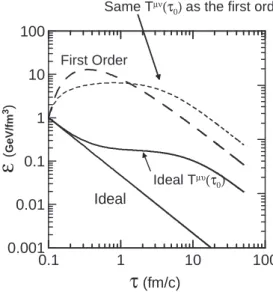
FIG. 2: The time evolution of energy density with the different initial conditions from Fig. 1. The dashed and short dashed lines represent the result of the LL and our theory, respectively . For comparison, our result of Fig. 1 is shown, again (idealTµν(τ0)). The last line
from the top is the result of ideal hydrodynamics. In this case, the energy heat-up is observed even in our theory.
proper timeτ0=0.1 fm/c. The first two lines from the top represents the results of the LL. The next two lines shows the results of our theory. The last line is the result of ideal hydro-dynamics. For the solid lines, we calculated with the viscosity and relaxation time which depend on temperature. Initially, the effect of viscosity is small because of the memory effect and the behavior of our theory is similar to that of ideal hy-drodynamics. After a time larger than the relaxation time, the memory effect is not effective anymore and the behavior is similar to the result of the LL. As we have mentioned, the behavior of our theory is the same as the result obtained in Ref. [13] in this case. For the dashed lines, we calculated with the constant viscosity and relaxation time,η=η(ε0)and
τR=τR(ε0). In this case, the viscosity is constant so that the heat production stays longer and has a smaller slope as func-tion of time asymptotically.
Sometimes the emergence of the initial heat-up in the LL (the dashed curve in Fig. 1) is interpreted as an intrinsic prob-lem of the first order theory. However, such behavior can also appear even in the second order theory. In Fig. 2, we set
G. S. Denicol et al. 105
relative intensity of the viscous terms compared to the pres-sure, the external work converted to the local heat production can overcome the temperature decrease due to the expansion.
V. SUMMARY AND CONCLUDING REMARKS
In this report, we presented a new formalism for the rela-tivistic dissipative hydrodynamics consistent with causality. We start from the physical analysis of the irreversible cur-rents according to the Landau-Lifshitz theory. Then, the irre-versible currents are given by integral expressions which take into account the relaxation time. In this way, causality is re-covered and at the same time a simple physical structure of the LL is preserved. In our approach, only one additional pa-rameter was introduced, the relaxation time,τR. The resulting equation of motion then becomes hyperbolic and causality can be restored [5]. Naturally, causality depends on the choice of the values of the parameters including the relaxation time.
More specifically, we verified that the linearized equation of motion for small perturbations in the homogeneous, sta-tic background coincides with Hiscock-Lindblom [14–16]
ex-cept for the coupling among the different irreversible currents. These couplings are not included in our theory considering the Curie principle. Of course the Curie principle is believed to be valid in the regime of the first order theory and in the sec-ond order regime these couplings might be present. However, the existence of the Curie principle may imply that these cou-plings are small compared with the direct terms.
We have applied our theory to the case of the one-dimensional scaling solution of Bjorken and obtained the analogous behavior of previous analysis. In this case we can prove explicitly the positiveness of entropy production. We showed the time evolution of the temperature. As expected, our theory gives the same result of Ref. [13], because the no-acceleration condition used in Ref. [13] is automatically satisfied in this model. Note that our theory is applicable to more general case where the acceleration is important.
Our theory is particularly adequate to be applied to a hydro-code such as SPheRIO which is based on the Lagrangian co-ordinate system [17, 18]. Implementation of the present the-ory to the full three-dimensional hydrodynamics is now in progress.
[1] T. Kodama, T. Koide, G. S. Denicol, and Ph. Mota, hep-ph/0606161.
[2] D. Teaney, Phys. Rev. C68, 034913 (2003). [3] C. Eckart, Phys. Rev.58, 919 (1940).
[4] L. D. Landau and E. M. Lifshitz,Fluid Mechanics(Pergamon, New York, 1959).
[5] I. M¨uller, Living Rev. Rel.2, 1 (1999).
[6] D. Jou, J. Casas-V´azquez, and G. Lebon, Rep. Prog. Phys.51, 1105 (1988); Rep. Prog. Phys.62, 1035 (1999),
[7] M. A. Aziz and S. Gavin, Phys. Rev. C70, 034905 (2004). [8] T. Koide, G. Krein, and R. O. Ramos, Phys. Lett. B636, 96
(2006).
[9] Such a memory function was also used in the hydrodynamic equations to take into account the time delay necessary to ther-malize the micro turbulences in a large scale system such as supernova explosion. See T.Kodama, R. Donangelo and M. Guidry, Int. J. Mod. Phys. C9, 745 (1998).
[10] P. M. Morse and H. Feshbach, Methods of Theoretical Physics, (McGraw Hill, New York, 1953), p865.
[11] T. Koide, G. S. Denicol, Ph. Mota, and T. Kodama, hep-ph/0909117.
[12] A. Muronga, Phys. Rev. C69, 034903 (2004).
[13] R. Baier, P. Romatschke, and U. A. Wiedemann, Phys. Rev. C 73, 064903 (2006).
[14] W. A. Hiscock and L. Lindblom, Ann. Phys. (N.Y.)151, 466 (1983).
[15] W. A. Hiscock and L. Lindblom, Phys. Rev. D31, 725 (1985). [16] W. A. Hiscock and L. Lindblom, Phys. Rev. D35, 3723 (1987). [17] C. E. Aguiar, T. Kodama, T. Osada, and Y. Hama, J. Phys. G
27, 75 (2001).