Printed in Brazil - ©2005 Sociedade Brasileira de Química 0103 - 5053 $6.00+0.00
S
ho
rt
R
e
p
o
rt
* e-mail: [email protected]
Regiospecific Synthesis of 1,2-Bis(azolyl)ethanes
Marcos A. P. Martins a , Wilson Cunico a , Geonir M. Siqueira b , Victor L. Leidens a , Nilo Zanatta a , Helio G. Bonacorsoa and Alex F. C. Flores*,a
a
Departamento de Quimica, Universidade Federal de Santa Maria, 97105-900 Santa Maria - RS, Brazil
b
Departamento de Química Orgânica, Universidade Federal de Pelotas, 96040-160 Pelotas - RS, Brazil
Este trabalho mostra a síntese de 1,2-bis-(5’-trialometilisoxazol-3’-il)etanos (3-6) e 1,2-bis(5’-trialometilpirazol-3’-il)etanos (7-10) a partir da ciclocondensação de 1,1,1,10,10,10-hexahalo-4,7-dimetoxideca-3,7-dien-2,9-dionas (1 e 2) com hidroxilamina e hidrazinas. Também é mostrada a síntese dos 1,2-bis(5’-alcoxicarbonilpirazol-3’-il)etanos (11-14) via reação da dienona 2, triclorometil-substituída, e hidrazina.
The synthesis of 1,2-bis(5’-trihalomethylisoxazol-3’-yl)ethanes (3-6) and 1,2-bis(5’-trihalomethylpyrazol-3’-yl)ethanes (7-10) from the cyclocondensation of 1,1,1,10,10,10-hexahalo-4,7-dimethoxydeca-3,7-dien-2,9-diones (1 and 2) with hydroxylamine and hydrazines is reported. In addition, the one-pot synthesis of 1,2-bis(5’-alkoxycarbonylpyrazol-3’-yl)ethanes (11-14) by reaction of chloro-substituted dienone 2 and hydrazines is also described.
Keywords: bis(azolyl)ethanes, pyrazoles, isoxazoles, enones
Introduction
Most organic compounds belong to the heterocyclic class and a great number of heterocycles have been of significant help for the human beings. Isoxazoles and pyrazoles belong to this class of compounds and are known to be important intermediates for the preparation of agrochemicals and pharmaceutical compounds.1,2 The
1,2-bis(azolyl)ethanes consist of two N-donor units linked by a flexible spacer. These compounds show desirable characteristics to be used as ligands of metals because they can either bridge two different metal ions, or act as bidentate chelants of single metal ions.3
We developed a general procedure for preparing 1,1,1-trihalo-4-alkoxy-3-alken-2-ones (β-haloacetylated enol ethers) using halogenated acylating groups CX3CO.4-7 These
compounds are of general interest as precursors for a variety of halomethyl-substituted heterocyclic compounds, e.g. isoxazoles,8,9 pyrazoles,10-12 pyrimidines13,14 and diazepines.15
Results and Discussion
In the course of our investigations on heterocyclic chemistry, we focused on the synthesis of trihalomethyl
azoles by cyclocondensation reaction of
1,1,1,10,10,10-hexahalo-4,7-dimethoxydeca-3,7-dien-2,9-diones(1 and
2), a (2 × CCC) block, with (NO) hydroxylamine and (NN) hydrazine blocks. Compounds 1 and 2 were previously synthesised from the reaction of hexen-2,5-dione dimethyl acetal with trichloroacetyl chloride or trifluoroacetic anhydride in pyridine using chloroform as solvent.5
The cyclization of 1 and 2 with two equivalent of hydroxylamine hydrochloride was carried out in pyridine and ethanol. The mixture was refluxed for 16 hours and gave regiospecifically the
1,2-bis(5’-trihalomethyl-5’-hydroxy-4’,5’-dihydroisoxazol-3’-yl) ethanes 3 and 4
(Scheme 1, Table 1). The mild reaction condition used for
the synthesis of 1,2-bis(isoxazolyl)ethanes 3-6 was
appropriate to preserve the trichloromethyl group on the heterocycle and to define the regiochemistry of the
cyclocondensation.16,17 The structure of
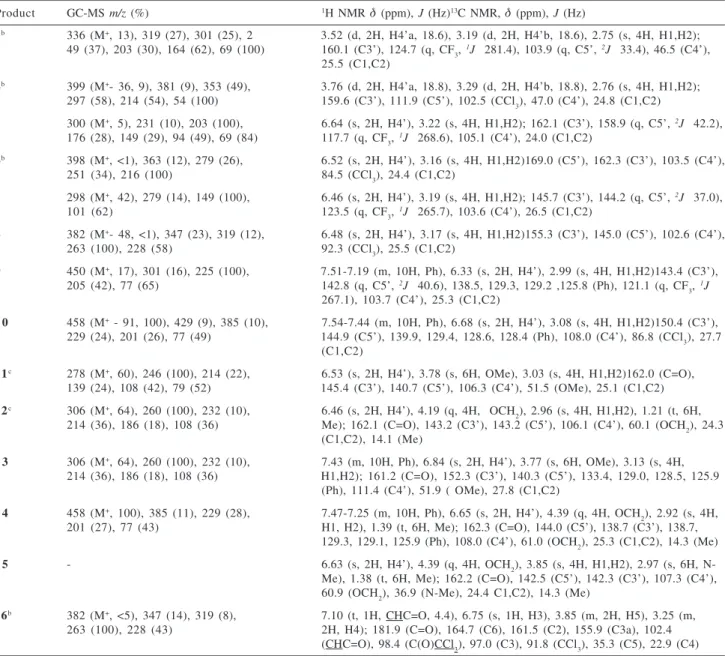
4,5-dihydro-isoxazole was evidenced by the presence of two doublets in the 1H NMR spectrum in the range of δ 3.10 to 3.70
assigned to H4’a e H4’b. The observation of a peak around
δ 47.0 in the 13C NMR spectrum from methylene C4’,
further confirmed the structure of 4,5-dihydroisoxazoles 3
and 4 (Table 3). Compounds 3 and 4 were dehydrated with concentrated sulphuric acid at 45 oC for 3 hours to afford
The cyclization of 1 and 2 with hydrazine hydrate or phenyl hydrazine, in a molar ratio of 1:2, in chloroform at 0 oC for 4 hours, furnished regiospecifically, the aromatic
5-trihalomethylpirazoles 7-10 (Scheme 1, Table 1). The products, as oils, were crystallized from a mixture of hexane/ethyl acetate (5:1). The expected 4,5-dihydropyrazole intermediates were not isolated.
On the other hand, the reaction of 2 with two
equivalents of hydrazines in a mixture of pyridine and methanol (or ethanol) under reflux for 24 hours led to 5-alkoxycarbonyl pyrazoles 11-14 (Scheme 2, Table 2). This reaction condition promoted the cyclocondensation and the hydrolysis of the trichloromethyl group.18,19 In addition,
the treatment of 5-trichloromethylpyrazoles 8 and 10 in pyridine with an appropriate alcohol under reflux, also led to the carboxypyrazoles 11-14, in good yields (Scheme 2, Table 2).
The structure of pyrazoles 7 - 15 was assigned by their NMR spectra. The 1H NMR spectrum of aromatic pyrazoles
displays the signal for methylene-3’ at δ 3.19 - 3.85, for the aromatic H-4’ at δ 6.33 – 6.85 and for 15 the N-Me appeared at δ 2.97. In the 13C NMR spectra of 7-15 the
signal from C-3’ appeared at δ 138.7 - 155.3 and signal from C-5’ at δ 140.3 – 145.0. For the pyrazole 15 they were assigned with two-dimensional correlation spectra HMBC (Heteronuclear Multiple Bond Correlation) by observing a cross peak between the C-5’ (142.5 ppm) and the N-methyl hydrogen signal at 3.85 ppm that confirms the 5-ethoxycarbonylpyrazole isomers. The signals for C-4’ of the pyrazole ring for compounds 7-15 appeared around δ 102.6 – 111 (Table 3).
The addition of precursor 2 to one equivalent of
hydrazine hydrate in acetonitrile at room temperature for 4 hours, furnished the trichloromethylated
tetrahydro-Table 1. Reaction conditions,a yields and melting points of alkoxycarbonyl pyrazoles 3-10
Precursor X R Products Found/calculated m.p. (oC)b Yields (%)c
C H N
1 F - dihydroisoxazole 35.7/35.73 3.00/3.00 8.3/8.33 165-167 7 5
3
2 Cl - dihydroisoxazole 27.5/27.62 2.40/2.32 6.5/6.44 201-203 7 9
4
3 F - isoxazole 40.0/40.02 2.10/2.01 9.33/9.30 Oil 9 4
5
4 Cl - isoxazole 30.0/30.11 1.50/1.52 7.10/7.02 156-158 9 4
6
1 F H pyrazole 40.2/40.28 2.70/2.70 18.8/18.79 222-225 6 9
7
2 Cl H pyrazole 30.3/30.26 2.00/2.03 14.1/14.12 160-162 7 3
8
1 F Ph pyrazole 48.3/48.12 3.00/2.94 10.20/10.20 188-190 7 4
9
2 Cl Ph pyrazole 58.7/58.67 3.60/6.58 12.40/12.44 184-186 7 7
1 0
a See experimental part; b The melting points are uncorrected; c Yields of isolated compounds.
pyrrolo [1,5-b]pyrazole 16 (Scheme 3). The product was
characterized by 1H, 13C NMR and 2D HMQC and HMBC
spectroscopy data (Table 3). The presence of two CCl3
groups with different chemical shift and the absence of methoxy group agree with the structure. To our knowledge there are no reports in the literature of this condensed heterocyclic compound. The formation of this condensed product was not observed when precursor 1 was used under the same conditions.
Conclusion
In conclusion, compounds 1 and 2 demonstrated high versatility as building blocks for the synthesis of many types of heterocycles that could provide potential biological activity. In addition, the use of
1,2-bis(5’-trihalo-methylpyrazol-3’-yl)ethane (7 and 9) as ligands in
coordination chemistry, is under investigation.20 Also, a new
type of condensed heterocycle (16) has been synthesized.
Experimental
Unless otherwise indicated, all common reagents and solvents were used as obtained from commercial suppliers without further purification. Yields listed in Table 1 and 2 are for isolated compounds. 1H, 13C NMR spectra were
recorded on a Bruker DPX 400 spectrometer (1H at 400.13
MHz and 13C at 100.63 MHz) at 298 K, digital resolution
of ±0.01 ppm, 0.5 mol L-1 in CDCl
3, Acetone-d6 or
DMSO-d6 containing TMS as in internal standard. All spectra were acquired in a 5 mm tube, at natural abundance. Mass spectra were registered in a HP 5973 MSD spectrometer connected to a HP 6890 GC and interfaced by a Pentium PC. The GC was equipped with a split-splitless, injector, auto sampler, cross-linked HP-5 capillary column (30 m, 0.32 mm of internal diameter), and helium was used as the carrier gas.
1,2-Bis(5’-trihalomethyl-4’,5’-dihydroisoxazol-3’-yl) ethanes (3,4)
To a solution of
1,1,1,10,10,10-hexahalo-4,7-Table 2. Reaction conditions,a yields and melting point of pyrazole compounds 11-15
Precursor X R R1 Products Found/calculated m.p. (oC)b Yields (%)c
C H N
2 / 8 Cl H Me 1 1 58.50/58.53 5.80/5.73 22.90/22.75 185-187 74 / 77
2 / 8 Cl H Et 1 2 61.30/61.30 6.60/6.61 20.40/20.42 186-188 79 / 82
2 / 10 Cl Ph Me 1 3 72.50/72.34 5.65/5.57 14.10/14.06 128-130 82 / 86
2 / 10 Cl Ph Et 1 4 73.20/73.22 6.15/6.14 13.20/13.14 140-142 86 / 73
2 Cl Me Et 1 5 61.70/61.30 6.80/6.61 20.40/20.42 - 7 5
a See experimental part; b The melting points are uncorrected; c Yields of isolated compounds.
Scheme 2. Synthesis of the 1,2-bis(5’-alkoxycarbonylpyrazol-3’-yl)ethanes.
dimethoxydeca-3,7-dien-2,9-dione (1 or 2) (2 mmol) in pyridine (4.2 mmol) was added hydroxylamine hydrochloride (4.2 mmol) in ethanol (15 mL). The mixture was stirred for 16 hours at 78 °C. The solvent was removed under reduced pressure and the residue was extracted with ethyl acetate and recrystallized from a mixture of hexane/ ethyl acetate (5:1).
1,2-Bis(5’-trihalomethylisoxazol-3’-yl) ethanes (5,6)
A mixture of 1,2-bis(5’-trihalomethyl-4’,5’-dihydro isoxazol-3’-yl)ethane (3 or 4) (1 mmol) in 97% sulphuric acid (8 mL) was stirred at 40 °C for 4 hours. The mixture
Table 3. Spectral dataa of compounds 3-16
Product GC-MS m/z (%) 1H NMR δ (ppm), J (Hz)13C NMR, δ (ppm), J (Hz)
3b 336 (M+, 13), 319 (27), 301 (25), 2 3.52 (d, 2H, H4’a, 18.6), 3.19 (d, 2H, H4’b, 18.6), 2.75 (s, 4H, H1,H2);
49 (37), 203 (30), 164 (62), 69 (100) 160.1 (C3’), 124.7 (q, CF3, 1J 281.4), 103.9 (q, C5’, 2J 33.4), 46.5 (C4’), 25.5 (C1,C2)
4b 399 (M+- 36, 9), 381 (9), 353 (49), 3.76 (d, 2H, H4’a, 18.8), 3.29 (d, 2H, H4’b, 18.8), 2.76 (s, 4H, H1,H2);
297 (58), 214 (54), 54 (100) 159.6 (C3’), 111.9 (C5’), 102.5 (CCl3), 47.0 (C4’), 24.8 (C1,C2)
5 300 (M+, 5), 231 (10), 203 (100), 6.64 (s, 2H, H4’), 3.22 (s, 4H, H1,H2); 162.1 (C3’), 158.9 (q, C5’, 2J 42.2), 176 (28), 149 (29), 94 (49), 69 (84) 117.7 (q, CF3, 1J 268.6), 105.1 (C4’), 24.0 (C1,C2)
6b 398 (M+, <1), 363 (12), 279 (26), 6.52 (s, 2H, H4’), 3.16 (s, 4H, H1,H2)169.0 (C5’), 162.3 (C3’), 103.5 (C4’),
251 (34), 216 (100) 84.5 (CCl3), 24.4 (C1,C2)
7 298 (M+, 42), 279 (14), 149 (100), 6.46 (s, 2H, H4’), 3.19 (s, 4H, H1,H2); 145.7 (C3’), 144.2 (q, C5’, 2J 37.0), 101 (62) 123.5 (q, CF3, 1J 265.7), 103.6 (C4’), 26.5 (C1,C2)
8 382 (M+- 48, <1), 347 (23), 319 (12), 6.48 (s, 2H, H4’), 3.17 (s, 4H, H1,H2)155.3 (C3’), 145.0 (C5’), 102.6 (C4’),
263 (100), 228 (58) 92.3 (CCl3), 25.5 (C1,C2)
9 450 (M+, 17), 301 (16), 225 (100), 7.51-7.19 (m, 10H, Ph), 6.33 (s, 2H, H4’), 2.99 (s, 4H, H1,H2)143.4 (C3’),
205 (42), 77 (65) 142.8 (q, C5’, 2J 40.6), 138.5, 129.3, 129.2 ,125.8 (Ph), 121.1 (q, CF 3,
1J 267.1), 103.7 (C4’), 25.3 (C1,C2)
1 0 458 (M+ - 91, 100), 429 (9), 385 (10), 7.54-7.44 (m, 10H, Ph), 6.68 (s, 2H, H4’), 3.08 (s, 4H, H1,H2)150.4 (C3’),
229 (24), 201 (26), 77 (49) 144.9 (C5’), 139.9, 129.4, 128.6, 128.4 (Ph), 108.0 (C4’), 86.8 (CCl3), 27.7 (C1,C2)
11c 278 (M+, 60), 246 (100), 214 (22), 6.53 (s, 2H, H4’), 3.78 (s, 6H, OMe), 3.03 (s, 4H, H1,H2)162.0 (C=O),
139 (24), 108 (42), 79 (52) 145.4 (C3’), 140.7 (C5’), 106.3 (C4’), 51.5 (OMe), 25.1 (C1,C2)
12c 306 (M+, 64), 260 (100), 232 (10), 6.46 (s, 2H, H4’), 4.19 (q, 4H, OCH
2), 2.96 (s, 4H, H1,H2), 1.21 (t, 6H,
214 (36), 186 (18), 108 (36) Me); 162.1 (C=O), 143.2 (C3’), 143.2 (C5’), 106.1 (C4’), 60.1 (OCH2), 24.3 (C1,C2), 14.1 (Me)
1 3 306 (M+, 64), 260 (100), 232 (10), 7.43 (m, 10H, Ph), 6.84 (s, 2H, H4’), 3.77 (s, 6H, OMe), 3.13 (s, 4H,
214 (36), 186 (18), 108 (36) H1,H2); 161.2 (C=O), 152.3 (C3’), 140.3 (C5’), 133.4, 129.0, 128.5, 125.9 (Ph), 111.4 (C4’), 51.9 ( OMe), 27.8 (C1,C2)
1 4 458 (M+, 100), 385 (11), 229 (28), 7.47-7.25 (m, 10H, Ph), 6.65 (s, 2H, H4’), 4.39 (q, 4H, OCH
2), 2.92 (s, 4H,
201 (27), 77 (43) H1, H2), 1.39 (t, 6H, Me); 162.3 (C=O), 144.0 (C5’), 138.7 (C3’), 138.7, 129.3, 129.1, 125.9 (Ph), 108.0 (C4’), 61.0 (OCH2), 25.3 (C1,C2), 14.3 (Me)
1 5 - 6.63 (s, 2H, H4’), 4.39 (q, 4H, OCH2), 3.85 (s, 4H, H1,H2), 2.97 (s, 6H,
N-Me), 1.38 (t, 6H, Me); 162.2 (C=O), 142.5 (C5’), 142.3 (C3’), 107.3 (C4’), 60.9 (OCH2), 36.9 (N-Me), 24.4 C1,C2), 14.3 (Me)
16b 382 (M+, <5), 347 (14), 319 (8), 7.10 (t, 1H, CHC=O, 4.4), 6.75 (s, 1H, H3), 3.85 (m, 2H, H5), 3.25 (m,
263 (100), 228 (43) 2H, H4); 181.9 (C=O), 164.7 (C6), 161.5 (C2), 155.9 (C3a), 102.4 (CHC=O), 98.4 (C(O)CCl3), 97.0 (C3), 91.8 (CCl3), 35.3 (C5), 22.9 (C4)
a NMR spectra were recorded on a Bruker DPX 400 in CDCl 3/TMS;
b aceton-d 6;
c DMSO-d.
was poured slowly on 25 mL of ice-water and the solution was extracted with ethyl acetate (3 × 10 mL). The solvent was removed under reduced pressure and the product was obtained in high purity.
1,2-Bis(5’-trihalomethylpyrazol-3’-yl) ethanes (7-10)
hours at room temperature. The solution was washed with 0.1 mol L-1 HCl (3 × 15 mL) and extracted with ethyl acetate
(3×10 mL). The solvent was removed under reduced pressure and the product was recrystallized from a mixture of hexane/ethyl acetate (5:1).
1,2-Bis(5’-alkoxycarbonylpyrazol-3’-yl) ethanes (11-15)
To a stirred solution 1,1,1,10,10,10-hexachoro-4,7-dimethoxydeca-3,7-dien-2,9-dione (2) (2 mmol) in pyridine (4.2 mmol) was added the appropriate hydrazine hydrochloride (4.2 mmol) in methanol (or ethanol) (15 mL) at room temperature. The mixture was stirred under reflux for 16 hours. The solution was washed with 0.1 mol L-1 HCl (3 ×
15 mL) and extract with ethyl acetate (3 × 10 mL). After removal of the solvent under reduced pressure, the product was recrystallized from a mixture of hexane/ethyl acetate (5:1).
Tetrahydropyrrolo[1,5-b] pyrazole (16)
Hydrazine hydrate (2.1 mmol) was added drop wise at room temperature to a stirred solution of 1,1,1,10,10,10-hexachloro-4,7-dimethoxydeca-3,7-dien-2,9-dione(2) (2 mmol) in acetonitrile (20 mL). The mixture was stirred for 4 hours at room temperature. The solution was washed with 0.1 mol L-1 HCl (3 × 15 mL) and extracted with ethyl
acetate (3 × 10 mL). The solvent was removed under reduced pressure and the product was recrystallized from hexane furnishing a gray solid. Yield 65%, m.p. 136-138 °C.
Acknowledgments
The authors thank the Conselho Nacional de Desenvolvimento Científico e Tecnológico (CNPq), PADCT-III/CNPq 62.0228/97-0-QEQ, and Fundação de Apoio a Pesquisa do Estado do Rio Grande do Sul (FAPERGS) for financial support. Fellowship from CAPES (W.C.) is also acknowledged.
References
1. Kromann, H.; Slok, F. A.; Johansen, T. N.; Krogsgaard-Larsen,
P.; Tetrahedron 2001, 57, 2195; Hjeds, H.; Christensen, I. T.;
Cornett, C.; Frolund, B.; Falch, E.; Pedersen, J. B.; Krogsgaard-Larsen, P.; Acta Chem. Scand. 1992, 46, 772; Bang-Andersen, B.; Lenz, S. M.; Skjaerbaek, N.; Soby, K. K.; Hansen, H. O.; Ebert, B.; Bogeso, K. P.; Krogsgaard-Larsen, P.; J. Med. Chem.
1997, 40, 2831; Bräuner-Osborne, H.; Nielsen, B.; Krogsgaard-Larsen, P.; Eur. J. Pharmacol.1998, 350, 311; Zimmermann, D.; Janin, Y. L.; Brehm, L.; Bräuner-Osborne, H.; Ebert, B.;
Johansen, T. N.; Madsen, U.; Krogsgaard-Larsen, P.; Eur. J.
Med.Chem. 2000, 35, 69; Bräuner-Osborne, H.; Egebjerg, J.;
Nielsen, E. O.; Madsen, U.; Krogsgaard-Larsen, P.; J. Med.
Chem. 2000, 43, 2609.
2. Mello, C. F.; Souza, F. R.; Souza, V. T.; Reatzlaff, V.; Borges, L. P.; Oliveira, M. R.; Bonacorso, H. G.; Zanatta, N.; Martins, M. A. P.; Eur. J. Pharmacol.2002, 451, 141
3. Driessen, W. L.; Schuitema, A. M.; Engelen, M.; Koval, I. A.; Gorter, S.; Reedijk, J.; Inorg. Chim. Acta2001, 324, 57. 4. Martins, M. A. P.; Colla, A.; Clar, G. ; Krimmer, S.; Fischer, P.;
Synthesis 1991, 483.
5. Martins, M. A. P.; Bastos, G. P.; Bonacorso, H. G.; Zanatta, N.; Flores, A. F. C.; Siqueira, G.M.; Tetrahedron Lett. 1999, 40, 4309.
6. Bonacorso, H. G.; Martins, M. A. P.; Bittencourt, S. R.T.; Lourega, R. V.; Zanatta, N. ; Flores, A. F. C.; J. Fluorine Chem.
1999, 99, 177.
7. Flores, A. F. C.; Brondani, S.; Zanatta, N.; Rosa, A.; Martins, M. A. P.; Tetrahedron Lett.2002, 43, 8701.
8. Martins, M. A. P.; Beck, P.; Cunico, W.; Pereira, C. M. P.; Sinhorin, A. P.; Blanco, R. F.; Peres, R.; Bonacorso, H. G.; Zanatta, N.; Tetrahedron Lett. 2002, 43, 7005.
9. Martins, M. A. P.; Sinhorin, A. P.; Zimmermann, N. E. K.; Zanatta, N.; Bonacorso, H. G.; Bastos, G. P.; Synthesis 2002, 1959.
10. Flores, A. F. C.; Martins, M. A. P.; Rosa, A.; Flores, D. C.; Zanatta, N.; Bonacorso, H. G.; Synth. Commun. 2002, 32, 1585.
11. Flores, A. F. C.; Zanatta, N.; Rosa, A.; Brondani, S.; Martins, M. A. P.; Tetrahedron Lett.2002, 43, 5005.
12. Martins, M. A. P.; Pereira, C. M. P.; Sinhorin, A. P.; Bastos, G. P.; Zimmermann, N. E. K.; Rosa, A.; Bonacorso, H. G.; Zanatta,
N.; Synth. Comm. 2002, 32, 419.
13. Zanatta, N.; Lopes, E. C. S.; Fantinel, L.; Bonacorso, H. G.; Martins, M. A. P.; J. Heterocyclic Chem. 2002, 39, 943. 14. Bonacorso, H. G.; Lopes, I. S.; Wastowski, A. D.; Zanatta, N.;
Martins, M. A. P.; J. Fluorine Chem. 2003, 120, 29. 15. Bonacorso, H. G.; Bittencourt, S. R. T.; Wastowski, A. D.;
Wentz, A. P.; Zanatta, N. Martins, M. A. P.; J. Heterocyclic
Chem. 1999, 36, 45.
16. Spiegler, W.; Götz, N.; Synthesis1986, 69.
17. Martins, M. A. P.; Flores, A. F. C.; Bastos, G. P.; Sinhorin, A. P.; Bonacorso, H. G.; Zanatta N.; Tetrahedron Lett. 2000, 41, 293.
18. Martins, M. A. P.; Freitag, R.; Flores, A. F. C.; Zanatta, N.;
Synthesis1995, 1491.
19. Martins, M. A. P.; Freitag, R.; Rosa, A.; Flores, A. F. C.; Zanatta, N.; Bonacorso, H. G.; J. Heterocyclic Chem.1999, 36, 217. 20. Martins, M. A. P.; Höerner, M., unpublished results.