Printed in Brazil - ©2006 Sociedade Brasileira de Química 0103 - 5053 $6.00+0.00
A
r
ti
c
le
*e-mail: [email protected]
Oxidation of Tertiary Homoallylic Alcohols by Thallium Trinitrate: Fragmentation
vs
. Ring Contraction
Luiz F. Silva Jr.,*,a Samir A. P. Quintiliano,a Helena M. C. Ferraz,a Leonardo S. Santosb and Marcos N. Eberlinb
a
Instituto de Química, Universidade de São Paulo, CP 26077, 05513-970 São Paulo-SP, Brazil
b
Instituto de Química, Universidade Estadual de Campinas, 13083-970 Campinas-SP, Brazil
A oxidação de álcoois homoalílicos terciários com trinitrato de tálio (TTN) foi investigada. Os álcoois que possuem uma metila na posição alílica perdem uma molécula de acetona via uma reação de fragmentação, levando a uma mistura de álcoois alílicos isoméricos como principais produtos, juntamente com os correspondentes derivados acetilados. Por outro lado, o tratamento com TTN de álcoois terciários análogos, sem a metila na posição alílica, fornece indanos, através de uma reação de contração de anel.
The oxidation of tertiary homoallylic alcohols with thallium trinitrate (TTN) was investigated. The alcohols bearing an allylic methyl group lose a molecule of acetone via a fragmentation reaction that leads to isomeric secondary allylic alcohols as major products, together with their corresponding acetylated derivatives. On the other hand, treating analogous tertiary alcohols without the allylic methyl group with TTN gives indans, through a ring contraction reaction.
Keywords: thallium trinitrate, ring contraction, homoallylic alcohols, fragmentation reaction, indan
Introduction
The reaction of primary homoallylic alcohols with thallium(III) salts has been carefully investigated by several groups, and these studies revealed four main different reaction pathways governed mainly by the structure of the substrate.1 The formation of cyclic ethers through an
electrophilic cyclization has been the most explored reaction (Scheme 1, Reaction A).2-7 With homoallylic alcohols
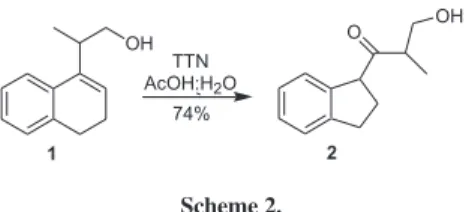
bearing an endocyclic double bond, oxidative rearrangement may lead to a ring contraction product (Scheme 1, Reaction B),6-9 as exemplified by the preparation of the indan 2 from
the alkenol 1 using thallium trinitrate (TTN) (Scheme 2).9
We observed that in these rearrangements the hydroxyl group has an active role, facilitating the addition of the thallium(III) to the double bond. The third type of reaction reported between thallium(III) and 3-alkenols proceeds via
fragmentation, in which a molecule of formaldehyde is lost (Scheme 1, Reaction C).10,11 This reaction was discovered
by Kocovský and Baines in the early 90’s, resulting in an efficient approach to obtain the hormones estrone and
estradiol.12,13 Finally, homoallylic alcohols can afford a
diastereomeric mixture of products of addition of the solvent when treated with thallium(III) in the presence of methanol (Scheme 1, Reaction D).7,9
Although the reactivity of several primary homoallylic alcohols has been investigated, the behavior of the corresponding tertiary alcohols has not been studied. Thus, we decided to investigate the reactivity of a series of tertiary homoallylic alcohols analogous to 1, with
thallium(III). However, as described herein, the oxidation of these substrates with TTN can give either fragmentation or ring contraction products depending on the structure of the substrate.
Results and Discussion
The required tertiary homoallylic alcohols 4a-g were prepared in good yields from the reaction of the esters 3a-g9 with excess of methyllithium (Table 1).14
Treatment of the tertiary homoallylic alcohols 4a-b with TTN, under conditions similar to those used in the ring contraction of 1, failed to form the expected indans. Instead, the isomeric primary allylic alcohols 5a-b and 6a-b were obtained, together with minor amounts of their acetylated derivatives 7a-b and 8a-b. Presumably, a molecule of acetone is lost in these fragmentations (Table 2, entries 1 and 2).
The different reactivity of 4a-b when compared to 1 can be explained considering the mechanism for the thallium(III) mediated ring contraction of homoallylic alcohols. In the rearrangement of 1, the coordination of the thallium(III) with the hydroxyl group leads to the formation of a heterocyclic six-membered ring intermediate. However, we believe that the formation of an analogous intermediate (10) from the substrates 4a-b would be sterically hindered, due to the presence of three methyl groups too close to each other, on which two of them would be in an axial position, as exemplified for 4a in Scheme 3.
The behavior of 4c in the oxidation with TTN is slightly different from 4a-b, because the indan 9c was isolated in addition to the fragmentation products (Table 2, entry 3). The formation of 9c can be rationalized as a result of the thallium(III) mediated oxidative rearrangement of the fragmentation product 5c, which bears a methoxyl group at the para position of the migrating carbon 8a, increasing its migratory aptitude and, thus, facilitating the ring contraction (Scheme 4).17,18 In the analogous allylic alcohols 5a-b this
mesomeric effect can not operate. To corroborate this proposition, the reaction of 4c was performed using enough TTN to consume all 5c formed. Indeed, under such a condition, the indan 9c was obtained in 42% yield (Table 2, entry 4).
Table 1. Preparation of the tertiary alcohols 4a-ga
Entry Substrate Product (Yield)15
1
2
3
4
5
6
7
a Reaction conditions: 6 equiv. of MeLi, THF, - 78 °C, 2 h.
Scheme 4. Scheme 3.
Three possible mechanisms can be invoked for explaining the fragmentation reaction of the alcohols 4a-c. First, the mechanism previously proposed by Kocovský and Baines13 for the thallium(III) promoted fragmentation
reactions was applied for the homoallylic alcohol 4a (Scheme 5, path A). The first step is an anti-Markovnikov electrophilic addition of the thallium(III), forming the cyclic ether 11. This step also represents a 5-endo-trig
ring closure, which is usually not favored. Reorganization of the bonds would lead to the loss of acetone, affording the allylic carbocation 12, which after solvolysis gives the final products 5a-8a. Considering that the course of several thallium(III) mediated cyclization reactions had been well explained by an initial 4-exo-trig cyclization, which proceeded by a Markovnikov addition of thallium(III),4 we set out to expand this feature in the
Kocovský mechanism through a new sequence of events (Scheme 5, path B). As the thallium(III) is isoeletronic to Pb(IV) and based on the recent work of Preite and Cuellar,19 the thallium(III) π-allylic complex 16 was
postulated as the key intermediate in the third hypothesis (Scheme 5, path C).
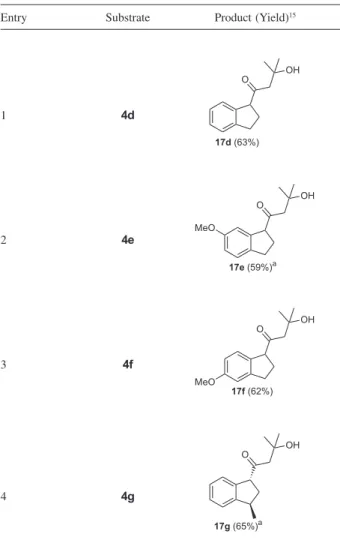
Instead of the fragmentation products observed in the oxidation of the alcohols 4a-c, the substrates 4d-g gave the ring contraction products 17d-g when treated with TTN (Table 3). Furthermore, these ring contraction products 17d-g were obtained in higher yields using 1.5 equiv. (59-65%) than using 1.1 equiv. of TTN (37-60%). This can be explained by the fact that the ring contraction is faster when the amount of the oxidizer is increased. Thus, the formation of byproducts is reduced, giving higher isolated yields for 17d-g. In entries 2 and 4, the starting material was not totally consumed, even with 1.5 equiv. of TTN. Thus, the alcohol 4g was treated with 1.7 equivalents of TTN expecting that the yield could be further increased. However, albeit no starting material was recovered, the yield was lower (59%) than that with 1.5 equivalents (65%). We consider that the additional excess of TTN oxidizes the ketone moiety of the indan 17g. The indan 17g was obtained exclusively in the trans configuration, which agrees with a similar result previously described.9
In summary, the reaction with TTN of the tertiary homoallylic alcohols 4a-c, which bear an allylic methyl group, fails to form the expected ring contraction products.
Table 2. Oxidation of 4a-c with 1.1 equiv. of TTN (entries 1-3) or with 1.7 equiv. of TTN (entry 4)a,b
Entry Substrate Products (Yield, Ratio)
1 4a
2 4b
3 4c
4 4c
Instead, the observed products are those originated from a fragmentation reaction. On the other hand, treating analogous tertiary alcohols without the allylic methyl group (4d-g) with TTN gives the corresponding indans (17d-g), in good yield, through a ring contraction reaction.
Experimental
General
THF was freshly distilled from sodium/benzophenone. Other reagents were used as received. Column chromato-graphy was performed using silica gel Acros 200-400 Mesh. TLC analyses were performed with silica gel plates Merck, using p-anisaldehyde solution for visualization.
1H and 13C NMR spectra were recorded on Bruker
spectrometers. IR spectra were measured on a Perkin-Elmer 1750-FT. Gas chromatography analyses were performed in a HP-6890 series II. High resolution mass spectra were performed on a VG Autospec/Fission Instrument and MicroTOF LC from Bruker Daltonics.
3-(1,2-Dihydronaphthalen-4-yl)-2-methylbutan-2-ol (4a). General procedure for the preparation of the 3-alkenols
4a-g
To a stirred solution of 3a9 (0.975 g, 4.24 mmol) in
anhydrous THF (10 mL), was added MeLi (17.0 mL of 1.6 mol L-1 solution in Et
2O, 25.4 mmol) at –78 °C.
The mixture was stirred at –78 ºC for 2 h, when water was carefully added dropwise at rt. The aqueous phase was extracted twice with AcOEt. The combined organic phase was washed with brine and dried over anhydrous MgSO4. The solvent was removed under reduced pressure. The residue was purified by flash chromato-graphy (gradient elution, 10-20% AcOEt in hexanes) giving impure 3-(1,2-dihydronaphthalen-4-yl)butan-2-one as byproduct (0.073 g) and 3-(1,2-dihydro-naphthalen-4-yl)-2-methylbutan-2-ol (4a) (0.436 g, 2.02 mmol, 48%); colorless oil; IR (film) ν
max/cm -1: 712,
942, 1453, 3444; 1H NMR (300 MHz, CDCl
3) δ 1.02
(s, 3H), 1.12 (s, 3H), 1.13 (d, J 7.2 Hz, 3H), 1.63 (br s, 1H), 2.16-2.37 (m, 2H), 2.70 (dd, J 6.3 and 9.3 Hz,
Table 3. Reaction of 4d-g with 1.5 equiv. of TTN in AcOH:H2O (2:1), rt
Entry Substrate Product (Yield)15
1 4d
2 4e
3 4f
4 4g
a4% of starting material were recovered on each case.
2H), 3.10 (q, J 7.5 Hz, 1H), 6.03 (dd, J 3.6 and 5.6 Hz, 1H), 7.09-7.40 (m, 3H), 7.42 (d, J 7.5 Hz, 1H); 13C
NMR (75 MHz, CDCl3) δ 15.7, 23.0, 27.4, 28.7, 28.8, 42.3, 72.7, 122.8, 125.6, 126.2, 126.5, 127.6, 136.2, 136.6, 139.8; LRMS (EI) m/z (rel. int.) 216 (M+, 2%),
158 (70), 129 (100). Anal. calc. for C15H20O: C, 83.28; H, 9.32. Found: C, 83.49; H, 9.24.
3-(1,2-Dihydro-6-methoxynaphthalen-4-yl)-2-methylbutan-2-ol (4b). The reaction was performed as described above, using 3b9 (1.03 g, 3.97 mmol), THF (10 mL) and MeLi
(18.0 mL, 28.8 mmol). The residue was purified by flash chromatography (gradient elution, 15-30% AcOEt in hexanes) giving impure 3-(1,2-dihydro-6-methoxy-naphthalen-4-yl)butan-2-one as byproduct (0.091 g) and 3-(1,2-dihydro-6-methoxynaphthalen-4-yl)-2-methylbutan-2-ol (4b) (0.745 g, 3.03 mmol, 76%); pale yellow oil; IR (film) ν
max/cm
-1: 944, 1163, 1246, 3457; 1H NMR (300 MHz,
CDCl3) δ 1.11 (s, 3H), 1.21 (s, 3H), 1.23 (d, J 6.6 Hz, 3H), 2.13-2.32 (m, 3H), 2.59-2.65 (m, 2H), 3.02 (q, J 7.2 Hz, 1H), 3.78 (s, 3H), 6.05 (dd, J 3.9 and 5.4 Hz, 1H), 6.67 (dd,
J 2.4 and 8.1 Hz, 1H), 7.00 (d, J 2.1 Hz, 1H), 7.05 (d, J 8.4 Hz, 1H); 13C NMR (75 MHz, CDCl
3) δ 15.7, 23.4, 27.5,
27.7, 28.8, 42.4, 55.2, 72.6, 110.0, 110.6, 126.2, 128.1, 128.7, 137.3, 139.6, 158.2; LRMS (EI) m/z (rel. int.) 246 (M+, 2%), 188 (91), 159 (100). Anal. calc. for C
16H22O2: C,
78.01; H, 9.00. Found: C, 78.00; H, 8.64.
3-(1,2-Dihydro-7-methoxynaphthalen-4-yl)-2-methylbutan-2-ol (4c). The reaction was performed as described above, using 3c9 (1.03 g, 3.97 mmol), THF (10 mL) and MeLi (15.0
mL, 24.0 mmol). The residue was purified by flash chromatography (gradient elution, 15-30% AcOEt in hexanes) giving impure 7-methoxy-naphthalen-4-yl)butan-2-one (0.060 g) and 3-(1,2-dihydro-7-methoxynaphthalen-4-yl)-2-methylbutan-2-ol (4c) (0.766 g, 3.11 mmol, 78%); pale yellow oil; IR (film) ν
max/cm -1:
943, 1201, 1250, 3455; 1H NMR (300 MHz, CDCl 3) δ 1.08
(s, 3H), 1.18 (s, 3H), 1.19 (d, J 6.2 Hz, 3H), 1.84 (br s, 1H), 2.14-2.30 (m, 2H), 2.64 (dd, J 6.3 and 9.3 Hz, 2H), 3.01 (q,
J 7.2 Hz, 1H), 3.76 (s, 3H), 5.85 (t, J 6.0 Hz, 1H), 6.66-6.71 (m, 2H), 7.31 (d, J 9.3 Hz, 1H); 13C NMR (75 MHz, CDCl
3)
δ 15.9, 23.2, 27.5, 29.1, 29.4, 42.6, 55.2, 72.8, 110.9, 113.9, 123.3, 124.3, 129.5, 138.5, 139.5, 158.3; LRMS (EI) m/z
(rel. int.) 246 (M+, 19%), 188 (90), 59 (100); HRMS [ESI
(-)] Calc. for [C16H22O2 – H]- 245.1542. Found: 245.1542.
1-(1,2-Dihydronaphthalen-4-yl)-2-methylpropan-2-ol (4d). The reaction was performed as described above, using 3d9 (2.52 g, 11.7 mmol), THF (25.0 mL) and MeLi
(43.8 mL, 70.0 mmol). The residue was purified by flash
chromatography (gradient elution, 15-30%, AcOEt in hexanes) giving impure 1-(1,2-dihydronaphthalen-4-yl)propan-2-one (0.0730 g) and the alcohol 4d (1.29 g, 8.17 mmol, 55%); white solid; mp 72.1-73.2 ºC; IR (KBr)
ν
max/cm
-1: 903, 1129, 1361, 3331; 1H NMR (300 MHz,
CDCl3) δ 1.20 (s, 6H), 1.61 (br s, 1H), 2.27 (ddd, J 4.6, 7.7 and 8.2 Hz 2H), 2.70 (s, 2H), 2.75 (dd, J 7.7 and 8.2 Hz, 2H), 5.95 (t, J 4.6 Hz, 1H), 7.12-7.21 (m, 3H), 7.36 (d, J 7.3 Hz, 1H); 13C NMR (75 MHz, CDCl
3) δ 23.3,
28.8, 29.9, 45.1, 70.7, 123.7, 126.3, 126.8, 127.7, 129.8, 133.6, 135.3, 136.6; LRMS (EI) m/z (rel. int.) 202 (M+,
10%), 144 (80), 129 (100); Anal. calc. for C14H18O: C, 83.12; H, 8.97. Found: C, 83.15; H, 8.57.
1-(1,2-dihydro-6-methoxynaphthalen-4-yl)-2-methyl-propan-2-ol (4e).The preparation was performed as described above, using 3e9 (0.832 g, 3.30 mmol), THF
(20 mL) and MeLi (12.4 mL, 20.0 mmol). The residue was purified by flash chromatography (gradient elution, 15-30% AcOEt in hexanes) giving impure 1-(1,2-dihydro-6-methoxynaphthalen-4-yl)propan-2-one (0.101 g) and the alcohol 4e (0.562 g, 2.42 mmol, 73%); pale yellow oil; IR (film) ν
max/cm
-1: 976, 1044, 1607, 3420; 1H NMR (300
MHz, CDCl3) δ 1.17 (s, 6H), 2.20 (ddd, J 4.5, 7.5 and 8.1 Hz, 2H), 2.20 (br s, 1H), 2.63 (s, 2H), 2.63 (dd, J 6.3 and 9.6 Hz, 2H), 3.79 (s, 3H), 5.97 (t, J 4.8 Hz, 1H), 6.68 (dd,
J 2.7 and 8.1 Hz, 1H), 6.94 (d, J 2.7 Hz, 1H), 7.06 (d, J
7.8 Hz, 1H); 13C NMR (75 MHz, CDCl
3) δ 23.6, 27.7,
29.7, 45.2, 55.2, 70.6, 110.6, 111.0, 128.1, 128.7, 130.3, 133.5, 136.4, 158.1; LRMS (EI) m/z (rel. int.) 232 (M+,
14%), 159 (81), 59 (100); Anal. calc. for C15H20O2: C, 77.55; H, 8.68. Found: C, 77.37; H, 8.61.
1-(1,2-dihydro-7-methoxynaphthalen-4-yl)-2-methyl-propan-2-ol (4f). The preparation was performed as described above, using 3f9 (0.786 g, 3.19 mmol),
anhydrous THF (6.0 mL) and MeLi (12.0 mL, 19.2 mmol). The residue was purified by flash chromatography (gradient elution, 10-30% AcOEt in hexanes) giving impure 1-(1,2-dihydro-7-methoxynaphthalen-4-yl)propan-2-one (0.097 g) and the alcohol 4f (0.485 g, 2.09 mmol, 65%); white solid; mp 84.6-86.0 °C; IR (KBr) ν
max/cm -1:
948, 1170, 1251, 3342; 1H NMR (300 MHz, CDCl 3)
δ 1.19 (s, 6H), 1.64 (br s, 1H), 2.26 (ddd, J 4.8, 7.5 and 8.1 Hz, 2H), 2.66 (s, 2H), 2.732 (dd, J 7.5 and 8.1 Hz, 2H), 3.78 (s, 3H), 5.80 (t, J 4.2 Hz, 1H), 6.69-6.71 (m, 2H), 7.25-7.29 (m, 1H); 13C NMR (75 MHz, CDCl
3)
δ 23.4, 29.4, 30.0, 45.4, 55.3, 70.8, 110.9, 114.0, 125.1, 127.3, 128.6, 133.4, 138.6, 158.5; LRMS (EI) m/z (rel. int.) 232 (M+, 15%), 174 (100), 159 (85); Anal. calc. for
1-(1,2-Dihydro-1-methylnaphthalen-4-yl)-2-methyl-propan-2-ol (4g). The preparation was performed as described above, using 3g9 (1.003 g, 4.36 mmol),
anhydrous THF (15 mL) and MeLi (16.3 mL, 26.2 mmol). The residue was purified by flash chromatography (gradient elution, 15-25% AcOEt in hexanes) giving impure 1-(1,2-dihydro-1-methylnaphthalen-4-yl)propan-2-one (0.055 g) and the alcohol 4g (0.602 g, 2.79 mmol, 64%); colorless oil; IR (film) ν
max/cm
-1: 753, 1140, 3410;
1H NMR (300 MHz, CDCl
3) δ 1.20 (s, 6H), 1.25 (d, J 6.9
Hz, 3H), 1.72 (br s, 1H), 2.10 (dddd, J 0.8, 5.0, 7.2 and 16.9 Hz, 1H), 2.46 (dddd, J 0.9, 4.2, 5.9 and 17.0 Hz, 1H), 2.64 (d, J 13.8 Hz, 1H), 2.76 (d, J 13.9 Hz, 1H), 2.88 (sx, J 6.9 Hz, 1H), 5.86 (t, J 4.5 Hz, 1H), 7.16-7.19 (m, 3H), 7.36-7.39 (m, 1H); 13C NMR (75 MHz, CDCl
3)
δ 19.9, 29.8, 31.2, 32.4, 45.1, 70.8, 123.8, 126.0, 126.3, 127.2, 128.1, 133.0, 134.4, 141.3; LRMS (EI) m/z (rel. int.) 216 (M+, 7%), 158 (50), 143 (100); HRMS [ESI(+)]
Calc. for [C15H20O + Na]+: 255.1361. Found 255.1350.
Oxidation of 4a by 1.1 equiv. TTN. General Procedure for the Oxidation of 4a-g with Thallium(III)
To a stirred solution of 4a (0.323 g, 1.50 mmol) in AcOH/H2O (2:1, 7.5 mL) at rt, was added TTN.3H2O (0.731 g, 1.64 mmol), which promptly dissolved. The mixture was stirred for 1 h and an abundant precipitation was observed. The mixture was then filtrated through a silica gel pad (10 cm, 200 mL of AcOEt as eluent) washed with the same volume of a saturated solution of NaHCO3. The aqueous phase was then extracted twice with AcOEt. The combined organic phase was washed with brine and dried over anhydrous MgSO4. The solvent was removed under reduced pressure and the residue was purified by flash chromatography (gradient elution, 15-40% ethyl acetate in hexanes) giving a mixture of the alcohols 5a and 6a (3:1, 0.135 g, 0.776 mmol, 52%) and of the esters 7a and 8a (2:1, 0.041 g, 0.19 mmol, 13%). Preparative TLC (1:1 AcOEt in hexanes) gave a 12:1 mixture of the alcohols 5a and 6a. The synthesis of the compounds 7a and 8a has already been reported.16 The full
characteri-zation of these compounds is given below. Mixture of the isomeric alcohols 1-(1,2-dihydronaphthalen-4-yl)ethanol (5a) and (Z )-1-ethylidene-1,2,3,4-tetrahydro-naphthalen-2-ol (6a): Colorless oil; IR (film) ν
max/cm -1:
739, 768, 1062, 1369, 2932, 3378; 1H NMR (300 MHz,
CDCl3) δ (5a) 1.45 (d, J 6.3 Hz, 3H), 1.7 (br s, 1H), 2.23-2.30 (m, 2H), 2.73 (t, J 8.1 Hz, 2H), 4.88 (dq, J 1.2 and 6.6 Hz, 1H), 6.17 (dt, J 0.9 and 4.8 Hz, 1H), 7.13-7.17 (m, 3H), 7.37 (d, J 7.5 Hz, 1H); (6a) 1.8 (br s, 1H), 1.97 (d, J 7.5 Hz, 3H), 2.17-2.24 (m, 2H), 2.92-3.06 (m,
2H), 5.00 (t, J 3.0 Hz, 1H), 6.27 (q, J 7.2 Hz, 1H), 7.11-7.23 (m, 3H), 7.49-7.56 (m, 1H); 13C NMR (75 MHz,
CDCl3) δ (5a) 22.6, 22.7, 28.2, 67.2, 122.8, 123.7, 126.3, 126.7, 127.7, 133.2, 136.8, 140.4; (6a) 13.7, 24.3, 30.0, 63.9, 123.0, 123.8, 125.8, 126.2, 126.7, 128.7, 133.2, 136.2; LRMS (EI) m/z (rel. int.) 174 (M+, 4%), 157 (30),
129 (100); HRMS [ESI(-)] Calc. for [C12H14O – H]
-173.0966. Found: 173.0946. Mixture of the isomeric esters 1-(1,2-dihydronaphthalen-4-yl)ethyl acetate (7a) and (Z)-1-ethylidene-1,2,3,4-tetrahydronaphthalen-2-yl acetate (8a): Pale yellow oil; IR (film) ν
max/cm
-1: 1041,
1241, 1449, 1735; 1H NMR (300 MHz, CDCl
3) δ (7a)
1.38 (d, J 6.6 Hz, 3H), 1.97 (s, 3H), 2.15-2.22 (m, 2H), 2.60-2.66 (m, 2H), 5.83 (dq, J 0.9 and 6.6 Hz, 1H), 6.07 (dt, J 0.6 and 4.5 Hz, 1H), 7.02-7.06 (m, 3H), 7.19 (d, J
6.9 Hz, 1H); (8a) 1.80 (d, J 7.5 Hz, 3H), 1.91 (s, 3H), 2.56-2.58 (m, 2H), 2.95-2.83 (m, 2H), 6.00 (t, J 3.6 Hz, 1H), 6.20 (q, J 6.9 Hz, 1H), 6.98-7.10 (m, 3H), 7.42-7.45 (m, 1H); 13C NMR (75 MHz, CDCl
3) δ (7a) 19.8,
21.4, 22.8, 28.0, 69.8, 122.8, 125.2, 126.1, 126.4, 126.9, 127.8, 132.8, 136.7, 170.4; (8a) 13.9, 21.2, 24.8, 27.8, 67.0, 123.8, 125.0, 126.3, 126.8, 128.6, 133.1, 133.9, 135.7, 170.6; LRMS (EI) m/z (rel. int.) 216 (M+, 3%),
156 (59), 141 (100); HRMS [ESI(+)] Calc. for [C14H16O2 + H]+217.1228. Found: 217.1231.
Oxidation of 4b by 1.1 equiv. TTN. The oxidation was performed following the general procedure, but using 4b (0.105 g, 0.427 mmol), AcOH/H2O (2:1, 2.1 mL) and TTN.3H2O (0.209 g, 0.407 mmol). The residue was purified by flash chromatography (gradient elution, 20-30% AcOEt in hexanes) giving a mixture of the alcohols 5b and 6b (3:1, 0.043 g, 0.210 mmol, 49%) and of the esters 7b and 8b (2:1, 0.021 g, 0.085 mmol, 20%). Mixture of the isomeric alcohols 1-(1,2-dihydro-6-methoxynaphthalen-4-yl)ethanol (5b) and (Z )-1-ethylidene-1,2,3,4-tetrahydro-7-methoxynaphthalen-2-ol (6b): Pale yellow oil; IR (film) ν
max/cm
-1: 1045, 1248,
1494, 3400; 1H NMR (300 MHz, CDCl
3) δ (5b) 1.45 (d,
J 6.3 Hz, 3H), 1.8 (br s, 1 H), 2.22-2.28 (m, 2H), 2.65 (t,
J 8.1 Hz, 2H), 3.79 (s, 3H), 4.85 (q, J 6.0 Hz, 1H), 6.19 (t, J 4.8 Hz, 1H), 6.69 (dd, J 2.7 and 8.1 Hz, 1H), 6.98 (d, J 2.4 Hz, 1H), 7.07 (d, J 4.8 Hz, 1H); (6b) 1.8 (br s, 1H), 1.95 (d, J 7.2 Hz, 3H), 2.55-2.60 (m, 2H), 2.95-3.05 (m, 2H), 3.81 (s, 3H), 4.99, (t, J 3.3 Hz, 1H), 6.25 (q, J 7.2 Hz, 1H), 6.73 (dd, J 2.4 and 8.1 Hz, 1H), 7.01-7.10 (m, 2H); 13C NMR (75 MHz, CDCl
3) δ (5b + 6b)
(-)] Calc. for [C13H16O2 – H]– 203.1072. Found 203.1077.
Mixture of the isomeric esters 1-(1,2-dihydro-6-methoxynaphthalen-4-yl)ethyl acetate (7b) and (Z )-1-ethylidene-1,2,3,4-tetrahydro-7-methoxynaphthalen-2-yl acetate (8b): Pale yellow oil; IR (film) ν
max/cm
-1: 1042,
1247, 1730; 1H NMR (300 MHz, CDCl
3) δ (7b) 1.49 (d,
J 6.6 Hz, 3H), 2.08 (s, 3H), 2.24-2.31 (m, 2H), 2.65-2.70 (m, 2H), 3.79 (s, 3H), 5.92 (dq, J 0.6 and 5.7 Hz, 1H), 6.20 (t, J 4.5 Hz, 1H), 6.71 (dd, J 2.4 and 8.1 Hz, 1H), 6.91 (d, J 2.4 Hz, 1H), 7.07 (d, J 8.4 Hz, 1H); (8b) 1.92 (d, J 7.2 Hz, 3H), 2.02 (s, 3H), 2.16-2.22 (m, 2H), 2.86-2.98 (m, 2H), 3.81 (s, 3H), 6.09 (t, J 3.3 Hz, 1H), 6.29 (q, J 6.9 Hz, 1H), 6.76 (dd, J 2.7 and 8.7 Hz, 1H), 7.02-7.08 (m, 2H); 13C NMR (75 MHz, CDCl
3) δ (7b)
19.7, 21.4, 23.2, 27.1, 55.3, 69.9, 109.4, 111.6, 126.9, 128.3, 129.5, 133.7, 136.5, 158.2, 170.3; (8b) 13.9, 21.2, 23.9, 28.0, 55.2, 66.8, 108.4, 113.4, 125.1, 128.8, 129.5, 133.1, 134.9, 158.1, 170.6; LRMS (EI) m/z (rel. int.) 246 (M+, 8), 186 (62), 171 (100); HRMS [ESI(+)] Calc.
for [C15H18O3 + H]+ 247.1334. Found: 247.1339.
Oxidation of 4c by 1.1 equiv. of TTN. The oxidation was performed following the general procedure, but using 4c (0.409 g, 1.66 mmol), AcOH/H2O (2:1, 8.3 mL) and TTN.3H2O (0.812 g, 1.83 mmol). The residue was purified by flash chromatography (gradient elution, 15-30% AcOEt in hexanes) giving the alcohol 5c (0.112 g, 0.547 mmol, 33%), a mixture of the esters 7c and 8c (2:1, 0.076 g, 0.309 mmol, 19%) and the indan 9c (0.094 g, 0.427 mmol, 26%). 1-(1,2-Dihydro-7-methoxy-naphthalen-4-yl)ethanol (5c): Colorless oil; IR (film)
ν
max/cm
-1: 827, 1251, 1603, 3416; 1H NMR (300 MHz,
CDCl3) δ 1.45 (d, J 6.3 Hz, 3H), 2.23-2.29 (m, 2H), 2.70 (t, J 8.1 Hz, 2H), 3.71-3.75 (m, 1H), 3.80 (s, 3H), 4.86 (q, J 6.6 Hz, 1H), 6.04 (dt, J 1.2 and 4.8 Hz, 1H), 6.71-6.74 (m, 2H), 7.33 (d, J 9.3 Hz, 1H); 13C NMR (75 MHz,
CDCl3) δ 22.7, 22.8, 28.8, 55.3, 67.6, 111.0, 114.1, 121.4, 124.2, 126.4, 138.9, 140.1, 158.4; LRMS (EI)
m/z (rel. int.) 204 (M+, 100%), 189 (27), 159 (98); HRMS
[ESI(-)] Calc. for [C13H16O2 – H]- 203.1072. Found,
203.1077. Mixture of the isomeric esters 1-(1,2-dihydro-7-methoxynaphthalen-4-yl)ethyl acetate (7c) and (Z)-1-ethylidene-1,2,3,4-tetrahydro-6-methoxynaphthalen-2-yl acetate (8c): pale yellow oil; IR (film) ν
max/cm
-1: 1039,
1249, 1497, 1732; 1H NMR (300 MHz, CDCl
3) δ (7c)
1.47 (d, J 6.6 Hz, 3H), 2.07 (s, 3H), 2.22-2.31 (m, 2H), 2.67-2.75 (m, 2H), 3.80 (s, 3H), 5.89 (q, J 6.3 Hz, 1H), 6.04 (t, J 3.3 Hz, 1H), 6.70-6.76 (m, 2H), 7.23 (d, J 9.3 Hz, 1H); (8c) 1.88 (d, J 7.2 Hz, 3H), 2.62-2.66 (m, 2H), 2.93-3.04 (m, 2H), 3.80 (s, 3H), 6.08 (t, J 3.0 Hz, 1H), 6.17 (q, J 7.2 Hz, 1H), 6.64 (d, J 2.4 Hz, 1H), 6.71-6.76
(m, 1H), 7.48 (d, J 9.0 Hz, 1H); 13C NMR (75 MHz,
CDCl3) δ (7c) 19.9, 21.5, 22.9, 28.7, 55.3, 70.2, 111.1, 114.2, 123.8, 124.2, 126.0, 136.4, 138.7, 158.6, 170.6. (8c) 13.9, 21.4, 25.3, 27.9, 55.3, 67.2, 113.0, 113.1, 122.8, 125.3, 127.1, 132.7, 137.2, 158.7, 170.6; LRMS (EI) m/z (rel. int.): 246 (M+, 21%), 186 (100), 171 (11);
HRMS [ESI(+)] Calc. for [C15H18O3 + H]+ 247.1334.
Found: 247.1332. 1-(2,3-Dihydro-5-methoxy-1H-inden-1-yl)-2-hydroxypropan-1-one (9c): pale yellow oil; IR (film) ν
max/cm
-1: 1152, 1255, 1706, 3510; 1H NMR (300
MHz, CDCl3) δ 1.58 (d, J 7.2 Hz, 3H), 1.65-1.77 (m, 1H), 2.34-2.50 (m, 1H), 2.93-2.98 (m, 2H), 3.50 (br s, 1H), 3.81 (s, 3H), 3.87 (q, J 7.8 Hz, 1H), 4.29 (dt, J 3.0 and 10.2 Hz, 1H), 6.72-6.81 (m, 2H), 7.13 (d, J 9.3 Hz, 1H); 13C NMR (75 MHz, CDCl
3) δ 15.3, 29.6, 34.2, 48.8,
55.4, 74.2, 111.8, 116.0, 128.3, 129.1, 141.0, 159.1, 212.6; LRMS (EI) m/z (rel. int.) 220 (M+, 11%), 175
(100), 147 (72); HRMS [ESI(-)] Calc. for [C13H16O3 – H]- 219.1021. Found: 219.1023.
Oxidation of 4c by 1.7 equiv. TTN. The oxidation was performed following the general procedure, but using 4c (0.130 g, 0.530 mmol) in AcOH/H2O (2:1, 3.0 mL) and TTN.3H2O (0.397 g, 0.893 mmol). The residue was purified by flash chromatography (gradient elution, 20-40% AcOEt in hexanes) giving a mixture of the esters 7c and 8c (2:1, 0.014 g, 0.055 mmol, 10%) and the indan 9c (0.049 g, 0.224 mmol, 42%).
1-(2,3-Dihydro-1H-inden-3-yl)-3-hydroxy-3-methyl-butan-1-one (17d). The oxidation was performed following the general procedure, using 4d (0.108 g, 0.532 mmol), AcOH/H2O (2:1, 2.4 mL) and TTN.3H2O (0.355 g, 0.798 mmol). The residue was purified by flash chromatography (gradient elution, 20-30% AcOEt in hexanes) giving the indan 17d (0.073 g, 0.335 mmol, 63%). Colorless oil; IR (film) ν
max/cm
-1: 758, 1154, 1698,
3437; 1H NMR (300 MHz, CDCl
3) δ 1.21 (s, 3H), 1.22
(s, 3H), 2.06 (s, 1H), 2.28-2.36 (m, 2H), 2.64 (d, J 17.4 Hz, 1H), 2.73 (d, J 17.4 Hz, 1H), 2.97 (td, J 7.2 and 15.6 Hz, 1H), 3.06 (dt, J 8.4 and 17.4 Hz, 1H), 4.08 (dd,
J 6.6 and 7.8 Hz, 1H), 7.16-7.29 (m, 4H); 13C NMR (75
MHz, CDCl3) δ 28.4, 29.1, 29.2, 31.8, 50.6, 59.2, 69.8, 124.7, 125.0, 126.5, 127.7, 140.1, 144.5, 213.1; LRMS (EI) m/z (rel. int.) 218 (M+, 1%), 144 (11), 117 (100);
HRMS [ESI(+)] Calc. for [C14H18O2 +Na]+ 241.1205.
Found 241.1221.
mmol), AcOH/H2O (2:1, 2.1 mL) and TTN.3H2O (0.260 g, 0.590 mmol). The residue was purified by flash chromatography (gradient elution, 25-30% AcOEt in hexanes) giving the indan 17e (0.057 g, 0.231 mmol, 59%) and the starting material 4e (0.004 g, 0.017 mmol, 4%). Colorless oil; IR (film) ν
max/cm
-1: 1033, 1462, 1698, 3477;
1H NMR (300 MHz, CDCl
3) δ 1.21 (s, 6H), 2.03 (s, 1H),
2.24-2.37 (m, 2H), 2.62 (d, J 17.4 Hz, 1H), 2.70 (d, J
17.4 Hz, 1H), 2.88 (td, J 7.5 and 15.3 Hz, 1H), 2.97 (td, J
7.5 and 15.3 Hz, 1H), 3.77 (s, 3H), 4.03 (dd, J 8.1 and 14.4 Hz, 1H), 6.74-6.79 (m. 2H), 7.15 (d, J 7.5 Hz, 1H);
13C NMR (75 MHz, CDCl
3) δ 28.8, 29.1, 29.2, 30.8, 50.4,
55.3, 59.3, 69.6, 110.1, 113.6, 125.3, 136.3, 141.4, 158.6, 213.0; LRMS (EI) m/z (rel. int.) 248 (M+, 6%), 174 (10),
147 (100); HRMS [ESI(+)] Calc. for [C15H20O3 + Na]+
271.1310. Found: 271.1304.
1-(2,3-Dihydro-5-methoxy-1H-inden-1-yl)-3-hydroxy-3-methylbutan-1-one (17f). The oxidation was performed following the general procedure, using 4f (0.075, 0.325 mmol), AcOH/H2O (2:1, 1.5 mL) and TTN.3H2O (0.216 g, 0.487 mmol). The residue was purified by flash chromatography (gradient elution, 20-30% AcOEt in hexanes) giving the indan 17f (0.050 g, 0.202 mmol, 62%). Colorless oil; IR (film) ν
max/cm
-1: 811, 1260, 1699, 3490;
1H NMR (300 MHz, CDCl
3) δ 1.20 (s, 3H), 1.21 (s, 3H),
2.82-2.47 (m, 2H), 2.62 (d, J 17.4 Hz, 1H), 2.71 (d, J
17.4 Hz, 1H), 2.94 (td, J 8.4 and 15.9 Hz, 1H), 3.04 (dt, J
7.8 and 15.9 Hz, 1H), 3.79 (s, 3H), 4.00 (dd, J 6.0 and 7.8 Hz), 6.72-6.76 (m, 1H), 6.84 (d, J 2.1 Hz, 1H), 7.13 (d, J
8.4 Hz, 1H); 13C NMR (75 MHz, CDCl
3) δ 29.0, 29.5,
29.6, 32.3, 50.6, 55.6, 58.7, 69.9, 110.5, 112.9, 125.6, 132.4, 146.5, 160.0, 213.8; LRMS (EI) m/z (rel. int.) 248 (M+, 4%), 174 (100), 91 (11); Anal. calc. for C
15H20O3: C,
72.55; H, 8.12. Found: C, 72.53; H, 7.92.
trans-1-(2,3-Dihydro-1-methyl-1H-inden-3-yl)-3-hydroxy-3-methylbutan-1-one (17g). The oxidation was performed following the general procedure, using 4g (0.104 g, 0.481 mmol), AcOH/H2O (2:1, 2.4 mL) and TTN.3H2O (0.321 g, 0.722 mmol). The residue was purified by flash chromatography (gradient elution, 25-30% AcOEt in hexanes) giving the indan 17g (0.072 g, 0.312 mmol, 65%) and the starting material 4g (0.004 g, 0.019 mmol, 4%). Pale yellow oil; IR (film) ν
max/cm
-1: 758, 1376, 1765, 3437;
1H NMR (300 MHz, CDCl
3) δ 1.18 (s, 3H), 1.20 (s, 3H),
1.29 (d, J 7.5 Hz, 3H), 1.87 (dt, J 12.9 and 8.1 Hz), 2.52-2.59 (m, 1H), 2.63 (d, J 16.8 Hz), 2.73 (d, J 16.8 Hz), 3.39 (sx, J 7.2 Hz, 1H), 4.07 (dd, J 3.0 and 8.7 Hz, 1H), 7.17-7.31 (m, 4H); 13C NMR (75 MHz, CDCl
3) δ 20.2,
29.2, 29.3, 37.5, 38.4, 50.6, 58.1, 70.0, 124.0, 124.8, 126.7,
128.0, 139.7, 149.2, 213.0; LRMS (EI) m/z (rel. int.) 214 (4%), 131 (100), 115 (29); HRMS [ESI(+)] Calc. for [C15H20O2 + Na]+ 255.1361. Found: 255.1350.
Acknowledgments
The authors wish to thank FAPESP, CNPq and CAPES for their continuous financial support. M. V. Craveiro is acknowledged for performing some initial experiments.
References
1. For some reviews concerning thallium(III) chemistry, see: McKillop, A.; Taylor, E. C. In Comprehensive Organometallic Chemistry; Wilkinson, G., ed.; Pergamon Press: New York, 1982, vol. 7, p. 465; Ferraz, H. M. C.; Silva Jr., L. F.; Vieira, T. de O.; Synthesis1999, 2001.
2. Byrd, J. E.; Halpern, J.; J. Am. Chem. Soc.1973, 95, 2586. 3. Ferraz, H. M. C.; Brocksom, T. J.; Pinto, A. C.; Abla, M. A.;
Zocher, D. T. H.; Tetrahedron Lett.1986, 27, 811.
4. Ferraz, H. M.; Ribeiro, C. M. R.; Grazini, M. V. A.; Brocksom, T. J.; Brocksom, U.; Tetrahedron Lett.1994, 35, 1497. 5. Ferraz, H. M. C.; Grazini, M. V. A.; Ribeiro, C. M. R.;
Brocksom, U.; Brocksom, T. J.; J. Org. Chem.2000, 65, 2606. 6. Ferraz, H. M. C.; Longo Jr., L. S.; Zukerman-Schpector, J.; J.
Org. Chem.2002, 67, 3518.
7. Silva Jr., L. F.; Craveiro, M. V.; Molecules2005, 10, 1419. 8. Ferraz, H. M. C.; Santos, A. P.; Silva Jr., L. F.; Vieira, T. de O.;
Synth. Commun.2000, 30, 751.
9. Ferraz, H. M. C.; Silva Jr., L. F.; Tetrahedron2001, 57, 9939. 10. Kocovský, P.; Pour, M.; J. Org. Chem.1990, 55, 5580. 11. Kocovský, P.; Langer, V.; Gogoll, A.; J. Chem. Soc., Chem.
Commun.1990, 1026.
12. Kocovský, P.; Baines, R. S.; Tetrahedron Lett.1993, 34, 6139. 13. Kocovský, P.; Baines, R. S.; J. Org. Chem.1994, 59, 5439. 14. Corey, E. J.; Snider, B. B.; J. Am. Chem. Soc.1972, 94, 2549. 15. Although 6 equivalents of methyllithium were used in these reactions, the corresponding methyl ketones were always obtained as a byproduct.
16. Ferraz, H. M. C.; Grazini, M. V. A.; Silva Jr., L. F.; Longo Jr., L. S.; Synth. Commun.1999, 29, 1953.
17. Ferraz, H. M. C.; Aguilar, A. M.; Silva Jr., L. F.; Synthesis
2003, 1031.
18. Silva Jr., L. F.; Sousa, R. M. F.; Ferraz, H. M. C.; Aguilar, A. M.; J. Braz. Chem. Soc.2005, 16, 1160.
19. Preite, M. D.; Cuellar, M. A.; Chem. Commun.2004, 1970.
Received: May 3, 2006
Published on the web: July 13, 2006