Article
J. Braz. Chem. Soc., Vol. 22, No. 9, 1686-1694, 2011. Printed in Brazil - ©2011 Sociedade Brasileira de Química 0103 - 5053 $6.00+0.00
A
*e-mail: [email protected]
Galvanostatic Removal of Pb
2+Ions from Diluted Solutions by the Use of a
Membrane-Less Flow-Through Cell with Stainless Steel Wool Electrodes
Lucio C. Almeida, Nerilso Bocchi,* Romeu C. Rocha-Filho and Sonia R. Biaggio
Departamento de Química, Universidade Federal de São Carlos (UFSCar), CP 676, 13560-970 São Carlos-SP, Brazil
A remoção de íons Pb2+ a partir de soluções diluídas foi estudada, em condições galvanostáticas,
usando uma célula de luxo sem membrana com eletrodos de esponja de aço inoxidável (SSW). A metodologia de superfície de resposta (variáveis independentes: corrente elétrica e vazão) foi usada para obter as condições ótimas para a remoção de Pb2+ a partir de 2 L de uma solução de Pb(NO
3)2
50 mg L–1 em NaNO
3 0,10 mol L –1 + H
3BO3 0,10 mol L
–1 (pH 4,8). A partir das superfícies de
respostas, concluiu-se que a vazão (59-341 L h–1) não inluencia signiicativamente no processo
de remoção de Pb2+. Por outro lado, o aumento da corrente elétrica leva a uma maior remoção de
Pb2+, com valores signiicantemente melhores de consumo de energia especíica e eiciência de
corrente quando comparados àqueles relatados na literatura. Para um experimento realizado na região de condições ótimas (70 mA e 200 L h–1), uma conversão de Pb2+ de 99,6% foi atingida
depois de 90 min de eletrólise. A utilização da célula de luxo sem membrana com eletrodos de SSW, além de ser energeticamente mais eiciente, levou à remoção de Pb2+ em ambos os eletrodos,
mais predominantemente no anodo, sobre o qual 95% dos íons Pb2+ foram convertidos a PbO 2.
The removal of Pb2+ ions from dilute solutions was investigated under galvanostatic conditions
using a membrane-less low-through cell with stainless steel wool (SSW) electrodes. The response surface methodology (independent variables: electric current and volumetric low rate) was used to ind the optimal conditions for Pb2+ removal from 2 L of an aqueous solution of 50 mg L–1
Pb(NO3)2 in 0.10 mol L–1 NaNO3 + 0.10 mol L–1 H3BO3 (pH 4.8). The obtained response surfaces
revealed that the volumetric low rate (59-341 L h–1) does not substantially affect the Pb2+ removal
process. On the other hand, the electric current increase led to higher Pb2+ removal, with signiicantly
improved values of speciic energy consumption and current eficiency when compared with those reported in the literature. For an experiment carried out in the optimum-condition region (70 mA and 200 L h–1), a Pb2+ conversion of 99.6% was attained after 90 min of electrolysis. The use of the
membrane-less low-through cell with SSW electrodes, besides being signiicantly more energy eficient, led to Pb2+ removal on both electrodes, but predominantly in the SSW anode, on which
more than 95% of the Pb2+ ions were converted to PbO 2.
Keywords: electrolytic removal of Pb2+ ions, electrochemical treatment, Pb2+ wastewater,
simultaneous cathodic/anodic Pb2+ removal, factorial design, response surface methodology
Introduction
Nowadays, environmental agencies of many countries require the treatment of aqueous efluents containing toxic metallic ions, such as Cd2+, Cr6+ and Pb2+, to decrease their
concentrations to lower values than those permitted for discharge into sewers (few mg L–1 down to zero, depending
on the country). The treatment of these efluents is usually done adjusting their pH or adding a suitable counter-ion
to form precipitates. The resultant solid sludge may then be sent to a licensed landill. Despite the eficiency of this methodology, the possible mobility of those metallic ions may lead to contamination of watercourses.
Electrochemical techniques have been extensively used for the treatment of aqueous efluents because they offer an environmentally and friendly way of removing toxic metallic ions1-15 and/or organic species16-22 via redox
metallic ions from dilute aqueous solutions is hindered by slow mass-transfer kinetics. Therefore, the use of conventional plane electrodes is ineffective because of low current eficiencies and high energy consumptions.25 This
limitation can be overcome by the use of three-dimensional porous electrodes,26 which lead to an enhancement of
the mass-transfer rate and allow the use of low current densities, but with a relatively high electric current per unit cell volume.27
Specifically for Pb2+ ions, several works on their
removal from aqueous solutions using three-dimensional electrodes were reported in the literature. De Leon and Pletcher1 investigated the inluence of different anions at
pH 2 (perchlorate, nitrate, tetraluoroborate, sulfate and chloride) on the kinetics and current eficiency for Pb2+
reduction at a reticulated vitreous carbon (RVC) cathode. The reaction was under mass-transport control only in chloride media, and with other anions in solution the reaction exhibited slower kinetics. For perchlorate, nitrate and tetraluoroborate, the anion effect was attributed to slow steps in the nucleation and/or early growth of the lead deposition on the carbon surface. In sulfate media, it was attributed to surface poisons and formation of a passivating layer. RVC cathodes of 20, 45, 60 and 80 pores per inch were also employed by Bertazzoli and co-workers2,3 for Pb2+
reduction from a simulated efluent (50 mg L–1 Pb(NO 3)2 +
0.5 mol L–1 H
3BO3 + 0.05 mol L–1 NaNO3, pH 4), at a
constant potential under mass-transport control. According to these authors, the low-through cell used was able to reduce the Pb2+ concentration from ca. 50 to 0.1 mg L–1
during recirculation times ranging from 20 to 40 min, depending on the RVC porosity and low rate, and higher degrees of Pb2+ reduction were attained at higher cathode
porosities and low rates. Using cyclic voltammetry and atomic force microscopy, Carreño et al.4 also investigated
anion effects on Pb2+ removal from aqueous solutions
using a RVC electrode. Higher removal eficiencies were achieved in chloride media, and lowest eficiencies were achieved in sulfate media, which were also attributed to the formation of a passivating surface ilm.
A three-dimensional cathode formed by a stack of copper screens was used by El-Dead et al.5 for Pb2+ removal
from a flowing alkaline solution (3 mol L–1 NaOH).
As expected, the limiting electric current for Pb2+
electrodeposition increased with Pb2+ concentration,
electrolyte low rate, screen mesh size, and/or cathode thickness. Ragnini et al.6 proposed the removal of
Pb2+ from aqueous solutions (50 mg L–1 Pb(NO 3)2 +
0.5 mol L–1 H
3BO3 + 0.05 mol L–1 NaNO3, pH 4.8) using a
low-trough cell with a recycled niobium felt. These were obtained by pressing niobium tips resulting from machining
of electron-beam reined niobium ingots. Operating at constant potential (−0.95 V vs. SCE), the Pb2+ concentration
was reduced to 0.5 mg L–1 during recirculation times from
94 to 150 min, depending on the low rate. As expected, higher degrees of Pb2+ removal were attained for higher
low rates. Kelsall and co-workers7,8 reported results of
experiments and modeling of simultaneous recovery of Pb and PbO2 in aqueous efluents from lead-acid battery
recycling plants. From an electrolyte containing 1 mmol L–1
Pb2+ at pH 12, the Pb2+ concentration was depleted to
less than 0.06 mg L–1 in a batch recycle reactor system
with graphite felt anodes and graphite or titanium felt cathodes. Simultaneous cathodic Pb and anodic PbO2
electrodeposition resulted in more rapid Pb2+ depletion
than for either reaction separately. Experimental electric current density-potential and charge eficiency-potential relationships were in broad agreement with model predictions, with near unity current eficiencies for mass-transport controlled PbO2 deposition from the electrolyte.
As reviewed above, none of the cited works reports the use of stainless steel wool (SSW) as electrode material for removing Pb2+ from aqueous effluents. However,
Paidar et al.9 reported the use of SSW and graphite felt
to simultaneously remove Cu2+ and Zn2+ from diluted
solutions, and concluded that SSW was a promising alternative material to graphite felt for the construction of three-dimensional electrodes. Moreover, SSW offers the advantage of simple electrode regeneration by anodic polarization. Using mild-steel wool and a stainless-steel mesh coil for gold electrowinning, Barbosa et al.10 observed
that electrolyte recirculation enhanced gold recovery from diluted liquors. Elsherief11 designed a low-by cell with a
spiral wound steel electrode for Cd2+ electrowinning. Using
250 mL of solution and optimized operating conditions, the Cd2+ concentration was reduced from 500 to less than
5 mg L–1 in 90 min.
In previous works, we reported on the prospects of a membrane-compartmentalized low-through cell with a SSW cathode for Pb2+ removal from diluted solutions,
under potentiostatic12 or galvanostatic13 conditions. In
the irst condition, the cell performance was evaluated for three cathode potentials: –0.70, –0.80 and –0.90 V vs. SCE. At –0.90 V vs. SCE and a volumetric low rate (Q) of 250 L h–1, the Pb2+ concentration was reduced from
50 to 1 mg L–1 (98% conversion) in a 90 min electrolysis.12
Using the same electrochemical low-through cell under galvanostatic conditions, the response surface methodology (RSM) was employed to ind the optimum conditions for Pb2+ removal from diluted solutions.13 From the obtained
response surfaces for Pb2+ removal eficiency and current
Q, it was concluded that the region around –0.25 A and 250 L h–1 (optimized condition) was the best one for Pb2+
removal, with values of Pb2+ removal eficiency and electric
current eficiency of 93 and 22%, respectively, after a 30 min electrolysis. Furthermore, a value of Pb2+ removal
eficiency of almost 99% was achieved after only 40 min of electrolysis.
In this work, the removal of Pb2+ ions from diluted
solutions was also investigated under galvanostatic conditions, but now using a low-through cell with both the cathodes and the anode made of SSW. This cell is similar to the low-through cell used in previous works,12,13
but with two important changes: the cationic membranes were removed and the two stainless steel plate (SSP) electrodes were covered with SSW and used as cathodes (the SSW electrode previously used as the cathode is now used as the anode). The beneits of such changes promptly became evident on the values of Pb2+ fractional
conversion (XPb2+), current eficiency (Φe) and speciic energy consumption (w). Thus, in order to determine the optimal conditions for the electrolytic removal of Pb2+ ions,
I and Q were simultaneously investigated as independent variables through a factorial design and also by RSM.28,29
Experimental
Chemicals
The diluted solution containing Pb2+ ions was prepared
using analytical-grade chemicals and distilled and deionized water (Milli-Q® system, Millipore). Lead nitrate
(Aldrich), sodium nitrate (Merck) and boric acid (Merck)
were used to prepare this solution with the following composition: 50 mg L–1 Pb(NO
3)2 in 0.1 mol L
–1 NaNO 3 +
0.10 mol L–1 H
3BO3 (pH 4.8). Atomic absorption standard
solutions used in the analyses were prepared using a Titrisol standard solution (Merck).
Central composite rotatable design
A central composite rotatable design (CCRD)30 with two
independent variables (I and Q) was employed to ind the optimum conditions for Pb2+ removal. Five levels of each
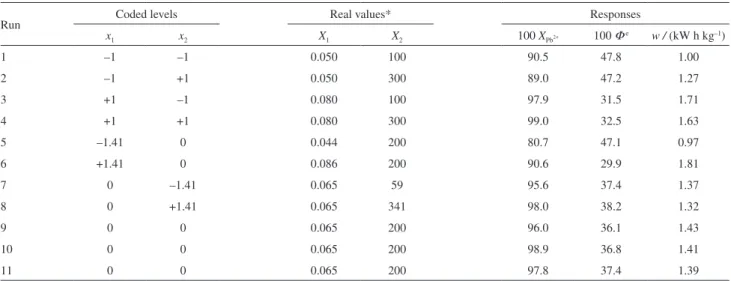
independent variable were chosen and three replications were carried out at the central point, totaling 11 experiments (see Table 1). Based on preliminary results, the ranges of the independent variables were: I from 44 to 86 mA and Q from 59 to 341 L h–1. The independent variables were
coded according to the following equation:28
(1)
where xi, Xi, Xi0 and ∆Xi are the coded level of the ith
independent variable, the real value of the ith independent variable, the real value of the ith independent variable in the central point, and the half of the difference between the upper and lower values of the ith independent variable, respectively.
The correlations between the independent variables and the responses were obtained by using second-order models (least-squares method):
(2)
Table 1. Coded/real values and obtained responses (calculated according to equations 4, 5 and 6) for the central composite rotatable design (CCRD) corresponding to the Pb2+ fractional conversion (X
Pb2+), electric-current eficiency (Φe), and energy consumption (w), for a 30 min electrolysis
Run Coded levels Real values* Responses
x1 x2 X1 X2 100 XPb2+ 100 Φe w / (kW h kg–1)
1 –1 –1 0.050 100 90.5 47.8 1.00
2 –1 +1 0.050 300 89.0 47.2 1.27
3 +1 –1 0.080 100 97.9 31.5 1.71
4 +1 +1 0.080 300 99.0 32.5 1.63
5 –1.41 0 0.044 200 80.7 47.1 0.97
6 +1.41 0 0.086 200 90.6 29.9 1.81
7 0 –1.41 0.065 59 95.6 37.4 1.37
8 0 +1.41 0.065 341 98.0 38.2 1.32
9 0 0 0.065 200 96.0 36.1 1.43
10 0 0 0.065 200 98.9 36.8 1.41
11 0 0 0.065 200 97.8 37.4 1.39
where Y is the response, b0 a constant coeficient, bi,
bii and bij the coeficients for the linear, quadratic and
interaction effects, respectively, xi and xj the coded levels
for the independent variables, k the number of independent variables and ε the random error.28 In the present case, the
mathematical relationships between the coded levels of the independent variables (I≡x1 and Q≡x2) and the responses
(XPb2+, Φe and w) were approximated by a second-order polynomial equation:
(3)
where Y is the predicted response, b0 a constant, b1 and b2
the linear coeficients, b11 and b22 the quadratic coeficients and b12 the interaction coeficient.
Experiments in the central point were performed in order to estimate the pure error. All the experiments were randomly carried out in order to minimize the effect of unexplained variability on the observed responses due to systematic errors.23 Finally, the results were analyzed by
the least-squares method and response surfaces28,29 were
generated in order to determine the best conditions for Pb2+ removal.
Electrolytic system and procedure for Pb2+ removal
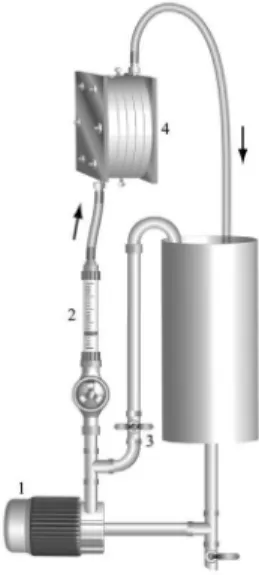
The whole system for Pb2+ removal (Figure 1) consisted
of a membrane-less flow-through electrochemical cell (diameter of 150 mm and length of 80 mm), a PVC reservoir, a magnetic recirculation pump, and a lowmeter to control the solution low rate. The low-through electrochemical cell (Figure 2) was mounted, in a
“sandwich” form, using ive PVC circular plates with the following dimensions: inner and outer diameters of 70 and 150 mm, respectively, and thickness of 12 mm. Each cell end contained a cathode made of Amway® SSW (70 mm
of diameter and 6 mm of thickness, ca. 9 g) pressed against an SSP (150 mm × 150 mm × 5 mm). In order to prevent leakage, silicone gaskets, with format identical to that of the PVC plates but thickness of 2 mm, were used between these plates. Two of the PVC plates acted as turbulence promoters, allowing a uniform electrolyte low distribution and standardization of the mass transport within the cell.6
In the central PVC plate, an Amway® SSW anode (70 mm
of diameter and 12 mm of thickness, ca. 18 g) was ixed by pressing against an SSP ring. The distance between each cathode and the anode was 22 mm. As described in detail elsewhere,13 their surface areas per unit volume were
2.7 × 10³ and 1.4 × 10³ m−1, respectively.
The assembled system was loaded with 2 L of the diluted Pb2+ solution and the performance of the cell evaluated by
CCRD. All experiments on the galvanostatic removal of Pb2+ ions were conducted in the recirculation mode, using
a PAR 273A potentiostat/galvanostat controlled by the Echem software. The electrolytic solution was periodically sampled and its Pb2+ content analyzed by a Varian SpectrAA
200 spectrophotometer with an air/acetylene lame.
Data analysis
In this work, as pointed out above, three parameters were used to evaluate the performance of the electrochemical system in each CCRD point: XPb2+, Φe and w. The value of XPb2+ was calculated as:
(4)
where C0 is the initial Pb2+ concentration and C the Pb2+
concentration after a given electrolysis time. The value of
Φe was calculated as:
Figure 1. Schematic representation of the continuous low-through system: (1) pump, (2) lowmeter, (3) bypass and (4) membrane-less low-through cell (diameter of 150 mm and length of 80 mm).
(5)
where n is the stoichiometric number of electrons for the global reaction of Pb2+ conversion, F the Faraday constant
and V the volume of electrolytic solution used in each test. Finally, the value of w (in W h kg–1) was calculated as:
(6)
where Ucell is the cell voltage, M the molar mass of lead and 3600 the conversion factor from second to hour.
Results and Discussion
Optimization of Pb2+ removal
Initially, a 23-full-factorial design with three independent
variables and two levels for each variable was adopted to evaluate the inluence of I, Q and surface area of the cathodes (only SSP or SSW ixed on SSP) on the Pb2+ electrolytic
conversion (data not shown). From the results thus obtained, it became clear that lower values of w were obtained for the membrane-less low-through cell operating with the cathodes of higher surface area (SSW ixed on SSP). Thus, with these cathodes, a set of experiments using a CCRD with only two independent variables (I and Q, Table 1) was conducted in order to obtain the optimum conditions for Pb2+ removal. Then, using the obtained responses (see
Table 1), a multiple linear-regression analysis (least-squares method) was employed to generate three second-order models,31 describing the dependence of X
Pb2+, Φe and w on the two independent variables. The obtained equations for the three adjusted models containing only the statistically signiicant coeficients (at 95% conidence level) are:
XPb2+ = 0.9758 + (5.96 × 10–2) x1 – (4.41 × 10–2) x12 (7)
Φe = 0.3643 – (6.91 × 10–2) x
1 + (1.40 × 10 –2) x
1 2 +
(1.08 × 10–2) x
22 (8)
w / (W h kg–1) = 1410.00 + 283.80 x
1 – 86.23 x1x2 (9)
where x1 and x2 correspond to the coded levels for I and
Q, respectively.
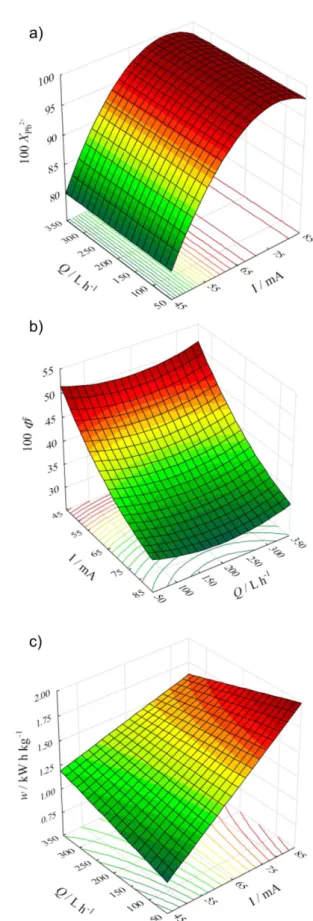
The response surface generated by equation 7 (Figure 3a) shows that, up to a certain point, the increase of the electric current positively inluences the Pb2+ conversion
process, leading to XPb2+values higher than 0.98 after a 30 min electrolysis, which is a signiicant improvement
Figure 3. Response surfaces generated from the CCRD method using equations 7, 8 and 9, for a 30 min electrolysis under galvanostatic conditions: (a) Pb2+ fractional conversion (X
when compared with those obtained in previous works.12,13
It is worthwhile to point out that two simultaneous processes contribute for Pb2+ removal during electrolyses
using the membrane-less low-through cell: Pb2+ + 2e–→ Pb
on the cathodes and Pb2+ + 2H
2O → PbO2 + 4H+ + 2e– on
the anode.
On the other hand, as one would expect, the corresponding values of Φe decrease as I is increased, as illustrated in
Figure 3b. This occurs because competitive parallel reactions, such as the oxygen, water and nitrate reduction reactions (O2 + 4H+ + 4e–→ 2H2O, 2H2O + 2e–→ H2 + 2OH– and
NO3 – + H
2O + 2e
–→ NO
2
– + 2OH–, respectively), and the
water oxidation reaction (2H2O → O2 + 4H+ + 4e–), become
important as I is increased.
As one would also expect, increases in I led to higher values of w (Figure 3c), although the highest obtained value is signiicantly lower than those reported in the literature for Pb2+ removal.1,4,7,12,13 The value of w depends on the cell
voltage, which can be expressed as:24
Ucell = Uocell + Σ|h| + ΣIR (10)
where Uo
cell is the thermodynamic equilibrium cell voltage,
Σ|h| the sum of the overpotentials at each electrode and ΣIR the sum of all ohmic drops in the cell due to the low of I through resistances (R). At this point, it is worthwhile to remember that the cationic membranes were removed in the low-through cell used in the present work. Therefore, the contribution from ΣIR was strongly minimized, thus remaining only the contributions from ohmic drops associated to the electrolyte, the distance between the electrodes and the magnitude of the electric current. It is clear from equation 7, that Q has no signiicant inluence on XPb2+ (see also Figure 3a), although several other studies showed that the rate of electrochemical reactions under mass transport conditions is dependent on Q.2,3,6,12
According to Koene and Janssen,32 increases in Q enhance
the electrochemical-reaction rate as a consequence of the diffuse layer becoming thinner. In the present case, lower Q values possibly promoted insigniicant changes in the mass transport coeficient, while higher ones led to the formation of preferential streaming channels and/or dead zones.33 Similarly for Φe (Figure 3b), the inluence of
Q is practically insigniicant. However, in the case of w (Figure 3c) there is a dependence on Q: for low I values, w increases with Q, while the opposite occurs for high I values. Such behavior is quite complex, being determined by the interplay between Ucell and Q.
The use of RSM also allows to find the region of optimum conditions for Pb2+ removal within the
experimental ranges. Thus, taking Figure 3a into account
and considering that Q affects the value of w, an optimized experiment was carried out by ixing I and Q at 70 mA and 200 L h–1, respectively. At these conditions, after a 30 min
electrolysis the obtained values of XPb2+ and w were equal to 0.98 and 1.5 kW h kg–1, respectively, while the value of
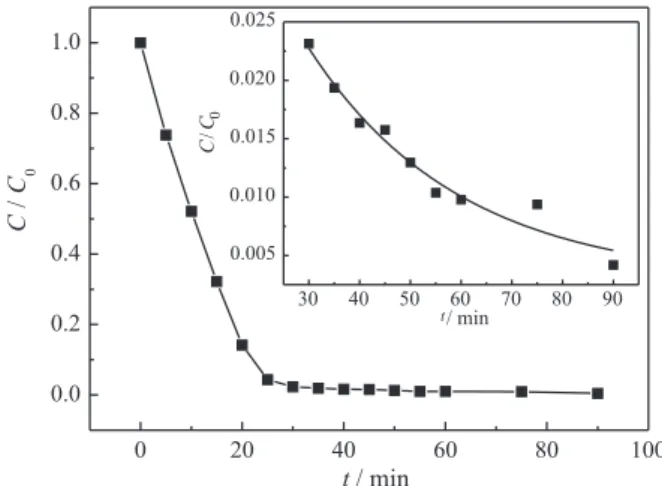
Φe was 0.35. Additionally, as it can be seen in Figure 4,
after a 90 min electrolysis, the Pb2+ concentration dropped
to 0.21 mg L–1 (X
Pb2+ = 0.996). Furthermore, by measuring the mass of the SSW electrodes (anode and cathodes) before and after the experiments, it became clear that more than 95% of the Pb2+ ions in solution were removed as PbO
2
deposited on the SSW anode.
Figure 4 shows that the decrease of the normalized Pb2+
concentration [C/C0] as a function of time is not exponential,
as one would expect for a mass-controlled reaction.13
Nevertheless, the values of XPb2+ and Φe are signiicantly higher than those reported in the literature1,3,7,12,13 for the
experimental parameter range used in the present study. By comparing the results obtained in the present work with those that we previously reported for a membrane-compartmentalized low-through cell with a SSW cathode for Pb2+ removal12,13 (see Table 2), one can clearly see that
Figure 4. Normalized Pb2+ concentration (C/C
0) vs. time for Pb2+ removal at 70 mA and 200 L h–1 in the membrane-less low-through cell with SSW electrodes. Insert: expanded view of results beyond 30 min of electrolysis.
Table 2. Comparison of the results for Pb2+ removal from diluted solutions using a low-through cell with stainless steel wool (SSW) as cathodes and anode (membrane-less cell, this work) or a low-through cell with SSW only as cathode, for a 30 min electrolysis
Method Ucell/ V 100 XPb2+ 100 Φe w / (kW h kg–1)
Galvanostatic [this work] 2.05 35 98 1.5
Galvanostatica,13 3.30 22 93 4.1
Potentiostaticb,12 3.50 17 81 5.3
the membrane-less low-through cell with SSW cathodes and anode here reported is much more eficient.
Validation of the quadratic models developed
Analysis of variance (ANOVA)31 was applied to
numerically validate the three quadratic models (XPb2+, Φe, and w) here developed (Table 3 exempliies the ANOVA for the XPb2+ model; the data for the Φe and w models can be seen in Tables S1 and S2 in the Supplementary Information, SI). The F-test (Fisher’s distribution) was also used in order to evaluate the model that best its the population from which the data were sampled. This statistical test is based on the ratio of two scaled sums of squares relecting different sources of variability.30,31 With the aid of ANOVA
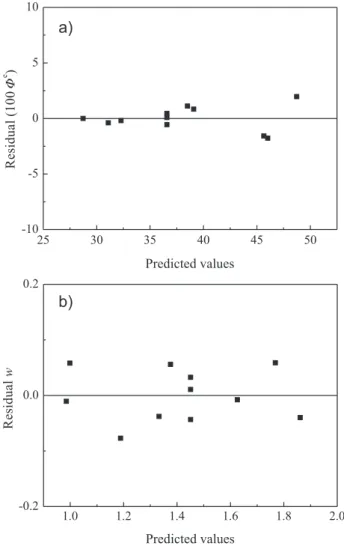
and the F-test, it was found that the regressions for the three models were statistically signiicant, since the calculated F-ratio for the regressions (19.56 for XPb2+, 38.46 for Φe and 48.23 for w) were greater than the values of the critical F-value (5.05 at 95% conidence level). For all models, the calculated values of the F-ratio for lack of it (1.74 for XPb2+, 9.21 for Φe and 7.23 for w) were smaller than the critical ones (19.16 at 95% conidence level), thus indicating that the data are well adjusted to the models. The use of an F-test presupposes that the residuals have a normal distribution.30,31 Figure 5 illustrates a typical plot of
the residuals versus the predicted values for the XPb2+ model; similar plots for the Φe and w models can be seen in the SI
(Figure S1). The fact that these plots present no systematic errors (all the residuals are randomly distributed around the mean) conirms the good agreement for the models.31
The determination coeficients (R2) for the models, which
are additional parameters for assessing the itting quality of the models, were close to unity (0.951 for XPb2+, 0.975 for Φe and 0.980 for w), indicating that the models were
statistically signiicant.30 Finally, probability plots were
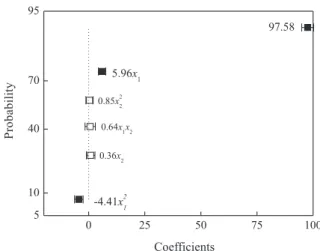
also obtained to evaluate the statistical signiicance of the coeficients for the three developed models (XPb2+, Φe and w). Figure 6 illustrates this plot for the XPb2+model; as it can be seen, the terms different from zero were statistically signiicant. Similar results were obtained in the probability
plots for the Φe and w models, as can be seen in Figure S2
in the SI.
Conclusions
The results here reported for the removal of Pb2+
ions from diluted solutions allow to conclude that a
Figure 5. Residual plot for the model of Pb2+ fractional conversion (X Pb2+) for a 30 min electrolysis under galvanostatic condition, using the low-through cell with SSW cathodes and anode.
Figure 6. Normal probability plot for the model of Pb2+ fractional conversion (XPb2+) for a 30 min electrolysis under galvanostatic condition, using the low-through cell with SSW cathodes and anode.
Table 3. Summary of the ANOVA with the data obtained using the CCRD (Table 1) for the Pb2+ fractional conversion (X
Pb2+), for a 30 min electrolysis
Source of variation Sum of squares Degrees of freedom Mean square (MS) Fratio (model signiicance, MS)
Regression (R) 313.80 5 62.76 MSR/MSr = 19.56a
Residual (r) 16.04 5 3.21
Lack of it (Lof) 11.59 3 3.86 MSLof/MSPe = 1.74b
Pure error (Pe) 4.45 2 2.23
Total 329.84 10 ____
Determination coeficient: 0.951; aF
membrane-less low-through cell with stainless steel wool (SSW) as cathodes and anode is signiicantly more eficient and economical than a previously used low-through cell with SSW only as cathode.
The use of factorial design along with RSM was useful for the optimization of the electrolytic removal process in a relatively small number of experiments; the conditions predicted by the developed models are in good agreement with the experimental results, as conirmed by variance analysis. The obtained response surfaces from the developed models revealed that Q (in the range 59-341 L h–1) did not
substantially affect the Pb2+ removal process. On the other
hand, the increase of I led to higher values of Pb2+ conversion,
at reasonable values of current efficiency and specific energy consumption, especially when compared with those reported in the literature. An experiment carried out within the optimum-conditions region (using 70 mA and 200 L h–1,
[Pb2+] = 50 mg L–1, 2 L of solution) yielded a Pb2+ conversion
of about 99.6%, after 90 min of electrolysis.
Finally, it should be emphasized that the use of a membrane-less low-through cell with SSW as cathodes and anode, besides being signiicantly more energy eficient, led to Pb2+ removal in both electrodes, but predominantly in
the anode. In the experiment mentioned above, more than 95% of the removed Pb2+ ions were converted to PbO
2 on
the SSW anode.
Supplementary Information
Supplementary data are available free of charge at http://jbcs.sbq.org.br as a PDF ile.
Acknowledgments
We gratefully acknowledge the Brazilian research funding agencies Conselho Nacional de Desenvolvimento Científico e Tecnológico (CNPq), Coordenação de Aperfeiçoamento de Pessoal de Nível Superior (CAPES) and Fundação de Amparo à Pesquisa do Estado de São Paulo (FAPESP) for inancial support and scholarships. Additionally, we thank Professor Edenir R. Pereira Filho (Departamento de Química, UFSCar) for discussions on factorial design, and Professor Luis Augusto M. Ruotolo (Departamento de Engenharia Química, UFSCar) for the use of the AA spectrophotometer.
References
1. De Leon, C. P.; Pletcher, D.; Electrochim. Acta1996, 41, 533. 2. Bertazzoli, R.; Widner, R. C.; Lanza, M. R. V.; Di Iglia, R. A.;
Sousa, M. F. B.; J. Braz. Chem. Soc.1997, 8, 487.
3. Widner, R. C.; Sousa, M. F. B.; Bertazzoli, R.; J. Appl.
Electrochem.1998, 28, 201.
4. Carreño, G.; Sosa, E.; González, I.; de León, C. P.; Batina N.; Oropeza, M. T.; Electrochim. Acta1999, 44, 2633.
5. El-Deab, M. S.; Saleh, M. M.; El-Anadouli, B. E.; Ateya, B. G.;
J. Electrochem. Soc.1999, 146, 208.
6. Ragnini, C. A. R.; Di Iglia, R. A.; Bizzo, W.; Bertazzoli, R.;
Water Res.2000, 34, 3269.
7. Brandon, N. P.; Pilone, D.; Kelsall, G. H.; Yin, Q.; J. Appl.
Electrochem.2003, 33, 853.
8. Cheng, C. Y.; Kelsall, G. H.; Pilone, D.; J. Appl. Electrochem.
2005, 35, 1191.
9. Paidar, M.; Bouzek, K.; Laurich, M.; Thonstad, J.; Water Environ. Res.2000, 72, 618.
10. Barbosa, L. A. D.; Sobral, L. G. S.; Dutra, A. J. B.; Miner. Eng.
2001, 14, 963.
11. Elsherief, A. E.; Electrochim. Acta2003, 48, 2667.
12. Gasparotto, L. H. S.; Bocchi, N.; Rocha-Filho, R. C.; Biaggio, S. R.; J. Appl. Electrochem.2006, 36, 677.
13. Almeida, L. C.; Gasparotto, L. H. S.; Bocchi, N.; Rocha-Filho, R. C.; Biaggio, S. R.; J. Appl. Electrochem.2008, 38, 167. 14. Ferracin, L. C.; Chácon-Sanhueza, A. E.; Davoglio, R. A.;
Rocha, L. O.; Caffeu, D. J.; Fontanetti, A. R.; Rocha-Filho, R. C.; Biaggio, S. R.; Bocchi, N.; Hydrometallurgy2002, 65, 137. 15. Ruotolo, L. A. M.; Gubulin, J. C.; Chem. Eng. J.2009, 149,
334.
16. Andrade, L. S.; Rocha-Filho, R. C.; Bocchi, N.; Biaggio, S. R.; Iniesta, J.; García-Garcia, V.; Montiel, V.; J. Hazard. Mater.
2008, 153, 252.
17. Andrade, L. S.; Tasso, T. T.; Silva, D. L.; Rocha-Filho, R. C.; Bocchi, N.; Biaggio, S. R.; Electrochim. Acta2009, 54, 2024. 18. Panizza, M.; Cerisola, G.; Chem. Rev.2009, 109, 6541. 19. Aquino, J. M.; Rocha-Filho, R. C.; Bocchi, N.; Biaggio, S. R.;
J. Appl. Electrochem.2010, 40, 1751.
20. Aquino, J. M.; Rocha-Filho, R. C.; Bocchi, N.; Biaggio, S. R.;
J. Braz. Chem. Soc.2010, 21, 324.
21. Aquino, J. M.; Irikura, K.; Rocha-Filho, R. C.; Bocchi, N.; Biaggio, S. R.; Quim. Nova2010, 33, 2124.
22. Comninellis, C.; Chen, G.; Electrochemistry for the
Environment, Springer: New York, 2010.
23. Jüttner, K.; Galla, U.; Schmieder, H.; Electrochim. Acta2000,
45, 2575.
24. Walsh, F. C.; Pure Appl. Chem.2001, 73, 1819.
25. Reyes Cruz, V.; Oropeza, M. T.; González, I.; de León, C. P.;
J. Appl. Electrochem.2002, 32, 473.
26. González-Garcia, J.; Montiel, V.; Aldaz, A.; Ind. Eng. Chem. Res.1998, 37, 4501.
27. Doherty, T.; Sunderland, J. G.; Roberts, E. P. L.; Pickett, D. J.;
Electrochim. Acta1996, 41, 519.
28. Box, G. E. P.; Draper, N. R.; Empirical Model-Building and
29. Myers, R. H.; Montgomery, D. C.; Anderson-Cook, C. M.;
Response Surface Methodology: Process and Product
Optimization Using Designed Experiments, 3rd ed., Wiley: New
York, 2009.
30. Bruns, R. E.; Scarminio, I. S.; Neto, B. B.; Statistical
Design-Chemometrics, Elsevier: Amsterdam, 2006.
31. Bezerra, M. A.; Santelli, R. E.; Oliveira, E. P.; Villar, L. S.; Escaleira, L. A.; Talanta2008, 76, 965.
32. Koene, L.; Janssen, L. J. J.; Electrochim. Acta2001, 47, 695. 33. Levenspiel, O.; Chemical Reaction Engineering, 3rd ed.,Wiley:
New York, 1998.
Submitted: March 11, 2011
Published online: June 9, 2011
Supplementary Information
S
I
J. Braz. Chem. Soc., Vol. 22, No. 9, S1-S2, 2011. Printed in Brazil - ©2011 Sociedade Brasileira de Química 0103 - 5053 $6.00+0.00
*e-mail: [email protected]
Galvanostatic Removal of Pb
2+Ions from Diluted Solutions by the Use of a
Membrane-Less Flow-Through Cell with Stainless Steel Wool Electrodes
Lucio C. Almeida, Nerilso Bocchi,* Romeu C. Rocha-Filho and Sonia R. Biaggio
Departamento de Química, Universidade Federal de São Carlos (UFSCar), CP 676, 13560-970 São Carlos-SP, Brazil
Table S1. Summary of the ANOVA with the data obtained using the CCRD (Table 1) for the current eficiency (Φe), for a 30 min electrolysis
Source of variation Sum of squares Degrees of freedom Mean square (MS) Fratio (model signiicance, MS)
Regression (R) 411.99 5 82.40 MSR/MSr = 34.50a
Residual (r) 11.49 5 2.39
Lack of it (Lof) 11.42 3 3.81 MSLof/MSPe = 14.63b
Pure error (Pe) 0.52 2 0.26
Total 423.93 10 −
Determination coeficient: 0.972; aF
5,5 = 5.05; bF3,2 = 19.16 (at 95% conidence level).
Table S2. Summary of the ANOVA with the data obtained using the CCRD (Table 1) for the speciic electric energy consumption (w) after a 30 min electrolysis
Source of variation Sum of squares Degrees of freedom Mean square (MS) F
ratio (model signiicance, MS)
Regression (R) 788611.95 5 157722.39 MSR/MSr = 35.12a
Residual (r) 22452.50 5 4490.50
Lack of it (Lof) 19392.36 3 6464.12 MSLof/MSPe = 4.22b
Pure error (Pe) 3060.15 2 1530.07
Total 811064.45 10 −
Determination coeficient: 0.973; aF
Figure S1. Residual plots for the models of (a) current eficiency (Φe)
and (b) speciic energy consumption (w) for a 30 min of electrolysis under galvanostatic condition, using the low-through cell with SSW cathodes and anode.
Figure S2. Normal probability plots for the models of (a) current eficiency (Φe) and (b) speciic energy consumption (w) for 30 min of electrolysis