O
RIGINALA
RTICLE Revista Brasileira de FisioterapiaGross motor performance and its association
with neonatal and familial factors and day care
exposure among children up to three years old
Desempenho motor grosso e sua associação com fatores neonatais,
familiares e de exposição à creche em crianças até três anos de idade
Santos DCC1,4, Tolocka RE2,Carvalho J1, Heringer LRC1,3, Almeida CM1, Miquelote AF4
Abstract
Objective: To analyze gross motor performance and its association with neonatal and familial factors and day care exposure among children up to three years of age attending public day care centers. Methods: This was a cross-sectional study that evaluated 145 children (58 aged 6-11 months, 54 aged 12-23 months and 33 aged 24-38 months) attending six public day care centers in Piracicaba, State of São Paulo. The Peabody Developmental Motor Scale-2 test was used to assess overall gross motor performance and the motor subtests that make up the scale (reflexes, stationary skills, locomotion skills and object manipulation). Neonatal, familial and daycare center exposure data were also collected and their association with suspected delays in gross motor performance was investigated. Results: The prevalence of suspected delays in gross motor performance was 17%, with disadvantages among children under 24 months of age and with regard to locomotion skills. There were associations of risk between suspected delays in gross motor performance and family income, and between suspected delays in locomotion skills and parental educational level. Children whose families had a monthly income of up to 700 reais were 2.81 times more likely to present delays in gross motor performance. Children whose parents had up to eight years of education were 4.63 times more likely to present delays in locomotion skills. There was no association of risk with the other variables. Conclusion: The results indicate the need for greater attention to motor development during the first 24 months of children who attend day care centers, especially those with low-income and less-educated parents.
Key words: day care centers; child; child development; environment; risk factors.
Resumo
Objetivo: Analisar o desempenho motor grosso e sua associação com fatores neonatais, familiares e de exposição à creche em crianças com até três anos de idade, frequentadoras de creches públicas. Métodos: Estudo transversal no qual foram avaliadas 145 crianças (58 com idade entre 6-11 meses, 54 entre 12-23 meses e 33 entre 24-38 meses) frequentadoras de seis creches públicas de Piracicaba (SP). O teste
Peabody Developmental Motor Scale-2 foi utilizado para avaliação do desempenho motor grosso global e subtestes motores que compõem a escala (Reflexos, Habilidades Estacionárias, Habilidades de Locomoção e Manipulação de Objetos). Foram coletados dados neonatais, familiares e de exposição à creche e pesquisada a associação desses ao desempenho motor suspeito de atraso. Resultados: A prevalência de suspeita de atraso no desempenho motor grosso foi de 17%, com desvantagens em crianças menores de 24 meses e em Habilidades de Locomoção; encontrada associação de risco de desempenho motor grosso suspeito de atraso e renda familiar, e suspeita de atraso em Habilidades de Locomoção e escolaridade paterna. Crianças cujas famílias tinham renda mensal até R$700,00 estavam 2,81 vezes mais expostas a apresentar desempenho motor grosso suspeito de atraso. Crianças cujos pais tinham até oito anos de escolaridade apresentaram risco 4,63 vezes maior de atraso em Habilidades de Locomoção. Não foi encontrada associação de risco com as demais
variáveis. Conclusão: Os resultados apontam maior atenção ao desenvolvimento motor durante os primeiros 24 meses de crianças que
frequentam creches, especialmente as inseridas em famílias com menor renda mensal e cujos pais têm menos escolaridade.
Palavras-chave: creches; criança; desenvolvimento infantil; meio ambiente; fatores de risco.
Received: 07/08/2008 – Revised: 30/11/2008 – Accepted: 13/01/2009
1Graduate Program in Physical Therapy, Faculdade de Ciências da Saúde (FACIS), Universidade Metodista de Piracicaba (UNIMEP), Piracicaba (SP), Brazil 2Graduate Program in Physical Education, FACIS, UNIMEP
3Centro Universitário do Leste de Minas Gerais (UNILESTE), Ipatinga (MG), Brazil 4Undergraduate Program in Physical Therapy, FACIS, UNIMEP
Correspondence to: Denise Castilho Cabrera Santos, Programa de Pós-Graduação em Fisioterapia - Bloco 7 sala 33, Faculdade de Ciência da Saúde, FACIS/UNIMEP, Rodovia do Açúcar Km 156, CEP 13400-911, Piracicaba (SP), Brazil, e-mail: [email protected]
Introduction
Child development consists in various interdependent domains (sensory-motor, cognitive and socioemotional) inlu-enced by biological factors (i.e. gestational age, birth weight, etc.), socioenvironmental factors (e.g. socioeconomic status, parental education, etc) and hereditary factors; all of these
factors can be afected by adverse or favorable situations1. he
irst years of life are particularly important as that is when vi-tal development occurs in all domains due to intense events in the development of the nervous system (NS), modulated by
the quality of the environment1. In the general context of child
development, motor development is regarded as an essential
component with implications to other developmental aspects2.
During the irst years, it provides the foundation for subse-quent development and optimizes functional performance in
areas such as learning, self-care, leisure, and games3. It is also
an important indicator of NS maturity and integrity and of
gen-eral well-being4.
In recent decades, the growing number of children enrolled
in day care centers5 in the irst few months of life5 has introduced
a new, permeating factor into their development, namely the daily experience of a collective environment. According to the
United Nations Children’s Fund (UNICEF)6, in 2001, 10.7% of
the Brazilian children up to three years old attended day care centers; in 2006, this proportion had risen to 15.5%; it is esti-mated that by 2011 this proportion will reach 50%. Although
access to childhood education is a fundamental right6,7 and
its purpose is the child’s integral development, the increase in the proportion of children who experience this collective
environment raises some concerns. Belsky8 warns that there
are risks and beneits associated with the daily care dispensed in early childhood; thus, it is important to know its efect on child development, without losing sight of the various factors that could potentially inluence this development. In Brazil, studies on children in day care centers are scarce and indicate problems concerning employee qualiications; infrastructure; the adoption of routines with emphasis on nourishment and hygiene; increased exposure to infections and possible
reper-cussions for motor development9-13.
It is estimated that around 200 million children up to the age of ive who live in developing countries fail to reach their cognitive, motor, and socioemotional development potential, considering that this is the result of the interrelation of genetic,
biological, and socioenvironmental factors1. A better
knowl-edge of the impact of these factors on child development in their irst years of life is fundamental to establishing strategies to promote progress and prevent delays. In this context, the aim of the present study was to analyze gross motor perfor-mance and its association with neonatal and familial factors,
as well as day care exposure of children up to three years old who attend public day care centers.
Methods
his was an exploratory cross-sectional study in which 145 children aged 0-3 attending six public day care centers in Piracicaba (SP) were evaluated as to motor performance, neo-natal and familial characteristics, and day care exposure. he study was approved by the Research Ethics Committee (Proto-col 80/05) of Universidade Metodista de Piracicaba (UNIMEP). For the sample calculation, the following parameters were taken into account: a inite population, 1456 children enrolled
in the 1st, 2nd, and 3rd stages of preschool (year of 2006 –
Mu-nicipal Education Department); estimated 20% probability of inding changes; 7% sampling error with a conidence interval of 95%; estimated minimal sample of 115 children. A conve-nience sample from the public day care centers of Piracicaba (SP) was used considering the following criteria: no interven-tion of any kind (e.g. physical educainterven-tion); interest on the part of the principals; and proximity to the university where the study was based. hree day care centers were located in the east part, two in the south part, and one in the north part of town. he collection was carried out on location from March 2006 to November 2007. he study included 0-3 year olds who attended day care centers on a full-time basis and whose guardians signed a consent form. Exclusion criteria were malformations, neurological problems, genetic syndromes and severe illnesses. From an initial sample of 162 children, 17 were excluded for absence due to illness or for leaving the school. hus, 145 children (73 boys and 72 girls) composed the inal sample of this study, of which 58 were 6-11 months old, 54 were 12-23 months old, and 33 were 24-38 months old.
he Peabody Developmental Motor Scale-2 (PDMS-2) test14
above average, average, below average, poor, very poor. In the present study, the motor performance variable was treated as a dichotomous variable; adequate gross motor performance when GMQ≥90 and suspected delay when GMQ<90; adequate performance in each subtest when EP≥8 and suspected delay when EP<8; in other words, there was suspected delay when the performance was below average, poor, or very poor.
he PDMS-2 was chosen for being a standardized instru-ment that evaluates gross motricity in detail and for being a diagnosis scale. It is also suitable to the age group studied and can be applied to day care centers. Each child was evaluated, according to chronological age or age corrected for prematurity, by two examiners (a graduate student and an undergraduate research fellow). One was responsible for conducting the test, and the other for recording the results. he examiners attended PDMS-2 training sessions and took part in an inter-examiner agreement study that included 14 infants evaluated separately by each examiner (Intraclass Correlation Coeicient =0.83; p<0.001). he resources used for the tests included a mat, a table and chair, PDMS-2 original material, and toys. he child had to be alert and wear clothes that did not restrict move-ments. he test was scheduled according to the daily routine of the day care centers, respecting the allotted times for meals, bathing, and napping. If interrupted, the tests were completed
within ive days, as established by the scale14.
he following independent neonatal variables were consid-ered: gestational age (< or ≥ 37 weeks of gestation) and birth
weight (< or ≥ 2500 g.; World Health Organization – CID1015)
and the Apgar score (< or ≥ seven in the 1st and 5th minute
of life). To collect the neonatal data, the family was asked to provide the researchers with a photocopy of the child’s Health Record Book; the missing information was completed by con-sulting the maternity records. Family data were collected by means of a closed questionnaire, adapted from the items on familial characteristics of the Afordances in the Home
Envi-ronment for Motor Development - Self-Report16, taking into
account: parental age (< or ≥ 20 years); parental education level (≤ or > eight years); parental cohabitation (yes or no); number of adults (> or ≤ two) and children (< or ≥ two) in the same house-hold; monthly family income (median income ≤ or > R$700.00, i.e. approximately twice the minimum wage). For risk analysis, we also considered the child’s median time attending day care centers (< or ≥ 6 months) and the child’s mean age at the time of enrollment (≤ or > 7 months).
Statistical analysis
he continuous variables were expressed by central ten-dency and dispersion measures, and the categorical variables
by frequencies. To test the diferences in motor performance between the groups (deined by age), the ANOVA test for independent groups was used (the assumptions of normal distribution [Kolmogorov-Smirnov test] and homogeneity of variance [Levene’s test] were conirmed); as a post hoc, Bon-ferroni’s test was applied. he chi-square test was used to an-alyze the association between the proportion of participants in the categories of the variable motor performance and the age groups and motor subtests. For the association and risk analysis of categorical data, we used the Prevalence Ratio Index or Odds Ratio (OR), with the respective Conidence Interval (CI). he risk association was considered signiicant when the lower limit of the CI was greater than one. he level of signiicance was set at 5%.
Results
Overall, the mean performance of the group was com-patible with the reference sample for the GMQ (100±11.02). However, considering the mean of performances ac-cording to the age groups (6-11 months = 97.15±9.03; 12-23 months = 99.42±11.63; 24-38 months = 105±11.18) there was a difference in the monthly mean score (F=7.46; p=0.01). The post hoc test indicated that children older than 24 months had a better performance, when compared to those aged between 6-11 and 12-23 months.
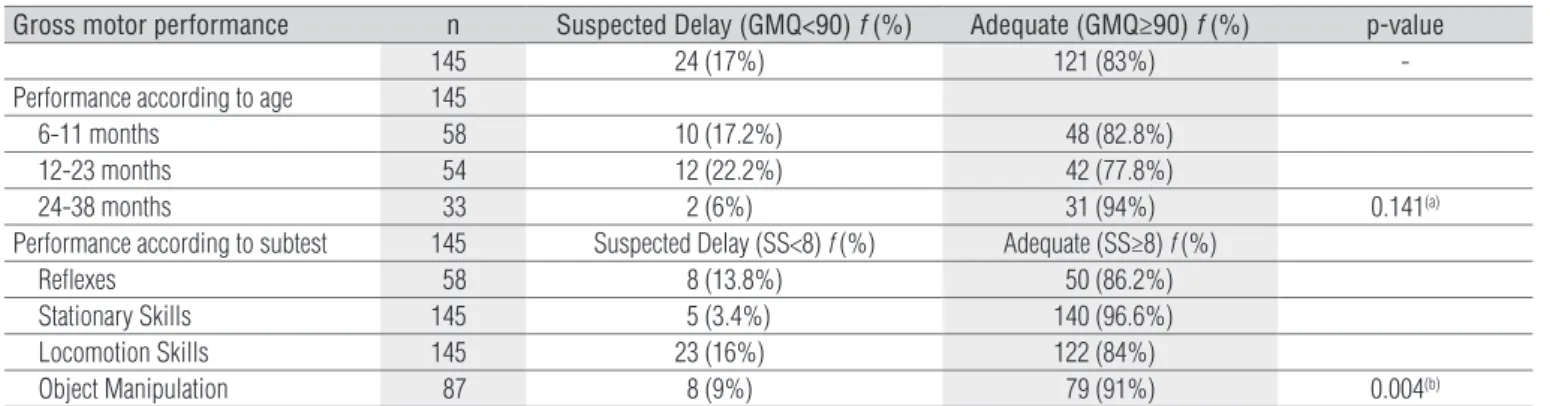
The prevalence of suspected delay in motor perfor-mance is displayed in Table 1. There was suspected delay in the overall gross motor performance in 17% of the chil-dren. Considering each age group, there is a tendency to a higher prevalence of suspected delay among children up to 11 months old (17.2%) and between 12-23 months (22%), compared with those older than 24 months (6%), although
there was no statistical significance (x2=3.91; p=0.141).
Sub-test analysis shows a higher prevalence of suspected delay in locomotion skills, followed by reflexes, object manipulation and stationary skills, with a significant difference between
the motor subtests (x2=13.30; p=0.004).
Because the prevalence of suspected delay in locomo-tion skills (16%) was similar to that of overall gross motor performance (17%), we also investigated the risk associa-tion for this subtest (Table 2). Children from families with an income of up to R$700.00 were 2.81 times more likely to have suspected delay in gross motor performance. Children whose parents had up to eight years of education were 4.63 times more likely to have suspected delay in locomotion skills. No risk association was found between the delay in motor performance and the other variables studied.
Table 1. Prevalence of children with suspected delay in gross motor performance according to subtest and age.
Gross motor performance n Suspected Delay (GMQ<90) f (%) Adequate (GMQ≥90) f (%) p-value
145 24 (17%) 121 (83%)
-Performance according to age 145
6-11 months 58 10 (17.2%) 48 (82.8%)
12-23 months 54 12 (22.2%) 42 (77.8%)
24-38 months 33 2 (6%) 31 (94%) 0.141(a)
Performance according to subtest 145 Suspected Delay (SS<8) f (%) Adequate (SS≥8) f (%)
Reflexes 58 8 (13.8%) 50 (86.2%)
Stationary Skills 145 5 (3.4%) 140 (96.6%)
Locomotion Skills 145 23 (16%) 122 (84%)
Object Manipulation 87 8 (9%) 79 (91%) 0.004(b)
GMQ= Gross Motor Quotient; SS=Standard Score; f=absolute frequency; %=relative frequency; (a)x2=3.91 (comparison by ages); (b)x2=13.30 (comparison by subtests).
Table 2. Independent variables associated with Gross Motor Performance and Locomotion Skills subtest.
Independent variables (n) n (%)
Gross Motor Performance Locomotion Skills
S A OR CI 95% S A OR CI 95%
Mother’s age (n=135)
<20 years age 7 (5%) 3 4 4.05 0.54-25.61 2 5 2.16 0.19-14.27
≥20 years age 128 (95%) 20 108 1 20 108 1
Father’s age (n=129)
<20 years age 3 (2%) 1 3 1.77 0.03-23.19 2 1 11.26 0.54-670.37
≥20 years age 126 (98%) 20 106 1 19 107 1
Mother’s education (n=133)
≤8 years 45 (34%) 7 38 0.97 0.32-2.86 7 38 1.06 0.35-3.17
>8 years 88 (66%) 14 74 1 13 75 1
Father’s education (n=91)(a)
≤8 years 37 (41%) 8 29 2.21 0.61-8.12 10 27 4.63 1.17-21.79(*)
>8 years 54 (59%) 6 48 1 4 50 1
Parent cohabitation (n=136)
no 45 (33%) 9 36 1.38 0.49-3.79 8 37 1.19 0.41-3.37
yes 91 (67%) 14 77 1 14 77 1
Adults at home (n=136)
>2 56 (41%) 10 46 1.12 0.41-3.02 9 47 0.99 0.35-2.73
≤2 80 (59%) 13 67 1 13 67 1
Children at home (n=134)
≥2 104 (78%) 16 88 0.73 0.24-2.53 16 88 0.73 0.24-2.53
<2 30 (22%) 6 24 1 6 24 1
Monthly family income (n=137)
≤R$700(b) 63 (46%) 16 47 2.81 1.02-7.88(*) 13 50 1.88 0.68-5.23
>R$700(b) 74 (54%) 8 66 1 9 65 1
Gestational age (n=133)
<37 weeks 14 (10.5%) 5 9 3.12 0.73-11.75 4 10 2.24 0.46-8.85
≥37 weeks 119 (89.5%) 18 101 1 18 101 1
Birth weight (n=133)
<2500 grams 8 (6%) 3 5 3.35 0.47-18.69 2 6 1.98 0.18-12.19
≥2500 grams 125 (94%) 19 106 1 18 107 1
Apgar 1’ (n=92)(c)
<7 6 (6.5%) 0 6 0.0 0.00-7.54 1 5 1.71 0.03-17.95
≥7 86 (93.5%) 11 75 1 9 77 1
Age at the time of enrollment (n=145)
≤7 months 78 (54%) 13 65 1.02 0.39-2.67 10 68 0.61 0.23-1.63
>7 months 67 (46%) 11 56 1 13 54 1
Time of day care exposure (n=145)
≥6 months 75 (52%) 12 63 0.92 0.35-2.40 12 63 1.02 0.38-2.72
<6 months 70 (48%) 12 58 1 11 59 1
f=relative frequency; S=Suspected Delay; A=Adequate; OR=Odds Ratio; CI 95%=Confidence Interval (significant association when limit >1); (*)=significant risk association; (a)=the
Discussion
Considering the group as a whole, 17% of the children had suspected delay in gross motor performance. he motor per-formance analysis showed disadvantages in children under 24 months old and in locomotion skills, as well as a risk asso-ciation between suspected delay in gross motor performance and family income and between suspected delay in locomotion skills and parental education level.
Several studies on children who attend day care centers and preschools report suspected developmental delays, in-cluding motor development. However, the studies are still inconclusive, and the prevalence of delay or suspected delay
ranges from 10% to 43% in the diferent studies11-13,17,18. he
suspected delays found in the present study are also vari-able if one takes into account the values for diferent ages (analysis of variance) and for the diferent motor domains (Table 1). Among the studies identiied in the literature, the present study is the only one to use a scale of diagnosis to assess the motor development of children who attend day care centers, therefore we believe the results may contribute to understanding the heterogeneity of the indings.
he disadvantage in locomotion skills evidenced by the present study suggests this is the most afected motor domain in the group examined, especially in the irst two years of life, a period considered fundamental for the acquisition of
indepen-dent erect locomotion2. here is evidence that, in many
institu-tions, infants spend most of the day in their cribs, which limits the opportunities to explore the environment and interact with other children, with potential repercussions for locomotion
skills5. According to Campos et al.19, early locomotion
experi-ences are essential to developmental changes, with a signiicant impact on social and emotional development, communication through motor actions, spatial perception and cognition.
he dynamism of the developmental process and the greater vulnerability associated with young age may explain the diferences found in the various age groups. he diference in motor performance between children under 24 months of age and children above that age suggests that the potential for full development is optimized with locomotion independence, i.e. the characteristics that inluence the way a child moves change over time according to experience and learning, but
also according to context and task20. One of the most common
models used to explain the changes in child development is the transactional model which states that there is a degree of
plasticity inherent to the child and to the environment21. he
basic assumption of this model is that development is facili-tated by a bidirectional and reciprocal interaction between the child and their environment, which are actively engaged with one another, changing and being changed by this interaction.
Development is considered unique and peculiar, resulting in the balance between the risk factors and the protection factors
of the child and the context21.
Bradley and Vandell22 point out that day care experiences
interact with experiences at home and their own characteris-tics to produce the results in development. he risk associa-tions that were found suggest the preponderant inluence of the family on the motor development of the group studied.
Ac-cording to Belsky et al.23, the family is the strongest and most
consistent predictor of child development, but the quality of the care given in the irst few years is very important.
Although the inluence of neonatal risk factors is well described in the literature, the present study had a low oc-currence of preterm births with low weight and Apgar score below seven (Table 2). In addition, no neonatal clinic com-plications were found, and preterm children were evaluated based on the corrected age. here is evidence that, in the absence of other disturbances and with age correction of pre-term children, the motor development may be similar to that
of children born at term24.
here was also a low occurrence of potentially unfavor-able family situations (e.g. teenage parents, low maternal edu-cation level). his may at least partially explain the absence of
risk association of suspected delay for these variables25. As for
the risk associations that were identiied, they suggest greater risk of overall delay among children from low income families and a risk of delay in locomotion skills associated with low paternal education level. he relationship between low socio-economic status/low income and developmental
disadvan-tage is well known1,26-28. Poverty ampliies children’s biological
vulnerability, leading to unfavorable results in development27.
he underprivileged segment of society combines social, eco-nomic and biological factors that determine a greater chance
of developmental delay28. Poverty and its associated
prob-lems (i.e. malnutrition, unsanitary living conditions; parental education and inadequate stimulation at home) are regarded
as the main risk factors in child development1 and may have
contributed to the indings.
he present study showed that, even in a group of chil-dren/families who use the public education system, there is a greater disadvantage (higher risk of motor development delay) associated with lower income (46% with an income under R$700.00; Table 2). Regarding parental education level, this result comes at a time of debate about the pertinence of including the father and his possible inluence on child de-velopment. he education level of the head of the household substantially afects child well-being due to the vulnerability of
children in early childhood29. It also has indirect repercussions
on proper child rearing because it inluences the access to and comprehension of the information disseminated by health and
education services and by the media30. he father’s role in
neu-rological and psychomotor development was evidenced in two studies. While studying the cognitive and motor development of 788 Chilean infants, researchers found that the best combi-nation of risk categories for child development were tempera-ment, maternal intelligence, paternal role and stimulation at
home27. he study by Barros et al.11 showed that biologically
healthy children may sufer negative inluences from
environ-mental risk factors, including the absence of a father11.
he present study did not ind any risk associations be-tween age at enrollment in day care or time of day care expo-sure and motor development, however the quality of the care received by the child may at least partially explain the indings
in the literature11-13,17,18. Surveys on the quality of education
in Brazilian preschools (1996-2003) showed that educators had diiculty overcoming poor eating and hygiene habits to
promote practices that lead to full development9. Although
preschools aim to foster development, the quality of the day care center environment as a place for child development has
been questioned30,31. he indings of the present study and the
reports in the literature suggest that, even if day care centers do not impair child development, they may not be acting sat-isfactorily to support and promote it, as recommended by the
National Education Guidelines7 and the National Curriculum
Reference Guide5.
The limitations of the present study were its cross-sec-tional design; the lack of investigations into the quality of the service provided at each day care center and at home, and the use of an assessment instrument still not validated in Brazil, which is also a limitation of this field of knowledge. There is a lack of instruments developed and/or validated in Brazil to evaluate early motor development. As a conse-quence, the use of foreign instruments has been frequent in
Brazilian research4,24,26.
In general, the results of the present study emphasize the need for more attention to motor development during the irst 24 months of life of preschool children, particularly those from lower income and less educated families. Given the mul-ticausal nature of development, which is inluenced by child/ environment interaction, and the importance of the object of study, i.e. child development, further investigation is needed into the associations found in the present study and into the use of study models (e.g. longitudinal studies) to explore the cause-and-efect relationships.
Acknowledgements
UNIMEP Research Support Fund (Protocol 369/05); UNIMEP Extension Support Fund (Protocol 21/06).
Grantham-McGregor S, Cheung YB, Cueto S, Glewwe P, Richter L, Strupp 1.
B. Developmental potential in the first 5 years for children in developing countries. Lancet. 2007;369(9555):60-70.
Wijnhoven TMA, de Onis M, Onyang AW, Wang T, Bjoerneboe GA, Bhandari 2.
N, et al. Assessment of gross motor development in the WHO multicentre growth reference study. Food Nutr Bull. 2004;25(1Suppl):S37-45.
Goyen TA, Lui K. Longitudinal motor development of “apparently normal” 3.
high-risk infants at 18 months, 3 and 5 years. Early Hum Dev. 2002; 70(1-2):103-15.
Santos DC, Gabbard C, Gonçalves VM. Motor development during the first 4.
year: a comparative study. J Genet Psychol. 2001;162(2):143-53.
Ministério da Educação e do Desporto. Secretaria de Educação Fundamental. 5.
Referencial curricular nacional para a educação infantil - vol.1 (livro na internet). Brasília-DF; 1998 [acesso em 2008 jul 25]. Disponível em: http:// portal.mec.gov.br/seb/arquivos/pdf/rcnei_vol1.pdf.
Unicef. Situação Mundial da Infância 2008 - Caderno Brasil [livro na 6.
internet]. Brasil; 2008 [acesso em 2008 jul 25]. Disponível em: http://www. unicef.org/brazil/pt/resources_11319.htm.
Presidência da República – Casa Civil. Lei de Diretrizes e Bases da 7.
Educação Nacional - LDBEN. Lei nº 9.304, de 20 de dezembro de 1996.
[acesso em 2006 Nov 22]. Disponível em: http://www.planalto.gov.br/ CCIVIL_03/LEIS/L9394.htm.
Belsky J. Early child care and early child development: major findings 8.
of the NICHD study of early child care. Eur J Dev Psychol. 2006;3(1): 95-110.
Campos MM, Füllgraf J, Wiggers V. A qualidade da educação infantil 9.
brasileira: alguns resultados de pesquisa. Cad Pesqui. 2006;36(127): 87-128.
Nesti MM, Goldbaum M. Infectious diseases and daycare and preschool 10.
education. J Pediatr. 2007;83(6):299-312.
de Barros KM, Fragoso AG, de Oliveira AL, Cabral Filho JE, de Castro 11.
RM. Do environmental influences alter motor abilities acquisition? A comparison among children from day-care centers and private schools. Arq Neuropsiquiatr. 2003;61(2A):170-5.
Souza SC. Avaliação do desenvolvimento neuropsicomotor do pré-escolar 12.
de creches públicas de Cuiabá-MT [tese]. São Paulo (SP): Universidade de São Paulo; 2004.
Biscegli1 TS, Polis LB, Santos LM, Vicentin M. Avaliação do estado 13.
nutricional e do desenvolvimento neuropsicomotor em crianças freqüentadoras de creche. Rev Paul Pediatr. 2007;25(4):337-42.
Folio MR, Fewell RR. Peabody Developmental Motor Scales. 2ª ed. Austin: 14.
Pro-Ed; 2000.
OMS - Organização Mundial da Saúde. Definições. In: CID-10 - 15.
Classificação estatística internacional de doenças e problemas relacionados a saúde. 10ª revisão. v.1, tradução do Centro Colaborador da OMS para a classificação de doenças em português. 7ª ed. São Paulo: EDUSP; 1999. p. 1181-6.
Rodrigues LPLBA. Development and validation of the AHEMD-SR [tese]. 16.
Texas: Texas A&M University; 2005.
Caon G, Ries LGK. Suspeita de atraso no desenvolvimento neuropsicomotor 17.
em idade precoce: uma abordagem em creches públicas. Temas Desenvolv. 2003;12(70):11-7.
Rezende MA, Beteli VC, Santos JLF. Follow-up of the child’s motor 18.
abilities in day-care centers and pre-schools. Rev Latino-am Enfermagem. 2005;13(5):619-25.
Campos JJ, Anderson DI, Barbu-Roth MA, Hubbard ED, Hertenstein 19.
MJ, Witherington D. Travel broadens the mind. Infancy. 2000;1(2): 149-219.
Gagen LM, Getchell N. Using ‘constraints’ to design developmentally 20.
appropriate movement activities for early childhood education. Early Childhood Educ J. 2006;34(3):227-32.
Sameroff AJ, Fiese BH. Transactional regulation: the developmental ecology 21.
of early intervention. In: Shokoff JP, Meisels SJ, editores. Handbook of early childhood intervention. 2ª ed. New York: Cambridge University Press; 2000. p.135-59.
Bradley RH, Vandell DL. Child care and the well-being of children. Arch 22.
Pediatr Adolesc Med. 2007;161(7):669-76.
Belsky J, Vandell DL, Burhinal M, Clarke-Stewart KA, McCartney K, 23.
Owen MT. Are there long-term effects of early child care? Child Dev. 2007;78(2):681-701.
Mancini MC, Teixeira S, Araújo LG, Paixão ML, Magalhães LC, Coelho 24.
ZAC, et al. Estudo do desenvolvimento da função motora aos 8 e 12 meses de idade em crianças nascidas pré-termo e a termo. Arq Neuropsiquiatr. 2002;60(4):974-80.
Kappel MDB, Carvalho MC, Kramer S. Perfil das crianças de 0 a 6 anos que 25.
freqüentam creches, pré-escolas e escolas: uma análise dos resultados da pesquisa sobre padrões de vida/IBGE. Rev Bras Educ. 2001;16:35-47.
Lima MC, Eickmann SH, Lima AC, Guerra MQ, Lira PI, Huttly SR, et al. 26.
Determinants of mental and motor development at 12 months in a low income population: a cohort study in northeast Brazil. Acta Paediatr. 2004;93(7):969-75.
de Andraca I, Pino P, de la Parra A, Rivera F, Castillo M. Risk factors for 27.
psychomotor development among infants born under optimal biological conditions. Rev Saude Publica. 1998;32(2):138-47.
Halpern R, Giugliani ERJ, Victora CG, Barros FC, Horta BL. Fatores de 28.
risco para suspeita de atraso no desenvolvimento neuropsicomotor aos 12 meses de vida. J Pediatr. 2000;76(6):421-8.
Unicef. Situação da criança brasileira - Índice de Desenvolvimento Infantil 29.
[livro na Internet]. Brasil; 2006 [acesso em 2008 jul 25]. Disponível em: http://www.unicef.org/brazil/pt/Pags_108_123_IDI_Abre.pdf.
Moreira LVC, Lordelo ER. Creche em ambiente urbano: ressonâncias no 30.
ecossistema desenvolvimental. Interação Psicol. 2002;6(1):19-30.
Amorim KS, Vitoria T, Rossetti-Ferreira MC. Rede de significações: 31.
perspectivas para análise da inserção de bebês na creche. Cad Pesqui. 2000;109:115-44.