S
YSTEMATICR
EVIEW Revista Brasileira de FisioterapiaEffects of constraint-induced movement
therapy as a rehabilitation strategy for
the affected upper limb of children with
hemiparesis: systematic review of the literature
Efeitos da terapia de movimento induzido por restrição como estratégia de
reabilitação do membro superior acometido de crianças hemiparéticas: revisão
sistemática da literatura
Nascimento LR1, Glória AE2, Habib ES3
Abstract
Background: Hand function impairment is the main disability among children with hemiplegic cerebral palsy. They start to perform most motor tasks exclusively with their unaffected upper limb, thereby causing a phenomenon described as learned nonuse. To minimize this phenomenon, constraint-induced movement therapy (CIMT) is emerging as a rehabilitation strategy for improving the functional use of the affected upper limb. Objective: The aim of this study was to conduct a systematic review of the literature on the effects of CIMT among children with hemiparetic cerebral palsy. Method: This was a systematic review of the literature using randomized clinical trials to analyze the effects of CIMT on the functional performance of the affected upper limb among children with hemiparesis. Results: Five studies fulfilled the inclusion criteria, and the methodological quality ranged from 2 to 6 (4.4±1.36), according to the PEDro scale. The studies included involved a total of 99 individuals who showed that CIMT had positive effects, compared with other rehabilitation strategies or no therapy. However, there was considerable variation between the studies regarding the measurement instruments used and the outcomes evaluated. Conclusion: Although the studies achieved positive results, it is difficult to draw any clear-cut conclusion regarding the effectiveness of CIMT because of the small number of studies and their methodological differences.
Key words: cerebral palsy; hemiparesis; rehabilitation; upper limb.
Resumo
Contextualização: A deficiência de função manual é a principal incapacidade em crianças com paralisia cerebral do tipo hemiplégica, as quais passam a realizar a maioria das tarefas motoras exclusivamente com o membro superior não acometido, determinando um fenômeno descrito como desuso aprendido. Para minimizar esse fenômeno, a terapia de movimento induzido por restrição (TMIR) emerge como estratégia de reabilitação para melhorar o uso funcional do membro superior acometido. Objetivo: O propósito desse estudo foi conduzir uma revisão sistemática da literatura para os efeitos da TMIR em crianças com hemiparesia devido à paralisia cerebral. Método: Revisão sistemática da literatura com ensaios clínicos aleatorizados analisando os efeitos da TMIR no desempenho funcional do membro superior acometido em crianças com hemiparesia. Resultados: Cinco estudos preencheram os critérios de inclusão e a qualidade metodológica variou entre 2 e 6 (4.4±1.36) de acordo com a escala PEDro. Os estudos incluídos envolveram um total de 99 indivíduos e demonstraram efeitos positivos da TMIR em comparação a outras estratégias de reabilitação ou ausência de terapia. Entretanto, foram encontradas variações consideráveis nos estudos em relação aos instrumentos de medidas utilizados e os desfechos dos estudos. Conclusão: Embora os estudos tenham alcançado resultados positivos, a definição de uma conclusão sobre a efetividade da TMIR é dificultada em função do pequeno número de estudos e suas diferenças metodológicas.
Palavras-chave: paralisia cerebral; hemiparesia; reabilitação; membro superior.
Received: 02/09/2008 – Revised: 03/11/2008 – Accepted: 02/12/2008
1 Department of Basic Sciences, Universidade Federal dos Vales do Jequitinhonha e Mucuri (UFVJM), Diamantina (MG), Brazil 2 Physical therapist
3 Department of Physical Therapy, Centro Universitário de Belo Horizonte, Belo Horizonte (MG), Brazil
Correspondence to: Lucas Rodrigues Nascimento, Rua Contria, 1500 - apto 1203B, Grajaú, CEP 30430-460, Belo Horizonte (MG), Brazil, e-mail: [email protected]
Introduction
Cerebral palsy (CP) is deined as a group of permanent disorders of movement and posture development that are attributed to nonprogressive disturbances that occurred in the developing fetal or infant brain. It is characterized by the inability to control motor functions and potentially has a negative efect on such children’s overall development by afecting the ability to explore, speak, learn and become independent1-3. Spastic
hemiplegia is one of the types of CP and accounts for more than one third of new cases. It causes spasticity and motor-functional disability contralateral to the brain damage2,4,5.
Gordon, Charles and Wolf6 stated that impaired hand
function is a major disability among children with hemiplegic cerebral palsy (HCP). Because of this, such children usually have considerable diiculty in using the afected upper limb to perform tasks, including two-handed activities, thereby
under-mining their independence and quality of life6-8.
As an adaptive mechanism due to disability of the afected upper limb, individuals with HCP perform most of their mo-tor tasks exclusively with their unafected upper limb, thereby
causing the phenomenon of learned nonuse6,9. he description
of this process was derived from basic research on monkeys and its concept was then generalized to include humans af-fected by stroke and other types of injury to the central nervous system (CNS). he general principle states that a portion of the motor deicit is caused not only by the injury per se but also by a learning phenomenon due to suppression of the movement of the afected limb10.
Speciically, learned nonuse occurs as a result of the con-ditioned suppression of movement, secondary to unsuccessful eforts to make voluntary movements during the acute phase of a neurological injury. Such individuals initially try to use the afected limb but, because of physiological reactions in the nervous system during the acute phase of the injury, there are
no observable voluntary movements9. Successive failure leads
these individuals to learn to use the unafected limb when per-forming tasks, thereby leading to learned nonuse. his nonuse is believed to be responsible for a gradual reduction in the cor-tical representation of the afected limb, which would prevent
its use during the chronic phase of a neurological injury9-11.
Considering the principles of learned nonuse, an interven-tion strategy called constraint-induced movement therapy (CIMT) has been developed. his consists of placing the un-afected upper limb in a cast and training of the contralateral
limb6. Evidence from using CIMT among adults who have
suf-fered strokes suggests that it has beneicial results. hese have been identiied mainly through tests on the levels of upper-limb impairment and focal disability and through subjective mea-surements. Such tests have suggested that intensive behavioral
training helps to transfer the gains achieved in the clinic to life outside the clinic11. However, the use of this therapy among
children with HCP is still controversial. hus, the aim of this study was to conduct a systematic review of the literature on the efects of CIMT on children with HCP.
Methods
A literature search with no limits on data or language was
conducted in the databases Medline, PEDro and PsycINFO
be-tween April and July 2008. he key words used were constraint-induced therapy, cerebral palsy, hemiplegia and hemiparesis. To identify unpublished research, an active search in the library of Universidade Federal de Minas Gerais was conducted using the equivalent keywords in Portuguese.
During study selection, the initial analysis was made by evaluating titles and abstracts, and this was conducted by two independent and blinded researchers. When the title and abstract were unclear, the article was read in full to eliminate uncertainties12. In case of disagreement among the
research-ers, a further assessor would review the selection and evalua-tion parameters.
he articles identiied by the search strategy were evalu-ated in terms of the following inclusion criteria: (1) study design: randomized controlled trial; (2) population composed of children afected by cerebral palsy that caused hemiparesis; (3) intervention strategy using CIMT; (4) control group using an intervention other than CIMT or no intervention; and (5) outcome relating to hemiparetic upper-limb function.
he studies that met the inclusion criteria were evaluated for methodological quality in accordance with the PEDro scale13. he PEDro scale is an 11-item scale designed for
rat-ing the methodological quality (internal validity and statistical information) of randomized controlled trials. Each item satis-ied (except for item 1, which, unlike the other items on the scale, relates to external validity) contributes one point to the total PEDro score (range: 0 to 10 points)13,14. When possible, the
scores described on the websites of the electronic databases
were used13. When this score was not available, two blinded
as-sessors evaluated the article to attribute a score.
Data analysis
Because of the insuicient data presented in some studies and the variety of diferent instruments used for measure-ments, no statistical analysis (meta-analysis) was performed.
hus, a descriptive analysis of the results is presented below. When possible, the percentage diferences between the treated and control groups and the minimal clinically important
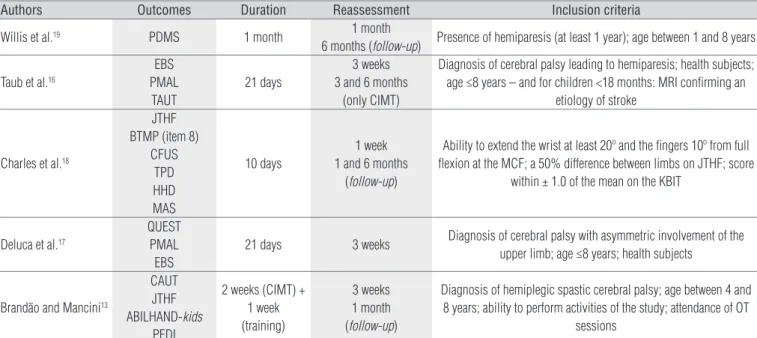
PDMS: Peabody Developmental Motor Scales; EBS: Emerging Behaviors Scale; PMAL: Pediatric Motor Activity Log; TAUT: Toddler Arm Use Test; MRI: Magnetic Resonance Imaging; JTHF: Jebsen-Taylor Test of Hand Function; BTMP: Bruininks-Oseretsky Test of Motor Proficiency; CFUS: Caregiver Functional Use Survey; TPD: two-point discrimination; HHD: hand-held dynamometer; MAS: Modified Ashworth Scale; MCF: metacarpophalangeal joints; KBIT: Kaufman Brief Intelligence Test; QUEST: Quality of Upper Extremity Skills Test; CAUT: Child Arm Use Test; ABILHAND-kids: Measure of manual ability; PEDI: Pediatric Evaluation of Disability Inventory; OT: Occupational therapy.
Table 1. Randomized clinical trials included in this systematic review.
Authors Outcomes Duration Reassessment Inclusion criteria
Willis et al.19 PDMS 1 month 1 month
6 months (follow-up) Presence of hemiparesis (at least 1 year); age between 1 and 8 years
Taub et al.16
EBS PMAL
TAUT
21 days
3 weeks 3 and 6 months
(only CIMT)
Diagnosis of cerebral palsy leading to hemiparesis; health subjects; age ≤8 years – and for children <18 months: MRI confirming an
etiology of stroke
Charles et al.18
JTHF BTMP (item 8)
CFUS TPD HHD MAS
10 days
1 week 1 and 6 months
(follow-up)
Ability to extend the wrist at least 20º and the fingers 10º from full flexion at the MCF; a 50% difference between limbs on JTHF; score
within ± 1.0 of the mean on the KBIT
Deluca et al.17
QUEST PMAL
EBS
21 days 3 weeks Diagnosis of cerebral palsy with asymmetric involvement of the
upper limb; age ≤8 years; health subjects
Brandão and Mancini13
CAUT JTHF
ABILHAND-kids
PEDI
2 weeks (CIMT) + 1 week (training)
3 weeks 1 month (follow-up)
Diagnosis of hemiplegic spastic cerebral palsy; age between 4 and 8 years; ability to perform activities of the study; attendance of OT
sessions diference (MCID; deined as a change of at least 10% in the
maximum score of the scale used) were analyzed. he MCID makes it possible to measure change in relation to the baseline and to avoid a ceiling efect in the scales11.
Results
he systematic search of the literature resulted in identify-ing 34 studies on hemiparetic children and treatments relatidentify-ing to CIMT. Among these 34 studies, ive were randomized clinical trials (RCT), and these were included in this systematic review. hirteen studies were literature reviews and the other sixteen studies did not have an RCT-supported design or did not have any direct relationship with the topic under examination and therefore were not included in this review.
he studies included involved a total of 99 subjects (49 treated with CIMT and 50 as the control group). he number of participants involved in each trial ranged from 16 to 25 (19.8±3.25). he methodological quality, as assessed using the PEDro scale, ranged from 2 to 6 (4.4±1.36). he study by
Brandão and Mancini15 was the only one that had not received
prior classiication using this scale, and thus, it was duly clas-siied for the purposes of the present study, by two blinded assessors. he inclusion criteria for participation in these ive studies varied and the total duration of the intervention ranged from 10 to 30 days (20.6±6.34). he duration of cast use and the use or absence of complementary therapies such as physical
therapy, occupational therapy or home exercises also difered between the studies (Tables 1 and 2).
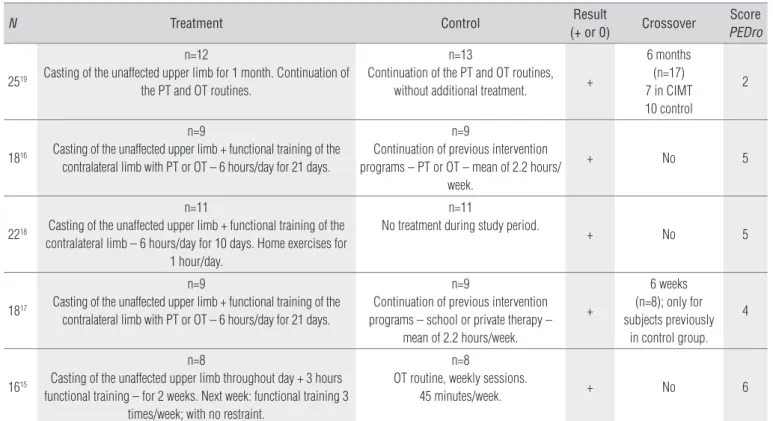
he study characteristics and results (summarized as ei-ther “+” when positive for the experimental group or “0” when
there was no diference in relation to the control group11) and
the inal score on the methodological scale are presented in Table 2. All the studies examined found that CIMT presented favorable characteristics as an upper-limb rehabilitation strategy. Table 3 presents the absolute results for outcomes in the studies, the percentage change in comparisons between phases and the percentage diference in variations between groups, with regard to the total variation allowed by the scale used in each study. For all studies, there was more improve-ment in the intervention group than in the control group, and this improvement was clinically signiicant for most of the vari-ables analyzed (MCID >10%). here was considerable variation between instruments used and between the methods used to evaluate the outcomes presented. he instruments most used were the Emerging Behaviors Scale (two studies16,17), Pediatric
Motor Activity Log (two studies16,17) and Jebsen-Taylor Test of
Hand Function (two studies15,18).
Discussion
Constraint-induced movement therapy is emerging as a treatment approach with the potential to improve the func-tional use of the afected upper limb among children with HCP.
hus, the present review evaluated the efectiveness of this type of intervention using the highest-level evidence available.
he study by DeLuca et al.17 presented evidence on the use
of CIMT among hemiparetic children, including the
acquisi-tion of new behavioral patterns, as shown by the Emerging
Behaviors Scale. he changes observed may be explained by a combination of the factors of which CIMT is composed, in just
Table 2. Study characteristics.
N Treatment Control Result
(+ or 0) Crossover
Score
PEDro
2519
n=12
Casting of the unaffected upper limb for 1 month. Continuation of the PT and OT routines.
n=13
Continuation of the PT and OT routines,
without additional treatment. +
6 months (n=17) 7 in CIMT 10 control
2
1816
n=9
Casting of the unaffected upper limb + functional training of the contralateral limb with PT or OT – 6 hours/day for 21 days.
n=9
Continuation of previous intervention programs – PT or OT – mean of 2.2 hours/
week.
+ No 5
2218
n=11
Casting of the unaffected upper limb + functional training of the contralateral limb – 6 hours/day for 10 days. Home exercises for
1 hour/day.
n=11
No treatment during study period.
+ No 5
1817
n=9
Casting of the unaffected upper limb + functional training of the contralateral limb with PT or OT – 6 hours/day for 21 days.
n=9
Continuation of previous intervention programs – school or private therapy –
mean of 2.2 hours/week.
+
6 weeks (n=8); only for subjects previously
in control group. 4
1615
n=8
Casting of the unaffected upper limb throughout day + 3 hours functional training – for 2 weeks. Next week: functional training 3
times/week; with no restraint.
n=8
OT routine, weekly sessions.
45 minutes/week. + No 6
PT: Physical Therapy; OT: Occupational Therapy.
Table 3. Study results: comparison between intervention and control groups.
NA=not available; *Absolute values not presented; the main author lacked the data. Analysis made by approximating graphical values (not confirmed); ** Absolute values not presented; no return after contacting main author. Analysis by approximating graphical values was not possible.
Authors Outcome Treatment Control Comparison
Pretest SD Post-test SD % Pretest SD Post-test SD % %
Willis et al.19 PDMS 143.2 NA 155.8 NA 6.43 102.2 NA 104.7 NA 1.27 5.16
Taub et al.16 EBS 12.2 5.64 21.5 4.45 30.0 12.7 6.51 15.0 5.66 7.42 22.58
PMAL (amount) 0.8 0.44 2.8 1.14 40.0 1.1 0.75 1.2 0.82 2.0 38.0
PMAL (quality) 0.9 0.62 2.7 0.97 36.0 1.6 1.2 1.9 1.13 6.0 30.0
TAUT NA NA NA NA 53.9 NA NA NA NA 18.0 35.9
Charles et al.18 JTHF 361.2 205.4 278.5 238 11.49 314.2 177.5 301.0 182.2 1.83 9.66
BTMP 4.8 3.0 7.2 2.9 3.33 4.8 3.7 5.2 4.2 0.55 2.78
CFUS (amount) 2.6 0.7 3.0 0.7 8.0 2.6 0.6 2.3 0.5 -6.0 14.0
CFUS (quality) 2.0 0.5 2.5 0.6 10.0 2.2 0.5 2.4 0.4 4.0 6.0
Deluca et al.17* QUEST 22.5 NA 36.25 NA 13.75 31.25 NA 30.0 NA -1.25 15.0
PMAL (amount) 0.77 NA 2.88 NA 42.2 1.15 NA 1.19 NA 0.8 41.4
PMAL (quality) 0.92 NA 2.69 NA 35.4 1.61 NA 1.96 NA 7.0 28.4
EBS 12.37 NA 22.10 NA 31.39 13.16 NA 15.53 NA 7.65 23.74
Brandão and Mancini15** NA
a single therapeutic process: casting of the unafected upper limb, treatment in a natural setting and intensive treatment for the afected upper limb. However, these authors suggest that these components should be broken down to identify the best intervention strategies and minimize the treatment costs and duration. Similar evidence comes from the study
by Willis et al.19, in which a speciic type of CIMT known as
forced-use therapy was employed. In this, the restriction was maintained without any speciic direction given for re-habilitation of the contralateral limb as a component of this intervention process, although participants were allowed to maintain routines such as physical therapy and occupational therapy. Positive results were found in the intervention group, compared with the control group, thus suggesting that the restriction component has considerable importance regard-ing the efectiveness of the treatment.
he results described by Taub et al.16 showed signiicant
improvements in the quality and amount of use of the more
impaired limb, compared with previous studies20,21. hese
im-provements were explained by the combination of casting with intensive training of contralateral limb using functional activi-ties. hese authors stated that despite the increasing popular-ity of restraint, it would seem to be of limited value when not coupled with active training.
he other studies analyzed15-18, unlike the method of Willis
et al.19, prioritized combined interventions that allowed lower
intensity of restraint use (in terms of consecutive hours or days). In a study using CIMT for six hours a day over a 10-day
period, Charles et al.18, found considerable evidence of beneits
from the use of CIMT, considering efect sizes and changes that were retained for up to six months after the intervention. he indings suggested that the intensity of training need not be as high as that applied to hemiparetic adults (constant use of the restraint) and that periods of intense structured practice may be more important than the duration of restraint.
Increased intensity and duration of interventions have been shown to contribute towards improved performance re-garding the speed of tasks and to facilitate the transition from skills characterized as inconsistent and varied to consistent and structured actions15,22 . However, this progression should
be undertaken with caution, because some components of in-terventions involving high-intensity training and restraint may lead to irritation and frustration among the children undergo-ing these procedures15.
Among the main modiications that have been described are improvements in the frequency and quality of movements presented by the afected limb following CIMT, as demonstrated by analysis of two-handed tasks. his evidence suggests that greater use of the afected limb is achieved during these
activi-ties, thus improving task performance in daily activities18.
According to Taub et al.16, the changes relating to use of
the afected limb, following CIMT, may increase the child’s
communication and social skills accompanied by signs of in-creased conidence and enjoyment in carrying out activities of daily life. he improvement in spontaneity of use of the afected limb also suggests that this type of intervention promotes mo-tivation and the perception of the possibilities of using the af-fected limb when performing daily tasks, thereby reducing the learned nonuse15.
A new intervention approach including functional training for one week, conducted after applying the CIMT protocol, was
described by Brandão and Mancini13. his method may have
an important role with regard to acquiring functionality, since it allowed the acquired skills to be incorporated into tasks of daily life after removal of the restraint, thus suggesting a new protocol for CIMT. However, these diferent types of treatment that have been described need to be compared in order to elu-cidate the best intervention method using CIMT.
In general, comparisons between control groups and groups using CIMT, among hemiparetic children, are still made by considering much longer interventions for the group receiv-ing the casts. his may overestimate the real efects from the
intervention. It has been shown15,16,23 that control groups need
to be ofered training sessions at the same intensity as that ap-plied to experimental groups. If this is not done, the positive results found from intervention groups might be attributable to diferences in the intensity of the treatment and not from the type of treatment studied.
his systematic review has presented important evidence regarding positive efects from CIMT as an intervention strat-egy for upper-limb rehabilitation among hemiparetic children. Nevertheless, the number of studies on this topic is limited and there are considerable methodological diferences between them, thus leading to inconclusive results. he studies use diferent instruments and scales to analyze the intervention efects, and this makes it diicult to compare the results ap-propriately and to perform meta-analyses. We suggest that further studies should be conducted to clarify the impact of using CIMT at diferent intensities, to investigate methods for combining CIMT with other techniques and to analyze the environmental context within which the activities are carried out. he use of valid and reliable instruments that are capable of measuring upper-limb function, two-handed activities and outcomes relating to activities and participation should be encouraged in order to enable better comparison between studies and understanding of the impact of this intervention on children’s daily lives.
1. O’Shea M. Cerebral palsy. Semin Perinatol. 2008;32(1):35-41.
2. Jones MW, Morgan E, Shelton JE, Thorogood C. Cerebral palsy: introduction and diagnosis (part I). J Pediat Health Care. 2007;21(3):146-52.
3. Rosenbaum P, Paneth N, Leviton A, Goldstein M, Bax M, Damiano D, et al. A report: the definition and classification of cerebral palsy April 2006. Dev Med Child Neurol. 2007;109:8-14.
4. Platt MJ, Pharoah POD. Epidemiology of cerebral palsy. Current Paediatrics. 1995;5:151-5.
5. Charles J, Lavinder G, Gordon AM. Effects of constraint-induced therapy on hand function in children with hemiplegic cerebral palsy. Pediatr Phys Ther. 2001;13(2):68-76.
6. Gordon AM, Charles JA, Wolf SL. Efficacy of constraint-induced movement therapy on involved upper-extremity use in children with hemiplegic cerebral palsy is not age-dependent. Pediatrics. 2006;117(3):363-73.
7. Gordon AM, Schneider JA, Chinnan A, Charles JR. Efficacy of a hand-arm bimanual intensive therapy (HABIT) in children with hemiplegic cerebral palsy: a randomized controlled trial. Dev Med Child Neurol. 2007;49(11):830-8.
8. Boyd RN, Morris ME, Graham HK. Management of upper limb dysfunction in children with cerebral palsy: a systematic review. Eur J Neurol. 2001;8 Suppl 5:150-66.
9. DeLuca SC, Echols K, Ramey SL, Taub E. Pediatric constraint-induced movement therapy for a young child with cerebral palsy: two episodes of care. Phys Ther. 2003;83(11):1003-13.
10. Taub E, Uswatte G, Mark VW, Morris DM. The learned nonuse phenomenon: implications for rehabilitation. Eura Medicophys. 2006;42(3):241-55.
11. Bonaiuti D, Rebasti L, Sioli P. The constraint induced movement therapy: a systematic review of randomized controlled trials on the adult stroke patients. Eura Medicophys. 2007;43(2):139-46.
12. Sampaio RF, Mancini MC. Estudos de revisão sistemática: um guia para síntese criteriosa da evidência científica. Rev Bras Fisioter. 2007;11(1):83-8.
13. PEDro [homepage na Internet]. Austrália: Physiotherapy Evidence Database; 1999. [atualizada em 2009 Feb 02; acesso em 2008 Nov]. Disponível em: http://www.pedro.fhs.usyd.edu.au/index.html
14. Maher CG, Sherrington C, Herbert RD, Moseley AM, Elkins M. Reliability of the PEDro scale for rating quality of randomized controlled trials. Phys Ther. 2003;83(8):713-21.
15. Brandão MM, Mancini MC. Efeitos da terapia de movimento induzido por restrição na funcionalidade de crianças com paralisia cerebral [dissertação]. Belo Horizonte, MG. Escola de Educação Física, Fisioterapia e Terapia Ocupacional-Universidade Federal de Minas Gerais; 2007.
16. Taub E, Ramey SL, DeLuca S, Echols K. Efficacy of constraint-induced movement therapy for children with cerebral palsy with asymmetric motor impairment. Pediatrics. 2004;113(2):305-12.
17. DeLuca S, Echols K, Law CR, Ramey SL. Intensive pediatric constraint-induced therapy for children with cerebral palsy: randomized, controlled, crossover trial. J Child Neurol. 2006;21(11):931-8.
18. Charles JR, Wolf SL, Schneider JA, Gordon MA. Efficacy of a child-friendly form of constraint-induced movement therapy in hemiplegic cerebral palsy: a randomized control trial. Dev Med Child Neurol. 2006;48(8):635-42.
19. Willis JK, Morello A, Davie A, Rice JC, Bennett JT. Forced use treatment of childhood hemiparesis. Pediatrics. 2002;110(1):94-6.
20. Palmer FB, Shapiro BK, Wachtel RC, Allen MC, Hiller JE, Harryman SE, et al. The effects of physical therapy on cerebral palsy: a controlled trial in infants with spastic diplegia. N Engl J Med. 1988;318(13):803-8.
21. Scherzer AL, Mike V, Ilson J. Physical therapy as a determinant of change in the cerebral palsied infant. Pediatrics. 1976;58(1):47-52.
22. Manoel Ede J, Conolly KJ. Variability and the development of skilled actions. Int J Psychophysiol. 1995;19(2):129-47.
23. Dromerick AW. Evidence-based rehabilitation: the case for and against constraint-induced movement therapy. J Rehabil Res Dev. 2003;40(1):vii-ix.
102