ITS2 variability of
Biomphalaria
(Mollusca, Planorbidae) species from the
Paranapanema Valley (São Paulo State, Brazil): Diversity patterns,
population structure, and phylogenetic relationships
Roseli Tuan and Priscila dos Santos
Laboratório de Bioquímica e Biologia Molecular, Superintendência de Controle de Endemias,
Secretaria da Saúde do Estado de São Paulo, São Paulo, SP, Brazil.
Abstract
The ribosomal DNA internal transcribed spacer 2 (ITS2) has been shown to be a useful genetic marker for species identification and phylogenetic reconstruction in the genus of freshwater snailsBiomphalaria (Preston 1910). Addi-tionally, ITS2 studies inBiomphalaria have uncovered significant intra-specific genetic variability suggesting the presence of cryptic species complexes. We obtained ITS2 sequences for theBiomphalaria species B. glabrata, B. tenagophila, B. occidentalis and B. peregrina from the Paranapanema Valley (São Paulo State, Brazil) and com-pared them with a comprehensive set of publishedBiomphalaria ITS2 sequences using Bayesian inference of phy-logeny. Analysis of the resulting trees showed that the newly obtainedB. glabrata sequences did not cluster with those from other Brazilian localities and that sub-structuring occurred among BrazilianB. tenagophila populations. Moreover, although ITS2 sequences seem to indicate clear genetic differentiation within bothB. glabrata and B. tenagophila, evidence in support of the occurrence of cryptic species is more compelling for the latter. We discuss the significance and implications of the detected patterns of ITS2 variability for taxonomic studies inBiomphalaria.
Key words:Bayesian inference,Biomphalaria, DNA sequences, internal transcribed spacer 2 (ITS2), ribosomal DNA. Received: December 13, 2005; Accepted: August 9, 2006.
Species of planorbid snails belonging to the genus
Biomphalaria, which includes the vectors of the blood fluke Schistosoma mansoni, have recently received in-creasingly attention in molecular systematic and phylo-geography studies (Campbellet al., 2000; Vidigalet al., 2000, 2004; DeJong et al., 2001; Mavárez et al., 2002; Pointieret al., 2005). These studies have largely supported the pivotal body of work on the taxonomy of Neotropical
Biomphalariacarried out by malacologist Lobato Paraense (Paraense, 2001) and, additionally, uncovered interesting patterns of intraspecific variability (Mavárezet al., 2002; Vidigalet al., 2004).
Among the genetic markers used so far in studies on
Biomphalaria, the nuclear ribosomal DNA (rDNA) inter-nal transcribed spacers (ITS) have been shown to be partic-ularly useful for species identification and phylogenetic reconstruction (Campbellet al., 2000; Vidigalet al., 2000; Pointieret al., 2005). Furthermore, ITS sequence studies have revealed and/or confirmed sub-structuring within widely distributed species such as B. glabrata and B.
tenagophila(Mavárez et al., 2002; Vidigalet al., 2004), adding to the body of evidence indicating that these nomi-nal taxa may constitute complexes of cryptic species (Woodruff and Mulvey, 1997; Spatzet al., 1999). In these circumstances, the investigation of genetic variability pat-terns across the range of distribution of these species takes a prominent role in helping to elucidate how many independ-ently evolving entities there are and which geographical ar-eas they occupy.
In this study, we obtained nuclear ribosomal DNA (rDNA) internal transcribed spacer 2 (ITS2) sequences fromB. glabrata,B. tenagophila, B. occidentalisand B. peregrinaspecimens collected in the Paranapanema Valley region (São Paulo State, Brazil). The newly obtained se-quences were compared to all other ITS2 sese-quences pub-lished to date for the same species. In doing so, we addressed the following issues: polymorphism and diver-gence patterns, phylogenetic relationships, and the possible occurrence of species complexes inBiomphalaria.
We collected 16Biomphalariasnails (Table 1) along the banks of different streams of the Paranapanema River in Ourinhos (lat -22.98, lon -49.87) and Ipauçu (lat -23.05, lon -49.62) and extracted total genomic DNA from the foot tis-sue of individual specimens using DNeasy Tistis-sue Kits
www.sbg.org.br
Send correspondence to Roseli Tuan. Superintendência de Con-trole de Endemias, Rua Paula Souza 166, 5 ° andar 01027-000 São Paulo, SP, Brazil. E-mail: [email protected].
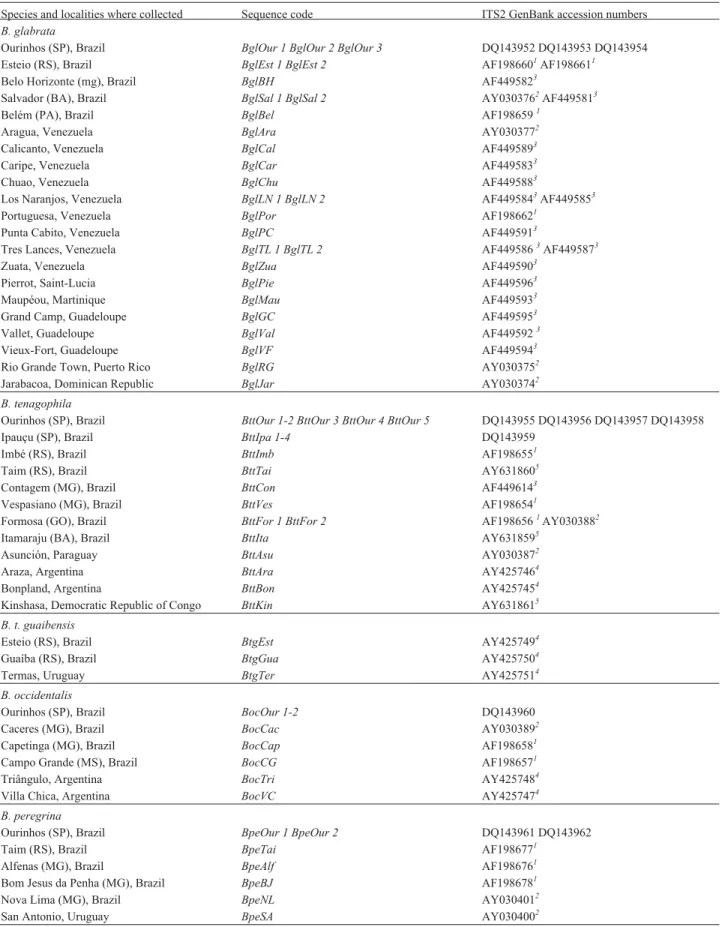
Table 1-BiomphalariarDNA ITS2 sequences used in the study.
Species and localities where collected Sequence code ITS2 GenBank accession numbers
B. glabrata
Ourinhos (SP), Brazil BglOur 1 BglOur 2 BglOur 3 DQ143952 DQ143953 DQ143954 Esteio (RS), Brazil BglEst 1 BglEst 2 AF1986601AF1986611
Belo Horizonte (mg), Brazil BglBH AF4495823
Salvador (BA), Brazil BglSal 1 BglSal 2 AY0303762AF4495813
Belém (PA), Brazil BglBel AF1986591
Aragua, Venezuela BglAra AY0303772
Calicanto, Venezuela BglCal AF4495893
Caripe, Venezuela BglCar AF4495833
Chuao, Venezuela BglChu AF4495883
Los Naranjos, Venezuela BglLN 1 BglLN 2 AF4495843AF4495853
Portuguesa, Venezuela BglPor AF1986621
Punta Cabito, Venezuela BglPC AF4495913
Tres Lances, Venezuela BglTL 1 BglTL 2 AF4495863AF4495873
Zuata, Venezuela BglZua AF4495903
Pierrot, Saint-Lucia BglPie AF4495963
Maupéou, Martinique BglMau AF4495933
Grand Camp, Guadeloupe BglGC AF4495953
Vallet, Guadeloupe BglVal AF4495923
Vieux-Fort, Guadeloupe BglVF AF4495943
Rio Grande Town, Puerto Rico BglRG AY0303752
Jarabacoa, Dominican Republic BglJar AY0303742
B. tenagophila
Ourinhos (SP), Brazil BttOur 1-2 BttOur 3 BttOur 4 BttOur 5 DQ143955 DQ143956 DQ143957 DQ143958
Ipauçu (SP), Brazil BttIpa 1-4 DQ143959
Imbé (RS), Brazil BttImb AF1986551
Taim (RS), Brazil BttTai AY6318605
Contagem (MG), Brazil BttCon AF4496143
Vespasiano (MG), Brazil BttVes AF1986541
Formosa (GO), Brazil BttFor 1 BttFor 2 AF1986561AY0303882
Itamaraju (BA), Brazil BttIta AY6318595
Asunción, Paraguay BttAsu AY0303872
Araza, Argentina BttAra AY4257464
Bonpland, Argentina BttBon AY4257454
Kinshasa, Democratic Republic of Congo BttKin AY6318615 B. t. guaibensis
Esteio (RS), Brazil BtgEst AY4257494
Guaíba (RS), Brazil BtgGua AY4257504
Termas, Uruguay BtgTer AY4257514
B. occidentalis
Ourinhos (SP), Brazil BocOur 1-2 DQ143960
Caceres (MG), Brazil BocCac AY0303892
Capetinga (MG), Brazil BocCap AF1986581
Campo Grande (MS), Brazil BocCG AF1986571
Triângulo, Argentina BocTri AY4257484
Villa Chica, Argentina BocVC AY4257474
B. peregrina
Ourinhos (SP), Brazil BpeOur 1 BpeOur 2 DQ143961 DQ143962
Taim (RS), Brazil BpeTai AF1986771
Alfenas (MG), Brazil BpeAlf AF1986761
Bom Jesus da Penha (MG), Brazil BpeBJ AF1986781
Nova Lima (MG), Brazil BpeNL AY0304012
San Antonio, Uruguay BpeSA AY0304002
1Vidigalet al.(2000);2DeJonget al.(2001);3Mavárezet al.(2002);4Vidigalet al.(2004);5Pointieret al.(2005).
(Qiagen). The nuclear rDNA ITS2 was amplified by the polymerase chain reaction (PCR) using the ITS2F and ETTS1 primers (Vidigalet al., 2000) in a 50µL total
vol-ume of amplification mixture containing 10-100 ng of
BiomphalariaDNA, 0.2 mM of each dNTP, 0.10 µm of
each primer and 1 U ofTaqDNA polymerase (BioLabs) with the supplied buffer. The following PCR temperature profile was used: a initial 4 min denaturation step at 94 °C followed by 35 iterations of 30 s at 94 °C, 1 min at 60 °C and 1 min at 72 °C plus a final 7 min extension at 72 °C. The PCR products were checked by agarose gel electrophoresis, cleaned using QIAquick PCR Purification Kits (Qiagen) and cloned using TOPO TA Cloning (Invitrogen) or pGEM-T (Promega) kits. One recombinant clone was se-quenced per individual. Sequencing was carried out at the Human Genome Research Center (CEGH, São Paulo).
Sequences were corrected using the program Chromas (Technelysium Pty Ltd.), aligned using the pro-gram ClustalX version 1.8 (Thompsonet al., 1997) and the alignments subsequently adjusted by eye using the program BioEdit version 7.0 (Hall, 1999). Two sequence alignments were built: one for the Ourinhos-Ipauçu data set, and an-other including a number of published sequences, also listed in Table 1. Nucleotide diversity (π, Nei, 1987,
equa-tions 10.5 or 10.6 and 10.7) and nucleotide divergence be-tween sequence groups (Dxy, Nei, 1987, equation 10.20
using Jukes and Cantor correction) were calculated using the program DnaSP version 4.1 (Rozaset al., 2003).
The program MrModeltest version 2.0 (Nylander, 2004) was used to determine the best-fit model of DNA se-quence evolution and model parameters for the sese-quence alignments. The data was used to choose the model form for Bayesian inference of phylogeny as implemented in the program MrBayes version 3.1 (Huelsenbeck and Ronquist, 2001). Two simultaneous independent searches were run for 1.5 x 10⁶generations, with trees saved every 100 gener-ations, and the first 1,500 sampled trees of each search dis-carded as “burn-in”. The data obtained in MrModeltest 2.0 was also used to obtain maximum-likelihood (ML) trees using the program PAUP* version 4.0 (Swofford, 2002), employing the heuristic search option and 100 random taxon addition replicates to improve tree searches. Clade support was assessed by 500 bootstrap pseudo-replicates, again with random addition of taxa (for the Ourinhos-Ipauçu data set only). Additionally, maximum parsimony (MP) trees were obtained using PAUP* 4.0 heu-ristic search option with 100 random additions, followed by computation of strict consensus trees and 1,000 bootstrap pseudo-replicates with random addition of taxa for measure of support. Gaps were treated as missing data. In all phylo-genetic analysesB. peregrinawas designated the outgroup.
The ITS2 fragments sequenced displayed a length range of 424-449 bp (primers excluded). The final align-ment matrix for the 16 sequences (9B. tenagophila, 3B. glabrata, 2B. occidentalisand 2B. peregrina) consisted of
468 characters, 69 of which were parsimony informative. The best-fit model of sequence evolution suggested by MrModeltest 2.0 for this alignment was the general time re-versible (GTR) plus G (gamma distribution for rate varia-tion among sites). The majority rule consensus tree obtained from the convergence of two independent Bayesian runs is shown in Figure 1. Exactly the same topol-ogy was observed in the single resulting ML tree (- lnL= 1094.27). MP searches yielded four equally parsimonious trees of length 87, consistency index (CI) = 0.977 and reten-tion index (RI) = 0.987. The strict consensus showed the same topology of the Bayesian/ML trees, except for the clade containing theB. glabratasequences, which became an unresolved trichotomy.
The tree depicted in Figure 1 shows a close relation-ship betweenB. tenagophilaandB. occidentalis, with this grouping being well differentiated from bothB. glabrata
andB. peregrina clades. These results are in accordance with previous ITS2 studies using the same species (Vidigal
et al., 2000; DeJonget al., 2001; Pointieret al., 2005). It is noteworthy, though, that some differentiation betweenB. tenagophilafrom the two collection sites was noticeable in the tree.
For comparison with previous studies, 48
Biomphalaria ITS2 sequences were added to the Ouri-nhos-Ipauçu data set, yielding a sequence alignment of 497 characters, 82 of which were parsimony informative. Iden-tical sequences (in the Ourinhos-Ipauçu data set) and sites 474 to 497 were removed before analyses. Included in the alignment were all B. glabrata, B. tenagophila, B. occidentalisandB. peregrinaITS2 sequences presented in Vidigalet al. (2000, 2004), DeJonget al. (2001), Mavárez
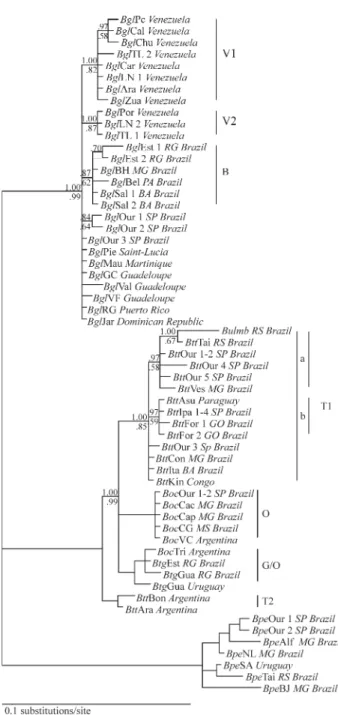
et al. (2002; except AF449580, due to sequence incom-pleteness) and Pointieret al. (2005). Figure 2 depicts the
Bayesian majority rule consensus tree obtained for this data set, using the parameters form of the GTR + G model, as recommended by MrModeltest 2.0. The ML analysis pro-duced two trees of - lnL = 1610.16, differing minimally from one another: tree # 1 hadBglBH sister toBglEst ½ and tree #2 displayed the same topology for the B. glabrata
clade as the Bayesian one. Both ML trees also differed from the Bayesian one by a minor variation in theB. peregrina
clade (BpeBJ sister toBpeTai/BpeSA). Evaluation of clade support for the ML trees via bootstrapping was precluded by computing limitations. The MP analysis yielded an in-calculable number of trees of length 160 (CI = 0.863, RI = 0.977), but the strict consensus of the first 100,000 re-tained trees produced the same topology as the Bayesian tree, except thatBglEst 1 andBglEst 2 did not cluster to-gether. MP bootstrap values (maximum number of trees re-tained per iteration set to 200) are indicated in Figure 2.
All B. glabrata sequences were recovered in a monophyletic clade, containing a set of defined branches denominated V1, V2 and B in Figure 2. These branches were also characterized by Mavárezet al. (2002), using concatenated ITS2 and mitochondrial 16S rDNA sequen-ces. Venezuela harbors two distinct ITS2 lineages (V1 and V2) and, interestingly, the Venezuelan sample reported in Vidigalet al. (2000) clearly belongs to subgroup V2, show-ing that this clade is more widespread than previously thought. The Brazilian clade (B), also reported by Mavárez
et al. (2002) for two sequences (BglBH andBlgSal 2), con-tained all other Brazilian sequences published to date (BglSal 1, DeJonget al., 2001;BglEst 1-2,BglBel, Vidigal
et al., 2000) except the ones from Ourinhos (BglOur 1-3), these latter sequences appearing in an unstructured, more basal, region of theB. glabrataclade, along with the se-quences from Central America (BglPie,BglMau,BglGC,
BglVal,BglVF,BglRG,BglJar).
In contrast to B. glabrata, the clade containing B. tenagophila,B. t. guaibensis, andB. occidentalissequences displayed a polyphyletic pattern (theB. tenagophila com-plex, Spatz et al., 1999; Vidigal et al., 2004). The B. tenagophila sequences were observed in two different branches (T1 and T2). The twoB. occidentalis samples from Argentina (BocTri andBocVC) also appeared on sep-arate branches, one clustered with B. t. guaibensis se-quences (G/O), the other with the remainingB. occidentalis
(O). However, unlike in Vidigalet al. (2004), support for joint monophyly of branches G/O and O was not obtained.
Interestingly, sub-structuring within the B. tenagophilaT1 branch was observed, extending the differ-entiation characterized for the Ourinhos/Ipauçu data set to other samples (T1 groups a and b). Additionally, some un-derivedB. tenagophila sequences were recovered, in the same fashion of the B. glabrata clade. In fact, sub-structuring withinB. tenagophilaT1 makes the nucleotide diversity in this branch only (π= 0.893% ± 0.232)
compa-rable to that found in the entire B. glabrata data set
(π= 0.729% ± 0.084). Divergence between branches within B. glabrata and B. tenagophila T1 is also similar (e.g.
DV1-V2= 1.277% ± 0.338, DT1a-b= 1.215% ± 0.434).
How-ever, when the entireB. tenagophilacomplex is considered it becomes apparent that not only is it comprised of highly diverse sequences (π= 1.604% ± 0.176) but also that
diver-gence within the nominal B. tenagophila is far larger
(DT1-T2 = 2.029% ± 0.532) than within the nominal B.
glabrata (for which DV1-V2 gives the highest pairwise
value). Finally, theB. peregrinaclade also encompasses a set of divergent sequences, which is reflected in a
ably high level of nucleotide diversity (π = 1.823% ±
0.412).
Whereas cross validation with independent biologi-cal markers remains a critibiologi-cal step in assessing the nature and significance of ITS2 variability inBiomphalaria, the patterns of genetic differentiation revealed in ITS2 studies nonetheless provide significant information about barriers to gene flow. Thus, it is remarkable to observe fixed dif-ferences betweenB. tenagophilasamples from Ourinhos and Ipauçu, localities no more than 30 km apart, and this finding may indicate low connectivity between these sites and deserves further investigation. It is also noteworthy thatB. glabratasequences from Ourinhos did not cluster with the remaining samples from Brazil, and in this case additional sampling within São Paulo and other Brazilian states will be needed to elucidate the significance of this finding on a broader phylogeographical scale. Nonethe-less, we note that in both cases the low magnitude of change (π< 1%) seems to indicate these are likely to be
examples of intraspecific polymorphism. Actually, a co-hesive status forB. tenagophilaT1 andB. glabrata sam-ples is suggested not only by the magnitude, but also by the pattern of distribution of ITS2 variability. The latter is apparent in the structure of both clades, which exhibit a few distinct but short branches and a set of undifferenti-ated sequences displayed in a “rake” fashion – the typical pattern of continuous sequence variability characteristic of single species (Crandall and Templeton, 1993). We in-vestigated this pattern further by examining statistical par-simony networks obtained with the program TCS (Clementet al., 2000) separately forB. glabrataandB. tenagophilaT1 sequences. In both cases, the most undif-ferentiated (zero length branches) sequences (BglOur 3,
BglPie, BglMau, BglGC, BglRG and BglJar for B. glabrata,BttCon,BttIta andBttKin forB. tenagophilaT1) occupied central (ancestral) positions in the networks, holding most of the mutational connections with other se-quences (data not shown). One direct implication of this finding is that, considering the presumably recent intro-duction of B. tenagophila into Africa (Pointier et al., 2005), ITS2 genotyping would offer limited power for source estimation of the Kinshasa population – the use of multiple and/or more sensitive genetic markers would be required in this case. However, since the reliability of net-work inferences (in particular the assignment of ancestral sequences) depends on dense populational sampling (Crandall and Templeton, 1993), and is, in general, an inadequate tool for use on data sets obtained mainly for taxonomic studies, these results must be regarded with caution, solely as preliminary conjectures to be tested with additional data.
When theB. glabrata clade was compared with the entireB. tenagophilacomplex clade, however, a more intri-cate picture emerged:vis-à-vis, theB. glabrataclade was shallower with less differentiated branches than the B.
tenagophilacomplex clade (Figure 2). Here, both the de-gree and the pattern of differentiation ofB. tenagophilaT1 and T2 branches supply compelling evidence that these samples may belong to distinct, yet cryptic, species.
Finally, in our reappraisal of the ITS2 data it was in-teresting to identify that the highest level of sequence diver-sity among all the species analyzed was forB. peregrina. Historically, species of greater epidemiological importance such asB. glabratahave received more attention in popula-tion genetic studies, and their respective levels of genetic diversity, therefore, emphasized (B. glabrata was once called “the most differentiated mollusc species yet de-scribed”, Woodruff and Mulvey, 1997). However, as data from multi-species studies accumulates it becomes evident that several NeotropicalBiomphalariaspecies (such asB. tenagophilaandB. peregrina) show remarkably high levels of genetic variability. This is a relevant finding from both epidemiological and evolutionary viewpoints and supports, for instance, the hypothesis of a Neotropical origin for the genus (Campbellet al., 2000; DeJonget al., 2001). More-over, it highlights the need for further studies aimed at in-vestigating patterns of population structure and species limits for these taxa.
Acknowledgments
Funding for this work was provided by the Brazilian agency FAPESP (Fundação de Amparo à Pesquisa do Esta-do de São Paulo), grant 03/00039-2.
References
Campbell G, Jones CS, Lockyer AE, Hughes S, Brown D, Noble LR and Rollinson D (2000) Molecular evidence supports an african affinity of the neotropical freshwater gastropod,
Biomphalaria glabrata, say 1818, an intermediate host for
Schistosoma mansoni. Proc Biol Sci 267:2351-8.
Clement M, Posada D and Crandall KA (2000) TCS: A computer program to estimate gene genealogies. Mol Ecol 9:1657-1659.
Crandall KA and Templeton AR (1993) Empirical tests of some predictions from coalescent theory with applications to intraspecific phylogeny reconstruction. Genetics 134:959-969.
DeJong RJ, Morgan JA, Paraense WL, Pointier JP, Amarista M, Ayeh-Kumi PF, Babiker A, Barbosa CS, Bremond P, Pedro Canese A, de Souza CP, Dominguez C, File S, Gutierrez A, Incani RN, Kawano T, Kazibwe F, Kpikpi J, Lwambo NJ, Mimpfoundi R, Njiokou F, Noel Poda J, Sene M, Velasquez LE, Yong M, Adema CM, Hofkin BV, Mkoji GM and Loker ES (2001) Evolutionary relationships and biogeography of
Biomphalaria(Gastropoda, Planorbidae) with implications regarding its role as host of the human bloodfluke,
Schistosoma mansoni. Mol Biol Evol 18:2225-2239. Hall TA (1999) BioEdit: A user-friendly biological sequence
alignment editor and analysis program for Windows 95/98/NT. Nucl Acids Symp Ser 41:95-98.
Mavárez J, Steiner C, Pointier J-P and Jarne P (2002) Evolution-ary history and phylogeography of the schistosome-vector freshwater snail Biomphalaria glabratabased on nuclear and mitochondrial DNA sequences. Heredity 89:266-272. Nei M (1987) Molecular Evolutionary Genetics. Columbia
Uni-versity Press, New York, 512 pp.
Nylander JAA (2004) MrModeltest 2.0. Program distributed by the author. Evolutionary Biology Centre, Uppsala Univer-sity.
Paraense WL (2001) The schistosome vectors in the Americas. Mem Inst Oswaldo Cruz 96(Suppl.):7-16.
Pointier J-P, DeJong RJ, Tchuem Tchuenté LA, Kristensen TK and Loker ES (2005) A neotropical snail host of
Schistosoma mansoni introduced into Africa and conse-quences for the schistosomiasis transmission:Biomphalaria tenagophilain Kinshasa (Democratic Republic of Congo). Acta Tropica 93:191-199.
Rozas J, Sanchez-Del Barrio JC, Messeguer X and Rozas R (2003) DnaSP, DNA polymorphism analyses by the coales-cent and other methods. Bioinformatics 19:2496-2497. Spatz L, Vidigal THDA, Caldeira RL, Dias Neto E, Cappa SMG
and Carvalho OS (1999) Study ofBiomphalaria tenagophila tenagophila, B. t. guaibensisandB. occidentalisby poly-merase chain reaction amplification and restriction enzyme
digestion of the ribosomal RNA intergenic spacer regions. J Molluscan Stud 65:143-149.
Swofford DL (2002) PAUP*. Phylogenetic Analysis Using Parsi-mony (*And Other Methods). Version 4. Sinauer Associ-ates, Sunderland.
Thompson JD, Gibson TJ, Plewniak F, Jeanmougin F and Higgins DG (1997) The ClustalX windows interface: Flexible strate-gies for multiple sequence alignment aided by quality analy-sis tools. Nucleic Acids Res 25:4876-4882.
Vidigal THDA, Kissinger JC, Caldeira RL, Pires ECR, Monteiro E, Simpson AJG and Carvalho OS (2000) Phylogenetic rela-tionships among BrazilianBiomphalariaspecies (Mollusca, Planorbidae) based upon analysis of ribosomal ITS2 se-quences. Parasitology 121:611-620.
Vidigal TH, Spatz L, Kissinger JC, Redondo RA, Pires EC, Simpson AJ and Carvalho OS (2004) Analysis of the first and second internal transcribed spacer sequences of the ribo-somal DNA in Biomphalaria tenagophila complex (Mollusca, Planorbidae). Mem Inst Oswaldo Cruz 99:153-158.
Woodruff DS and Mulvey M (1997) Neotropical schistosomiasis: African affinities of the host snailBiomphalaria glabrata
(Gastropoda: Planorbidae). Biol J Linn Soc 60:505-516.