Efficiency of treatments for controlling
Trichoderma
spp during spawning in
cultivation of lignicolous mushrooms
María Belén Colavolpe, Santiago Jaramillo Mejía, Edgardo Albertó
Laboratoty of Mycology and Mushroom Cultivation, Instituto de Investigaciones Biotecnológicas/ Instituto Tecnológico de Chascomús, Consejo Nacional de Investigaciones Científicas y Técnicas,
Universidad Nacional de San Martín, Provincia de Buenos Aires, Argentina.
Submitted: August 21, 2013; Approved: April 17, 2014.
Abstract
Trichoderma sppis the cause of the green mold disease in mushroom cultivation production. Many disinfection treatments are commonly applied to lignocellulose substrates to prevent contamination. Mushroom growers are usually worried about the contaminations that may occur after these treat-ments during handling or spawning. The aim of this paper is to estimate the growth of the green mold Trichoderma spon lignocellulose substrates after different disinfection treatments to know which of them is more effective to avoid contamination during spawning phase. Three different treatments were assayed: sterilization (121 °C), immersion in hot water (60 and 80 °C), and immersion in alka-linized water. Wheat straw, wheat seeds andEucalyptusorPopulussawdust were used separately as substrates. After the disinfection treatments, bagged substrates were sprayed with 3 mL of suspen-sion of conidia ofTrichoderma sp(105conidia/mL) and then separately spawned with Pleurotus ostreatusorGymnopilus pampeanus. The growth ofTrichoderma spwas evaluated based on a quali-tative scale.Trichoderma spcould not grow on non-sterilized substrates. Immersions in hot water treatments and immersion in alkalinized water were also unfavorable treatments for its growth. Co-cultivation with mushrooms favoredTrichoderma sp growth. Mushroom cultivation disinfection treatments of lignocellulose substrates influence on the growth ofTrichodermasp when contamina-tions occur during spawning phase. The immersion in hot water at 60 °C for 30 min or in alkalinized water for 36 h, are treatments which better reduced the contaminations withTrichodermasp during spawning phase for the cultivation of lignicolous species.
Key words:Trichodermasp,Pleurotus ostreatus,Gymnopilus pampeanus, green mold disease.
Introduction
Trichoderma sp, also known as green mold, is a cellulolytic filamentous fungus, which frequently contami-nates mushroom substrates. This fungus is often observed in the early stages of the process, especially during spawn-ing run period, but also durspawn-ing croppspawn-ing period and causes huge losses in mushrooms crops (Jandaik and Guleria, 1999; Yarma and Vijay, 1996).
Trichoderma sppinfection in edible basidiomycetes have been known for a long time (Komon-Zelazowskaet al., 2007). An Agaricus green mold disease started in Northern Ireland in 1985 and rapidly spread over farms
across Europe and was quickly succeeded by subsequent outbreaks all along Ireland in 1986, in England and Scot-land in 1987, in the NetherScot-lands in 1994, in France in 1997 and in Spain in 1998 (Hermosaet al., 1999; Mamounet al., 2000). This disease also occurred in the United States and Canada (Castleet al., 1998) causing important economic losses. The escalation of green mold evoked extensive re-search efforts to identify and study the causative agent (Castle et al., 1998; Krupke et al., 2003; Hatvani et al., 2007).
Green mold causes economic losses not only in Agaricusbut also in PleurotusandLentinulacultivation.
Send correspondence to Edgardo Albertó. Laboratoty of Mycology and Mushroom Cultivation, Instituto de Investigaciones Biotecnológicas/ Instituto Tecnológico de Chascomús, Consejo Nacional de Investigaciones Científicas y Técnicas, Universidad Nacional de San Martín, CC 164. 7130, Chascomús, Provincia de Buenos Aires, Argentina. E-mail: [email protected], [email protected].
Sharma and Vijay (Sharma and Vijay, 1996) reported a green mold attack in oyster mushroom in North America. Serious cases of green mold diseases in P. ostreatus in mushroom farms were recently detected in South Korea, It-aly, Hungary and Romania (Hatvaniet al., 2007). Komón-Zelazowska,et al.(2007), determined that the causal agents of this disease were two genetically closely related, but phenotypically strongly different, species ofTrichoderma, which have been described asTrichoderma pleurotumand Trichoderma pleuroticola. They belong to theHarzianum clade of Hypocrea/Trichoderma which also includes Trichoderma aggressivum, the causative agent of green mold disease ofAgaricus. Both species have been found on cultivatedPleurotusand its substratum in Europe, Iran, and South Korea, but T. pleuroticola has also been isolated from soil and wood in Canada, the United States, Europe, Iran, and New Zealand. T. pleuroticola displays pachy-basium-like morphological characteristics typical of its neighbors in the Harzianum clade, whereasT. pleurotumis characterized by a gliocladium-like conidiophore morphol-ogy which is uncharacteristic of the Harzianum clade. Dif-ferent species ofTrichoderma spincludingT. viridae,T. harzianumandT. polysporum, commonly cause also injury both to mycelia and basidioma of Lentinula edodes (Tokimoto and Komatsu, 1979).Trichoderma spproduces several enzymes involved in degradation of the fungal cell walls that may contain chitinases and glucanases (Sivan and Chet, 1989; Geremiaet al., 1993; Ait-Lahsen et al., 2001).
Various treatments are used for the preparation of substrate for mushroom cultivation to eliminate competi-tive fungi. They are: steam sterilization, steam pasteuriza-tion, hot water immersion and chemical treatment (Jaramillo and Albertó, 2013); but they are not always suc-cessful. Contaminations according to mushroom growers may even occur sporadically after these treatments during handling or spawning. The purpose of this paper is to esti-mate the growth of the green mold Trichoderma sp on lignocellulose substrates after different disinfection treat-ments to know which of them are more effective to avoid contamination during spawning phase.
Materials and Methods
Strains
Strains used in this work are conserved in ICFC (IIB-INTECH collection of Fungal Cultures, Laboratory of Mycology and Mushroom cultivation, IIB-INTECH; Chascomús, Argentina (reference in the WDCM data base: 826).
Pleurotus ostreatus
ICFC 153/99, commercial strain, 19-XI-1999, leg. E. Albertó; Gymnopilus pampeanus: ICFC 444/01, Capital Federal, Buenos Aires, Argentina; growing onEucalyptus,
10-V-2001, leg E. Albertó; ICFC 548/03, Burzaco, Buenos Aires, Argentina, growing on Melia azedarach stalk, 15-11-2003, E. Albertó; Trichoderma sp: ICFC 767/12, Chascomús, Buenos Aires, Argentina; 12-VIII-2012. Leg. M. B. Colavolpe, isolated fromP. ostreatuscultivation bag.
Spawn production
It was prepared following Pieckenstainet al.(1999). Briefly, glass bottles filled with boiled wheat grains and 1% w/w CaCO3were sterilized for 1.5 h at 121 °C, cooled and inoculated with an agar plug (1 cm diam.) cut from the ad-vancing margin of a 5-d-old colony grown on PDA (potato dextrose agar). Bottles were incubated in the dark, at 25 °C, with periodical shaking, during 15 days forPleurotusand Trichoderma sp,and 30 days forGymnopilus.
Trichodermasp inoculum
Conidia ofTrichoderma spwere massively produced using the spawn method. When spawning run period was finished, colonized bottles were left near a window at room temperature until the grains became all green colored due to the mature conidia. A suspension of Trichoderma sp conidia in distilled water was prepared. Colonized grains were immersed in distilled water under laminar flow; conidia were released by shaking. Then, water was filtered using cheesecloth and dropped into an Erlenmeyer flask. Concentration of conidia was adjusted to 105conidia/mL using a Neubauer chamber. Conidia suspension was not stored; a new suspension was made evey time it was needed.
Substrate preparation
Chopped wheat straw, wheat seed,Populusor Euca-lyptussawdust were separately used. Substrates were sub-jected to different treatments (see next point), then immediately bagged in polypropylene bags (15 x 30 cm) containing 100 g of wet substrate with the addition of 1% w/w of CaCO3. After they reached room temperature, they were sprayed with 3 mL of water suspension of conidia of Trichoderma sp. per bag and mixed. Then, bags were inoc-ulated with 10% of spawn of the mushroom used in each experiment (w/w) and afterwards they were stopped with cotton plugs held by PVC (polyvinyl chloride) cylinders.
Treatments of the substrate
proposed by Contreras et al. (2004). Substrates were soaked into an alkaline solution prepared with 0, 5% of cal-cium oxide for 0, 5 min, 12 h, 24 h or 36 h.
Experimental design and cultivation conditions
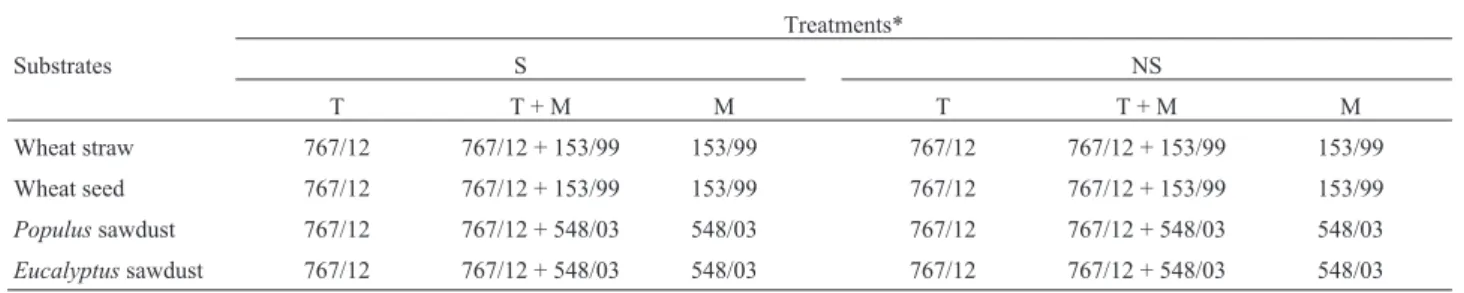
Three experiments with different objectives were car-ried out. The first experiment was focused on the evaluation of the growth of the green moldTrichoderma spafter the steam sterilization treatment. Two strains and four different sterilized and non-sterilized substrates were used (Table 1); the following treatments were performed: T (Trichoderma sp spray inoculum), T + M (Trichoderma sp spray inoculum + mushroom spawn), and M (mushroom spawn). Table 1 shows the experimental design. The second experi-ment was focused on the evaluation of the effect of differ-ent temperatures of heat treatmdiffer-ents of substrates on the growth of the green mold. Temperatures of 60, 80 °C (di-rect immersion in hot water) and 120 °C (steam sterilization of bagged substrates) were assayed. Two strains and three different substrates were used. The following treatments were performed: T, T + M and M (Table 2). The third ex-periment was focused on the evaluation of the growth of the green mold after immersion of the substrate in alkalinized water. Wheat straw was immersed in an alkaline solution during four different periods of time: 5 min, 12 h, 24 h and 36 h. One strain ofPleurotus ostreatusand one substrate (wheat straw) were used. Three treatments were tested: T, T + M and M. Controls without inoculating were performed in all experiments, bags were observed after 10 days of in-cubation at 25 °C in the dark. Five replicates for all treat-ments and experitreat-ments were carried out. The results were qualitatively expressed by assessing the visual degree of growth and colonization ofTrichoderma sp. The following symbols indicate degrees of growth of the green mold dis-ease in the bags: (+): Poor growth, less than 20% of sub-strate colonization; (+ +): Intermediate growth, 20-50% of substrate colonization; (+ + +): abundant growth, more than 50% of substrate colonization; (-): non-growth. Figure 1 shows the visual differences inTrichoderma spgrowth in the bags with wheat straw substrate spawned with Pleurotus ostreatusand the symbols used.
Results and Discussion
It is well known that substrate is one of the most im-portant contamination sources for green mold disease, es-pecially if it has a high level of carbohydrates (Fletcheret al., 1986). Different species ofTrichodermacan contami-nate the substrates; this may be due to the use of different substrates, the origin, and manufacturers (Komon-Zela-zowska et al., 2007). Contamination is the result of the inoculum potential plus the ability to rapidly grow in the substrate. The treatments of the substrates are generally used to affect the inoculum potential with the objective of eliminating all the spores ofTrichodermaspp present in the substrate, but they do not deal with the colonization ability if a new inoculum is introduced after heat treatment. Ar-rival of inoculum during spawning is frequent, and in a sub-strate without competitors, this inoculum may develop rap-idly. It is very common for South American mushroom growers to spawn substrate with their hand, without any mechanized help and in absence of care to avoid contami-nation. Thus, many of the contaminations that bags suffer withTrichodermasp could occur during spawn phase. To learn more about the conditions that promoteTrichoderma sp growth on lignocellulose substrates during spawning phase we designed a number of experiments in which sub-strates were treated with different methods commonly used to eliminate contaminations and then were inoculated with Trichodermasp previous to the inoculation with the mush-room spawn. To standardize the experiment, we firstly de-signed a method to inoculate the substrates with a spray of a suspension of conidia of Trichoderma sp. We used two mushroom species:P. ostreatus,widely worldwide culti-vated (Lechner and Albertó, 2011) and Gymnopilus pampeanusa species which, at present, is being studied for mushroom production (Colavolpe and Albertó, 2012, 2014). The latter can easily grow on sawdust ofPopulus andEucalyptusbut not on wheat straw. In our first experi-ment, results showed that sterilized substrates favor Trichoderma sp growth (+). This result is in agreement with previous works (Velázquez-Cedeñoet al., 2004; Ve-lázquez-Cedeñoet al., 2006). It is really interesting to ob-serve that T treatment on NS did not produce the growth of
Table 1- Experimental design to evaluate the growth of green mold disease after sterilization treatment.
Treatments*
Substrates S NS
T T + M M T T + M M
Wheat straw 767/12 767/12 + 153/99 153/99 767/12 767/12 + 153/99 153/99
Wheat seed 767/12 767/12 + 153/99 153/99 767/12 767/12 + 153/99 153/99
Populussawdust 767/12 767/12 + 548/03 548/03 767/12 767/12 + 548/03 548/03
Eucalyptussawdust 767/12 767/12 + 548/03 548/03 767/12 767/12 + 548/03 548/03
ICFC strains used: 767/12,Trichoderma sp; 153/99,Pleurotus ostreatus; 548/03,Gymnopilus pampeanus.T: spray ofTrichodermaconidia suspension; M:mushroom spawn, S: sterilized substrate, NS: non-sterilized substrate. Five replicates for each test were performed.
Trichoderma sp although it had a high concentration of conidia. It is supposed that S treatment due to high tempera-ture and the cooking effect, released nutrients that benefited the green mold. It is also considered that the reduction of the natural microbial flora of the substrate by the steriliza-tion acsteriliza-tion increases Trichoderma sp opportunities to colo-nize the substrate because of a lower presence of competi-tive micro flora which reduces the possibility of mycelial growth. Bacterial strains can inhibit the growth of Trichoderma sp by production of volatile organic com-pounds (Mackie and Whetley, 1999) or by releasing antibi-otics (Nielsenet al., 2000). Species of bacteria belonging to genusPseudomonashave been identified as antagonists of Trichoderma sp(Upadhyayet al., 1991; Elliset al., 2000). Velázquez-Cedeñoet al.(2004) proved that the capacity of T. longibrachiatumto compete with P. ostreatus in dual cultures decreased in the presence of other micro-orga-nisms in the substrates. The presence of total microflora in-creased the production of phenoloxidases byP. ostreatus despite a less abundant colonization of the substrate. The production of laccases has already been described as a re-sponse to environmental stress (Rayneret al., 1994; Score et al., 1997; Savoieet al., 2001). Velázquez-Cedeñoet al. (2007) proved that Bacillus spp. and specifically Paenibacillus polymyxafrom cultivation substrates are im-plicated in their selectivity by both inhibiting the growth of T. harzianumand stimulating defenses’ of the mushroom P. ostreatusthrough the induction of laccases.
We used four different substrates to test the growth of Trichoderma sp. Wheat straw which is commonly used for
Table 2 -Experimental design to evaluate the growth of green mold disease after immersion of substrates in water at 60, 80 °C or steam sterilization. Treatments* Substrates 60 °C 80 °C NS S T T+M M T T+M M T T+M M T T+M M Wheat straw 767/12 767/12 + 153/99 153/99 767/12 767/12 + 153/99 153/99 767/12 767/12 + 153/99 153/99 767/12 767/12 + 153/99 153/99 Populus sawdust 153/99 767/12 + 153/99 153/99 767/12 767/12 + 153/99 153/99 767/12 767/12 + 153/99 153/99 767/12 767/12 + 153/99 153/99 Populus sawdust 444/01 767/12 + 444/01 444/01 767/12 767/12 + 444/01 444/01 767/12 767/12 + 444/01 444/01 767/12 767/12 + 444/01 444/01 ICFC strains used: 767/12, Trichoderma sp ; 153/99, Pleurotus ostreatus ; 444/01, Gymnopilus pampeanus. T: spray of Trichoderma conidia suspension; M: mushroom spawn, S: sterilized substrate, NS: non-sterilized substrate. Five replicates for each test were performed. *Controls of 60 °C, 80 °C, NS and S treatments without inoculation were also carried out.
the production ofPleurotusspecie in the region (Carabajal et al., 2012); wheat seed which is used for spawn produc-tion,Populus, frequently used forPleurotus and Shiitake cultivation, andEucalyptuswhich is also used for Shiitake (Pireet al., 2001) andGymnopilus(Colavolpe and Albertó, 2012, 2014). The growth of Trichoderma sp was high (+++) for all substrates for T+M treatment with S. No strong differences among substrates and treatments in the growth ofTrichoderma spwere observed. Controls were free of contaminants. The source of contaminations in M treatments is unknown, it was probably present in the susbtrate and could survived due to a not enought sterlization time; for example sawdust (Table 3) in which longer steam treatments are needed.
In a second experiment, the analysis of table 4 also re-inforces this hypothesis. In fact,Trichoderma sp did not grow in 60 °C, 80 °C and NS treatments for T treatment. This is a relevant result if we take into account that the con-centration of conidia ofThichodermaherein used is high and probably very difficult to find in natural substrates. We also used a high ratio of spawn (10%), trying to find a bal-ance of forces between the concentration of conidia and the % of spawn. The lack of contamination of non-treated sub-strates may occur because of the microbiological quality of the substrate and also due to inability ofTrichoderma spto grow on “non-sterilized substrates” which is probably be-cause of the poor assimilable nutrient availability. Trichodermasp had difficulty in growing in M presence; the growth of M may affect some of the antagonistic bacte-ria present in NS and even thermoresistant ones present in 60 °C, or 80 °C. It is important to remark what happened with T+M treatments. In the case of 60 °C and 80 °C treat-ments,Trichoderma spgrew withPleurotus ostreatusand withGymnopilus pampeanus, in a smaller proportion than in S treatments but its growth was very clear. Controls were free of contaminants. We believe that there is an interaction between Trichoderma sp and the mushroom that favors green mold growth. This interaction could be due to the mushroom enzymes action. Enzymes of the mushroom
were released to the media and produced an extracellular digestion of the substrate. The nutrients, now available for Trichoderma sp, could be partially absorbed by the fungus and used to colonize the substrate. It is interesting to point out that growth ofTrichoderma spwas practically the same at 60 °C and 80 °C. So, if the mushroom grower uses an im-mersion in hot water treatment, 60 °C should be used to save energy and lower production costs. The immersion in hot water has some negative aspects: it uses a great amount of water, which could be a negative factor due to scarcity of this resource in some areas and it produces a reduction in yields due to the loss of nutrients extracted during heating by lixiviation (Jaramillo and Albertó, 2013). Additionally, the use of the alkaline method produces yields that can vary from 37 to 126% depending on the substrates (Contreraset al., 2004) and so is a preferable treatment method.
In the third experiment, we evaluated the growth of Trichoderma spafter the effect of the immersion of the sub-strate in alkalized water at different immersion times (Ta-ble 5). For T treatment, results showed thatTrichoderma sp did not grow when period of treatment was 24 or 36 h. Trichoderma sp managed to develop for T+M treatment which means thatTrichoderma spcould have been bene-fited by the enzymatic action of mushrooms in the co culti-vation. The period of time in which the lower growth (+) was obtained was 36 h. Controls were free of contaminants. Some researchers suggested that adjusting pH to alkaline levels is a good means of inhibiting the growth of competi-tor fungi without seriously affecting the growth of P. ostreatus (Stölzer and Grabbe, 1991). Contreras et al. (2004) pointed out that no fungal contamination was found in the treated substrates; however certain group of bacteria like pseudomonads, bacilli and coliforms were detected. In this case bacteria action could have also helped to control Trichodermasp development. For this experience, M treat-ments grew and colonized the substrate without any diffi-culty, which means that pH did not affect mushroom running. From this fact it may be concluded that adjust-ing pH by soakadjust-ing in alkaline solution to alkaline levels is a
Table 3- Growth of green mold disease after sterilization treatment*.
Treatments
Substrates S NS
T T + M M C T T + M M C
Wheat straw +++ (5) +++ (5) - (5) - (5) - (5) + (5) + (2) - (5)
Wheat seed ++ (5) +++ (5) - (5) - (5) - (5) - (5) - (5) - (5)
Populussawdust ++ (5) +++ (5) + (2) - (5) - (5) - (5) - (5) - (5)
Eucalyptussawdust + (5) +++ (5) + (1) - (5) - (5) - (5) - (5) - (5)
*See Table 1 for experimental design.
Colavolpe
et
al.
Treatments
Substrates Mushroom 60 °C 80 °C S NS
T T + M M C T T + M M C T T + M M C T T + M M C
Wheat straw 153/99 - (5) ++ (4) - (5) - (5) - (5) ++ (4) - (4) - (5) +++ (5) +++ (5) + (2) - (5) - (5) + (5) + (5) - (5)
Populussawdust 153/99 - (5) + (5) - (5) - (5) - (5) ++ (5) - (5) - (5) +++ (4) +++ (5) + (1) - (5) - (5) + (4) - (5) - (5)
Populussawdust 444/01 - (5) ++ (4) - (5) - (5) - (5) ++ (5) - (5) - (5) ++ (4) +++ (5) + (1) - (5) - (5) ++ (4) + (5) - (5)
*See Table 2 for experimental design.
T: Trichoderma sp(ICFC 767/12);M:Mushroom spawn (ICFC 153/99 or ICFC 444/01). S: Sterilized treatment, NS: non-sterilized treatment. C: Control (treatment without inoculation). (+): poor growth; (+ +): intermediate growth; (+ + +): abundant growth; (-): non-growth; the number between parentheses indicates number of replicates that obtained the result shown.
Table 5- Growth of green mold disease after substrate immersion in alkalinized water during different times. Substrates were inoculated with a spray ofTrichoderma(T) and withPleurotus ostreatusspawn (M).
Treatments Immersion in alkalinized water S
Duration of treatment
Substrate Ut 5’ 12 h 24 h 36 h
Wheat straw T T+M M C T T+M M C T T+M M C T T+M M C T T+M M C T T+M M C -(5) +(4) +(2) -(5) +(4) ++(4) -(4) -(5) +(4) ++(4) -(4) -(5) -(5) ++(4) -(5) -(5) - (5) +(4) -(5) -(5) +++
(5) +++
(5)
-(5) -(5)
good means of limiting the growth of green mold, and prob-ably other fungi, without seriously affecting the growth of P. ostreatus. This confirms reports by Stölzer and Grabbe (1991) and Hernándezet al.(Hernándezet al., 2003), who suggested the use of alkaline pHs to cultivate this mush-room.
The results here obtained reinforce the hypothesis that mushroom cultivation treatments of the substrates could influence the growth of green mold disease. As a sequence, these treatments would also influence the con-tamination which may occur during spawning phase. Care for sanitary handling of spawn has to be considered by mushroom farmers. Also, inoculation of bags has to prefer-ably be done in rooms instead of outdoors to avoid contami-nations.
Factors that influenceTrichoderma spgrowth can be summarized as follows: i) the quality of the substrate (mi-crobiological charge of contaminants) before treatment; ii) inability ofTrichoderma spto grow on non-sterilized sub-strates; iii) reduction of the natural microbial flora by the sterilization action which reduces competition for the sub-strate; iv) Co- cultivation with mushrooms which promotes Trichoderma spgrowth probably by the release of nutrients easily assimilable (simple sugars); v) Immersion in an alka-line solution limitsTrichoderma spgrowth.
Conclusion
Mushroom cultivation disinfection treatments of lignocellulose substrates influence on the growth of green mold disease when contaminations occur during spawning phase. The immersion in hot water at 60 °C for 30 min and immersion in alkalinized water for 36 h are the recom-mended treatments to avoid contaminations with Trichodermasp during spawning phase for the cultivation of xylophages species. Care for sanitary handling of spawn has also been considered by mushroom farmers to reduce contaminations. Further studies have to be carried out in or-der to determine the effects of the treatments on the release or immobilization of readily available nutrients (C and N) and the development of bacteria by focusing on those able to be antagonists ofTrichodermaspp.
Acknowledgments
This research was made possible by the support of the Argentinian National Research Council (CONICET) and the National University of San Martín (UNSAM).
References
Ait-Lahsen H, Soler A, Rey M, de La Cruz J, Monte E, Llobell A (2001) An antifungal exo-alpha-1, 3-glucanase (AGN 13.1) from the biocontrol fungusTrichoderma harzianum. Appl Environ Microbiol 67:5833-5839.
Carabajal M, Levin L, Albertó E, Lechner B (2012) Effect of co-cultivation of twoPleurotusspecies on lignocellulolytic
enzyme production and mushroom fructification. Interna-tional Biodeterioration & Biodegradation 66(1):71-76. Castle A, Speranzini D, Rghei N, Alm G, Rinker D, Bissett J
(1998) Morphological and molecular identification of
Trichoderma sp isolates on North American mushroom farms. Appl Environ Microbiol 64:133-137.
Colavolpe B, Albertó E (2012) Avaliação da produção do cogu-melo comestívelGymnopilus espectabilisvar pampeanus
em serragem de poplar eEucalyptus. Anales del VII Sim-posio de Biotecnología Aplicada a la Agricultura. Univer-sidad Paranaense, Umuarama.
Colavolpe, B. Albertó E (2014) Cultivation requirements and substrate degradation of the edible mushroom
Gymnopiluspampeanus- a novel species for mushroom cul-tivation. Scientia Horticulturae 180:161-166.
Contreras EP, Sokolov M, Mejía G, Sánchez JE (2004) Soaking of substrate in alkaline water as a pretreatment for the cultiva-tion ofPleurotus ostreatus. Journal of Horticultural Science and Biotechnology 79(2):234-240.
Ellis RJ, Timms-Wilson TM, Bailey MJ (2000) Identification of conserved traits in fluorescent pseudomonads with anti-fungal activity. Environ Microbiol 2:274-284.
Fletcher JT, White PF, Gaze RH (1986) Mushrooms: Pest and Disease Control. Intercept Limited, Newcastle, England, 159 pp.
Geremia R, Goldman GH, Jacobs D, Ardiles W, Vila SB, Van Montagu M, Herrera-Estrella A (1993) Molecular character-ization of the proteinase-encoding gene, prb1, related to mycoparasitism byTrichoderma sp harxiunum. Mol Micro-bial 8:603-613.
Hatvani L, Antal Z, Manczinger L, Szekeres A, Druzhinina IS, Kubicek CP, Nagy A, Nagy E, Vágvölgyi C, Kredics L (2007) Green mold diseases ofAgaricusandPleurotusspp. are caused by related but phylogenetically different
Trichoderma spspecies. Phytopathology 97:532-537. Hermosa MR, Grondona I, Monte E (1999) Isolation of
Trichoderma sp harzianum Th2 from commercial mush-room compost in Spain. Plant Dis 83:591.
Hernández D, Sánchez JE, Yamasaki, K (2003) Composting, a simple procedure for preparing substrate for cultivation of
Pleurotus ostreatus. Bioresource Technology 90(2):145-50. Jandaik S, Guleria DS (1999) Yield loss inAgaricus bisporusdue
toTrichoderma spinfection. Mushroom Res 8:43-46. Jaramillo S, Albertó E (2013) Heat treatment of wheat straw by
immersion in hot water decreases mushroom yield in
Pleurotus ostreatus. Rev Iberoam Micol 30(2):125-129. Komon-Zelazowska M, Bissett J, Zafari D, Hatvani L,
Manczinger L, Woo S, Lorito M, Kredics L, Kubicek CP, Druzhinina IS (2007) Genetically closely related but pheno-typically divergent Trichoderma spspecies causes green mold diseases in oyster mushroom farms worldwide. Ap-plied & Environmental Microbiology 73(22):7415-7426. Krupke OA, Castle AJ, Rinker DL (2003) The North American
mushrooms competitor, Trichoderma sp aggressivum f.
aggressivum, produces antifungal compounds in mushroom compost that inhibit mycelial growth of the commercial mushroom Agaricus bisporus. Mycological Research 107(12):1467-1475.
proposed species for mushroom production. Rev Iberoam Micol 28:148-154.
Mackie AE, Whetley RE (1999) Effects and incidence of volatile organic compound interactions between soil bacterial and fungal isolates. Soil Biol Biochem 3:375-385.
Mamoun ML, Savoie JM, Olivier JM (2000) Interactions between the pathogenTrichoderma sp harzianumTh2 andAgaricus bisporusin mushroom compost. Mycologia 92:233-240. Nielsen TH, Thrane C, Christophersen C, Anthoni U, Sorensen J
(2000) Structure, production characteristics and fungal an-tagonism of tensin - A new antifungal cyclic lipopeptide from Pseudomonas fluorescens strain 96.578. J Appl Microbiol 89:992-1001.
Pieckenstain F, Mercuri O, Albertó E (1999) Mevinolin in natu-rally occurring specimens ofPleurotus cornucopiae. Micol Neotrop Aplicada 12:1-7.
Pire G, Wright JE, Albertó E (2001) Cultivation of shiitake using sawdust of widely available local woods in Argentina. Mic Int Aplic 13(2):1-5.
Rayner ADM, Griffith GS, Wildman HG (1994) Induction of met-abolic and morphogenetic changes during mycelial interac-tions among species of higher fungi. Biochem Soc Trans 22:389-394.
Savoie JM, Mata G, Mamoun M (2001) Variability in brown line formation and intracellular laccase production during inter-action between white-rot basidiomycetes andTrichoderma sp harzianumbiotype. Mycología 93:243-248.
Score AJ, Palfreyman JW, White NA (1997) Extracellular pheno-loxidase and peroxidase enzyme production during interspecific fungal interaction. Int Biodeterior Biodegrad 39:225-233.
Sharma SR, Vijay B (1996) Yield loss inPleurotus ostreatusspp. caused byTrichoderma sp viride. Mushroom Res 5:19-22. Sivan A, Chet I (1989) Degradation of fungal cell walls by lytic
enzymes fromTrichoderma sp harzianum. J Gen Microbiol 135:675-682.
Stölzer S, Grabbe K (1991) Mechanisms of substrate selectivity in the cultivation of edible fungi. In: Maher, MJ (ed) Mush-room Science 13. Science and Cultivation of Edible Fungi. Balkema, Rotterdam, pp 141-146.
Tokimoto K, Komatsu M (1979) Effect of carbon and nitrogen sources in media on the hyphal interference between
Lentinus edodesand some species ofTrichoderma sp. An-nals of the Phytopathological Society of Japon 45:261-264. Upadhyay RS, Visintin L, Jayaswal K (1991) Environmental fac-tors affecting the antagonism of Pseudomonas cepacia
againstTrichoderma sp viride. Can J Microbiol 37:880-884. Velázquez-Cedeño M, Farnet AM, Ferre E, Savoie JM (2004)
Variation of lignocellulosic activities in dual cultures of
Pleurotus ostreatusand Trichoderma sp longibrachiatum
on unsterilized wheat straw. Mycologia 96:712-719. Velázquez-Cedeño MA, Farnet AM, Mata G, Savoie JM (2006)
Estudio preliminar de la microflora bacteriana termo tole-rante de la pulpa de café y la paja de trigo con potencial de inhibición contra Trichoderma sp viride en el cultivo de
Pleurotus. Rev Mex Micol 22:33-39.
Velazquez-Cedeno M, Farnet AM, Mata G and Savoie JM (2007). Role of Bacillus spp. in antagonism between Pleurotus ostreatus and Trichoderma harzianum in heat-treated wheat-straw substrates. Bioresource Technology 99:6966-6973.