Rui M. L. Ferreira
1, Vanessa A. Nicolau
2, S´ılvia R. Amaral
3,
Jo˜ao G. A. B. Leal
4& Ant´onio B. Almeida
51
CEHIDRO-Instituto Superior T´ecnico, TULisbon, Av. Rovisco Pais, 1049-001
Lisboa, Portugal, [email protected]
2
CEHIDRO-Instituto Superior T´ecnico, TULisbon, Av. Rovisco Pais, 1049-001
Lisboa, Portugal, [email protected]
3
Laborat´orio Nacional de Engenharia Civil, Av. do Brasil, 101, 1700-066 Lisboa,
Portugal, [email protected]
4
Dept. of Civil Engineering, Faculty of Sciences and Technology, UNL, Quinta
da Torre, 2829-516 Caparica, Portugal; e-mail: [email protected]
5
CEHIDRO-Instituto Superior T´ecnico, TULisbon, Av. Rovisco Pais, 1049-001
Lisboa, Portugal, [email protected]
ABSTRACT
This paper is aimed at presenting i) a simple, yet sound, conceptual model
ap-plicable to the simulation of erosion, deposition and transport of cohesionless
sediment in stratified flows under high shear stresses and ii) numerical solutions
in idealized unsteady flow non-equilibrium transport situations. The conceptual
model for the granular phase comprises 2DV mass and momentum and energy
equations and constitutive equations, all derived within the dense limit of the
Chapman-Enskog kinetic theory. 1D shallow-flow conservation and closure
equa-tions are derived for the fluid-granular mixture. Formulas for the average velocity
in the transport layers, the vertical net flux of sediment mass and the thickness of
the transport layer are thus obtained. Numerical solutions for dam-break flows
over cohesionless mobile beds in prismatic and non-prismatic channels are
ob-tained and discussed.
Keywords
: Granular flows, sheet-flow, dam-break
1
INTRODUCTION
This paper is consecrated to the development of a one-dimensional conceptual
model applicable to flows with high geomorphic potential, herein geomorphic
flows. A large number of flows can be included in this category, including rock
or snow avalanches, debris flows or river flows in the upper regime exhibiting
sheet flow. They have in common the ultimate driving mechanism, gravity, the
fact that they are slender flows and the fact that they occur at or generate high
shear stresses. Another common feature is the importance of the micromechanical
characteristics of the sediment in the definition of the constitutive equations.
Given the common features, the conceptual model will be developed for
sheet-flows, i.e. clearly stratified flows with a transport layer under high shear stresses,
but is expected to be applicable also to debris-type flows, i.e. flows of a dense
mixture of granular material and water whose transport layer occupies the full
flow depth.
smooth, round and only slightly inelastic the kinetic theory requires only small
modifications in order to provide 2DV conservation laws for the mass,
momen-tum and fluctuating energy of the granular material and constitutive equations
for the stress tensor, conductivity and viscosity coefficients and dissipation rate.
The inclusion of frictional effects and viscous fluid-grain interactions is done by
patching in
ad hoc
theories (Ferreira 2005, p. 249). The 2DV conceptual model
is presented in Section 2. In the same section, the 2DV equations are
depth-averaged, in accordance with the shallow-flow hypothesis and with appropriate
kinematic boundary conditions. The continuum hypothesis is employed to merge
the necessary conservation equations expressing 1D mass and momentum
conser-vation.
In Section 3, the closure equations are obtained by process of numerical
exper-imentation. The 2DV conservation and constitutive equations of the transport
layer are solved in steady uniform conditions. Formulae for the average velocity
in the transport layers, the vertical net flux of sediment mass and the thickness
of the transport layer are obtained.
As they generate both sheet-flows and debris-like flows, dam-break flows are
adequate to test the solutions of the conceptual model. Numerical solutions
obtained for dam-break flows over cohesionless mobile beds, in prismatic and
non-prismatic channels, are presented in Section 4.
2
CONSERVATION EQUATIONS
Sheet-flow is a two-dimensional stratified flow involving a mixture of water and
granular material, picked up from the bottom. The granular phase is composed
of cohesionless sediment grains, nearly elastic, slightly rough and approximately
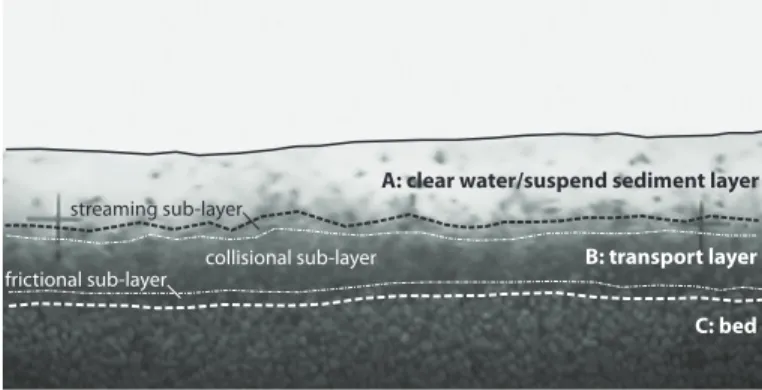
spherical. The fluid is viscous and incompressible. The flow structure is depicted
in Figure 1. Three main layers are promptly identified:
A
, characterized by small
mean sediment concentrations or by clear water and where turbulent stresses are
dominant;
B
a transport layer, featuring decreasing concentrations upwards and
stresses mainly originated in the granular phase and
C
the bed, composed of
grains with no appreciable horizontal mean motion.
A: clear water/suspend sediment layer
B: transport layer
C: bed
frictional sub-layer
collisional sub-layer
streaming sub-layer
Figure 1. Detail of a sheet-flow with highlighted layered structure.
In layer
B
, it is expected that granular collisional stresses are dominant except
in a thin bottom boundary layer where frictional stresses are dominant. The
collisional dominance assumption simplifies the expressions of the bulk granular
viscosity and of the granular conductivity (details in Ferreira 2005, pp. 231-250).
The 2DV conservation equations of layer
A
are the Reynolds-averaged
Navier-Stokes equations. For layer
B
, the mass and momentum conservation equations,
derived within the framework of the Chapman-Enskog theory, are, respectively
ρ
(g)D
t
(ν) +
ρ
(g)νu
(i,ig)= 0
(1)
ρ
(g)νD
t3 2ρ
(g)νD
t(Θ) =−Φi,i+Tij(g)u (g)
j,i −γ(gw) (3)
whereρ(g) is the density of the sediment grains,nu is the solid fraction (concen-tration at a specific point in the flow), u(ig) is the velocity field of the granular phase,P(g) is the granular pressure,T(g)
ij is the granular stress tensor,f (gw)
j is the
force per unit volume expressing the interaction (essentially of viscous nature) of fluid and granular phases, Θ is the granular temperature, Φi is the flux of
fluctuating energy andγ(gw) is the rate of dissipation, due to inelastic collisions and viscous damping (details in Ferreira 2005, pp. 247-249), of the fluctuat-ing energy. In equations (1) to (3) the operator Dt(·) stands for the material
derivative for which the convective operator is relative to the mean low, Ein-stein’s notation is used for space derivatives and the bracket operator · stands for point-wise time or ensemble average (ergodicity is assumed). Equation (3) reveals that, unlike thermodynamic systems a granular system can maintain a steady state of agitation, characterized by a given granular temperature, if and only if the rate of production equals the diffusive flux and the dissipation, i.e. if
Tij(g)uj,i(g) = Φi,i+γ(gw).
Conservation equations are also needed for the water phase. These can be obtained from a control volume analysis within the continuum hypotheses:
−ρ(w)Dt(ν) + (1−ν)ρ(w)u(i,iw)= 0 (4)
(1−ν)ρ(w)D t
u(jw)=−P,j(w)+Tji,i(w)+ (1−ν)ρ(w)g
j−fj(gw) (5)
where ρ(w) is the density of the fluid, u(w)
i,i is the fluid velocity field, P(w) is the
isotropic fluid pressure, Tij(w) is the fluid stress tensor.
In order to derive the 1D conservation equations, i) the 2DV equations of conservation of each constituent are summed (equations 1 and 4 and 2 and 5), ii) cinematic boundary conditions are applied the free-surface, bed and margins and iii) the equations are depth-integrated, within the continuum hypothesis. The 1D conservation of total mass is
∂tA+∂x(uh) =−∂tA0=−
Q
b−Q∗ b
(1−pb)Λ−Al
(6)
whereA=Aw+Ab,Ab= hb
0 σ(η)dηis the area of the cross-section occupied by layer B, hb is the thickness of layer B, Aw is the area corresponding to layer A,
A0 is the area below the channel (the channel bed), Qb = CbubAb is the actual
volumetric sediment discharge, Cb is the actual sediment concentration, Q∗b =
C∗
bubAb is the equilibrium sediment discharge, Cb∗ is the equilibrium sediment
concentration, ub is the velocity of B, pb is bed porosity, Λ is an adaptation
length (the length scale of non-equilibrium sediment transport) and Al is the
lateral contribution of mass from the channel banks. In the proposed model, the calculation ofAl is simplified, as shown in Figure 2.
∆Zb
A
Erosion. No failure
l
∆Zb
Erosion. Bank failure
Al
∆Zb
Deposition
The equation of conservation of total momentum is
∂tM +∂x
ρbu2bAb+ρ(w)uw2Aw+ρbgIb+ρ(w)gIw
+g
ρbAb+ρ(w)Aw
∂xZb=−τbP+gρbKb+gρ(w)Kw (7)
where Zb is the bed elevation, M = ρbAuis the mass discharge, u is the
layer-averaged velocity,uw is the velocity of layerA,τbis the bed shear stress,P is the
wetted perimeter,ρb=ρ(w)(1 + (s−1)Cb), s=ρ(g)/ρ(w) andIb, Iw,Kb and Kw
are impulsion terms.
The equation of conservation of mass in the transport layer is
∂tHb+∂x(Hbub) =−
Q
b−Q∗ b
Λ −T(1−pb)
(8) where the conservative variable isHb=AbCb.
The equation of conservation of the bed is (1−pb)∂tA0= Qb−Q
∗ b
Λ −Al(1−pb) (9)
The system of equations (6), (7), (8) and (9) admits four unknowns, the conservative variablesA,M,HbandA0. At each time step, the primitive variables
u,Cbmust be computed from the conservative ones.
Closure equations for hb, ub, τb, Cb∗ and Λ are needed. They will be derived
in the next section within the same granular dynamics paradigm.
3 CLOSURE EQUATIONS
Numerical experiments are performed to derive the closure equations. A detailed characterization of the two-dimensional (vertical) flow in the transport layer is obtained by solving numerically the following set of ODEs
dY
dz =M(Y, z) (10)
whereY=
T(g) P(g) u(g)
x Θ Φ ν T(w) P(w) u(xw) T
and
M(Y, z) =
−ρ(g)νgsin(β)−f D
−ρ(w)(s−1)νg 5π1/2
8
T(g) νρ(g)ϑ1ϑ3dsΘ11/2
−π1/2 4
1 νρ(g)ϑ
1ϑ4 Φ dsΘ1/2
5π1/2 8
(T(g))2
νρ(g)ϑ1ϑ3dΘ11/2 −π241/2
1−e(gw)
ρ(g)νϑ 1Θ
3/2 d π1/2
4
1+ϑ1
ρ(g)ϑ 1ϑ4
1+8ϑ1+4ν2dg0 dν
Φ
dΘ3/2− s−s1
gν
1+8ϑ1+4ν2dg0 dν
Θ
−ρ(w)(1−ν)gsin(β) +f D
−ρ(w)g
T(w) ρ(w)
1/2 1 κz(1−ν)1/2f(ν)
(11)
0 2 4 6 8 10 12 14 16
-5 -4 -3 -2 -1 0 1 2 3 4 5
dissipation, diffusion and production
z
/
d
3 21
1 2 3 3 2 1
0 2 4 6 8 10 12 14 16
0 5 10 15
velocity z / d 1 2 3 0 2 4 6 8 10 12 14 16
0 0.2 0.4 0.6
solid fraction
z
/
d 12
3 0 2 4 6 8 10 12 14 16
0 0.5 1 1.5 2
granular temperature z / d 1 2 3 0 2 4 6 8 10 12 14 16
-8 -3 2
flux
z
/
d
3 2 1
0 2 4 6 8 10 12 14 16
0 1 2 3 4
granular shear stress
z / d 3 2 1
(a) (b) (c)
(d) (e) (f)
u( )g/Ög s(-1)d
s
¾¾¾¾ n Q/ ((g s-1)d)
s
T( )g/(r g s(-1)d)
s ( )w
F/(r (( )w g s(-1)d) )
s3/2
non/dimentional dissipation, diffusion and production
z d / z d / z d / z d / z d / z d /
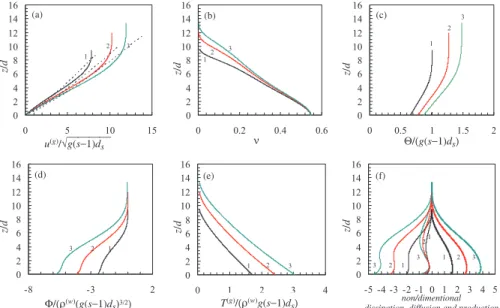
Figure 3.
Computed profiles of non-dimensional quantities in the
transport layer. Simulations 1, 2 and 3 correspond to, respectively,
θ
= 1.74
,
θ
= 2.49
and
θ
= 3.07
.
(details in Ferreira 2005, pp. 252-256). The results for plastic pellets with
d
=
0.003 m,
s
= 1.27 and coefficient of restitution
e
= 0.825 are shown in Figure 3.
Equations for
h
b,
u
b,
τ
band
φ
nets3,2= (Q
b−
Q
∗b)/Λ follow from the solution
shown in Figure 3. The existence of a frictional layer across which the shear
stress may vary allows for determining the mass flux between the bed and the
transport layer. The integration of the equation of conservation of momentum in
the vertical direction over the frictional layer renders (Ferreira (2005) p. 279)
∂
t(A
0) =
φ
net3,2=
gρ
(w)(s
−
1) tan (ϕ
b)
u
b(ρ
bu
x)
|
z=Zf(Q
b−
Q
∗b)
(12)
where
Z
fis the elevation of boundary between the frictional and collisional layers.
In equation (12) it is implicit that the equilibrium concentration is
C
∗b
=
C
fu
2/
(g(s
−
1) tan (ϕ
b)
h
b)
(13)
and the adaptation length is
Λ =
u
b(ρ
bu
x)
|
z=Zfgρ
(w)(s
−
1) (1
−
p
b
) tan (ϕ
b)
(14)
As seen in Figures 3c and 3d, the the modulus of the flux of the fluctuating
kinetic energy increases toward the bed and the granular temperature is never
zero. This means that fluctuating energy is constantly being extracted from the
mean flow and directed toward the bottom. As a consequence, the frictional
sub-layer cannot increase indefinitely. It is assumed that this sub-layer has a thickness of
2d. The value of the concentration in
ρ
band of (u
x)
z=Zfcan be read in Figures
3b and 3a, respectively. An estimate for the velocity in the transport layer can
be obtained by fitting the profiles of Figure 3a:
u(z)/u
=
116(z/h)
5/6(15)
where
h
is the flow depth. The depth-averaged velocity becomes
Depth-averaging the equation of conservation of the fluctuating energy,
Fer-reira (2005), pp. 278-287, obtained and algebraic relation for the thickness of
the transport layer. Taking in account the values of the restitution coefficient
and the internal friction angle at the bed, the non-dimensional thickness of the
transport load layer appears to depend little on the type of sediment and may be
approximated by
h
b/d
= 1.7 + 5.5θ
(17)
In rivers undergoing sheet-flow, flow resistance is only marginally influenced
by the particular shape of the stream bed, as alluvial bed forms are absent. The
micromechanical properties of the sediment and the interaction with the fluid, in
particular the energy dissipation in binary collisions and the interstitial viscous
dissipation, are the mechanisms to accommodate in the characterization of the
flow resistance. The results of Sumer et al. (1996) allow for the computation
of the friction factor. It was found that the bed shear stress can be adequately
described by
τ
b≡
ρ
(w)C
fu
2provided that the friction coefficient is
C
f= 0.02(h/d)
−1/2(w
s/u
∗)
−1/2
(18)
For practical purposes, the ratio
u
∗/w
s, where
w
sis the fall velocity is considered
to be 2.
4
COMPUTATIONAL RESULTS
The important formative potential of dam-break flows implies that they transport
an extremely high sediment load over long distances. They generally feature
debris-like characteristics at the wave front and a stratified sheet-like flow behind
it. The overall quality of the model is thus tested in dam-break flows performed
in idealized conditions, namely, instantaneous rupture and cohesionless mobile
bed. Mathematically, it is a Riemann problem, a particular Cauchy problem.
Written in vector notation, the first order, non-homogeneous, hyperbolic
sys-tem of conservation laws (equations 6, 7 and 8) that describe geomorphic
dam-break flows is
∂
t(
V
(
U
)) +
∂
x(
F
(
U
)) =
G
(
U
)
(19)
where
V
:
Êx
]0,
+
∞
[
→
Ê3
is the vector of dependent conservative variables,
U
:
Ê3
→
Ê
3
is the vector of primitive variables,
F
:
Ê3
→
Ê
3
is the flux vector,
G
:
Ê3
→
Ê
3
is the vector of the source terms and
x
and
t
are the space and
time co-ordinates, respectively.
A validation test was performed by comparing the results of the model with
laboratory results performed at UCL, Louvain-la-Neuve, Belgium (details in Benoit
2005 pp. 56-56 and Ferreira et al. 2006). The sediment particles were PVC
pel-lets with
s
= 1.56 kg m
−3and equivalent diameter
d
= 3.9 mm. The dimensions
of the particles exhibited little variability. The initial conditions, in terms of
h
L, the upstream water depth,
Z
bL, the upstream bed elevation,
h
R, the
down-stream water depth,
Y
Lthe upstream elevation above the upstream bed level,
α
≡
hR+|
min(
0,ZbL)
|
hL+max
(
0,ZbL)
and
δ
≡
ZbL
hL+max
(
0,ZbL)
, are shown in Table 1.
Table 1. Summary of the initial data for experimental tests.
hL Yb
L hR YL α δ
Name
(m) (m) (m) (m) (−) (−) 35 00 00 0.35 0.00 0.00 0.35 0.000 0.00035 10 00 0.25 0.10 0.00 0.35 0.000 0.286
35 10 10 0.25 0.10 0.10 0.35 0.286 0.286
found, especially for the flat bed case (test 35 00 00). Tests 35 10 00 and 35 10 10
show two different types of hydraulic jump that may occur in the
α
−
δ
plane
(Ferreira 2005, Ferreira et al. 2006). Due to the low downstream water depth in
test 35 10 00, the jump is induced by the non-equilibrium transport and friction
(Capart & Young 1998). The the jump observed in 35 10 10 is independent of the
source terms in equation (19). A general poor agreement in the bed elevation is
found in the vicinity of the gate, due to un-acountable geotechnical slope failure.
Figure 4. Computed and measured of the flow profiles corresponding
to the tests identified in Table 1
In order to test the effects of the variability of channel configuration and the
influence, on the final solution of the parameters that govern lateral bank failure,
a test was performed with trapezoidal erodible banks. Initial conditions comprise:
Z
bL= 0.06 m,
h
L= 0.21 m and
h
R= 0.0 m. The initial bed width is
b
f= 0.15
m and the inverse bank slopes are
m
= 0.84, which corresponds to an initial
bank slope angle of 50
o. This channel configuration mimics the experimental
tests presented by Le Grelle et al. (2003). The material of the bed and margins
is sand with
d
= 1.8 mm,
s
= 2.62, tan(ϕ
b) = 0.4. For the sake of numerical
stability, the friction coefficient was
C
f= 0.0067.
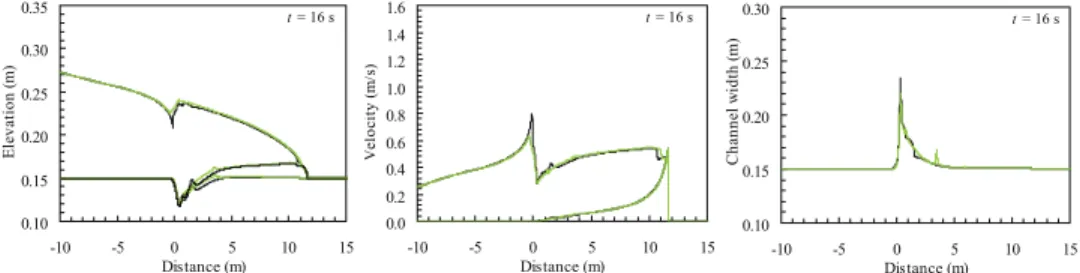
Numerical results are obtained with a conservative firs order flux difference
splitting discretization based on Euler’s method and Roe’s Riemann solvers
(de-tails in Ferreira 2005, pp. 465-479). The results are shown in Figure (5). Two
scenarios are shown, SimBe1 for which the critical bank slope is
m
cr= 0.7 and
SimBe2 for which
m
cr= 0.825. The equilibrium bank slope was, in both cases
m
eq= 0.839.
0.10 0.15 0.20 0.25 0.30
-10 -5 0 5 10 15 Distance (m)
C
h
a
n
n
e
l
w
id
th
(
m
)
t = 16 s
0.0 0.2 0.4 0.6 0.8 1.0 1.2 1.4 1.6
-10 -5 0 5 10 15 Distance (m)
V
e
lo
c
it
y
(
m
/s
)
t = 16 s
0.10 0.15 0.20 0.25 0.30 0.35
-10 -5 0 5 10 15 Distance (m)
E
le
v
a
ti
o
n
(
m
)
t = 16 s
Figure 5. Longitudinal profiles of the flow depth, bed elevation and
thickness of the transport layer (left), layer-averaged velocity and
ve-locity in the transport layer (center) and channel width at the initial
bed elevation (right).
X
′= (x/t)/
√
gY
L