Braz. J. of Develop.,Curitiba, v. 6, n. 10, p.78980-78995, oct. 2020. ISSN 2525-8761
Temporal standardization of tumbling and rest in the production of cooked
ham
Padronização temporal de tombamento e repouso na produção de presunto
cozido
DOI:10.34117/bjdv6n10-361
Recebimento dos originais: 08/09/2020 Aceitação para publicação: 16/10/2020
Andrêssa Cristina Datsch Demari
Instituição: Universidade Federal de Pelotas Endereço: Elizeu Maciel S/N, Capão do Leão/RS
E-mail: [email protected]
Ivan Ricardo Carvalho
Instituição: Universidade Regional do Noroeste do Estado do Rio Grande do Sul, Ijuí, RS, Brasil Endereço: Rua do Comércio
E-mail: [email protected]
Ângela Maria Fiorentini
Instituição: Universidade Federal de Pelotas Endereço: Elizeu Maciel S/N, Capão do Leão/RS
E-mail: [email protected]
Gustavo Henrique Demari
Instituição: Universidade Federal de Pelotas Endereço: Elizeu Maciel S/N, Capão do Leão/RS
E-mail: [email protected]
Gislaine Regina Rodrigues
Instituição: Universidade Federal de Pelotas Endereço: Elizeu Maciel S/N, Capão do Leão/RS
E-mail: [email protected]
Francine Lautenchleger
Universidade Estadual do Centro-Oeste (UNICENTRO), Guarapuava, PR, Brasil Endereço: Rua 11 de Outubro
E-mail: [email protected]
Tamires da Silva Martins
Instituição: Universidade Federal de Pelotas Endereço: Elizeu Maciel S/N, Capão do Leão/RS
E-mail: [email protected]
Catia Cristine Urnau Vivian
Instituição: Universidade Federal de Pelotas Endereço: Elizeu Maciel S/N, Capão do Leão/RS
Braz. J. of Develop.,Curitiba, v. 6, n. 10, p.78980-78995, oct. 2020. ISSN 2525-8761
Maristela Cortez Sawitzki
Instituição: Universidade Federal de Pelotas Endereço: Elizeu Maciel S/N, Capão do Leão/RS
E-mail: [email protected]
ABSTRACT
The work aims to evaluate and standardize the times of tumbling and rest of the meat in the processing of cooked ham, seeking to minimize the working time and the reduction in the formation of bubbles, without affecting the quality of the final product. The research was carried out in a meat sausage company, located in the Northwest region of Rio Grande do Sul-Brazil, following the formulation standards used by the company. The experimental design was randomized blocks (due to the fact that it is a large experiment and does not have control of all variables, carried out in batches and in different periods) organized in a factorial scheme (4 x 5) four times of tumbling x five times of rest, three repetitions. The presence of micro and macrobubbles is directly associated with the time of tumbling and time of rest of the mass. With the increase in tumbling time, the presence of microbubbles on the lateral and bottom surface of the ham increases. The resting time of the mass has a direct influence on the appearance of the ham, with a lower incidence of bubbles both on the side and on the surface of the ham. The shorter tumbling time (200 minutes), allows greater efficiency in the production time in the industry, however, a longer rest time of the mass is necessary. The longer tumbling time (270 minutes), favored the lower incidence of microbubbles when inlaid without rest (0 h), however as the rest time increased, there was an increase in the presence of bubbles. Therefore, to standardize the tumbling time in ham production depends on the industry objective, where the company can choose the process with longer tumbling time and no rest time. However, if the industry aims for efficiency in tumbling, shorter tumbler time may be used, but the rest time should be longer.
Keywords: quality of production, experimentation in products animals origins, meat production
chain.
RESUMO
O trabalho visa avaliar e padronizar os tempos de revolvimento e descanso da carne no processamento de presunto cozido, buscando minimizar o tempo de trabalho e a redução na formação de bolhas, sem afetar a qualidade do produto final. A pesquisa foi realizada em uma empresa de embutidos de carne, localizada na região Noroeste do Rio Grande do Sul-Brasil, seguindo os padrões de formulação utilizados pela empresa. O delineamento experimental foi em blocos ao acaso (por se tratar de um grande experimento e não possuir controle de todas as variáveis, realizado em lotes e em diferentes períodos) organizado em esquema fatorial (4 x 5) quatro vezes de tombamento x cinco vezes de descanso, três repetições. A presença de micro e macrobolhas está diretamente associada ao tempo de tombamento e ao tempo de descanso da massa. Com o aumento do tempo de revolvimento, aumenta a presença de microbolhas nas faces lateral e inferior do presunto. O tempo de descanso da massa influencia diretamente no aspecto do fiambre, com menor incidência de bolhas tanto nas laterais como na superfície do fiambre. O menor tempo de tombamento (200 minutos), permite maior eficiência no tempo de produção na indústria, porém, um maior tempo de descanso da massa é necessário. O maior tempo de tombamento (270 minutos) favoreceu a menor incidência de microbolhas quando incrustadas sem repouso (0 h), porém com o aumento do tempo de repouso, houve aumento na presença de bolhas. Portanto, a padronização do tempo de bica na produção de presunto depende do objetivo da indústria, onde a empresa pode escolher o processo com maior tempo de bica e sem descanso. No entanto, se a indústria almeja
Braz. J. of Develop.,Curitiba, v. 6, n. 10, p.78980-78995, oct. 2020. ISSN 2525-8761
eficiência no tamboreamento, um tempo menor de tambor pode ser usado, mas o tempo de descanso deve ser maior.
Palavras-chave: qualidade da produção, experimentação em produtos de origem animal, cadeia de
produção de carne.
1 INTRODUCTION
The demand for pork consumption is growing, as it is directly linked to the human diet, both directly and as an essential ingredient in various meat products (Ramos & Gomide, 2012). Pork meat has excellent flavor (Bezerra et al., 2007), nutritional value such as proteins (Maganhini et al., 2007), lipids, (Bragagnolo & Rodrigues-Amaya, 2002), carbohydrates, vitamins and minerals (Santos, 2005).
On the rise, world pork production went from 88,432 thousand tons of carcasses in 2002 to 3,759 million tons in 2017 (Abpa, 2018). Among the producers, Brazil is the fourth largest exporter in the world, accounting for 9.7% of total exports, behind only the European Union, the United States of America and Canada. Brazil also stands out for the consumption of pork, as it is among the largest consumers, with 2,795 thousand tons behind China, the European Union, the United States and Russia (Abpa, 2018).
Pork meat has aspects that facilitate its transformation and makes it possible to add sales value and contribute to consumption (Ramos & Gomide, 2012), among which stands out the production of processed ham from cuts of the back of the pork (shank), submitted to the thermal process (Brasil, 2000; Pedroso & Demiate 2008).
The production of cooked ham goes through some stages, which can influence the final quality of the product, such as the quality of the raw material influenced by the intrinsic characteristics of the animals, which unbalance the pH and consequently change the color and texture (Terra & Fries, 2000), interfering with the process, appearance, sensory characteristics and storage.
After obtaining the raw material, the next process is the preparation of the brine, where ingredients such as water, curing salts (sodium or potassium nitrite), protein of animal and/or vegetable origin, sugars, malt-dextrin, condiments, aromas and spices. The addition of these ingredients, as well as, the order of addition can influence the physical-chemical characteristics of the brine, the retention and release of liquid, texture and sensory characteristics (Pedroso & Demiate, 2008). During the injection of the brine, it is pumped into the meat through a system of needles effecting distribution of the ingredients, mainly of the curing agents in the piece in a uniform way that will result in the color, flavor and appearance (Bressan & Perez, 2001; Mendes et al., 2017).
Braz. J. of Develop.,Curitiba, v. 6, n. 10, p.78980-78995, oct. 2020. ISSN 2525-8761
Another important factor in the manufacture of ham is the tumbling or “massage”, which aims to accelerate the dissolution process, through the migration of ingredients between the muscle fibers of the meat and performing the extraction of myofibrillar proteins (Lawrie, 2005). In this step, the product's residence time can interfere with the release of liquid and the formation of bubbles after cooking, due to the breaking of the meat fibers and homogenization and bonding of the brine with the meat occur (Vanin, 2010), because, solubilization of myofibrillar proteins occurs (Dzudie & Okubanju, 1999).
The equipment that performs the massage is called tumblers, which improve the absorption of the ingredients and the cohesion of the cuts of meat, reducing losses after cooking. This operation makes it possible to remove the air bubbles present between the meat raw material and the brine, in addition to preventing the expansion of the bubbles during cooking (Katsaras & Budras, 1993), where the reduction of the tumbling time can increase the formation of bubbles and liquid release in the ham, and the longer the time of tumbling, the greater the effect on the quality of the ham.
After the tumbling process, the rest of the material can be performed, where it will provide the maturation and integration of the ingredients, fixing the color and flavor in the product, improving the visual and sensory aspect of the ham (Lawrie, 2005).
The presence of bubbles in the ham causes a bad appearance of the product to the consumer, not being attractive at the time of purchase. In addition to presenting an unpleasant appearance to the consumer, depending on the size and number of bubbles present in the ham, it is subject to microbiological contamination, as well as changes in the color of the ham, changing the flavor and aroma, because through the oxygen present in bubbles there is the possibility of oxidative processes (Terra et al, 2004).
Other important factors are the ham cooking time and temperature, because when used inappropriately they can interfere with quality, such as color change, lipid oxidation, rancification, presence of undesirable compounds, consequently decreasing the life of the meat product (Mathias et al., 2010).
The formulation of the meat derivative also influences the manufacturing process, as it reflects on the physical-chemical and sensory quality, due to the association of the ingredients causing water retention, influencing the color and texture (Nascimento et al., 2007), making it necessary to define and adjust the time of each stage of ham production.
In this way, this work aims to evaluate and standardize the times of tumbling and rest of the meat in the processing of cooked ham, seeking to minimize the working time and the reduction in the formation of bubbles, without affecting the quality of the final product.
Braz. J. of Develop.,Curitiba, v. 6, n. 10, p.78980-78995, oct. 2020. ISSN 2525-8761
2 MATERIAL AND METHODS
The research was carried out in a meat sausage company, located in the Northwest region of Rio Grande do Sul-Brazil, following the formulation standards used by the company.
The raw material pork, was obtained from pork legs originating from the slaughter of animals of the company, as well as, the formulation of the ham and the ingredients.
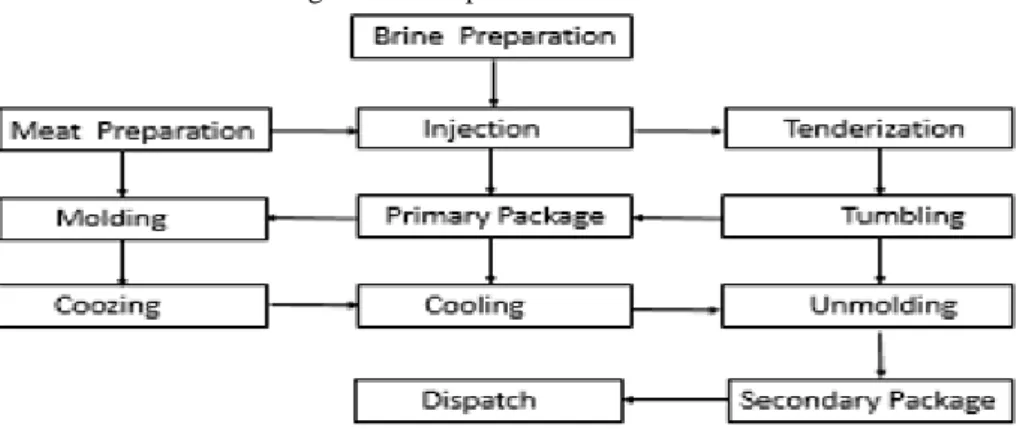
The processing of ham follows several steps (Figure 1), some of which are of extreme importance so that the pieces do not present any anomaly and remain in the pre-established pattern. Among the sequencing of the activities of production, injection, inlay, cooking and cooling are the bottlenecks that most interfere in the final result (Bressan & Perez, 2001).
Figure 1: Ham production flowchart
The meat raw material was prepared in the company's cutting and refining room, and for each treatment, 2,500 kg of pork ham was used, and the following cuts were cut and divided into 4 parts, the following cuts were used in the injection stage: outside flat, topside, rump steak and knuckle. In order to improve the alloy, 345 kg of the pig muscle called "tortuguita" were ground.
The brine was made with the use of water, a mix of phosphate, refined salt, aroma identical to that of the natural meat, soybean vegetable protein, sugar, carrageenan, spices, sodium erythorbate, glutamate, curing salt and cochineal dye, in a rectangular stainless steel tank with a capacity of 2,000 liters of brine, and a temperature between 5-6 ºC. Then, the brine was stored in tanks until it reached a temperature of -2 to 2 ºC, which is recommended for injection of the brine. Afterwards, it was injected into the meat through a system of needles, where the meat goes through a conveyor to the tenderizer, which has the purpose of making cross-sections, deposited in a hopper (raw material storage silo), until reaching the recommended injection percentage for each formulation.
Braz. J. of Develop.,Curitiba, v. 6, n. 10, p.78980-78995, oct. 2020. ISSN 2525-8761
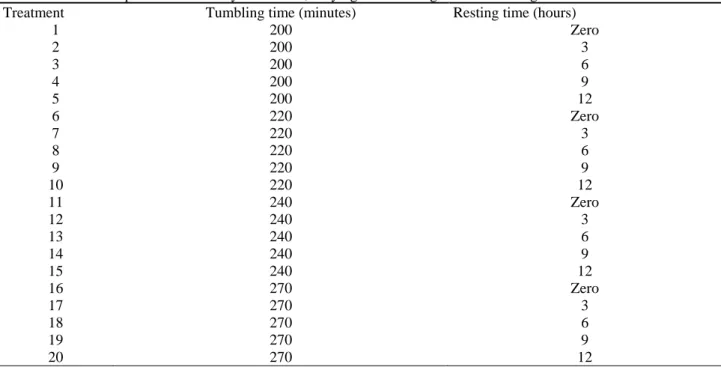
Table 1: Description of the twenty treatments, varying the tumbling time and resting time of the cooked ham.
Treatment Tumbling time (minutes) Resting time (hours)
1 200 Zero 2 200 3 3 200 6 4 200 9 5 200 12 6 7 220 220 Zero 3 8 220 6 9 220 9 10 220 12 11 12 240 240 Zero 3 13 240 6 14 240 9 15 240 12 16 17 270 270 Zero 3 18 270 6 19 270 9 20 270 12 Source: Author, 2019.
After the injection, the samples were sent to the tumblers, with a capacity of 5,000 kg, for homogenization of the mass. For the test, 4 similar tumblers (same brand, capacity, RPM, inclination and formulation of ham) were used, with different tumbling periods (200, 220, 240 and 270 minutes). Each tumbler when unloaded, originated 5 storage tanks, which generated 100 pieces of ham per tank. These tanks were sent to the inlay at different rest times, zero hours (just after unloading), 3 h, 6 h, 9 h and 12 h.
After tumbling, the samples were sent to the inlay sector, each tank generated 100 pieces of ham, with an average weight of 3.45 kg, deposited in thermo-processed cook-in packages, then placed in stainless steel shapes and packed in cages for cooking.
The cooking was carried out in tanks with water previously heated by steam, with temperature controlled by a digital thermometer, closed when the core (internal part) of the product reached a temperature of 72 ºC. After cooking, the samples were sent to cooling, in identical tanks, placed side by side, until reaching a temperature of 5 ºC.
The experimental design was randomized blocks (due to the fact that it is a large experiment and does not have control of all variables, carried out in batches and in different periods) organized in a factorial scheme (4 x 5) four times of tumbling x five times of rest, three repetitions, as shown in table 1.
Braz. J. of Develop.,Curitiba, v. 6, n. 10, p.78980-78995, oct. 2020. ISSN 2525-8761
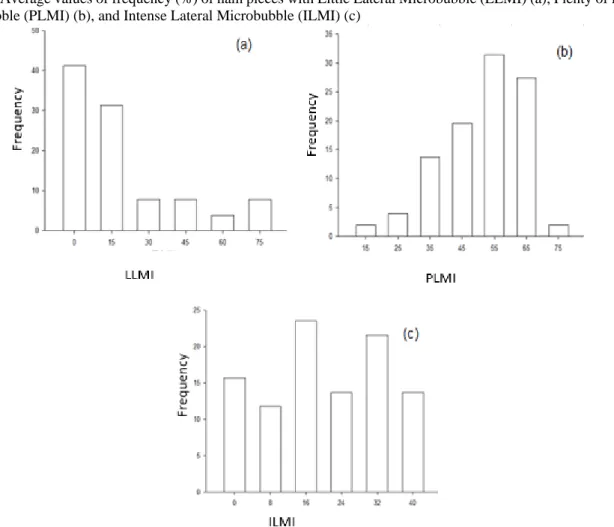
Figure 2. Average values of frequency (%) of ham pieces with Little Lateral Microbubble (LLMI) (a), Plenty of Lateral Microbubble (PLMI) (b), and Intense Lateral Microbubble (ILMI) (c)
The quantification of pieces by the presence of bubbles, was performed after unmolding and the number of pieces with the presence of Little Lateral Microbubble (LLMI), Plenty of Lateral Microbubble (PLMI), Intense Lateral Microbubble (ILMI), Little Microbubble Below (LMIB); Plenty of Microbubbles Below (PMIB), Intense Microbubbles Below (IMIB), Little Lateral Macrobubble (LLMA), Plenty of Lateral Macrobubble (PLMA), Intense Lateral Macrobubble (ILMA), Little Macrobubble Below (LMAB), Plenty of Macrobubble Below (PMAB), and Intense Macrobubble Below (IMAB). The pattern of the samples was defined according to the images illustrated in figures 2 to 5.
Braz. J. of Develop.,Curitiba, v. 6, n. 10, p.78980-78995, oct. 2020. ISSN 2525-8761
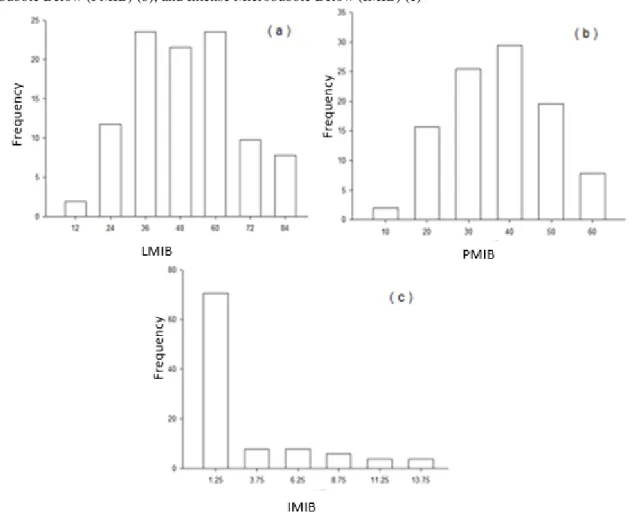
Figure 3. Average values of frequency (%) of ham pieces with Little Microbubble Below (lmib) (a), Plenty of Microbubble Below (PMIB) (b), and Intense Microbubble Below (IMIB) (c)
The discrete observations obtained in this study were submitted to the adjustment of continuous effects, establishing parametric properties for the measured variables. Afterwards, a descriptive analysis was used and later the frequency distribution, showing the formation of classes and the amplitude of the effects. Subsequently, the assumptions of normality and homogeneity of residual variances were applied (Ramalho et al., 2012), thus proceeding to the analysis of variance at 5% probability in order to identify the interaction between time of tumbling and time of rest, these when significant were broken down to simple effects by means of linear regressions with adjustment of the highest significant degree of the polynomial, based on the t test at 5% probability. In order to identify the trend of association between the measured variables, a linear correlation with its effects based on the t test at 5% probability was performed.
3 RESULTS AND DISCUSSION
According to the variable LLMI (Little Lateral Microbubble) Figure 2 (a), evaluated in ham samples, there was a variation from 0 to 75% of this phenomenon in the evaluated treatments, with 40% of the pieces showing no damage. For the variable PLMI (Plenty of Lateral Microbubbles)
Braz. J. of Develop.,Curitiba, v. 6, n. 10, p.78980-78995, oct. 2020. ISSN 2525-8761
Figure 2 (b), there was a variation of 15 to 75% in the treatments evaluated, with 55% presenting PLMI with a frequency of 33%. For the variable ILMI (Intense Lateral Microbubble) Figure 2 (c) the magnitude was from 0 to 40%, with 24% of the treatments evaluated showing 16% of pieces with the presence of ILMI.
In the variable LMIB (Little Microbubble Below) Figure 3 (a), there was a variation of 12 to 84% of this effect in the evaluated treatments, with 24% of the pieces showing 36% and 60% of bubbles. For the variable PMIB (Plenty of Microbubble Below) Figure 3 (b), there was a variation of 10 to 60% in the treatments evaluated, with 30% of the pieces evaluated 40% presenting PMIB. Whereas for the variable IMIB (Intense Microbubble Below) Figure 3 (c) the magnitude was 1.25 to 13.75%, where 70% of the pieces evaluated presented 1.25% presence of IMIB.
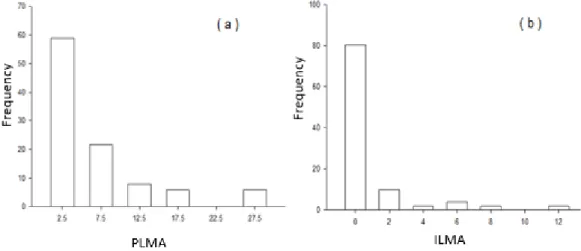
Figure 4: Average values of frequency (%) of ham pieces with Plenty of Lateral Macrobubble (PLMA) (a), and Intense Lateral Macrobubble (ILMA) (b)
The variable PLMA (Plenty of Lateral Macrobubble) Figure 4 (a), there was a variation of 2.5 to 27.5% of this phenomenon in the evaluated treatments, being that 60% of the pieces presented 2.5% of bubbles. For the variable ILMA (Intense Lateral Macrobubble) Figure 4 (b), there was a variation from 0 to 12% in the treatments evaluated, with 80% of the pieces evaluated showing 0% damage.
Braz. J. of Develop.,Curitiba, v. 6, n. 10, p.78980-78995, oct. 2020. ISSN 2525-8761
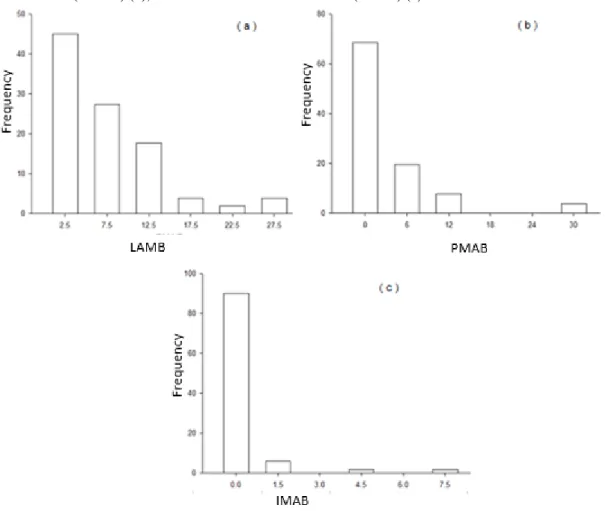
Figure 5. Average values of frequency (%) of ham pieces with Little Macrobubble Below (LMAB) (a), Plenty of Macrobubble Below (PMAB) (b), and Intense Macrobubble Below (IMAB) (c)
According to the variable LMAB (Little Macrobubble Below) Figure 5 (a), there was a variation of 2.5 to 27.5% of this phenomenon in the evaluated treatments, with 45% having 2.5% of bubbles. For the variable PMAB (Plenty of Macrobubble below) (supplementary material), there was a variation from 0 to 30% in the evaluated treatments, with 68% of the pieces evaluated showing 0% of damage. For the variable IMAB (Intense Macrobubble Below) (c) the magnitude was from 0 to 7.5%, with 90% of the treatments evaluated presenting 0% pieces with the presence of IMAB.
The analysis of variance made it possible to reveal significance in the interaction between tumbling time x resting time at 5% probability for the Little Lateral Microbubble variable (LLMI). The correlation estimate allows understanding relationships between characters and elucidating cause and effect actions of the characters involved, and divides the direct and indirect effects of the response by the variables analyzed and quantifies the contribution of each character (Rodrigues et al., 2017).
To perform Pearson's linear correlation (Table 2), 11 characters of the ham were used, and allowed to reveal that the ham pieces that presented Little Lateral Microbubble (LLMI) have a negative relationship (without or minimal relation), with the pieces that present Plenty of Lateral
Braz. J. of Develop.,Curitiba, v. 6, n. 10, p.78980-78995, oct. 2020. ISSN 2525-8761
Microbubble (PLMI), Intense Lateral Microbubble (ILMI), Plenty of Microbubble Below (PMIB). However, the pieces with Little Lateral Microbubble (LLMI) have a positive relationship (in relation) with the Little Microbubble Below (LMIB), showing that the ham pieces that presented LMIB also had Little Lateral Microbubble (LLMI). The relationship between bubbles may be due to the massaging of the mass in the tumbler, this is because the meat alloy starts in the tumbling process, through the extraction of myofibrillar proteins, during the coagulation of proteins in cooking (Lachowicz et al., 2003), and allows the removal and expansion of bubbles to occur during cooking (Katsaras & Dudras, 1993).
Table 2. Linear correlation for 11 characters in cook-in ham.
LLMI PLMI ILMI LMIB PMIB IMIB LLMA PLMA ILMA LMAB IMAB
LLMI . PLMI -0.612* . ILMI -0.845* 0.196 . LMIB 0.741* -0.326* -0.637* . PMIB -0.634* 0.543* 0.425* -0.866* . IMIB -0.269 0.183 0.287* -0.582* 0.450* . LLMA -0.339* -0.327* 0.438* -0.502* 0.174 0.014 . PLMA -0.224 -0.043 0.207 -0.377* 0.388* -0.042 0.351* . ILMA -0.436* 0.084 0.386* -0.442* 0.15 0.28 0.350* -0.109 . LMAB -0.211 -0.033 0.211 -0.18 0.084 -0.123 0.422* 0.238 -0.2 . PMAB -0.157 0.051 0.156 -0.324* 0.367* 0.055 0.1 0.754* -0.009 0.079 .
* Pearson's linear correlation coefficients (n = 91) significant at 5% probability of error.
(1) LLMI: Little Lateral Microbubble; PLMI: Plenty of Lateral Microbubble; ILMI: Intense Lateral Microbubble;
LMIB: Little Microbubble Below; PMIB: Plenty of Microbubble Below; IMIB: Intense Microbubble Below; LLMA:
Little Lateral Macrobubble; PLMA: Plenty of Lateral Macrobubble; ILMA: Intense Lateral Macrobubble; LMAB: Little Marcobubble Below; PMAB: Plenty of Macrobubble Below.
The ham pieces that had a Plenty of Lateral Microbubble (PLMI) showed a negative correlation with Little Microbubble Below (LMIB) and Little Lateral Macrobubble (LLMA), however the ham pieces with Plenty of Lateral Microbubble (PLMI) have a positive correlation with Plenty of Microbubble Below (PMIB). The analysis also showed that the ham with Intense Lateral Microbubble (ILMI) has a negative correlation with Little Microbubble Below (LMIB), and positive correlation with Plenty of Microbubble Below (PMIB), Intense Microbubble Below (IMIB), Little Lateral Macrobubble (LLMA) and Intense Lateral Macrobubble (ILMA). The Little Lateral Macrobubble (LLMI) showed a positive correlation with Plenty of Lateral Macrobubble (PLMA), Intense Lateral Macrobubble (ILMA) and Little Macrobubble Below (LMAB).
However, Plenty of Lateral Macrobubble (PLMA) showed a positive correlation with Plenty of Macrobubble Below (PMAB). In general, the interrelationship between the formation of bubbles may be due to the firmness of the mass, which allows greater compression between the muscles,
Braz. J. of Develop.,Curitiba, v. 6, n. 10, p.78980-78995, oct. 2020. ISSN 2525-8761
causing greater adherence in the packaging and reduction in the size and quantity of the bubbles (Xargayó et al., 2010).
We can also verify that the ham with Little Microbubble Below (LMIB) showed a negative correlation with Plenty of Microbubble Below (PMIB), Intense Microbubble Below (IMIB), Little Lateral Macrobubble (LLMA), Plenty of Lateral Macrobubble (PLMA), Intense Lateral Macrobubble (ILMA) and a Plenty of Macrobubble Below (PMAB). As for the ham that presented Plenty of Microbubble Below (PMIB), it has a positive correlation with Intense Microbubble below (IMIB), Plenty of Lateral Macrobubble (PLMA) and Plenty of Macrobubble Below (PMAB).
The results obtained in the interaction of the frequency and intensity of microbubbles and macrobubbles either on the lateral or on the surface of the ham are interconnected, because when LLMI occurs we also have the presence of LMIB and when there is PLMI it presents PMIB, and the same happens for ILMI that had a positive correlation for IMIB. The presence of microbubbles and macrobubbles in the ham is associated with the time of tumbling and resting, impacting the stage of inlay, where the machine responsible for dosing the mass in the molds cannot remove the empty spaces from the previous stage (Xargayó, 2010).
In general, hams that presented macrobubbles, simultaneously, present microbubbles, but those with microbubbles do not always have macrobubbles.
In relation to the time of tumbling, it is observed in (supplementary material) (a) that the pieces of ham had an influence in relation to the time of tumbling. For Little Lateral Microbubble (LLMI) (a), the longer tumbling time tends to increase the microbubbles, similar to what happened for Little Microbubble Below (LMIB) (supplementary material)(a), Plenty of Lateral Macrobubble (PLMA), and Little Macrobubble Below (LMAB) (a). However, the longer tumbling time reduces the number of pieces with Plenty of Lateral Microbubble (PLMI) (b), Intense Lateral Microbubble (ILMI) (c), Plenty of Microbubble Below (PMIB) (b), Intense Microbubble Below (IMIB) (c), Plenty of Macrobubble Below (PMAB) (b) and Intense Macrobubble Below (IMAB) (c).
The longer the massage time, the greater the effects on the quality of the final product, as the solubilization and extraction of proteins occurs with increased tumbling, increasing the water holding capacity in the product and reducing the presence of bubbles (Lagars & Xargayó, 2010). As the drumming time increases, the muscle structure relaxes, favoring the absorption and distribution of the brine, which increases the mobilization of the muscle protein, giving it alloy to the mass (Xargayó, 2010).
For the resting time, it is observed in (supplementary material), the microbubbles present on the lateral of the ham, there is a linear tendency of the longer resting time present an increase in
Braz. J. of Develop.,Curitiba, v. 6, n. 10, p.78980-78995, oct. 2020. ISSN 2525-8761
pieces with Little Lateral Microbubble (LLMI) with the longest resting time (a). There is also a tendency for longer rest times to present a reduction in pieces with Plenty of Lateral Microbubble (PLMI) (b) and Intense Lateral Microbubble (ILMI) (c).
The increase in LLMI with the time of rest improves the visual aspect of the ham, as it has few empty spaces on the outside of the piece, this is because the time of rest allows the best compaction of the mass, perfecting the step of filling and molding the product (Xargayó et al., 2010). Shows the microbubbles present in the lower region of the ham, the result was similar to that found in the evaluation of lateral microbubbles, where the increase in resting time tends to increase the Little Microbubble Below (LMIB) (a). For the variable Plenty of Microbubble Below (PMIB) (b), the tendency for the longest rest time is to present fewer bubbles, as well as for Intense Microbubble Below (IMIB) (c). Thus, the presence of microbubbles on the surface (below) of the ham, decreases with the increase in the resting time of the mass, due to the curing time that allows the greater approximation and union of the myofibrillar proteins extracted during the tumbling (Xargayó et al., 2010).
As already verified in the previous tests, the longer rest time allows for a reduction in the presence of bubbles, observed in (supplementary material), where the amount of Plenty of Lateral Macrobubble (PLMA) tends to decrease with the rest time. In the resting stage, compaction of the mass occurs, reducing empty spaces and preventing the appearance of larger bubbles in the final product (Xargayó, 2010).
The amount of Little Macrobubble Below (LMAB) (a) tends to reduce until 7 hours of rest, and subsequently tends to increase the bubbles. Thus, in (a) we can evidence that the increase in the resting time has a tendency to reduce the presence of LMAB and IMAB (c) presenting a higher frequency of pieces with PMAB (b).
Regarding the interaction of tumbling time and rest, it is observed that the tumbling time of 200 minutes tends to increase the number of pieces with Little Lateral Macrobubble (LLMA) with the increase in the rest time. 220 and 270 min tumbling tends to reduce macrobubbles with resting time, however, the time of 240 increases the number of pieces with Little Lateral Macrobubble (LLMA) up to 3 hours of rest and tends to reduce until 9 hours and increase from 10 hours on.
When the tumbling evaluation is carried out for 200 minutes, later in the resting stage, a longer resting time is necessary to achieve the expected result, which is a reduction in the presence of microbubbles and macrobubbles, while in the other periods of tumbling the increase in the resting time favors the reduction in the presence of bubbles. The brine dispersion and the binding strength of the ham are greater when longer tumbling cycles occur (Lachowicz et al., 2003).
Braz. J. of Develop.,Curitiba, v. 6, n. 10, p.78980-78995, oct. 2020. ISSN 2525-8761
4 CONCLUSION
The presence of micro and macrobubbles is directly associated with the time of tumbling and time of rest of the mass.
With the increase in tumbling time, the presence of microbubbles on the lateral and bottom surface of the ham increases.
The resting time of the mass has a direct influence on the appearance of the ham, with a lower incidence of bubbles both on the side and on the surface of the ham.
The shorter tumbling time (200 minutes), allows greater efficiency in the production time in the industry, however, a longer rest time of the mass is necessary.
The longer tumbling time (270 minutes), favored the lower incidence of microbubbles when inlaid without rest (0 h), however as the rest time increased, there was an increase in the presence of bubbles.
Therefore, to standardize the tumbling time in ham production depends on the industry objective, where the company can choose the process with longer tumbling time and no rest time. However, if the industry aims for efficiency in tumbling, shorter tumbler time may be used, but the rest time should be longer.
Braz. J. of Develop.,Curitiba, v. 6, n. 10, p.78980-78995, oct. 2020. ISSN 2525-8761
REFERÊNCIAS
Abpa. (2018). Associação Brasileira de Proteína Animal. Relatório anual, 2018.
Associação Brasileira de Normas Técnicas. NBR 14141: escalas utilizadas em análise sensorial. Rio de Janeiro, 1998b. 3 p
Bezeera JMM, Cavalcante Neto A, Silva LDPGD, Lui JF, Rodrigues AE, Martins TDD. (2007). Caracterização do consumidor e do mercado da carne suína na microrregião de campina grande, estado da Paraíba. Ciência Animal Brasileira. 8(3): 485-493.
Bragagnolo N, Rodriguez-Amaya DB. (2002). Teores de colesterol, lipídios totais e ácidos graxos em cortes de carne suína. Ciência e Tecnologia de Alimentos. 22(1): 98-1043.
https://doi.org/10.1590/S0101-20612002000100018
Brasil. (2000). Ministério da Agricultura E Do Abastecimento Secretaria De Defesa Agropecuária. Instrução Normativa Nº 20, De 31 De Julho De 2000.
Bressan MC, Perez JRO. (2001). Tecnologia de carnes e pescados. Centro de Editoração/FAEPE. Lavras. Portuguese.
Dzudie T, Okubanjo A. (1999). Effects of rigor state and tumbling time on quality of goats hams. Journal of Food Engineering, 42: 103-107.
Freire J. (2006). Análise Sensorial- Metodologia. Escola Superior Agrária de Coimbra.
Katsaras K, Budras K. (1993). The relationship of the microstructure of cooked ham to its properties and quality. Lebensm Wiss Technology, 26(3): 229-234.
https://doi.org/10.1006/fstl.1993.1050
Lachowicz K, Sobczak M, Gajowiecki L, Zych A. (2003). Effects of massagind time on texture, rheological properties, and struture of three pork ham muscles. Meat Sciense. 63: 225-233. doi: 10.1016/s0309-1740(02)00073-6.
Lagares J, Xargayó M. (2010). Modernizando la indústria Masajeo computerizado de la carne. Metalquimia, S.A. 108-113.
Lawrie RA. Ciência da Carne. Porto Alegre: Artmed. 2005; 384.
Maganhini MB, Mariano B, Soares AL, Guarnieri PD, Shimokomaki M, Ida EL. (2007). Carnes PSE (Pale, Soft, Exudative) e DFD (Dark, Firm, Dry) em lombo suíno numa linha de abate industrial. Ciência e Tecnologia de Alimentos. 2007; 27(supl.): 69-72. https://doi.org/10.1590/S0101-20612007000500012
Mathias SP, Rosenthal A, Gaspar A, Deliza R, Slongo AP, Vicente J, Masson LM, Barbosa C. (2010). Alterações oxidativas (cor e lipídios) em presunto de peru tratado por Alta Pressão Hidrostática (APH). Ciência e Tecnologia de Alimentos. 30(4): 852-857.
Braz. J. of Develop.,Curitiba, v. 6, n. 10, p.78980-78995, oct. 2020. ISSN 2525-8761
Nascimento R, Campagnol PCB, Monteiro ES, Pollonio MAR. (2007). Substituição de cloreto de sódio por cloreto de potássio: influência sobre as características físico-químicas e sensoriais de salsichas. Alimentos e Nutrição. 18(3): 297-302.
Pedroso RA, Demiate IM. (2008). Avaliação da influência de amido e carragena nas características físico-químicas e sensoriais de presunto cozido de peru. Ciência e Tecnologia de Alimentos. 28(1): 24-31. http://dx.doi.org/10.1590/S0101-20612008000100005
Ramalho MAP, Abreu AFB, Santos JB, Nunes JAR. (2012). Aplicação da genética quantitativa no melhoramento de plantas autógamas. Lavras, UFLA. 350p. Portuguese.
Ramos F, Gomide LA. (2012). Qualidade de Carnes. Fundamentos e Metodologias. 2ª Reimpressão. ed UFV, 599p.
Rodrigues GR, Demari ACD, Bernardo KBD, Demari G, Carvalho IR, Szareski VJ, Nardino M, Follmann DN, Dellagostin SM, Datsch VC, Pelegrin AJ, Souza VQ. (2017). Hygienic sanitary evaluation of the scalding stage in the process of swine slaughtering. Australian Journal of Basic and Aplied Sciences. 11: 72-76.
Santos BPD. (2005). Caracterização físico-química e sensorial dos apresuntados elaborados com carne suína provenientes da raça JSR, e acrescidos dos hidrocolóides: carragena, fécula de mandioca e maltodextrina. Masters dissertation. Universidade Federal do Paraná. Curitiba.
Terra NN, Fries LLM. (2000). A qualidade da carne suína e sua industrialização. 1◦ Conferência Internacional Virtual sobre Qualidade de Carne Suína 16 de novembro a 16 de dezembro de 2000 — Concórdia, SC.
Terra NN, Terra AB, Terra LM. (2010). Defeitos nos Produtos Cárneos: Origens e Soluções. Ed.Varela. 2010; São Paulo- SP.
Vanin NG. (2010). Aplicação de alta pressão hidrostática em produtos fatiados embalados à vácuo: uma revisão. Monografia de Engenharia de Alimentos. 2010; UFRGS. Porto Alegre.
Xargayó M. (2010). Processo de fabricación de produtos cárnicos cocidos de músculo enterro III: Masaje. Metalquimia, S.A. 2010; Girona: 100-105.
Xargayó M, Freixanet L, Lagares J, Fernandez E, Ponnet PJ. (2010). Efectos de uma fase de pre- massaje ( secuencia de impactos de presión) em la elaboración de produtos cárnicos cociso de músculo entero. Metalquimia, S.A., Girona:136-147.
Xargayó M, Lagares J, Freixanet L, Fernandez E. (2010). Embutición de produtos de músculo entero. Metalquimia, S.A., Girona: 36-147.
Xargayó M, Lagares J, Fernández E, Sanz D. (2010). Compactación de la carne durante la embutición del jamon: Um nueco avance em la automatización de los produtos cocidos de alta calidad. Metalquimia, S.A., Girona:150-156.