Effectiveness of track stiffness reduction in attenuation of metro
in-duced vibrations received by historical buildings
Abstract
Preservation of historical buildings is a main challenge in civil engineering field. One of the main concerns in this regard is metro induced vibration re-ceived by historical structures. There is a need to evaluate effectiveness of vibration mitigation measures in preservation of monumental buildings. The most widely used method of reducing metro vibrations is changes in the structure of the vibration source (not sufficiently investigated in the litera-ture). In response to this need, effectiveness of track stiffness reduction in mitigation of vibration was investigated in this research. Comprehensive field tests were conducted in the Iranian metro lines. The track stiffness as well as the induced vibrations were measured. It was shown that track stiff-ness has noticeable role in the track levels of vibration, and in turn in metro vibration reduction. The amounts of vibration reduction were derived as a function of track stiffness reduction.
Keywords
Railway track, stiffness, vibration, historical buildings
1 INTRODUCTION
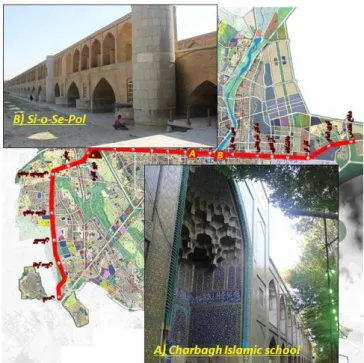
Construction of subways have eased the transportation and caused a boom in tourism industries in ancient and historical cities (Gonzalez-Navarro and Turner 2016, Sadeghi and Esmaeili 2017). However, there are various reports indicating damages made by the metro induced vibrations to the cultural and historical structures/build-ings adjacent to the metro lines (Vogiatzis 2012, Galvín, Mendoza et al. 2018). For instance, the ICHTO report (Sadeghi and Esmaeili 2017) indicates that the subway vibration levels has exceeded the allowable limits in the subway, Line 1, in Isfahan. Isfahan has several historical monuments registered by the ICHTO or UNESCO including Si-o-Se-Pol, a thirty-three arches bridge built 700 years ago, Charbagh Islamic school, a historical school built 600 years ago, and SarDar-e-Keymeghah, a building built 400 years ago (Sadeghi and Esmaeili 2017) (Figure 1).
There are several methods of reducing metro induced vibrations (Connolly, Kouroussis et al. 2015, Xu, Yan et al. 2015, Esmaeili, Naeimi et al. 2016). Vibration Reduction Methods (VRM) are categorized into three different groups. They are the VRM at source, at the propagation path, and at the receiver (Younesian and Sadri 2014, Con-nolly, Kouroussis et al. 2015). In the majority of the cases, the most preferable method is the VRM at the source since it is less costly and more practical compared to other methods (Cox and Wang 2003). In addition to prevent any possible rail/wheel irregularities or track roughness (which accuse extraction of vibrations), the main ap-proach for attenuation of the vibration at the source is reduction of track stiffness (Cox and Wang 2003, Van Leuven and Vanhonacker 2008, Sadeghi and Esmaeili 2017). This is the most widely approach employed in the new and existing railway tracks. A low track stiffness can be achieved mostly by the use of Floating Slab Track (FST) or High Resilient Fastening systems (HRF) (Sadeghi and Esmaeili 2017). In FST, track stiffness can be reduced by decreas-ing the modulus of elasticity of elastic layer, increasdecreas-ing the thickness of elastic layers, or decreasdecreas-ing the area of the elastic layers used under the slab-track. In the HRF, the track stiffness is reduced by installing elastic elements on the bottom or in the rail web which prevents the direct connection between rail and track and cause a considerable reduction in the stiffness of the track system.
A large amount of research has been made to drive a suitable methods for reduction of track stiffness (Cox and Wang 2003, Saurenman and Phillips 2006, Van Leuven and Vanhonacker 2008, Sadeghi and Esmaeili 2017). As a result, the HRF systems have been introduced and widely used in the world. Cox and his colleagues made a research in which they have partially studied the HRF method in the laboratory and proposed a relationship between track stiffness and vibration level based on laboratory tests (Cox and Wang 2003). Wang et al. conducted some field
J. Sadeghia* M. H. Esmaeilia
a Iran University of Science and Technology, Tehran, Iran. E-mail:
[email protected], [email protected]
*Corresponding author
http://dx.doi.org/10.1590/1679-78255252
measurements to investigate the effectiveness of a new type of HRF (whit the stiffness of 5 Mpa) recently appeared in Chinese subway lines (i.e. vanguard fasteners produced by Pandrol company) (Wang, Wei et al. 2016). Thorough field measurements, they found that this system is capable of reducing the vibration level up to 25 decibels. Van Leuven and Vanhonacker (Van Leuven and Vanhonacker 2008) developed a new HRF with the considerably low stiffness values (Less than 7 MPa) capable to reduce vibration levels up to 30 decibels. They installed this system in Brussels subway and monitored its dynamic behavior. Sadeghi and Esmaeili developed and implemented a HRF in the vicinity of monumental buildings in Isfahan subway line which decreased the vibration levels to the level below the acceptable range of allowed vibration (Sadeghi and Esmaeili 2017). In 1983, Federal Transportation Association (FTA) arranged a series of tests to investigate the effectives of a new kind of HRF system manufactured by Clouth Gummiwerke AG company in Germany (Chen 1995). This system has 13 MPa stiffness and called Cologne-egg. The results showed that it could reduce the vibration of the subway up to 8 decibels in the range of 31.5 to 63 Hz (Chen 1995). This system was further evaluated and implemented in the railways around the world including Chinese metro lines (Cui, Chen et al. 2016), Australia and Europe (Delkor-Rail 2017). Kun et al.(Kun, Lei et al. 2017) examined the effectiveness of Cologne-egg on the vibration response of bridge system compared with three other conventional fastening types. A special HRF system called Cradle fasteners with the ability to reduce the track stiff-ness by 2.5 MPa was developed by ABV Company in Russia (ABV-Co 2017). It has been installed on the Sokolniki line of Moscow subway under the Pushkin Museum of Fine Arts and A. M. Shilov art gallery. The evaluation of this system showed that this system is capable of reducing the vibrations up to 10 decibels at frequencies from 32 to 63 Hz (ABV-Co 2017).
Several research works have been made on the use of the FST in the design of low-stiffness track systems. Xin and Gao modeled a Train-FST-Bridge system using a combination of Finite Element and Multi Body Dynamics tech-nique to investigate the effects of track stiffness on wheel-rail forces, slab and bridge responses (Xin and Gao 2011). They concluded that a change in the stiffness of floating slab track (FST) does not noticeably affect the wheel-rail force and bridge response, but they have considerable effect on the response of the rails and slab track. They offered the optimum stiffness for a pad under a slab in the range of 20 to 40 MN/m3 . Zhu et al. developed a FST system
which provides the possibility of mitigating vibrations at low frequencies of 9 to 16 Hz (Zhu, Wang et al. 2017). They evaluated the effectiveness of their proposed FST in urban rail transit system. Toll et al (Töll, Achs et al. 2018) verified the performance of a FST System after 20 Years of Service. Similar works on FST systems were conducted by Ma et al. (Ma, Jiang et al. 2017) and Zhao et al. (Zhao and Ping 2018). A summary of stiffness variations of FST systems used in European countries was done by International Union of Railways (UIC 2008).
Fig. 1. Isfahan Metro Line 1 and historical monuments in the vicinity of this Line.
works on the on attenuation levels of track induced vibrations. In other words, the full scale evaluation of the effec-tiveness of stiffness reduction methods (i.e. HRF and FST approach) has not been sufficiently investigated.
Addressing the limitations of the available literature, the effectiveness of the FST and the HRF on reducing metro induced vibrations has been investigated in this research. This was made by comprehensive experimental investigations. Seven track fields, with various track structures which cover different arrangements of FST and HRF were selected. The track stiffness was measured in each track field and track induced vibrations were recorded at various train speeds. The filed results obtained were used to derive a relationship between track vibration tion and track stiffness and as a result, a new mathematical expression was proposed by which the vibration reduc-tion level for various track stiffness values can be derived.
2 Field measurements procedure
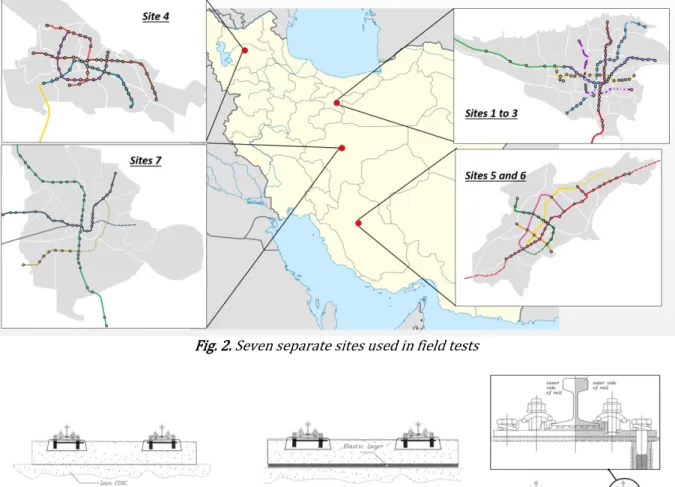
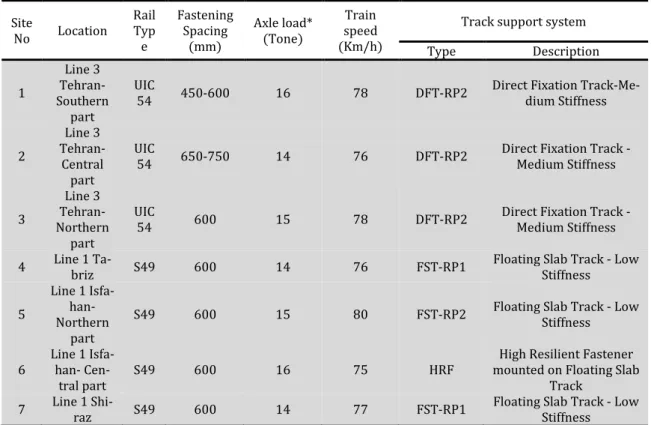
Field measurements were made in seven separate sites spread in the Iranian subway network (Figure 2). The Sites were selected and used in this investigation in a way to cover various possible track structures (i.e., Direct Fixation Track (DFT), Floating Slab Track (FST) and High Resilient Fastener (HRF)). A schematic view of various track structures used in the tests is presented in Figure 3. Sites 1 to 3 are in the Tehran metro network (in the Iranian capital city) in which the track structure is DFT type (Figure 3-a). Site 4 is in Tabriz (a city in the north-west of Iran) with FST system. Sites 5 and 6 are in the Isfahan metro first line (in the central part of Iran). The track structure in these sites includes two types namely FST and HRF (Figure 3-b and c). Site 7 is in Shiraz (a city in the south-center of Iran). The track structure in this site is FST type with high stiffness elastic layer. Details of the track structure and train parameters at the measurement sites are presented in Table 1. The track and rolling stock pa-rameters conditions (provided in Table 1) were either measured in the sites or provided by the metro authorities. More details of the test sites are presented in (Sadeghi, Liravi et al. 2017).
Fig. 2. Seven separate sites used in field tests
Two types of sensors were used for the measurement. They are Linear Variable Differential Transformer (LVDTs) for the track stiffness measurements and accelerometers for the track vibration measurements. LVDTs were selected with the consideration of the possible ranges of the train loads and accelerometers, taking into con-sideration the amplitude and frequency ranges of track vibrations.
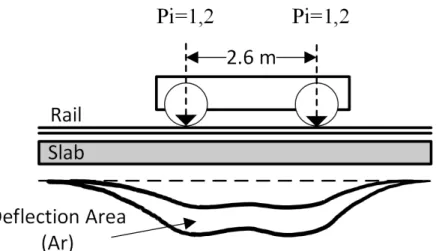
The stiffness of the tracks was computed using the Talbot-Wasiutynski method(Ali Zakeri and Abbasi 2012, Heydari-Noghabi, Varandas et al. 2017, Sadeghi, Liravi et al. 2017). For this purpose, the vertical deflections of the rail relative to the tunnel invert were measured for two different axle loads. Schematic view of the Talbot-Wasiutyn-ski method is presented in Figure 4. Instrumentations and testing procedure were precisely designed considering the Talbot-Wasiutynski method detailed in the literature (Kerr 2000, Sadeghi, Liravi et al. 2017). In each site, 3 meters of the tracks were instrumented (i.e., LVDTs were set on 5 consecutive rail seats) to obtain the pattern of the rail deflections at the rail seats positions (Figure 5-a). Japanese data logger series TML7200 was used to record the data.
Table 1. General specifications of the train and tracks in the fields
Site
No Location Rail Typ e Fastening Spacing (mm) Axle load* (Tone) Train speed (Km/h)
Track support system
Type Description
1 Line 3 Tehran- Southern part UIC
54 450-600 16 78 DFT-RP2
Direct Fixation Track-Me-dium Stiffness 2 Line 3 Tehran- Central part UIC
54 650-750 14 76 DFT-RP2
Direct Fixation Track - Medium Stiffness 3 Line 3 Tehran-Northern part UIC
54 600 15 78 DFT-RP2
Direct Fixation Track - Medium Stiffness
4 Line 1
Ta-briz S49 600 14 76 FST-RP1
Floating Slab Track - Low Stiffness
5
Line 1 Isfa-han- Northern
part
S49 600 15 80 FST-RP2 Floating Slab Track - Low
Stiffness
6
Line 1 Isfa-han-
Cen-tral part
S49 600 16 75 HRF
High Resilient Fastener mounted on Floating Slab
Track
7 Line 1
Shi-raz S49 600 14 77 FST-RP1
Floating Slab Track - Low Stiffness
* P2 in equation 1
The track stiffness was calculated by dividing the amount of the differences in the wheel loads by the area under the load-deflection curve (Ali Zakeri and Abbasi 2012) as indicated in Eq.1 .
𝑘𝑘= (∑ 𝑝𝑝2− ∑ 𝑝𝑝1)/𝐴𝐴𝑟𝑟 (1)
where K and Ar are track stiffness (MPa) and the area between the load-deflection curves for the first and second axle loads (kN), respectively. P1 and P2 are the first and the second wheel loads.
Fig. 4. Schematic view of the Talbot-Wasiutynski method used to derive rail support modulus (Track stiffness)
Fig. 5. Field measurement (a) LVDTs installed for track stiffness measurement, (b) Installation of vibration sensors (ac-celerometers) on the slab, (c) Installation of vibration sensors (ac(ac-celerometers) on the tunnel base, (d) Data logger and
Table 2. General specifications of the accelerometers used in measurements
- Model Tokyo-Sokki
ARF100A
Tokyo-Sokki ARF500A
1 Sensitivity (m/s2) 1 5
2 Capacity (m/s2) 100 500
3 Frequency range (Hz) 1-240 1-690
4 Sensing element Piezoelectric Piezoelectric
5 Natural frequency (Hz) 300 870
6 Temperature range (oC) -10 to +50
3 Experimental results and discussions
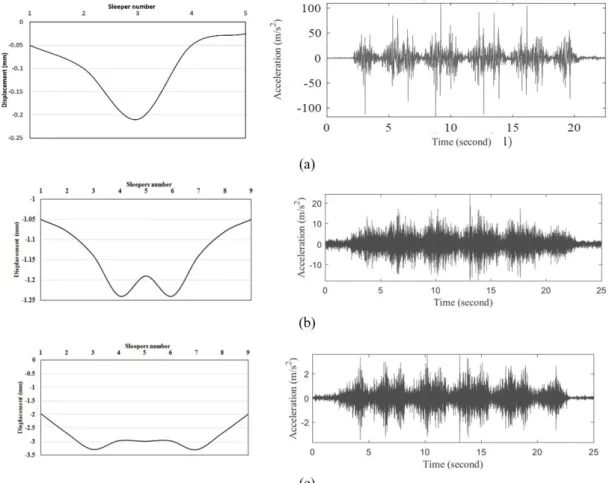
As explained in the test procedure, the vertical deflections of the rail along 3 meters of the rail were recorded and consequently, the track stiffness were computed based on the Talbot-Wasiutynski method. Moreover, the ac-celerations of the rail heel and slab at the fastener position, and the acac-celerations of the tunnel base were recorded. Samples of results in DFT, FST, and HRF track structure types, measured in Sites 2, 7 and 6 are presented in Figure 6-a to c, respectively (track deflection at left and acceleration at right). As indicated, the track deflection and accel-eration values change considerably depending on the track structure type. The deflections values was reduced up to 15 times from that of the stiff (i.e. DFT) to soft (i.e. HRF) track structure type, while the corresponding accelera-tion values were increased up to 25 times. These considerable difference is due to the considerable variaaccelera-tions in the stiffness of the track in the test sites.
Fig. 6. Samples of track deflection (Left) and acceleration (Right), measured in various track structure types (a) DFT (measured in Site 2), (b) FST (measured in Site 7) (c) HRF (measured in Site 6), Accelerations and deflections were
Using omega arithmetic method (Mercer 2006) the corresponding velocity for each measurement was com-puted and presented in decibels form. A summary of the results obtained is presented in Table 3. Based on this table, although the track stiffness does not have much influences on the rail vibration level, the tunnel base and slab vibration level decreases considerably as the track stiffness decreases.
Table 3. Summary of the results obtained (track stiffness and vibration levels)
Site Deflection*
(mm) Track stiffness (MPa)
Vibration velocity level
(dB reference 25.4×10⁻⁶ mm per second)
Rail Slab Tunnel base
1 0.6 81 100 92 89
2 0.21 83 105 97 95
3 0.24 87 107 103 99
4 1.35 60 97 91 82
5 2.87 43 90 83 65
6 3.25** 9 93 75 64
6 2.13 53 92 84 71
6 3.15 15 93 81 69
7 1.24 54 96 93 79
*Measured at fastener location.
**High resilient fastener mounted on FST.
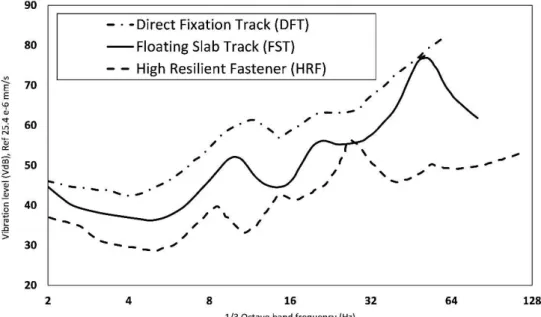
Using the Fourier transform, the time histories of the recorded accelerations were converted into the fre-quency domain. That is, each record was analyzed using a uniform filtering process and Fast Fourier Transform function to drive the frequency domain responses. The level in 1/3 octave bands was derived. From the results obtained in the frequency domain, the frequencies at which the largest amount of energy was produced can be distinguished. The greatest vibration levels to the structure can be made at these frequencies. Moreover, natural frequencies as well as velocities of the waves received by the accelerometers were evaluated from the results in the frequency domain. The vibration spectra measured on the tunnel invert in Site 4, 1 and 6 with the three tested track structures (i.e. HRF, DFT and FST) is presented in Figure 7. The general form (pattern) of the spectra obtained from other sites is similar. As illustrated, the peak level of vibrations measured on the tunnel base is mainly between 40 and 80 Hz.
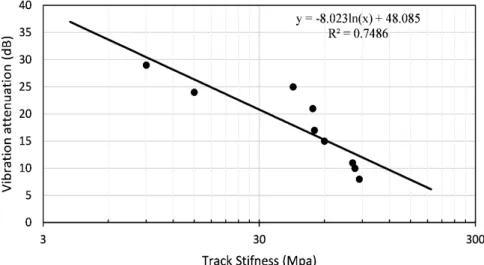
Based on the results obtained (Table 3), the effectiveness of track stiffness in the reduction of track vibrations (velocity levels) is illustrated in the logarithmic scale in Figure 8. The results indicate a linear logarithmic relation-ship between the track stiffness and the vibrations attenuation (the difference between velocities recoded at the tunnel invert and rail). As illustrated, the vibration attenuation between the rail and the tunnel base increases with decreases in the track stiffness. For instance, 10 times reduction in the track stiffness causes 19 dB reductions in the vibration level.
Fig. 8. Effectiveness of track stiffness reduction on reducing track vibrations
Based on the analysis of the measurements (Figure 8), a mathematical expression for vibration attenuation levels were developed which consider the effect of track structural properties (track stiffness) on the vibration attenuation. As a result, the best regression expression was derived as:
𝑉𝑉𝐴𝐴𝐴𝐴= 8.023 𝑙𝑙𝑛𝑛(𝐾𝐾)−48.085 (2)
where K is the track stiffness in MPa and 𝑉𝑉𝐴𝐴𝐴𝐴 (Vibration Attenuation Level) is the level of attenuation in dB reference 25.4×10⁻⁶ mm per second.
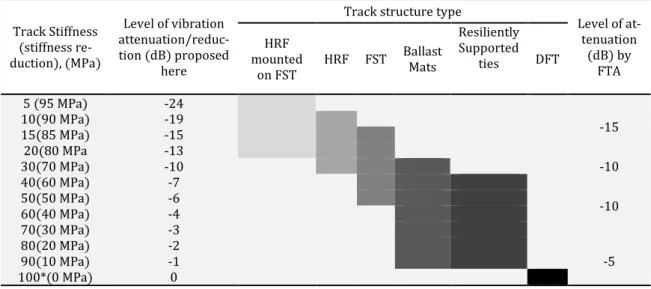
The Federal Transportation Association (FTA) is the most widely vibration assessment manual used in the planning phase of railway design (Hanson, Towers et al. 2006, Thalheimer and Poling 2013, Zou, Wang et al. 2017). In this model, the FTA considers reduction of vibration for various track structures in a form of a table in which all of the reductions are given as single numbers to be subtracted from the base vibrations level.
Table 4. Vibration attenuation levels due to track stiffness reduction obtained in this research for various track
struc-tures compared with those of FTA
Track Stiffness (stiffness re-duction), (MPa)
Level of vibration attenuation/reduc-tion (dB) proposed
here
Track structure type
Level of at-tenuation (dB) by FTA HRF mounted on FST
HRF FST Ballast Mats
Resiliently Supported
ties DFT
5 (95 MPa) -24
-15
10(90 MPa) -19
15(85 MPa) -15
20(80 MPa -13
30(70 MPa) -10 -10
40(60 MPa) -7
-10
50(50 MPa) -6
60(40 MPa) -4
70(30 MPa) -3
80(20 MPa) -2
-5
90(10 MPa) -1
100*(0 MPa) 0
*Reference value
4 Conclusions
The metro induced vibration is one of the main concerns in historical cities where metro lines are close to the monumental buildings. Although considerable number of researches have been conducted on the effect of track and train parameters on ground-borne vibration level, the effect of track stiffness reduction has not been sufficiently studied. This is addressed in this research. A number of vibration measurements have been made in different Metro systems, each with different track structure. The measurements covered a wide range of track stiffness (rail support modulus). The influences of the track stiffness on the ground borne vibration attenuation were investigated by analyses of the field measurements.
The results showed that there is a clear trend towards lower levels of vibration on the invert of the tunnel where track support stiffness is reduced. The changes in the vibration levels in various conditions of track structure were discussed and consequently correlations between the track stiffness reductions and track level of vibrations attenuation were developed. It was shown that, the vibration level decreases by approximately 19 dB for each 10-fold decrease in the track support stiffness.
Based on the results obtained, the amount of railway induced vibrations attenuation/reductions as a function of track stiffness were derived in this research. The results were compared with attenuation values for each track structure type proposed in the FTA manual (as the most widely railway vibration assessment manual used in the world). It was shown that the proposed attenuation expression developed here (which provides the vibration at-tenuation level as a function of track stiffens) is more precise and more comprehensive in evaluation of various track structures when compared with the conventional/current methods.
References
ABV-Co report (2017). Vibration protecting using rail fastening systems, CRADLE.
Ali Zakeri, J. and R. Abbasi (2012). “Field investigation on variation of rail support modulus in ballasted railway tracks.” Latin American Journal of Solids & Structures 9(6).
Chang, K., C. Kim and S. Borjigin (2014). Variability in bridge frequency induced by a parked vehicle. Proceedings of the 4th KKCNN Symposium on Civil Engineering.
Connolly, D., G. Kouroussis, O. Laghrouche, C. Ho and M. Forde (2015). “Benchmarking railway vibrations–track, vehicle, ground and building effects.” Construction and Building Materials 92: 64-81.
Cox, S. and A. Wang (2003). “Effect of track stiffness on vibration levels in railway tunnels.” Journal of Sound and Vibration 267(3): 565-573.
Cui, X., G. Chen, H. Yang, Q. Zhang, H. Ouyang and M. Zhu (2016). “Study on rail corrugation of a metro tangential track with Cologne-egg type fasteners.” Vehicle System Dynamics 54(3): 353-369.
Delkor-Rail (2017). On track with Delkor Rail Quality Track Products & Infrastructure Solutions Resilient Bonded Baseplates. https://www.delkorrail.com/. Australia.
Esmaeili, M., M. Naeimi, B. Soltani and M. Afsartaha (2016). Reducing Slab Track Vibrations by Using Asphalt Con-crete in the Substructure. 2016 Joint Rail Conference, American Society of Mechanical Engineers.
Galvín, P., D. L. Mendoza, D. Connolly, G. Degrande, G. Lombaert and A. Romero (2018). “Scoping assessment of free-field vibrations due to railway traffic.” Soil Dynamics and Earthquake Engineering 114: 598-614.
Gonzalez-Navarro, M. and M. A. Turner (2016). “Subways and urban growth: evidence from earth.”
Hanson, C. E., D. A. Towers and L. D. Meister (2006). Transit noise and vibration impact assessment.
Heydari-Noghabi, H., J. Varandas, M. Esmaeili and J. Zakeri (2017). “Investigating the Influence of Auxiliary Rails on Dynamic Behavior of Railway Transition Zone by a 3D Train-Track Interaction Model.” Latin American Journal of Solids and Structures 14(11): 2000-2018.
Kerr, A. D. (2000). “On the determination of the rail support modulus k.” International Journal of Solids and Struc-tures 37(32): 4335-4351.
Kun, L., X. Lei and S. Zeng (2017). “Influence analysis on the effect of rail fastening parameters on the vibration response of track–bridge system.” Advances in Mechanical Engineering 9(8): 1687814017702839.
Ma, M., B. Jiang, M. Li and X. Sun (2017). “A Laboratory Test on the Vibration Mitigation Efficiency of Floating Ladder Tracks.” Procedia engineering 199: 2705-2710.
Mercer, C. (2006). “Acceleration, velocity and displacement spectra omega arithmetic.” Prosig signal processing tutorials.
Sadeghi, J. and M. H. Esmaeili (2017). “Safe distance of cultural and historical buildings from subway lines.” Soil Dynamics and Earthquake Engineering 96: 89-103.
Sadeghi, J., H. Liravi and M. H. Esmaeili (2017). “Experimental investigation on loading pattern of railway concrete slabs.” Construction and Building Materials 153: 481-495.
Saurenman, H. and J. Phillips (2006). “In-service tests of the effectiveness of vibration control measures on the BART rail transit system.” Journal of Sound and Vibration 293(3-5): 888-900.
Thalheimer, E. and J. Poling (2013). “A Simple, Effective Method for a “Detailed” Building Vibration Analysis.” Noise Control Engineering.
UIC (2008). Ballastless track, Application and experience with ballastless track.
Van Leuven, A. and T. Vanhonacker (2008). Testing criteria for non-ballasted track and embedded track systems. 2008 American Public Transportation Association (APTA) Rail Conference. San Francisco CA, United States, Amer-ican Public Transportation Association.
Vogiatzis, K. (2012). “Environmental ground borne noise and vibration protection of sensitive cultural receptors along the Athens Metro Extension to Piraeus.” Science of the Total Environment 439: 230-237.
Wang, P., K. Wei, Y. Liang and F. Wang (2016). “Experimental investigation of the vibration-attenuating effect of rail suspension fasteners on environment vibration induced by subway.” Journal of Vibroengineering 18(6).
Xin, T. and L. Gao (2011). “Reducing slab track vibration into bridge using elastic materials in high speed railway.” Journal of Sound and Vibration 330(10): 2237-2248.
Xu, Q.-y., B. Yan, P. Lou and X.-l. Zhou (2015). “Influence of slab length on dynamic characteristics of subway train-steel spring floating slab track-tunnel coupled system.” Latin American Journal of Solids and Structures 12(4): 649-674.
Younesian, D. and M. Sadri (2014). “Performance analysis of multiple trenches in train-induced wave mitigation.” Journal of Low Frequency Noise, Vibration and Active Control 33(1): 47-63.
Zhao, C. and W. Ping (2018). “Effect of elastic rubber mats on the reduction of vibration and noise in high-speed elevated railway systems.” Proceedings of the Institution of Mechanical Engineers, Part F: Journal of Rail and Rapid Transit: 0954409717752201.
Zhu, S., J. Wang, C. Cai, K. Wang, W. Zhai, J. Yang and H. Yan (2017). “Development of a vibration attenuation track at low frequencies for urban rail transit.” Computer-Aided Civil and Infrastructure Engineering 32(9): 713-726.