FX interventions in Brazil: a synthetic control
approach
1M´arcio Garcia (PUC-Rio)
Marcos Chamon (IMF) and Laura Souza (Ita´u Unibanco)
EESP-FGV
II Semin´ario em Macroeconomia Aplicada
October 19, 2017
1
The views expressed in this presentation are those of the presenter and do not necessarily represent those of the IMF or IMF policy.
Published by the Journal of International Economics:
Introduction
I The extraordinary monetary policies pursued in developed countries (and the eventual normalization of those policies) created many problems for central banks in developing countries trying to manage their economies.
I Expressions like ”currency wars” or ”monetary tsunamies” marked the monetary expansion phase.
I Many (IT) central banks complained:
I According to the Central Bank of Brazil: ”... the fragility in some mature economies, combined with
favorable perspectives for the Brazilian economy has determinedan inflow of foreign resources, part of which has been going to the credit market. In this sense, the excess of external inflows may weak (sic) the credit channel, smooth its contribution to the aggregate demand moderation as well as cause distortions in the price of domestic assets” (Central Bank of Brazil, 2011).
I The Central Bank of Chile warned: ”... the main risks for financial stability associated with larger gross
capital inflows include the generation of currency and maturity mismatches, credit booms that lead to a deterioration in loan quality, and local asset price misalignment” (Central Bank of Chile,2011).
Introduction
I The Central Bank of Turkey admonished: ”... in emerging economies, short-term capital flows and rapid
credit growth feed macro financial risks. [...] The major risk factor for emerging economies is the macroeconomic imbalances driven by rapid capital inflows. Central banks of emerging economies continued to implement macroprudential measures to contain the potential adverse effects of capital flows”(Central Bank of Turkey, 2011).
I But the policy normalization phase wasnt any better.
I The ”taper tantrum” created havoc in risky assets, especially EM currencies.
I This paper deals with the impacts of and policy reactions to the taper tantrum in Brazil.
Introduction
I Are sterilized interventions effective? Do they change the level and/or the volatility of the ER?
I Endogeneity problems: countries intervene only when there are large and undesirable movements of the ER
I the endogeneity bias may understate the effect of the interventions.
I VARs, IVs and high-frequency data are often used, but may not well address the endogeneity problems.
I We use a large, “pre-announced”, FX intervention program deployed by the Brazilian Central Bank in the wake of the Taper Tantrum.
I Because the program came as a surprise, it is ideal to apply techniques of synthetic control; we use techniques by Abadie et al. (2010), Carvalho et al. (2016) and event study for robustness check.
I We find a large effect of the program announcement on the level of the exchange rate (at least 10% appreciation), but not as much effect on the ER volatility; extensions of the original program were not as effective.
FX Intervention Program in Brazil
I On August 22, 2013 the central bank announced a major program of FX intervention:
I Daily sales of US$ 500 million worth of currency forwards.
I US$ 1 billion spot every Friday through repurchase agreements.
I Program to last until at least the end of the year.
I On December 18, 2013 program extended:
I Daily sales reduced to US$ 200 million.
I Spot interventions if liquidity needed.
I Program to last until at least mid-2014.
I On June 2014 program extended to end-2014.
I On December 2014, the program was extended and it ended on March 31, 2015.
1.9 2.1 2.3 2.5 2.7 2.9 3.1 3.3 0 20 40 60 80 100 120
Cumulative Swap Interventions Cumulative Credit Lines Interventions Exchange Rate (BRL/USD)
US $ bi lli on Announcementof program of daily interventions
Source: AC Pastore and BCB
Program extended Program extended
Program extended
Announcement that program will not be extended
Equivalence between FX Forward Interventions and
Sterilized Interventions
I Here, the exchange rate is quoted in units of BRL per USD.
I The BCB commits to sell (1+i*) USD at t+1 for (1+i*).F BRL;
I The private sector portfolio, in t
I Increases by the present value of (1+i*) USD in t+1, i.e., 1
USD;
I Decreases by the present value of (1+i*).F, i.e., (1+i*).F/(1+i)=S BRL (by CIP).
I This FX forward intervention has the same effects of a sterilized sale of USD by the BCB, i.e.
I The BCB sells 1 USD, and conducts open market purchases in the same amount, i.e., S BRL.
I The CIP basis exists, but is of 2nd order for the purposes of this paper (cupom cambial is the onshore dollar rate, usually higher than libor).
FX Intervention Program in Brazil
I Program was large:
I Announcement implied ∼ USD $50 billion
I Eventual stock reached ∼ USD $110 billion. This is about 1/3 of the stock of reserves
I FX Interventions through currency forward:
Literature on Intervention
I Not much theoretical literature supporting effectiveness:
I Portfolio balance effect;
I Signaling effect.
I There is a very large empirical literature on FX Intervention.
I Sarno and Taylor (2001) survey early literature (mainly advanced economies); evidence not supportive (intervention tiny compared to size of bond markets).
I Menkhoff (2013) provides a more recent survey covering Emerging Markets, where evidence is more supportive (intervention can be sizable relative to domestic bond markets).
The Effectiveness of Sterilized Interventions
I “In any event, governments plainly believe that sterilized
intervention has its uses, for they continue to practice it despite the lack of any hard evidence that it is consistently and predictably effective.” (OR, 1996)
I “Despite many empirical studies, it is not clear yet whether
sterilized intervention meets the same criteria that regulators use to decide whether to approve a cancer drug - that it is safe and effective.” (Engel, 2015)
Literature on Intervention
I In the Brazilian context, a number of papers of intervention, including:
I Andrade and Kohlscheen (2014) estimates a 0.3% movement after announcement of a swap auction
I Barroso (2014) estimates a 0.5% effect for a US$ 1 billion intervention.
I Vervloet (2010) estimates effect of US$ 1 billion intervention to be 0.10-1.14% (with low duration)
I Broadly speaking, estimates in the range of 0.1-0.5 percent for a US$ 1 billion intervention.
Our paper
I To find an instrument for daily FX sterilized interventions is hard;
I The Brazilian program was different because all the news about future FX interventions was concentrated at the announcement;
I This begs a methodology like diff-in-diff, and synthetic controls is the way to implement it.
I Our paper is the first to apply these methodologies to FX sterilized interventions.
I The quite sizeable result (10% appreciation of the exchange rate) is large compared to the literature.
Estimating the Effect
I We use a synthetic control approach (Abadie et al. 2010) and an alternative new econometric methodology that estimates a synthetic control using the time-series dimension of the data (ArCo, Carvalho et al. 2016) to estimate the effect of the program on the exchange rate and its volatility;
I In a nutshell it consists of using data from other countries to
construct a synthetic Brazil, i.e, a counterfactual.
I Synthetic control not suitable for studying small frequent interventions, but suitable for large event;
Synthetic Controls
I We estimate weights for different countries that can explain the behavior of the exchange rate in Brazil prior to the program announcement, following Abadie et al.(2010).
I Log change in the counterfactual exchange rate will be given by weighted average of the log change in the exchange rate for the other countries.
I Weights minimize the mean square error (in the pre-program period) of the log change in the exchange rate and other control variables.
Abadie et al. (2010)
I Let YitI denote the exchange rate in a country i in period t for a country that adopts a policy (e.g. an FX intervention program) at time T0, and YitN denote non-observed exchange rate that would
have occurred had the country not adopted the FX interventions program.
I Without loss of generality, suppose the policy change occurred on country i = 1 (Brazil in our case). We assume that YN
it follows a
factor model given by:
YitN = δt+ θtZi+ λtµi+ εit
where λt is an unknown common factor that depends on time, Zi is
a vector of observable variables, θt is a vector of parameters and µi
is a unobserved vector of factor loadings. At last, εit is a mean zero
Abadie et al. (2010)
I Consider W = (ω2, ..., ωj +1)0 as a vector of weights such that
ωi≥ 0 andP j +1
i =2ωi = 1. Suppose that there is an optimal weight
vector ˆW that can accuratey replicate pre-treatment observations in Brazil. Abadie et al. (2010) show that under regular conditions YN
it =
Pj +1
i =2ωˆiYit. Thus, we can calculate ˆα1t = Yit−P j +1 i =2ωˆiYit
for t ≥ T0.
I Define X1as a matrix of pre-treatment characteristics of the
Brazilian exchange rate that contains Y and Z , and similarly X0 for
the control countries. Hence, the optimal weight vector ˆW is chosen through the minimization of the following equation
q
(X1− X0W )ˆ 0V (X1− X0W )ˆ (1)
where V is a k × k symmetric and positive semi-definite matrix (k is the number of explanatory variables). Also V is chosen to minimize the mean square prediction error in the period prior to the policy change.
ArCo - Carvalho et al. (2016)
I We also an alternative new econometric methodology that estimates a synthetic control using the time-series dimension of the data proposed by Carvalho et al. (2016), which allows for negative weights and statistical inference.
I Abadie et al. (2010) kills the time-series dimension by using time averages of variables;
I ArCo incorporates the time-series dimension;
I Basically, the counterfactual is constructed by regressing the variable of interest for the treated country in the control variables for the donor pool (other countries).
Data
I We use weekly data for:
I Log Change in the Exchange Rate
I Log Change in the Volatility
I Log Change in Equity Index
I Log Change in Bond Index
I Portfolio Flows (EPFR) scaled by 2012 GDP
I Our sample consists of 16 countries: Australia, Brazil, Chile, Colombia, India, Indonesia, Korea, Malaysia, Mexico, New Zealand, Peru, Philippines, Poland, Russia, South Africa, Thailand, and Turkey.
BRL vs. Peers After The Program Announcement
85 90 95 100 105 110 6/20/13 6/27/13 7/4/13 7/11/13 7/18/13 7/25/13 8/1/13 8/8/13 8/15/13 8/22/13 8/29/13 9/5/13 9/12/13 9/19/13 9/26/13 10/3/13 10/10/13 10/17/13Australia Brazil Chile Colombia India Indonesia
Korea Mexico Malaysia New Zealand Phillippines Poland
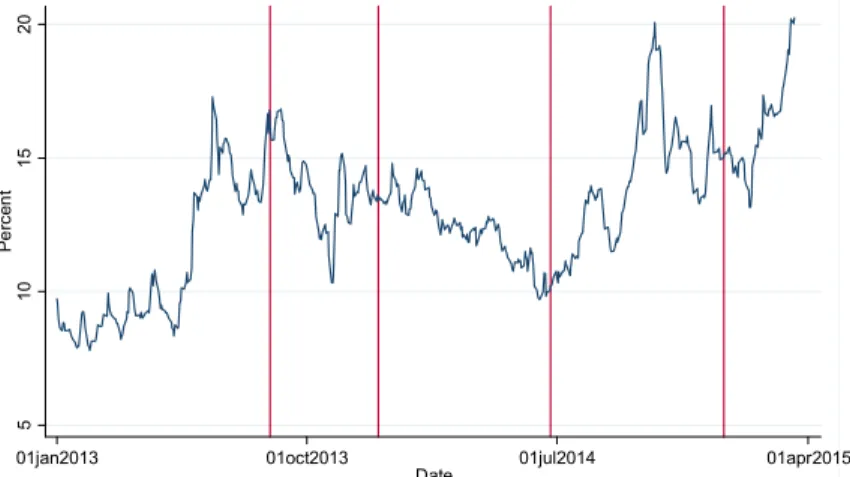
Brazilian Real Option-Implied Volatility
Figure 2. Brazilian Real Option-Implied Volatility.
Notes: Vertical bars indicate the program announcement and extensions. Source: Bloomberg.
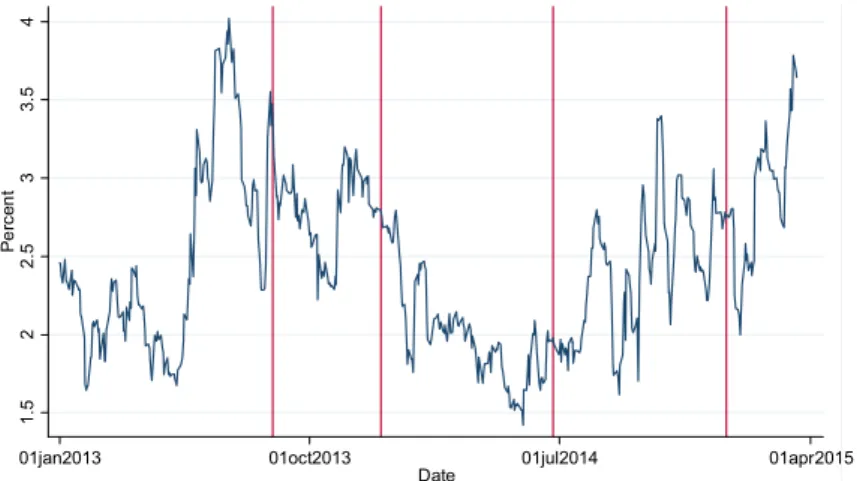
Figure 3. Brazilian Real Option-Implied Risk Reversal.
Notes: Vertical bars indicate the program announcement and extensions. Risk Reversal measures the difference between implied volatility of money put and out-of-the-money call (25 delta). Source: Bloomberg.
5 10 15 20 Pe rc en t
01jan2013 01oct2013 01jul2014 01apr2015
Date 1. 5 2 2. 5 3 3. 5 4 Pe rc en t
01jan2013 01oct2013 01jul2014 01apr2015
Brazilian Real Option-Implied Risk Reversal
Figure 2. Brazilian Real Option-Implied Volatility.
Notes: Vertical bars indicate the program announcement and extensions. Source: Bloomberg.
Figure 3. Brazilian Real Option-Implied Risk Reversal.
Notes: Vertical bars indicate the program announcement and extensions. Risk Reversal measures the difference between implied volatility of money put and out-of-the-money call (25 delta). Source: Bloomberg.
5 10 15 20 Pe rc en t
01jan2013 01oct2013 01jul2014 01apr2015
Date 1. 5 2 2. 5 3 3. 5 4 Pe rc en t
01jan2013 01oct2013 01jul2014 01apr2015
Effect of Program Announcement on the Exchange Rate
-2 0 -1 5 -1 0 -5 0 5 Pe rc en ta ge P oi n ts01jun2013 01aug2013 01oct2013 01dec2013
Effect of Program Announcement on the Exchange Rate
-2 0 -1 5 -1 0 -5 0 5 Pe rc en ta ge P oi n ts01jun2013 01aug2013 01oct2013 01dec2013
Effect of Program Announcement on Option-Implied
Volatility
-5 0 5 Pe rc en ta ge P oi n ts01jun2013 01aug2013 01oct2013 01dec2013
Effect of Program Announcement on Option-Implied
Volatility
-5 0 5 Pe rc en ta ge P oi n ts01jun2013 01aug2013 01oct2013 01dec2013
Risk Reversal
-2 -1 0 1 2 3 Pe rc en ta ge P oi n ts01jun2013 01aug2013 01oct2013 01dec2013
Effect of December 2013 Announcement on Exchange Rate
-1 0 -5 0 5 10 Pe rc en ta ge P oi n ts01oct2013 01dec2013 01feb2014 01apr2014
Effect of December 2013 Announcement on Volatility
-1 0 -5 0 5 10 Pe rc en ta ge P oi n ts01oct2013 01dec2013 01feb2014 01apr2014
Effect of December 2013 Announcement on Risk Reversal
-4 -2 0 2 4 Pe rc en ta ge P oi n ts01oct2013 01dec2013 01feb2014 01apr2014
Effect of June 2014 Announcement on Exchange Rate
-5 0 5 10 Pe rc en ta ge P oi n ts01apr2014 01may2014 01jun2014 01jul2014 01aug2014 01sep2014
Effect of December 2014 Announcement on Exchange Rate
-5 0 5 10 Pe rc en ta ge P oi n ts01oct2014 01nov2014 01dec2014 01jan2015 01feb2015 01mar2015
Event Study Regression
∆log (et) = c + γ1∆(CDIt− LIBORt) + γ2∆log (VIXt)
+γ3∆log (Commoditiest) + γ4∆log (DollarIndext)
+γ5∆(Dollar − AsiaIndext) + γ6FXIntt+ εt
I We use daily data to estimate a regression of the change in the log of the exchange rate on:
I Change in interest rate differential
I Change in log(VIX)
I Change in log CRB commodity prices
I Change in log of a Dollar Index relative to AE; relative to Latin American (excluding Brazil); and relative to Asian currencies
I Regression estimated using data from January 2013 until 20 days prior to August announcement.
I Results used to compute changes in exchange rate beyond those implied by fitted model (analogous to Cumulative Abnormal Returns in finance)
Exchange Rate
-1 0 -5 0 5 10 Pe rc en t -20 -10 0 10 20Days from Announcement Aug 22 2013 -1 0 -5 0 5 10 Pe rc en t -20 -10 0 10 20
Days from Announcement Dec 18 2013
Volatility
-7 .5 -5 -2 .5 0 2. 5 5 Pe rc e n ta g e P o in ts -20 -10 0 10 20Days from Announcement Aug 22 2013 -7 .5 -5 -2 .5 0 2. 5 5 Pe rc e n ta g e P o in ts -20 -10 0 10 20
Days from Announcement Dec 18 2013
Risk Reversal
-2 .5 0 2. 5 Pe rc e n ta g e P o in ts -20 -10 0 10 20Days from Announcement Aug 22 2013 -2 .5 0 2. 5 Pe rc e n ta g e P o in ts -20 -10 0 10 20
Days from Announcement Dec 18 2013
Conclusion
I Estimates point to a large effect of the program announcement on the exchange rate (10 percentage points)
I Some estimates point to a decline in option-implied volatility, but results not as stark/robust as for the level
I Second announcement had a smaller effect on the exchange rate (0-5 percentage points), but not significant
I Effect likely priced-in before by the market
I Third and fourth announcements had virtually no effect.
I The Brazilian massive intervention program was capable of reverting the exchange rate overshooting in the midst of the Taper Tatrum.
I Such programs should be used only sporadically to calm markets during crises, and not to prevent ER depreciation when economic fundamentals deteriorate.