1Trabalho Sinfruit 157 - Simpósio Internacional de Fruticultura - Avanços na Fruticultura (17 a 21 Outubro)
2Dr., Scientific Researcher of Horticulture Centre, Instituto Agronômico (IAC). Av. Theodureto de Almeida Camargo 1500, CEP 13075-630, Campinas-SP, Brazil
3Dr., Scientific Researcher of Ecophysiology and Biophysics Centre, Instituto Agronômico (IAC), Av. Barão de Itapura 1481, CEP
13020-902, Campinas-SP, Brazil
GAS EXCHANGES IN PEACH PALMS AS A FUNCTION
OF THE SPAD CHLOROPHYLL METER READINGS
1MARIA LUIZA SANT’ANNA TUCCI2, VALÉRIA APARECIDA MODOLO3,
NORMA DE MAGALHÃES ERISMANN4, EDUARDO CARUSO MACHADO5
ABSTRACT - The close relationship between the chlorophyll-meters readings and the total chlorophyll
and nitrogen contents in leaves, has allowed their evaluation both in annual and perennial species. Besides, some physiological events such as the CO2 assimilation have also been estimated by chlorophyll meters.
This work was carried out aiming to evaluate the gas exchanges of peach palms as a function of the chloro-phyll SPAD-Meter readings. Three year-old peach palms from Yurimaguas, Peru were studied in Ubatuba, SP, Brazil, spaced 2 x 1 m in area under a natural gradient of organic matter which allowed four plots to be considered, according to the peach palms leaves colors, from light yellow to dark green. The SPAD readings and the stomatal frequency of leaflets were evaluated. The photosynthetic photon flux density (PPFD, μmol
m-2 s-1), the leaf temperature (T
leaf, ºC), the CO2 assimilation (A, μmol m
-2 s-1), the stomatal conductance (g
s,
mol m-2 s-1), the transpiration (E, mmol m-2 s-1) and the intercellular CO
2 concentration(Ci, μmol mol -1) were
evaluated with a portable infrared gas analyzer (LCA-4, ADC BioScientific Ltd., Great Amwell, U.K.). A linear increase in the CO2 assimilation as a function of the SPAD readings (y = -0.34 + 0.19x, R
2 = 0.99),
indicates that they can be a rapid and cheap complementary method to evaluate in peach palms some im-portant physiological events, such as CO2 assimilation.
Index Terms: Bactris gasipaes Kunth, CO2 assimilation, stomatal conductance.
TROCA GASOSA EM PUPUNHA COMO FUNÇAO DE LEITURAS
EM CLOROFILOMETRO
RESUMO - A estreita correlação entre leituras medidas com clorofilômetros portáteis e os teores de clorofila
total e de nitrogênio em folhas têm permitido que esses teores tanto em espécies anuais como perenes sejam estimados por meio desses equipamentos. Da mesma forma, alguns eventos fisiológicos, como assimilação de CO2, têm também sido estimados. Este trabalho teve o objetivo de avaliar as trocas gasosas em
pupu-nheiras, em função das leituras realizadas em clorofilômetro SPAD-Meter. Foram estudas em Ubatuba-SP, Brasil, pupunheiras de três anos, originárias de Yurimaguas, Peru, plantadas em espaçamento 2 x 1 m, em área apresentando gradiente natural de matéria orgânica, fato que permitiu a consideração de quatro plots cada um, apresentando pupunheiras de coloração distinta variando do amarelo-claro ao verde-escuro. Foram avaliadas as leituras SPAD e a frequência estomática dos folíolos. A densidade de fluxo de fótons fotossin-téticos (DFFF, μmol m-2 s-1), a temperatura das folhas (T
folha, ºC), a assimilação de CO2 (A, μmol m -2 s-1), a
condutância estomática (gs, mol m-2 s-1), a transpiração (E, mmol m-2 s-1) e a concentração intercelular de CO 2
(Ci, μmol mol
-1) foram avaliadas pelo analisador portátil por radiação infravermelha (LCA-4, ADC
BioS-cientific Ltd., Great Amwell, U.K.). Correlação linear da assimilação de CO2, em função das leituras SPAD
(y = -0.34 + 0.19x, R2 = 0.99), indicou que o clorofilômetro SPAD-Meter pode ser um meio complementar,
rápido e barato de se estimar importantes eventos fisiológicos em pupunheiras, como a assimilação de CO2.
INTRODUCTION
The Amazonian palm peach palm (Bactris
ga-sipaes Kunth), besides the high quality heart-of-palm,
bears nutritive fruits highly consumed by populations from its natural habitat, as sources of carbohydrates and vitamins.
In São Paulo state, Brazil the peach palm growing area for heart-of-palm production is ca. 3.700 ha (Anefalos et al., 2007) and is expanding. In the peach palm germplasm banks of Instituto Agronômico (IAC)/APTA, studies have been carried out concerning the matrix plants characterization, as well as the nutritional requirements for fruits produc-tion (MODOLO et al., 2010).
Contrarily to what occurs in its natural habitat, in the São Paulo state subtropical conditions, the peach palm has to face climate seasonality, with evident effects on its physiology, that have been studied majorly concerning the CO2 assimilation and
the vegetative growth. Concerning the vegetative growth, Tucci et al. (2007) observed lower growth rates throughout the cold winter months and higher ones in summer. In parallel, the CO2 assimilation was
lower in the winter months (TUCCI et al., 2010), what have been attributed by the authors to the lower night temperatures throughout the winter.
Besides the climate, mainly temperature and air vapor pressure deficit (VPDair) among other
factors, the CO2 assimilation rate is modulated by
the plant nutritional status majorly by nitrogen, es-sential to plant metabolism, once it is a constituent of proteins and nucleic acids(KOSLOWSKY; PAL-LARDY, 1997).Actually, the nitrogen deficiency usually decreases photosynthesis, more than other macronutrients,and high linear correlations between CO2 assimilation and leaves nitrogen content have
been observed in a number of perennial species (Koslowsky e Pallardy, 1997).
Nitrogen plays a crucial role in peach palms development. Deenik et al. (2000), emphasize the fact that peach palms show significant response to nitrogen fertilization. Positive influences of nitrogen were observed on aspects of the crop such as: seed-lings growth (LA TORRACA et al., 1984); increase of aerial biomass (BOVI et al., 1998; BOVI et al., 2000;MOLINA et al., 2002; RAMOS et al., 2004), increase of the offshoots number per plant and of the main stem diameter (BOVI et al., 2002) and increase of root density(BOVI et al., 1999). The need of attending the peach palm nitrogen requirements is crucial and so, the detection of a lack of it by means of a rapid diagnosis is interesting, aiming to correct it before yield losses occur.
Symptoms of N deficiency in peach palms were related by La Torraca et al. (1984); Falcão et al. (1998); Bovi et al. (1998) and Molina (1999), including leaves of light green color, a decrease in the palm vigor, older leaves chlorosis, yellowing of all leaves in severe cases, weak and undeveloped offshoots and susceptibility to soil water deficit.
The peach palm nutritional status has been evaluated by means of foliar analysis and com -parisons with the suitable values for the species. However, the analysis are expensive, lasting, and sometimes they do not allow corrections before losses in production occur, and a rapid and cheaper method to perform N periodic evaluations would be interesting. The process becomes feasible by using digital chlorophyll-meters, which have been widely used in the rapid and non-destructive evaluations of leaves total chlorophyll, as well as of the N status, because of the close relationship between them.
Among the authors who reported linear rela -tionships between chlorophyll-meters readings and the total chlorophyll content in leaves, are Schaper and Chacko (1991) for the following fruit trees: ca -shew, lychee, jackfruit, durian, annona and starfruit, and Fanizza et al. (1991) for the grapevine. Concern-(1991) for the grapevine. Concern-Concern -ing the relationships between chlorophyll meters and plant N status, Neilsen et al. (1995),considered the use of the chlorophyll meter SPAD-502 interesting, to determine the response of apple trees cultivars to the N fertirrigation.
Besides the chlorophyll and nitrogen content, the use of chlorophyll-meters has been also extended, to estimate photosynthesis and other physiological aspects of crops. Gas exchanges measurements and chlorophyll-meters readings can give useful information on the relationships between them (SCHAPER; CHACKO, 1991; MARKWELL et al., 1995; YAMAMOTO et al., 2002).According to Fanizza et al. (1991), the non-destructive nature of chlorophyll-meters readings, makes the equipment particularly useful in studies on photosynthesis and senescence in grapevines, which depend on the continued monitoring of the chlorophyll content and degradation. Rajcan et al. (1999)observed a positive correlation between the chlorophyll-meter readings and the soluble carbohydrates content, in senescent corn leaves. Torres Neto et al. (2002) observed in papaya, relationships between the chlorophyll a
fluorescence, important indicative of the performance of the photochemical of photosynthesis, and the chlorophyll-meter readings.
the CO2 assimilation in oil palms (Elaeis guineensis
Jacq.) grown under high aluminum content. In boron deficient coconuts (Cocos nucifera L.), Pinho et al. (2010) correlated the chlorophyll-meter readings and photosynthesis. As for peach palms, Tucci et al. (2006) observed seasonal variations in the leaves chlorophyll-meter readings, as well as variations among the leaves ontogenetic levels.
This work was carried out aiming to evaluate the chlorophyll-meter readings on leaves of peach palms growing under a natural fertility gradient, correlating the equipment readings with the CO2
assimilation, the transpiration rate, the stomatal conductance, the instantaneous and intrinsic water efficiencies, as well as with the leaves instantaneous carboxylation efficiency. Stomatal frequencies on both leaflets surfaces were also evaluated.
MATERIAL AND METHODS
Plant Material
Studied plants belong to the Putumayo land -race (Yurimaguas) and were obtained from seeds collected at the peach palm germplasm bank, main -tained by Instituto Agronomico (IAC)/APTA at its Experimental Stations. Plants were spaced 2 x 1 m, by the time of this study they were three years old, and had been harvested one time, since the beginning of the experiment. Peach palms had been cultivated under a natural gradient of organic matter through soil top-layer and a visual observation of the palms, propitiated the classification of them into four plots, according to the color of leaves, as follows: Plot 1, peach palms presenting intense chlorosis, leaves color light-yellow; Plot 2, peach palms presenting less intense chlorosis, leaves color greenish-yellow; Plot 3, leaves color light green; Plot 4, plants present -ing leaves color green intense, as usually occurs in peach palm crops properly fertilized.
Location
The trial was located in a private farm in Uba-tuba (23°27’S, 45°04’W, 6 m alt.), São Paulo, Brazil, in a region originally covered by the Atlantic Forest, with mean annual temperature and rainfall of about 20.8° C and 2,841 mm, respectively, no water deficit, potential evapotranspiration of 992 mm and water surplus 1849 mm (ORTOLANI et al., 1995). The soil was an Allic Alluvial (Udifluvents), sandy-textured.
Stomata counting
Lamina stomatal frequency was determined on the abaxial and adaxial surfaces for two leaflets of the medium part of leaf + 2 of four plants randomly
selected (pinnate leaves) in each plot. The stomatal frequency was determined from impressions collect -ed from the leaf blade. A thin layer of clear cellulose acetate (nail polish) was applied, and the impressions were examined at a magnification of 250x on a Zeiss optical microscope. Stomatal counts were made at ten different locations on each imprint. Plants were sampled after the gas exchanges measurements.
SPAD readings
Chlorophyll-meter readings were evaluated by means of a chlorophyll-meter SPAD-Meter (Soil and Plant Analyses Development), Minolta 502, Japan. The equipment provides readings which cor -respond to the intensity of the leaves green color, that is, to the total chlorophyll content in leaves (MALAVOLTA et al., 1997). Measurements were performed in July, 2001, at 10:00 a.m. in four plants per plot, on a leaflet of the medium part of leaf +2, the second fully expanded leaf, from the top, accord -ing to Tomlinson criteria (TOMLINSON, 1990). On each leaflet the SPAD readings were performed on the proximal, distal, as well as on the medium part of them.
Gas exchanges
It was not possible to reach the fronds, be-cause of the height of the canopies. Therefore, leaves were detached from the palms. After cutting the leaf, gas exchange measurements were performed imme -diately on a leaflet from the medium part of the leaf, according to Prado et al. (2001) and Gomes and Prado (2007). Gas exchange measurements were taken on July, 2001 from 10 to 11 a.m. The photosynthetic photon flux density (PPFD, μmol m-2 s-1), the leaf
temperature (Tleaf, ºC), the CO2 assimilation (A, μmol m-2 s-1), the stomatal conductance (g
s, mol m -2 s-1),
the transpiration (E, mmol m-2 s-1) and the
intercel-lular CO2 concentration(Ci, μmol mol
-1) were
evalu-ated with a portable infrared gas analyzer (LCA-4, ADC BioScientific Ltd., Great Amwell, U.K.). The instantaneous water use efficiency (A/E, μmol CO2
m-2 s-1/ mmol H 2O m
-2 s-1), the intrinsic water use
ef-ficiency (A/gs, μmol CO2 m
-2 s-1/ mol m-2 s-1) and the
instantaneouscarboxylation efficiency (A/Ci, μmol CO2 m
-2 s-1/ Pa-1) were calculated from A, E, g s and
Ci values. Measurements were taken on the adaxial surface of a sunlit leaflet, on the medium part of the second completely expanded leaf (leaf + 2).
Statistics
RESULTS AND DISCUSSION
Climate
Evaluations were carried out on a typical winter day for the region, and from 10:00 to 11:00 a.m. when evaluations were performed, the air tem-perature was 22 ± 1 ºC, the air relative humidity, 90 ± 5%, the VPDair ca. 0.5 kPa, and the maximum PPFD
around 1300 umol m-2 s-1. However, at the time of the
assessments the sky became cloudy and the PPFD was 360 ± 15 umol m-2 s-1. The leaf temperature (T
leaf)
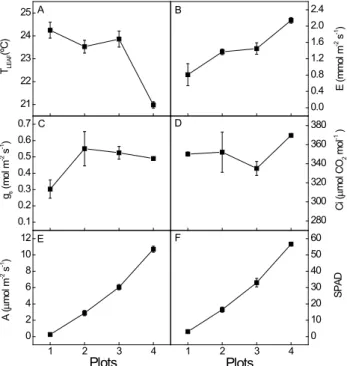
(Fig. 1A) was ca. 24ºC for the plants from plots 1, 2 and 3, differing significantly of leaves from plot 4, which presented lower Tleaf, ca. 21ºC, possibly due to a higher E (Fig. 1B), showed by the leaves of higher SPAD readings (Table 1).
It is worth mentioning that the Ubatuba region on the northern São Paulo state coast represents one of the most suitable peach palm growing regions in the state, once there is no annual water deficit and therefore the VPDair, important to the peach palm photosynthesis modulation (Tucci et al, 2010) remains low throughout the year, with no need for irrigation (BOVI, 1998).
SPAD readings and stomata counting
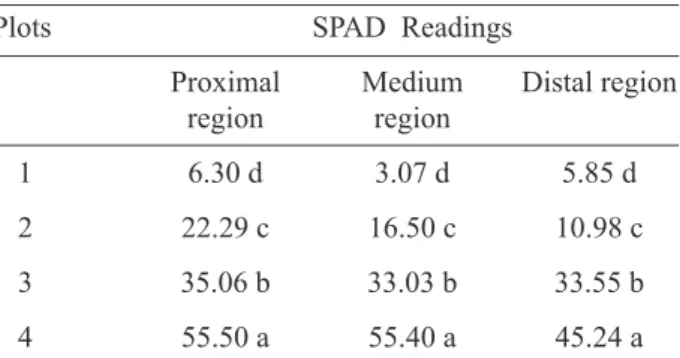
The difference in the color of leaves observed among Plots was confirmed by the SPAD readings (Table 1), once the results showed a typical change in leaf color and morphology among plots, the later represented by the difference in the stomatal fre-quency among leaves of the four Plots (Table 2). The SPAD readings, higher on leaves of Plot 4, showed significant differences among leaves of plants from all plots, regardless the leaflet part considered. As for the leaflet medium portion where the gas exchanges measurements were performed, increasing SPAD readings were observed on leaves from Plot 1 to 4, corresponding to 3.1 and 55.4, respectively. On leaflets portions proximal and distal, there were also significant differences, the data varying from 6.3 for plot 1 to 55.5 for Plot 4 and from 5.9, for Plot 1 to 45.2, for Plot 4, for the proximal and distal regions, respectively. SPAD readings of leaves from Plot 4, measured on the proximal and on the medium por-tion of leaflets are in agreement with those related by Tucci et al. (2006), when observing the SPAD readings variation as a function of leaves ontogeny. The authors related average SPAD readings of 56, for leaves +2, +3 e + 4 of peach palms growing in the so-called ‘planalto paulista’, in São Paulo state. SPAD readings observed in winter, spring and sum-mer on leaves of the same ontogeny were lower.
The stomatal frequency on the leaflets adaxial
surface (Table 2) was significant lower than on ab -axial surface, showing a higher value of 9.4 stomata mm-2 on the dark green leaves of Plot 4. The results
are consistent with Tucci et al. (2000) who observed on peach palm leaves a frequency significant higher on leaflets abaxial surfaces. The later was higher on leaflets of plants from Plot 3, corresponding to 65.6 stomata mm-2, what was 26% higher than 51.9 sto
-mata mm-2 observed on leaflets from plants showing a
severe chlorosis. The abaxial surfaces of leaves from Plots 1, 2 e 3 showed a stomatal frequency higher than 60 stomata mm-2.It is interesting to note that
Tucci et al. (2000) observed on the leaflets abaxial surfaces of peach palms, growing under climate conditions different from those of this experiment an average of 101.4 stomata mm-2. A hypothesis for the
high difference, can be found in Cutter (1986), who mentioned the fact that, stomatal frequencies, under some circumstances, can be altered by factors such as, light intensity and humidity of the growing sites, at the moment of stomata initiation.
Gas exchanges
The CO2 assimilation (Fig 1E) showed sig
-nificant variation (P ≤ 0,05) among plots increasing linearly from plants of Plot 1 to those of Plot 4, corresponding to 0.3 and 10.1 µmol m-2 s-1,
respec-tively, paralleling the SPAD readings (Fig 1F). It is important to note that gs (Fig 1C) showed a different
dynamics in comparison to assimilation, once their values on plants of Plots 2, 3 e 4 do not differ, show -ing a gs ca. 0.54 mmol m
-2, s-1, whereas on leaves of
Plot 1 gs was 0.30 mmol m-2, s-1. So, for the same
stomatal conductance, leaves from Plot 4 showed CO2 assimilation 3.5 times higher than those from
Plot 2 and 1.7 times higher than those from Plot 3. On the other hand the Ci values (Fig 1 D)
remained practically unchanged among plots, indicat -ing that the assimilation of plants from Plots 1, 2 and 3 was not limited by the CO2 diffusion through the
stomata, therefore not meaning a stomatal constraint but probably a metabolic one. This becomes clearer when one observes the ratios A/gs and A/Ci(Fig 2
B,C). The later indicates the instantaneous carboxyl -ation efficiency of the enzyme ribulose 1,5 bisfosfato carboxilase/oxigenase (Rubisco). Thus, once the Ci
soluble proteins of the Calvin cycle, as well as of the thylakoid membranes (KOSLOWSKY; PAL -LARDY, 1997). Thus, a nitrogen deficiency can result in low photosynthetic efficiency chloroplasts, highlighting the close relationship between CO2
as-similation and leaves N and protein content.Besides that, A/gs and A/E (Fig 2A) also decreased in leaves
of plants from Plots from 4 to 1, indicating that for similar values of gs the assimilation was more effi
-cient on the dark green leaves of Plot 4. The results indicate that the apparent chlorophyll and N deficien -cies on plants of Plots 1, 2, and 3, caused metabolic constraints to the CO2 assimilation on plants from
these plots more intense on plants of Plot 1 which
presented the lowest SPAD readings.
A linear increase in the CO2 assimilation as
a function of the SPAD readings (Fig. 3), fitted by the equation y = -0.34 + 0.19x, R2 = 0.99, indicating
that evaluations carried out by means of chlorophyll meters readings on peach palm leaves can be an important, rapid and non-destructive complementary method to evaluate the chlorophyll and nitrogen leaves content and also some aspects of important physiological events such as CO2 assimilation.
It is important to note that further studies should be performed under the different edapho-climatic conditions where peach palms have been grown in São Paulo state, Brazil.
TABLE 1 - SPAD readings of peach palm leaves measured on different parts of the leaflets, proximal region,
medium region and distal region.
Plots SPAD Readings
Proximal
region Medium region Distal region
1 6.30 d 3.07 d 5.85 d
2 22.29 c 16.50 c 10.98 c
3 35.06 b 33.03 b 33.55 b
4 55.50 a 55.40 a 45.24 a
Means followed by the same letter in the vertical position do not differ by Tukey test at 5% probability.
TABLE 2 - Stomatal frequency of peach palm leaflets on the abaxial and the adaxial surfaces.
Plots Abaxial Adaxial
1 51.95 c 4.55 a
2 62.95 ab 5.20 a
3 65.65 a 5.25 a
4 60.55 b 9.40 b
0 1 2 3 4 5 0 5 10 15 20 25
1 2 3 4
0.00 0.05 0.10 0.15 0.20 0.25 0.30 A A /E ( µ mo l C O2 ( mmo l H 2 O) -1 B A /gs ( µ mo l C O2 ( mo l H 2 O) -1 C Plots A /Ci ( µ mo l m
-2 s -1 P
a
-1 )
1 2 3 4
0 10 20 30 40 50 60 0.1 0.2 0.3 0.4 0.5 0.6 0.7
1 2 3 4
0 2 4 6 8 10 12 21 22 23 24 25 0.0 0.4 0.8 1.2 1.6 2.0 2.4 280 300 320 340 360 380 F S P A D C gs ( mo l m
-2 s -1) E E ( mmo l m
-2 s -1) Plots A ( µ mo l m
-2 s -1)
A
Plots
TLEAF
(º C) B D Ci ( µ mo l C O2 mo l
-1 )
FIGURE 1 - Values of leaf temperature (Tleaf, A), transpiration (E, B), stomatal conductance (gs, C),
in-tercellular CO2 concentration (Ci, D), leaf CO2 assimilation (A, B) and SPAD chlorophyll readings (SPAD, F) of peach palms, on a typical winter day in Ubatuba, SP, Brazil. Each symbol represents the mean value of 4 plants.
FIGURE 2 - Values of the instantaneous water efficiency (A/E, A), the intrinsic water efficiency (A/gs, B)
FIGURE 3 - Three year-old peach palm leaves CO2 assimilation as a function of the SPAD chlorophyll
readings. Each symbol represents the mean value of 4 plants. 0 10 20 30 40 50 60
0 2 4 6 8 10 12
y = -0.34 + 0.19x R2
= 0.99
A (
µ
mo
l m
-2 s -1 )
SPAD
CONCLUSION
The observed linear increase in the CO2
as-similation as a function of the SPAD readings (y = -0.34 + 0.19x, R2 = 0.99), indicates that they can be a
rapid and cheap complementary method to evaluate, in peach palms, some important physiological events, such as CO2 assimilation.
REFERENCES
ANEFALOS, L.C.; MODOLO, V.A.; TUCCI, M.L.S. Expansão do cultivo da pupunheira no Vale do Ribei-ra-SP, Brasil, 2002-2006. Informações Econômicas, São Paulo, n. 37, p.37-43, 2007.
BOVI, M.L.A.; BASSO, L.C.; TUCCI, M.L.S. Avaliação da atividade in vivo da fosfatase ácida e
do crescimento de progênies de pupunheira cultiva-das em duas doses de nitrogênio e fósforo. Revista Brasileira de Ciência do Solo, Campinas, v. 22, p.
427-434, 1998.
BOVI, M.L.A.; GODOY JR., G.; SPIERING, S.H. Respostas de crescimento da pupunheira à adubação NPK. Scientia Agricola, Piracicaba, v. 59, n. 1, p. 161-166, 2002.
BOVI, M.L.A.; LAMBAIS, M.R.; TUCCI, M.L.S.; GODOY JR., G.; SPIERING, S.H. Biomass accumu-lation and vesicular-arbuscular mycorrhizal coloniza-tion in pejibaye (Bactris gasipaes) as a function of NPK fertilization. Acta Horticulturae, The Hague,
v. 513, n.3, p. 153-168, 2000.
BOVI, M.L.A.; SPIERING, S.H.; BARBOSA, A.M.M. Densidade radicular de progênies de pupu-nheira em função de adubação NPK. Horticultura Brasileira, Brasília, v.17, n.3, p.186-193, 1999.
CRISTANCHO, R.J.A.; HANAFI, M.M.; SYED OMAR, S.R.; RAFII, M.Y. Variations in oil palm
(Elaeis guineensis Jacq.) progeny response to high
concentrations in solution culture. Plant Biology, Stuttgart, v. 13, n. 2, p. 333-342, 2011.
CUTTER, E.G. Epiderme. In: CUTTER, E.G. Ana-tomia vegetal: células e tecidos. 2.ed. São Paulo:
Livraria Roca, 1986. p. 97-145
DEENIK, A.; ARES, A.; YOST, R.S. Fertilization response and nutrient diagnosis in peach palm
(Bactris gasipaes): a review. Nutrient Cycling in
Agroecosystems, Dordrecht, v. 56, p.195-207, 2000.
FANIZZA, G.; DELLA GATTA, C.; BAGNULO, C. A non-destructive determination of leaf chlorophyll in Vitis vinifera. Annals of Applied Biology,
War-wick, v. 119, p. 203-205, 1991.
GOMES, F.P.; PRADO, C.H.B.A. Ecophysiology of coconut palm under water stress. Brazilian Journal of Plant Physiology, Piracicaba, v. 19, n. 4, p.
377-391, 2007.
KOSLOWSKY, T.T.; PALLARDY, S.G. Physiology of woody plants. 2.ed. San Diego: Photosynthesis,
1997. cap. 5, p.87-134.
LA TORRACA. S.M.; HAAG, H.P.; DECHEN, A.R. Nutrição mineral de frutiferas tropicais I. Sintomas de carências nutricionais em pupunha. O Solo, Pi-racicaba, v. 76, n. 1, p. 53-56, 1984.
MODOLO, V.A.; TUCCI, M.L.S.; SPIERING, S.H. Growth charachterization in palms progenies under Subtropical conditions. In: INTERNATIONAL HORTICULTURAL CONGRESS, 28.. 2010, Lisboa.
MALAVOLTA, E.; VITTI, G.C.; OLIVEIRA, S.A.
Avaliação do estado nutricional das plantas: princípios e aplicações. 2.ed. Piracicaba: Potafós, 1997. 319p.
MOLINA, E. Fertilización del pejibaye para pal-mito: research report for the short course on peach palm production. San Jose: Centro de Investigacio-San Jose: Centro de Investigacio-nes Agronómicas, Universidad de Costa Rica, 1999.
MOLINA, E.; ALVARADO, A.; SMYTH, T.J.; BONICHE, J.; ALPÍZAR, D.; OSMOND, D. Res-puesta del pejibaye para palmito (Bactris gasipaes) al nitrógeno en andisoles de Costa Rica. Agronomia Costarricense, San Jose, v. 26, n. 2, p. 31-42, 2002.
MARKWELL, J.; OSTERMAN, J.C.; MITCHELL, J.L. Calibration of the Minolta SPAD-502 leaf chlo-rophyll meter. Photosynthesis Research, Dordrecht, v. 46, p. 467-472, 1995.
NEILSEN, D.; HOGUE, E.J.; HERBERT, L.C.; PARCHOMCHUK, P.; NEILSEN, G.H. Use of rapid techniques for estimating the N status of fertirrigated apple trees. Acta Horticulturae, The Hague, v. 383,
p. 211- 218, 1995.
ORTOLANI, A.A.; CAMARGO, M.B.P.; PEDRO JUNIOR, M.J. Normais climatológicas dos postos meteorológicos do Instituto Agronômico: 1. Centro
Experimental de Campinas. Campinas: Instituto Agronômico, 1995. 13p. (Boletim Técnico)
PINHO, L.G.R.; CAMPOSTRINI, E.; MON-NERAT, P.H.; PIRES NETTO, A.T.; MARCIANO, C.R.; SOARES, Y.J.B. Boron deficiency affects gas exchange and photochemical efficiency (JPI test pa-rameters) in green dwarf coconut. Journal of Plant Nutrition, new York, v. 33, n. 3, p. 439-451, 2010.
PRADO, C.H.B.A.; PASSOS, E.E.M.; MORAES, J.A.P.V. Photosynthesis and water relations of six tall genotypes of Cocos nucifera in wet and dry seasons.
South African Journal of Botany, Pretoria, n. 67, p. 169-176, 2001.
RAJCAN, I.; DWYER, L.M.; TOLLENAAR, M. Note on relationship between leaf soluble carbohy-drate and chlorophyll concentrations in maize during leaf senescence. Field Crops Research, Amsterdam, v. 63, p. 13-17, 1999.
RAMOS, A.; BOVI, M.L.A.; FOLEGATTI, M.V.; DIOTTO, A.V. Efeitos da fertirrigação sobre a produção de palmito da pupunheira. Horticultura Brasileira, Brasília, v. 22, n. 4, p. 734-739, 2004.
SCHAPER, H.; CHACKO, E.K. Relation between extractable chlorophyll and portable chlorophyll meter readings in leaves of eight tropical and sub -tropical fruit tree species. J. of Plant Physiology, Washington, v. 138, p. 674-677, 1991.
TOMLINSON, P.B. The structural biology of palms. Oxford: Clarendon Press, 1990. 463p.
TORRES NETO, A.; CAMPOSTRINI, E.; OLIVEI -RA, J.G.; YAMANISHI, O.K. Portable chlorophyll meter for the quantification of photosynthetic pig -ments, nitrogen and the possible use for assessment of the photochemical process in Carica papaya L.
Brazilian Journal of Plant Physiology, Piracicaba, v.14, n.3, p. 203-210, 2002.
TUCCI, M.L.S.; BOVI, M.L.A.; MACHADO, E.C.; SPIERING, S.H. Seasonal variation in growth of peach palms cultivated in containers under subtropi-cal conditions. Scientia Agricola, Piracicaba, v. 64, n. 2, p. 138-146, 2007.
TUCCI, M.L.S.; BOVI, M.L.A.; MACHADO, S.; SPIERING, S.H. Stomatal frequency and size in leaves of pejibaye. Acta Horticulturae, The Hague,
v. 516, p. 145-154, 2000.
TUCCI, M.L.S.; ERISMANN, N.M.; MACHADO, E.C.; RIBEIRO, R.V. Diurnal and seasonal varia -tion in photosynthesis of peach palms grown under subtropical conditions. Photosynthetica, Praga, v.
48, n. 3, p. 421-429, 2010.
YAMAMOTO, A.; NAKAMURA, T.; ADU-GYAM -FI, J.J.; SAIGUSA, M. Relationship between chlo -rophyll content in leaves of sorghum and pigeon pea determined by extraction method and by chlorophyll meter. Journal of Plant Nutrition, New York, v. 25,