Neotropical Entomology
journal homepage: www.scielo.br/ne ISSN: 1519-566X
SYSTEMATICS, MORPHOLOGY AND PHYSIOLOGY
Changes in the Fat Body during the Post-Embryonic Development of the
Predator
Toxorhynchites theobaldi
(Dyar & Knab) (Diptera: Culicidae)
TV P
ݮĮ
1, DS A
½Äù
2, M R
ý«Ê
-O
Ù㮦Ê
3, EF V
®½½
2, JE S
ÙÙÊ
1, GF M
Ùã®ÄÝ
11Depto de Biologia Geral, 2Depto de Biologia Animal. Univ Federal de Viçosa, Viçosa, MG, Brazil 3Department of Entomology, Kansas State University, ManhaƩ an, Kansas, USA
Keywords
Morphology, morphometry, trophocyte
Correspondence
GçÝãòÊ F MÙã®ÄÝ,Depto de Biologia Geral, Univ Federal de Viçosa, Viçosa, MG, Brasil; gmarƟ [email protected]
Edited by Roberto Romani – University of Perugia/Italy
Received 23 August 2010 and accepted 25 May 2011
Abstract
Several studies have focused on understanding the biochemistry and morphology of the fat body of the hematophagous mosquito Aedes aegypti (L.) (Diptera: Culicidae). In contrast, few studies, if any, have
focused on morphological characters of the fat body in other mosquitoes, especially non-hematophagous taxa such as the culicid Toxorhynchites.
Larvae of Toxorhynchites prey upon the larvae of other mosquito species
and are used in vector mosquito control. We investigated aspects of the fat body trophocytes, including the morphometric analyses of the lipid droplets, protein granules and nuclei, during Toxorhynchites theobaldi (Dyar & Knab) post-embryonic development. Following
the body weight increase from larval stage L2 to L4, the size of lipid droplets within the trophocytes also increase, and are likely the result of lipogenesis. Lipid droplets decrease in size during L4 to the female pupal stage and increase once again during the period from newly-emerged to mature adult females. Protein granules are observed for the irst time in female pupae, and their appearance might be related to protein storage during metamorphosis. The size of the nucleus of trophocytes also increases during larval development, followed by a decrease during metamorphosis and an additional increase as adult female ages. In conclusion, the morphology of thefat body of T. theobaldi
changes according to the developmental stage. Our study provides for the irst time important insights into T. theobaldi fat body development
and contributes to understand this species biology.
IntroducƟ on
The fat body plays an important role in energy storage and utilization providing nutrients for insect growth, light and reproduction (reviewed in Roma et al 2010).
The trophocytes are the major cell type of the fat body that lines the abdominal cavity and is located underneath the insect epidermis (Cruz-Landim 1975, Martins & Pimenta 2008). The trophocyte cytoplasm is illed with lipid droplets, proteins granules and glycogen (Martins
et al 2011). While lipid droplets are widely found in
trophocytes during developmental stages of all insects, protein granules generally appear during metamorphosis. In general, protein granules are consumed during energetically cost activities, such as migration and reproduction (Locke & Collins 1965, Zara et al 2003, Zara
& Caetano 2004).
during their larval growth. During metamorphosis, the fat body is rebuilt through cellular turnover to the extent that when the adult insect emerges, the fat body has been reshaped or completely replaced (Larsen 1976, Grzelak & Kumaran 1986, Wang & Haunerland 1991, 1992).
The non-hematophagous mosquitoes Toxorhynchites
spp. (Culicidae) are predators of several aquatic invertebrates (reviewed in Focks 2007). The predatory behavior in these species occurs throughout their larval development (reviewed in Steffan & Evenhuis 1981), while adults feed solely on plants (Trpis 1972, Trimble & Smith 1978, Chowanadisai et al 1984). Larvae of Toxorhynchites are found widely distributed in natural
and arti icial containers and are potential natural agents for the control of other Culicidae, such as Aedes albopictus
(Skuse) and Aedes aegypti (L.) (Tikasingh & Eustace
1992, Kesavaraju & Juliano 2004, Kesavaraju et al 2007,
Albeny et al 2010) and other Diptera (Lounibos & Frank
1987). In spite of Toxorhynchites relevance for biocontrol
of mosquito vectors, little is known in terms of their physiology and internal morphology, including the lack of information regarding changes in fat body cells used for nutrient storage during post-embryonic development. In contrast, several studies to date were focused on understanding the fat body of the hematophagous mosquitoes, mainly A. aegypti (Wigglesworth 1942,
Raikhel & Lea 1983, Martins & Pimenta 2008, Martins
et al 2011) and Culex quinquefasciatus (Say) (Alves et al
2010, Cardoso et al 2010, Martins et al 2011, in press).
In the present work, we investigated morphological changes in the fat body of T. theobaldi during its
post-embryonic development. The results obtained indicate signi icant differences for trophocytes, especially related to lipid droplet size increase during the larval development and during aging of the adult mosquito. The presence of protein granules and changes in the size of the nucleus are also discussed regarding their possible role in T. theobaldi fat body physiology. Our study
provides insights into T. theobaldi fat body development,
contributing to understand aspects of the physiology this tissue in the studied species. Potentially, how T. theobaldi
trophocytes respond to biotic (e.g, mosquito development and age) or abiotic (i.e., environmental cues) factors can have an impact on its ability to function as a biocontrol agent. Identifying such responses is a prerequisite for the ef icient use of such species in biocontrol programs against other mosquito larvae.
Material and Methods
Mosquitoes
Larvae of T. theobaldi were collected from arti icial
containers in the ield and maintained in dechlorinated
tap water under laboratory conditions. Seven days after adult emergence, insects were allowed to mate. All developmental stages were obtained from the F1 generation. Seven groups, with six individuals/group, of F1 mosquitoes were used in the studies described here: larval stages one (L1) through four (L4) (fed on
A. aegypti larvae ad libitum), two-day old female pupae,
newly-emerged and four-to-six day-old fertilized females. These adult females were fed on 50% honey solution ad libitum. All individuals were maintained using a 12/12
photoperiod at 28 ± 3°C and 80% humidity.
Body mass
Larvae and pupae were gently dried in bath tissue and adults were anesthetized with CO2 and immediately weighted using a precision scale. The body mass (mg) was recorded for six individuals from each of the samples described above.
DissecƟ on and fi xaƟ on
Specimens were dissected under a stereoscope using 0.1 M phosphate buffered saline (PBS) at pH 7.2. The abdomen was separated from the thorax, cut at the last abdominal segment and stored in 4% formaldehyde
ixative in PBS until use.
Morphometry
Samples were rinsed in PBS, dehydrated in a graded ethanol series (30-100%) and embedded in historesin (Leica). Four-m thin sections were stained with
hematoxylin and eosin. These histological sections were observed and photographed with an Olympus BX60 light microscope coupled with an Olympus Q-color3 digital camera. Lipid droplets were measured individually in all seven groups described above. Protein granules were measured from pupae, while nuclei were measured from L2 to four-to-six day-old adult females. For all measurements taken, each cell component was randomly selected and measured for a total area per group of individuals equivalent to 800 m2 in histological
sections. Also, for each of the three cell components, their respective areas were determined considering their boundaries with the software Image ProPlus.
StaƟ sƟ cs
Body weight, lipid droplet and nuclei of different T.
theobaldi developmental stages were compared using
Results and Discussion
The fat body of T. theobaldi is located underneath
the epidermis and is formed basically by a mass of trophocytes. Visual inspection using light microscopy reveals that the trophocytes that comprise the fat body contain large lipid droplets and protein granules. Also, nuclei of trophocytes are easily recognized in almost all developmental stages. Well developed nucleolus similar to previously described for other dipterans (Sohal 1973, Tobe & Davey 1974, Stoppie et al 1981, Martins et al 2011)
are also present (Figs 1A-D).
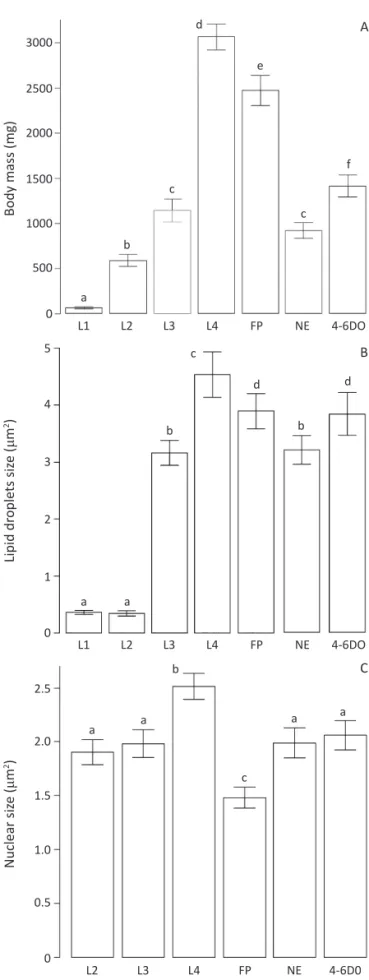
A signi icant increase in body mass was detected during development of T. theobaldi (F1;34 = 84.83, P<
0.0001) (Fig 2A), with a 52-fold body mass increase from L1 to L4 (Fig 2A). During metamorphosis, there is a reduction of nearly 0.87-fold in the body mass of L4 larvae to female pupae and another decrease of approximately 3.5-fold from pupae to newly-emerged females (Fig 2A). However, adult females have a 2-fold increase in their body mass on their fourth to sixth day of adulthood (Fig 2A).
Trophocytes have a cytoplasm rich in lipid droplets in all samples analyzed (Fig 1B, C). As with body mass, the area of the lipid droplets of trophocyte varies according to the developmental stages (F1;342= 39.89, P< 0.0001).
However, differences are not statistically signi icant from L1 (0.36 ± 0.039 μm2) to L2 larvae (0.35 ± 0.050 μm2).
On the other hand, a 1.4-fold increase in size is detected from L3 (3.16 ± 0.22 μm2) to L4 (4.54 ± 0.40 μm2), but
once females pupate, a ~0.9-fold decrease in the area of
the lipid droplets occurs. After metamorphosis, the size of the lipid droplets decreased by ~0.8-fold in the newly-emerged females in comparison to pupae, increasing once again in four-to-six day-old females (~1.2-fold) (Fig 2B).
Based on the body mass and on the morphometric analysis of the trophocyte lipid droplets, it can be inferred that the lipid storage increases during larval development. It is interesting to note that in spite of a body mass increase of ~9.5-fold from L1 to L2, the lipid droplets do not signi icantly increase in size. This suggests that body weight gain is not solely associated to the increase in lipid droplet size, and may be due to an increase in other structures or organelles as well as increase in the number of lipid droplets per cell. However, as the fat body cells are so tightly clustered, accurate assessment of cell limits and of the number of droplets per cell is dif icult. The increase in size of the lipid droplets continues until the L4 stage, when these cells reach their maximum size (Fig 2B). The increase in the lipid droplet size may be correlated with the overall weight gain by the larvae. For instance, from L1 and L2 to L4, the lipid droplet increases ~13-fold, while body mass increases ~52-fold.
There is a marked increase in the size of lipid droplets from L2 to L3 (Fig 2B), suggesting that the T. theobaldi
lipid storage is possibly enhanced during this development interval than any other point during larval development. Thus, food deprivation during the L2-L3 transition may be more critical for larval development than in other stages. Future studies shall clarify the importance of feeding and lipid storage during these early larval stages.
Fig 1Histological sections of
the Toxorhynchites theobaldi
fat bodies stained with hematoxylin and eosin. A) L2 fat body. Trophocytes (T) form a cell mass located underneath the epidermis (e) and the cuticle (c). These cells have a prominent nucleus (N) with a developed nucleolus (n); B) L4 fat body. Cells are illed with large lipid droplets (L) and also have a prominent nucleus (N); C) Fat body of two-day-old female pupa. Protein granules (arrows) are strongly stained and noticeable between the lipid droplets (L); D) Four-to-six day-old female fat body. Lipid droplets (L) are weakly stained in contrast with the protein granules (arrow). Bars = 10 m.
A
e c
n T
N
L
L
L
L
L
N
N
C
B
During insect larval development, there is a need for nutrient storage for building the adult body; therefore, it is expected that the lipid reserves increase mainly prior to metamorphosis. Even though Toxorhynchites is
predatory during their entire larval stage, fourth-instars are the most robust and ef icient predators (reviewed in Steffan & Evenhuis 1981). Prey consumption is thought to be higher during the fourth-instar larvae to assure nutrient storage prior to metamorphosis (Trpis 1972, Trimble & Smith 1978, Chowanadisai et al 1984). With
this in mind, such high predation may explain why the body and the lipid droplets reach their maximum size in L4 (Fig 2B). Otherwise, poorly fed larvae delay adult sexual development and have reduced egg production (Amalraj et al 2005).
Considering that the female pupae and the newly-emerged females do not feed, decrease in body mass and lipid storage due to storage nutrient utilization during metamorphosis is expected. Additionally, the decrease in body mass is higher in comparison to lipid droplet size, and it can be partially explained by lipid utilization during metamorphosis. However, as the body mass and the lipid droplets size increase in the four-to-six day old females, it suggests that individuals that feed on sugars undergo lipogenesis during adulthood, as reported for A. aegypti
adult females (Ziegler & Ibrahin 2001) and other insects (reviewed in Canavoso et al 2001).
Protein granules become clearly visible in the cytoplasm of trophocytes from female pupae and remained in adult females of T. theobaldi (Figs 1C, D).
The protein granule size ranged from 2.92 ± 0.43 μm2
in female pupae to 2.54 ± 0.16 μm2 and 3.45 ± 0.34 μm2
in newly-emerged and in four-to-six day old females, respectively. Nevertheless, the protein granule size are similar in both pupae and adult females (F1;150 = 2.69,
P= 0.074). The storage of protein granules in the fat body after insect larval development is thought to come mainly from the accumulation of tyrosine-rich proteins, such as vitellogenin and arylphorin (Haunerland et al
1990). These proteins are consumed during aging of adult females and are a key source of nutrients that are mobilized during egg development in the anautogenous yellow fever mosquito A. aegypti (Raikhel & Lea 1983)
and other hematophagous (Tobe & Davey 1974) and non-hematophagous dipterans (Thomsen & Thomsen 1974, Stoppie et al 1981).
Besides lipid droplets, the trophocyte nuclear size also varies between some T. theobaldi developmental
stages (F1;294 = 7.14,P< 0.0001). At the beginning of
its larval development, no signi icant difference in nuclear sizes is detected between L2 and L3. However, nuclear size increases ~1.3-fold from L3 to L4, and decreases 1.7-fold during metamorphosis. Conversely, after emergence, nuclei size increases ~1.3-fold, and it increases ~1.04-fold in 4-6 day-old females in
Fig 2 Body mass, trophocyte lipid droplet and nuclear sizes at different development stages of Toxorhynchites theobaldi. Vertical bars denote standard error. Letters (a-f) indicate the signi icant differences of: A) body mass (F1;34= 84.83, P< 0.0001); B) lipid droplet size (F1;342= 39.89, P < 0.0001); and C) nuclear size (F5;294 =
7.14, P< 0.0001). L1-L4 - larvae; FP - two-day-old female pupae; NE - newly-emerged and 4-6DO - four-to-six day-old adult females.
3000
5
2.5 2000
3
1.5 2500
4
2.0 1500
2
1.0 1000
1
0.5 500
0
0 L2 L1 L1
L3 L3
NE NE
L2 L2
FP FP
L4 L4
4-6DO 4-6DO
L4 NE
L3 FP 4-6D0
0 a
a
a a
b
c
a a
b
a c
b
d A
B
C c
e
d c
b f
d
Body mass (mg)
Lipid dr
ople
ts siz
e (
μ
m
2)
Nuclear siz
e (
μ
m
comparison to the newly-emerged ones. In spite of this, the nuclei of trophocytes in adults still have the same size as in the L2-L3 (Fig 2C).
Ploidy levels and DNA synthesis are known to be common to the fat body of insects as reported to several species (Wigglesworth 1967, Butterworth & Rash 1986, Butterworth et al 1988, Dittmann et al 1989) and are
generally association with the increase in the nuclei size of trophocytes in insect fat bodies. The association of nuclei development in fat body cells as the result of DNA synthesis in larvae and adult insects also seems to be the case here for the nuclei of trophocytes in T. theobaldi larval and adult stages. However, the reduction
in size of the trophocyte nuclei detected in pupae is still unclear.
In conclusion, we identi ied for the irst time the morphological changes during the post-embryonic development of T. theobaldi, and we showed that the
fat body in this species undergoes signi icant changes at the macro (overall structural changes) and cellular levels. Toxorhynchites is an important natural enemy
of mosquito vectors and is a widely studied model to control mosquito larvae. The better understanding of
Toxorhynchites biology can improve mass rearing, leading
to the development of homogenous populations with synchronous metamorphosis, eclosion and uniform adult size that can then be applied towards mosquito vector control.
Acknowledgments
To CNPq, CAPES and Fapemig for funding support. MRO is supported by NIH grants AI074691 and AI088051.
References
Albeny DS, Cassiano SR, Ataíde LMS, Vilela EF (2010) Primeiro
registro do gênero Toxorhynchites (Theobald) (Diptera,
Culicidae) em Mata Atlântica, Viçosa, MG. Ceres 57: 181-184. Alves DM, Serrão JE, Melo AL (2010) Alterations in the fat body and
midgut of Culex quinquefasciatus larvae following exposure to different insecticides. Micron 41: 592-597.
Amalraj D, Sivagnaname N, Das P (2005) Effect of food on immature development, consumption rate, and relative growth rate of
Toxorhynchites splendens (Diptera Culicidae), a predator of
container breeding mosquitoes. Mem Inst Oswaldo Cruz 100: 893-902.
Butterworth FM (1972) Adipose tissue of Drosophila melanogaster. V. Genetic and experimental studies of an extrinsic studies of an extrinsic in luence on the rate of cell death in the larval fat body. Dev Biol 28: 311-325.
Butterworth FM, Emerson L, Rasch EM (1988) Maturation and degeneration of the fat body in the Drosophila larva and
pupa as revealed by morphometric analysis. Tissue Cell 20: 255-268.
Butterworth FM, Rasch EM (1986) Adipose tissue of Drosophila
melanogaster: VII. Distribution of nuclear DNA amounts along
the anterior-posterior axis in the larval fat body. J Exp Zool 158: 77-85.
Canavoso LE, Jouni ZE, Karnas KJ, Pennington JE, Wells MA (2001)
Fat metabolism in insects.Annu Rev Nutr 21: 23-46.
Cardoso AF, Cres RL, Moura AS, Almeida F, Bijovsky AT (2010) Culex
quinquefasciatus vitellogenesis: morphological and biochemical
aspects. Mem Inst Oswaldo Cruz 105: 254-262.
Chowanadisai L, Benjaphong N, Phanthumachimda B (1984)
Laboratory observations on Toxorhynchites splendens
Wiedemann in Thailand. Southeast Asian J Trop Med Public Health 15: 337-341.
Crawley MJ (2002) Statistical computing. An introduction to data analysis using s-plus. JohnWiley and Sons.
Cruz-Landim C (1975) Estudo do corpo gorduroso de Apis mellifera
adansonii ao microscópio óptico e eletrônico. Anais do 3º
Congresso Brasileiro de Apicultura, p.137-144.
Dittmann F, Kogan PH, Hagedorn HH (1989) Ploidy levels and DNA synthesis in fat body cells of the adult mosquito Aedes aegypti: the role of juvenile hormone. Arch Insect Biochem Physiol 12: 133-143.
Focks DA (2007) Toxorhynchites as biocontrol agents. J Am Mosq
Control Assoc 23: 118-127.
Grzelak K, Kumaran AK (1986). Developmental changes in the larval fat body during metamorphosis in Galleria mellonella. J Insect Physiol 32: 445-453.
Haunerland NH, Nair KN, Bowers WS (1990) Fat body heterogeneity
during development of Heliothis zea. Insect Biochem 20:
829-837.
Haunerland NH, Shirk PD (1995) Regional and functional differentiation in the insect fat body. Ann Rev Entomol 40:121-145.
Kesavaraju B, Juliano SA (2004) Differential behavioral responses to water-borne cues to predation in two container-dwelling mosquitoes. Ann Entomol Soc Am 97: 194-201.
Kesavaraju B, Damal K, Juliano SA (2007) Threat-sensitive behavioral responses to concentrations of water-borne cues from predation. Ethology 113: 199-206.
Larsen WJ (1976) Cell remodeling in the fat body of an insect. Tissue Cell 8: 73-92.
Locke M, Collins JV (1965) The structure and formation of protein granules in the fat body of an insect. J Cell Biol 26: 857-884. Lounibos L, Frank J (1987) Survival, development and predatory
effects of mosquito larvae in Venezuelan Phytotelmata. J Trop Ecol 3: 221-242.
Martins GF, Pimenta PFP (2008) Structural changes in fat body of
Aedes aegypti caused by aging and blood-feeding. J Med Entomol
Martins GF, Serrão JE, Ramalho-Ortigão JM, Pimenta PFP (2011) Hystochemical and ultrastructural studies of the mosquito Aedes
aegypti fat body: effects of aging and diet type. Micro Res Tech.
DOI: 10.1002/jemt.20990
Martins GF, Serrão JE, Ramalho-Ortigão JM, Pimenta PFP (in press) A comparative study of the fat body morphology in ive mosquito species. Mem Inst Oswaldo Cruz.
Raikhel AS, Lea AO (1983) Previtellogenic development and vitellogenin synthesis in the fat body of a mosquito: an ultrastructural and imunocytochemical study. Tissue Cell 15: 281-300.
Roma GC, Bueno OC, Camargo-Mathias MI (2010) Morpho-physiological analysis of the insect fat body: a review. Micron 41: 395-401.
Sohal RS (1973) Fine structural alterations with age in the fat body of the adult male house ly, Musca domestica. Z Zellforsch 140: 169-175.
Steffan WA, Evenhuis NL (1981) Biology of Toxorhynchites. Annu
Rev Entomol 26: 159-181.
Stoppie P, Briers T, Huybrechts R, De Loof A (1981) Molting hormone, juvenile hormone and the ultrastructure of the fat
body of adult Sarcophaga bullata (Diptera). Cell Tissue Res
221: 233-244.
Thomsen E, Thomsen M (1974) Fine structure of the fat body of
the female of Calliphora erythrocephala during the irst
egg-maturation cycle. Cell Tissue Res 152: 193-217.
Tikasingh ES, Eustace A (1992) Suppression of Aedes aegypti by
predatory Toxorhynchites moctezuma in an island habitat. Med Vet Entomol 6: 272-280.
Tobe SS, Davey KG (1974) Autoradiographic study of protein synthesis in abdominal tissues of Glossina austeni. Tissue Cell 6: 255-268.
Trimble RM, Smith SM (1978) Geographic variation in development time and predation in the tree-hole mosquito, Toxorhynchites
rutilus septentrionalis (Diptera: Culicidae). Can J Zool 56:
2156-2165.
Trpis M (1972) Development and predatory behavior of
Toxorhynchites brevipalpis (Diptera: Culicidae) in relation to
temperature. Environ Entomol 16: 538-546.
Wang Z, Haunerland NH (1991) Ultrastructural study of storage protein granules in fat body of the corn earworm Heliotis zea. J Insect Physiol37: 353-363.
Wang Z, Haunerland NH (1992) Fate of differentiated fat body tissues during metamorphosis of Helicoverpa zea. J Insect Physiol 38: 199-213.
Wigglesworth VB (1942) The storage of protein, fat, glycogen and uric acid in the body and other tissues of mosquito larva. J Exp Biol 19: 56-77.
Wigglesworth VB (1967) Polyploidy and nuclear fusion in the fat body of Rhodnius (Heteroptera). J Cell Sci 2: 603-616.
Zara FJ, Caetano FH (2004) Ultramorphology and histochemistry of fat body cells from last instar larval of the Pachycondyla
(=Neoponera) villosa (Fabricius) (Formicidae: Ponerinae). Braz
J Biol 64: 725-735.
Zara FJ, Caetano FH, Cabrera ACG, Jaffé K (2003) Ultrastructure of last larval instar fat body cells of Pachycondyla (= Neoponera) villosa (Formicidae: Ponerinae): cytochemical and chemical analysis. Anim Biol 53: 1-16.