1
COST Action TU1203
:
Crime Prevention through Urban Design & Planning (CP-UDP)
Cooperation in Partnerships
and Process of CP-UDP
COST Action TU1203
Crime Prevention through Urban Design and Planning
(CP-UDP)
Cooperation in Partnerships
and Process of CP-UDP
Results of Working Group 1
COST ACTION TU1203
Working Group 1
Cooperation in Partnerships And Process Of CP-UDP
Members And Case Study Authors
Mónica Diniz, Portugal
Daniela Idrovo, Spain
Michel Le Calloch, France
Adam Rybka, Poland
Minas Samatas, Greece
Herbert Schubert, Germany
Paul van Soomeren, Netherlands
Randy Bloeme, Netherlands
Svetlana S. Stanarevic, Serbia
Elad Persov, Israel
Authors
Herbert Schubert
Paul van Soomeren
Daniela Idrovo
Elad Persov
Randy Bloeme
Miguel Saraiva
Foreword
What is COST?
COST – European Cooperation in Science and Technology - is an intergovernmental framework aimed at facilitating the collaboration and networking of scientists and researchers at European level. It was established in 1971 by 19 member countries and currently includes 35 member countries across Europe, and Israel as a cooperating state. COST funds pan-European, bottom-up networks of scientists and researchers across all science and technology fields. These networks, called 'COST Actions', promote international coordination of national-funded research. By fostering the networking of researchers at an international level, COST enables break-through scientific developments leading to new concepts and products, thereby contributing to strengthening Europe’s research and innovation capacities. COST’s mission focuses in particular on: building capacity by connecting high quality scientific communities throughout Europe and worldwide; Providing networking opportunities for early career investigators; Increasing the impact of research on policy makers, regulatory bodies and national decision makers as well as the private sector. Through its inclusiveness, COST supports the integration of research communities, leverages national research investments and addresses issues of global relevance. Every year thousands of European scientists benefit from being involved in COST Actions, allowing the pooling of national research funding to achieve common goals. As a precursor of advanced multidisciplinary research, COST anticipates and complements the activities of EU Framework Programs, constituting a “bridge” towards the scientific communities of emerging countries.
In particular, COST Actions are also open to participation by non-European scientists coming from neighbor countries (for example Albania, Algeria, Armenia, Azerbaijan, Belarus, Egypt, Georgia, Jordan, Lebanon, Libya, Moldova, Montenegro, Morocco, the Palestinian Authority, Russia, Syria, Tunisia and Ukraine) and from a number of international partner countries. COST's budget for networking activities has traditionally been provided by successive EU RTD Framework Programs. COST is currently executed by the European Science Foundation (ESF) through the COST Office on a mandate by the European Commission, and the framework is governed by a Committee of Senior Officials (CSO) representing all its 35 member countries. More information about COST is available at
www.cost.eu
COST action TU1203: Crime Prevention through Urban Design and Planning (CP-UDP)
The focus of COST Action TU1203 is Crime Prevention through Urban Design and Planning (CP-UDP). The Action was chaired by Professor Clara Cardia of the Polytechnic University of Milan, Italy. Clara Cardia completely unexpectedly died April 30th 2015. From then on Dr. Umberto Nicolini of LABQUS Milan chaired the COST action.
The Action comprises country representatives from European countries and some partnership countries. The countries presently involved are: Austria, Belgium, Bulgaria, Czech Republic, Denmark, Finland, France, FYR of Macedonia, Germany, Greece, Hungary, Ireland, Israel, Italy, Lithuania, Netherlands, Poland, Portugal, Romania, Serbia, Slovenia, Spain, Sweden, Switzerland and the United Kingdom. Its objective is to make a substantial advancement towards the goal of building “safe cities”. Studies have proved that there is a correlation between the structure and organization of urban space and crime: new criminological theory supports this point of view. The Justice and Home Affairs Council of the EU has underlined that crime prevention through design and planning is a successful and effective strategy for crime prevention and needs to be supported. Despite this, new projects are being implemented all over Europe without considering safety criteria, creating urban areas where crime and fear of crime make life difficult. The Action develops new knowledge and innovative approaches putting together theoretical thinking and practical experience. Thus the scientific program forecasts to work simultaneously on one hand on the innovative approaches deriving from research and experts, on the other hand on the know-how acquired through best practical experience. It brings together, value and disseminate the local research and experiences of participating countries, thus contributing to building a body of European expertise in the field of CP-UDP. It also uses its wide network to promote awareness, hoping that at the end of the Action more countries and decision bodies will be aware of the importance of incorporating crime prevention principles in planning decisions and projects.
From the Chair and the Core Group
The activity of COST Action TU1203 is organized along two main courses: producing innovative thinking in CP-UDP on one hand; and consolidating and diffusing existing knowledge on the other.
• The Action achieves the first course - innovative thinking - through working groups and invited experts which will develop new issues of environmental crime prevention, such as theories, private public partnerships, new technologies, new partnerships between police and planners, new implication of local authorities etc.
• It approaches the second course mainly through case studies located in different European cities. Each of the case studies focuses on aspects that are of major importance for the Action, and were organized by the hosting city with the support of the Action Core Group.
• The dissemination goal is considered of crucial importance and it is achieved, starting from the first year, by building networks of communication at international as well as the national levels. These networks are used for diffusing step by step the knowledge acquired by the Action.
• In order to make the results of the thematic working groups and the case studies immediately available to the Cost TU 1203 community and to the larger network it has been decided to produce a series of booklets, which develop the approached subject in short and synthetic form and are conceived so s to be easily readable to persons coming from different backgrounds. This booklet in thus one in a series.
See for the most recent information on this COST-action TU 1203: http://costtu1203.eu and http://www.cost.eu/domains_actions/tud/Actions/TU1203
Content
1 Introduction 8
2 Objective 9
3 General theoretical framework 11
4 Theoretical Connectivity 12
5 General model of partnerships and process 13
6 Actors and partnerships (elements and structure) 14
6.1 Identifying the partners 14
6.2 Building a network 14
6.2.1 Interdisciplinary cooperation 14
6.2.2 Trust and networks 15
6.3 Methods of work 15
6.3.1 Participatory culture 15
6.3.2 The role of the police 16
6.3.3 Cultural differences 16
6.3.4 Convincing strategy vs. mandatory Top Down 17 6.3.5 The bottom-Up perspective: New Governance 18
7 Temporal organization of the proceedings: process 20 7.1 Processes in a four dimensional (time/space) sociotechnical/ physical – space 20
7.2 Existing and new environments 21
7.3 Integrated or separated approaches 21
7.4 Existing knowledge on process approach 22
7.5 System engineering 25
7.6 Design thinking 26
7.7 Action in the process 27
8 Conclusion 30 9 Recommendations 31 10 References 32 Appendix 34 Case Studies 34 1. French Examples 34
1.1
COMMUNAL CONSULTATION COMMITTEE FOR SITUATIONAL PREVENTION IN LYON (3CPS)
34
1.2
STATUTORY INTRODUCTION OF PUBLIC SECURITY STUDIES THROUGHOUT FRANCE
36
2. German Examples 38
2.1
BOSKO COLOGNE AS PARTNERSHIP ON THE MI- CRO LEVEL OF A
QUARTER
38
2.2
THE PARTNERSHIP FOR CRIME PREVENTION IN URBAN PLANNING AND DESIGN IN LOWER
SAXONY ON THE MACRO
2.3
THE TOOL "SECURITY FOR PUBLIC SPACES" IN LOWER SAXONY
45
3. Dutch Examples 50
3.1
DUTCH POLICE LABEL SECURE HOUSING
50
3.2
VEILIGHEIDSEFFECTRAPPORTAGE (VER)
51
4. Portuguese Examples 52
4.1
COMMUNITY SAFETY PARTNERSHIP IN ALTA DE LISBOA
53
4.2
CPTED TRAINING TO MUNICIPAL URBAN PLANNERS / POLICE OFFICERS
58
4.3
PRIORITY INTERVENTION NEIGHBOURHOODS AND ZONES
60
4.4
THE AQUA-ADD PROJECT
63
5. Polish Example 66
5.1
POLISH ACTIVITIES
66
5.2
GOVERNMENT PROGRAM “SAFER TOGETHER” FOR REDUCING CRIME AND ANTISOCIAL BEHAVIOR
66
6. Serbian Example 69
6.1
NATIONAL FRAMEWORK
69
6.2
PBILD PROGRAM PEACEBUILDING AND INCLUSIVE LOCAL DEVELOPMENT
70
7. Spanish Example 72
7.1
REGIONAL APPROACHES
72
7.2
EXAMPLE BELVITGE
72
8. Greek example 75
8.1
GREEK PERSPECTIVE
75
Introduction
This document summarizes the analysis made by a working group of the COST action TU 1203 of processes and partnerships for Crime Prevention through Urban Design and Planning (CP-UDP) based on several experiences in different countries. Building on the different case studies (see appendix) we identified and selected the main strategies used to develop the partnerships and also the main processes used to prevent crime from a CP-UDP perspective. As we will see the two key concepts – partnerships and processes – are often interwoven.
When analysing the case studies and national reports we have taken in account the overall socio-political conditions and the culture of each country. This is important if we want to build a common knowledge base for a European CP-UDP strategy, though we know such a knowledge base may be difficult to be implemented in several cases, due to economic, political and cultural differences. The analysis of the collected examples may contribute to a new Integrated Network Theory of CP-UDP (Schubert, 2016).
1
Objective
The objective of the working group working on the issue of partnership and process was to identify and select the best strategies that may be used for developing innovative partnerships and processes and to develop an integrated network theory of CP-UDP.
The word innovative/innovation is mostly reserved for new technical inventions (a new camera, drone, app). We like to stress that also social innovations are important though they seem to be less visible and flashy. The working group noticed that a social innovation in one country may be an outdated approach in another country. Also in this respect technical and social innovations differ.
The working group (WG) was formed in the COST TU 1203 Lodz meeting (October 2014) and kept working in following meetings in Hannover, Belgrade and Kaunas. The working group started to work on scope and action ideas. The decision was taken to split the task in two dimensions:
Dimension 1 (partnership): had its focus on kinds of cooperation and ties – forms of partnership – that strengthen the implementation of CP-UDP by interrelations between authorities, corporations, institutions and (other) participants; in short participants or stakeholders.
Dimension 2 (process): had its focus on defining the phases and steps of the sequence or flow that CP-UDP follows – or should follow – to be successfully implemented.
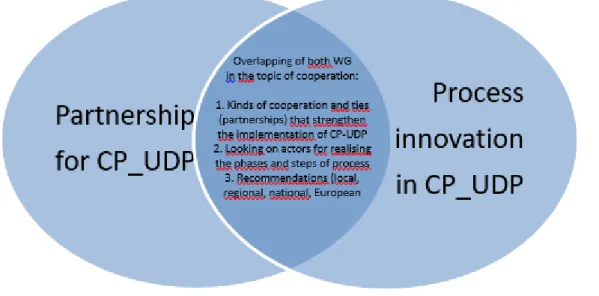
Since there is no sharp distinction between the two dimensions, the WG decided to go for an interference approach to tackle the overlapping topics in cooperation.
Illustration 1: the two overlapping dimensions
Making CP-UDP strategies really feasible and effective implies a sound implementation in the strategic and operational system of urban planning, design, and management.
• On one hand, it is important to integrate those institutions and disciplines in the process, which are able to achieve the objectives in the context of inter- and transdisciplinary cooperation. This is the perspective of the different stakeholders that are sources for partnerships in CP-UDP.
• On the other hand, CP-UDP strategies and measures must be embedded in local, regional and national urban planning, design and management processes (paper, flow charts, schemes, order, sequences, and algorithms).
These two dimensions may be presented interdependently as:
Illustration 2: independent dimensions
The working group pursued the goal to analyse, which forms of trust and cooperation are conditions for successful partnerships and strategies for action in CP-UDP and also identify and analyse the phases and steps of the processes that CP-UDP needs for a successful implementation. Therefore, examples from different European countries were collected. Delegates from France, Germany, Greece, Netherlands, Poland, Portugal, Serbia and Spain, were asked to present relevant case studies of each country as examples. These examples represent on the one hand the practice of forms of cooperation on the macro-level of state and regions, and on the micro-level of city and neighbourhoods. On the other hand, the various examples depict strategic and operational forms of cooperation between different actors through the CP-UDP processes. All the examples are shown in de appendix.
We have studied and visited several cases in different European countries. Cases, which are extremely interesting, especially from the perspective of the efficiency of CP-UDP. We have learned even more from the reanalysis of all these cases, regarding the CP-UDP implementation in contemporary Europe.
2
General theoretical framework
System theory is the transdisciplinary study of the abstract organization of phenomena, independent of their substance, type, or spatial or temporal scale of existence. It investigates both the principles common to all complex entities, and the (usually mathematical) models which can be used to describe them.
Among the principles of this theory is the use of the same concepts to describe the main features of different systems, the search for general laws that facilitate the understanding of the dynamics of the system. It is a theory that seeks rules of general value that can be applied to all kinds of systems and with any degree of reality. Importantly, the systems consist of modules ordered parts are interrelated and interact with each other. This is one of the main reasons why the analysis of processes and partnership should be done this way. The systematic approach is a kind of logical process applied to solve problems and comprises the following six classic stages:
problem identification,
determine alternative solutions,
select an alternative implementation of the selected alternative,
determine the efficiency of realization
revising as needed any stage of the process.
In this case system theory will be used to sort the basics: (1) elements and structures as a prerequisite; (2) Partnership as occasion for interdisciplinary connections (operations and coupling); (3) coupling the elements for making an order. A similar logic implies also the governance theory: (1) institutions; (2) skills; (3) temporal organization of the proceedings (process).
3
Theoretical Connectivity
The social cohesion between residents and users of an area is declared to a preventive factor that protect in the same way as urban design, because people take responsibility for their community in a stronger way (Saville/Cleveland 2003 and 2008). The social cohesion among residents is combined with shared expectations for control and their willingness to intervene on behalf of the common good and to reduce crime (Sampson 2012). This logic of collective efficacy can be transferred from neighbourhood relations in a residential area to interdisciplinary and inter-institutional relations in the planning and construction process. Therefore it is necessary that all actors that are interdependent in planning and development processes have knowledge from each other and contract clear rules by cooperating in crime prevention. This requires that these actors feel bonded to each other and trust in interdisciplinary cooperation that will lead to a significant reduction of crime – especially in preventing violence. The cohesion and connectivity induce relations between the community and external organisations and institutions that allow greater influence in planning processes.
4
General model of partnerships and process
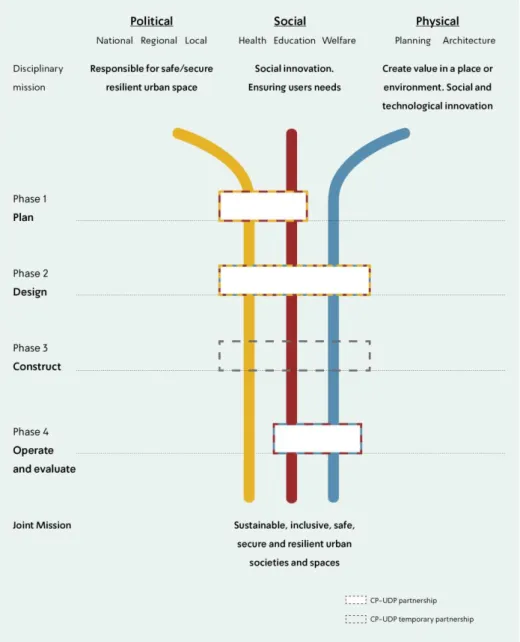
Illustration 3: general model of partnerships and process Model: CP-UDP as a generator of shared value through stakeholders’partnerships and process
The diagram presents the CP-UDP as a process that creates partnerships among different stakeholders in urban development project-process. The model creates three clusters of stakeholders: Social (health, education and welfare), Institutional (national authorities and local institutions), and Physical (planning/urbanism and architecture). These stakeholders participate in different stages of urban development process. The phases are divided according to project lifecycle of - planning, design, construction, operation and evaluation. During this multi-stakeholder process, the CP-UDP expert acts as shared value catalyst, bringing together the disciplinary missions of each stakeholder under the framework of the CD-UDP protocol. This is to be an iterative process whereby evaluation indicators call for feedback and which will lead to a safer, inclusive, resilient and sustainable city, responding to Goal 11 of the UN Sustainable Development Goals.
5
Actors and partnerships (elements and
structure)
In order to have an integral and holistic approach for CP-UDP it is important to integrate institutions and disciplines in the process, which are able to achieve the objectives in the context of inter- and transdisciplinary cooperation. This is called the partnership part. This part is divided in three sub-sections, namely: identifying the partners, building a network and methods of work.
5.1 Identifying the partners
Developing sustainable partnerships starts with identifying the key-actors and including them in a working group. It is important to do this in a very early stage since the problem definition as well as possible solution might be different from actor to actor. There are three categories of actors: social, institutional and academic actors.
Social actors are mostly formed by residents and non-residents like local businesses and associations. It is important to include people from all ages, men as well as women, people with different physical abilities and people from different socio-economic backgrounds, with special attention to immigrants. Social actors may – or may not – be organized in associations. A good example of very active social actors united in resident-associations is summarized in the Portuguese case study (see appendix, case study 4).
Institutional actors can be divided in public and private actors. Public actors are e.g. the police, representatives of the municipality, social services, urban planners, non-profit organisations and housing associations. There are also several institutional actors that fall between public and private like schools, churches/mosques and other cultural and religious actors.
There is special role for academic actors from universities and academies in capacity building for partnerships and networks, because they are responsible for the qualification of professionals from different disciplines that have to be familiar with criteria of CP-UPD and must be connectable in interdisciplinary collaboration.
5.2 Building a network
As shown in the model, partnerships develop occasionally. The different actors all have their own responsibilities, but they come together when an overarching goal emerges like e.g. a local crime problem. Over time, different partnerships occur more often and actors might meet other actors in different partnerships. At that point, there is a solid basis for the start of a CP-UDP network. However, for building networks we need specific requirements that will be described in this paragraph.
Building networks in CP-UDP starts with political will, commitment and promotion. Public actors such as ministries and state-run agencies should engage in disseminating the criteria of CP-UDP and initiating networks of cooperation among relevant organizations, institutions and associations that are active in the field of CP-UDP and that can make contributions for establishing CP-UDP in national, regional and local structures.
At the local level coordinators are required who build and organise networks of cooperation between the different actors – i.e. organizations and their representatives.
5.2.1 Interdisciplinary cooperation
The interdisciplinary composition of the cooperation depends on the specific planning tasks. The goal is to coordinate the actions of investors and involved disciplinary experts on one hand and the public administration on the other hand (double principal-agent-perspective) during the planning, design and construction process. The interdisciplinary partnerships should also be connected to residents and citizens.
The recommendations in this regard are:
The partnership should represent all residents within the project area. Here it is important to find the right balance between formal and informal ways of community building.
The police and representatives of the municipality should not assume that the population is homogenous. In fact, it is diverse with different needs in different resident-groups.
The partnership should improve communication and participation by involving younger people and immigrants in the Associations of Residents.
The cooperation between police and social services should pursue the same objectives. Very often, especially in case of drug offences, the police and social services confront each other with severe prejudice and a sort of predisposition: The police feel that social service protects criminals, whereas the social workers feel that the police tend to punish drug addicts. Here the two parties are confronted with a mix of legal issues and health issues.
5.2.2 Trust and networks
It takes time to trust, to learn the different ‘languages’, methods of work and interests of the diverse stakeholders and to act incorporating all the diverse points of view from the community. In this sense, it’s not only about creating partnerships, but also about how to maintain them over time, how to keep them open to new actors and to keep the motivation for the cooperation on security issues, especially in deprived areas.
The Portuguese examples underline that the engagement of local stakeholders in regular meetings with the police and municipality services representatives (e.g. urban planning, maintenance, housing, social development) on community security issues, contributes to the promotion of a culture of active citizenship and participation on security at local level. These systematic partnership meetings allow a clear understanding of the territory problems and resources, ensuring a bottom-up definition of urban security strategies, taking into account the security priorities and needs felt by residents of that specific territory, enabling local partners to take a pro-active role in planning, with the police, crime prevention activities.
5.3 Methods of work
In the strategy to develop sustainable partnership in CP-UDP two main axes play a role. On the one hand a horizontal axis of partnership is required between the police, experts in architecture, urban planning, landscape architecture, and in place management. On the other hand, also a vertical axis is crucial between the Key Decision-makers of the community (like the Mayor and relevant departments) and of the various agencies, organizations and companies. CP-UDP should work as an orientation frame that interconnects the actors and organizations. The main question is: Who are the relevant actors in the cooperation circles of the two axes? A municipal strategy to work on a shared vision, with local partnerships, in the process of identification of priority intervention neighbourhoods to be targeted to urban regeneration interventions, enables more effective and sustainable responses over time, since the residents/users participate actively in the process of urban regeneration, taking ownership of those territories.
The decision of these organisations must be committed to cooperation. Set the framework for goals and delegate members of staff, so that they work together with specialists from other disciplines and implement plans that are based on the criteria of CP-UDP.
5.3.1 Participatory culture
Developing a participatory culture and an active participation on security/safety issues takes time:
for citizens to cooperate with the police;
for the police to incorporate the community contributions into the police strategies;
for the designers and planners to incorporate the police perspective into the urban planning services. Regular partnership meetings to assess safety and security problems and planning crime prevention activities, with inclusive and transparent methods of work, are critical to consolidate and built up the trusting relationship amongst partners, namely with the police, and the resilience to overcome the constrains that tend to appear over time. It is important to note that it is harder to develop a participatory culture in one country than another (see the case studies in de appendix. E.g. examples 6 and 7).
5.3.2 The role of the police
The involvement and support of the police hierarchy (Command and direct police chiefs) regarding the community policing team schedules and decision process regarding the partnership joint decisions on strategies/activities to be deployed, facilitate prompt responses and cooperation between the community policing team and stakeholders (residents, local partners, municipal services).
A CP-UDP training targeting both police officers and urban planners – but even better all stakeholders including e.g. the residents - in the same training course facilitates the interaction and cooperation between these different actors. Also the urban walk or safety and security walks1 to the study case areas, to jointly analyse the causes of insecurity problems and potential solutions, is a critical step to encourage that cooperation, since taking urban planners to the field with the police officers, will help to confront the design by urban planners with the consequences on security level, over time, in the territory.
Although it is often not easy to include the police vision in the design and planning process, the community policing partnerships facilitate the interaction between local stakeholders and urban planners, facilitating the process of including diverse actors in the planning participatory processes, reinforcing a bottom-up process of including recommendations to the security/safety in the study areas.
Last but certainly not least is the role the police have as a ‘crime and insecurity knowledge centre’. The police have data on recorded crimes. However, rather high percentages of crime are unrecorded; these percentages are different for types of crime as well as for countries, districts/regions, cities and neighbourhoods. A rough estimate of the percentage of unrecorded crime (dark number) can be made by using the 'percentage of offence reported to the police'. This percentage is available in most countries from victim surveys.2 A problem might be that in most countries the police staff is not educated as criminological researchers
Besides crime there is also fear of crime/feelings of insecurity. This is a phenomenon the police are less familiar with. In most victim surveys also questions on fear of crime are included (see the international UN-standard: International Crime Victim Survey). But often different countries have different approaches and different questions. See e.g. for Germany: http://www.defus.org/nano.cms/sicherheitsaudits. Unlike the ICVS these outcomes are more difficult to compare.
A final remark was made in the working group that is sometimes appears to be impossible to share police info and data with outsiders because the information is highly secret or too vague and soft.
5.3.3 Cultural differences
There are differences in the theoretical understanding of cooperation in the European countries – maybe based on different cultures. Similarly, the national reports of successful or failed actions in CP-UDP from different European countries, collected in the working group are also very useful to understand the challenge and the difficulty of implementing CP-UDP in particular national examples.
The influence of different socio-political conditions and national cultures can be illustrated taking the Greek example (see appendix, example 8): The two basic problems for implementing an efficient CP-UDP strategy in current Greece are the central state administrative system and lack of trust between political, state institutions, including the police, and the Greek citizens. Until Greece obtains a decentralized political and administrative system with relative autonomous regions and municipalities, the key actors to accept and disseminate the CP-UDP criteria, initiating pertinent networks of cooperation at the central, regional and local levels are the ministers of the Greek government. Academic experts and public officials must help ministries to revitalize the Local Crime Prevention Councils (LCPC) in every region and prefecture, which were established by Law 2713/1999 and had been actually cancelled after a few years. Eventually the Greek Regional Governors and Mayors with local police, educators, church, NGO’s have to undertake the CP-UDP strategy. Successful technological instruments and policy innovations of CP-UDP already implemented in some European countries could be adopted in Greece, provided that the implementation costs are low, given the Greek economic situation. In the traditional crime cases of agricultural areas community CP-UDP can help, provided that the local actors will decide to enforce an effective CP strategy.
Note 1 A safety and security walk is a structured method that involves people in the local community in investigating both the physical and social environments. See also the publication (2009) by The Swedish National Council for Crime Prevention: Brottsförebyggande rådet (The Swedish National Council for Crime Prevention). (2009). Safety and security walks. Stockholm.
See: http://www.veilig-ontwerp-beheer.nl/publicaties/safety-and-security-walks
Note 2 See also: Key findings from the 2000 International Crime Victims Survey (ICVS), Appendix 4 Table 9. For more info:
5.3.4 Convincing strategy vs. mandatory Top Down
In some countries the creation of networks follows a strategy to convince the different actors by CP-UDP. The examples of Germany and Portugal (see appendix, examples 2 and 4) are based on the approach that the partnership takes place voluntarily. The collaboration has the positive effect of an increased efficiency. The single player has to make less effort and comes to better results. The example ESSP from France (see appendix, example 1) represents an opposite approach: At specific planning and construction projects, the implementation of cooperation on the CP-UDP criteria is mandatory and is enforced top down.
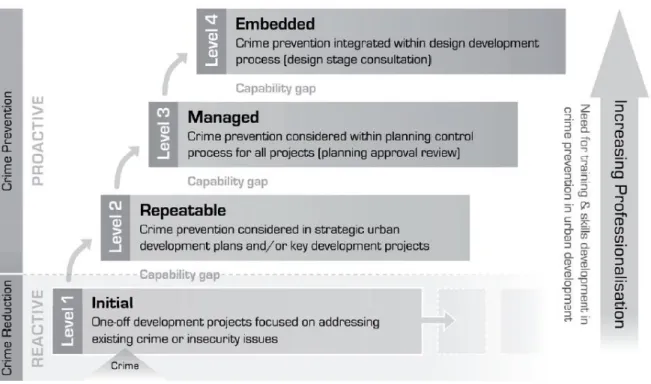
This example shows that there could be different ways for different European regions. Only measures, which are taken on wide and general scale have real national impact. Therefore, a set of measures must be obligatory (by law like ESSP in France and the example burglary resistant doors and windows in the Dutch Building Code (see appendix, example 3)). The crime prevention solution has to be embedded completely as the Salford scheme below shows (Illustration 4). The prerequisite for that is politicians who prescribe a law making the crime prevention measure obligatory. After some resistance industry and government will embed the measure. Much in the same way important requirements for fire disaster prevention, health promotion and traffic safety have evolved.
Illustration 4: Crime Prevention Capability Maturity Model
Source:.Wootton, A.B. & Davey, C.L., 2012.
Firstly, one crime prevention expert should sort out the best and most feasible prevention requirements for a specific crime type. Secondly, a few implementers and researchers have to prove that the crime prevention expert is right (evidence based research). Thirdly, a motivated politician could make a law that standardises CP-UDP in the existing national or local building, planning and management rules and legislation. The example shows the process on a national scale, but the same might be done locally or in Europe as a whole.
The key question is: does this top down approach lead to better results? Do voluntary partnerships allow the diversity of stakeholders less or more opportunities to participate as mandatory forms of cooperation? What is the difference in the effects? This contrast was compromised in the working group: for a few rather easy and technical issues the law or building code is easy and evidence based effective. But for most issues on the local or regional level you need co-operation and negotiation.
5.3.5 The bottom-Up perspective: New Governance
In the recent discourse three steps of development in public policy and governance are mentioned (Osborne 2006):
Public Administration (PA),
New Public Management (NPM),
New Public Governance (NPG).
PA represents the post-1945 era of the welfare state, when the state was confidently expected to meet all the social and economic needs of the citizens. Policymaking and implementation are vertically integrated within government. This logic focuses precisely upon this policymaking and implementation system. Because of its vertically integrated nature, hierarchy is the key governance mechanism. The emphasis is on top-down control by laws and rules.
The spread of the NPM took place from the late 1980s onward. In its most extreme form, asserting the superiority of private-sector managerial techniques over those of PA. NPM is based on the assumption that the application of economic thinking and techniques to public services would automatically lead to improvements in the efficiency and effectiveness of the services. The focus on neoliberal control by market triggered the withdrawal of state institutions: In some countries like the UK the police budget and formation was reduced in this period while the volume of private security services has grown enormously.
Increasingly the NPM has become perceived as limited and one-dimensional. So the NPG is prevailing since the beginning of the 21st century. This approach represents a contemporary stream of management theory, concerned with the relational organization and a plural state, where multiple inter-dependent actors contribute to the delivery of public services and a pluralist state. Its focus is very much upon inter-organizational relationships, where trust, relational capital and relational contracts act as the core governance mechanisms. This promotes processes of negotiation among the local stakeholders. They take joint responsibility for the production of security in the community by building networks for exchange of resources and for participation. The NPG is a new pluralistic governance body including government agencies, actors of the private sector, non-profit organizations and a series of social groups: Firstly, the NPG emphasizes the dispersion of power – all institutions and organizations in the society have the right to participate in public affairs management, and in solving public problems like CP-UDP. Secondly, in the logic of NPG the government agencies coordinate social interests, build dialogue platforms, and integrate public resources. Thirdly, the NPG is based on a complex network whose members are actors of state institutions, market, public organizations, community and civil society. Fourthly, the governance network relies on trust and reputation.
Therefore, the strategy to convince the different actors by CP-UDP represents the current public policy of New Public Governance. The approach of partnerships in CP-UDP corresponds with the currently prevailing guideline, not to force through rules and laws, but to enable to do the right things and the things right through negotiation (Illustration 5).
Illustration 5: Mixed Strategies for Establish Crime Prevention through Urban Design and Planning
The working group discussed the contrast between strategies initiated top-down or bottom-up in depth and resolved it finally by integrating both directions of action as equivalent options. Under this mixed perspective they represent two complementary strategies (see illustration5):
The voluntary cooperation among the various disciplines of urban design and planning, public order and others promotes a transdisciplinary culture. As part of the New Public Governance the initiative is based on the associations and institutions in which the various professional groups articulate their interests and disseminate professional standards.
The impetus to mandatory forms of cooperation may also be added from the political spheres and public administration. For this, the basic condition of participatory democracy is necessary so that the stakeholders of the civil society – in particular residents – may be able to participate in processes of CP-UDP.
But also the top-down approach evidently works in some cases. Based on a sophisticated meta evaluation Farrell (2013) explores why crime is dropping since a few decades. He shows that 'the security hypothesis proposes that more and better security plays a key role in driving down different types of crime'3.
However, there are only a few evidence based examples that some types of crime (like car theft and burglary) are successfully prevented by technological innovations. In complex situations where (fear of) crime is obviously present and many stakeholders and lots of different interests play their role, negotiation is necessary. In the UK this approach was once known as the multi-agency approach, or partnership approach (Sampson et al.,1988; Sampson 2012)4.
Important mediators are the police and prevention councils, so that the residents can express their needs and can be brought up to the criteria of CP-UDP.
Last but not least economic players such as developers and investors should be strengthened. They must be able to be connected with the strategies of CP-UDP too. Farrel and Tilley (2017) state that persuading manufacturers to improve security technology has not always been easy. They describe that some persuasion has been needed. This can come from various sources, including consumer demand, police pressure, insurance company carrots, governmental exhortation, or governmental regulation (or the prospect of it). In the event, Farrel and Tilley describe that governmental exhortation and regulation has often proven necessary to put pressure on manufacturers to turn their attention to security and attend to its effectiveness.
Maybe the top-down approach of "first” and “second generation" CPTED (Atlas et al. 2008; Saville/Cleveland 2008; Colquhoun 2004) fits no longer into the Europe of the 21st century. Therefore, the working group concluded that a common European negotiation strategy is necessary that is based on the “next generation” of CP-UDP, introducing the community as the active part of the CP process and partnership – namely applying the collaborative approach at local level, based on synergies between governmental ministers, public officials, academic experts, the police, the civil society, and the community. Technological innovations, policies and instruments are successful CP-UDP strategies in a given country, if they can be adjusted to the special conditions of the national, regional and local structures; yet, they must be adopted and accepted by all collaborating partners, especially by the communities/municipalities which know best their specific crime problems and they will pay the socio-economic CP cost.
Noot 3 See Farrell (2013): “The security hypothesis appears to pass each test. It suggests that more and better security drove the crime drop.
Triangulation from various data signatures provided strong supporting evidence for car theft in Australia, and even stronger for the UK (Farrell et al. 2011a2011b), similarly strong evidence for the Netherlands (van Ours and Vollaard 2013), and supporting evidence for the US (Fujita and Maxfield 2012). Thus the security hypothesis passes the preliminary evidence and cross-national tests. The security hypothesis is crime specific.”
Noot 4 The ‘multi-agency’ approach to crime prevention has received considerable attention in recent years. (…) Building on the evidence of research
fieldwork, the paper strives for a more socially nuanced understanding which is alive to the complexities of locality-based crime prevention initiatives and of the power differentials running between different state agencies, as well as to the competing sectional interests within existing communities. Source:
6
Process
This analysis goes from understanding the dimensions of the processes, through the existing process knowledge to the specific actions in a process for CP-UDP.
In this paragraph we will focus on defining the phases and steps of the process that CP-UDP needs for a successful implementation. There are two ways to come up with a definition of the process steps:
Analyze what CP-UDP processes - implemented in several European countries - look like. Analyzing the examples presented in the appendix is thus the first way to proceed.
Analyze what the good practices in other fields of expertise are; domains like quality management, sustainability, risk management, system engineering and design management may be of interest here. Though these domains often do not have any knowledge of CP-UDP they are used by important partners/stakeholders in CP-UDP e.g. builders, designers, risk managers, etc.
In this respect we elaborate upon the earlier study done in this COST-action (Grönlund et al., 2014). Focusing on ‘process’ the recommendations of this publication can be summarized as: update the process model summarized in the Safepolis manual (Laboratorio Qualità Urbana e Sicurezza 2007) and CEN’s Technical Report on CP-UDP (TR14383-2:2007).
We will elaborate upon it later but for the moment we define a process as “A set of interrelated or interacting activities, which transforms inputs into outputs”.5
These interrelated or interacting activities involve a group of partners (partnership). These partners ‘walk’ together in the direction of a clear goal and a golden sky taken from article 1 in the European Urban Charter: "a secure and safe town free, as far as possible, from crime, delinquency and aggression". The assumption is that CP-UDP will be the way to walk and though the walk might be difficult and hard through storm, rain and darkness you will walk with your partners and not alone.
6.1 Processes in a four dimensional (time/space) sociotechnical/ physical –
space
CP-UDP is about the question ‘how to prevent crime as well as fear of crime – feelings of insecurity – by changing the social and physical environment using design, planning, management and engineering?’.
An environment is always a four dimensional concept: a space-time manifold. Since Einstein we know that time and space is actually one: “Relative space is inseparably fused to relative time, the two forming what is called the space-time manifold, or simply process. If, as it were, we slice through time at one timeless instant, we do not get a purely spatial cross-section, we get nothing at all.” (Blaut, 1961). Hence the word ‘environment’ always implies that in such an environment processes take place in time and space.
Making changes in such an environment – and that is what CP-UDP does – almost always implies a mix of
social and physical measures. All too often the social and the physical are still seen as to separate
dimensions too (like time and space). But – following the actor network theory - this dualism does not exist in real life. Or - as Bruno Latour (1993) says: “we are sociotechnical animals, and each human interaction is sociotechnical”.
So when we promote CP-UDP changes in such a social and a physical/technical environment it is actually a four dimensional (time/space) socio-technical – or social-physical – space. To make it a bit easier: envisage a community in a physical environment; e.g. a neighborhood. So engineering is always hard boiled physical engineering, but also social engineering. The same goes for urban design, - planning and – management which is not only about bricks and mortar but also about people, stakeholders, partners and partnerships.
6.2 Existing and new environments
There is a very practical but huge difference between maintaining existing environments versus planning new environments.
In an existing environment one can simply go to the place and analyze what is there: from its demographics to architecture, from crime to culture, etc.
A new environment is less easy and open to explore. However, there still are different things to analyze:
Ecosystem, including natural resources, climate condition, geo-political trends, etc.
Knowledge from the experiences from adjacent or comparable environments (and/or people having experience in that respect).
Desires and knowledge of people or businesses who have indicated that they want to (re) settle to that new environment.
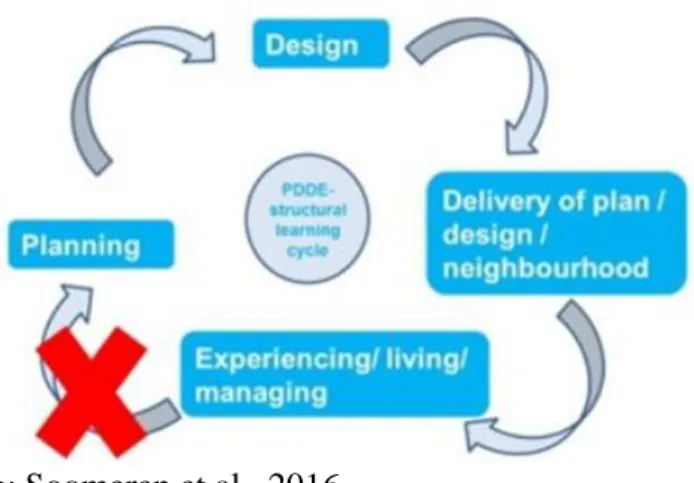
It is at this point that structural learning from past experiences and existing information from urban managers proves to be vital. The cycle of Planning – Design – Experience and back to planning is an important tool here. See also illustration 12.
Though we assume in a new environment ‘nothing is there yet’ this is often not the case. There is a plan or even a rather specific design. Even better if this plan or design has been developed with the participation of end users. This is actually the essence of design thinking and system engineering: user centered and co-creative and focused on solutions more than problems (Rowe, 1987). In urban planning and design this user centered co-creation approach has become easier thanks to social media. E.g. for new to build neighborhoods often the potential population of new dwellers is already on line. They can be drawn into the design process.
6.3 Integrated or separated approaches
The Safepolis manual and the technical report CEN 14383 presents two approaches:
An integrated approach and
A specialized approach
The safety experts are using the first approach, when the Working Group of a regular planning process for new or existing area will be expanded with some experts specialized in safety, security, and crime prevention/reduction: police officers, security risk professionals, social workers or some residents. What they actually do is rather simple: they look at the ‘bright’ designs from the ‘dark side’ of fear and offending. Thus, the advisors act to counterbalance the creative optimism designers must have to do their job. This counselling approach is costly though, because it depends upon the availability of flexible crime experts able to speak a design and planning language.
Unfortunately, police officers trying to do this job all too often lack the knowledge and expertise to come up with new and better solutions from a crime preventive point of view. Police officers may also strictly hold on to their checklists or training courses.
In the second approach, a separate working group specialized in the prevention/reduction of crime and fear of crime by urban planning, design and maintenance is set up to advise (and influence) the planners/designers, developers/builders and/or services. This approach is often working with a checklist. In the checklist approach, energy is devoted to the production and validation of guidance and lists summarizing ‘good’ and ‘bad’ design features, judged from the crime preventive and fear reducing point of view. Checklists are then disseminated to—or even forced upon—planners and designers. Often their reaction is negative because they have other priorities and they also aspire to achieve their own creative design goals. Planners and architects often look down on those pessimistic crime fighters speaking a completely different language of burglary, robbery and fear. The checklist approach is often only successful in relation to small-scale and technical solutions like target hardening and lighting. These types of technical requirements can also easily be included in building legislation and codes—as has been done for instance in the Netherlands (see appendix, example 3). On the higher scale levels, like urban/district planning, neighborhood design and landscaping, it still proves difficult—if not impossible—to mold crime prevention into a list of simple ‘do’s and don'ts’.
6.4 Existing knowledge on process approach
Worldwide standards: ISO 9000, 14000 and 31000
CP-UDP – and is other continents CPTED - is a new design-led and environmental approach to crime prevention following theoretical thinkers like C. Ray Jeffery, Ron Clarke, Marcus Felson, Paul and Patricia Brantingham, Jan van Dijk and David Weisburd.
In the Safepolis manual and CEN’s technical report (CEN/TR 14383-2) this environmental approach has been connected with a managerial approach according to the international standards on quality management (ISO 9000 series). The ISO 9000 Quality management approach focuses on the overall quality goals, demanding involvement from senior management in order to integrate quality into the business system. It also sought to improve effectiveness via process performance metrics: numerical measurement of the effectiveness of goals, tasks and activities. In this way, expectations of continual process improvement and tracking the ultimate business goals— customer satisfaction—were made explicit. Since standards are (obligatory) always tested, elaborated upon and evolving, the ISO 9001 version issued in 2015 (ISO 9001:2015) shows an important change compared to earlier versions. One of the changes is the plug in model it uses: standards from other sectors (food safety, automotive sector, health and safety) can easily be plugged into the more general ISO 9001 standard. Also more specific standards/requirements – e.g. on auditing, documentation, etc. – as well as more generic standards and requirements – like risk management, environmental management - can be plugged in. Last but not least the new ISO 9001 standard (as well as standards on sustainability ISO 14000 and risk ISO 31000) also have a stronger focus on stakeholders/partners (stakeholder analyses) and ask for a more thorough analysis of the context influencing the goals of the organization.
The ISO 9001:2000 standard and also the standards on sustainability (ISO 14000 series) and risk management (ISO 31000) are thus 'process-oriented' with – as mentioned before - a process simply defined as “a set of interrelated or interacting activities, which transforms inputs into outputs”.
The ultimate goal and desired outcome in the case of the ISO 9000 series standard may be summarized as 'a happy client' (i.e. enhancing customer satisfaction by meeting customer requirements). In the case of the newer ISO 14000 sustainability standards, the desired outcome is having a good environmental management system in place.
Even though these standards are voluntary, organizations find it hard to ignore the compliance with world-wide ISO 9001 and ISO 14001 standards when taking part in national or international trade and/or delivering national or international services. An organization implements—and often also advertises—these standards because they agree it will make (management) processes more effective, efficient and transparent. But organizations are often also 'voluntarily forced' to implement these standard and comply with - and pay for - external auditing once a year because their clients ask for such standards. When an organization is not certified, its competing power in the market for products and services is diminished.6
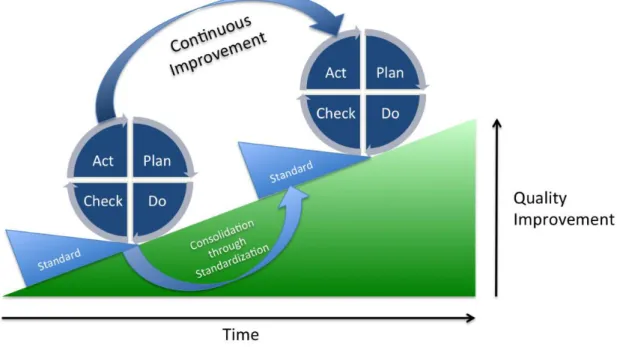
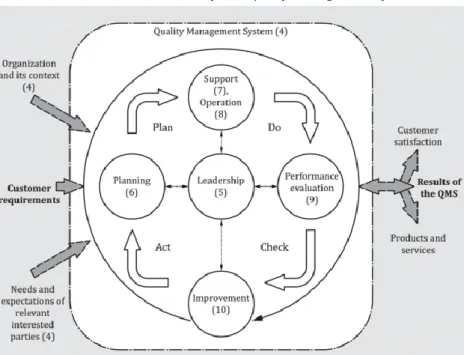
These standards follow the plan-do-check-act cycle or PDCA cycle (illustration 7). Plan–do–check–act - or plan– do–check–adjust - is an iterative four-step management method for the control and continuous improvement of processes, services and products. It is also known as the Deming circle/cycle/wheel.7
Note 6 Of course this goes especially for profit organisations and less for non-profit organisations, although more and more non-profit organisations are also forced to listen to market issues like client satisfaction and output/outcome requirements set by their managerial and political authorities. This is also part of the changing policies mentioned before: New Public Management (NPM) and New Public
Governance (NPG).
Illustration 6: plan-do-check-act cycle – continues improvement
Source: Plan-Do-Check-Act cycle (copied from the standard ISO 9001:2015) 8
PLAN
Establish the objectives and processes necessary to deliver results in accordance with the expected output (the target or goals). By establishing output expectations, the completeness and accuracy of the specification is also a part of the targeted improvement. When possible, start on a small scale to test possible effects. In design thinking this is called ‘prototyping’.
DO
Implement the plan, execute the process, and make the product. Collect data for charting and analysis in the following ‘CHECK’ and ‘ACT’ steps.
CHECK
Study the actual results (measured and collected in ‘DO’ above) and compare against the expected results (targets or goals from the ‘PLAN’) to ascertain any differences. Look for deviation in implementation from the plan and also look for the appropriateness and completeness of the plan to enable the execution, i.e., ‘Do’. Charting data can make this much easier to see trends over several PDCA cycles and in order to convert the collected data into information. Information is what you need for the next step ‘ACT’.
ACT
If the CHECK shows that the PLAN that was implemented in DO is an improvement to the prior standard (this is called the baseline), then that becomes the new standard (baseline) for how the organization or partnership should ACT going forward (new standards are enACTed). If the CHECK shows that the PLAN that was implemented in DO is not an improvement, then the existing standard (baseline) will remain in place. In either case, if the CHECK showed results different than expected (whether better or worse), then there is some more learning to be done... and that will suggest potential future PDCA cycles.
Note 8 "PDCA Process" by Johannes Vietze - Own work. Licensed under CC BY-SA 3.0 via Commons – https://commons.wikimedia.org/wiki/File:PDCA_Process.png#/media/File:PDCA_Process.png
Illustration 7: Plan-Do-Check-Act cycle – quality management system
Source: ISO 9001:2015 Standards https://www.iso.org/obp/ui/#iso:std:iso:9001:ed-5:v1:en
The new ISO 31000 standards on risk management are also based on the PDCA-cycle and the process model of the 31000 standard as presented in illustration 8.
Illustration 8: New ISO 31000 standards on risk management.
The most interesting column is the one on the right in which a risk assessment process is divided in
‘Risk identification’
‘Risk analysis’
Risk evaluation’
In short: what is the risk, what is the magnitude of the risk and is that acceptable or tolerable? These steps are also included in all CP-UDP processes.
A very interesting move in this risk management standard is the definition of a risk. Normally the insurance definition - in the end still derived from Blaise Pascal 1623-1662 - defines a risk as chance (or: likelihood, probability) multiplied by seriousness of the consequences (e.g. in material/immaterial damage done). In short: a risk is seen as a danger, as something bad.
In this standard ISO 31000 risk is seen as a possible harmful incident, or as possible a good thing happening. The definition of risk is simply: ‘the effect of uncertainty to objectives’, in which an effect is a deviation from the expected positive and/or negative. Hence there are positive risks like the invention of a very good and valuable product while looking for something else (e.g. the invention of penicillin). This is a concept also known as serendipity.
6.5 System engineering
9System engineering (SE) is a new approach that is used in software engineering but also in engineering like urban planning, urban design, architecture and product design.
The SE Mission: assure the fully integrated development and realization of products which meet stakeholders’ expectations within cost, schedule, and risk constraints.
Systems Engineering brings two vital elements to a project that are not usually present:
A disciplined focus on the end product, its enabling products, and its internal and external operational environment (i.e., a system view)
A disciplined vision of stakeholders’ expectations independent of daily project demands
In SE each process is defined by a purpose, outcomes, and activities. There is a worldwide standard (ISO) which explains and standardizes the process of SE: ISO 15288. Again the steps – the process - look familiar:
a) Stakeholder Requirements Definition b) Requirements Analysis c) Architectural Design d) Implementation e) Integration f) Verification g) Transition h) Validation i) Operation j) Maintenance k) Disposal
The effect of such a standard is that in software design, in product design as well as in the design of neighborhoods and cities talking and exchanging information about these processes can be made comparable. And since people working in software design, urban planning and architecture work on a worldwide basis nowadays, all can share the same terminology and ideas about a design process.
Note 9 Text taken from the System Engineering Primer as published by Incose (International Council on Systems Engineering)
6.6 Design thinking
Design thinking is an approach very much alike System Engineering. It is user centered and co-creative and focused on solutions more than problems. The five principles of service design thinking (Stickdorn and Schneider, 2010/33)
User centered: service should be experienced through the customer’s eyes
Co-creative: all stakeholders should be included in the service design process
Sequencing: the service should be visualized as a sequence of interrelated actions (imagine a service as a movie)
Evidencing: intangible servicesshould be visualized in terms of physical artefacts
Holistic: the entire environment of a service should be considered.
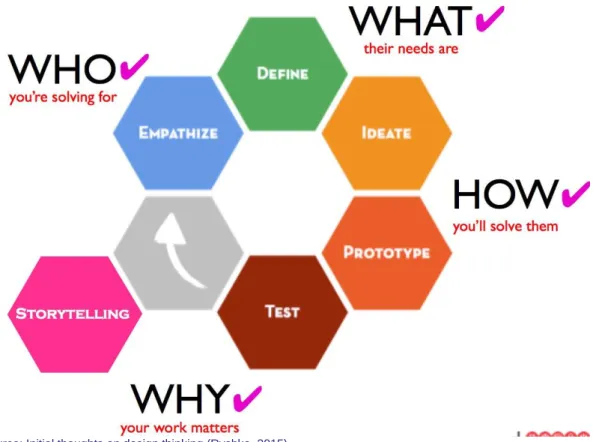
Design thinking combines the generation of new ideas with their analysis and an evaluation of how they apply generally. A designer uses abduction to generate an idea or a number of ideas, deduction to follow these ideas to their logical consequences and predict their outcomes, testing of the ideas in practice, and induction to generalize from the results. This learning in turn helps generate new ideas. (Dunne and Martin, 2006/518). It is interesting to examine design thinking as a research method. Although it is not a scientific method, it was proved to be leading to a more innovative solution as design becomes not only the solution but also part of the research method. The keyword here is ‘prototyping’ and bringing onboard users to reflect on early prototypes and even participate in the design of 2nd' and 3rd generations. A designer becomes a facilitator, using its design skills as a social mean for accurate innovation (illustration 9).
Illustration 9: Design thinking scheme
Source: Initial thoughts on design thinking (Ryshke, 2015)
BS 7000-1:200, British Standard Design Management Systems - Guide to Managing Innovation.
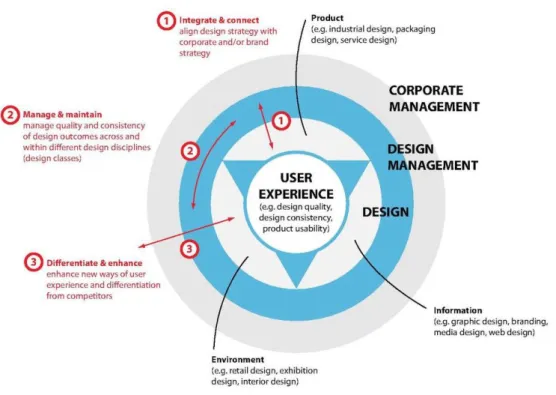
This British standard is used to manage knowledge, perceptions, and values, as methods to understand users, technology, design, and managerial process. Its aim is to influence on employees, managers, customers (users), stakeholders, work process, methods, perceptions and organizational structures (illustration 10).
Illustration 10: British Standard Design Management Systems
Source: Weiss (2010)
Change become a reality through the following managerial modifications: work team structure, physical work environment, work team inner communication, attitude toward people, presentation of problems, and finally – change in the definitions of the reasons for facing that problem. Hence this is all about ‘effective partnerships’. It changes the way an organization perceives creativity and translate it into innovation through the following self-questioning: How do we get new ideas? Do we have a structured process for that? How do we filter ideas? What do we do with the ideas filtered? What is our knowledge source for transferring creativity into innovation? How do we find and bring onboard our future clients? De we have a public innovation brief? How do we do risk analysis?
CEN 14383 series specific for CP-UDP
Last but not least the existing set of CP-UDP standard must be mentioned. It is a set of documents of which there is one European standard (CEN/EN-14383-1 on Terminology) and the others documents are easy adoptable texts that might be used to find consensus in a partnership (technical reports TR and technical specifications TS in the CEN 14383 series). At the moment there are seven texts available. See also www.CEN.eu and see Grönlund et al. (2014) for a review.
6.7 Action in the process
Analyzing the step by step approaches – processes – followed in the examples presented from countries all over Europe (see appendix) and looking at the examples taken from other domains like design thinking, system engineering and the management of risks, quality and sustainability, we may distinguish five general steps that seem to be present in every case and example, though the names and concept used may be different:
I. Stakeholder analyses: who are the institutions and people involved in the process; who are the partners? See here also the partners distinguished in the chapter on partnership. The builders and owners of (new) property are often mentioned first, but they are not alone. There is an important list of stakeholder to take into account: the residents, the police, architects, urban planners, designers, urban managers/maintenance, neighborhood organizations, etc. The importance of this part in the process is to identify each type of stakeholder, but also analyze the different qualities they might represent like: age, gender, experience/knowledge, etc. In the Safepolis handbook (and CEN Technical Report 14383-2:2007) this is called “the identification of the stakeholders to contribute to the process”. In short: WHO? An important distinction is that between the democratically elected institutes (city council, local authorities) and all others. The first group represents the people/society10 and in the end they are in charge.