5
The use of plants by human communities in the Iberian Peninsula:
carpological perspectives
1João Pedro Tereso
a, b, c*, Marian Berihuete Azorín
d, Ferran Antolín
ea InBIO - Rede de Investigação em Biodiversidade e Biologia Evolutiva, Laboratório Associado (Portugal); CIBIO - Centro de
Investigação em Biodiversidade e Recursos Genéticos, Universidade do Porto (Portugal)
b UNIARQ - Centro de Arqueologia da Universidade de Lisboa (Portugal)
c MHNCUP - Museu de História Natural e da Ciência da Universidade do Porto (Portugal) d Institute of Botany, Hohenheim University, Germany
e Integrative Prehistory and Archaeological Science (IPNA/IPAS), University of Basel (Switzerland)
*Corresponding author: [email protected]
T
he papers in this special issue werepresented at the 1st Iberian Carpology
Meeting - the use of plants by human communities in the Iberian Peninsula: carpological perspectives (1º Encontro de
Carpologia Ibérica - Uso de plantas pelas comunidades humanas na Península Ibérica: perspetivas carpológicas, in Portuguese). The event was celebrated at the University of
1 This paper was not subjected to peer-review.
Porto during the 22nd and 23rd of June 2017, with the institutional support of the University of Basel (Switzerland) and the University of Hohenheim (Germany).
The authors of this introduction, as organizers of the event, would like to begin by acknowledging that this is only the first official meeting of carpologists in the Iberian Peninsula. Meetings among carpologists working in this area existed since the 1990s,
6
particularly out of the friendship that built among Guillem Pérez-Jordà (University of Valencia, Spain), Natàlia Alonso (University of Lleida, Spain), Lydia Zapata (University of the Basque Country), Leonor Peña-Chocarro (CSIC, Spain) and Jacob Morales (University of the Canary Islands, Spain). The goal of these initial meetings was to discuss identifications and research problematics as well as to share experiences in an informal way. With time, the community of researchers grew and most of the specialists supported the idea of a more official meeting where research could be presented and discussed in a more formal framework, and ideally published afterwards. It is vital for a discipline like Carpology that case studies do not end in unpublished grey literature and it would be in the context of this meeting that most of this key research necessary to target bigger questions could be discussed within a specialised audience and made available to the public.
The change into an official meeting also allowed an easy opening to all researchers interested in the Archaeobotany of the Iberian Peninsula, thus reaching a wider audience and facilitating new synergies with other researchers. For this first meeting we had 15 lecturers from the University of Porto (Portugal), the CSIC (Spain), the University of Copenhaguen (Denmark), the University of Santiago de Compostela (Spain), the University of Basel (Switzerland), the University of Hohenheim (Germany), the University of Barcelona (Spain), the University of Lleida (Spain), the University of Valencia (Spain) and Wessex Archaeology (UK).
A tribute to A.R. Pinto da Silva
The year 2017, when the meeting took place, was the 25th anniversary since A.R. Pinto da Silva (1912-1992) passed away and it was decided to dedicate the meeting to his memory and his work, taking the opportunity to make his legacy known.
António Rodrigo Pinto da Silva was an agronomist and made most of his career at the Estação Agronómica Nacional (Lisboa, Portugal). Known as a botanist and taxonomist, since the early stages of his career, he began studying archaeological plant remains – mostly seeds and fruits. His earliest archaeobotanical work seems to have been the identification of carpological remains from the Chalcolithic site of Vila Nova de S. Pedro, in the 1930s, at the request of Afonso do Paço. He would study material from
this site until the 1950s (Silva, 1988).
Since then, he made contact with many archaeologists and ended up studying carpological remains from c. 40 sites from
different chronologies and distributed
throughout the whole country. During more than 50 years, A.R. Pinto da Silva identified carpological remains and throughout most of that time he was the only carpologist working in Portugal. Only at a later stage M. Hopf began studying Castro de Zambujal and a few
other Portuguese sites (Hopf, 1981). Working
alone most of the time, he tried to get in contact with foreign investigators in order to mitigate some of the difficulties he had with
problematic carpological material. In
unpublished reports he mentions his contacts with M. Kislev, seeking for some help identifying grains of wheat different from
7
those he was familiar with, as a botanist and agronomist.
Although field recovery strategies from these early studies in Portuguese Archaeology
do not fulfil today’s methodological
requirements and despite the fact that there was a clear lack of integration between
archaeological and archaeobotanical
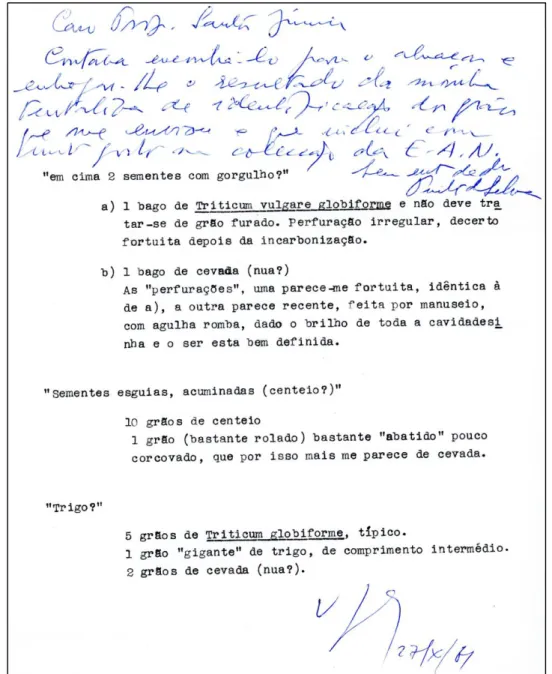
information (see example of a short report in
Figure 1), the amount of data that A.R. Pinto da Silva obtained is still relevant and needs to be taken into consideration by current
archaeobotanists and archaeologists.
Moreover, an event such as the 1st Iberian
Carpology Meeting is only possible due to the
efforts of early investigators, such as Pinto da Silva, who were responsible for first getting the scientific community interested in these subjects.
8
Papers in this special issue
During this 1st Iberian Carpology Meeting, we
had the opportunity to listen to many interesting communications. These have translated into some of the here presented contributions, which approach a variety of topics. All papers were peer-reviewed as in regular issues and we would like to thank all anonymous reviewers for their participation in this endeavour.
Antolín and others present the
archaeological assemblage from the Middle Neolithic site Pou Nou-2 (Catalonia) dated to the second half of the 5th millennium cal. BC. With over 10000 seeds analysed, their paper discusses the role of the wild plant species harvested, with special emphasis on acorns.
Stika contributes with the archaebotanical studies carried out in the Chalcolithic site of Alcalar (Portugal). The presence in the 3rd millennium BC settlement of 27 taxa of cultivated and wild taxa with edible or medicinal uses is reported.
Leite and colleagues shed new light on the formerly studied Iron Age site Castro de Plaheiros. According to the archaeobotanical studies, mainly cereals and some legumes were consumed.
Seabra and others present the evidence of storage in the Iron Age settlement Crastoeiro (Portugal). The information allows a better understanding about crop diversity, as well as storage practices. Of special interest is the identification of the oldest remains of rye in the Iberian Peninsula, dated to the 1st century cal. BC.
A similar thematic is approached by Tereso and others in the study of the horrea of Quinta de Crestelos (Portugal). The archaeobotanical assemblages coming from several storage structures, dated between the 1st century BC and the 2nd century AD, document the use of different cultivated plants, while the study of the wood charcoal has revealed the exploitation of several wild taxa, such as
Arbutus unedo, evergreen Quercus, Cistus sp., Fraxinus sp. and Pinus pinaster, both for fire
wood and as raw material for buildings and storage related constructions.
Finally, the work of Berihuete and others revises the state of the art on the study of underground plant storage organs. They conclude that while it is true that these kind of remains are not favoured by taphonomy, the main constrain in their analysis is the scarcity of specialists trained to recognize and identify them and the lack of comparison material and atlases. Nonetheless, they are optimistic on the possibilities of overcoming this situation and conclude their paper with a series of remarks of how to start such a process.
Papers in this special issue are good
examples of the archaeobotanical
investigation carried out nowadays focusing on Iberian contexts, by different generations of Iberian and non-Iberian investigators working in distinct European institutions. Through these studies now published, relevant data becomes available for the first time to the scientific community. We hope that their publication in an Iberian open-access journal will help reach different audiences and promote Archaeobotany among students, archaeologists and other
9
investigators in the fields of historical and biological sciences.
References
Hopf, M. 1981. Pflanzliche Reste aus Zambujal. In: Sangmeister E.; Schubart, H. (eds.) Zambujal, die grabungen
1964 bis 1973. Madrider Beiträge Band 5: 315-340.
Pinto da Silva, A. 1988. A Paleoetnobotânica na Arqueologia Portuguesa. Resultados desde 1931 a 1987. In: Queiroga, F.; Sousa, I.; Oliveira, C. (eds.) Actas do encontro Paleoecologia e
Arqueologia. Vila Nova de Famalicâo, Câmara Municipal,