HOW CAN FAMILY BUSINESSES USE THEIR
OWN TRADITION AS A SOURCE OF
INNOVATION
The case of SousaTêxtil
João Carlos Neto de Sousa
Nº152116272
Dissertation written under the supervision of Laure Leglise
Dissertation submitted in partial fulfilment of requirements for the MSc in Management with Specialization in Strategy and Entrepreneurship, at Católica Lisbon School of Business and
2
ABSTRACT
Title : How can family businesses use their own tradition as a source of innovation
Author : João Carlos Neto de Sousa
In order to survive in today’s fast paced and competition driven work environment it is inevitable for family owned business to ensure longevity through a proper innovation plan. The difficulty lies in how to come up with innovations. Thus, focusing on their own individual and collective capabilities and providing them with a new meaning seems an effective measure. One way of doing so is to search inside the company’s history and see how they can use this accumulation of know-how and transform it into an innovation strategy. Scholars have been studying family firms on how they are managed, what factors influence the strategic decisions and also how they ensure longevity. Nonetheless, there is a lack of research in how family-owned companies manage their relations and how they withstand more powerful and meaningful business relationships. With this in mind, the case of SousaTêxtil, a textile company that managed to innovate in their customer management by reapplying temporally distant knowledge and customs, is being examined. SousaTêxtil and its owner, Carlos Sousa, have been, throughout the years, improving their internal processes. The findings suggested that, although the company is largely affected by non-economic factors, the quality of interpersonal relationships and the usage of idiosyncratic knowledge are the main success factors.
3
SUMÁRIO
Título : How can family businesses use their own tradition as a source of innovation
Autor : João Carlos Neto de Sousa
Para que uma empresa seja capaz de não só sobreviver nos dias de hoje, mas também garantir a sua longevidade, é necessário um plano de inovação adequado. A dificuldade está apenas em como inovar. Deste modo, focando nas suas próprias capacidades e atribuir-lhes um novo significado ou funcionalidades parece ser uma medida eficaz. Um método a usar é procurar na história da empresa e ver como se pode usar o conhecimento acumulado numa estratégia de inovação. Investigadores têm estudado empresas familiares sobre como são lideradas, quais os fatores que influenciam as decisões estratégicas e também a longevidade. No entanto, não há informação sobre como as empresas familiares lidam com as relações e como são capazes de ter relacionamentos comerciais mais poderosos e significativos. Sabendo isto, utilizei o caso da SousaTêxtil, uma empresa têxtil que conseguiu inovar na gestão de seus clientes, reaplicando conhecimentos e tradições temporariamente distantes. Esta empresa e o seu líder, Carlos Sousa, têm, ao longo dos anos, aperfeiçoado os seus processos. Os resultados sugerem que, embora a empresa seja amplamente afetada por fatores não-económicos, a qualidade das relações interpessoais e o uso do conhecimento são os principais fatores de sucesso.
4
ACKNOWLEDGEMENTS
First, I would like to thank Laure Leglise’s support as my thesis counsellor. She was always available for my concerns and was extremely helpful in all her advices. It was a true pleasure having her behind me in this last chapter of my academic life. I also would like to thank all the people that I interviewed and gave me an amount of their time to help me into getting the most out of the usable information for my thesis.
Second, I would like to thank all my friends, Manuel, Francisca and Melissa, for their support and opinions. A special thanks to my girlfriend, Laura, that showed to be an incredible support, giving me different points of view and challenging me in new insightful conclusions and, most of all, for being a fountain of motivation and happiness that helped me to push through.
I need to thank the support that my grandparents gave me, for all the special sweets that my grandmother baked and for all the jokes that my granddad had ready. On a similar note, I need to thank for all the time that both of my brothers-in-law, Marc and Anders, spent listening to me and for their valuable opinions as well.
I would like to thank both of my sisters, Kiki and Marta. They, ever since, serve as examples and role models for me. I especially appreciate their lifelong advices, their around-the-clock availability and, most of all, their unconditional support even if they don’t see eye-to-eye with my decisions.
Last and more importantly, I would like to thank my parents. With their support and advices, I was able to fulfil my academic objectives that I planned to accomplish. They managed, not only presently but also throughout my life, to always support me in following my ideas and inspired me to become the person that I am today. I am especially thankful that they don’t miss an opportunity to make it perfectly clear to me where I have to improve and what I need to change.
To my mum that served as an example of stability and support to whatever it was about and whoever it was concerned. For teaching me, supporting me and pushing me, I thank you mum.
Finally, a thank-you to my dad that served as both an example of perseverance and resilience and that showed me that, although you might have the odds against you, hard work, determination and ambition is what it takes to be successful.
5
TABLE OF CONTENTS
1 Introduction ... 7
2 Literature Review ... 9
2.1 Family firms ... 9
2.1.1 Types and main characteristics ... 9
2.2 Socio emotional wealth theory ... 10
2.2.1 Sources, Dimensions and Outcomes ... 11
2.3 Agency and Stewardship Perspectives ... 12
2.4 Tradition in family own businesses ... 13
2.5 ITT Model ... 14
2.6 Family-managed innovation strategy ... 15
2.7 Entrepreneurial orientation ... 16
3 Methodology ... 18
3.1 Qualitative Approach ... 18
3.2 Data Collection and data analysis ... 19
4 Case Study ... 21
4.1 History ... 21
4.2 Description of the business ... 22
4.3 Stakeholders, Environment and Relations ... 24
5 Findings ... 28
5.1 Being self-aware of existent knowledge and capabilities ... 28
5.2 Being able to provider new meanings to old customs ... 29
5.3 Using a learning by doing strategy ... 30
5.4 Customer relationship as a field for innovation ... 32
6 Discussion ... 33
7 Conclusion ... 35
8 Bibliography ... 38
6
LIST OF TABLES
Table 1: Interviewees ... 20
LIST OF FIGURES
Figure 1: A Model of Innovation through Tradition ... 14Figure 2 : Evolution of Sales ... 22
Figure 3 : Knitting's Process... 23
7
1 INTRODUCTION
“Around the globe, over history, and across diverse social contexts, founder
managed firms (FMFs) have functioned as a primary engine of economic development and growth.” (Gedajlovic, Lubatkin, & Schulze, 2004, page 899). Family-owned businesses or
FOB’s, have a much stronger presence in the overall global economy than one might think. It is known that “Family businesses are the predominant form of business organization around
the world, and they contribute extensively to global wealth creation. While FBs are especially prevalent among privately held small and medium-sized enterprises many of the largest publicly traded corporations are also classified as family businesses” (Bammens, Voordeckers, & Van
Gils, 2011, page 134).
On the other side, family firms are also often seen as traditional firms, reluctant in seeking new opportunities, since they have a more conservative ideology. Indeed there exists tension between continuity and change. FOB’s have a very high resistance to change due to their “complex, longstanding stakeholder structure that involves family members … where
emotional attachment to family firm ownership may detract from the firm’s focus on economic goals.” (Mustakallio, Autio, & Zahra, 2002, page 205).
Nevertheless, ”evidence has revealed that more than half of the most innovative
large European firms are controlled by family owners “ (Duran, Kammerlander, van Essen, &
Zellweger, 2016, page 1224). Indeed, Short, Payne, Brigham, Lumpkin et Broberg (2009) have highlighted FOB’s innovative potential since they “exhibit peculiar features largely overlooked
in traditional models of innovation, which may create advantages in certain dimensions or facets of the innovation process and disadvantages in others “(Bammens, Notelaers, & Van
Gils, 2015, page 123). One way is to use tradition as a source of innovation. Considering tradition as the accumulation of symbolical and cultural know-how handed down through generations, family businesses are especially well suited to use it. They have privileged access to past knowledge, benefiting from valuable and hard-to-replicate information and methods for building a competitive advantage (De Massis, Frattini, & Lichtenthaler, 2013). Although they present enormous potential to use old knowledge as a source of innovation, most of the times they are constrained by non-economic factors, such as emotional attachment, pride or altruism, that prevent them to heighten their attributes.
The research question aims to discover how family-owned businesses utilize their own capabilities and history as a valid source of innovation. The goal is to prove that certain traditions should be re-instated and that, after adaptation for different types of stakeholders, it
8 can be a good method to strengthen relationships. Although it is still a field that lacks theoretical coherence due to the difficulties in approaching social and emotional factors (Gomez-Mejia, Cruz, Berrone, & De Castro, 2011) we’ve seen that “In the past several years there has been a
notable increase in the understanding of the family business field (Aronoff and Ward, 1991). Few works, however, have been published about the characteristics and results of the internationalization process of family business” (Gallo & García Pont, 1996, page 45).
To answer the research question, the qualitative methodology of a case study was used. The case of a Portuguese textile family-owned company – SousaTêxtil Lda was studied. This company proved to be relevant to answer my research question since it managed to have well founded and withstanding customer and supplier relationships, gaining competitive advantage against others due to the new meaning that they attribute to old customs.
This thesis will follow the subsequent structure: an overview of the literature regarding family firms, their specificities and the main influencers in their behavior is given. After that, information regarding the types of ideologies typically attribute to family businesses is presented, followed by some literature concerning tradition, innovation and the overall evolution and function of a family-owned business. The third chapter introduces the methodology used to collect and analyze the data, with reasoning for choosing a qualitative approach to answer the research question. In the fourth chapter, the reader is provided with the case study about SousaTêxtil Lda, passing through the company’s history, evolution and environment. After the case, the main findings are analyzed, based on the interviews, with respect to customer and supplier relations, harmful non-economic factors and idiosyncratic knowledge. In the final chapter the findings are presented and conclusions are drawn and discussed within the context of the stated literature
9
2 LITERATURE REVIEW
We begin by defining different types of family-owned business and distinguishing between them. After that, we can begin our study into the theories that explain FOB’s erratic behaviour and the reasons behind it. After better understanding their behaviour, we can analyse how FOB’s manage tradition and ultimately, how they use it as a source of innovation. As a last step, we look upon methods family firms’ can use to innovate.
2.1 Family firms
On the contrary as what many people expect, family firms not only constitute one of the biggest shares in the worldwide business but are also one of the main contributors of innovation outputs (Bammens et al., 2011). Although the majority of family firms are classified as SME’s (Small and Medium sized Enterprises), a significant part of the largest companies in the world are partially owned by families. Indeed, 18% of firms in the Fortune 500 are family-owned and around 30% of them were founded by families (Anderson & Reeb, 2004). Various definitions were found, due to the lack of theoretical coherence (Gomez-Mejia et al., 2011).For the purpose of this research we consider that a family firm can be defined by any business where relatives’ shares account for at least 20% of the total value (La Porta, Lopez-de-Silanes, & Shleifer, 1999).
2.1.1 Types and main characteristics
Firstly, family firms have a set of non-economic factors that are taken into consideration in their decision making process, which does not happen in a regular firm. The three main factors are: blurred boundaries between family and firm, family values affecting the company and the altruistic behaviour among family owners (Gomez-Mejia et al., 2011). Inside the various types of FOB’s, we can differ between family firms and lone founder controlled firms. For family firms there needs to be a single family holding the majority of the shares and a family member as an officer or director. Nevertheless, literature does not coincide on a standard definition (Gomez-Mejia et al., 2011). Differently, in lone founder firms, we only have one significant owner, officer or director that, although having a individualistic nature, also shares entrepreneurial, innovation and economic pursuits (Bammens et al., 2011). In both types of companies, there are three main basis for management processes: Succession, human resources and strategic choices (Gomez-Mejia et al., 2011). There is a clear desire to transfer
10 the business to the next generation, where a family member is always favoured even if a better alternative is available. Indeed, Gomez-Mejia et al. (2011) say that in FOBs human resource practices are less formalized, more emphasis is placed on informal training and seniority is the guide for promotions and establishing wage levels. Lastly, strategic choices appear to be harder to reach since they are affected by risk taking, international diversification, debt and R&D investment: FOBs are usually more risk averse since their performance is tied to family wealth. In order to a company to go international it demands external funding, it may require outside talent, it require increased ties to foreign stakeholders or resources. Debt is always less likely to be used in order to prevent attendant risks to their undiversified wealth. Likewise, diversification in FOBs is not duly appreciated since it requires expertise from outside; stepping away from traditional family methods; if needed, outside financing lowers family control and ultimately, larger and complex knowledge requirements force recruitment which in turn increases information asymmetries.
Distinguishing between types of FOB is not enough since they are subject to different factors. Different families will have different priorities, one might focus on the company when the other might focus on the family wealth. Therefore, it is important to talk about socio emotional wealth, the theory that explains why certain decisions are made and the main reasons for it.
2.2 Socio emotional wealth theory
Miller & Le Breton-Miller (2014), show that the socio emotional wealth theory originates in the behavioural agency theory, since one could define SEW as the non-economic utilities that family members receive from their businesses that shape their own personal preferences according to affective endowments. It helps linking causes and effects since it sorts family firms’ priorities. Nevertheless, entrepreneurial action can have similar motivations so it is not specific to family firms and it is not exhaustive in analysing the priorities (Miller & Le Breton-Miller, 2014). In other words, “ the SEW model suggests that family firms are typically
motivated by, and committed to, the preservation of their SEW … where gains or losses represent the pivotal frame of reference that family-controlled firms use to make major strategic choices and policy decisions. “ (Gomez-Mejia et al., 2011, page 259).
11
2.2.1 Sources, Dimensions and Outcomes
Although that the way it is used varies among types of firms and life cycle of firms, it is still possible to identify the main general “sources of these SEW priorities — patriarchal
duty, altruism, pride, desire for family harmony, political power, status, and control over wealth.” (Miller & Le Breton-Miller, 2014, p. 714). These SEW sources share a common goal:
enhance family reputation and social status (Miller & Le Breton-Miller, 2014).
SEW is considered to be the reason why family members behave opportunistically since it accounts for collaborative behaviours and emotional aspects. In order to simplify the process of analysing it, for a wide range of companies, Gomez-Mejia et all (2011) created the FIBER dimensions: family control and influence; family members’ identification with the firm; binding social ties; emotional attachment and renewal of family bonds to the firm through dynastic succession (Berrone, Cruz, & Gomez-Mejia, 2012). By definition, family control is the amount of control over strategic decisions that family members have. Increasing identification with the firm is bound to happen because the firm becomes an extension of the family itself, influencing attitudes and internal processes. Social ties refer to family firms’ social relations, not only between them but also to a wide set of constituencies. The fourth dimension refers to the range of emotions that characterizes families and shows to be particularly useful in understanding why, in some circumstances, members take the opportunity to be altruistic to each other. Finally, the last dimension links to the sense of dynasty and perpetuation of family values that represents the plan for succession in a long-term view (Berrone et al., 2012).
When analysing the effects of socio-emotional wealth in family firms one has to take in consideration the paper from Miller & Le Breton-Miller (2014) where the main outcomes are analysed. It was noted that there is a desire to take control over a business and guarantee security for later generations, which may induce risk aversion and even dysfunctional conservatism. There is a tendency for nepotism, practice for people in position of power that refers to favouring family members, is appointed as the second outcome that is clearly incompetent management. Additionally, this entrenchment of family executives may cause strategic stagnation. Lastly, care for reputation in the community may create loyal partners who help enhance financial performance.
These outcomes may be more noticeable depending on the company and on the family. With this in mind, we will analyse the two theories that tend to explain the behaviour.
12
2.3 Agency and Stewardship Perspectives
Due to the wide extension of factors that tend to influence the erratical behaviour of FOB, we distinguish between three main perspectives that tend to provide explaining factors for the company’s management.
First, as Le Breton Miller et al. (2011) explain in their paper, the stewardship perspective is defined as human caring, generosity and responsible devotion to a social group. A strong socio-emotional aspect to a family’s involvement with the business and the concern for subsequent generations’ wealth are their main motivations. Whereas the main consequences are expressed in three aspects: profound investment in the future; ample funding of that investment and willingness to sacrifice short term gains for long term growth (Le Breton-Miller, Miller, & Lester, 2011). Additionally, this perspective is said to have three common forms: continuity, community and connection. Investing for the long run whilst developing new products and technologies helps to ensure the continuity for future generations and it enhances the robustness of the firm. A bigger concern for the community will result in increasing employee training, a more flexible and inclusive culture and a higher personnel retain. Lastly, FOBs will have narrow targeted groups of customers benefited from a more personal networking, focused on marketing approaches (Miller, Le Breton-Miller, & Scholnick, 2007). Secondly, the stagnation perspective regards family business as inferior and subject to various critical weaknesses resulting in stagnation. FOB’s are said to be sentimental and conflict ridden, resource starved, subject to conservatism and cronyism, in short, slow growing and short lived which was proven not to be true according to the investigation (Miller et al., 2007).
Thirdly, the agency perspective is characterized by self-serving family motivations. Such motivations are: risk averse behaviour in order to conserve wealth for the family, restrain in investment to preserve for children, and altruism towards children with both positions in the company and abundant compensation (Le Breton-Miller et al., 2011). In this perspective, extrinsic rewards are the biggest form of motivation since there are lower levels of commitment and identification with the firm. In terms of the company management it will assume a more control oriented philosophy, with a more individualistic way of thinking resulting in high power distance (J. H. Davis, Schoorman, & Donaldson, 1997).
All in all, we can say that it depends on the embeddedness of a certain business within a social group. “Different governance conditions suggest different degrees of family
13
and thus influenced by a family agenda” (Le Breton-Miller et al., 2011, page 707). In the end,
it will change according to the number of family members working there, the dispersion of family control and the existence of multigenerational involvement.
In conclusion, one needs to understand the context that the company was raised and that is currently being managed. All the socioemotional factors affect how the company behaves in the day-to-day operations and also, how it uses its own history and tradition in order to predict future circumstances.
2.4 Tradition in family own businesses
Block, Miller, Jaskiewicz & Spiegel (2013) start with the idea that longevity and long-term orientation are usually, the main attributes that family firms present. Indeed, longevity requires a sustainable business model that ensures creation of competitive advantage easily obtained by product innovation. Nevertheless, “family firms have been found to have
lower research and development (R&D) intensity relative to other firms” (Block, Miller,
Jaskiewicz, & Spiegel, 2013, p.180) which leaves a problem on how to have product innovation. Using old customs and tradition as source of knowledge is therefore presented as one possible solution.
In the more recent years, customers have showed an increasing demand for nostalgic products from less chaotic and unstable times since they fell unhappy with present options or fearful of the future (Brown, 2001). Tradition is defined as the “accumulation of know-how, symbolic and cultural content, and micro-institutions of practice handed down across generations and contributing to shaping the identity of individuals” (A. De Massis, Frattini, Kotlar, Petruzzelli, & Wright, 2016, page 95). It is used as a link between past, present and future increasing legitimacy and reliability. On the opposite side, it may be harmful: relying on past knowledge can cause path dependence, inflexibility and conservatism reducing a firm’s capability to successfully innovate and meet current environmental needs and expectations. In other words, it may lead to a recency bias where there is a tendency to give excessive weight to the most recent knowledge and overlooking the potential benefits of old knowledge. It is believed that the more recent events are the best possible outcome and that may inadvertently hinder a firm’s innovative performance (A. De Massis et al., 2016).
In order to address this problem, the innovation through tradition model will be presented that, when applied in a product development strategy, serves to leverage distant existing knowledge for product development.
14
2.5 ITT Model
Considering the theoretical background of this model, it presents tradition as a relationship of content, processes and authority (De Massis et al., 2016, p. 96).
Taking this into consideration, it seems to have a perfect suit and a simple application to family firms. FOB have privileged access to past knowledge due to their intimate link to its history of values and products that, as it was mentioned before, are being appreciated more because tradition enables elicit strong and positive feelings that ultimately increases the product value (De Massis, 2015). On top of that, tradition is a highly idiosyncratic resource that cannot be easily replicated by others that allied with product uniqueness builds towards forming competitive advantage.
Source: Extracted from Innovation through tradition (A. De Massis et al., 2016, page 98).
The ITT model is aiming to innovate using past knowledge. Based on two main capabilities, it makes use of tradition to achieve product innovation, either by new functionalities or new meanings. These two capabilities are firstly the interiorization process, that allows assimilation and sharing of knowledge pertaining to the firms traditions and secondly the reinterpretation process, that allows combination of selected forms of past knowledge with up to date technologies that are both aiming to develop new products. In this model, we consider firm tradition and territorial tradition as the two main sources of past knowledge where the first refers to the firm’s traditions and the second to the standing traditions Figure 1: Model of innovation through tradition
15 and practices of certain communities where the company is located. After this, it is important to differentiate this knowledge between codified or tacit. The last refers to beliefs and values at the base of an organization’s culture and cannot be easily transferred because they are not expressed in an explicit form. The first refers to materials, product signs (colours, textures or symbols) or manufacturing processes. After the reinterpretation of the knowledge, the product innovation either results in new meanings where there is a change in the reason why customers buy the product or it results in new functionalities, where there is innovation in the technology on which the product is built.
Concluding, tradition can be a valid source for innovation, if used in the right way with the appropriate environment. Nevertheless, innovation does not imply different products in its essence. As previously shown, tradition enables positive feelings in customers and, at the same time, are based in idiosyncratic knowledge and hard to replicate. This ultimately shows that its usage is not only good to create value but also to maintain competiveness in the present market, even if we require past knowledge.
2.6 Family-managed innovation strategy
Block, Miller, Jaskiewicz, & Spiegel (2013) proved that family firms have been found to have lower willingness to spend resources in R&D whereas founder firms exhibit a different behaviour. Family firms and lone founder present opposite behaviours, when the first tend to only choose projects that seem not to challenge family’s financial and managerial control the latter is known to have entrepreneurial orientation and to recognize the greater importance of innovation (Block et al., 2013). In family ownership situations, the family prioritizes providing careers and financial securities to family members and such SEW effects harm the firm innovation abilities. In founder firms it is the founder entrepreneur who typically has overseen the innovations leading to a company’s growth and success and is likely to be a significant legacy of successful innovations. Block, Miller, Jaskiewicz, & Spiegel (2013) conclude with the idea that founder managed firms produce innovations with high economic and technological importance and that family managed firms produce innovations with low importance and that not all types of major owners or executives have the same motivations. This part is especially useful in terms of understanding how, although we may have a lone founder company, SEW concerns affect his behaviour because even though he is used to control and lead the company independently of his family, he can never really detach from the family
16 wellbeing (Block et al., 2013).
Adding to this, some authors consider family firms not to be a homogenous group, where the behaviour of family firms with a family CEO differs from a founder CEO or an external CEO. In fact, it depends on the effects of innovation input and output – the firm’s financial investment towards new opportunities and its transformed result. Family firms have lower innovation input and higher innovation output compared to nonfamily firms, this happens due to family’s sensitivity to uncertainty and their high commitment to ensure the success of an investment (Duran et al., 2016). Additionally, Duran, Kammerlander, Van Essen & Zellweger (2016), support both the hypothesis that family firms with a founder CEO have higher
innovation input than those without a founder CEO and the hypothesis that family firms with a family CEO have higher innovation output than those without a family CEO.
As a way to catapult the FOB performance, one should consider the firm’s attributes and characteristics. As it was proven before, FOB have a clear link with innovation and previous access to privileged knowledge. Nevertheless, they face SEW constrains with longevity for family wealth as the usual main objective (A. De Massis et al., 2016). For these reasons, a good future plan should be guaranteed not only to ensure the family wealth fare but also to bring new methods of combining knowledge into competitive advantages.
2.7 Entrepreneurial orientation
As we have seen before, FOBs present an innovative side that requires some entrepreneurial characteristics. This orientation refers to the processes, practices and decision-making styles of firms that act entrepreneurially (Short, Payne, Brigham, Lumpkin, & Broberg, 2009).
An entrepreneurial firm is defined as one that exhibits five entrepreneurial behaviours: autonomy, competitiveness aggressiveness, innovativeness, proactiveness and risk taking. In this study, autonomy is considered as the ability and willingness to work independently in new ventures. Competitive aggressiveness is characterized by an aggressive response aimed at overcoming threats in a competitive market place in which, according to the authors, “family firms may have a strong predilection to favour competitiveness from the
defensive mode” (Short et al., 2009, p.13). When firms show a propensity to introduce newness
through experimentation and creativity aimed at creating new products, services and processes, it is referred as the firm innovativeness level. Proactiveness refers to acting in anticipation of market changes, seeking new opportunities followed by new products to fight competition.
17 FOBs present a rather defensive strategy, likewise in the competitive aggressiveness dimension. At last, the dimension of risk taking is associated with risk return trade-off in financial analysis where FOBs maintain a rather conservative and risk averse attitude.
With these dimensions, we can now decide if a FOB presents entrepreneurial orientation or if it doesn’t. Many times, the biggest challenge for the entrepreneur lies in the reasons to stand behind the fear of changing.
In the paper by Salvato, Chirico & Sharma (2010), the reader is presented with the inhibitors of change. That are the following: past performance, commitment to continue founder’s business and the feeling of personal responsibility for the founder’s business. Positive past performance increases the pressure for success and also the stewardship effects such as collectivism behaviour, empowerment and pro-organizational goals that are considered as the main focus and therefore hinder the willingness to take part in risky ventures (J. H. Davis et al., 1997). There can be an unhealthy feeling of commitment in continuing the past business even if the industry is declining, since family firms are commitment intensive and members are emotionally attached to it. Individuals are inclined to protect and justify their ideas, fearing loss of reputation if the acknowledge that their actions leads to poor performance, giving them a greater feeling of responsibility for the founder’s business (Alfredo De Massis, Frattini, Majocchi, & Piscitello, 2018). There is even, sometimes, “a tendency to overestimate the
likelihood of positive events and an illusion of control which increases confidence that previous negative results will be turned around” (Salvato, Chirico, & Sharma, 2010, p.325) which
presents some parallelism with the Halo effect.
Often, successors are seen as the optimal transformational leaders (Breton-Miller, Miller, & Steier, 2004) that are able to thwart the drift of the organization (P. Davis & Englis, 1998). The truth is that there is a deep institutional identity with the firm’s past that evokes a strong sense of continuity in present and future generations, proving the existing resistance to change and impacting strategic choices (Lee, Lim, & Lim, 2003).
18
3 METHODOLOGY
3.1 Qualitative Approach
In order to answer the research question, a qualitative method was used to write a case study. Since we are dealing with a small family business, with a great deal of history but lacking in a proper track record, this was the most suitable option to use. The purpose of a qualitative research is to explore, understand and discover a central phenomenon on the basis of rich, contextual and detailed data (Creswell, 2002). The dissertation aims to discover how SousaTêxtil used its own methods and customs to build sustainable relationships. A triangulated approach was used to better assess the particularities and importance of various data, which included interviews, archive data and direct observation (Pettigrew, 1990). All in all, this served as a method of “gaining a better and more accurate understanding of all facets of strategic management” (Bettis, Gambardella, Helfat, & Mitchell, 2015, page 639) since FOBs may be a valid source of knowledge in customer relationship management.
Bearing in mind the articles used, the case of SousaTêxtil Lda was chosen since it provides both answers to issues brought up by the concepts in the literature review. This company is partly owned between my parents and fully managed by my father. Both my sister and I worked part-time there in the past. During my analysis, I maintained an observant position and was especially aware of the proximity issue. For this, I maintained a position of objectivity and neutrality regarding my own judgement. This company used their old customs and traditions throughout the years as a way of customer and supplier management. The company’s behaviour falls inside of the socio-emotional theory and shares the initial ideology with the innovation through tradition model. As an exception, it appears that some usually negative non-economic constrains, such as resistance to change and innovation risk averse, tend to be the basis of success since they influence the company stakeholder’s continuous and long-lasting relationships.
SousaTêxtil is 37 years old and has a lot of history and tradition as the basis for its success. It is a company that has been out running the odds and striving for becoming better. In the end, it is an extreme and unique case of a family own business that presents non-economic factors that constrain the normal function of a business, comparing to a non-family owned.
19
3.2 Data Collection and data analysis
In the data collection process, there is a clear majority in primary data. Since we are dealing with a family owned business, there was some previous knowledge acquired. As a first official approach to the company for the thesis’ purpose, interviews with the current CEO were conducted. Later on, more interviews followed passing through family members, clients, previous and current workers. The interviews were done in a semi-formal format in order to allow interviewees to talk freely and to ensure a safe space to share their most true and honest opinions. In all interviews, notes were taken and the data was complement by audio recording. The interviews were transcribed and analysed. Nevertheless, the origin of some of the answers was required to be kept anonymously. Moreover, participant observation was used since I had worked inside the company in the past and had the opportunity to revisit and analyse. Although I was working alongside the financial department of the company most of the time, I still had the opportunity to experiment other departments such as procurement, sales and after sales services.
Secondary data such as internal and external documentation was collected in order to triangulate data to assure its validity. As it was stated before, I used to work in this company and I still have direct family members working there. In order to prevent any bias and ensure a complete objective and academic perspective, I chose to only use my knowledge for the history and description of business part. The rest of the data and information was obtained through interviews, most of the times anonymously, and from official company’s documents.
For the purpose of gathering data for the thesis, I was allowed to attend meetings, revisit the financial records of the company as well as official documents and meeting transcripts and even to participate in present activities. With this own experience in various departments, some different and interesting perspectives on some of the struggles and characteristics of this company make it such an interesting case to analyse.
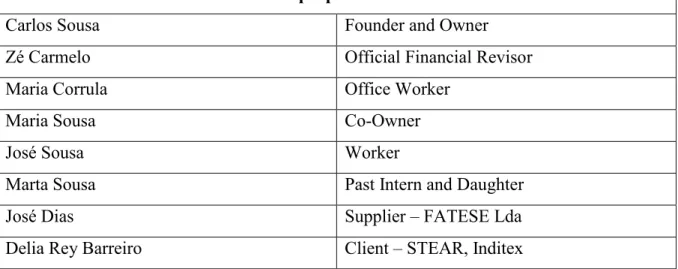
The main objective was to obtain relevant information about the company and its leader and to learn about the evolution and possible consequences from people that had experience and temporal knowledge. Parallel to the case study, eight interviews were conducted. Amongst the people interviewed are the CEO, his wife and co-owner, two workers from the company, one supplier and, lastly, a client - with Delia Barreiro representing Inditex.
20 Table of people interviewed
Carlos Sousa Founder and Owner Zé Carmelo Official Financial Revisor Maria Corrula Office Worker
Maria Sousa Co-Owner
José Sousa Worker
Marta Sousa Past Intern and Daughter José Dias Supplier – FATESE Lda Delia Rey Barreiro Client – STEAR, Inditex
Table 1: Interviewees
The case study written was the first step of my analysis since it gave me a clear look upon the company’s history, revenues, evolution and some of it peculiarities of being a FOB, relating directly to the research question.
After that, a full description of the company’s business processes is given.
In the end, I have approached the history and evolution of the company’s stakeholder relations considering the environment and the characteristics of the leader.
To better understand the content of each interview and to more effectively use the information absorbed, an open coding system was used in which common concepts in the data were identified and grouped into specific categories. Subsequently the data was coded to help establish patterns and highlight key elements and ideas. It was especially helpful when trying to get links between the leader attributes and how it contributes to the business success. Providing an example, a quote from one of the interviewees was marked as “Characteristics of the leader”, as it showed how the leader’s traits directly affect the company’s behaviour: “likes to control and to be on top of every single things that is happening”. I was looking for direct opinions and thoughts from my interviewees of the leader’s traits that are perceived by others, which turned out to have immediate link to the business and how the company is portrait. A table with the complete overview of coding can be found in the Appendices (Appendix 2) with categories like: “Background implications”, “Company’s Environment”, “Managerial Style” and “Quality of relationships”.
21
4 CASE STUDY
4.1 History
On the 27th of January of 1981, Carlos Sousa and Octávio Alcântara officially signed
their new fabric trading company, Alcântara e Sousa, Lda based in Lisbon. After knowing each other from business trades between their respective companies, these newly entrepreneurs decided, in a 50/50 partnership, to join forces in a new venture, with just seven employees.
After working in complementary companies in the textile industry, they realized the opportunity that existed in commercializing directly from one single company what they used to do from two. Focused in inner linings, the company traded all sort of “clothing accessories”, such as pocket fabrics, shoulder pads, stuffing and acetates, viscose and polyester liners.
Later on, during 1984, the two partners stopped seeing eye-to-eye in the strategic decisions for the future of the company. On the 1st of February of 1985, Carlos Sousa gets 100%
ownership by buying out his previous partner, making it SousaTêxtil, Lda.
This would be the biggest step so far for the young entrepreneur after his previous experiences in sales and retailing. The new owner, that was a shepard until 14 years of age and that only has the minimum mandatory school, had greater plans for the company’s trajectory. On this year, the company did their first ever imports from Lainière de Picardie, France and Texunion, Munster. Nevertheless, it continued to sell exclusively to the Portuguese market. By the end of the year, the business is already twice as big as it was by the end of 1981.
The first exports were realised in 1989 mainly due to the expansion of the group Yves Saint Lauren. Companies like Camp David from Sweden and the French Henri Lassan were subcontractors of YSL and had high demand for not only fabrics but also Portuguese labour, which was considerably cheaper than the European average.
In the turn from 1989 to 1990, the most important step happened. After a lot of perseverance and healthy past business relations, the company was able to finally schedule a meeting in La Coruña, Spain as a possible supplier for the group Inditex. This first meeting was so successful that Carlos returns to Lisbon with one of the biggest orders the company had so far.
This lead to a succession of orders that were close to absorb all the production volume. Pushed by this urge to complete orders, the company started to subcontract part of the production outside Europe and ended up by only doing the fabric transformation in Portugal, decreasing both costs and waiting times.
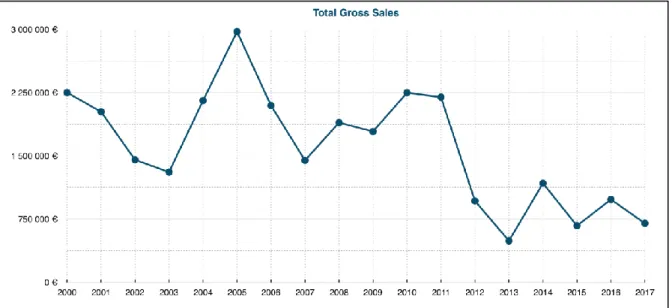
22 As a general tendency, the company sales started to constitute primarily, year-by-year, orders from Inditex and other companies from the group. During the 90’s, the company sold 80% for the Portuguese market and 20% to La Coruña. From 2000 until 2004, the Spanish group took around 40% of the company’s production volume. As soon as the 2008 crisis hit Portugal leading to the foreclosure of a lot of factories, the Spanish group takes more than 80% of the company’s production. From 2010 onwards, SousaTêxtil was selling over than 95% to the Spanish group. In 2017, sales to the Portuguese market represented less than 1% of the total volume.
In the years to come, the company would hit its’ lowest point due to Inditex’s turn to the Asian markets, which made it possible for them to produce their products cheaper and ultimately harmed their overall clothing quality. In the past 8 years, the company managed to get some stability once again and it has by now a sales average of over 1 million euros per year with zero marketing expenditures.
Figure 2: Evolution of Sales
Source: from the author
4.2 Description of the business
SousaTêxtil, by their own definition, describes their activity by the “wholesale of fabrics, which is not limited to commercialization”. Although it doesn’t have its own factory, the products sold require some sort of transformation process, either dyeing or waterproofing where these final steps are outsourced to long-term partners.
23 Indeed, there is always stock of the most demanded products. Nevertheless, the company works by order. In other words, it is ensured the existence of raw materials is ensured but the effective manufacture of the final product is only done upon receiving an order. Zara and other brands of the group are especially known for their “fast-fashion” methods. With this, following demanding deadlines is of the extreme importance and, in order to reduce delivering times, the company located their big storage unit next to their main partners.
There are two main products used by the company: knit fabric and cloths. The company sells a wide variety of fabrics, but they are all a variation of these two kinds of materials.
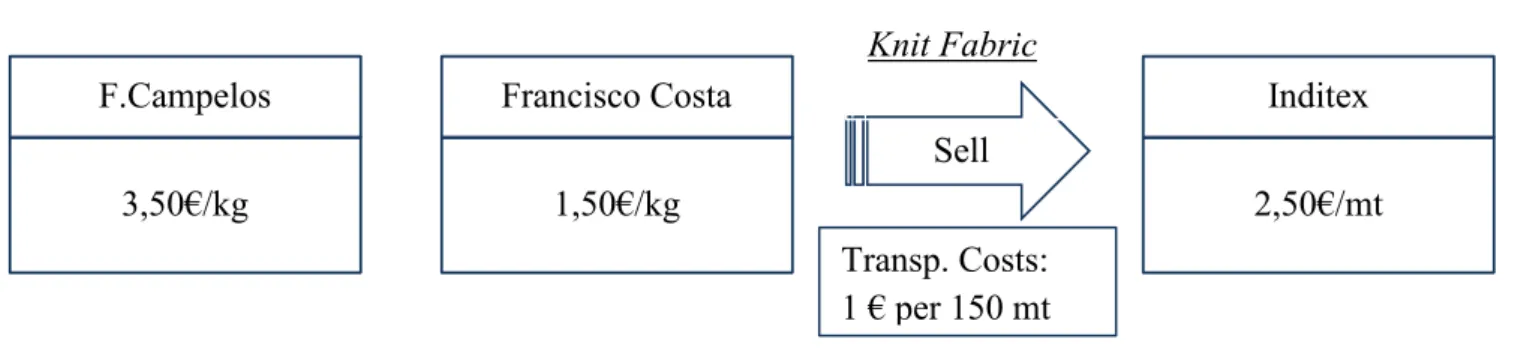
Knit fabric is the result of the successive intertwines of individual yarns, all in the same orientation. This type of material is an exterior fabric and it is used in pullovers, blazers and cardigans. For this specific job, the company outsources the entire process to two different Portuguese companies located in the north of the country. The first, F.Campelos, is in charge of procuring sufficient yarn and knitting it together. Francisco Vaz da Costa, a family business in Guimaraes, oversees the dyeing processes according to the order specifications.
From one of the interviews, I was presented with some production costs values and the production process that included wasted fabric and that, in the end, each kilogram turned out in 2,50 meters of screen. From this we can infer that, if we consider 1 meter of fabric weighting on average 400 grams, that the company presents a margin of 50 cents per meter sold.
Source: from the author
Cloths, on the other hand, are what we previously called as clothing accessories and are used in the interior of clothing. For this product, the company maintains a similar process, changing only the partners used. In the 90’s, SousaTêxtil used an English company to buy raw screen at fall of loom from past English colonies like Hong Kong due to its cheap price, nowadays it uses the Belgian Chemitex trading group. For special processes it uses one out of
Sell 3,50€/kg F.Campelos 1,50€/kg Francisco Costa 2,50€/mt Inditex Transp. Costs: 1 € per 150 mt Knit Fabric
24 two companies: Francisco Vaz da Costa for 100% cotton and Fatese for polyester with cotton. A transportation company picks up the order from production and delivers it at the factory. From the same interview, I’ve obtained that the company has a margin of around 40 cents per meter of fabric sold as we can see from bellow.
Source: from the author
4.3 Stakeholders, Environment and Relations
SousaTêxtil is partly owned by Carlos Sousa with 80% and 20% by Maria Sousa, with the latter one having resigned her voting rights and transferring them to her husband. All in all, this company is 100% family owned and has a decision-making scheme centered in the family leader that has been leading the company alone for the past 30 years.
Indeed, the leader has always taken decisions that would best benefit the company and the family at the same time. Decisions that are clearly not purely based on economic factors since not only the company’s performance was directly linked to the family’s wealth but also because Carlos Sousa had two of his older brothers working there for several years and he was well-known in the community.
From this standpoint it was clear that the company’s behaviour was identical to its leader. A mix of family values and personal values are presented as the main reasons for the company never going abroad, since it was risky and it required substantial investment.
Although the company is more focused in cost control with tight internal controls, there is collectivism behaviour, with a great deal of trust involved. In fact, the company showed a control-oriented philosophy regarding internal issues and a very involvement oriented regarding customer relations. It was also clear that although there is a healthy amount of trust between employees, they have to follow specific mechanisms previously defined that serve as
Sell 70 cent/mt Chemitex 37 cent/mt Dyeing 1,47€/mt Inditex Transp. Costs: 1 € per 150 mt Clothing
+
25 control mechanisms. All in all, it presented collectivistic goals in its actions but with very a high power distance.
Culture and tradition affect how the company will appear to others. This serves as a main reason for some of the company’s different characteristics: there are no marketing expenditures since there is no willingness to get more clients; stakeholder portfolio didn’t change for the past 10 years; there is no R&D and the whole business runs with just three people. All of the characteristics mentioned above show how the company is negatively different to non-family businesses and could be reasons for stagnation and ultimately the failure of any business.
Perhaps the most interesting fact about this business is the interpersonal relationships existing amongst the stakeholders. Although these participants didn’t change a lot in the past decade, they present a close and strong bond that is not usual to find. Regarding suppliers, F.Campelos, F. Vaz da Costa and Fatese, they are all family businesses and have close bonds with SousaTêxtil since they consider Carlos Sousa perseverance and attention to detail in his weekly visits as the main driver for the success of the partnership that has already turned into some close friendships. When talking about clients’ relationships, a similar effect happens with the exception of Inditex high rate of position rotation that requires a more frequent contact.
Carlos Sousa said that he guided his business ethics and behaviour just like he was raised. For him, there is “nothing like a good presential meeting where you can look the person
in the eyes”. He thrived to establish SousaTêxtil as a reliable supplier in the eyes of the Spanish
group and said that, “when facing so much competition and tight schedules, due to their
fast-fashion business model, it is crucial that you are seen as a company that can deliver the product with quality and before the deadline”. Therefore, he visits the offices regularly in order to
ensure the quality of the relations already established. He says that he visits the factory at least 3 times per month and that, “sometimes, I go there just to chat or because I was visiting some
suppliers around” which is impressive since its a 6 hour drive each way from Lisbon to La Coruña that he does in time to have dinner with his family and “sometimes I have to hurry and arrive Lisbon on time for some meetings. Some days I get up at 3am and I am behind the steering wheel of the car for 10 hours in one single day.”
Close relations and some admiration for his efforts are, from his point of view, the drivers for his success amongst the people in Inditex he deals with. He believes that if he wouldn’t maintain this personal relationship and presential visits that the company would be longer bankrupt since “some products are very sensible to colours and certain treatments
26
making it very easy to get it wrong. I like things to be perfect and I like my company to be seen as an image of quality and reliability.”
As a side note, he believes that getting international opportunities is not hard but maintain that position is extremely hard. He said that “soon or later, you will be given a chance.
If you have done well, you will get a second one. If not, you will have to move on. I don’t speak a lot of Spanish but there is no one in that department that I don’t talk to and now there is no one there that doesn’t know who I am”.
Elements such as the weekly visits and the extensive travelling prove that the company does present some behaviours usually associated with old ways of doing business, but Carlos believes it to be a point in his favour rather than against him “my company is doing well
because we focused on doing what we know with the people we know. We learned throughout the years that we can’t compete in innovation terms with other companies that also serve Inditex. We can, on the other hand, provide them with the products that we know how to make and that we ensure quality on. Imagine that we would jump on a new type of product that it’s different from what we and my suppliers are used to and that I don’t even understand that well. It’s a huge gamble for us because apart from the financial risk for the company due to the big investments, it could jeopardize our status as a reliable supplier in the eyes of Inditex.”
Regarding the relations between direct family members, they are extremely positive since they share ideologies and have a conjoint sense of gratitude for each other. Oppositely, relations between direct family members inside the business don’t work so well. Two of the three offsprings worked there for a few months and they both stepped out for not being able to combine family and business issues. As Marta Sousa stated “Nothing prepares you to work
with your family. Here is clearly the case. All the emotions are constraints in how you approach problems and solutions. It’s much harder to be heard and to have opportunities to do different or to innovate. You can’t easily express your true opinion because you have two people disagreeing with each other that one is your dad and boss and you the daughter and worker. It is impossible to be only one of them. And if you get upset, which happens often, those problems don’t stay at work. They obviously go home with you and you talk about them over dinner”.
There seems to be an inability to separate the business from the family life with it having already damaging some aspects of the family life. One of the reasons for it was the non-existence of a well-designed succession plan that didn’t provide with division of responsibilities and originated, for many times, in a clear collision between views, opinions and managerial behaviours. The other reason relies on the pride of the CEO of having his offspring working in
27 the family business, leading to nepotism in attributing positions. This proved to be wrong not only ethically but also managerially since, again, the responsibilities were not well clearly divided and the leader not being ready to let go of some aspects and losing some control.
Currently, Carlos is 64 years old and is already thinking about his retirement but, in the earlier days of the company he had the opportunity to go international and form alliances with others Spanish companies but he refused and now he explained: “If I could have escalated
the business more? Yes, I had that opportunity but, at that time, it was quite risky and the whole family was depending on this one company. It was hard for me personally since I only know the Portuguese market and had always to rely on other workers to speak with clients or suppliers from other countries. Looking back, I think it was the right decision taking into consideration that I was leading the company alone and didn’t had the right tools for that step”. Asked about
his family involvement in the business, he said “it would have been much more different if they
were working with me. I could focus in Portugal and, at the same time, transfer my knowledge to them (his kids) and they would deal with all the other parts since they are all well educated and speak fluently Spanish and English. It would be the perfect mix of old and new knowledge and a reason for our family to be proud: the success of the company and the tight bonds that I was raised with and could transmit to my kids”
28
5 FINDINGS
In this chapter, I will focus on which innovative aspects this company presents that positively influences how they perform. The company way of turning some traditional aspects, based on old customs, and proving them with a positive meaning is the true success factor. In each section, a clear presentation of what were the challenges and consequences that tradition implied, explaining the way the company turned them into positive and making the ultimate connection of the company’s own traditions as the reason for success.
5.1 Being self-aware of existent knowledge and capabilities
Most commonly, relying on past knowledge can cause path dependence and reduce a firm’s capability to successfully innovate. Nevertheless, there is a way to use past knowledge to the company’s benefit.
SousaTêxtil, from the start on, was perfectly aware of own capabilities and were sure to focus where they could perform the best. After a knowledge search inside the company, where they analysed their past competencies and compared with present ones, they found useful past-knowledge across their multiple domains. They have found that they could not compete in innovative products since they didn’t have the capability to produce them. Also, they don’t have the financial power to enlarge they product portfolio. Knowing this, they focused on what they know how to do best: proving a reliable source of high quality cloths and knit fabrics.
In the end, the company realized that by focusing on tradition, they were able to both
elicit positive feelings in clients and to develop a sustainable competitive advantage. Instead of trying to adventure in new market trends that involved high investment, SousaTêxtil rather focused on two simple products that would sustain their position as a supplier and ensure the survival of the company. They manage to understand their exact position in the market, where they could optimize their market offer and build a strong image and position.
Quote by CEO: “it is crucial that you are seen as a company that can deliver the
product with quality and before the deadline… … I like my company to be seen as a image f quality and reliability”
Quote by client: “Our relationship continued and I started giving more jobs to
29
5.2 Being able to provider new meanings to old customs
After realizing where the core competences are and what would be the position the company would target to achieve in the market, they realized the importance of using that interpretation as a way to improve their position.
The company chose to use old customs, like presential meetings and small offerings as a source of inspiration, and by giving them a different meaning, they managed to get the clients’ attention. SousaTêxtil realized that Inditex took meaningful actions into consideration, since these actions expressed a sense of commitment and professionalism from the company side. With that, he started going more often to the offices instead of making phone calls, building more trusting and withstanding relationships and also managing to reap direct economic benefits from it.
As we can see, the company adopted a more direct behaviour that was not so common in the FOB’s world. In some aspects, both leader and the company, present clear entrepreneurial characteristics such as autonomy and proactiveness. There is an autonomous ideology of searching new opportunities and an encouragement into following them, if valuable. There is, on a similar note, a certain level of proactiveness in anticipating trends or future needs. Throughout the years, the company continued to use its own tradition and history as a way of conducting business.
On the other hand, we have a different version of competitive aggressiveness. In this case, there is a lack of an offensive combative posture regarding the market. It is better defined as a restrained position until the point that it needs to overcome some kind of threat. This is
related to the lack of an innovativeness side in the company, that is supported by a risk averse and cost control mentality.
Quote by CEO: “If I go there, I can see what they are doing and get a better idea of how I should prepare for what is coming. I talk to them and try to know what is the next trend so that I can have my product ready in time”
Quote by CEO: “The risk is very high. I much rather play safe and perform very
well in two products and ensure a next order rather than not performing up to the standards in ten products…. I have no shame in only producing two products. I do them perfectly and deliver them always before the time due. They already know us because of that and that is how I want to be known”
30 In the end, the company is basing a lot if methods on their own traditions. Although they were not providing the market with innovative products, Carlos and his company were aiming and betting high in building a strong status quo. They picked up on past traditions and old-fashioned traits, such as building both social and business relationships with a bigger focus on respect and face-to-face meetings, perhaps unaware of doing so, and they provided them with a new meaning and new significance to their clients. SousaTêxtil establish itself in the market with an image of being close to the client, based on old values and attributes generally characteristic of the old way of doing business.
5.3 Using a learning by doing strategy
SousaTêxtil evolution was based on what it could learn from the market, suppliers, clients and competition. In the early years, Carlos saw opportunities and invested in them. SousaTêxtil still has, in its headquarters, a variety of stock from different sorts and by-products of some experiments made. Additionally, there was some years ago, a partnership made with another Portuguese company with the purpose of creating a new 50/50 owned company, demonstrated some entrepreneurial orientation, that would do exactly what SousaTêxtil is paying others to do. Both of these examples happened in a time where the textile business was increasing and that still showed positive signs for the future. The situation worldwide changed rapidly and these ambitious were quickly put on the side due to the high risk involved even just in getting the investment back. The company tried to have some product innovation, but it learned that it was not equipped to do so since the profit likelihood was significantly small.
Quote by client: “he is always informed and 100% sure about what he is selling to
31 Bearing this in mind, it had become clear that this company was not investing in product innovation. In fact, they were, on an attempt for cost reduction, in a few business model innovations. This happened with the change and expansion of suppliers started in 1981. Records show a company getting better and more efficient suppliers that would not only represent a cost reduction but a change in the business since it allowed the company to, for example, eliminate their expensive transportations department in 2000 or when they started dealing directly with F. Campelos with knit fabrics that allowed them to cut one whole step in the production process since this company is able to do both of them together.
These changes, of course, were hard to accomplish as it is a company quite attached to their past performance and to their commitment to continue. They happened because they were seen as a clear economic advantage and a way to save money.
The main conclusion is that although there was a high expectancy regarding the
environment and the evolution of the textile industry, it never occurred. The crisis hit the company and the focus changed. SousaTêxtil focused on their core products and the ones that had more efficient lines of production, ensuring the survival of the business and the family’s wealth. The company was born on a basis of learning by doing and maintained that ideology until today, although its learning curve is significantly less steep than it was some years ago.
Quote by co-founder: “The crisis affected this industry. It was declining before…
than the 2008 crisis almost killed it. We went through it and we learnt how to go through it.”
Quote by former worker: “A good leader needs to have good relationships and they
have that. A good majority of its profits are derivative from good relationships.”
Quote by CEO: “my company is doing well because we focused on doing what we
know with the people we know. We learned with the years that we can’t compete in innovation terms with other companies that also serve Inditex. We can, on the other hand, provide them with the products that we know how to make and that we ensure quality on.”
32
5.4 Customer relationship as a field for innovation
The quality of interpersonal relationships in this company is, without a question, the most important success factor. Indeed, the company shows an excellent customer and supplier management.
As it is stated in the case, the company’s stakeholders hardly changed in the past 10 years. As expected, there are closer bonds and higher trust levels established with both suppliers and clients than in a normal company. Indeed, both suppliers and clients look upon the company and its leader in a different way since they know the story, struggles and way of working. The company has the same suppliers that it had 20 years ago hence the explanation for such tight bonds and, additionally, for being one of the reasons of the lack of product innovation and the risk averse towards research and development activities. The clients share this same perspective with the difference that, in this case, there is some entrepreneurial spirit in the importance of making connections and establishing new relationships. This is due to Inditex high rates of change of personnel in their procurement and research department, making it insufficient having only a couple of connections in order to keep up with market trends and predict demands.
Concluding, the company benefits from their stakeholder strategy with their client management that allows them to predict sales, getting ahead of competition and gaining more leverage for establishing the price. Likewise, well-founded supplier relations resulting in getting better manufacturing prices due to seniority and expectancy of additional orders. By re-using old-fashioned methods, based on respect and presentation, the company was able to present a distinctive image towards the market.
Quote by client: “he is the person that represents a company that has a good image
towards us.” We know that we have a serious supplier, that delivers on-time and with quality. That’s why we have been partners for so many years now. “
Quote by supplier: “For all the years that he worked with us, he gained our
admiration. He went through some tough times and pulled through. And he even helped our company when we were facing some problems … He vales loyalty and people that help him. He then rewards them. He is a true friend of a friend. Unless you did him wrong, if so, you’re done”