MSC IN BUSINESS ADMINISTRATION
THE ROLES OF LEADERSHIP IN THE
DEVELOPMENT OF DYNAMIC CAPABILITIES IN
THE CASE OF MAZONI, S.A.
Joana Rodrigues dos Santos
Supervisor: Prof. Nuno Cardeal
Dissertation submitted in partial fulfillment of requirements for the degree
of MSc in Business Administration, at Católica Lisbon – School of
Business and Economics
January, 2011Joana(Rodrigues(dos(Santos,(152109336(( I
Aknowledgements
This dissertation turned out to be a bigger challenge than I expected. Skills such as initiative, creativity, impartiality, and objectivity were required. Only with the support and enthusiasm of my family throughout the whole process was I able to put was I able to those skills into practice. I especially thank my older brother for his guidance and insight.
I am very grateful for the tireless support of my supervisor Prof. Nuno Cardeal. His availability and feedback played a fundamental role in the quality of this project and his help allowed me to wade through the difficulties I faced. Without his guidance I do not know how this thesis would have turned out to be.
The development of the skills required for this dissertation were also mainly due to Católica Lisbon and for my teachers both in the Undergraduate and the MSc degrees. They contributed for to increase my knowledge and enrich my capabilities.
I also owe a special gratitude to all the members of Mazoni, S.A., especially Mr. Fernando Sampaio and his son, Mr. Pedro Sampaio. Without them, this project would not be possible. Their availability and accessibility in providing the needed information were paramount for this study.
Finally, I want to thank my friends for their support and for their interest in the subject of this dissertation. Without their questions and doubts some of the addressed matters might not have occurred to me. Moreover, I want to thank for their patience in listening to me when I was facing the different obstacles of the whole process.
Joana(Rodrigues(dos(Santos,(152109336(( II
Abstract
Dissertation title:
The roles of leadership in the development of dynamic capabilities in
the case of Mazoni, S.A.
Author: Joana Rodrigues dos Santos
This dissertation aims to answer the research question: What is the role of the leaders in the development of a company’s dynamic capabilities. In order to have a better understanding of the problem, the study is applied to a practical case – the shoe company Mazoni, S.A.
Before focusing on this issue, defining the concept of dynamic capabilities turned out to be crucial. Therefore, several authors were considered, along with their various designations. A pattern was drawn from what was and was not agreement upon.
Firstly, two frameworks were combined in order to best assess the object of this study. The microfoundations of dynamic capabilities by Teece (2007); and the leadership agenda*, developed by Dos and Kosonen (2010), which evaluates the leaders’ roles in what they called “strategic agility” of business model renewal.
Then, we analyze the case of Mazoni, S.A. In order to better understand the company in question, we studied the footwear industry in Europe and then zoom in on Portugal’s footwear industry. Finally, we dissect Mazoni from its foundation to our current days.
The step before assessing the leader’s capabilities was to define what Mazoni’s dynamic capabilities were. In their opinion, they provide product and service quality both with relative low cost. With this they mean that they do not sell the cheapest shoes, but taking their medium/high quality into account, they represent one of the best options in market.
Finally, the assessment of the leader’s roles was performed. A table that combined the two previously addressed frameworks was filled out with quotes from several interviews with members of Mazoni. This encoded information enabled us to realize which were the competencies that the leaders possessed when managing the Mazoni shoe company.
Joana(Rodrigues(dos(Santos,(152109336(( III
Table&of&Contents&
Aknowledgements!...!I(
Abstract!...!II(
Introduction!...!1(
Literature!Review!...!2(
1.(
Dynamic!capabilities!...!2(
1.1(Notion(introduction(...(2(
1.2(Definitions(of(dynamic(capabilities(...(2(
2.!Microfoundations!of!dynamic!capabilities!...!3(
2.1(Introduction(...(3(
2.2(Sensing((and(shaping)(opportunities(and(threats(...(4(
2.3(Seizing(opportunities(...(4(
2.4(Managing(threats(and(reconfiguration(...(5(
3.!Leadership!...!6(
3.1(Accelerating(Business(Model(Renewal:(The(Leadership(Action(Agenda(...(6(
Methodology!...!11(
1.!CaseDstudy!method!...!11(
2.!Company!selection!...!11(
3.!Data!research!and!collection!...!11(
Secondary(data(...(11(
Primary(data(...(12(
Data(analysis(process(...(13(
Data!Analysis!...!15(
1.!The!footwear!industry!in!Portugal!...!15(
2.!Mazoni’s!foundation!...!15(
3.!The!two!main!capabilities!of!Mazoni!...!17(
Product(quality(with(low(costs(...(17(
Service(quality(with(low(costs(...(18(
Discussion!...!20(
1.!Srategic!Sensitivity!...!21(
2.!Fostering!Leadership!Unity!...!26(
3.!Making!Resources!More!Fluid!...!30(
Conclusion!...!33(
References!...!35(
Joana(Rodrigues(dos(Santos,(152109336(( 1
Introduction
This dissertation urged with the controversial concept of dynamic capabilities applied to the leadership of a Portuguese-based shoe company - Mazoni. As the environments are increasingly constantly changing, this is a matter that has gained emphasis in the recent years.
The research question that remained was to which extent the leaders of Mazoni had responsibility in developing the firm’s dynamic capabilities. Before starting the study, it turned out to be important to explain correctly what the concept of dynamic capabilities is. As it can be seen later on, this is a recent subject to which authors have not yet reached an agreement in its definition. Therefore, several are presented and the common factors in each one were highlighted. Furthermore, a leadership framework was also analyzed as a metric to assess the practical case in focus.
Before the application of the concept to Mazoni’s case, an industry analysis is performed. Moreover, some facts and figures about the Portuguese footwear industry in 2010 were included in order to have a better understanding of the environment in which Mazoni is inserted.
After this, the analysis was initiated and an assessment of the dynamic capabilities of the company’s leaders is performed. Through crossing two frameworks from different authors, there was a study about the possession of certain capacities needed to build a successful company that could overcome its competitors in changing environments.
Finally, the conclusions about the advantages and gaps of the leadership of Mazoni were summed up, and the limitations of the analysis were stated.
Joana(Rodrigues(dos(Santos,(152109336(( 2
Literature Review
The aim of this paper is to analyze the role of the leaders of a Portuguese shoe company in the development of their dynamic capabilities. For this matter, it is extremely important that the concept of dynamic capabilities is well clarified before proceeding with the study.
In the past decades, dynamic capabilities have been a subject that created considerable controversy when it comes to its definition. Although it is a relatively recent notion, many authors realized that it is becoming a relevant matter. Not having the conscience of what dynamic capabilities really are can limit the performance of a company (Ambrosini and Bawman, 2009).
Moreover, as Ambrosini and Bawman (2009) mentioned, the fact that there are still questions to answer related to this topic can reduce the ability to fully leverage these dynamic capabilities. The authors claim that their article (Ambrosini and Bawman, 2009) has a limited utility because it lacks empirical work. Therefore, this dissertation bases itself in their introductory notion of how dynamic capabilities can create value, posteriorly is applied to a real case.
Based on Teece et al. (1997), the same authors recognize that the concept of dynamic capabilities could be an evolution of the Resource-Based View model, and even could overcome its limitations.
1. Dynamic capabilities 1.1 Notion introduction
Resources by themselves do not create much value for the company. It is about the way executives use their ability to use them efficient and effectively. Therefore, possessing VRIN resources - valuable, rare, inimitable, and non-substitutable (Barney 1991), and not applying dynamic capabilities can jeopardize the potential of a company’s success (Ambrosini and Bawman, 2009).
Moreover, “Dynamic capabilities (…) may help firms to avoid developing core rigidities which inhibit development, generate inertia and stifle innovation” by Leonard-Barton (1992) in (Ambrosini and Bawman, 2009, 32). These rigidities are precisely the limitations of the Resource-Based View theory, and dynamic capabilities emerged as a solution to the restrictions of the previous model (Ambrosini and Bawman, 2009). The VRIN resources have to be adapted to the evolving environments, upgraded when they are not enough, or restructured. Firms have to realize that resources may lose or decrease their value if they are not managed accordingly to the changes of their surrounding markets (Ambrosini and Bawman, 2009).
1.2 Definitions of dynamic capabilities
As mentioned, the definition of this concept is very controversial. Many authors have come to their own designations with elements they thought essential to understand the complexity
Joana(Rodrigues(dos(Santos,(152109336(( 3 behind this expression. The article written by Ambrosini and Bawman (2009) has several definitions of dynamic capabilities, and since there is no consensus, some were highlighted. The definition that is considered the original one is “the firm’s ability to integrate, build, and reconfigure internal and external competences to address rapidly changing environments” (Teece et al., 1997, 516).
All the other definitions are considered adaptations (Ambrosini and Bawman, 2009). According to Eisenhardt and Martin (2000), dynamic capabilities are: “The firm’s processes that use resources – specifically the processes to integrate, reconfigure, gain and release resources – to match or even create market change. Dynamic capabilities thus are the organizational and strategic routines by which firms achieve new resources configurations as markets emerge, collide, split, evolve and die” (Eisenhardt and Martin, 2000, 1107).
Another approach to the concept is that they are: “the abilities to reconfigure a firm’s resources and routines in the manner envisioned and deemed appropriate by its principal decision-maker” (Zahra et al., 2006, 918).
Finally, “the capacity of an organization to purposefully create, extend or modify its resource base” (Helfat et al., 2007, 1).
Even though these definitions use different terms, a pattern can be drawn (Ambrosini and Bawman, 2009). Every author is in agreement when considering the core concept - dynamic capabilities are “organizational processes in the most general sense and their role is to change the firm’s resource base” (Ambrosini and Bawman, 2009, 33). In addition, they all realized that dynamic capabilities are not bought in the market; they are developed or reconfigured internally.
Ambrosini and Bawman (2009) also agglomerated what dynamic capabilities are not. They are not about luck, Zahra et al (2006) and Helfat et al. (2007) state that their use is intentional. Finally, they are not a synonym of strategic change but they are directly related to it as a tool for achieving it. Finally, the concept is clearly related to one type of change, the intentional transformation of the resource base (Ambrosini and Bawman, 2009).
2. Microfoundations of dynamic capabilities 2.1 Introduction
Teece (2007) developed a framework applied to the concept of dynamic capabilities. Its objective would be to “explain the sources of enterprise-level competitive advantage over time, and provide guidance to managers for avoiding the zero profit condition that results when homogeneous firms compete in perfectly competitive markets” (Teece, 2007, 1320). He constructed a model that explains the foundations of a company to create and maintain competitive advantage facing other market players.
Joana(Rodrigues(dos(Santos,(152109336(( 4
2.2 Sensing (and shaping) opportunities and threats
1. Nature of the capability
In order to create new technologies, companies have to find the gaps in the markets and look at them as opportunities to generate value. But, finding emerging markets is not always an easy task. Therefore, Teece (2007) defined sensing (and shaping) new opportunities as “very much a scanning, creation, learning, and interpretive activity” (Teece, 2007, 1322). It is about analyzing the markets, and from that, developing ideas and considering the context of the company.
Realizing which will be the trends to address an opportunity is extremely important (Teece, 2007). Managers have to presume what will be the changes in future technologies, and how other players – competitors, suppliers, and customers – will react. Still, these are all assumptions, and it is important to consider an amount of uncertainty in their decisions.
2. Microfoundations
An opportunity can be discovered either by the imaginative and cognitive characteristics of an individual capacity, or through an investigation process such as a research and development activity. Managers need not only to have access to relevant information, but also, to recognize, sense and shape developments (Teece, 2007). This requires individuals to use their own capabilities, knowledge, and capacity to interpret data in whatever forms it is presented.
Teece (2007) developed several microfoundations that should be considered for these analyses to bring useful outcomes. The author realized that a manager should anticipate consumers’ needs, but also, its suppliers should understand them accurately. He mentioned the finding of Freeman (1974) that the success of an innovation is much correlated with the developers perceiving righteously what the consumers’ needs are. If the suppliers are not completely aware of the given needs, the innovation may not completely match the demand.
2.3 Seizing opportunities
1. Nature of the capability
In early stages, the hypotheses for developing new technologies are enlarged, and as long as the investigation continues, the focus is progressively tightened (Teece, 2007). Therefore, it is very important to well determine the timing when companies have to make choices between different alternatives. Relevant implications for investment decisions have been considered in one of Teece’s previous work (1986) – staying flexible until a dominant design emerges, and then investing in the one that appears to be the winner.
Joana(Rodrigues(dos(Santos,(152109336(( 5
2. Microfoundations
Selecting product architectures and business models
Choosing the right business model and designing it correctly is essential to achieve success in a new or already existing technology. Adequate models can bring enormous value to the company creating advantageous cost structures and generating valuable propositions to satisfying consumers (Teece, 2007).
Selecting enterprise boundaries
Any company that is investing in an innovation has its limitations. Hence, success passes by defining their barriers and considering them in every decision. Identifying and controlling the existing “bottleneck assets” in the value chain is a critical strategic element to leverage value from the innovation (Teece, 2007). The second relevant step is to overcome these limitations, even if for that the company has to outsource some features.
Avoiding bias, delusion, deception, and hubris
Investment decisions errors can be prejudicial and endanger the success of a technological development. The damage might be even bigger in fast moving environments as there is less time and chances of recovering from mistakes. If investments are larger, it means that they are not that frequent so, firms do not learn so much from error, and therefore, mistakes are more likely to happen (Teece, 2007).
2.4 Managing threats and reconfiguration
1. Nature
Successful companies usually develop routines to achieve operational efficiency (Teece, 2007). These procedures are established in the organization to determine how to act facing different circumstances. These measures may not be sustainable when it comes to a changing environment. But, the change of routines is costly so, companies have to weigh their decisions when it comes to reconfiguration.
However, there is a factor that is biasing organizations when an investment decision urges. A company may limit its investments in innovations when it has fixed assets. These turn out to act as anchors because enterprises will invest in innovations that are “close-in” to the existing asset base (Teece, 2007). “Managers face and must overcome at least two constraints—cognitive limitations and framing biases—arising from established assets by Teece (2000) mentioned in Teece (2007, 1335).
In order to minimize potential internal conflicts, the old assets and new ones have to be complemented. This will also lead to a maximization of complementarities and productive change in the company.
Joana(Rodrigues(dos(Santos,(152109336(( 6 Helfat and Peteraf (2003) state that capability redeployment can take one of two forms: sharing of capability between the old and the new, and the geographic transfer of capability from one market to another. “Both are possible, but neither is easy” (Teece, 2007, 1336).
2. Microfoundations
Achieving decentralization and near decomposability
As companies are more decentralized, different managers observe different information and control different decisions in what Teece (2007, 1336) called “devolution of decision rights to quasi-independent profit centers”. In this structure, opportunities and threats can be more easily noticed, and observed in detail. In rapidly changing environments, different units within the company should have as much independency as possible as long as there is still coordination between one another.
Learning, knowledge management, and corporate governance
Intangible assets are also critical for a company’s success. Firms realized the importance of incentive structures that enable learning, and generation of new knowledge. Teece (2007) enumerates many types of learning, all of them with their function – experiential, vicarious, individual and organizational. Sensing can also require learning about the environment and new technological capabilities.
A key microfoundation is therefore, “a good incentive design and the creation of learning, knowledge-sharing, and knowledge integrating procedures” (Nonaka and Takeuchi, 1995; Chesbrough, 2003) in Teece (2007, 1339).
3. Leadership
In a posterior part of the study, the focus deepens into the leadership of the company. Therefore, the framework developed Doz and Kosonen (2010) was considered to assess the roles of the leaders in developing the firm’s dynamic capabilities.
Doz and Kosonen (2010)questioned how leaders could influence and have a preponderant role in accelerating the evolution of an organization’s business model. The framework that assesses top managers in what the authors call “strategic agility” of business model renewal. They divided it in three “meta-capabilities” – strategic sensitivity, leadership unity, and resource fluidity. The model is composed by a set of priorities that will enable leaders to succeed in transforming or renewing their models in a faster way.
3.1 Accelerating Business Model Renewal: The Leadership Action Agenda
3.1.1 Strategic sensitivity
It enables firms to find the opportunities for new businesses and be sensitive enough to realize what the best timing to take action is.
Joana(Rodrigues(dos(Santos,(152109336(( 7 1. Anticipating: sharpening foresight
Organizations can lose competitive advantage or value creation if they take too long to react to changes in the environment. Therefore, leaders should be able to predict in advance when the right time to renew their model is (Doz and Kosonen 2010).
Moreover, the authors realized that the more developed the sector is, the more difficult it is to anticipate the needs. The tools to predict it are very useful when it comes to a continuous business model where the risks are known. But, facing the demand of new business models or transformation of them, these can be less useful.
2. Experimenting: gaining insights
Once the foresight tools did not work as efficiently as the company was expecting, making experiments is the best method to find out how to adapt a company’s business model. However, most of the times, the experiments are difficult to implement until the end; they usually are left in the middle of their course. But, companies still gain because it raises dialogue among top managers about potential key strategic. It enhances discussion about critical matters.
3. Distancing: gaining perspective
Frequently, managers are so embedded in their company’s issues that they are not able to distance themselves and reflect about the totality of the business model. Executives should develop the skill of seeing the company from outside in order to observe the organization within its environment, how it could be different, and imagining a completely different set of activities and relationships.
4. Abstracting: gaining generality
Consists in understanding different features independently from their context or their historical past in order to create a less biased analysis of a given business model.
5. Reframing: imagining new business models
Distancing and abstracting lead to reframing which means creating new perspectives and new alternatives by applying different business models to the same business (Doz and Kosonen, 2010). The objective of the top managers would be to create diverse and independent alternatives. Therefore, they must develop a great cognitive diversity. “The ability to generate multiple strategic frames for a business model is rare and valuable” (Doz and Kosonen, 2010, 375).
Joana(Rodrigues(dos(Santos,(152109336(( 8
3.1.2 Fostering leadership unity
The second meta-capability developed by Doz and Kosonen (2010) is the leadership unity. It involves the intuition of a top manager when making changes in a business model. Two factors are very important to achieve success – new adaptive leadership work and leadership team unity.
The accelerating of a business model renewal is only feasible if the top managers are able to gain commitment from the other members of the company to take risks in decision-making.
1. Dialoguing: surfacing and sharing assumptions, understanding contexts
The most part of management teams exchange insights through discussion - each one gives their arguments and the more assertive wins. The problem is that frequently the managers have different levels of power, and many times, the one that wins is the one with the most power. This makes the dialogue useless, and prevents the commitment from the other parts to a new business model.
Therefore, CEOs should be the ones incentivizing dialogue and full openness in expressing employee’s minds. No fear should be installed in case of disagreements, and people should not be stopped from contributing with their opinion. What is decisive is not the content of the dialogue but creating full commitment within the team, and trust in the outcome of the decision process.
2. Revealing: making personal motives explicit
As mentioned previously, dialogue should be encouraged but not only in expressing opinions but also in sharing their “aspirations and fears, satisfactions and discomforts” (Dos and Kosonen, 2010, 377). After the authors’ study, they realized that the most important role to enhance communication is the CEO’s. If the CEO trusts and respects its top managers, they will feel much more valued and will not be afraid of expressing their intuitions towards any decision.
3. Integrating: building interdependencies
The more interdependent the business units are, the more it makes sense to have an articulated team. Management teams are supposed to make decisions together about shifts in their business models but, if these are too independent, the decisions are not related, and therefore, they do not ear opinions from people that are not integrated in their units.
Joana(Rodrigues(dos(Santos,(152109336(( 9 Companies gain in aligning interests. The fact that people within an organization are all working for a common objective unifies them and make them work together. A tool that can lead to a better unification is to provide incentives based on total corporate functioning and not on subunit performance. This way, the different sectors will not only be thinking internally but they will have to care about other units and acknowledge that other units also depend on them.
5. Caring: providing empathy and compassion for empowerment
In order to be able to reinvent models, top managers should have one quality – care about their employees. When leaders can create empathy among the company, people feel safer and respected what leads to people being more comfortable in attempting new things and playing new roles.
3.1.3 Making resources more fluid
Finally, the third meta-capability developed by Doz and Kosonen (2010) is resource fluidity. It is emphasized to enable firms to redeploy and reallocate their resources, including people, to the new given opportunities. It is very important that the resources are aligned with the change and are willing to work for that objective.
1. Decoupling: gaining flexibility
Many times, inside the companies there was the notion that if one unit changes it would create tension in the other units to change as well. To avoid this, the authors realized is that if the business is more decentralized but still, articulated, more power would be given to each sector to make their own decisions without “prejudicing” others (Doz and Kosonen, 2010).
2. Modularising: disassembling and reassembling business systems
Instead of changing the business model as a whole; separating different units, changing them and then putting them together again reduces risks and can be more financially affordable.
3. Dissociating: separating resource use from ownership
In order to increase the company’s flexibility to enhance a successful business model shift, organizations can “dissociate their organizational structure (roles and responsibilities) from the underlying business processes” (Doz and Kosonen, 2010, 379).
4. Switching: using multiple models
Another solution can be to create different models to provide alternatives when it comes to leverage an opportunity of a product or market innovation. The models would be parallel but separate and could be combined through their development or life cycles.
Joana(Rodrigues(dos(Santos,(152109336(( 10 5. Grafting: acquiring to transform oneself
Many companies opt to acquire completely different models, which stimulates the change within the company. Grafting frequently results in an evolutionary change. It starts by complementing the old model with the new ones without endangering the old one. The model only becomes relevant at a certain point until it turns out the leading developing model of the company.
The two frameworks from Teece (2007), and Dos and Kosonen (2010) were combined in order to assess the leadership of company in question – Mazoni. The microfoundations of the dynamic capabilities developed by the first author, and the three meta-capabilities by Dos and Kosonen were interrelated in order to realize which are the capacities possessed by the leaders and which should be developed to enhance the performance of Mazoni.
Joana(Rodrigues(dos(Santos,(152109336(( 11
Methodology
The subject of this paper urged with a question related to the dynamic capabilities’ concept entering in conformity with the leadership roles of a company. The focus is a Portuguese-based company inserted in the footwear industry which name is Mazoni. Therefore, the research question of this study is: What is the role of the leaders in the development of dynamic capabilities throughout the company enabling them to attain competitive advantage? It consists mainly in observing the position of the leadership of Mazoni in their achievement of success considering the development of their dynamic capabilities.
1. Case-study method
The method chosen to approach this analysis was the case-study method Yin (2009). The author defends that there are certain issues that are better studied when based on practical cases. Consequently, it was relevant to assess the success of the application of the two previously mentioned concepts – dynamic capabilities and leadership – in an existing company.
This technique is based on empirical data of a particular case when the theory is not enough to understand the matter or because there is no theory that can explain the issue in question.
2. Company selection
There were several factors that led Mazoni to be considered as an interesting company for this case-study.
Firstly, there was a previous study about the company that enabled an investigation primarily based on already gathered and analyzed information. Secondly, the availability that the firm showed in receiving me, and providing the needed information is extremely important for this analysis to be possible. It is a small dimension company, with nowadays around 90 people, which also decreases complexity in the analysis. Finally, Mazoni was founded by one man only – Mr. Fernando Sampaio – that with his years of experience in the footwear industry was capable of building what the company is today.
3. Data research and collection
The collection of relevant data for this paper is divided in two different types: secondary and primary data.
Secondary data
• The secondary data obtained was based on previous studies about Mazoni by Cardeal (2010); an article about the footwear industry in Portugal (Vale and Caldeira, 2007) for the characterization of the industry; and the APICCAPS database - the Portuguese association of
Joana(Rodrigues(dos(Santos,(152109336(( 12 the footwear industry and items related to it. The sources of the main study – Cardeal (2010) – consisted in interviews to eight company members, performed in the company’s facilities. There were also 3 interviews to industry specialists in order to compare Mazoni to the average companies of the sector.
• Finally, the data collection was concluded by direct observation. The company provided full availability for the author to be wherever in the facilities and to talk to everyone. Therefore, he was able to observe several situations of problem solving inter and intra teams.
It is important to emphasize that all the information contained in this article was gathered until 2009.
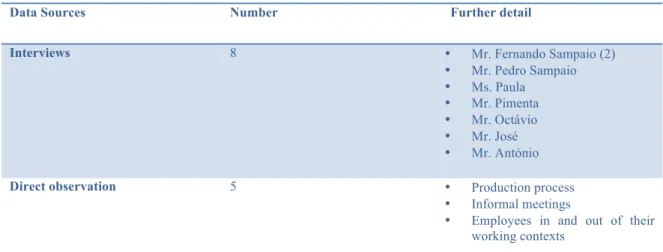
Figure 1 – Secondary data
Data Sources Number Further detail
Interviews 8 • Mr. Fernando Sampaio (2)
• Mr. Pedro Sampaio • Ms. Paula • Mr. Pimenta • Mr. Octávio • Mr. José • Mr. António
Direct observation 5 • Production process • Informal meetings
• Employees in and out of their working contexts
Primary data
• The primary data was mainly based on interviews also in the facilities of Mazoni the two main leaders of the company – Mr. Fernando Sampaio and Mr. Pedro Sampaio. The study only aimed the people that made their own decisions, which led to Mr. Pedro Sampaio being also considered for his increasing responsibility in the past few years. Moreover, this second interview was with the presence of the designer of Mazoni that also added his insights several times with his knowledge about the company.
The main objective would be to focus on my research question for this study and to complete gaps of information that the previous study did not include.
Moreover, my assessment in the interviews was also to ask what happened in these past two years that I did not have information about. If they felt any consequences of the crisis, and what measures that had taken or would take if it was the case. The aim of these questions was to realize what changes would be done by the leader in case there were changes in the environmental market.
Joana(Rodrigues(dos(Santos,(152109336(( 13 The interviews were conducted in a semi-structured method in which several topics and questions were highlighted as important. Still, several other questions were introduced in the conversation, as they were relevant for the information research.
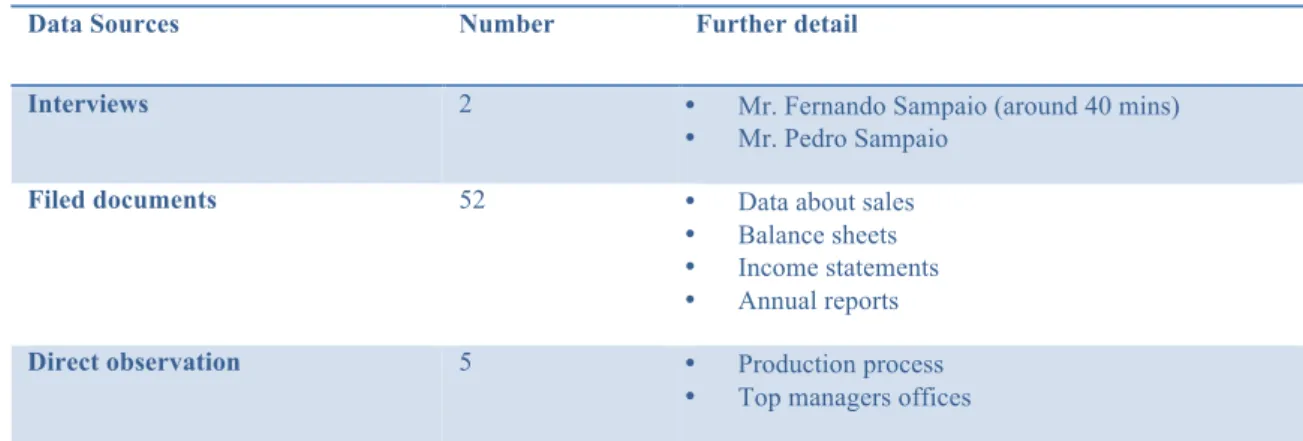
• For further documentation, I had access to filed documents such as balance sheets or reports and accounts in order to support the managers’ testimonials and avoid potential bias of their perspectives.
• Finally, I had also my own direct observation to Mazoni’s facilities being able to see how the production process worked, the room separations for the people in charge of the different departments and brands.
Figure 2 – Primary data
Data analysis process
All the documentation included in Figures 1 and 2 was included in an organized databasis that supports this study
The data gathered to include in this study was mainly based on these interviews through the encoding method. This means that through the testimonials of the members of Mazoni, conclusions were taken about the leadership of the firm.
I based myself on the two frameworks by Teece (2007) and Dos and Kosonen to assess the leadership of Mazoni. The information was taken out from the interviews and then organized in tables that combined both frameworks. This way, I could realize which were the capabilities that the leaders possess or not.
The questions in the interviews were never directly about the capacities. Instead, the focus was more on the company as a whole and the decisions that were taken facing several situations. Moreover, the other employees were also inquired about the feelings towards the leadership and how they would define their own conditions as members of Mazoni. From that, it was possible
Data Sources Number Further detail
Interviews 2 • Mr. Fernando Sampaio (around 40 mins)
• Mr. Pedro Sampaio
Filed documents 52 • Data about sales • Balance sheets • Income statements • Annual reports
Direct observation 5 • Production process • Top managers offices
Joana(Rodrigues(dos(Santos,(152109336(( 14 to realize what were the roles of the leaders, how they took some decisions, and the reasons why.
Joana(Rodrigues(dos(Santos,(152109336(( 15
Data Analysis
1. The footwear industry in Portugal
There are four main players in the footwear industry in Europe - Italy, Spain, France and Portugal (Vale and Caldeira, 2007). Even though Italy has a major role, Portugal has also relied on the footwear industry, which represents a great part of its overall manufacturing production.
In the decades of 70s and 80s of the 20th Century, the industry was mainly characterized by a
basis on mass production. In that time, companies were able to be competitive by lowering their costs. Therefore, the objective would be to create strong economies of scale, and combining it with Portuguese low cost salaries. In these decades, customers’ needs were less sophisticated; customers would look for the cheapest shoes to wear. Hence, companies’ success passed by being able to provide the lower price possible which was only feasible with low production costs.
The markets started to change with the vanishing of the international commerce barriers in the 90s. As international trades became more frequent, and the Asian markets opened up to the Western countries, the mass productions moved to Asia – mainly China. Consequently, the foreign-owned companies started to reallocate their factories in the Eastern countries where they could find lower labour costs (M. Vale and J. Caldeira, 2007).
Another factor that modified the footwear industry is the characteristics of the consumers. In Europe, people would no longer see shoes as a basic product. Instead, they searched for a fashion product. Status became a strong factor that influenced the consumer decision-making process. This led the companies to change their way of acting in the market and start producing differentiating items that could stand out. Thus, they saw themselves obliged to develop new competencies that would enable the production and management of small orders of distinguishing footwear that would require quick responses. In order to accompany the sector’s evolution, organizations needed to build capabilities such as flexibility, quick reaction, market knowledge, design, and commercialization in order to achieve success.
2. Mazoni’s foundation
The creation of Mazoni – Indústria de Calçado, S.A. was an idea of his only founder and still main shareholder – Mr. Fernando Sampaio.
Before investing in this project in 1993, Mr. Fernando Sampaio had already built approximately twelve years of experience in the sector. He worked in the commercial department of a company in Felgueiras - a Northern region where most shoe companies are allocated in Portugal. Mazoni was not an exception because the founder wanted to take advantage of his already established
Joana(Rodrigues(dos(Santos,(152109336(( 16 networking in the area. Mr. Sampaio had an important role in the internationalization of the company he previously integrated. This enabled him to create a good networking of contacts with different companies worldwide.
Still before Mazoni, he was invited to create a shoe company – Novel. For four years he worked as a manager of the firm he had founded with three other partners. However, he had several disagreements with his associates for they had no experience in the industry.
It was then that Mr. Fernando Sampaio decided to found Mazoni by himself. To install Mazoni’s facilities, he rented a friend’s space that was suitable to install a footwear unit of around 80 people. The plan was to create a factory that could produce from around 800 to 1000 pairs of shoes per day. After two years, Mr. Sampaio took advantage of the option to buy the building.
What usually happened in the sector was that organizations were founded with a reduced number of members (around three) and then expanded. But, the founder decided to structure the company right from the beginning with more than 40 employees. For the main positions he chose people with whom he had worked and trusted. For the rest of the workers, he took advantage of the fact that Felgueiras is an important center in the footwear industry, and used word-of-mouth to find the suitable people for the positions he needed.
The success of Mazoni depended mainly on the experience that Mr. Fernando Sampaio had. The knowledge and the international contacts’ network that he had built until then enabled the firm to start right away producing and delivering orders. In the first 3 months of the company he produced maybe 50, 60 or 70 thousand pairs of one model. Few years after, with the industry reconfiguration, he adapted his factory to smaller orders’ production and more customized shoes.
Finally, the founder created a modeling department, which he thought was crucial for a shoe company to attain success. At the time, most companies did not have such department; it was a matter that was put aside. Even though having a relatively small company, the leader did not conceive the thought of not having a development department in Mazoni.
2.1 Hierarchy
Joana(Rodrigues(dos(Santos,(152109336(( 17 Figure 3 – Mazoni’s structure
Source: E10
The founder of Mazoni has kept his position as the main leader. After comes his son, that is gaining more and more responsibility throughout the years. Continuing, we have Mr. Mário, which is the person in charge for the whole administrative part but he still has to ask to Mr. Fernando Sampaio’s agreement for every decision made.
Side by side with the programming leaded by Ms. Paula, we have the Modeling section. It consists in two parts: the development and the sampling, which are both managed by Mr. José.
Finally, we have Mr. Pimenta responsible for the whole production section, supervising the whole process.
3. The two main capabilities of Mazoni
In order to better characterize Mazoni, they have two premises upon which they act in the market. Mr. Fernando Sampaio considers that the success of Mazoni depends on the combination of the two: product and service quality, both with low costs (Cardeal, 2010). These are the considered dynamic capabilities for this study.
Product quality with low costs
Firstly, he claims that they position themselves where quality is praised. They want to make a superior product that is long lasting and that the consumer can trust. But, their advantage is being able to provide such product to the client with relatively low costs.
Control throughout the process Modeling
Joana(Rodrigues(dos(Santos,(152109336(( 18 To attain a good quality product in the end of the production process, all employees have in mind that they all are controllers. When the item arrives to their unit, they have to verify if it has no defect before starting to work on it. For that, it was established throughout the company an openness principle allowing workers to point problems to others’ items.
Mazoni’s members realize that the sooner they find the imperfection the less waste of work they have. If a shoe arrives to the final process with defect, they will have to start it all over again, and work twice as much.
Suppliers
The founder of the company defends that the quality of the final product is very dependent on the choice of the suppliers. Close and continuing relationships lead to reliability. This way they know exactly what Mazoni searches for – not the cheapest, but the best quality/price ratio, they are willing to pay more if that means a great improve in quality.
Adequate professionals
The last important factor they value to reach product quality with low costs is choosing the right professionals for the right positions. This passes by having skilled and acknowledged staff for the more demanding jobs, but also, having less qualified workers for more basic functions. All of them are needed and valued to attain their first premise.
Service quality with low costs
Mazoni attain the second principle through the combination of two factors: meeting the established schedules, and the creation of new products, mainly based on clients’ ideas.
Delivering on time
Being able to deliver a quality product on time can create great value to the client. A customer that makes his first purchase to Mazoni and realizes that not only the product is reliable, but also, that they provide a good service is crucial to generate loyalty (E2, p.1).
If they fulfill their compromise of meeting the delivery date, the customer will come back. At the moment that this trust is broken once, the client stops going to Mazoni (E2, p.1) Therefore, Mr. Fernando Sampaio claims that a competent customer service is a key component for success.
As previously mentioned, during the 90s the needs of the clients became more sophisticated, and therefore, customers started to look for more fashionable items. This led to the elimination of mass production to reduced-sized orders. Hence, the leader started to acquire equipment such as machines and technological systems to better plan the production of the shoes. Once the latter
Joana(Rodrigues(dos(Santos,(152109336(( 19 elements were acquired, they required formation to the employees to know how to work and leverage the machine as much as possible (E1, p.3). Mr. Fernando Sampaio’s objective was to increase the flexibility of manufacture within Mazoni. This way they could produce faster, and compromise themselves to deliver in shorter periods.
Innovation based on consumers’ insights
Mazoni has created, since the beginning, a modeling department. The objective would be to have a creative section that would base itself on clients’ propositions. For the leader, this was a critical measure when he founded the company (E2, p.7). A firm would not be competitive or have any future if they did not have personnel only considering the conceptualization of new ideas and development of new items.
Joana(Rodrigues(dos(Santos,(152109336(( 20
Discussion
After the definition of the two main dynamic capabilities of Mazoni, we can now start the discussion on whether the leaders had a relevant role in their development or not.
Firstly, it is important to define the top managers that we are considering. Consulting Figure 3, we can see a diagram of the hierarchy of the company. There are three top managers that may be important to focus on. But, through the analysis, I realized that the only person that takes decisions by himself is Mr. Fernando Sampaio – the founder of Mazoni. Even though his son – Mr. Pedro Sampaio started to have such responsibilities, this only happened approximately 4 years ago. Therefore, when it comes to study the development of quality product and service to the clients with low costs, the person in charge of all the decision-making is Mr. Fernando Sampaio, which will be our main focus in this assessment.
As explained before, Teece (2007) considered 3 main areas in the dynamic capabilities’ development in a given company. Moreover, Dos and Kosonen (2010) developed a framework with different capacities that should be covered by the leaders of a firm.
My study involves the interrelation between both frameworks and had the aim of applying it to Mazoni’s case. Therefore, a table (figure 4) was made in order to sum up the capacities that Mr. Fernando Sampaio has to manage his company.
Three figures (5, 6 and, 7) were constructed with the three different categories of leadership capacities. Moreover, to fulfil these tables, I gathered encoded information from the interviews and selected the relevant ones for this analysis.
Before going deeper in the study, we can already realize that most of Mr. Fernando Sampaio’s capabilities were directly related to sensing opportunities and threats what can be assumed as being a leader that has a good intuition and methodology to perceive the market characteristics and changes. Moreover, we only had information about one case of seizing opportunities mainly because he has been adapting his business model but not changing it drastically. Finally, he had several cases of managing threats and reconfiguration. This is directly related to what was mentioned before when realizing that constantly adapts the established model according to the market necessities.
Joana(Rodrigues(dos(Santos,(152109336(( 21
Figure 4 – Assessment of the dynamic capabilities
Sensing opportunities and
threats Seizing opportunities Managing threats and reconfiguration
St ra te gi c se ns it iv it y Anticipating ! ! ! Experimenting ! ! Distancing Abstracting Reframing ! Fo st er in g le ad er sh ip uni ty Dialoguing ! Revealing ! Integrating ! Aligning ! Caring ! Ma ki ng R es ou rc es m or e fl ui d Decoupling ! Modularising ! Dissociating Switching ! Grafting ! 1. Srategic Sensitivity 1.1 Anticipating
The first topic that was covered was whether the leaders had a good prediction of the future or not. Meaning, if they were able to anticipate events or modifications in the footwear industry that could have impact on Mazoni. There were three situations in which Mr. Fernando Sampaio clearly showed sensitivity in determining the future market behaviours.
In anticipating, he approached the three microfoundations of Teece (2007). He managed to manage threats in the market and reconfiguration. As we can consult in figure 5, there are examples in the capabilities of the leader having a great experience in the industry, and having a sharpened point of view to figure out the future tendencies of the market.
The company had a turning point several years ago when the leaders decided to distribute Mazoni’s business risk into and increased number of clients. They depended mainly on a small number of big foreign retailers what led the leader to realize that the impact if one of those collapsed would be extremely high. In order to avoid a major prejudice that could arise from the instability of any of those countries, Mr. Sampaio decided to start exploring other markets. “…
Joana(Rodrigues(dos(Santos,(152109336(( 22 Holland was a market in which we had much interest in entering, some in France, and also some in Spain. In 2009, we started basically in Holland because it was a very strong market and mainly because it was considered a distribution channel for the Central Europe” (E10, p.4). Finally, we could realize that Mr. Fernando Sampaio had evidence of compelling the capacity of seizing opportunities. The founder claims that an expansion does not make sense, at least for now, because it would imply doubling the production capacity and the market demand would not fulfil it all.
1.2 Experimenting
This topic is mainly about leaders taking risks of trying to enter new markets. Therefore, it was directly related to sensing opportunities and threats’ type of dynamic capabilities.
As it can be seen in the table below (figure 5), Mr. Fernando Sampaio took advice from a friend to create the DARK brand that would satisfy the Portuguese market. Even though it was not that successful at that time, the leader had his mind open enough to try entering a new market to assess its sustainability. He decided then to let the brand as it was instead of eliminating it and waited for his son to enter the company and focus on what could be the potential of this new brand. In 2007, Mr. Pedro Sampaio developed the brand to be representative of Mazoni Company. From then on, instead of only producing the clients’ ideas, they started to create their own designs in order to show them in fairs and expositions. “… In the fairs we are not represented as Mazoni but as Dark with the objective of making it grow. (…) At least we want to continue with it and want it to be more and more well-known and we want to continue investing in our own collection for Dark” (E9, p.5).
1.3 Distancing
Through the analysis of the data that we had for the study, there was no information that could justify this matter. In terms of developing both dynamic capabilities of Mazoni, there was no evidence that Mr. Fernando Sampaio had a distancing factor when looking at his company.
1.4 Abstracting
As abstracting is a directly related capacity to the previous one, also we did not find data that would support the possession to this competence. Usually the observation of externalities was based on Mazoni’s example.
Joana(Rodrigues(dos(Santos,(152109336(( 23 1.5 Reframing
When Mazoni was founded, the industry was facing a phase of big-sized orders and very standardized products. But, some time later, they realized that the customers’ needs were changing, and consequently, they were more sophisticated. European consumers wanted now designed shoes that could represent their status in the society. Therefore, companies had to change their model into starting to make smaller production lines with more differentiated items. “In 1993, there were 10, 15, 20 thousand pairs of shoes easily. (…) Our first order was around 10 thousand pairs, at that time a 10 thousand, 5 thousand order was easy to find, today it is not anymore” (E10, p.7)
The only leader at the time - Mr. Fernando Sampaio – was able to reorganize its production centre and adapt to the changing reality fast enough not to have major consequences. This competence entered in the managing threats and reconfiguration type of capabilities.
Joana(Rodrigues(dos(Santos,(152109336 24 Figure 5 – Strategic sensitivity
Sensing opportunities and threats Seizing opportunities Managing threats and reconfiguration
An ti ci p at in g
“The first thing is a question of mentality, we have to internalize that the industry will never be a mass production industry again. If we assume that, we have to adapt the factory to that, from the employees to the machines”. (E1, p. 5)
“We already thought about expansion. The factory is at the moment established around 700, 850 pairs, increasing productivity in 100 pairs would imply an expansion to double the production. What would happen is that it would double the capacity because they are the most expensive machines. Consequently, just to increase 100, 150 pairs produced, it more worth it to leave it as it is, take advantage of it and work with partners. Having here the most qualified part of the production and the rest in other companies where there is the same controlling that there is here. The development is still performed here as well; the only thing that changes is the labouring that is subcontracted.” (E10, p.6)
“Several years ago we (Mazoni) were completely centralized in 3 or 4 major clients. If some of those markets entered in a crisis, we suffered enormously the effect from the breakdown in that market. (...) And, so, in 2009 we were in a transition phase from those 3 or 4 clients to a higher diversity of customers.” (E10, p. 4)
Ex p er im en ti n g
“A company should have its own design in order to have its own collection to present in the show rooms, fair, etc. (...) we could not go to the fairs with products that came from clients’ ideas. The company has to have its own collection to be able to show to their clients what they are capable of doing and what is their potential.” (E2, p.1)
“... I had a friend who knew the domestic market very well and that had opened a shoe shop to his wife. He insisted a lot for me to develop a brand that would be targeted for the Portuguese market. I ended up creating the Dark brand. We developed a collection and I told him: but you are the one that is selling, delivering and receiving. And so it went on for 2 or 3 years. But it never generated high earnings and we ended up having uncollectable costs which led to my decision of leaving the brand in stand-by until my son came to Mazoni.” (E5, p.1) Di st an ci n
g “When I am not present, he (Mr. Pedro Sampaio) is the one that represents me and the only one that has independency
to represent me. This was mainly due to his presence with me to all the fairs, due to his presence in every meeting with clients or suppliers. It gives him an increased knowledge that he already has, nowadays, to take many decisions, even if I am here.” (E9, p.1)
Joana(Rodrigues(dos(Santos,(152109336 25 Re fr am in g
“...And, it is obvious that the quantities have also been adapted. Formerly, 6,000 pairs of shoes were produced nowadays these numbers are insane. Before, companies had 4 or 5 lines of productions, today, we have 1 or 2 lines and they are usually small-sized lines of production that produce 500, 600 pairs because they are adapted to the market reality of today, it is completely different.” (E10, p.7)
“…We (Mazoni) could not reach the same situation of 8 or 10 years ago when people said that the industry had become obsolete, and that we could not even have the ability to have low-cost labour. We were able to reorganize ourselves, accept order that were smaller and smaller, develop more products that were more differentiated, with more design, with a different completion, and different details, more similar with the Italian-styled ones.” (E10, p.2)
Joana(Rodrigues(dos(Santos,(152109336 26
2. Fostering Leadership Unity
In this topic, all the data about the capacities developed by the leader of Mazoni were categorized as the third type of dynamic capabilities (Teece, 2007) – Managing threats and reconfiguration.
2.1 Dialoguing
At Mazoni, the working members are completely integrated in the context of the company. Mr. Fernando Sampaio has been implementing the principle of always verifying the previous productive unit. He was able to make people realize that the faster they find a defect in an item, the more effective they are and the less wasted work there is.
Mazoni’s employees are not afraid to point out mistakes done by others; they established enough openness for that. “… I have the habit of gathering my employees in order that everyone can tell altogether eye-to-eye and in front of me what went wrong. (…) Realizing why that happened on the previous days of the week, but they say it face to face in order for that not to happen in flowing week” (E1, p.1). This is very important because it enhances the ability of not letting errors in the shoes pass. They are aware that if they are flexible in this matter it can mean more work for them and having to start all over again. The leader influenced them to understand that one of main capabilities of Mazoni is the quality. Hence, if the product reaches the end of the production process not matching their quality patterns, they will have to start from the beginning. The controlling is very tight and no employee can ignore that. Without the implemented value of an open communication this would be extremely difficult to perform.
2.2 Revealing
Mr. Fernando Mazoni is very demanding with his employees but he also shares an image of reliability. The workers know that they have to work hard, but they also know that the leader is ready to defend his workers if needed. As it can be seen in figure 6, he claimed that in difficult situations such as small numbers of orders, he puts his employees ahead of others. First, he tries to make sure that his employees have work and are maintained occupied and integrated in the company. Only after, the subcontracts are considered.
Another factor about the leader valuing Mazoni’s members is giving responsibility to the most experienced workers. Even though the decisions have to be in agreement with Mr. Fernando Sampaio, he still lets the top managers of the company build the solutions.
Joana(Rodrigues(dos(Santos,(152109336 27 2.3 Integrating
As previously said, there are interdependencies throughout the whole production process. Every unit controls the previous one. This fact leads to having different units that work on their part of the shoe but still, all of them are intertwined both because they work for a final item, and because the controlling is performed in every division.
2.4 Aligning
Mazoni’s members have a very strong sense of common interest. Since the very beginning, the founder convinced his employees that the company belongs to everyone and not only to him. He settled the value that he alone could not have built Mazoni, and therefore, everyone acknowledges that everyone effort contributed and still contributes.
With this, he was able to make his employees willing to do sacrifices when it was needed in order to satisfy the customers and deliver the orders on time. Likewise, they know that if the clients do not like their work, they will not come back and the company will decay. Hence, they work as hard as they can for the success of Mazoni.
2.5 Caring
Mr. Fernando Sampaio praises very much the environment in his company. Since the employees are inside Mazoni for many years, this led to building tight relationships with them. His experience and knowledge about every member of the firm makes his presence crucial for human resources management and conflict management.
His efforts in this matter aim to have employees that like to work at Mazoni. He wants to have his workers motivated “… And most of all liking what you are doing because if we do not like what we do, things do not go well, we do not feel motivated. Getting up in the morning, and this happens to me too, looking at the mirror and not liking what you see, in this case the day goes wrong. (…) We need to like us in order to feel good in the place we are, and also during the day liking what we are doing.” (E1, p. 17).
Joana(Rodrigues(dos(Santos,(152109336 28 Figure 6 - Fostering Leadership Unity
Managing threats and reconfiguration
Di
al
og
u
in
g “...Because people are aware of that (having to verify the shoes and not being afraid to say if there are defects)! If it is not perfectly made, call the person in charge: “look, I do not think this is well done, you should go see (what happened)!” Usually, we do not let (errors) pass just because it is from a friend. I think that people are aware that it is better that it stops right
away than in the end having to do a whole new shoe because that one simply will not be able to go ahead (in the production process).” (E4, p.7)
“…And it is having the courage to say: “this one and that one cannot go on!” and getting to the end of the day and having the courage to say: “10 spare pairs stayed here because…, they are rejected, they do not have enough quality or it does not match our patterns of quality!” (E2, p. 3)
“Because several years ago, we had that principle: “I am not going to accuse my colleague”, but today that is over.” (E6, p.4)
Re
ve
al
in
g
“Because Mazoni has the capacity for 800 or 900 pairs a day that “feed”, let’s say, these 85 or 90 people that work here. Our first preoccupation is going to be having order enough for these people, for this company, if we do not; like this year where we subcontracted 15% or 20% or 25%, it is okay, we do not.” (E9, p.4)
“When I am not present, there is one person that is administrative, that is with me since the beginning, that is a person that I trust, and that, even at distance, he does not take any decisions without discussing it with me, he has that autonomy.” (E9, p.1)
“I say that because today I have my son here for 4 years and the truth is that things have changed somewhat. When I am not present, we can say that he is the one that represents me and has the autonomy to represent me. Also because, he always comes with me to all the fairs, and his presence with me to all meetings with clients, or suppliers. That increases his knowledge that he already has right now in order to be able to take some, or let’s say, many decisions, even if I am present. There are issues that he is the one to decide, and not me, even if I am here (Mazoni’s facilities).” (E9, p.1)
Joana(Rodrigues(dos(Santos,(152109336 29 In te gr at in g In te gr at in g
“…Because if the person ahead of you does let pass any errors of the previous person, we are together working for quality!” (E4, p.7)
“...Because people are aware of that (having to verify the shoes and not being afraid to say if there are defects)! It is not good, call the person in charge: “look, I do not think this is well done, you should go see (what happened)!” Usually, we do not let (errors) pass just because it is from a friend. I think that people are aware that it is better that it stops right away than in the end having to do a whole new shoe because that one simply will not be able to go ahead (in the production process).” (E4, p.7)
“It is like that, the person ahead of you controls the previous jobs, always!” (E6 p. 5)
Al
ig
n
in
g
“...(Regarding the quality) people have the notion that this is ours, it is not only of the owner, and while we work here it is ours as well! We have to be here and do our best! That’s the policy we have internally.” (E6, p.3)
“We made a lot of efforts, many times, to deliver orders on time!” (E4, p.5)
“...Everyone is important for the product to come to an end, and reach the responsible for the controlling of the final shoes, because it is also important to control the shoes.” (E2, p.3) “We, and I am going to talk about Mazoni’s case. (…) Our preoccupation this year (2011) is going to be trying to be even more “aggressive” with our clients.” (E9, p.4)
“They (the employees) have the openness to every now and then, when there are sacrifices to make and those sacrifices are for the best of the company, a common good.” (E10, p.2)
Ca
ri
n
g “Nowadays, the experience that Mr. Fernando had within the company is very important, even with human resources management and conflict management. He knows the employees for several years, it is an old team, several are here since the company’s foundation.” (E10, p.1)
“The way that he communicates with people and how he interacts with the employees of Mazoni is critical, we cannot forget that there is a core group of people that works here for 20 years, the heads of the different departments are almost all working with him for 20 years. Therefore, that is fundamental for when there are hard decisions to make, that these workers are on his side and do not turn back on him, that is essential.” (E10, p.2)
Joana(Rodrigues(dos(Santos,(152109336 30
3. Making Resources More Fluid
Oppositely to the previous leadership category, this one was categorized in the managing threats and reconfiguration type of dynamic capabilities (Teece, 2007).
3.1 Decoupling
This capacity is related to gaining flexibility within the company. The main leader always tried to accompany the technological advances in order for the production process to be more fast and adaptable to the surrounding environment. Hence, throughout the years, Mr. Fernando Sampaio bought new machines and acquired new technologies when he thought the investment was worth it to make Mazoni more competitive.
“…Today we program a machine to make a part of a shoe, you put it in the machine and that part comes out done. Before, it would have to be done by hand, for example, and then it was not standardized, it had gluing problems, imperfections, among others.” (E1, p.2) The new machines and the new technologies enabled Mr. Fernando Sampaio to increase the adaptability of Mazoni to the market. This would be much more complex if the separation degree was not sufficiently high.
3.2 Modularising
As previously explained, the factory process of this firm is separable when it comes the controlling of the previous units. They are interdependent but Mr. Fernando Sampaio is able to disassemble them when it comes to finding potential problems in the units or defects that may be coming specific units.
Moreover, he emphasizes the importance of giving internal training Mazoni’s employees by external companies. This factor influences even more the separability of the different units because the training programs are performed independently from the sectors. Each department receives different preparation, which increases the separability of the units.
3.3 Dissociating
There is no evidence to support this capability. Dissociating consists in having different suppliers for the different departments in order not to create too much dependency of a decreased number of suppliers. But, even though some departments may need different raw materials, the leader does not specify different contractors for the different units.