Edward Mauricio Alférez Salinas
Derivation and Consistency Checking of
Models in Early Software Product Line
Engineering
Dissertação para obtenção do Grau de Doutor em Engenharia Informática
Orientadora : Prof. Dra. Ana Maria Diniz Moreira,
Associate professor, Universidade Nova de Lisboa Co-orientador : Prof. Dr. Vasco Miguel Moreira do Amaral,
Assistant professor, Universidade Nova de Lisboa
Júri:
Presidente: Prof. Dr. Luís Manuel Marques da Costa Caires Arguentes: Prof. Dr. Xavier Franch
Prof. Dr. Jean-Michel Bruel Vogais: Prof. Dr. António Rito Silva
Prof. Dr. Ademar Manuel Teixeira de Aguiar Prof. Dr. João Batista da Silva Araújo Júnior Prof. Dra. Ana Maria Diniz Moreira
iii
Derivation and Consistency Checking of Models in Early Software Product Line Engineering
Copyright c Edward Mauricio Alférez Salinas, Faculdade de Ciências e Tecnologia, Universidade Nova de Lisboa
Acknowledgements
The path to pursue a Ph.D. is not only embellished of fresh ideas, sudden inspiration and scientific beauty; it is often a path with many obstacles and throwbacks. However, thanks to God I was able to make my way regardless all the difficulties.
Also, I want to thank special people that accompanied and supported me. First, I want to thank to my parents who supported me, my dreams, ideas, and plans from the very beginning of my life. Furthermore, I want to acknowledge my brother that believed in me, and that together with my parents encouraged me to start and finish this Ph.D. project.
In my life I had many teachers, mentors, and professors – too many to mention here. Certainly, my advisers played a key role in my dissertation. It is worth noting that I had not just one adviser, but two advisers who supported me in different ways. First, Ana Moreira helped me to refine my style in scientific thinking, working, and writing. She called me to work in her team in Portugal for a European project and next gave me the opportunity for doing my Ph.D. Second, I want to thank my co-advisor Vasco Amaral who believed in my abilities and supported me unconditionally. I learned many invaluable truths from him about the world of research, science, and academics. I thank to Ana and Vasco for every discussion about fundamental issues of my research. It was an honour and a real pleasure working with them. Their support, encouragement, and advice have gone further than I would have imagined and expected.
As further mentors I want to thank Marta Silvia Tabares and Raquel Anaya. I met and worked with them before starting my Ph.D. work. I profited always from our discussions and useful advice that helped me to believe in research and to continue my studies in Europe. During the years of my Ph.D. studies I worked and discussed with many other researchers that contributed to the evolution of my thinking and understanding of many problems in computer science. Apart from my advisers and mentors some of the most influential persons were João Araújo, Uirá Kulesza and Roberto Lopez-Herrejon.
viii
organizationally over all this time.
Abstract
Software Product Line Engineering (SPLE) should offer the ability to express the derivation of product-specific assets, while checking for their consistency. The derivation of product-specific assets is possible using general-purpose programming languages in combination with techniques such as conditional compilation and code generation. On the other hand, consistency checking can be achieved through consistency rules in the form of architectural and design guidelines, program-ming conventions and well-formedness rules. Current approaches present four shortcoprogram-mings: (1) focus on code derivation only, (2) ignore consistency problems between the variability model and other complementary specification models used in early SPLE, (3) force developers to learn new, difficult to master, languages to encode the derivation of assets, and (4) offer no tool support.
This dissertation presents solutions that contribute to tackle these four shortcomings. These solutions are integrated in the approach Derivation and Consistency Checking of models in early SPLE (DCC4SPL) and its corresponding tool support.
The two main components of our approach are the Variability Modelling Language for Require-ments (VML4RE), a domain-specific language and derivation infrastructure, and the Variability Consistency Checker (VCC), a verification technique and tool. We validate DCC4SPL demonstrat-ing that it is appropriate to find inconsistencies in early SPL model-based specifications and to specify the derivation of product-specific models.
Resumo
Engenharia de Linhas de Produtos de Software (ou SPLE, do inglês Software Product Line Engineering) deve ser capaz de expressar a derivação de artefactos para produtos específicos, ao mesmo tempo que verifica a sua consistência. A derivação de artefactos para produtos específicos é possível usando linguagens de programação de propósito geral em combinação com técnicas como compilação condicional e geração de código. Por outro lado, a verificação de consistência pode ser alcançada através de regras de consistência na forma de diretrizes de desenho e arquitetura, convenções de programação e regras de boa formação. As abordagens atuais apresentam quatro insuficiências: (1) concentram-se apenas na derivação de código, (2) ignoram problemas de consistência entre o modelo de variabilidade e outros modelos de especificação complementares utilizados nas fases iniciais do SPLE, (3) forçam aos desenvolvedores a aprender novas linguagens, difíceis de dominar, para codificar a derivação de artefactos, e (4) não oferecem suporte ferramental. Esta dissertação apresenta soluções que contribuem para enfrentar estas quatro insuficiências. Estas soluções são integradas na abordagem DCC4SPL (do inglêsDerivation and Consistency Checking of models in early SPLE) e suas ferramentas de suporte.
As duas principais componentes da nossa abordagem são o VML4RE (do inglêsVariability Mo-delling Language for Requirements), uma linguagem de domínio específico e infraestrutura derivação, e o VCC (do inglêsVariability Consistency Checking), uma técnica e ferramenta de verificação. A abordagem foi validada, demonstrando que o DCC4SPL é apropriado para identificar inconsistên-cias nas especificações de Linhas de Produtos de Software baseadas em modelos e para especificar a derivação de modelos para produtos específicos.
Contents
I Overview 3
1 Introduction 5
1.1 Research Question . . . 7
1.2 Research Topics . . . 9
1.3 Contribution Overview. . . 10
1.4 Research Method . . . 13
1.5 Research Context . . . 15
1.6 Structure of this Dissertation. . . 16
2 Background 19 2.1 Overview. . . 19
2.2 Fundamentals . . . 20
2.2.1 Separation of Concerns (SoC) . . . 22
2.2.2 Software Composition and Decomposition . . . 22
2.2.3 Modelling and Resulting Models . . . 22
2.2.4 Consistency . . . 23
2.2.5 Reuse . . . 23
2.2.6 Customization . . . 23
2.2.7 Variability and Commonality . . . 23
2.3 Approaches and Models . . . 24
2.3.1 Software Product Line Engineering (SPLE) . . . 24
2.3.2 Model-Driven Development (MDD) . . . 28
2.3.3 Domain-Specific Language Engineering (DSLE) . . . 30
2.3.4 Consistency Checking . . . 32
xiv CONTENTS
3 DCC4SPL Approach 35
3.1 DCC4SPL Process Overview. . . 35
3.2 DCC4SPL Example . . . 39
3.2.1 Create or Modify Feature Model . . . 39
3.2.2 Create or Modify Model-Based Specifications . . . 39
3.2.3 Create or Modify VML4RE Composition Specification . . . 43
3.2.4 Check Consistency Using VCC . . . 44
3.2.5 Create Feature Model Configuration(s) . . . 46
3.2.6 Derive Model-Based Specifications for Product(s) Using VML4RE. 46 3.3 Main Elements. . . 47
3.3.1 Preliminars . . . 47
3.3.2 Abstract Syntax . . . 49
3.3.3 Semantics . . . 58
3.4 Inside VML4RE . . . 59
3.4.1 Abstract Syntax . . . 59
3.4.2 Syntactic Mapping . . . 63
3.4.3 Semantics . . . 66
3.5 Inside VCC . . . 70
3.5.1 Abstract Syntax . . . 70
3.5.2 Semantics . . . 73
3.6 Tool Support . . . 77
3.6.1 DCC4SPL External Tools. . . 77
3.6.2 DCC4SPL Tool . . . 80
3.7 Summary. . . 81
4 Validation 83 4.1 Goal and Research Questions . . . 83
4.2 Attributes and Metrics . . . 84
4.2.1 Attributes with Quantitative Metric Values . . . 85
4.2.2 Attributes with Qualitative Metric Values . . . 87
4.3 Case Studies . . . 89
4.4 Validation Settings . . . 90
4.4.1 Study Phases and Assessment Procedures. . . 90
4.5 Quantitative and Qualitative Validation . . . 93
4.5.1 Qualitative Validation . . . 93
4.5.2 Quantitative Validation . . . 96
4.6 Summary of Results. . . 97
CONTENTS xv
5 Conclusions 99
5.1 Summary of Contributions . . . 99
5.2 Future Work . . . 100
5.3 Final Remarks . . . 101
6 Bibliography 103
II Research Papers 115
7 Introduction 117
8 A Model-Driven Approach for Software Product Lines Requirements
Engineer-ing 119
9 Multi-View Composition Language for Software Product Line Requirements 127
10 VML* – A Family of Languages for Variability Management in Software
Prod-uct Lines 149
11 Model-Driven Requirements Specification for Software Product Lines 173
12 Evaluating Approaches for Specifying Software Product Line Use Scenarios 187
13 Supporting Consistency Checking between Features and Software Product Line
Use Scenarios 215
14 Ensuring Consistency Between Feature Models and Model-Based Specications
List of Figures
2.1 Informal sketch representing some of the fundamental concepts, approaches,
models, and their relationships presented in this dissertation. . . 21
2.2 SPL process framework (adapted from [79]). . . 26
2.3 Example of feature model for an E-Shop SPL [32]. . . 28
2.4 (Left) Four-layers metamodel hierarchy, (Right) An example of the four-layer metamodel hierarchy using Meta-Object Facility (MOF). . . 29
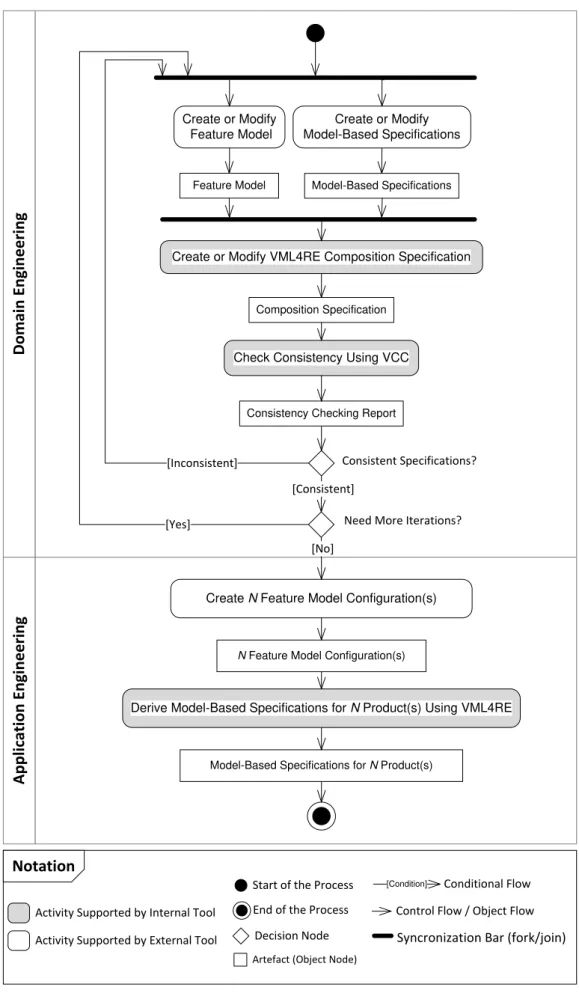
3.1 DCC4SPL main activities and artefacts. . . 36
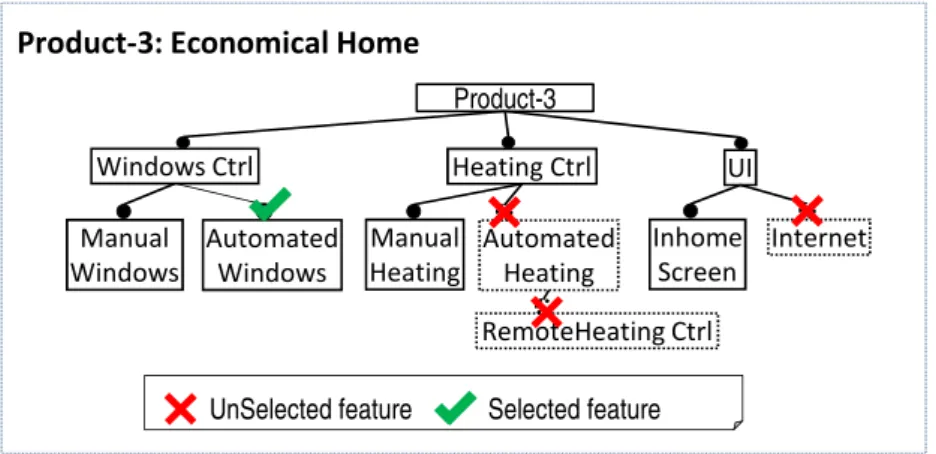
3.2 (a) Simplified sample of the Smart Home feature model, (b) Sample configu-ration that includes all features, and (c) Sample configuconfigu-ration that excludes the Automated Windows feature. . . 40
3.3 (a) Sample customized model-based specifications for Product-1, (b) Map-ping between feature expressions and model fragments, and (c) Notation used in use case and activity diagram in (a).. . . 41
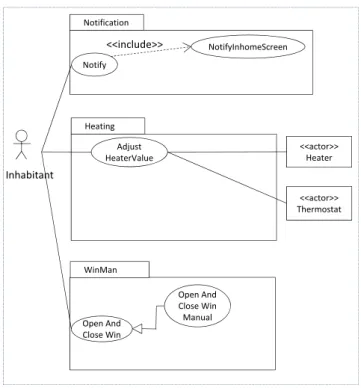
3.4 Sample use case diagram for SMARTHOMEcontaining only model elements related to mandatory features.. . . 42
3.5 Composition specification of variants A-W (associated to an atomic feature expression - AUTOMATEDWINDOWS) and R-H (associated to a compound feature expression - AND ( "REMOTE HEATING CTRL" , "AUTOMATED HEATING" , "INTERNET"). . . 43
3.6 Sample configuration that excludes all the features except Automated Win-dows. . . 47
3.7 Main parts in the DCC4SPL metamodel. . . 49
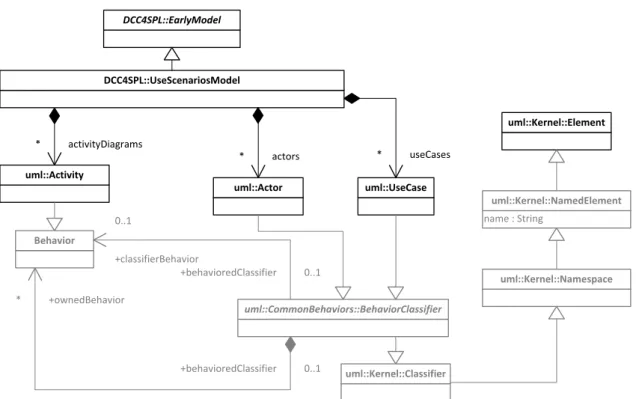
3.8 Some of the UML metaclasses related to scenario modelling and to the Use Scenarios Model and Model Element metaclasses of DCC4SPL. . . 51
3.9 Part of the UML metamodel focused on activity diagrams. . . 52
3.10 Part of UML focused on use case diagrams. . . 54
xviii LIST OF FIGURES
3.12 Parts of the DCC4SPL metamodel related to VML4RE. . . 60
3.13 Actions in VML4RE. . . 62
3.14 First part of the concrete syntax specification of VML4RE related to VML4RE and Variant. . . 63
3.15 Second part of the concrete syntax specification of VML4RE related to actions. 65 3.16 Third part of the concrete syntax specification of VML4RE related to Mod-elElement and Expressions. . . 66
3.17 (c) Sample VML4RE model fragment related to the variant remote heating control in the Smart Home and its corresponding: (a) metamodel, (b) con-crete syntax specification, and (d) relationships between model elements related to the sample model fragment. . . 67
3.18 Graph rule to insert an Association between actorY and useCaseX . . . 69
3.19 Graph rule to replace useCaseB by useCaseC. . . 70
3.20 Parts of DCC4SPL metamodel related to VCC. . . 71
3.21 Mapping feature model elements to propositional logic and CNF ([22][28]). 78 3.22 DCC4SPL tool support high-level architectural view. . . 79
List of Tables
1.1 Publications mapped to their contributions. . . 13
4.1 Main research questions related to the research topics and the sub-questions used to address them.. . . 84
4.2 Attributes used during quantitative validation. . . 85
4.3 Attributes used during qualitative validation. . . 87
4.4 Summary of the rules implemented in our study and applied (*) for Smart Home (SH), CCCMS (CC), Mobile Photo (MP). . . 93
4.5 Information of the size in the case studies. . . 95
4.6 Number of elements in the composition specifications and consistency checking time in the case studies. . . 96
4.7 Summary of quantitative validation. The upwards arrow means “Good”, the rightwards arrow means “Average”, and the downwards arrow means “Bad”.. . . 96
Abbreviations
AMPLE Aspect-Oriented, Model-Driven Product Line Engineering AOM Aspect-Oriented Modelling
AOSD Aspect-Oriented Software Development CCCMS Car Crash Crisis Management System CNF Conjunctive Normal Form
DCC4SPL Derivation and Consistency Checking of models in early SPLE DSL Domain Specific Language
DSLE Domain Specific Language Engineering EBNF Extended Backus–Naur Form
Ecore Eclipse Modelling Framework Core
EMF Eclipse Modelling Framework HUTN Human Usable Textual Notation MDD Model-Driven Development MOF Meta-Object Facility
OMG Object Management Group OOP Object-Oriented Programming SPL Software Product Line
SPLE Software Product Line Engineering UML Unified Modelling Language VCC Variability Consistency Checker
Part I
1
Introduction
The current trend of globalization is pressuring organizations developing software-intensive products to explore efficient ways to provide high-quality products of increasing size and complexity customized to the special needs of individual customers of market seg-ments. Software Product Line Engineering (SPLE) [79,27,31] is a software development paradigm that aims at addressing this challenge based on the observation of three facts: (1) most products in a market segment or application domain are not new, (2) products usually share many common features, and (3) most organizations build software systems in a particular domain, repeatedly releasing product variants by removing features or adding new features. SPLE takes into account these three insights to provide an approach to increase the productivity of software development organizations, enabling them to cope with the diversity of the global market to develop product variants through systematic reuse of software assets which have been proactively planned with respect to expected future requirements [86].
During the first years of SPLE, attention has been focused on detailed design and code generation for new products. To date there is no effective approach to deal with the issue of derivation and consistency checking of models during early modelling of Software Product Lines (SPLs). Early modelling is requirements specification and architectural design. This part of the software development process eases reasoning about the products to be derived, establishes critical trade-offs early in the software life cycle, and supports the creation of software specifications for the developers before implementation in code (where changes may be difficult and expensive to make).
1. INTRODUCTION
requirements and architectural models in a repository, expecting that they will be reused for the creation of new products. Instead, it is required to describe what assets are available, what variable and common features the assets have, which features will be part of each product, and how each selection of features triggers the transformation of reusable assets to create concrete software products. The way these descriptions are made, used, and processed represents a significant research challenge due to the difficulty to modularize variabilities and to express and derive concrete products at the level of abstraction that the modellers require.
Products derivation cannot be addressed in isolation because the quality of the prod-ucts is also determined by the consistency between the feature model (an SPL variability model) and other assets that model the features. The problem of deriving products using inconsistent inputs is that it produces products that do not satisfy their requirements, therefore of low-quality and less cost-effective (due to the effort and time to find inconsis-tencies and repair their effects during code derivation). In the context of this dissertation, inconsistencies are violations of consistency rules (architectural and design guidelines, programming conventions and well-formedness rules) established between a variability model and other models. Inconsistencies are rarely simple in practise because they may involve several interrelated features and model fragments in different models which are usually developed by diverse stakeholders.
In addition to the derivation of products and consistency checking, a common factor that adds complexity to the development of SPLs is that there is not one customer or com-pany supplying the requirements. In fact there are potentially hundreds of yet unknown customers which make the number of features, assets, and their incompatibilities and dependencies to rise exponentially. To derive products or to check consistency given a large number of combinations of features is not feasible without an adequate approach and proper automation support.
This dissertation addresses models derivation and consistency checking by proposing a novel and tool-supported approach called Derivation and Consistency Checking of models in early SPLE (DCC4SPL). One of the main characteristics of DCC4SPL is that it employs models that help developers to work at the level of abstraction that they require. This right level of abstraction is reached by hiding or masking implementation details, using a specification vocabulary familiar to system modellers, bringing out the big picture, or focusing on different aspects of a system. The use of models favours the application of Model-Driven Development (MDD) [94,85] where models are the primary development assets, and concrete systems are produced as a result of model transformations. Thus, DCC4SPL uses SPL assets as input models that are transformed to derive customized models expressing product requirements specifications or architectural models. Given that the languages used to write the models have a well-defined form (syntax) and meaning, DCC4SPL automates the mining and processing of dependencies and incompatibilities the variability model and other models to check consistency of the SPL specification.
1. INTRODUCTION 1.1. Research Question
Models derivation is supported by VML4RE. VML4RE is a Domain Specific Language (DSL) that specifies how to derive models for specific products based on the transformation of reusable model fragments. This language eases the derivation of models by specifying usually complex model transformations employing a vocabulary familiar to requirements engineers and software architects. VML4RE is inspired in the Aspect-Oriented paradigm [44,19] and, therefore, it refers to the process of derivation of models as a composition process designed to weave different models and model fragments related to several systems concerns (each concern corresponds to a feature or groups of features in the SPL context) to finally produce the models for concrete systems.
The second part of DCC4SPL is VCC, which addresses consistency checking between feature models and other models that design the features, for example: activity and com-ponent diagrams. VCC mines relationships between features from the feature model and from other models that design the features. Then, it employs propositional formulas to relate all the mined relationships. Checking if all the products in an SPL satisfy consistency rules is based on searching for a satisfying assignment of a propositional formula. The novelty of VCC, is fourfold: (1) it can be applied to early model-based SPLE such as requirements specification and architectural design, (2) it considers complex composition situations where the customization of models for specific products depends on the pres-ence or abspres-ence of sets of features (or any other variability unit), (3) it checks consistency for the entire SPL instead of individual products, without compromising efficiency, and (4) since our focus is on early modelling, VCC does not assume a correct and complete feature model; instead, it helps developers to complete the feature model based on the detected inconsistencies with respect to other models.
As noted at the beginning of this section, one of the important objectives of SPLE is the efficient derivation of high-quality products. While the results related to the achievement of these challenges demonstrate the value of DCC4SPL, the organizational and economical aspects also determine the success in SPLE but are out of the scope of this dissertation. We believe that no single tool or approach can provide the optimal and general solution for any software engineering problem. Instead, the contributions of this dissertation provide significant pieces in SPLE and its technology tool box that consist of the tool-supported approach DCC4SPL.
1.1
Research Question
Based on the need to support the derivation of particular products from reusable assets, and the need to check consistency between the SPL feature model and the assets that are modelling its features, the main research statement of our work is to investigate:
1. INTRODUCTION 1.1. Research Question
To understand the meaning of this research question we will analyse it into its six major keywords1:
• Guaranteemeans “to assure a particular outcome”2. In the context of this dissertation the main outcome is the derivation of products and consistent specification in early modelling (i.e., requirements and architecture modelling). This outcome includes two parts: (1) specifications on how to derive product-specific early models (or model-based specifications) expressed at the level of abstraction that developers require, and (2) the guarantee that the early models and the feature model of the SPL are consistent between them. (These will be explained further in Section1.2-Research Topics)
• Effectivemeans two things: first, “producing or capable of producing an intended result” and second, “presently existing in fact and not merely potential or possible”3. This means that apart from providing a conceptual base and process we are also interested in a prototypal tool support that concretizes them.
• Consistencymeans “ability to be asserted together without contradiction” and “agree-ment or harmony of parts or features to one another or a whole”4. Inconsistencies result from the violations of consistency conditions that can be as diverse as architec-tural and design guidelines, programming conventions and well-formedness rules. In the context of this dissertation, consistency checking implies the verification of consistency conditions related to the relationships between the feature model and its related model-based specifications. Such relationships may be dependencies and incompatibilities between parts of models, and dependencies and incompatibilities between features.
• Derivationmeans “the act of obtaining something from a source or origin”5. In the context of this dissertation, derivation of products means to transform requirements and architectural models to obtain product-specific requirements and architectural models. In Aspect-Orientation it is common to use the term “composition” to refer the idea of “bringing together separately created software elements” [44]. Given that the VML4RE tool that supports the derivation of products is inspired in the Aspect-Orientation paradigm, we usually employ the term “composition” to refer to the derivation process. We use model transformations to actually perform the composition. Model transformations allow adding, removing, connecting, or replacing parts of models with new or already existing parts of other models.
• Early Modellingmeans to specify system concerns at the requirements specification and architectural design development stages. Examples of models used during early
1Some of them will be further discussed during Chapter2-Background. 2http://www.thefreedictionary.com/guarantee
3http://www.thefreedictionary.com/effective
1. INTRODUCTION 1.2. Research Topics
modelling of software are use case, activity and components diagrams written in the Unified Modelling Language (UML). In a model-driven perspective of software de-velopment the use of models provide a vehicle to direct the course of understanding, design, construct, deploy, operate, maintain and modify software [70].
• Software Product Linemeans “a set of software-intensive systems that share a com-mon, managed set of features satisfying the specific needs of a particular market segment or mission and that are developed from a common set of core assets in a prescribed way” [27]. We provide background information about software product line engineering in Subsection2.3.1-Software Product Line Engineering (SPLE).
The previous six keywords that compose our main research question establish the central goal of this dissertation: to provide an approach with tool support that guarantees the derivation of product-specific early models assuring that what it is supposed that the SPL can produce (expressed in a variability model such as a feature model) does not contradict with the definition of what can be actually produced (expressed with early models).
1.2
Research Topics
The research question sets the context of our research agenda, which we decomposed into two finer-grained, more focused topics that constitute the main concerns of this dissertation:
1. Support to express and perform product-specific models derivation.
General-purpose model transformation languages, such as ATL [52], AGG [89], QVT6[75] require that developers have a deep knowledge of the abstract syntax of the models to describe their composition. However, most developers do not know the details of the abstract syntax of the languages that they use [51]. Also, even if developers know those details, there is still a barrier of learning and applying correctly the specifities (e.g., syntax and computing style) of new highly specialized languages such as model transformations languages. This research topic leads to the following research question:
Question 1. How to support expressing and perfoming product-specific model derivation?
2. Support for consistency checking between variability model and other models.
To produce product-specific models from an SPL, models have to be composed according to a specific selection of variability units (e.g., features) from a variability model (e.g., a feature model). This process requires a mapping between variability units, and artefacts, such as models, that specify them. A number of different approaches have been proposed to create mappings among variability models
1. INTRODUCTION 1.3. Contribution Overview
and other models [48, 31]. However, ensuring consistency between variability models and not code-based assets has not been thoroughly researched. Consistency checking is particularly important given the need to assure that variability and models’ constraints are reliable. Failures in consistency will produce customized systems that do not satisfy their requirements. This research topic leads to the following research question:
Question 2. How to support consistency checking between the variability model and other models?
The definition of these two research topics was necessary to set the boundaries and the focus of the research presented in this dissertation. The results of the research and development on these two research topics, guided by Question 1 and Question 2, lead to the major contributions of this Ph.D. dissertation.
1.3
Contribution Overview
The three main contributions of DCC4SPL organized by research question are as follow:
1. Model derivation using VML4RE.The research question 1:“How to support express-ing and performexpress-ing product-specific model derivation?”is addressed with the Variability Modelling Language for Requirements (VML4RE). VML4RE is both a domain spe-cific language and derivation infrastructure spespe-cifically tailored to express how to derive product-specific requirements models. We provided a specialization of VML4RE to model use scenarios as it provides language constructs (e.g., actions7) specifically designed for compositions of UML use cases and activity diagrams. VML4RE was one of the base languages used to create Variability Modelling Lan-guage (VML*) which was a common contribution created as a collaboration between the partners of the research project AMPLE (Section1.5-Research Context). VML* is used as an infrastructure to support the creation of new languages similar to VML4RE, each one specialized in a different kind of models. For example a ver-sion for architecture called VML4Arch was developed [97]. VML4RE presents the following benefits:
• Vocabulary familiarity. It supports the process to specify the derivation of product-specific models, using a vocabulary (i.e., syntax) and concepts fa-miliar to SPL developers. This hides the details of the model transformation language and process from the SPL developers. Thus, helping them to avoid thinking about many of the implementation details of general purpose model transformation languages.
1. INTRODUCTION 1.3. Contribution Overview
• Derivation flexibility.It provides actions types for both positive8and negative9 models’ derivation mechanims.
• Modularity. It supports a better modularization of feature specifications. It allows to model each feature, or group of closely related features, in separated models. Also, it separates variability information (i.e., configuration knowl-edge10), instead of integrating it directly into the SPL models as other authors propose (e.g., [30,45,25]). Modularity to express feature specifications and vari-ability information leads to better stvari-ability of the early models specifications, composition specifications and configuration knowledge.
2. Consistency checking between variability model and other models using VCC. The research question 2:“How to support consistency checking between the variability model and other models?” is addressed with the Variability Consistency Checking (VCC). VCC is a verification approach and tool that supports consistency checking between a variability model (e.g., a feature model), and the models that design the variability units of the variability model (e.g., features). There are different kinds of models used to design (sometimes we say,realize) the meaning of variability units, for example: use case, activity, and component diagrams.
VCC mines constraints between variability units from the variability model and from the models that design variability. Then, VCC employs propositional formulas to relate all the mined constraints. Checking if all the products in an SPL satisfy consis-tency constraints is based on searching for a satisfying assignment of a propositional formula. VCC also presents the elements involved in a violation of a consistency rule and explains the cause of the inconsistency. VCC presents the following benefits:
• Consistency checking genericity. It can be applied to check consistency of any model. We show examples of features models and several types of UML models, such as use case, activity and component diagrams. Also, it considers complex composition situations where the derivation of models for specific products depends on the evaluation of variability unit expressions11, and not only depending on the presence or absence of individual variability units.
• Consistency checking multi-view awareness. It can check consistency between multiple models and the variability specification independently of the number of languages employed.
8Positive variability is a derivation mechanism where new models are created adding parts to an initial model.
9Negative variability is a derivation mechanism where new models are created removing parts from an initial model.
10Configuration knowledge is the mapping between features and model fragments and the information on how to derive product-specific models according to selections of features.
1. INTRODUCTION 1.3. Contribution Overview
• Consistency checking scalability. It checks consistency of all possible products during domain engineering, without compromising the performance of the verification process.
3. Tool support.The tool support contributes both research topics: “support to express and perform product-specific models derivation” and “support for consistency checking between variability model and other models”. We developed three tool prototypes:
• VML4RE. VML4RE uses EMFTEXT12which provides the software
infrastruc-ture to derive a concrete syntax and Eclipse plug-in editor based on the meta-model of each language written in EMF13Ecore14. This technology separates concrete syntax and abstract syntax, easing maintenance of the languages. The style of the concrete syntax chosen for VML4RE is HUTN (Human Us-able Textual Notation)15provided by EMFTEXT. This style and the VML4RE language constructs, provide a suitable notation for describing requirements composition.
• VCC. This tool alleviates developers from the tedious and error-prone task of manually checking variability models and their related model-based specifi-cations for consistency. VCC has several reusable components, for example to map variants and model elements, to assign and persist identifiers for vari-ability units, to translate from propositional logic to Conjunctive Normal Form (CNF) form (a format readable by satisfiability solvers), and to create constraints based on composition specifications and model-based specifications.
• Feature model metamodel and editor. This implementation is written in EMF Ecore. The metamodel was a translation to EMF Ecore of the features model implemented as a Java library by the Software Product Lines On-line Tools (SPLOT) research community. All our implementation is open-source and relased as two Eclipse plug-ins in the SPLOT website16.
The contributions of this work have been published and presented in international confer-ences and in specialized book chapters (PartII-Research Papersincludes a copy of the most relevant). The publications target the research topics and contribute to specific parts of the DCC4SPL approach (described in Chapter3). PartII-Research Papersprovides more information about each publication such as authors, summary, authors’ contribution, publication event and references to workshops, technical reports and papers presented in journals and conferences that complement the main publications.
12http://www.emftext.org/: EMF textual concrete syntax mapper. 13www.eclipse.org/emf/: Eclipse Modeling Framework.
14www.eclipse.org/emf/: EMF Core.
1. INTRODUCTION 1.4. Research Method
No Title of the Publication Contrib.
A A Model-Driven Approach for Software Product Lines Requirements Engineering [9] 1 B Multi-View Composition Language for Software Product Line Requirements [15] 1, 3 C VML* – A Family of Languages for Variability Management in Software Product Lines [97] 1, 3 D Model-Driven Requirements Specification for Software Product Lines [13] 1 E Evaluating Approaches for Specifying Software Product Line Use Scenarios [6] 1 F Supporting Consistency Checking between Features and SPL Use Scenarios [12] 2, 3 G Ensuring Consistency between Feature Models and Model-Based Specifications 2, 3
- The VCC Approach [11]
Table 1.1: Publications mapped to their contributions.
Table1.1lists the publications and assigns to them an identifier to facilitate the descrip-tion of each contribudescrip-tion and the reference of each publicadescrip-tion. Table1.1also summarizes the relationships between contributions and publications. The research papers that con-tributed the most to define the specification of models derivation are papers A to E, and the research papers that contributed the most to define the consistency checking are papers F to G. Tool support is defined in several papers, from B to C, and from F to G.
1.4
Research Method
In this dissertation we based our research in theTechnology17Researchmethod. This method is suitable for the purpose of producing new or better artefacts [84]. Once new artefacts are ready, researchers have to show that they actually fulfil the posed requirements and thereby satisfying the need on which they are based. Technology research does not always produce artefacts that are complete, regarded from a user’s point of view. It is common to make a so-called functional prototype, which must be able to undergo the necessary evaluation. If the prototype looks promising, it can later on be elaborated to a complete, commercial product. Such finalization is typically done by other people than researchers [84].
The main steps in the technology research process are:
• Problem analysiswhere researchers answer “what is the potential need” for a new technology. In this step researchers identify a need for new or better artefacts.
• Innovationwhere researchers answer “how to make an artefact that satisfies the need” identified during problem analysis. In this step researchers produce new or better artefacts.
• Validationwhere researchers answer “how to show that the artefact satisfies the need”. In this step it is necessary to check that the artefacts created during innovation satisfy their requirements. When new artefacts are obtained, the researcher has a basis for
1. INTRODUCTION 1.4. Research Method
new questions, leading to new investigations. Therefore, technology research is an iterative process.
Next, for each step we outline a summary on how we followed the technology research process in this work:
1. Problem analysis. Based on the literature review and the analysis of existing approaches for SPLE, we found two problem areas which were introduced in Section1.1: “support to express and perform product-specific models derivation”, and “support for consistency checking between variability model and other mod-els”. We presented the literature review in a technical report of the state-of-the-art in model-driven SPL [60]. Also, the industrial partners of our European research project AMPLE18, Siemens A.G, SAP A.G and Holos, helped to identify the problem areas addressed in this dissertation.
2. Innovation. The innovation phase tackled the problem areas identified during problem analysis with three contributions (described in Section1.3-Contribution Overview): “model derivation using VML4RE”, “consistency checking between variability model and other models using VCC” and “tool support”. The new technology represented by DCC4SPL, is described in the research papers in PartII -Research Papers, and in the Chapter3-DCC4SPL Approachof this dissertation.
3. Validation. The results were validated with literature search, examples and case stud-ies, prototypes, comparative metrics, and feedback obtained during the elaboration and presentation of peer-reviewed scientific publications.
• Literature searchof existing techniques and tools has been applied related to all research results. A continuous process of reviewing other research results and technology developments has been undertaken.
• Examples and case studieswere established and reused to validate our approach and those of others. The main two case studies are the SPL Smart Home and the Car Crash Crisis Management System. Smart Home [71] was defined as a case study in the AMPLE project. The Car Crash Crisis Management system was proposed by a group of international researchers as a common case study to compare different modelling approaches [56]. Both case studies were used along this dissertation to illustrate DCC4SPL.
• Several prototypessupport this dissertation to illustrate and validate the concepts and languages defined. The main two prototypes are the domain specific lan-guage and derivation infrastructure VML4RE (Variability Modelling Lanlan-guage for Requirements) and the verification approach and tool VCC (Variability Con-sistency Checker) that checks conCon-sistency between feature models and other
1. INTRODUCTION 1.5. Research Context
models. Also, we built a feature model metamodel and editor based on an existing feature modelling library provided by the SPLOT research community.
• Comparative metricswere used to validate and further strengthen the results. We apply quantitative and qualitative methods that gathered statistical data to support the research claims. For example, the paper “Evaluating Approaches for Specifying Software Product Line Use Scenarios” presents an empirical evaluation that takes into account relevant quality attributes for variability management (e.g., modularity, expressivity and stability). It compares four key, representative techniques that aim at a better management of common and vari-able model specifications between products of an SPL. The techniques chosen to be evaluated span from type of notation (graphical or text-based), style to resolve variability (based on annotations or compositions), and quantification expressiveness. The result of this study concluded that our approach improves both modularity of the specifications of features along the models as well as stability of the models. Also, Chapter4-Validation, employs more attributes and metrics.
• Peer-reviewed scientific publicationswere produced for our main contributions. Having our main results evaluated by international specialized researchers further strengthens the validity of our claims. A copy of the main papers is given the PartII-Research Papersof this dissertation.
We believe that validating our research results using case studies, examples, prototypes, comparative metrics, and peer-reviewed scientific publications, as well as the positive feedback of our academic and industrial partners in the European project AMPLE, shows the relevance of the results obtained.
1.5
Research Context
The research work leading to this dissertation started in the context of the European project AMPLE (Aspect-Oriented, Model-Driven Product Line Engineering). The aim of AMPLE was to provide an SPL development methodology to offer improved modularization of variations, their holistic treatment across the software lifecycle and maintenance of their traceability during SPL evolution. AMPLE combined AOSD (Aspect-Oriented Software Development) [44, 19] and MDD [58,94,85] techniques to both address variability at each stage in the SPLE lifecycle and manage variations in associated artefacts, from requirements through architecture to code.
1. INTRODUCTION 1.6. Structure of this Dissertation
Software Engineering and Automation (SEA) at the Johannes Kepler University, Austria19. Also, part of the evaluation of our approach related to variability modelling and compo-sition was performed together with researchers from the Software Productivity Group (SPG), Brazil. SPG is a multi-institutional group formed by researchers from the Infor-matics Center of the Federal University of Pernambuco (CIn/UFPE)20, the Department of Computing Systems of the Federal University of Campina Grande (DSC/UFCG)21and the Department of Informatics e Applied Mathematics of the Federal University of Rio Grande do Norte (DIMAp/UFRN)22.
1.6
Structure of this Dissertation
This dissertation is organized in two parts. The first part “Overview” gives a motivation for this work, the research context and background of the work done. The second part “Research Papers” contains the set of research papers produced related to this dissertation.
Next, we introduce each one of the two parts of this dissertation and how they are composed.
Part I - Overview. In addition to this introductory chapter, the first part of this dissertation reviews the most important aspects relevant to understand our contributions in:
• Chapter2-Backgroundprovides a review of the base concepts, techniques, tools and practices related to the subject of this dissertation, such as Software Product Line Engineering, Model-Driven Development and consistency checking. This chapter is not intended to provide an historical overview nor a comprehensive survey. It rather concentrates on the aspects we think are more useful to understand this dissertation and to highlight the relationships between them.
• Chapter3-DCC4SPL Approachgives an overview of our approach and highlights the relationships between its components, VML4RE and VCC, as well as their respective tool support.
• Chapter4-Validationaddresses the questions raised by each research topic and the methods used to answer them.
• Chapter5-Conclusionssummarizes the main contributions of this dissertation and identifies future work.
Part II-Research Paperscontains a copy of some of the main book chapters and peer-reviewed papers accepted and presented in international events describing the main results of this dissertation.
19http://www.sea.uni-linz.ac.at/ 20http://www.cin.ufpe.br/
1. INTRODUCTION 1.6. Structure of this Dissertation
• Chapter8-A Model-Driven Approach for Software Product Lines Requirements Engineer-ing[9]presents how model-driven techniques can be used to automatically derive
requirements models for specific products of an SPL, and traceability views that explicitly illustrate the relationships between features and UML requirements model elements.
• Chapter9-Multi-View Composition Language for Software Product Line Requirements [15]presents details about the design criteria and use of the Variability Modeling
Language for Requirements (VML4RE). This chapter and the previous one set the bases for the VML4RE description provided in Chapter3.
• Chapter10-VML* – A Family of Languages for Variability Management in Software Product Lines[97]presents how to build new VML* languages for new SPL contexts
avoiding error-proneness of language development. Some features of VML* such as the use of feature expressions instead of only atomic features were exported to new versions of VML4RE that improved the language implementation described in paper[15].
• Chapter11 -Model-Driven Requirements Specification for Software Product Lines [13]
presents different approaches for specifying and composing requirements in SPLs as well the motivation and description of some of the design patterns followed by DCC4SPL.
• Chapter12-Evaluating Approaches for Specifying Software Product Line Use Scenarios [6] presents an empirical evaluation of four key and representative techniques that aim at a better management of common and variable use scenario specifications between products of an SPL. This evaluation takes into account relevant quality attributes for variability management, such as modularity, expressivity and stability. This evaluation is one of the key parts of Chapter4-Validation.
• Chapter13-Supporting Consistency Checking between Features and Software Product Line Use Scenarios[12]presents an approach whose driving objective is to enable
consis-tency checking in the problem space between requirements models and features.
• Chapter14-Ensuring Consistency Between Feature Models and Model-Based Specications - The VCC Approach [11] proposes an approach to support consistency checking between a feature model and its corresponding model-based specifications. The resulting approach is called Variability Consistency Checking (VCC). Also, this paper exemplifies how to use VML4RE composition language with VCC. This paper supports the consistency checking activity of DCC4SPL provided in Chapter3.
2
Background
This chapter lays the foundations to understand the subjects related to this dissertation. It is composed of three sections: “Overview” offers a glimpse of the fundamentals, approaches and models employed, “Fundamentals” presents some concepts in software engineering, and “Approaches and Models” provides an overview of some approaches and their corresponding models where those fundamentals are applied.
2.1
Overview
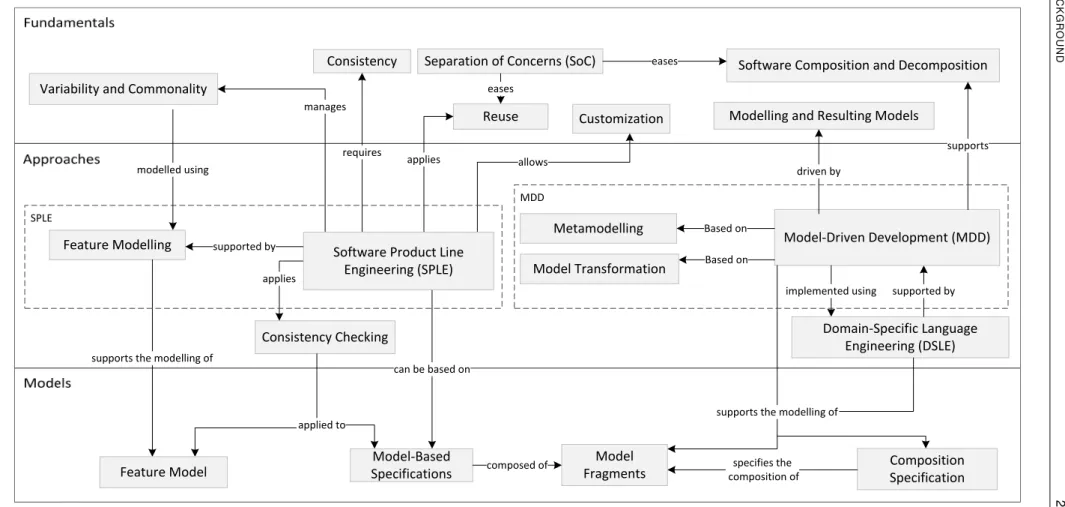
This section introduces the essential concepts and their relationships required to under-stand this dissertation. To ease the underunder-standing of the whole “puzzle” of concepts, Fig-ure2.1shows an informal sketch representing some of the main fundamentals, approaches, models, and their relationships presented in this dissertation. The most important concepts introduced here will be further explained in Sections2.2and2.3.
Figure2.1shows thatSoftware Product Line Engineering (SPLE)applies plannedreuseof software assets in a domain. In SPLE, a functionality or non-functional property is called featureand each feature can be common to all (or a subset of) the products in a domain or be unique (i.e., varies) for some products. SPLE managesvariabilityandcommonality by supporting the overall process to identify common and variable features, as well as to manage the set of products configurations. Duringfeature modellingdevelopers create a feature modelthat presents the available features in an SPL and shows the constraints on their usage. For example, the selection of one feature may preclude or require the selection of other features.
2. BACKGROUND 2.2. Fundamentals
features with the assets related to common features. The result of this composition is the customizationof reusable assets in the context of a specific software product variant. There is not standard way to customize reusable assets for specific product variants. In our approach, the way to describe how to weave the assets related to variable features with those related to common features is through acomposition specification.
In what concerns supporting technologies for SPLE, our approach usesModel-Driven Development (MDD)andDomain-Specific Language Engineering (DSLE). MDD is driven by modellingand resultingmodelsthat represent different perspectives of a system. In MDD the act of writing models using a language is calledmodelling, while the act of writing a language (i.e., modelling a language) is calledmetamodelling. Models can be transformed to other model(s) usually to produce a translated model written in other language or to customize some of itsmodel fragments(i.e., to perform amodel transformation). There are languages such as UML that can be used to model requirements and architecture. Also, it is possible to create custom-made languages that employ a vocabulary that is specific to a domain using DSLE. DSLE and MDD are related very closely. DSLE is supported by MDD which provides the conceptual bases for metamodelling,modelling and using the resulting models as the main development assets. MDD is implemented using DSLE which provides specialized languages for writing models, metamodels and model transformations.
Principles such asSeparation of Concerns (SoC)aim at improving modularization of systems. SoC advocates that developers should decompose a system in such a way that each one of the resulting decompositions (e.g., models, classes, packages) implements, if possible, only one concern. If each part of a system is focused on a special concern of the system, each part can be modified easily and with fewer side effects on other parts. Applying SoC in SPL modelling eases to reason aboutsoftware composition and decomposition encouraging developers to implement and evolve concerns (e.g., a feature or set of features in an SPL) more separately, so they can be reused to compose new products.
After specifying an SPL using different models, they may evolve and changes in these models may result in inconsistencies with what is specified in the feature model. Consistency checkingis useful in early SPLE to guarantee consistency among the various models. For example, to verify that the models that document, design and implement features do not have contradictions with respect to the specification of the feature model.
2.2
Fundamentals
2.
B
A
C
K
G
R
O
U
N
D
2.2.
Fundamentals
Customization
allows
Variability and Commonality
Separation of Concerns (SoC)
Reuse
Consistency Checking
modelled using
Feature Modelling
Software Composition and Decomposition
Model-Based Specifications
can be based on supports the modelling of
Feature Model
Model-Driven Development (MDD)
manages
supports
Domain-Specific Language Engineering (DSLE)
implemented using applies
eases
eases
Composition Specification Model
Fragments
composed of specifies the
composition of
Metamodelling Based on
Based on
Model Transformation
Modelling and Resulting Models
driven by
supports the modelling of
Consistency
requires
applies
MDD SPLE
supported by
supported by Software Product Line
Engineering (SPLE)
applied to
Figure 2.1: Informal sketch representing some of the fundamental concepts, approaches, models, and their relationships presented in this dissertation.
2. BACKGROUND 2.2. Fundamentals
2.2.1 Separation of Concerns (SoC)
This is a fundamental principle of software engineering that is credited to Dijkstra [36,35] and Parnas [76,77]. It states that in software development it is easier to manage a problem by breaking it down into smaller pieces than to solve the problem as is. Such pieces are the concernsof a software system, where a concern is a semantically coherent issue of interest to the problem domain. Concerns are the primary criteria for decomposing software into smaller, more manageable and comprehensible parts. Thus, we should decompose a program in such a way that each one of the resulting modules implements one single concern. Indeed, a non-modular design, without a clear separation of concerns leads to bad modularization (resulting in scattering and tangling of concerns) that advanced software engineering approaches, such as Aspect-Oriented Software Development (AOSD), aim to address [38,19,44].
2.2.2 Software Composition and Decomposition
In all phases of the software life cycle, concerns of a software system are separate pieces, distinguishable from other concerns. However, such separation is non-trivial to achieve, especially in large-scale and evolvable software [16]. Design and implementa-tion techniques have to support separaimplementa-tion of concerns explicitly by providing appropriate (de)composition mechanisms. Decomposition means to break down a software design into pieces; composition ties these pieces together to get a complete software product. Design and implementation techniques have to provide different kinds of (de)composition mechanisms at different levels of abstraction in order to account for the diversity of possible concerns. Prominent examples of decomposition modules are the concepts of functions in structured programming and classes in Object Oriented Programming (OOP). While functions decompose a software system along its instructions, classes decompose a software system along the data to be encapsulated [16].
2.2.3 Modelling and Resulting Models
2. BACKGROUND 2.2. Fundamentals
2.2.4 Consistency
A system is consistent when there is logical coherence (i.e., no contradictions) bewteen its parts. Consistency depends on the verification of consistency conditions that should be guaranteed in a system. These can be as diverse as architectural and design guide-lines, programming conventions and well-formedness rules. Consistency conditions may involve several different and interrelated models required to represent the perspectives (also called: viewsor concerns) and information needed by diverse system stakeholders [40]. A traditional example of consistency conditions (or consistency rule) among different models is that “if a sequence diagram has a messageMwhose target is an object of classC,
the class diagram of classCmust contain methodM” [66].
2.2.5 Reuse
Software reuse is the process of creating software systems from existing software rather than building software systems from scratch [63]. Separated concerns in software devel-opment can be more easily reused in different contexts than intermingled ones. The more independent a concern is, the easier it can be detached from or attached to a (different) software system. Reuse can be applied to employ part of the implementation or design of a concern (e.g., a use scenario, a component, a model, or library) in different variants of one software product or in different software systems.
2.2.6 Customization
Customizing a software system means adjusting the given system structure and behaviour in the boundaries of the supported variability [93]. This means to choose the concerns desired for a system and to select those implementations that best fit a requirements specification. Customization is required to meet the specific needs of different stakeholders on a software system, therefore, software design and implementation ideally should support the easy customization and derivation of system variants.
2.2.7 Variability and Commonality
2. BACKGROUND 2.3. Approaches and Models
2.3
Approaches and Models
This section introduces the approaches that will be addressed in this dissertation and the models that they use or help to produce. The middle part of Figure2.1shows four main approaches: Software Product Line Engineering (SPLE), Model-Driven Develop-ment (MDD), Domain-Specific Language Engineering (DSLE) and Consistency Checking. They are related to other sub-approaches shown into dashed lines: feature modelling, metamodelling and model transformation. All approaches are related to the fundamentals explained in Section2.2and use or help to produce different kinds of models (shown at the bottom of Figure2.1).
Software Product Line Engineering (SPLE) is the application domain of this disser-tation. SPLE is supported by feature modelling which is a key technique employed to describe variability and commonality in an SPL and to produce a feature model. This dissertation employs the feature model as one of the input artefacts in SPLE.
Model-Driven Development (MDD) is described through two of its distinctive tech-niques: metamodelling and model transformations. A connection to Domain-Specific Languages Engineering (DSLE) is established where MDD techniques, such as metamod-elling, are applied to create new domain-specific languages. This dissertation uses DSLs to create languages to express composition specifications and the actual transformation of the models.
Consistency Checking is an activity applied to guarantee logical coherence between different interrelated parts in a system. Some common types of consistency checking are described in this section. This dissertation applies consistency checking to guarantee that the models employed to specify an SPL, such as feature model and model-based specifications, are logically coherent. Consistent models are more reliable as they have not contradictions between them, therefore, they can be used to derive product-specific models.
2.3.1 Software Product Line Engineering (SPLE)
Software Product Line Engineering is an approach to increase software quality and pro-ductivity through systematic reuse of assets [79,27,31]. SPLE encompasses the creation and management of products’ families for a particular domain. In SPLE each product in the family is derived from a shared set ofcore assets, following a set of prescribed rules [27]. A core asset can be any relevant artefact in the software process, such as code units (packages, classes, methods, etc.) or models, documentation, configuration files, etc.
Products in an SPL are characterized by theirfeatures, which are useful to express product functionalities or properties concisely [79]. Features may be common to all products or vary between products. The termscommonalityandvariabilityare often used to denote the common and variable features within a product line, respectively.
2. BACKGROUND 2.3. Approaches and Models
process conceptual framework [79] as well as an overview on feature modelling. We chose this conceptual framework because it considers that all kind of artefacts may be reused, from requirements through code, to testing units. However, in comparison with our work, it does not address the development of effective solutions for models derivation and consistency checking based on MDD and DSLE.
SPL Process Framework [79]. This conceptual framework uses a collection ofreusable artefactsas input and offers the possibility of mass customization. Reusable artefacts, or core assets,encompass not only code-based units such as packages, libraries and compo-nents, but also all types of software development artefacts such as requirements models, architectural models, test plans, and test designs. According to Pohl et al., “to facilitate mass customization, the platform (i.e., the collection of reusable artefacts1) should provide the means to satisfy different stakeholder requirements. For this purpose, the concept of variability is introduced in the platform. As a consequence of applying this concept, the artefacts that can differ in the applications of the product line are modelled using variability” [79].
Figure2.2shows an adaptation of the original figure of the Pohl’s SPLE conceptual framework [79]2. It has two main processes:Domain Engineering(also known asCore Asset
Development) andApplication Engineering(also known asProduct Development) [79,27]. Domain Engineeringis the process responsible for “establishing the reusable platform and thus for defining the commonality and the variability of the product line” [79]. Traceability links between these artefacts facilitate systematic and consistent reuse. Product management is also part of the domain engineering process and deals with the economic aspects of the SPL such as the market strategy and the management of the product portfolio of the company. Domain engineering sub-processes include:
• Domain Requirements Engineeringencompasses all activities for eliciting and docu-menting the common and variable requirements of the product line. The output of this sub-process comprises the common and variable requirements for all foresee-able applications3of the product line as well as a variability model (e.g., a feature model)4.
• Domain Designencompasses all activities for defining the reference architecture of the product line. The reference architecture provides a common, high-level structure for all the product line applications. The input for this sub-process consists of the domain
1The definition of platform can be also extended to the technologies on which other technologies or processes are built.
2Our adaptation considers the cases where: (1) variabilities and commonalities may be modelled in the same model. This is represented by single geometrical shapes with white and black parts representing models with fragments related to commonalities and variabilities, respectively; and (2) models used in each sub-process of SPLE can be modelled separately; this is represented by disconnected shapes.
2. BACKGROUND 2.3. Approaches and Models
Application N ‐Artefacts
Domain
Engineering
Applica
tion
E
ngineering
Domain Artefacts Including Feature Model Domain
Requirements Engineering
Domain Design Domain
Implementation Domain Testing
Application 1 ‐Artefacts Application Requirements
Engineering
Application Design
Application Implementation
Application Testing
Specification and Derivation of Requirements and Architectural
Models
Figure 2.2: SPL process framework (adapted from [79]).
requirements and the variability model from domain requirements engineering. The output encompasses the reference architecture and a refined variability model that includes the so-calledinternal variability, i.e., the variability that is necessary for technical reasons.
• Domain Realizationdeals with the detailed design and the implementation of reusable software components. The input of this sub-process consists on the reference ar-chitecture including a list of reusable software artefacts to be developed in domain realization. The output of domain realization encompasses the detailed design and implementation assets of reusable components.
• Domain Testingdeals with the validation and verification of reusable components. Domain testing tests the components against their specifications, i.e., requirements, architecture and design artefacts. In addition, domain testing develops reusable test artefacts to reduce the effort for application testing.
Application Engineeringis the process responsible for “deriving product line applications from the platform established in domain engineering” [79]. Application Engineering exploits the commonality of the product line and ensures the correct binding of the variability according to the applications’ specific needs. The application engineering sub-processes are:
2. BACKGROUND 2.3. Approaches and Models
• Application Domain Designencompasses all activities for producing the application architecture.
• Application Realizationencompasses all activities for creating a running application together with the detailed design artefacts.
• Application Testingencompasses all activities necessary to validate and verify an application against its requirements.
It is important to note that neither the domain and application engineering nor their sub-activities have to be performed sequentially. This is expressed in Figure2.2with a loop with an arrow for each process. A dotted line marks the part of the framework that is directly related with the subject of this dissertation. We also make explicit that there is a composition process that derives models for specific target products (or “applications”in Figure2.2) from reusable requirements and architectural models for the entire SPL created duringDomain Requirements EngineeringandDomain Design.
Another important aspect of this framework is that testing does not consider consis-tency between the variability model and other assets, focusing only on testing imple-mented components against their requirements and architecture specifications. In this dissertation we address some of the gaps in the SPL process considering consistency between feature models and other model-based assets (e.g., requirements and architecture models) and automatic derivation of model-based assets.
Feature Modelling. Feature modelling is a method and notation to capture the available
common and variable features of the systems in a family and to describe the incompatibil-ities and dependencies between features [53,31].
Feature modelling was first proposed by Kang et al [53] and since then it has been extended with several concepts. For example, feature and group cardinalities, attributes, and diagram references [32]. A classic example of a feature model is illustrated in Figure
2.3. This feature model expresses an electronic commerce system that supports one or more different payment methods, provides tax calculation taking into account either the street-level address, or postal code, or just the country, and it may or may not support shipment of physical goods. Such feature model may be complemented with additional information, such as binding times (features may be intended to be selected at certain points in time), domain constraints (e.g., dependencies and incompatibilities, where selecting a certain feature may require or exclude the selection of another feature), default attribute values and default features, stakeholders interested in a given feature and priorities [32].
2. BACKGROUND 2.3. Approaches and Models
E-shop
Tax
Calculation Shipping
Mandatory
Optional
Inclusive OR
Notation
Payment
Credit
Card
Debit
Card
Electronic
Cheque
Address Resolution
Country
Street
Address
Postal
Code
Exclusive OR
Figure 2.3: Example of feature model for an E-Shop SPL [32].
projected development cost for each feature, and so forth. In the context of generative software development [31], feature models are used during domain analysis are the starting point in the development of both SPL architecture and DSLs.
2.3.2 Model-Driven Development (MDD)
Model-Driven Development (MDD) refers to the systematic use of models as first-class entities throughout the entire software lifecycle [85, 59]. MDD is based on metamod-elling, which helps to express well-defined languages, and model transformations, which automate the software development process. This section introduces these base MDD techniques and presents Domain-Specific Languages (DSL) as a way to put MDD into practise.
Metamodelling. Metamodelling can be defined as the analysis, construction and
de-velopment of the frames, rules, constraints, models and theories applicable and useful for modelling a predefined class of problems [94]. In other words, metamodelling is the practice of constructing models that specify other models.
A metamodel is known as the abstract syntax of a language and encompasses all the constructs that can be used in that language. A model is said to conform to its metamodel, or that it is an instance of its metamodel in the way that a particular computer program conforms to the grammar of the programming language in which it is written.
The left-hand side of Figure2.4 presents a four layers metamodelling framework. This framework is exemplified using MOF, a modelling formalism employed to define metamodels 5. The right-hand side of Figure2.4depicts a short example based on the modelling of a film released as DVD. It can be interpreted as follows:
• M0, Data Layershown in the left hand side of Figure 2.4describes the instances
![Figure 2.2: SPL process framework (adapted from [79]).](https://thumb-eu.123doks.com/thumbv2/123dok_br/16527464.736043/46.892.111.745.131.551/figure-spl-process-framework-adapted-from.webp)
![Figure 2.3: Example of feature model for an E-Shop SPL [32].](https://thumb-eu.123doks.com/thumbv2/123dok_br/16527464.736043/48.892.111.740.129.401/figure-example-feature-model-e-shop-spl.webp)