STRUCTURAL SUSTAINABILITY OF CAMBISOL UNDER
DIFFERENT LAND USE SYSTEM
(1)Paula Cristina Caruana Martins(2), Moacir de Souza Dias Junior(3), Ayodele Ebenezer Ajayi(4) & Fátima Maria de Souza Moreira(5)
SUMMARY
Incongruous management techniques have been associated with some significant loss of agricultural land to degradation in many parts of the world. Land degradation results in the alteration of physical, chemical and biological properties of the soil, thereby posing a serious threat to sustainable agricultural development. In this study, our objective is to evaluate the changes in a Cambisol structure under six land use systems using the load bearing capacity model. Sampling was conducted in Amazonas Region, Brazil, in the following land use: a) young secondary forest; b) old secondary forest; c) forest; d) pasture; e) cropping, and f) agroforestry. To obtain the load bearing capacity models the undisturbed soil samples were collected in those land use systems and subjected to the uniaxial compression test. These models were used to evaluate which land use system preserved or degraded the Cambisol structure. The results of the bulk density and total porosity of the soil samples were not adequate to quantify structural degradation in Cambisol. Using the forest topsoil level (0-0.03 m) as a reference, it was observed that pasture land use system was most severe in the degradation of the soil structure while the structure were most preserved under old secondary forest, cropping system and forest. At the subsoil level (0.10-0.13 m depth), the soil structure was most degraded in the cropping land use system while it was most preserved in young secondary forest and pasture. At the 0.20-0.23 m depth, soil structure degradation was most severe in the old secondary forest system and well preserved in young secondary forest, cropping and agroforestry.
Index terms: structure degradation, bulk density, precompression stress, Amazonas.
(1) Parte da Tese de Mestrado do primeiro autor apresentada ao Programa de Pós-Graduação em Ciência do Solo do
Departamen-to de Ciência do Solo da Universidade Federal de Lavras - DCS/UFLA. Received for publication in September 6, 2011 and approved in September 4, 2012.
(2) Eng.-Agrônoma, Doutoranda do DCS/UFLA Bolsista do CNPq. Campus Universitário UFLA, s/n. Inácio Valetim. CEP
37200-000 Lavras (MG). E-mail: [email protected]
(3) Eng. Agrícola, Ph.D em Crop and Soil Science, Professor Associado, DCS/UFLA Bolsista CNPq e Pesquisador Mineiro
FAPEMIG. E-mail: [email protected]
(4) Professor, Soil, Water and Environment Section, Department of Agricultural Engineering, Federal University of Technology,
PMB 704, Akure, Ondo State, (Nigeria). E-mail: [email protected]
RESUMO: SUSTENTABILIDADE ESTRUTURAL DE UM CAMBISSOLO SOB
DIFERENTES SISTEMAS DE USO
Técnicas inadequadas de manejo têm sido associadas com a degradação de terras agricultáveis em muitas partes do mundo. A degradação do solo resulta em alterações das propriedades físicas, químicas e biológicas do solo, o que representa séria ameaça ao desenvolvimento agrícola sustentável. O objetivo deste estudo foi avaliar as alterações da estrutura de um Cambissolo sob seis sistemas de uso da terra por meio dos modelos de capacidade de suporte de carga. A amostragem foi realizada na região Amazônica, Brasil, nos seguintes sistemas de uso: a) floresta secundária nova; b) floresta secundária velha; c) floresta; d) pastagem; e) roça; e f) agrofloresta. Para obter os modelos de capacidade de suporte de carga, as amostras indeformadas foram coletadas nesses sistemas de uso da terra e submetidas ao ensaio de compressão uniaxial. Esses modelos foram usados para avaliar qual sistema de uso da terra preserva ou degrada a estrutura do Cambissolo. Os resultados da densidade do solo e porosidade total do solo não foram adequados para quantificar a degradação estrutural do Cambissolo. Utilizando a profundidade de 0-0,03 m da floresta como referência, observou-se que a pastagem foi o sistema de uso da terra que mais promoveu degradação da estrutura do solo, ao passo que a estrutura foi mais preservada na floresta secundária velha, roça e floresta. Na profundidade de 0,10-0,13 m, a estrutura do solo foi mais degradada no sistema de cultivo roça e mais preservada na floresta secundária jovem e pastagem. Na profundidade de 0,20-0,23 m, a degradação da estrutura do solo foi mais intensa na floresta secundária velha e mais preservada na floresta secundária nova, roça e agrofloresta.
Termos de indexação: degradação da estrutura, densidade do solo, pressão de pré-consolidação, Amazonas.
INTRODUCTION
The appropriate management of land resources is critical to sustainable agricultural production, as its inappropriate use could result in the alteration of the physical, chemical and biological properties of the soil thereby promoting degradation. It is therefore imperative to evolve a strategic land use and management systems and system mixes that would promote efficient utilization of this limited resource by preserving its structure and thereby prevent degradation and attendant compaction.
There been concerted efforts in the literature to investigate the effect of different land use system and management practices on soil physical, mechanical, hydrological and chemical and sometimes engineering properties (Silva et al., 2006; Dias Junior et al., 2007; Araujo Junior et al., 2008; Glab & Kulig, 2008). Most of these studies have been premised on the investigation of the indexes of structural sustainability or degradation. Some land use and soil management system have been reported to cause significant increase in bulk density and mechanical strength of soils (Taylor, 1971; Glab & Kulig, 2008; Abid & Lal, 2008; Severiano et al., 2008); decrease in total porosity, pore size and continuity of pores in soils (Glab & Kulig, 2008; Severiano et al., 2008), reduction in soil’s nutrient absorption, infiltration and redistribution of water (Arvidsson, 2001; Ishaq et al., 2001; Lipiec et al., 2006), reduction of hydraulic conductivity (Arvidsson, 2001; Silva et al., 2006), reduction of gas exchange (Gysi, 2001) and increase in the soil’s load
bearing capacity and compactibility (Dias Junior et al., 2007; Silva et al., 2007; Araujo Junior et al., 2008; Dias Junior et al., 2008).
mechanized agriculture in the Amazon Region of Brazil due to the productive nature of Cambisol soil widely found in the region, this study was designed with the objective of evaluating the changes in a Cambisol structure under six different land use systems using the load bearing capacity model.
MATERIAL AND METHODS
Soil samples were collected in the Benjamin Constant County (4° 26' S and 69°36' W), North Western State of Amazon. This region commonly referred to as the Upper Amazon lies within the triangular border between Brazil, Colombia and Peru. The dominant soil class in the region is Cambisol (Ustox) (Coelho et al., 2005). The climate of the upper Amazon, by the criteria of Köppen, is tropical humid or super humid (Af), with no significant dry season and an annual average temperature of 25.7 oC. Mean
annual rainfall is 2,562 mm. The total rainfall of the driest month is greater than 100 mm, with higher rainfall concentrated in the months from December to April (Coelho et al., 2005).
The studied area represents a discontinuous surface of approximately 218,400 m2 and was divided
into six windows for standardized sampling under the project Biosbrasil (http://vsites.unb.br/ib/zoo/bios/ indexe.html). The windows were also selected to ensure that the practices are very similar in each the identified land use systems, indicating there are no accentuated differences in terms of intensity of use in each system. The approximate area of each window is 3.64 ha, divided into 100 x 100/50 m sampling grids. These windows were divided to reflect the various land use system and the dominant soil types (Fidalgo et al., 2005). The predominant land use systems in agricultural production system in the study area are based on a cycle of deforestation and burning of secondary vegetation to grow crops over a given period. In some instances, agroforestry resulting from the spontaneous regeneration of secondary forest species is practiced. Interviews with farmers in the region revealed that most of the areas used in agroforestry systems were deforested between 1979 and 1983 and were planted with banana and cassava. The use for agroforestry began soon after the first few cycles of cultivation, between 1980 and 1984 (Fidalgo et al., 2005). The secondary forest system was further divided into young secondary forest and old secondary forest according to their stage of regeneration.
Thus, within the scope of this study(6), the land
use system are classified as forest - areas with original forest type, with no evidence of the removal of timber
(Windows 1 and 4); old secondary forest - includes secondary forest areas in advanced stages of regeneration with more than five years of formation after being used for cropping (Windows 3, 4 and 5); young secondary forest - includes secondary forest areas in early stages of regeneration with less than five years of formation after being cropped (Windows 2, 3, 4 and 5); agroforestry - includes areas where much of the vegetation is formed by the spontaneous regeneration of secondary forest species and is also planted to annual crops for economic interests (Windows 2 and 5); cropping - includes areas planted to annual crops (cassava, maize, sugarcane and pineapple) and perennial crop (banana) (Windows 2, 3, 4.5 and 6); and pasture - includes areas for livestock production, covered by grasses (Window 6). These land use systems were compared using the load bearing capacity models to identify which one preserves or degrades the Cambisol structure.
To obtain the load bearing capacity models, in March 2008, undisturbed soil samples were collected at depths 0-0.03, 0.10-0.13, and 0.20-0.23 m from field within the different six land use systems. In each land use system, 10 undisturbed soil samples were collected in 6.5 x 2.5 cm aluminum rings, using Uhland undisturbed soil sampler. The sampling device was pushed carefully into the soil using a falling weight. Thus a total of 180 samples were collected i.e. (six land use systems x three depths x 10 samples per depth). At each point of sample collection, the ring filled with soil was removed from the Uhland sampler, and wrapped with plastic materials and paraffin wax until uniaxial compression tests were performed.
In the laboratory, the soil samples were carefully trimmed to the size of their respective rings, whose inner diameter, height and weight had been pre-measured. This was used to determine the initial field bulk density of each sample. The disturbed soil samples scraped near the intact soil cores were air-dried and passed through a 2 mm sieve and stored in plastic bags prior to other analyses. Basic soil characterization of the samples was performed according to Brazilian standard procedures as described in Embrapa (2006). Particle-size-distribution was determined using the pipette method after dispersing with 1 mol L-1 NaOH (Day, 1986) (Table
1). Particle density was determined using 95 % hydrated alcohol with 20 g of air-dried soil material in a 50 mL pycnometer (Blake & Hartge, 1986b). The total porosity (TP) was calculated from the expression:
)
PD BD 1
(
TP=
-where DB is bulk density (Mg m-3) and PD is particle
density (Mg m-3).
(6) Project BiosBrasil/Conservation and sustainable management of below ground biodiversity (CSM-BGBD) implemented by the
For the uniaxial compression test, some prepared soil cores samples held in the aluminum rings, from each land use system and at the various depths, were initially saturated in a tray filled with water up to 2/3 of the samples height, for 24 h. The saturated samples were later air-dried in the laboratory to obtain the water content levels between 0.28 to 0.66 m3 m-3
and then subjected to uniaxial compression test (Bowles, 1986) using a Boart Longyear consolidometer in which the pressures were applied by compressed air. For the test, the undisturbed soil samples were kept within the coring cylinders, which were placed into the compression cell, and afterward submitted to pressures of 25, 50, 100, 200, 400, 800 and 1,600 kPa. Each pressure was applied until 90 % of the maximum deformation was reached (Taylor, 1948) and then the pressure was increased to the next level following the procedures described in Dias Junior & Pierce, (1995) and Dias Junior et al. (2008).
The precompression stress (sp) for each of the
samples were obtained from the corresponding soil compression curves constructed from the applied stress versus bulk density data (Dias Junior & Pierce, 1995; Ajayi et al., 2010). The precompression stresses were thereafter plotted as a function of volumetric water content. Regression analyzes were performed to obtain the mathematical equations that corresponds to the load bearing capacity models using the software Sigma Plot 8.0 (Sigma Plot, 2002) and comparisons of the regression lines were performed using the procedure described in Snedecor & Cochran (1989). The results of the bulk density (Blake & Hartge, 1986a) and total porosity (Table 1) were analyzed for variance and comparison of means was implemented with Scott-Knott (p<0,05) procedure.
RESULTS AND DISCUSSION
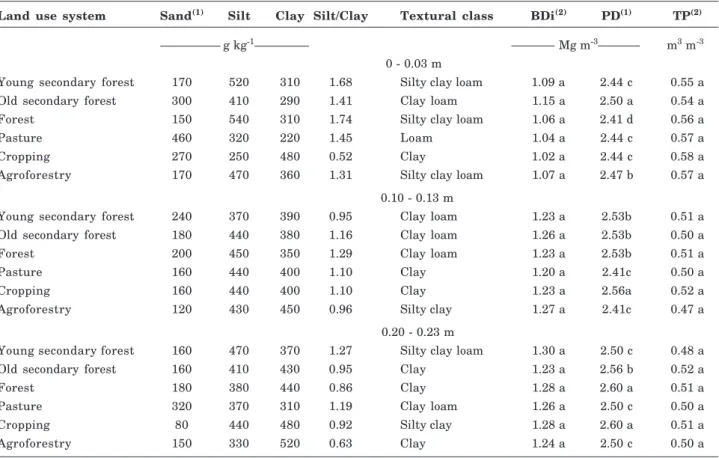
The particle size distribution, silt/clay ratio and textural classes of the Cambisol at different depths and land use systems are presented in table 1. The high silt/clay ratio is peculiar for this soil class and this trend is maintained in almost all the different land use systems. The variability of this ratio is in agreement with the low pedogenic development of the Cambisol class (Kämpf & Curi, 2012).
The values of the initial field bulk density and total porosity (Table 1) did not differ among the six different land use systems and in the various depths considered in this study. This indicates that bulk density and total porosity may not be appropriate to accentuate the effect of the various land use systems on the Cambisol structure. These results agree with that of Martins (2009) which concluded that not all variation in the initial bulk density and total porosity may not be sufficient as indexes of soil structure degradation. However, it should be noted, that the insignificance in the variation of the initial bulk density does not
imply that there is no soil structure deformation as a consequence of the various land use systems, rather it implied that most of the deformations occur within the region of the secondary compression curve, wherein they would be elastic and recoverable (Figure 1); suggesting that changes in these properties will not be adequate to characterize the soil structure degradation. Degradation of soil structure occurs only when the deformation (inducing variations in these properties) occur within the region of plastic deformation, wherein the deformations are not recoverable, being bounded by preconsolidation pressure. From that initial observation, it was concluded that soil structure degradation in this study would be analyzed using the load bearing capacity models (a variation of precompression stress against moisture content) of the soil samples at the various depths under the different land use systems.
It was observed that for the three depths and different land use systems considered, the precompression stress (σp) decreases exponentially with
volumetric water content (θ), as similarly observed in
previous other studies (Mosaddeghi et al., 2003; Peng et al., 2004; Severiano et al., 2009; Ajayi et al., 2011). Using the model proposed by Dias Junior & Pierce (1995) σp = 10(a + bθ), where σ
p is the precompression stress, “a” and “b” are empirical parameters of the adjustment of the model, and θ is the volumetric water
content; representative load bearing capacity models for the different land use systems for the various depth were constructed (Figures 2 to 4).
At 0-0.03 m depth, when compared, the load bearing capacity models for old secondary forest, cropping and forest were not statistically different. Similarly the load bearing capacity model of the young secondary forest and agroforestry were not different (Table 2). In the land use systems that were not statistically different, a single equation was then fitted to all values of precompression stress and volumetric water content, therefore generating a single and representative load bearing capacity model for these mixes of land use systems (Figure 2).
systems may be related to the formation of biopores and the steady incorporation of organic matter from the decomposition of roots and leaves (Muller et al., 2001, 2004). Similarly, the loosening of soil particles during tillage operations is significant at this depth (Arkin & Taylor, 1981).
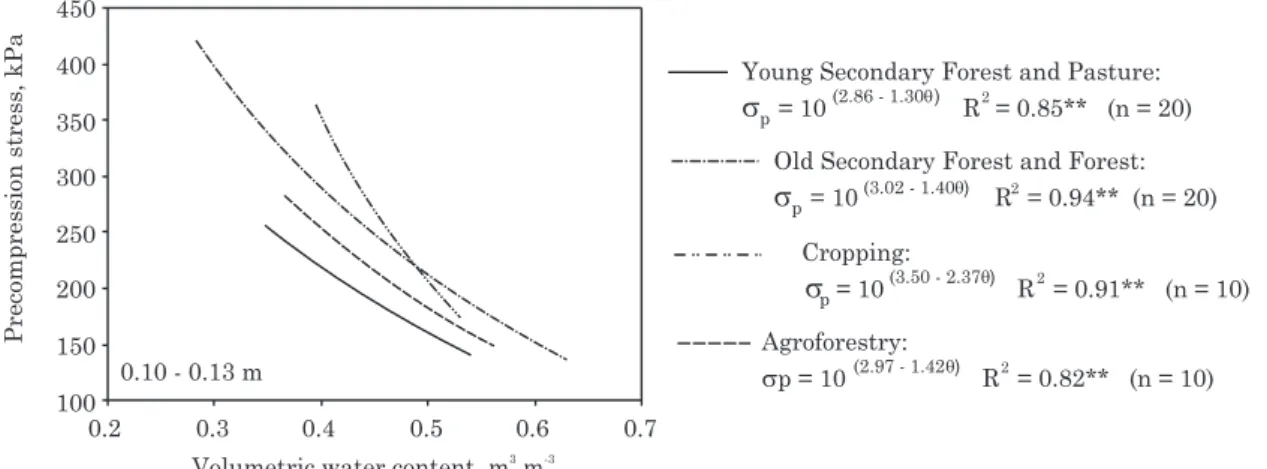
For the 0.10-0.13 m depth, the load bearing capacity models for young secondary forest and pasture were not different. Those of the old secondary forest and forest land use systems were also not different (Table 2). Therefore the respective data were of the land use systems that were not statistically different were fitted with a single equation generating a single load bearing capacity model for these land use systems (Figure 3).
The result showed that at 0.10-0.13 m depth, cropping was found to degrade most the soil structure, while young secondary forest and pasture preserved the soil structure (Figure 3). The high bearing capacity of the cropping land use system is indicative of the Cambisol structure degradation that may have been induced by the hard pan created by tillage implement used in initial land preparation (Arkin & Taylor, 1981). The lower bearing capacity presented by young secondary forest and pasture may be indicative of a Land use system Sand(1) Silt Clay Silt/Clay Textural class BDi(2) PD(1) TP(2)
g kg-1 Mg m-3 m3 m-3
0 - 0.03 m
Young secondary forest 170 520 310 1.68 Silty clay loam 1.09 a 2.44 c 0.55 a
Old secondary forest 300 410 290 1.41 Clay loam 1.15 a 2.50 a 0.54 a
Forest 150 540 310 1.74 Silty clay loam 1.06 a 2.41 d 0.56 a
Pasture 460 320 220 1.45 Loam 1.04 a 2.44 c 0.57 a
Cropping 270 250 480 0.52 Clay 1.02 a 2.44 c 0.58 a
Agroforestry 170 470 360 1.31 Silty clay loam 1.07 a 2.47 b 0.57 a
0.10 - 0.13 m
Young secondary forest 240 370 390 0.95 Clay loam 1.23 a 2.53b 0.51 a
Old secondary forest 180 440 380 1.16 Clay loam 1.26 a 2.53b 0.50 a
Forest 200 450 350 1.29 Clay loam 1.23 a 2.53b 0.51 a
Pasture 160 440 400 1.10 Clay 1.20 a 2.41c 0.50 a
Cropping 160 440 400 1.10 Clay 1.23 a 2.56a 0.52 a
Agroforestry 120 430 450 0.96 Silty clay 1.27 a 2.41c 0.47 a
0.20 - 0.23 m
Young secondary forest 160 470 370 1.27 Silty clay loam 1.30 a 2.50 c 0.48 a
Old secondary forest 160 410 430 0.95 Clay 1.23 a 2.56 b 0.52 a
Forest 180 380 440 0.86 Clay 1.28 a 2.60 a 0.51 a
Pasture 320 370 310 1.19 Clay loam 1.26 a 2.50 c 0.50 a
Cropping 80 440 480 0.92 Silty clay 1.28 a 2.60 a 0.51 a
Agroforestry 150 330 520 0.63 Clay 1.24 a 2.50 c 0.50 a
Table 1. Particle size distribution, silt/clay ratio, textural classes and physical characteristics of the Cambisol samples at three depths under different land use systems
(1) and (2):Average of three and 10 replications, respectively, BDi: Initial bulk density; PD: particle density; TP: total porosity.
Average in columns and the same depth with the same letter did not differ by Scott-Knott at 5 %.
Preconsolidation Pressure
Secondary Compression curve
(Elastic Deformation)
Virgin Compression Curve (Plastic Deformation)
Log Applied Pressure
Bulk Sensity
Land use system Homogeneity Intercept “a” Slope “b” 0 - 0.03 m
Old secondary forest x cropping H ns ns
Old secondary forest and cropping x forest H ns ns
Old secondary forest, cropping and forest x young secondary forest H * * *
Old secondary forest, cropping and forest x agroforestry H * * * *
Old secondary forest, cropping and forest x pasture H * * * *
Young secondary forest x agroforestry H ns ns
Young secondary forest and agroforestry x pasture H * * ns
Young secondary forest and agroforestry x old secondary forest, cropping and forest H * * * * 0.10 - 0.30 m
Young secondary forest x pasture H ns ns
Young secondary forest and pasture x agroforestry H * ns
Young secondary forest and pasture x old secondary forest H * * ns
Young secondary forest and pasture x forest H * * ns
Young secondary forest and pasture x cropping H * * * *
Old secondary forest x forest H ns ns
Young secondary forest and pasture x old secondary forest and forest H * * ns
Old secondary forest and forest x cropping H ns * *
Old secondary forest and forest x agroforestry H * * ns
Cropping x agroforestry H * * * *
0.20 - 0.23 m
Forest x pasture H ns ns
Forest and pasture x old secondary forest H * * * *
Forest and pasture x cropping H ns * *
Forest and pasture x young secondary forest H * * * *
Forest and pasture x agroforestry H * * * *
Young secondary forest x old secondary forest H * * * *
Old secondary forest x cropping H * * * *
Old secondary forest x agroforestry H * * ns
Young secondary forest x cropping H ns * *
Young secondary forest x agroforestry H ns * *
Cropping x agroforestry H ns * *
Table 2. Comparison of the load bearing capacity models(1) [σσσσσp = 10(a + bθθθθθ)] of a Cambisol samples for different
land use systems at 0 - 0.03, 0.10 - 0.13 and 0.20 - 0.23 m depths
(1)According described in Snedecor & Cochran (1989). H: Homogeneous, *and **: F test significant at 5 and 1 % level, respectively;
ns: not significant.
Volumetric water content, m m3 -3
Precompression stress, kPa
0.3 0.4 0.5 0.6 0.7 50
100 150 200 250 300 350 400 450
0 - 0.03 m
Pasture:
s p= 10
(2.84 - 0.91q) R2
= 0.83** (n = 10)
Old Secundary Forest, Cropping and Forest
s p= 10
(3.43 - 2.38q) R2
= 0.86** (n = 30)
Young Secondary Forest and Agroforestry
s p= 10
(2.77 - 0.88q) R2
= 0.81** (n = 20)
recovery of the Cambisol structure due to formation of biopores and organic matter incorporation from decomposing roots associated with these land use systems (Muller et al., 2001, 2004).
A comparison of the precompression stress data for the various land use systems at 0.20-0.23 m depth indicated that the load bearing capacity models for forest and pasture land use systems were not different (Table 2). Thus, a representative load bearing capacity model was generated for these mix of land use systems (Figure 4).
It was observed that at 0.20-0.23 m depth, the old secondary forest land use system degraded most the Cambisol structure, while the young secondary forest, cropping and agroforestry systems preserved the soil structure. The observed degradation in this layer by the old secondary forest may be related to the natural consolidation of the Cambisol structure associated with compression of the soil by thick roots that is trying to occupy the spaces previously occupied by air and water when the soil was deforested (Arkin & Taylor, 1981; Araújo et al., 2004). It was observed that the extent of
degradation of the soil is related to the stage of regeneration of the secondary forest.
CONCLUSIONS
1. The results of the bulk density and total porosity of the soil samples were not adequate to quantify structural degradation in Cambisol.
2. Using the forest topsoil level (0-0.03 m) as a reference, it was observed that pasture land use system was most severe in the degradation of the soil structure while the structure were most preserved under old secondary forest, cropping system and forest.
3. At the subsoil level (0.10-0.13 m depth), the soil structure was most degraded in the cropping land use system while it was most preserved in young secondary forest and pasture.
4. At the 0.20-0.23 m depth, soil structure degradation was most severe in the old secondary forest
Figure 3. Load bearing capacity models for a Cambisol at 0.10 - 0.13 m depth under different land use systems.
Figure 4. Load bearing capacity models for a Cambisol at 0.20 - 0.23 m depth under different land use systems.
Volumetric water content, m m3 -3
Precompression stress, kPa
0.2 0.3 0.4 0.5 0.6 0.7
100 150 200 250 300 350 400 450
0.10 - 0.13 m
Young Secondary Forest and Pasture:
s p= 10
(2.86 - 1.30q)
R2= 0.85** (n = 20)
Old Secondary Forest and Forest:
s p= 10
(3.02 - 1.40q) R2
= 0.94** (n = 20)
Cropping:
s p= 10
(3.50 - 2.37q)
R2= 0.91** (n = 10)
Agroforestry:
sp = 10(2.97 - 1.42q) R2= 0.82** (n = 10)
Volumetric water content, m m3 -3
Precompression stress, kPa
0.3 0.4 0.5 0.6 0.7
50 100 150 200 250 300 350 400
0.20 - 0.23 m
Young Secondary Forest:
s
p= 10
(3.00 - 1.40 )q
R2= 0.87** (n = 10)
Old Secondary Forest:
sp= 10(2.78 - 0.75q) R2= 0.71** (n = 10) Forest and Pasture:
sp= 10(2.90 - 1.12q) R2= 0.87** (n = 20) Cropping:
sp= 10(3.39 - 2.13q)
R2= 0.93** (n = 10)
Agroforestry:
sp= 10(2.65 - 0.70q) R2
system and well preserved in young secondary forest, cropping and agroforestry.
LITERATURE CITED
ABID, M. & LAL, R. Tillage and drainage impact on soil quality I: Aggregate stability, carbon and nitrogen pools. Soil Tillage Res., 100:89-98, 2008.
AJAYI, A.E.; DIAS JUNIOR, M.S.; CURI, N.; OKUNOLA, A.; SOUZA, T.T. & PIRES, B.S. Assessment of vulnerability of Oxisols to compaction in the Cerrado region Brazil. Pedosphere, 20:252-260, 2010.
AJAYI, A.E.; DIAS JUNIOR, M.S.; CURI, N. & OLUFAYO, A.A. Soil color as simple indicator of load bearing capacity in Brazilian Oxisols. J. Ind. Soc. Soil Sci., 59:14-21, 2011. ARAUJO JUNIOR, C.F.; DIAS JUNIOR, M.S.; GUIMARÃES, P.T.G. & PIRES, B.S. Resistência à compactação de um Latossolo cultivado com cafeeiro, sob diferentes sistemas de manejo de plantas invasoras. R. Bras. Ci. Solo, 32:23-21, 2008.
ARAUJO JUNIOR, C.F.; DIAS JUNIOR, M.S.; GUIMARÃES, P.T.G. & ALCÂNTARA, E.N. Capacidade de suporte de carga e umidade crítica de um Latossolo induzida por diferentes manejos. R. Bras. Ci. Solo, 35:115-131, 2011. ARAÚJO, E.A.; LANI, J.L.; AMARAL, E.F. & GUERRA, A.
Uso da terra e propriedades físicas e químicas de Argissolo Amarelo distrófico na Amazônia Ocidental. R. Bras. Ci. Solo, 28:1-8, 2004.
ARKIN, G.F. & TAYLOR, H.M. Modifying the root environment to reduce crop stress. 3.ed. St. Joseph, American Society of Agricultural Engineers, 1981. 407p.
ARVIDSSON, J. & KELLER, T. Soil precompression stress. I. A survey of Swedish arable soils. Soil Tillage Res., 77:85-95, 2004.
ARVIDSSON, J. Subsoil compaction caused by heavy sugar beet harvesters in southern Sweden I. Soil physical properties and crop yield in six field experiments. Soil Tillage Res., 60:67-78, 2001.
BLAKE, G.R. & HARTGE, K.H. Bulk density. In: KLUTE, C., ed. Methods of soil analysis. Physical and mineralogical methods. 2.ed. Madison, American Society Agronomy, 1986a. Part 1. p.363-375. (Agronomy Monograph, 9). BLAKE, G.R. & HARTGE, K.H. Particle density. In: KLUTE,
A., ed. Methods of soil analysis. Physical and mineralogical methods. 2.ed. Madison, American Society Agronomy, 1986b. Part 1. p.377-381. (Agronomy Monograph, 9). BOWLES, J.E. Engineering properties of soils and their
measurements. 3.ed. New York, McGraw Hill, 1986. 218p. COELHO, M.R.; FIDALGO, E.C.C.; ARAÚJO, F.O.; SANTOS, H.G.; SANTOS, M.L.M. & PÉREZ, D.V. Solos das áreas-piloto do Projeto GEF BIOS (Conservation and sustainable management of below-ground biodiversity: Phase I), Município de Benjamin Constant, Estado do Amazonas. Rio de Janeiro, Embrapa Solos, 2005. 158p. (Boletim de Pesquisa).
CORREA, J.C. & REICHARDT, K. Efeito do tempo de uso das pastagens sobre as propriedades de um Latossolo Amarelo da Amazônia Central. Pesq. Agropec. Bras., 30:107-114, 1995.
DAY, P.R. Particle fractionation and particle size analysis. In: KLUTE, C. A., ed. Methods of soil analysis. Physical and mineralogical methods. Madison, American Society Agronomy, 1986. Part 1. p.545-567. (Agronomy Monograph, 9).
DIAS JUNIOR, M.S. & PIERCE, F.J. A simple procedure for estimating precompression stress from soil compression curves. Soil Technol., 8:139-151, 1995.
DIAS JUNIOR, M.S. & PIERCE, F.J. Revisão de literatura: O processo de compactação do solo e sua modelagem. R. Bras. Ci. Solo, 20:175-192, 1996.
DIAS JUNIOR, M.S.; FONSECA, S.; ARAUJO JUNIOR, C.F. & SILVA, A.R. Soil compaction due to forest harvest operations. Pesq. Agropec. Bras., 42:257-264, 2007. DIAS JUNIOR, M.S.; SILVA, S.R.; SANTOS, N.S. & ARAUJO
JUNIOR, C.F. Assessment of the soil compaction of two Ultisols caused by logging operations. R. Bras. Ci. Solo, 32:2245-2253, 2008.
EMPRESA BRASILEIRA DE PESQUISA AGROPECUÁRIA -EMBRAPA. Centro Nacional de Pesquisas de Solos. Sistema brasileiro de classificação de solos. 2.ed. Rio de Janeiro, 2006. 306p.
FIDALGO, E.C.; COELHO, M.R.; ARAÚJO, F.O.; MOREIRA, F.M.S.; SANTOS, H.G.; SANTOS, M.L.M. & HUISING, J. Levantamento do uso e cobertura da terra de seis áreas relacionadas ao projeto “Conservation and sustainable management of below-ground biodiversity: Phase 1”, município de Bejanmin Constant, (AM) (Land use and land cover survey in benchmark area of CSM-BGBD/ BiosBrasil Project: Phase 1, Benjamin Constant, Embrapa Solos, 2005. (Boletim de Pesquisa e Desenvolvimento, 71)
FIGUEIREDO, G.C.; SILVA, A.P.; TORMENA, C.A.; GIAROLA, N.F.B.; MORAES, S.O. & ALMEIDA, B.G. Desenvolvimento de um consolidômetro pneumático: Modelagem da compactação, penetrometria e resistência tênsil de agregadosde solo. R. Bras. Ci. Solo, 35:389-402, 2011.
GLAB, T. & KULIG, B. Effect of mulch and tillage system on soil porosity under wheat (Triticum aestivum). Soil Tillage Res., 99:169-178, 2008.
GYSI, M. Compaction of a Eutric Cambisol under heavy wheel traffic Switzerland: Field data and a critical state soil mechanics model approach. Soil Tillage Res., 61:133-142, 2001.
ISHAQ, M.; IBRAHIM, M.; HASSAN, A.; SAEED, M. & LAL, R. Subsoil compaction effects on croppings in Punjab, Pakistan: II. Root growth and nutrient uptake of wheat and sorghum. Soil Tillage Res., 60:153-161, 2001. JONES, R.J.A.; SPOOR, G. & THOMASSON, A.J. Vulnerability
KÄMPF, N. & CURI, N. Formação e evolução do solo (pedogênese). In: KER, J.C.; CURI, N.; SCHAEFER, C.E.R. & TORRADO, P.V., eds. Pedologia: Fundamentos. Viçosa, MG, Sociedade Brasileira de Ciência do Solo, 2012. p.207-302.
LIPIEC, J.; KUŒ, J.; SLOWIÑSKA-JURKIEWICZ, A. & NOSALEWICZ, A. Soil porosity and water infiltration as influenced by tillage methods. Soil Tillage Res., 89:210-220, 2006.
MARTINS, P.C.C. Avaliação da sustentabilidade da estrutura de um Cambissolo sob diferentes sistemas de uso da terra na Amazônia Ocidental. Lavras, Universidade Federal de Lavras, 2009. 44p. (Tese de Mestrado)
MOSADDEGHI, M.R.; HEMMAT, A.; HAJABBASI, M.A. & ALEXANDROU, A. Pre-compression stress and its relation with the physical and mechanical properties of a structurally unstable soil in central Iran. Soil Tillage Res., 70:53-64, 2003.
MULLER, M.M.L.; GUIMARÃES, M.F.; DESJARDINS, T. & MITJA, D. The relationship between pasture degradation and soil properties in the Brazilian Amazon: A case study. Agric. Ecosyst. Environ., 103:279-288, 2004.
MULLER, M.M.L.; GUIMARÃES, M.F.; DESJARDINS, T. & MARTINS, P.F.S. Degradação de pastagens na Região Amazônica: Propriedades físicas do solo e crescimento de raízes. Pesq. Agropec. Bras., 36:1409-1418, 2001. PACHECO, E.P. & CANTALICE, J.R.B. Compressibilidade,
resistência a penetração e intervalo hídrico ótimo de um Argissolo Amarelo cultivado com cana-de-açúcar nos tabuleiros costeiros de Alagoas. R. Bras. Ci. Solo, 35:403-415, 2011.
PENG, X.H.; HORN, R.; ZHANG, B. & ZHAOA, Q.G. Mechanisms of soil vulnerability to compaction of homogenized and recompacted Ultisols. Soil Tillage Res., 76:125-137, 2004.
SEVERIANO, E.C.; OLIVEIRA, G.C.; CURI, N. & DIAS JUNIOR, M.S. Potencial de uso e qualidade estrutural de dois solos cultivados com cana-de-açúcar em Goianésia. R. Bras. Ci. Solo, 33:159-168, 2009.
SEVERIANO, E.C.; OLIVEIRA, G.C.; DIAS JUNIOR, M.S.; OLIVEIRA, L.F.C. & CASTRO, M.B. Pressão de preconsolidação e intervalo hídrico ótimo como indicadores de alterações estruturais de um Latossolo e de um Cambissolo sob cana-de-açúcar. R. Bras. Ci. Solo, 32:1419-1427, 2008. SEVERIANO, E.C.; OLIVEIRA, G.C.; DIAS JUNIOR, M.S.;
CASTRO, M.B.; OLIVEIRA, L.F.C. & COSTA, K.A.P. Compactação de solos cultivados com canadeaçúcar: I -Modelagem e quantificação da compactação adicional após as operações de colheita. Eng. Agríc., 30:404-413, 2010a. SEVERIANO, E.C.; OLIVEIRA, G.C.; DIAS JUNIOR, M.S.; CASTRO, M.B.; OLIVEIRA, L.F.C. & COSTA, K.A.P. Compactação de solos cultivados com canadeaçúcar: II -Quantificação das restrições às funções edáficas do solo em decorrência da compactação prejudicial. Eng. Agríc., 30:414-423, 2010b.
SIGMA PLOT. Scientific Graphing Software: Versão 8.0. San Rafael, Jandel Corporation, 2002.
SILVA, A.R.; DIAS JUNIOR, M.S. & LEITE, F.P. Camada de resíduo e pressão de preconsolidação de dois Latossolos. Pesq. Agropec. Bras., 42:89-93, 2007.
SILVA, A.R.; LIMA, J.M. & DIAS JUNIOR, M.S. Efeito da adsorção de fosfato em parâmetros físicos e na compressibilidade de solos tropicais. R. Bras. Ci. Solo, 23:219-226, 1999.
SILVA, S.R.; BARROS, N.F. & COSTA, L.M. Atributos físicos de dois Latossolos afetados pela compactação do solo. R. Bras. Ci. Solo, 10:842-847, 2006.
SNEDECOR, G.W. & COCHRAN, W.G. Statistical methods. 8.ed. Ames, Iowa State University Press, 1989. 503p. SPOOR, G.; TIJINK, F.G.J. & WEISSKOPF, P. Subsoil
compaction: Risk, avoidance, identification and alleviation. Soil Tillage Res., 73:175-182, 2003.
TAYLOR, D.W. Fundamentals of soil mechanics. New York, John Wiley & Sons, 1948. 700p.
![Table 2. Comparison of the load bearing capacity models (1) [ σ σ σ σ σ p = 10 (a + bθ θ θ θ) θ ] of a Cambisol samples for different land use systems at 0 - 0.03, 0.10 - 0.13 and 0.20 - 0.23 m depths](https://thumb-eu.123doks.com/thumbv2/123dok_br/15893374.669743/6.892.91.803.150.760/table-comparison-bearing-capacity-cambisol-samples-different-systems.webp)