Vol.58, n.1: pp. 96-102, January-February 2015 http://dx.doi.org/10.1590/S1516-8913201502658
ISSN 1516-8913 Printed in Brazil
BRAZILIAN ARCHIVES OF BIOLOGY AND TECHNOLOGY
A N I N T E R N A T I O N A L J O U R N A L
Extraction of Indigo from Some Isatis species and Dyeing
Standardization Using Low-technology Methods
Nazan Comlekcioglu
1*, Lale Efe
2and Sengul Karaman
11Biology Department; Kahramanmaras Sutcu Imam University; Kahramanmaras – Turkey. 2Crop Fields
Deparment; Kahramanmaras Sutcu Imam University; Kahramanmaras - Turkey
ABSTRACT
Fresh leaves of four Isatis species culture form of I. tinctoria L and wild forms of I. buschiana Schischkin, I. candolleana Boiss. (endemic) and I. tinctoria L. subsp. corymbosa. (Boiss.) were used for indigo production. Dyes were extracted by fermentation and hot water application. The extracted dyes were optimized with different pH and reducing agents. Results showed that the dye from hot water application produced the desired dying quality at pH 11. Reducing agent concentrations had no significant effect on color quality. Dark blue and blue colors were obtained from I. tinctoria and I. candolleana extracts although I. tinctoria subsp. corymbosa and I. buschiana produced mostly yellow-gray colors. Light, dry and wet rubbing fastness values varied between 3 and 3/4 while washing fastness was between 2 and 4/5. The highest indigo amounts were determined spectrophotometrically as 4.19 mg/g and 2.53 mg/g in I. tinctoria and I. candolleana, respectively. Results also showed that harvesting season was important for indigo production and the highest indigo amount was observed in mid-June.
Key words:Isatis spp., woad,indigo, natural dye, fermentation, fastness, spectrophotometry
*Author for correspondence: noktem @ksu.edu.tr
INTRODUCTION
Most of the dyes used in textile industries are synthetic (Gilbert and Cook 2001) but there has been an increasing interest about natural dyes in fabric coloration. This is because of the stringent environmental standards imposed by many countries in a response to the toxic and allergic reactions associated with synthetic dyes (Kamel et al. 2005). Among the naturals dyes, indigo has been obtained from a variety of plant sources such
as Indigofera tinctoria, Polygonum tinctorium,
Nereum tinctorium and Isatis tinctoria (Gilbert
and Cook 2001; Tozzi et al. 2005). However, once
its chemical synthesis from aniline was
established, it has been largely produced by chemical industry and almost superseded natural
indigo (Bechtold et al. 2002; Puchalska et al.
2004). Natural indigo is produced by fermenting the leaves of indigo bearing plants. During the fermentation, indican in the leaves is hydrolized to form indoxyl and glucose by the action of
endogenous β-glucosidase and subsequently
Isatis tinctoria L. (woad, Brassicaceae), which is an ancient European dye and medicinal plant, has a long and well-documented history (Brattström et al. 2010; Han et al. 2011). Successful cultivation
of I. tinctoria in mountain and marginal areas
offers an alternative to traditionally grown crops
(Spataro et al. 2007); therefore, I. tinctoria could
be an important indigo source for natural dyeing applications. There are several reports on the
extraction of indigo from I. tinctoria leaves
(Balfour-Paul 1998; Stoker et al. 1998; Gilbert et al. 2004; Tozzi et al. 2005; Sales et al. 2006; Angelini et al. 2007; Rocha et al. 2011). Simple extraction method is required for an effective and ecological production of natural indigo (Bechtold et al. 2002). Detailed information is needed for a basic optimized and standardised extraction of
indigo precursors and dye formation. The dye
yield is usually low with traditional fermentation method.
The aim of this study was to develop an efficient and eco-friendly method for coloring textiles by using natural indigo and to determine the amount of indigo potentials in the plants. Hence, four
different species of Isatis genus were cultivated
and rosette leaves of the plants used as raw
materials for extraction. Natural dyestuff
extractions and seasonal indigo production from culture and native species of Isatis were tested and dyeing potentials were compared.
MATERIALS AND METHODS
Material
Fresh leaves of four Isatis species (culture form of
I. tinctoria and wild forms of I. buschiana, I.
candolleana (endemic) and I. tinctoria subsp.
corymbosa) were used for indigo production. The
seeds of I. tinctoria were provided from
IPK-Institute for Plant Genetics and Crop Plant Research, Gatersleben, Germany and were grown
in Kahramanmaras/Turkey. I. candolleana, I.
buschiana, and I. tinctoria subsp. corymbosa were
biennial, while I. tinctoria was annual in trial
field. The other wild species were collected from
South-East Mediterranean Region of Turkey. All of the specimens were identified according to the Flora of Turkey (Davis 1965). Cotton yarn was used as cellulose material for the dyeing experiments. Raw cotton yarn was soaked in 500 mL tap water for 1 h before the dyeing treatments.
Extraction of Indigo
Rosette leaves were harvested from the cultivated plants by cutting 10 cm from the ground they reached about 30 cm in the end of May and early June. Leaves (100 g) were washed and cut into
small pieces of 1 cm2. The dyestuff was then
extracted by using 1000 mL of hot water (60, 70 or 80ºC) or fermentation (24 h). Two different pH (9.0 and 11.0) and four different reducer
(Na2S2O4, Sigma) concentrations (1, 5, 10 and 20
g l-1) were tested in extraction experiments. All the
experiments were repeated three times and mean values were used.
Fermentation Application
Plant materials (100 g) were fermented in 1000 mL water for 24 h in the dark and placed at the room temperature. The extraction liquor was divided into two equal volumes and the pH adjusted to 9.0 and 11.0 using 2 N NaOH (Merck) solution. Extraction liquor was aerated for 1 h by using a compressor to enable complete oxidation of the indigo precursors (Stoker et al. 1998; Chanayath et al. 2002).
Hot Water Application
The extraction was carried out at temperatures of 60, 70 or 80ºC for 10 min. The leaves were removed and the sample was rapidly cooled to 50ºC. Extraction medium was divided into two equal volumes and the pH adjusted to 9.0 and 11.0 with 2 N NaOH solutions. The extract was aerated by using a magnetic stirrer until the blue color development (Stoker et al. 1998; Balfour-Paul 1998).
Reduction Step
The pH adjusted dye solutions were equally
divided into 100 mL volumes and then Na2S2O4
(1, 5, 10 and 20 g L-1) was added for reduction of
indigo. After that the cotton yarns (1 g yarn/100 mL dye solution) were soaked in it and incubated for 60 min at 50ºC in water bath. During the dyeing process, stirring and aeration were performed manually every 15 min for 1 min. Finally, dyed cotton yarns were rinsed with tap water (approx. 500 mL) three times for the removal of excess unbound dyes.
Fastness Tests
Color fastness tests on dyed samples were carried
out using ISO standard methods. The light
ISO/FDIS 105-B02. Then, color fading was evaluated by comparing each sample with
standard blue scale. The washing fastness of the
samples was also tested on the basis of
ISO 105-C06:2010. Dry and wet rubbing fastness of the samples were tested using ISO 105-X12:2001and ISO 105-X16:2001 methods. Shade changes in washing and rubbing fastness were determined using a grey scale (Marks 1–5, 1 = poor, 5 = excellent).
Indigo Extraction and Sample Preparation for Spectrophotometry
Indigo content of leaves was extracted following Stoker et al. (1998) and Sales et al. (2006) with some modifications. The chopped leaves (approx.
1 cm2 in size) were weighed (1.0 g) and placed in
tubes containing 10 mL of distilled water. Then the tubes were immersed in a boiling water bath for 10 min and cooled rapidly in ice bath. The leaf pieces were removed and NaOH solution was added to adjust the pH at 11.0. Samples were then aerated for 30 sec and allowed to stand at room
temperature (20-25oC) for 1 h before acidification
to pH 1.0-2.0 with HCl (Merck). After 30 min, 5.0 mL of ethyl acetate (Merck) was added to 1.0 mL aliquot of sample and the absorbances were
measured at 600 nm. Finally, indigo
concentrations were calculated by using the indigo calibration curve. Calibration curve was prepared by dissolving indigo standard (Sigma) in ethyl acetate (Sales et al. 2006). Experiments were repeated three times and mean values were used.
RESULTS AND DISCUSSION
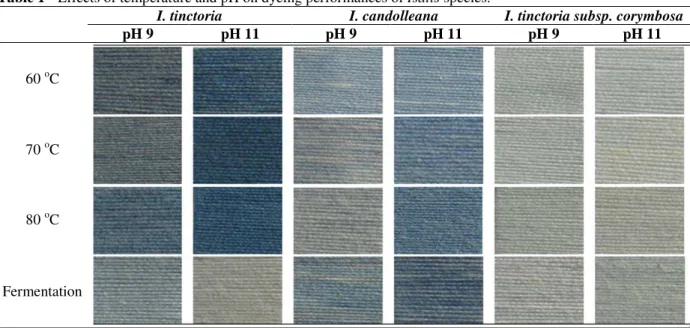
The extraction of dye components from the plant materials was performed with hot water and fermentation without the addition of chemicals or solvents. The results on the effects of pH, fermentation and temperature levels on dyeing
potentials of Isatis species by using 1 g l-1
reducing agent are shown in Table 1. The main
colors obtained from I. tinctoria, I. candolleana
and I. tinctoria subsp. corymbosa were dark blue,
blue and gray-blue, respectively (Table 1).
Table 1 - Effects of temperature and pH on dyeing performances of Isatis species.
I. tinctoria I. candolleana I. tinctoria subsp. corymbosa
pH 9 pH 11 pH 9 pH 11 pH 9 pH 11
60 oC
70 oC
80 oC
Fermentation
No blue color was obtained from I. buschiana,
therefore this plant was not studied in further
experiments. The desired blue colors were
obtained from I. tinctoria in all hot water
extraction treatments at pH 11.0; however, extraction with fermentation failed to give blue color. The success in hot water extraction could possibly be due to leaf epidermal wax melting.
Blue colors were also observed in I. candolleana
extraction at pH 11.0 using both hot water and fermentation. The extraction carried out at the 70
and 80oC give similar blue colors with I. tinctoria
and I. candolleana; therefore, the extractions at
70oC could be favorable for energy saving. Blue
colors obtained from I. tinctoria subsp. corymbosa
difference between these closely related species could be due to their genetical makeup. The production of indigo precursors are affected by genetical differences (Angelini et al. 2007), hence, indigo producing capacity varies among the plants (Spataro et al. 2007). High dyestuff containing plants and easy extraction with water are the desired factors for the selection of dye plant (Bechtold et al. 2003).
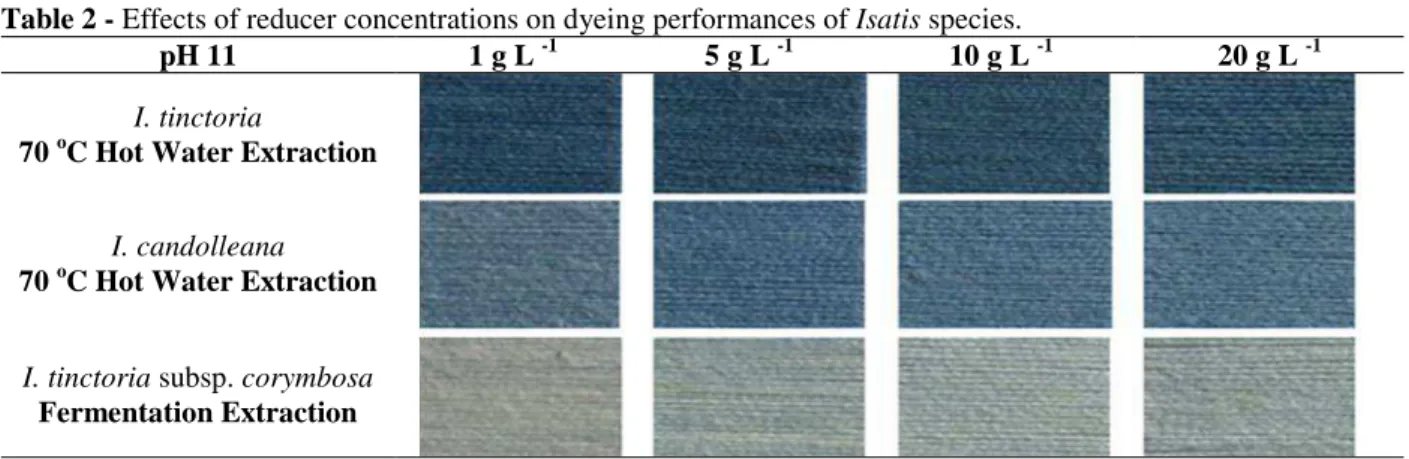
The effects of reducer concentrations in dyeing
were studied at 70oC and pH 11.0. Difference in
color obtained by different reducer concentrations was insignificant (Table 2). Color improvement
was not also observed with increasing
concentration of reducer in I. tinctoria subsp.
corymbosa.
Table 2 - Effects of reducer concentrations on dyeing performances of Isatis species.
pH 11 1 g L -1 5 g L -1 10 g L -1 20 g L -1
I. tinctoria
70 oC Hot Water Extraction
I. candolleana
70 oC Hot Water Extraction
I. tinctoria subsp. corymbosa
Fermentation Extraction
Various shades of blue color were obtained in all
the tested Isatis species, except I. buschiana. The
shades of light blue were much more than
yellow-greenish and were obtained in I. tinctoria subsp.
corymbosa while the most desired blue colors
were obtained from I. tinctoria and I. candolleana.
In caustic-hydrosulphite method, which is widely used to reduce indigo, dyeing vat is generally
prepared in 80 g l-1 concentration. An excess of
reducing agent results in irregular dyeing and increase of ecological damage (Kumbasar et al. 2006). For this reason, the control of pH and reducing agent concentrations are very important and this study represents an environmental friendly process with a small amount of hydrosulphite resulting succesfull dyeings. Hot water extraction method was reported as the most
suitable choice to fulfill the extraction
immediately after the harvest (Bechtold et al. 2002). It was simple and the yield could be obtained in the same day; however, this method required higher energy consumption. Energy consumption is not necessary for extraction with fermentation, but bad odor and overflows are the main problems and extra time is required for better results. However, simple and rapid dyeing process, no intermediate drying steps and one bath dying are the requirements of a technical dyehouse
(Bechtold et al. 2003). Both the techniques studied here met these requirements.
Fastness Properties
The requirements for natural colorants in textile industry are the quality of fastness properties as
well as color appearance in terms of
reproducibility (Kumbasar et al. 2006). Washing
fastness of the samples ranged in 2 to 4/5 for I.
tinctoria; 2/3 to 4/5 for I. candolleana; 3 to 4/5 for
I. tinctoria subsp. corymbosa (Table 3). Poor or insufficient washing fastness could be identified as a limitation for the use of natural dyes extracted
from the different representative sources.
Sufficient dyestuff fixation also can be seen as a good mark for washing fastness bleeding (Bechtold et al. 2006). The dry rubbing fastness
ranged in 3/4 to 4 for I. tinctoria and I.
candolleana; 4/5 for I. tinctoria subsp. corymbosa.
The wet rubbing fastness ranged in 3 to 3/4 for I.
tinctoria and I. candolleana, 3/4 for I. tinctoria
subsp. corymbosa. The light fastness grade 2 or 3
was required as the lowest limit for positive selection; however, values of light fastness could be increased by further investigations to exceed the limit of grade 2-3 (Bechtold et al. 2006). Our results showed that light fastness grade were 3 and
3/4 for I. tinctoria and 3 for I. candolleana while
results presented were at an acceptable light fastness level. The light fastness is also influenced by various factors such as chemical and physical properties of dye, dye concentration, nature of fibers (Cristea and Vilarem 2006; Guinot et al. 2006). Padfield and Landi (1996) also stated that indigo was much more light resistant on wool than that of cotton. In this study, the impurities in dyebath, which was released from raw cotton yarn, could reduce the affinity of dye particules to
cotton yarn, therefore low fastness results could be caused by these impurities.
In the market, the main features of indigo-dyed denim fabrics demand has to meet the low washing fastness, average light fastness and low dry-rubbing resistance (Kumbasar et al. 2006). In this study, acceptable values for light, rubbing and washing fastness were obtained for denim fabrics (Table 3).
Table 3 - Fastness properties of dyed cotton yarn.
I. tinctoria I. candolleana I. tinctoria subsp.
corymbosa
Mat blue Dark blue Light blue Light blue Dark blue Light blue
Light Fastness 3* 3/4 3 3 3 2/3
W
as
h
in
g
F
as
tn
es
s
T
y
p
e
o
f
th
e
re
fe
re
n
ce
f
ab
ri
c acetate 2/3 2/3 3 3/4 3 3/4
cotton 3 3 4 3/4 3/4 4
nylon 2 2 2/3 3 2/3 3
polyester 4 4 4 4 4 4
acrylic 4 4 4/5 4/5 4/5 4/5
wool 4 4 4 4 4 4/5
Rubbing Fastness
Dry 4 3/4 4 4 3/4 4/5
Wet 3 2/3 3/4 3/4 3 3/4
*Scores for fastness tests: 1- Poor, 2-Weak, 3- Average, 4-Good, 5-Excellent
The Amount of Indigo
Seasonal variations of indigo were determined in
Turkish native Isatis species and compared with I.
tinctoria. Significant differences in indigo
production were found between the species in
growing season. The seasonal change in the
amount of indigo production was determined and indigo extraction was performed between April 1 and August 7 from plant leaves with two-week
interval. Seasonal course of indigo is shown in
Figure 1. Indigo content generally increased from beginning of April until the mid of June, and began to decrease with temperature increase until beginning of July, then remained stable until the middle of August. Rosette plants completed their vegetative development in August. The highest
indigo value was recorded at mid June in I.
tinctoria.
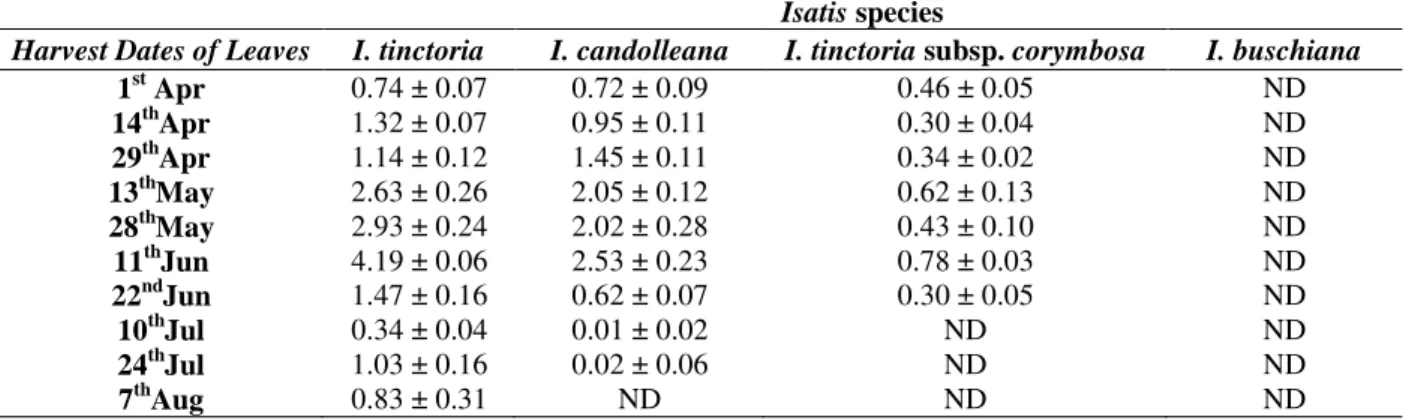
The results of indigo content in Isatis spp. are
given in Table 4. Indigo content were higher in I.
tinctoria and I .candolleana than I. tinctoria subsp.
corymbosa while indigo could not be detected in I.
buschiana. Mean indigo content measured in fresh
leaves of I. tinctoria and I. candolleana ranged
from 0.34 to 4.19 mg g-1 and 0.01 to 2.53 mg g-1,
respectively. I. tinctoria subsp. corymbosa
produced indigo in a range from 0.3 to
0.78 mg g-1, which was 80% lower than that of I.
tinctoria. These results were also supported with the dyeing experiments (Table 1). Blue colors
obtained from I. candolleana were close to the
colors from I. tinctoria. I. tinctoria subsp.
corymbosa produced lighter blue colors; however,
no blue colors were obtained from I. buschiana.
The analysis showed that indigo reached to its maximum level in mid June, therefore mid-June could be the best time to harvest.
Table 4 - Seasonal variation of indigo content in Isatis spp (mg g-1). The values represent the mean ± standard deviation.
Isatis species
Harvest Dates of Leaves I. tinctoria I. candolleana I. tinctoria subsp. corymbosa I. buschiana
1st Apr 0.74 ± 0.07 0.72 ± 0.09 0.46 ± 0.05 ND
14thApr 1.32 ± 0.07 0.95 ± 0.11 0.30 ± 0.04 ND
29thApr 1.14 ± 0.12 1.45 ± 0.11 0.34 ± 0.02 ND
13thMay 2.63 ± 0.26 2.05 ± 0.12 0.62 ± 0.13 ND
28thMay 2.93 ± 0.24 2.02 ± 0.28 0.43 ± 0.10 ND
11thJun 4.19 ± 0.06 2.53 ± 0.23 0.78 ± 0.03 ND
22ndJun 1.47 ± 0.16 0.62 ± 0.07 0.30 ± 0.05 ND
10thJul 0.34 ± 0.04 0.01 ± 0.02 ND ND
24thJul 1.03 ± 0.16 0.02 ± 0.06 ND ND
7thAug 0.83 ± 0.31 ND ND ND
ND: Not detected
This study presented an indigo content between
0.34 to 4.19 mg g-1, which was confirmed by
Gilbert et al. (2004) and Angelini et al. (2007)’s previous observations. Angelini et al. (2007) reported that the harvest time had significant effect on leaf yield and indigo amount. They also stated that the genetical factor was another important criterion that affected the production of indigo
precursors. Therefore, in this study, different Isatis
species produced different indigo yield as a result of their genetic makeup. High temperature, light intensity and inadequate rainfall could limit the plant growth and indigo amount (Stoker et al. 1998; Sales et al. 2006). Therefore, the decrease in indigo in late-June could be due to the climatic changes.
CONCLUSIONS
Following cultivation of the plant material, a simple procedure for the extraction of indigo precursors was investigated in terms of crop and dye quality, aiming to bring some contribution to
the knowledge of Turkish native Isatis species as a
new potential dyeing plant. The study focused on the determination of indigo production potentials and effect of harvest times for indigo contents in
Isatis spp. Results confirmed that indigo yield and
quantity depended on the genetic factors, harvest time and extraction conditions. Extracted dye from
I. candolleana was comparable to I. tinctoria.
Thus, I. candolleana could be a promising plant
for indigo dyeing. However, I. tinctoria subsp.
corymbosa and I. buschiana were not suitable for this purpose.
ACKNOWLEDGEMENT
We thank Kahramanmaras Sutcu Imam University for funding of this study (Grant no: 2009/1-1D). Valuable helps of Dr. Ashabil AYGAN are also gratefully acknowledged.
REFERENCES
Angelini LG, Tozzi S, Nassi N. Differences in leaf yield and indigo precursors production in woad (Isatis tinctoria L.) and Chinese woad (Isatis indigotica Fort) genotypes. Field Crop Res. 2007; 101: 285-295.
Balfour-Paul J. Indigo. London: British Museum Pres, 1998.
Bechtold T, Turcanu A, Geissler S, Ganglberger E. Process balance and product quality in the production of natural indigo from Polygonum tinctorium Ait. Applying low technology methods, Bioresource Technol. 2002; 81: 171-177.
Bechtold T, Turcanu A, Ganglberger E, Geissler S. Natural dyes in modern textile dyehouses-how to combine experiences of two centuries to meet the demands of the future? J Clean Prod. 2003; 11: 499-509.
Bechtold T, Mussak R, Mahmud-Ali A, Ganglberger E, Geissler S. Extraction of natural dyes for textile dyeing from coloured plant wastes released from the food and beverage industry. J Sci Food Agr. 2006; 86: 233-242.
Chanayath N, Lhieochaiphant S, Phutrakul S. Pigment Extraction Techniques from the Leaves of Indigofera tinctoria Linn. and Baphicacanthus cusia Brem. and Chemical Structure Analysis of Their Major Components. CMU J. 2002; 1: 149-160.
Cristea D, Vilarem G. Improving light fastness of natural dyes on cotton yarn. Dyes Pigments. 2006; 70: 238-245.
Davis PH. Flora of Turkey and The East Aegean Islands, edited by PH Davis, Edinburgh at the University Press, Volume I. 1965, 287-307.
Gilbert GK, Cooke DT. Dyes from plants: Past usage, present understanding and potential. Plant Growth Regulation. 2001; 4: 57-69.
Gilbert KG, Maule HG, Rudolph B, Lewis M, Vandenburg H, Sales E, et al. Quantitative analysis of indigo and indigo precursors in leaves of lsatis spp. and Polygonum tinctorium. Biotech Prog. 2004; 20: 1289-1292.
Guinot P, Roge A, Gargadennec A, Garcia M, Dupont D, Lecoeur E, et al. Dyeing plants screening: an approach to combine past heritage and present development. Color Technol. 2006; 122: 93-101. Han J, Jiang X, Zhang L. Optimisation of extraction
conditions for polysaccharides from the roots of Isatis tinctoria L. by response surface methodology and their in vitro free radicals scavenging activities and effects on IL-4 and IFN-γ mRNA expression in chicken lymphocytes. Carbohydrate Polymers. 2011; 86(3): 1320-1326.
ISO 105-C06:2010 Textiles - Tests for colour fastness. Part C06: Colour fastness to domestic and commercial laundering
ISO/DIS 105-X12 Textiles - Tests for colour fastness. Part X12: Colour fastness to rubbing.
ISO/DIS 105-X16 Textiles - Tests for colour fastness. Part X16: Colour fastness to rubbing, small areas. ISO/FDIS 105-B02 Textiles - Tests for colour fastness.
Part B02: Colour fastness to artificial light: Xenon arc fading lamp test.
Kamel MM, El-Shishtawy RM, Yussef BM, Mashaly H. Ultrasonic assisted dyeing III. Dyeing of wool with lac as a natural dye. Dyes and Pigments. 2005; 65: 103-110.
Kumbasar EPA, Aydın H, Ondogan Z, Ozcelik M, Ondogan EN. Automatic indigo measurement system as part of a dosing system for indigo dyeing. Fibres Text East Eur. 2006; 14: 86-90.
Padfield T, Landi S. The light-fastness of the natural dyes. Stud Conserv. 1996; 4: 181-196.
Puchalska M, Polec-Pawlak K, Zadrozpna I, Hryszko H, Jarosz M. Identification of indigoid dyes in natural organic pigments used in historical art objects by high-performance liquid chromatography coupled to electrospray ionization mass spectrometry. J Mass Spectrom. 2004; 39:1441-1449.
Rocha L, Carvalho C, Martins S, Braga F, Carnide V. Morpho-agronomic characterization and variation of indigo precursors in woad (Isatis tinctoria L.) accessions. Plant Genetic Resources. 2011; 9(02): 206-209.
Sales E, Kanhonou R, Baixauli C, Giner A, Cooke D, Gilbert K, Arrilaga I, Segura J, Ros R. Sowing date, transplanting, plant density and nitrogen fertilization affect indigo production from Isatis species in a Mediterranean region of Spain. Indust Crop Prod. 2006; 23: 29-39.
Song J, Imanaka H, Imamura K, Kajitani K, Nakanishi K. Development of a highly efficient indigo dyeing method using indican with an immobilized β -glucosidase from Aspergillus niger. J Biosci Bioeng. 2010; 110: 281-287.
Spataro G, Paola T, Valeria N. Genetic Variation and Population Structure in a Eurasian Collection of Isatis tinctoria L. Genetic Resources Crop Evol. 2007; 54 (3): 573-584.
Stoker KG, Cooke DT, Hill DJ. An improved method for the large-scale processing of woad (Isatis tinctoria) for possible commercial production of woad indigo. J Agr Eng Res. 1998; 71: 315-320. Tozzi S, Lercari B, Angelini LG. Light Quality
Influences Indigo Precursors Production and Seed Germination in I.tinctoria L. and I. indigotica Fort. Photochem Photobiol. 2005; 81: 914-919.