UNIVERSIDADE DA BEIRA INTERIOR
Engenharia
Airframe Assembly, Systems Integration and Flight
Testing of a Long Endurance Electric UAV
Afonso Santos Rodrigues
Dissertação para obtenção do Grau de Mestre em
Engenharia Aeronáutica
(ciclo de estudos integrados)
Orientador: Prof. Doutor Pedro Vieira Gamboa
Intentionally left blank
To Adelino and Elsa, my parents.
“Once you have tasted flight, you will forever walk the Earth with your eyes turned skyward, for there you have been and there you will always long to return.”
Acknowledgments
This thesis is the result of 9 months I spent as a student in the Structures and Vibrations Laboratory of Prof. Pedro Gamboa in the Department of Aerospace Sciences at University of Beira Interior. This period was a very interesting and rewarding time, with many collaborations, and it was a pleasure to work in such environment.
First, I would like to thank my thesis advisor Doctor Pedro Gamboa of the Engineering Faculty at University of Beira Interior. The door to Prof. P. Gamboa office was always open whenever I ran into a difficult step or had a question about my work or writing. He consistently allowed this thesis to be my own work, but steered me in the right direction whenever he thought I needed it.
This thesis would not have been possible without the great help of Eng. Pedro Santos, and Eng. Alexandre Duarte. I would like to thank them very much because during the entire duration of this project, they taught me thousands of things in the domain of model aircraft.
I would also like to thank in particular my fellow Pedro Moutinho for conducting the majority of the LEEUAV flight tests performed and also for helping me throughout this work.
Finally, I must express my very profound gratitude to my parents and to my girlfriend for providing me with unfailing support and continuous encouragement throughout my years of study and through the process of researching and writing this thesis. This accomplishment would not have been possible without them. Thank you.
Intentionally left blank
Resumo
A necessidade de adoção de novas técnicas e práticas no ramo da Indústria Aeronáutica é uma consequência do desenvolvimento tecnológico. O presente trabalho aborda o uso de energia solar como principal fonte de energia na aviação, com enfoque num voo de grande autonomia de uma aeronave não tripulada. Esta tese de mestrado surge na sequência de trabalhos anteriores relativos ao LEEUAV, nos quais se efetuou o projeto e construção de uma aeronave não tripulada de grande autonomia. Assim, o principal objetivo deste trabalho é a integração de sistemas, testes de voo e validação de conceitos.
O UAV Solar LEEUAV é um protótipo de 4.5 metros de envergadura e de estrutura ultraleve parcialmente coberto de células fotovoltaicas sendo projetado para cumprir uma missão de voo contínuo de pelo menos 8h no equinócio. O avião de 5.42kg foi testado com sucesso mostrando a concordância com os cálculos teóricos já elaborados. O voo mais longo conseguido foi de 3.13 horas correspondendo a uma distância total percorrida de 96.265 km.
De modo a validar o conceito de aeronavegabilidade do LEEUAV foram efetuados vários voos de teste e recolhidos dados de voo (pressão estática e dinâmica, temperatura do ar, velocidade no solo e ângulo de arfagem) para posterior análise, utilizando um controlador de voo com múltiplos sensores a bordo. A análise dos resultados obtidos permitiu precisar o desempenho geral da aeronave, os principais defeitos, concordância com os resultados teóricos assim como determinar os valores reais dos coeficientes aerodinâmicos (𝐶𝐿, 𝐶𝐷) através de um algoritmo de leitura e processamento de dados de voo, em Software MATLAB.
Por fim, são referidas algumas sugestões para o desenvolvimento de novos trabalhos com o objetivo de tornar O LEEUAV num veículo aéreo não tripulado de referência.
Palavra-chave
UAV Solar, Energia Solar, Voo Sustentável, LEEUAV, Indústria Aeronáutica, Células Fotovoltaicas, Propulsão Elétrica, Validação de Conceitos, Desempenho Aerodinâmico.
Intentionally left blank
Abstract
The need to adopt new techniques and practices in the Aerospace Industry branch is a consequence of technological development. The present work aims to study the use of solar power as a main energy source in the aviation, in this case for a flight of long endurance of an unmanned air vehicle. This master thesis follows on previous works of the LEEUAV, where it was done the design and construction of a long endurance unmanned aerial system. Thus, the main objective of this work is the systems integration, flight testing and concepts validation.
LEEUAV, a prototype of 4.5 meters’ wingspan and ultralight structure partially covered by solar cells was designed to fulfil a continuous flight mission of at least 8 hours on the equinox. The 5.42Kg remotely piloted aircraft was successfully tested showing the agreement with theoretical calculations already made. The longest flight achieved lasted more than 8.5 hours’ resulting in a total distance travelled of more than 75 km.
In order to validate the airworthiness concept of the LEEUAV several flight tests were performed and their respective data (static and total pressure, air temperature, ground speed and pitch angle) was collected for further analysis, using a flight controller with multiple sensors on board. The results obtained allowed to study the general performance of the aircraft, the main defects, agreement with the theoretical results as well as determine the real values of aerodynamic coefficients (𝐶𝐿, 𝐶𝐷), through a reading and processing flight data algorithm in Software MATLAB.
Finally, some future expectations for upcoming work are suggested in order to make the LEEUAV an Unmanned Aerial Vehicle of reference.
Keywords
Solar UAV, Solar Energy, Sustainable Flight, LEEUAV, Aeronautical Industry, Photovoltaic Cells, Electric Propulsion, Concepts Validation, Aerodynamic Performance.
Contents
Acknowledgments ... vii
Resumo ... ix
Abstract... xi
Contents ... xiii
List of Figures ... xvii
List of Tables ... xix
Nomenclature ... xxi
Acronyms ... xxiii
1 Introduction ... 1
1.1 Motivation and Objectives ... 1
1.2 History of Solar Powered Flight ... 2
1.2.1 Photovoltaic effect and solar cell ... 2
1.2.2 The Combination of Electric Flight and Solar Cells ... 2
1.2.3 Early stages of Solar Aviation ... 3
1.2.4 Manned Solar Flight ... 4
1.2.5 Long Endurance Platforms and Eternal Flight ... 6
1.3 State of the Art ... 8
1.4 Present and Future UAV Applications ... 10
1.5 LEEUAV Project ... 12
1.6 Structure of this Work ... 13
2 Basic Concepts ... 15
2.1 Introduction ... 15
2.2 Main Forces of an Aircraft and Energies ... 15
2.3 Unmanned Aerial Vehicle ... 16
2.4 Wing Aerodynamics ... 18
2.5 Flight Control of an Unmanned Aircraft ... 21
2.6 Electric Propulsion ... 23
2.7 Propeller ... 25
2.8 Solar Cell ... 26
2.8.1 Working Principles ... 26
2.8.2 Solar Irradiance ... 27
2.8.3 Types of Solar Cells ... 28
2.8.4 Efficiency of the solar cells ... 29
2.8.5 Solar cell I-V characteristic curve ... 29
2.9 Energy Storage ... 31
2.9.1 Types of Batteries ... 31
2.9.3 Solar Panel Charge Controller (SCC) ... 34
2.9.4 Maximum Power Point Tracker ... 34
3 Aircraft Description ... 35
3.1 Introduction ... 35
3.2 UAV Final Design and Specifications ... 35
3.3 Materials ... 36
3.4 Fuselage, Wings and Tail Construction ... 36
3.5 Systems of Solar LEEUAV ... 38
4 Wing Tip Modification ... 41
4.1 Introduction ... 41
4.2 Wing Tip Modification Goals and Corrective Actions ... 41
4.3 Possibilities for Practical Procedures ... 42
4.4 Final Wing Tip Modification ... 44
5 UAV Systems Integration ... 47
5.1 Introduction ... 47
5.2 LEEUAV Systems Integration ... 47
5.2.1 Flight Control System ... 47
5.2.2 Navigation System ... 50
5.2.3 Land-Air Communication System ... 53
5.2.4 Propulsion System ... 55
5.2.5 Electrical System ... 57
5.2.6 Solar System ... 59
5.2.7 Integration onto the Wing ... 60
5.3 Ground Control Station ... 61
5.3.1 Flight Control System ... 61
5.3.2 Land-Air Communication System ... 64
5.3.3 Electrical System ... 65
5.3.4 Recording System ... 66
5.4 Final Assembly Diagram ... 66
5.5 System Integration Test ... 67
6 Aircraft Mission and Flight Testing ... 68
6.1 Introduction ... 68
6.2 Solar UAV Mission and Objectives ... 68
6.3 Solar UAV Mission Simulation ... 68
6.3.1 Typical Mission Profile ... 68
6.3.2 Airworthiness and Emergency Situations ... 70
6.3.3 Weather Conditions ... 71
6.3.4 Take-off and Landing Field ... 71
6.3.5 Safety Procedures ... 72
6.4 Ground Tests before Flight ... 72
6.4.2 Propulsion and Control Systems Tests ... 73
6.4.3 Solar Panels Tests ... 74
6.4.4 Communication and Navigation Systems Tests ... 74
6.5 Flight Controller Programing and Flight Data Retrieval ... 75
6.6 Flight Testing ... 76
6.6.1 First Flight Test ... 76
6.6.2 Flight Tests for Concept Validation ... 76
6.6.3 Flight Test for Performance Analysis ... 77
7 Results ... 81
7.1 Introduction ... 81
7.2 Flight Tests Results/Analysis ... 81
7.2.1 Flight A-1 (Integrity, Balance and Circuit Manoeuvres) ... 81
7.2.2 Flight A-2 (Auto-tune and Systems Operability) ... 81
7.2.3 Flight A-3 (Autonomous Flight)... 82
7.2.4 Flight A-4 and A-5 (Flight Performance – Aerodynamics) ... 82
7.2.5 Flight A-6 (Flight Performance - Power) ... 86
7.2.6 Comparison of Experimental Results and Theoretical Estimates ... 90
7.3 Continuous 3h Solar Flight ... 93
7.4 Flight Difficulties and Hazards ... 95
7.5 Error Analysis ... 96
7.6 Other observations ... 97
8 Conclusion ... 99
8.1 Main Achievements ... 99
8.2 Prospective Future Improvements ... 99
8.3 Suggested Future Work ... 100
List of Figures
Figure 1 - Sunrise I (1974) and Solaris (1976) [3] ... 4
Figure 2 - Solar Excel (1990) [3] ... 4
Figure 3 - Gossamer Penguin (1980) and its successor, Solar Challenger (1981) [3] ... 5
Figure 4 - Icaré 2 (1996) and Solair II (1998) [3] ... 6
Figure 5 - Centurion (1997-1999) and Helios (1999-2003) [13] ... 7
Figure 6 - DARPA Vulture (2012) and Solar Impulse II (2014) [17,19] ... 8
Figure 7 - Sunseeker Duo (2013) and Sunstar (under development) [9] ... 9
Figure 8 – Facebook Aquila (2016) and Google’s Solara 50 [23,24] ... 9
Figure 9 - Silent Falcon UAV and AtlantikSolar [25,26] ... 10
Figure 10 – DHL Package delivery and medical emergency drones [30] ... 11
Figure 11 - Forces acting on an airplane at level flight ... 15
Figure 12 - Main components of an Unmanned Aerial System[56] ... 17
Figure 13 - Solar airplane basic principle [39]... 17
Figure 14 - Section of an airfoil ... 18
Figure 15 - Lift and drag coefficients depending on the angle of attack [39] ... 19
Figure 16 - Total drag vs Airspeed [1] ... 20
Figure 17 – Aircraft principal axis and control surfaces [57] ... 22
Figure 18 - Architecture of the propulsion system ... 23
Figure 19 - On top brushed Vs brushless motors, below inrunner vs outrunner motors [40,41] .. 24
Figure 20 - Concept of the blade element theory [39] ... 26
Figure 21 - Working principle of a solar cell [42] ... 27
Figure 22 - Earth solar radiation spectrum [42] ... 28
Figure 23 - Best research (NREL)- cell efficiencies [43] ... 29
Figure 24 - Solar cell current to voltage (I-V) characteristic curve [44] ... 30
Figure 25 - Variation of the current to voltage curve of a solar cells with irradiance and temperature [33] ... 30
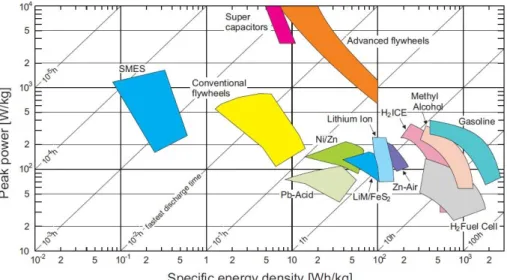
Figure 26 - The Ragone Plot - Peak power and specific energy density of various energy storage methods [39] ... 31
Figure 27 - Charge and discharge process of a lithium battery [47] ... 32
Figure 28- Charge (right) and discharge (left) process of a lithium-ion battery [48]... 33
Figure 29 - 3D Drawing views of LEEUAV ... 36
Figure 30 - Photo of the LEEUAV during flight test campaign ... 37
Figure 31 - Systems of the LEEUAV ... 38
Figure 32 - Systems of the ground control station ... 39
Figure 33 - Wing tip vortices formation [49] ... 41
Figure 34 - Photo of the wing tip with the wing box removed ... 43
Figure 35 - CATIA rendering of a wing tip modification (Method 1) ... 43
Figure 36 - CATIA rendering of a wing tip modification (Method 2) ... 44
Figure 37 - Photo of dual-side print result of the new wing box polystyrene core ... 44
Figure 38 - Lamination of the new wing box ... 45
Figure 39 - CAD design of wing tip modification method ... 45
Figure 40- Flight controller support structure ... 49
Figure 41 - Photo of the LEEUAV flight controller connections ... 49
Figure 42 - GPS support structure ... 50
Figure 43 - Airspeed sensor installation and support structure ... 51
Figure 44 - On left the "RunCam 600TVL" and on right the OSD "AlceOSD 0v3" ... 52
Figure 45 - Arrangement of the land-air communication system components ... 54
Figure 46 - Propulsive system of LEEUAV ... 56
Figure 47 - Top view of LEEUAV wing with solar panels ... 60
Figure 48 - LEEUAV solar panels fixation method ... 60
Figure 49 - Ground control station ... 61
Figure 50 - Video image received on GCS during LEEUAV flight ... 62
Figure 51 - Mission planner software (flight data screen) [52] ... 63
Figure 53 - Ground control station antennas tripod ... 64
Figure 54 - LEEUAV on-board components positioning ... 66
Figure 55 – LEEUAV and general aviation mission profile [53] ... 69
Figure 56 - Fingertip method for C.G. positioning ... 73
Figure 57 - Aircraft acting forces in steady-state glide flight ... 78
Figure 58 - MATLAB algorithm diagram ... 79
Figure 59 - LEEUAV during A-3 flight test ... 82
Figure 60 - Number of acceptable points per airspeed value ... 83
Figure 61 - Drag vs Airspeed (LEEUAV without photovoltaic panels) ... 84
Figure 62 - Drag vs Airspeed (LEEUAV with photovoltaic panels) ... 84
Figure 63 - LEEUAV with and without photovoltaic panels drag polar ... 85
Figure 64 - Lift-to-drag ratio of LEEUAV (with and without photovoltaic panels) ... 85
Figure 65 - CL(3/2)/CD vs Airspeed of LEEUAV (with and without photovoltaic panels) ... 86
Figure 66 - Electric Power vs Airspeed (with and without systems) ... 87
Figure 67 - Specific Endurance vs Airspeed ... 88
Figure 68 - Electric Power/Airspeed vs Airspeed ... 88
Figure 69 –Specific Range vs Airspeed ... 89
Figure 70 - Electric and Required Power vs Airspeed ... 89
Figure 71 - Propulsive System Efficiency vs Airspeed ... 90
Figure 72 - Drag and Required Power vs Airspeed (real and theoretical results) ... 91
Figure 73 - CL/CD and CL3/2/CD vs Airspeed (real and theoretical results) ... 91
Figure 74 - Specific Range and Specific Endurance vs Airspeed (real and theoretical results) 92 Figure 75 - Propulsive System Efficiency vs Airspeed (real and theoretical results) ... 92
Figure 76 - Time vs Daily Irradiance (Castelo Branco) ... 94
List of Tables
Table 1 - Categorization of UAVs according to U.S. Department of Defense [38] ... 16
Table 2 - LEEUAV final design specifications (without solar panels) ... 35
Table 3 - Weight variation of the wing tips modification ... 46
Table 4 - Required torque for each control surface servomotor ... 47
Table 5 - Voltage range and operational power consumption of all on-board components .... 57
Table 6 - Weather restrictions for LEEUAV flight ... 71
Table 7 - Flight tests specifications and goals ... 77
Table 8 - LEEUAV A-7 flight characteristics ... 93
Table 9 - Flight difficulties and hazards during LEEUAV flight tests ... 95
Table 10 - Measurement results, relative error and average uncertainty ... 96
Nomenclature
η𝑝𝑟𝑜𝑝 Propeller Efficiency 𝐶𝐷 Drag Coefficient
𝐶𝐷𝑖𝑛𝑑 Induced Drag Coefficient 𝐶𝐷𝑝𝑎𝑟 Parasite Drag Coefficient
𝐶𝑓 Friction Coefficient 𝐸𝐷𝑖𝑠𝑠 Dissipative Energy [J] 𝐸𝐾𝑖𝑛 Kinetic Energy [J] 𝐸𝑚𝑒𝑐 Mechanical Energy [J] 𝐸𝑝𝑜𝑡 Potential Energy [J] 𝐹𝑓𝑜𝑟𝑚 Form Factor
𝐼𝑚𝑎𝑥 Maximum Sun Irradiance [W/m2] 𝑀𝑝𝑙𝑟 Resistance Moment [Nm]
𝑃𝑒 Electric Power [W] 𝑃𝑟𝑒𝑞 Required Power [W] 𝑃𝑠ℎ𝑎𝑓𝑡 No-load Power [W]
𝑆𝑟𝑒𝑓 Reference Wing Area [m2] 𝑆𝑥 Surface Deflection Angle [º] 𝑣𝐺 Ground Speed [m/s]
𝑣𝑎𝑖𝑟 Airspeed [m/s] ℎ Altitude [m] 𝐴𝑅 Aspect Ratio
𝐶 Charge/Discharge Rate 𝐶 Battery Capacity [mAh] 𝐶ℎ Transmission Channel 𝐷 Drag Force [N] 𝐼 Current [A] 𝐿 Lift Force [N] 𝑃 Power [W] 𝑄 Interference Factor 𝑅𝐶 Rate of Climb [m/s] 𝑅𝑒 Reynolds Number 𝑇 Thrust Force [N] 𝑇 Torque [Nm] 𝑈 Voltage [V] 𝑊 Weight [N] 𝑏 Wingspan [m] 𝑐 Wing chord [m]
𝑒 Oswald Efficiency Factor 𝑚 Mass [kg] 𝑡 Time [s] 𝑉 Speed [m/s] 𝛼 Angle of Attack [º] 𝛽 Slideslip Angle [º] 𝛾 Path Angle [º]
𝛿 Thrust Setting 𝜂 Efficiency
𝜇 Air Dynamic Viscosity [Ns/m2] 𝜌 Air Density [kg/m3]
Acronyms
A.C. Aerodynamic Centre
AEROG Aeronautics and Astronautics Research Centre (UBI) AGL Above Ground Level
ALT Altitude AM Air Mass
AM Amplitude Modulation Signal ARM Advanced RISC Machines BET Blade Element Theory BFS Backward Facing Step BLDC Brushless Direct Current CAD Computer Aided Design
CATIA Computer Aided Three-Dimensional Interactive Application CCTAE Centro de Ciências e Tecnologias Aeronáuticas e Espaciais (IST) C.G. Centre of Gravity
CNC Computer Numerical Control
DARPA Defense Advanced Research Projects Agency DC Direct Current
DCA Department of Aerospace Sciences DDD Dull, Dirty or Dangerous Category
DLR German Research Institute for Aviation and Space Flight DoD U.S. Department of Defense
DVR Digital Video Recorder EMI Electromagnetic Interference
ERAST Environmental Research Aircraft and Sensor Technology ESC Electronic Speed Controller
FAA Federal Aviation Administration FBWA Fly by Wire A
FEM Finite Element Method
FEUP Faculdade de Engenharia da Universidade do Porto FFS Forward Facing Step
FM Frequency Modulation Signal FPV First Person View
GCS Ground Control Station
GLONASS Global Navigation Satellite System GNSS Global Navigation Satellite System GPS Global Positioning System
GUI Graphical User Interface HALE High Altitude Long Endurance HALSOL High Altitude Solar Project HUD Head Up Display
IAS Indicated Airspeed
IDMEC Instituto de Engenharia Mecânica (IST)
INS Inertial Navigation System IR Infrared Radiation
IST Instituto Superior Técnico JST Japan Solderless Terminal
LAETA Laboratório Associado de Energia, Transportes e Aeronáutica LCD Liquid Crystal Display
LEEUAV Long Endurance Electric Unmanned Aerial Vehicle MALE Medium Altitude Long Endurance
MIT Massachusetts Institute of Technology MP Mission Planner Software
MPP Maximum Power Point
MPPT Maximum Power Point Tracker
NASA National Aeronautics and Space Administration NATO North Atlantic Treaty Organization
NREL National Renewable Energy Laboratory OSD On Screen Display
PDU Power Distribution Unit PM Power Module
PPM Pulse-Position Modulation Signal PWM Pulse-Width Modulation Signal RC Radio Control
RPAS Remotely Piloted Aircraft System RPM Rotations Per Minute
RSSI Received Signal Strength Indication RTL Return to Launch
SBAS Satellite Based Augmentation System SBUS Serial BUS
SCC Solar Charge Controller SD Secure Digital (Card) SIT System Integration Testing TAF Tests After Flight
TAS True Airspeed TBF Tests Before Flight TIF Tests In Flight TOW Take-off Weight
UAS Unmanned Aerial System UAV Unmanned Aerial Vehicle
UBEC Ultimate Battery Eliminator Circuit UBI Universidade da Beira Interior UHF Ultra-High Frequency
USA United States of America USB Universal Serial Bus VDC Video Diversity Controller
Chapter 1
1 Introduction
1.1 Motivation and Objectives
The demand for more efficient means of transport is an increasingly widespread reality due to the need to preserve the environment for the sustainability of future generations. It is known that the long-term consumption of energy derived from fossil fuels will become unsustainable.
The ability for an aircraft to fly during an extended period of time has become a key issue and a target of research all over the world. Both manned and unmanned aviation is taking an increasingly important place in our society, to meet the needs of civilian and military areas. Regarding the unmanned aviation, the required endurance for law enforcement, border surveillance, forest fire fighting or power line inspections are in the range of a couple of hours. However, for other applications at high altitudes, such as communication platforms for mobile devices, weather research and forecast, environmental monitoring, require the craft to remaining airborne for days, weeks or even months.
At present, external sources of power are required for this type of flight endurance, using for example, solar powered platforms or refuelling the aircraft.
Using photovoltaic modules to collect energy from the sun, during the day time, allows solar aircraft to use part of the energy to fly and store the surplus of energy for the night flight. Using cutting-edge technology some recently solar powered airplanes are being designed to fly near space, i.e., above the common atmospheric flight region and below the spacecraft flight region (approximately 20–100 km). Future solar unmanned aircraft vehicles (UAVs) projects claim that they will be able to fly continuously for months, or even years, depending on the reliability of the airplane system and sunlight conditions, something which is impossible with traditional, fossil-fuelled airplanes. Solar-powered airplanes can function as complement to low-altitude satellites, with the advantage of having a relatively low altitude, free deployment, high resolution, high frequency of coverage, and low cost.
Solar-powered airplanes can also function as an alternative to high-altitude balloons and airships, with the advantage of having free-manoeuvre capability, high resilience to weather, as well as being easy to launch and recover. Compared with low-altitude airplanes, solar-powered airplanes have the advantage of reaching relatively high altitudes and covering large areas [1].
The present work is a result of a three-year collaborative research project involving two higher education universities, UBI and IST, which form part of three research units that follow the line of research of Aeronautics and Space of Associated Laboratory for Energy, Transports and Aeronautics (LAETA), namely Centre for Aerospace Science and Technology (CCTAE), Aeronautics and Astronautics Research Centre (AEROG), Institute of Mechanical Engineering
(IDMEC) and Institute of Science and Innovation in Mechanical and Industrial Engineering (INEGI). The LEEUAV was decided upon in a consortium meeting, having in mind the ultimate goal of creating a vehicle capable of flying for at least 8 hours at the equinox with low power requirements and carrying a payload of up to 1kg. The mission profile also requires a short take-off and landing distance, high flight altitude (at least 1000 meters) and a descent without power.
This work follows the need to search for, test and validate new techniques and practices in the aviation area such as the use of solar energy in UAVs. This thesis aims to validate the concept of an unmanned airplane that gets most of its energy from solar irradiance.
The main objectives of this work are to:
Learn about the concepts inherent to unmanned solar flight aircraft; Finish the LEEUAV airframe and systems integration;
Plan LEEUAV missions;
Perform flight and ground tests;
Analyse LEEUAV’s aerodynamic performance;
Compare the theoretical results with practical results; Draw conclusions about the results achieved.
1.2 History of Solar Powered Flight
1.2.1 Photovoltaic effect and solar cell
Since the 7th century B.C. solar energy has been used in different ways, such as the use
of bronze shields, to focus the sunlight onto wooden ships so that they were set alight or for astronomical and illumination purposes. In 1839 Edmond Becquerel discovered the photovoltaic effect while experimenting with electrolytic cells and later in 1921 Albert Einstein received the Nobel Prize for explaining this process [2].
The first photovoltaic cell based on the photoelectric effect was created in 1888 by Aleksandr Stoletov, but it was unpractical. Then in 1954 Bell Laboratories announced the invention of the first practical silicon cell with an efficiency of 4%, converting enough energy of the sun’s irradiance to power some electrical equipment, but it was unused until the 1960’s, when NASA began to use it to power its space craft’s [2].
As the space industry evolved so did the photovoltaic technology and both efficiency and reliability was improved. During the oil crisis in the 1970’s photovoltaic cells became recognized as an alternative energy source but sadly the interest for greener energy alternatives declined as the price of oil fell.
1.2.2 The Combination of Electric Flight and Solar Cells
Electric flight was not discovered in this century neither in the last decades but it has currently been on the radar of researchers. In the 1880s a couple of French army officers named
Renard and Krebs equipped a hydrogen-filled dirigible, La France, with huge batteries and an 8-horsepower electric motor that enabled it to do what no balloon had ever done before: return to its launch site at the end of a flight, taking the lead over the existing steam engine [3]. Since La France, many other flights of model electric aircraft were attempted, as with German pioneer Fred Militky, who first achieved a successful flight with an uncontrolled model aircraft in October 1957 [4]. Since then, better model airplanes have been developed with the improvements in the field of motors and batteries [5]. Electric propulsion in manned airplanes was abandoned for the following 90 years.
The combination of electrical flight and solar cells was just made in 1970 decade by Robert Boucher, a pioneer that used electric motors for model airplanes, building a couple of pilotless solar-powered aircraft under contracts with the Defence Advanced Research Projects Agency [4].
Despite the existence of solar powered RC aircraft, the first manned electrically powered flight was made in 1973, where Fred Militky and Heino Brditschka converted a Brditschka HB-3 motor glider to an electric powered aircraft, the Militky MB-E1. The full size manned aircraft flew solely under electric power for 14 minutes, with a 10kW electric motor powered by Ni-Cd batteries [6].
At present, the endurance of an electric aircraft is very low, when compared to the internal combustion engine. This fact lies in the high energy required by electrical flight, which in turn, results in weight and space restrictions as well as high density batteries. The combination of electric flight and solar cells has become very useful once that the battery’s size and weight can be reduced by applying solar cells, and thus, allowing long endurance flights.
Following the re-introduction of the electric powered flight, many experimental and commercial electric aircraft have been created since the 70’s, searching for better results, namely in the endurance and efficiency fields. In world history, before 90’s, the inexistence of high density batteries had led to the abandonment of electric aviation.
However, as soon as the high-density lithium-ion batteries were commercialized the existence of electric aircraft flying without any external source of power become a reality. Presently, the average maximum flight endurance of an electric aircraft, without external sources of power, is about 3 hours on gliders.
1.2.3 Early stages of Solar Aviation
After two more decades since the invention of the first photovoltaic cell, in November 4th 1974 R.J. Boucher from Astro Flight Inc. achieved the first solar powered flight with the
airplane Sunrise I. Since that day many more solar powered aircraft have been built and improved but very few have been put into commercial use. The Sunrise I had a wingspan of 9.76m and weighed 12.25kg with 4096 solar cells over the wings capable of producing a 450W power output [3]. The inaugural flight lasted 20 minutes at an altitude of 100m, but further flights achieved almost four hours of continuous flight. Despite the short lifetime of the Sunrise
I caused by a serious damage during a sandstorm, the Sunrise II was even better weighting less and containing more efficient solar cells. After weeks of testing the Sunrise II also got damaged due to a failure in the command and control system. Despite all these incidents with the first solar aircraft, the solar flight has proved to be reliable.
Figure 1 - Sunrise I (1974) and Solaris (1976) [3]
In Europe, Fred Militky developed a solar aircraft project named Solaris in 1976 and on 16th of August of the same year, it successfully completed three flights of 150 seconds at an
average altitude of 50m [4]. With the foundations implemented, the solar flight era was launched. Since then, thanks to technology development and the emergence of more efficient solar cells, many solar powered model aircraft have been built. Nevertheless, the general flight endurance of model aircraft was short until the 1990s when Wolfgang Schaeper achieve the official record with Solar Excel aircraft: flight duration of (11h34m), total distance of (190 km), at an altitude (2065 m) with medium speed of (62.15km/h) [7].
Figure 2 - Solar Excel (1990) [3]
1.2.4 Manned Solar Flight
After all the efforts to successfully produce the solar powered aircraft, the new challenge that fascinated the pioneers at the end of the 70’s was manned flights powered solely by the sun.
As stated above, the first manned electrical flight, completed in 1973 by Fred Militky and Heino Brditschka, had a very low flight endurance and it eventually became unusable [6]. In order to accomplish the feat of increasing the endurance of the electrical powered flight, on 29th of April 1979, Larry Mauro built Mauro Solar Riser, the first solar-powered man-carrying
capable of producing 350W at 30V. The solar charge of 1.5 hours was enough to power the aircraft for 3-5 minute, enabling it to reach a gliding altitude [3].
On the 19th of December 1978, Britons David Williams and Fred To launched Solar One on
its maiden flight at Lasham Airfield, Hampshire. The Solar One was a motor-glider aircraft originally built as a pedal-powered airplane to attempt the Channel crossing. The airplane proved too heavy to be successfully powered by human power and was then converted to solar power, using an electric motor driven by batteries that were charged before flight by a solar cell array on the wing. The maiden flight of Solar One took place at Lasham Airfield; Hampshire on June 13, 1979 [6,8].
Figure 3 - Gossamer Penguin (1980) and its successor, Solar Challenger (1981) [3]
Looking for better endurance results Dr. Paul B. MacCready and Aerovironment Inc demonstrated, on August 23, 1977, the first sustained and manoeuvrable human-powered flight with the Gossamer Condor. After that , on the 12th June 1979, they completed the crossing of
the English Channel with the human-powered Gossamer Albatross (second version of Gossamer Condor), Dr. MacCready created the third version of Gossamer, the Gossamer Penguin, which resulted in a 3/4 scale version of the original Gossamer, converted it into a man-carrying solar plane. On the 18th of May 1980, the Gossamer Penguin, with MacCready’s 13 years old son
Marshall on board, realized what can be considered as the world’s first piloted solar powered flight in Europe.
Despite the Gossamer Penguin having shown good results in the early stages of solar aviation, flying at high altitudes was not safe for the pilot. In order to conquer the English Channel crossing with a solar powered airplane, with some sponsors, MacCready built the Solar Challenger which was a 14.2m wingspan, high-wing aircraft with 16128 solar cells producing 2500W at sea level. On July 7, 1981, the Solar Challenger flew for 5 hours traveling a total distance of 163 miles from Paris to London, under solar-power at an altitude record of 14.300 feet.
At the same time of the English conquest with Solar Challenger, a competitor in Germany Günther Rochelt constructed a canard design aircraft with 2499 wing-mounted solar cells, which produced an output power of 1.8kW. His objective was to accomplish exactly the same performance (crossing the English Channel), but he only succeeded on the 21th of August 1983
[3]. The Solair I crossed the English Channel using electric power mostly from solar energy and thermals, which are currents of hot air that help the aircraft to climb.
In 1986, after a meeting with Günther Rochelt, in the United States, Eric Raymond started designing the Sunseeker, which has become his own manned solar powered aircraft in 1989. In August 1990, Sunseeker crossed the USA in 21 solar powered flights with 121 hours in the air [9].
Figure 4 - Icaré 2 (1996) and Solair II (1998) [3]
In Ulm, Germany, there is a competition named Berblinger Prize in tribute to the first aeronautical pioneer to employ the principle of gliding flight. The Berblinger Prize [10] is awarded for special efforts, developments and innovative ideas in the construction of aviation devices in the field of general aviation. In the 1996 event, the prize to develop a real, practically usable solar aircraft, capable of staying airborne with at least half of the solar energy in a clear summer day, was won by Prof. Rudolf Voit-Nitschmann from Stuttgart University with Icaré 2, a world record breaking solar plane [11]. Through the years there have been several other solar powered airplanes to participate in this competition, as Solair II and Sole Mio, demonstrating the new technological applications and improvements in the various areas.
1.2.5 Long Endurance Platforms and Eternal Flight
With the purpose of creating a long endurance flight aircraft, AeroVironment Inc. funded by US government, created the first prototype HALSOL but the project was abandoned once seeing that the existing system technology, mainly the energy storage, was inadequate for this type of mission. Thus, the project took the direction of solar propulsion with the Pathfinder which achieved its first flight at Dryden in 1993. In 1994, the Pathfinder became part of NASA’s Environmental Research Aircraft Sensor Technology (ERAST) and in 1995, it exceeded Solar Challenger’s altitude record for solar powered aircraft when it reached an altitude of 15392m. In 1998, Pathfinder was upgraded for Pathfinder Plus, which had a larger wingspan and new solar, aerodynamic and propulsion systems technologies. The purpose of Pathfinder Plus was to validate the concept of its successor, the Centurion.
The Centurion was considered to be the base prototype technology for the following years of solar aviation [12]. With the double wingspan of Pathfinder, it was capable of carrying
45kg of remote sensing and data collection instruments for use in scientific studies and also 270kg of sensors, telecommunications and imaging equipment for up to 24400m of altitude. The Pathfinder lithium battery provided enough energy to power the airplane for a five-hour flight after sunset, but this was insufficient to fly during the entire night.
Figure 5 - Centurion (1997-1999) and Helios (1999-2003) [13]
The last prototype of the series designated as Helios was intended to be the ultimate "eternal airplane", incorporating energy storage for night-time flight. For NASA, the two primary goals were to demonstrate sustained flight at an altitude near 30480m (100000ft) and flying non-stop for at least 24 hours, including at least 14 hours above 15240m (50000ft). In 2001, Helios achieved the first goal near Hawaii with an unofficial world-record altitude of 29524m (96863 ft) and a 40-minute flight above 29261m (96000 ft). Unfortunately, it never reached the second objective as it was destroyed when it fell into the Pacific Ocean on June 26, 2003 due to structural failures [13].
In Europe, some developments were also made, for example the Solitair aircraft developed by DLR Institute of Flight Systems which had the particularity of having adjustable solar panels for optimum solar radiation absorption [14]. On the other hand, to prove the feasibility of high altitude long endurance (HALE) flight, more aircraft such as the Heliplat and the Solong were tested, the last in June of 2005 with just 4.75m wingspan and 11.5kg of MTOW flew for 48 hours and 16 minutes in California’s Colorado Desert [15].
In 2001, a British company named QinetiQ proved to be very active in the field of solar HALE platforms with its Zephyr 6 aircraft that broke the official world record flight time of an unmanned aircraft with a 54-hour flight in New Mexico on the 10th of September 2007, reaching
a maximum altitude of 17786m (58355ft) [16]. After Zephyr 6 established the record of the longest flight time, it did not take long for the British company to present more ambitious goals, in particular, the creation of a HALE platform with a capacity of carrying a 100kg payload in order to fulfil some missions such as forest monitoring, urban mapping, coastal monitoring, electric cable inspections and others.
After 2009 more amazing feats were achieved, in 2003, a well-known project named Solar Impulse started in Switzerland, aiming to be the first manned aircraft making the circumnavigation of the Earth using just solar energy as its source of power. In December 2009, it flew for the first time and in July 2010 Piccard and Borschberg completed successful
solar-powered flight from Switzerland to Spain lasting 26 hours. Shortly afterwards, in 2016, the manned solar-powered airplane Solar Impulse 2, completed the circumnavigation of the Earth [17].
1.3 State of the Art
To establish the state of the art of solar airplane field, in this section of the document the most advanced current practices, projects and future ambitions for solar powered airplanes are listed.
In 2007, The Defence Advanced Research Projects Agency (DARPA) of United States with the cooperation of Boeing Phantom Works proposed a featured HALE project, named DARPA’s Vulture air vehicle program intended to create a solar aircraft weighting 453kg which would be able to fly for periods of up to five years [18]. The big advantage of this project lay in the capacity to operate as a very low altitude satellite platform allowing dramatic increases of sensors resolution, better mapping capacities as well as improving the communications range and feasibility as it circumnavigates the Earth several times during its 5-year journey. However, the DARPA Vulture project was cancelled in 2012 [19].
Figure 6 - DARPA Vulture (2012) and Solar Impulse II (2014) [17,19]
Even before the Solar Impulse I had successfully completed its first intercontinental flight in 2012, the Solar Impulse II had started being built in 2011, but a structural failure of the aircraft's main spar occurred during static tests in July 2012, delaying the flight tests. On 2nd June 2014, the Solar Impulse II, a 71.9m wingspan aircraft weighting 2300 kg completed its
first flight and months later on 9th March 2015 it set off on its circumnavigation of the Earth,
composed by 17 stages starting and finishing at Abu Dhabi. On 26th July 2016, the Solar Impulse
II completed its 43041km journey around the world and set many records, such as the 5663km flight and the longest non-stop solo flight of 117 hours without refuelling [17].
The Solar Flight company is a solar powered aircraft producer that has already proved its value with the Sunseeker Duo, which is a two-person airplane that is able to cruise directly on solar power with two people on board for at least 12 hours, thanks to its 1510 high efficiency solar cells. The same company is also developing another manned solar aircraft, the Sunstar aiming to achieve the lowest power requirements to fly for months or even years. After reaching
cruise altitude, the Sunstar’s three motors stop and the propellers fold back to decrease the drag [20].
Figure 7 - Sunseeker Duo (2013) and Sunstar (under development) [9]
After buying the program from QinetiQ in 2013, Airbus Defence & Space is now working on the Zephyr 8, the latest version of a record-breaking series aircraft with an ultra-lightweight airframe designed to loiter slowly over an area of interest at up to 70000ft. The Zephyr 8, like its previous version has the capability to fully charge its batteries from the sunlight during the day and maintain the same altitude at night. With 30% less weight and 50% more battery capacity, Airbus says that the Zephyr 8 can stay airborne for at least a month [21].
The giant social media Facebook has unveiled a prototype of a solar-powered UAV designed to fly above 60000ft for more than three months. Aquila is a carbon-fibre light weight aircraft whose mission is to provide Internet connectivity, through a laser-based communication, to remote locations of the world. On 21th July of 2016 the full-scale Aquila
prototype made its first 90-minute flight allowing the verification of the general aircraft performance through several tests [22,23].
Figure 8 – Facebook Aquila (2016) and Google’s Solara 50 [23,24]
It did not take much time before the giant Google bought out the American company, Titan Aerospace, which is currently working on Solara 50 and 60 aircraft. The Solara is a solar powered UAV project which intends to create a HALE platform that works as a satellite, allowing to monitor a significant number of meteorological events as well as provide solutions for agricultural applications, asset tracking, pipeline monitoring, search and rescue, disaster recovery, fire monitoring, etc. [24].
In the Autonomous Systems Lab (ASL) of ETH Zurich an unmanned solar aircraft project, the AtlantikSolar was created with the main objective of being the first fully solar powered aircraft to cross the Atlantic Ocean, a journey of 5000km and 7 days of continuous flight. This 5.6m wingspan aircraft has already proved its value by successfully completing an 81-hour continuous flight [25]. On the other side of the world, a USA company named Silent Falcon, has been developing the Silent Falcon UAV. With a wingspan of 4.4m and a MTOW of 142N, the Silent Falcon is capable of flying continuously for 7h [26].
Figure 9 - Silent Falcon UAV and AtlantikSolar [25,26]
1.4 Present and Future UAV Applications
In order to highlight the importance of solar powered UAVs, this section includes some applications that clearly justify all the research around the world in this particular area of aviation.
Solar-powered airplanes are suitable to perform various missions and applications not only for civilian recreation but also in military and commercial fields. Following this line of thinking the UAV applications can be subdivided into three main areas: Civilian, Commercial and Military area.
The most diffused area is probably the Civilian one, where the small UAVs commonly known as “drones”, are in an exponential growth. Although there is no exact data for the “commercialization boom” of civilian UAVs, they have been seen on the market since early 2008. The applications in the civilian world are mainly focused on personal entertainment, however, other uses such as mapping, private surveillance, aerial photography, shows and events also form part of civilian applications.
In regards to the commercial field, the UAV market is under development and the applications are growing remarkably. Each day new applications are found or suggested by the companies. Presently, UAVs can be seen in areas of agriculture where they are used for sowing, spraying of insecticides, plant growth verification and problems identification. Even though the Federal Aviation Authority (FAA), European Aviation Safety Agency (EASA) and other aviation authorities are stablishing restricted rules in relation to unmanned aviation, some companies continue to join efforts in order to improve the applicability of UAVs in our daily lives by using them as fast air-mail carriers for small packages, for inspection of electric lines, ground recognition or mapping applications.
Figure 10 – DHL Package delivery and medical emergency drones [30]
Still within commercial area, UAVs have proven to be very helpful in some social and community security applications such as combat and fire monitoring, anti-theft control, coastal surveillance, surveillance of crowds, disaster monitoring mapping, pollution, nuclear observations and accident contamination measurement, tracking of volcanic ash clouds, Illegal activity control and maritime surveillance. Many of these applications fall within the category of dull, dirty, or dangerous (DDD) aerial work and are associated with high risks and costs [27], making the UAVs a problem-solving application.
Although today there is a widespread use of UAVs in our daily lives, it all started in the military area in 1849 when the Austrian Army sent unmanned bomb-filled balloons to attack Venice. Since then, improvements and enhancements have been made in the field of UAVs [28]. Today they are used by the majority of air forces armies all over the world and according to Unmanned Aerial Vehicles Systems Association (UAVS), the UAVs applications can be separated in security (serial crowd monitoring, traffic and security watch), search and rescue (maritime and mountain), monitoring (waterways, oil and gas pipeline, fishery protection, surveillance missions and borders monitoring), disaster management (disaster effects management and damage estimation and rescue) and communications and munitions [29].
Speaking a bit of the UAVs future applications, they are expected to be found in humanitarian work, delivering vaccines and other critical medical supplies to remote locations in the developing countries as is the case of Bill and Melinda Gates Foundation UAV project, currently under development at the Massachusetts Institute of Technology (MIT). Expanding internet access is another amazing goal, Facebook Inc. is financing a project whose main objective is to create a perpetual solar flight aircraft capable of amplifying the internet signal from satellites to some remote areas in the world where internet access is very weak or inexistent.
In Netherlands, a student has revealed a prototype of an “ambulance drone”, a flying defibrillator able to reach heart attack victims within precious life-saving minutes, making it a probably future application.
From a long-term point of view, there are other ambitious challenges for UAVs applications, such as [30]:
Early warning systems (the use of UAVs to prevent and warn about natural disasters as earthquakes, hurricanes, tornados, avalanches, tsunamis and forest fires);
Emergency services (acting as a tracking device using different sensors to find a missing child, tracking animals in danger or just looking for danger situations in a city);
News reporting (accident monitoring, weather time-lapse, aerial photography and direct interview ability);
Delivery (medical, mail, package and grocery deliveries and send-it-back returns); Business activity monitoring (construction monitoring, topological surveying, instant
environmental impact assessment, power line monitoring and geological surveying); Marketing (spot advertising, multimedia formations, etc.);
Policy UAVs (domestic violence monitors, neighbourhood watch and surveillance); Smart home UAVs (home security);
Science and discovery (animals watching, ocean currents monitoring, aurora borealis inspecting, archaeology among others);
Gaming, entertainment, educational, health care and sport, among others.
The purpose of composing this rather exhaustive list is not an attempt to cover everything, but to show the enormous versatility of this platform.
1.5 LEEUAV Project
This small section is intended to contextualize the current work in the LEEUAV project timeline through a short review of each phase.
It all started with the idea of creating a long flight and environmentally reliable platform, capable of flight for more than 8 hours at the equinox with the minimum environmental impact. In LAETA, with the co-operation of CCTAE and IDMEC from IST, the AeroG from UBI and INEGI, the LEEUAV’s preliminary and conceptual design was carried out by UBI whose main objectives and tests were successfully achieved by Luís Cândido [31]. In that work the main aircraft characteristics and structures, including the fuselage, tail and wing were suggested and designed. In a second phase of Luís Cândido work a pre-prototype with a polystyrene wing was built in order to analyse the behaviour of the conceived aircraft flight structures and the performance of the wing airfoil.
The work of Tiago Ferreira [32] from IST, comprised the design, test and evaluation of a possible LEEUAV propulsion system. In 2015, Joana Sousa’s master thesis [33] proposed to validate the LEEUAV’s solar propulsion system, as well as simulate the possible flight conditions and determine the global efficiency to predict the best fixing position of the solar panels on the wing. A work done by Alexandre Duarte [34] consisted of design, analyse and built the carbon fibre fuselage, tail boom and control surfaces of LEEUAV.
With the airframe and wing built, the present work is about to test and analyse the LEEUAV’s flight performance. However, before flight there were a set of tasks that have to be performed in order to safely fly the LEEUAV, such as the integration of all electronic components and their functional tests. Furthermore, several hazards, such as the loss of roll
control at low airspeeds, tip stall tendency while turning and unstable spiral mode were detected during pre-prototype flight which forced to modify the existing wing tip by applying a washout of 4.5 degrees and an adequate endplate preventing the detected wing tip stall.
At the same time, two other works were done, namely the influence of the solar panels thickness in the low speed airfoil of the LEEUAV by Luís Freitas [35] and the real-time streaming of solar energy system data by Pedro Moutinho [36]. The first work provided the most suitable position for the fixation of the solar panels in the wing, i.e., the position where the drag caused by solar panels is lower and consequently the lift-to-drag ratio is higher for the designed LEEUAV cruise speed. The second one, also very important, aimed to stream the energy consumed by the motor/systems and the energy produced by photovoltaic panels during the flight to the ground control station and further based on the on-board stored energy estimate the remaining flight time.
1.6 Structure of this Work
After a quick introduction of the main goals of this work, the document was written with a logical order to facilitate the comprehension of the proposed goals. In order to contextualize the reader in the document, a brief introduction is presented at the beginning of each chapter.
This document comprises five main sections:
Basic Concepts: A brief introduction of the main UAV concepts and an explanation of the theoretical principles behind a solar airplane were given in chapter 2; Aircraft Description: In this section the LEEUAV specifications and other main
aspects of the aircraft are described and justified (chapter 3);
Systems Integration: The third section includes the electronic, navigation and control systems integration. This section also covers a part dedicated to the solar cells integration (chapter 5);
Mission and Flight Testing: The fourth section starts by defining the mission objectives for this Solar UAV, followed by the ground tests and flight experiences (chapter 6);
Results: After retrieving the flight data from LEEUAV, a performance analysis was carried out using a Mechanical Energy Method. In this section the good and bad aspects of LEEUAV are described as well as the hazards found and the corrective actions taken to solve them (chapter 7).
Chapter 2
2 Basic Concepts
2.1 Introduction
The objective of chapter 2 is to give a small explanation of the basic principles inherent to the flight of any fixed wing aircraft, in particular, unmanned solar aircraft. The systems and technologies involved and the knowledge required for the comprehension of this thesis are also addressed in this chapter. Much more information about the aviation principles could be included in this section, but that would extend the document considerably.
2.2 Main Forces of an Aircraft and Energies
A fixed wing aircraft flies thanks to the action of the four main forces during the majority of the flight phases (figure 11).
During a level or steady flight, the propeller, jet or fan in case of turbojet engines is responsible for creating the thrust force which pulls the aircraft forward. Thrust force is directly proportional to the power of the engine and inversely proportional to speed of the aircraft.
Figure 11 - Forces acting on an airplane at level flight
When the aircraft is moving, there is a flow of air in its airframe that creates an opposite force called drag. The drag force can be subdivided into many types (pressure drag, friction drag, parasite drag and induced drag) that are created by different physical phenomena, flight conditions and components of the airplane, such as wings, airframe, control surfaces and other external parts of the aircraft.
Besides the two main horizontal forces applied on an aircraft during its flight, another two vertical forces are present, namely, lift and weight. The weight force is the sum of weight of all components and systems of the aircraft at any moment of the flight. For the same aircraft, a higher weight requires a higher flight speed and usually higher power consumption. The last force and probably the most important is the lift. Lift force is created by the airflow in the wings, and its appearance is explained in the section 2.4 below.
To further understand the method applied in the LEEUAV performance analysis in chapter 6, it is necessary to clarify some physical energies that are present in everything on Earth and in this case in an aircraft. The mechanical energy 𝐸𝑚𝑒𝑐 of an object is the sum of all physical energies presented in the same object. Despite the variety of energies, for this work only the potential, kinetic and dissipative energies were considered, so the mechanical energy is given by:
𝐸
𝑚𝑒𝑐= 𝐸
𝑝𝑜𝑡+ 𝐸
𝑘𝑖𝑛+ 𝐸
𝑑𝑖𝑠 (1)The potential energy 𝐸𝑝𝑜𝑡 is the energy that an object has because of the gravitational field of the Earth. Mathematically, is the result of the object mass times gravity acceleration times relative altitude to the Earth’s surface.
𝐸
𝑝𝑜𝑡= 𝑚𝑔ℎ
(2)The kinetic energy 𝐸𝑘𝑖𝑛 is the energy possessed by an object in motion and its value depends on the object mass and velocity.
𝐸
𝑘𝑖𝑛=
1
2
𝑚𝑣
2
(3)
The dissipative energy is the result of an irreversible process that takes place in all non-conservative systems. In those situations, the energy (internal, kinetic or potential) is transformed from an initial form to some final form. In the aerodynamic domain, the dissipative energy is represented by drag, which is a force, opposite to the relative motion of any object in a fluid.
2.3 Unmanned Aerial Vehicle
An unmanned aerial vehicle (UAV) commonly known as remotely piloted aircraft system (RPAS) or as a drone, is an aircraft that does not require the presence of a pilot on-board. The UAV’s flight is monitored by a remote-control station operator on the ground or in another vehicle. The existing state of the art technology allows a fully autonomous flight capability, processed by on-board computers inside the UAV [37].
Despite the existence of controversial assignments for the weight categorization of UAVs the United States Department of Defense (DoD) has divided the unmanned aircraft systems (UAS) in 5 distinct groups shown in table 1.
Table 1 - Categorization of UAVs according to U.S. Department of Defense [38]
UAS Group Maximum weight (lbs) Nominal operating altitude (ft) Speed (kts)
Group 1 0–20 < 1,200AGL 100
Group 2 21–55 < 3,500AGL < 250
Group 3 < 1,320 < FL 180 < 250 Group 4 > 1,320 < FL 180 Any airspeed Group 5 > 1,320 > FL 180 Any airspeed
With respect to the range/altitude categorization, the UAVs can be divided into 6 categories, from the smallest to the largest (altitude, range): hand-held (<600m, <2km), close (1500m, 10km), NATO type (3000m, 50km), Tactical (5500m, 160km), medium altitude long endurance (MALE) (9000m, 200km) and High-Altitude Long Endurance (HALE) (9100m, infinite range) [38]. Considering table 1, the LEEUAV aircraft fits into the category of close and possible in Group 1 (DoD).
Concerning the UAV typical structures and working principles, the general UAVs have a solid airframe that sustains all the components inside providing them the best working conditions. These conditions comprise a good cooling, adequate disposition and fixation of all components. The general structure of an UAV comprises at least one communication module that receives and sends information to a remote-control station via a data link connection. In turn, the communication module is connected to the flight controller (if present) whose function is to receive the operator inputs, process and send them to all components, such as motor, control surfaces (servo-motors), etc. Further, the motor and actuators are responsible to change the aircraft attitude. In some cases, the flight controller has the auto-flight function that uses on-board sensors and a computer module to control the airplane. Figure 12 shows the main system components of an Unmanned Aircraft System (UAS).
Figure 12 - Main components of an Unmanned Aerial System[56]
In addition to the UASs described, the aircraft portrayed in this work has another module, once it is powered by photovoltaic cells during flight. Solar aircraft usually have solar panels above the wings or covering other potential parts like tail or fuselage which collect solar energy from the sun’s irradiance during the day and convert it into electric energy through the photovoltaic effect (figure 13).
Although it is not the case of the LEEUAV, whose maximum designed mission flight time is 8 hours at the equinox and always under sun light, other solar aircraft are forced to have enough on-board stored energy to ensure all the aircraft energy requirements for the night flight until the next morning, where a new cycle starts (figure 13).
2.4 Wing Aerodynamics
There are two types of aircraft configurations, the fixed wing aircraft and the rotary wing aircraft. The LEEUAV fits into the first category and its working principles are discussed in this chapter.
Figure 14 - Section of an airfoil
In order to understand the working principles that occur on a wing, figure 14 shows the cross section of a wing in a laminar airflow with a constant speed V. This airflow creates a different pressure distribution on the upper and lower side of this section, that once integrated is represented by two forces, lift and drag. These forces can be calculated using the following equations:
𝐿 =
1 2𝜌𝑉
2𝑆𝐶
𝐿and
𝐷 =
1 2𝜌𝑉
2𝑆𝐶
𝐷 (4,5)Where 𝐶𝐿 and 𝐶𝐷 are respectively the lift and drag coefficients, 𝜌 is the air density, S the wing area and V the relative airspeed. 𝐶𝐿 and 𝐶𝐷 heavily depend on the airfoil, the angle of attack and the Reynolds number (Re) which represents the air flow viscosity.
𝑅𝑒 =
𝜌𝑉𝑐
𝜇
=
𝑉𝑐
𝑉
(6)Here,
𝜇
is the dynamic viscosity that once divided by the air density gives the kinematic viscosity and𝑐
represents the chord of the airfoil. The dependency on the angle of attack is depicted in figure 15. Increasing it makes𝐶
𝐿 increase, but progressively the flow separatesfrom the airfoil starting at the trailing edge and this gives rise to a turbulent zone that makes the
𝐶
𝐷 increase. At stall, the lift is maximum but the drag is high too. After this point, thewithout being followed by the lift that drops. Thus, the interesting and safe zone for an airplane is before the stall point, for glider especially at the point where the glide ratio
𝐶
𝐿/𝐶
𝐷 ismaximum.
Figure 15 - Lift and drag coefficients depending on the angle of attack [39]
What was described so far is the case of an infinite length wing, but for a real wing, vortices are produced at the wing tips and airflow is redirected for other directions as a result of lift force creation, which induce an additional drag called the induced drag. It represents the energy spent for producing the wake behind the wing and follows:
𝐶
𝐷𝑖𝑛𝑑=
𝐶
𝐿2𝑒𝜋𝐴𝑅
(7)AR is the aspect ratio, i.e. the ratio between the wingspan b and the chord length c that can also be expressed with the wing area using
𝐴𝑅 =
𝑏𝑐
=
𝑏2
𝑏𝑐
=
𝑏2
𝑆. The variable e is the Oswald
efficiency factor that has a value between 0 and 1, being 1 the ideal case where the load distribution on the wing is elliptical. In many cases, its value is between 0.75 and 0.85. This induced drag has to be taken into account especially for small aspect ratio airplanes as it becomes more important.
Finally, there is the parasitic drag coming from non-lifting parts, like the fuselage, tail, surface irregularities and bumps, flaps, landing gear, etc., the parasitic drag also called by friction drag is the resistance force that is created when a solid body moves through a fluid, in this case, the air.
𝐶
𝐷𝑝𝑎𝑟= (𝐶𝑓𝐹
𝑓𝑜𝑟𝑚𝑄𝑆
𝑤𝑒𝑡)/𝑆
(8)𝐶𝑓 is the friction coefficient, 𝐹𝑓𝑜𝑟𝑚 is the form factor, 𝑄 is the interference factor and 𝑆𝑤𝑒𝑡is the wet
surface area of the airplane.
Despite the existence of other drags sources, for this particular subsonic aircraft the value of the final drag coefficient can be approximated by the sum of the induced drag with the parasite drag coefficients [39].
𝐶
𝐷= 𝐶
𝐷𝑖𝑛𝑑+ 𝐶
𝐷𝑝𝑎𝑟 (9)Other important parameters of gliders and long endurance flight aircraft, is the aircraft aerodynamic efficiency, glide ratio or lift-to-drag ratio (L/D). The glide ratio is the amount of lift generated by a wing or vehicle, divided by the aerodynamic drag it creates by moving through air.
A higher or more favourable L/D ratio is typically one of the main goals in the design stage of an aircraft, once that the required lift is set by aircraft's weight, delivering that lift with lower drag leads directly to better fuel/energy economy, climb performance and glide ratio (without thrust).
The aerodynamic efficiency of an aircraft is then given by:
𝐿
𝐷
=
𝑊𝑐𝑜𝑠(
γ)
𝑊𝑠𝑒𝑛(
γ)=
1
tan (
γ)=
∆𝑋
∆𝑍
(10)Considering zero wind conditions and no lateral disturbances, L/D only depends on the path angle (γ) which is the angle between the horizontal plane of the aircraft and relative wind. It is also equal to the distance travelled divided by the altitude lost. Achieving the maximum distance for altitude lost in windy conditions requires further modification of the best airspeed, as does alternating cruising and thermaling. Presently the best efficiency reached by sailplanes is around 35. This means that the aircraft can fly forward 35 units of distance, without thrust, for each unit of descent.
Knowing the lift and drag formulas (4,5), it is easy to understand the influence of the airspeed, altitude and aircraft configuration on the aerodynamic efficiency during the flight. The typical drag variation along airspeed for a fixed wing aircraft is depicted in figure 16 and it is possible to see that there is an optimal airspeed value where the total drag is minimum and in turn the required thrust.
Figure 16 - Total drag vs Airspeed [1]
Working the formulas 4, 5 and 7, for non-powered flight (gliding flight) and symmetric drag polar, the airspeed for minimum power/drag is also the maximum endurance airspeed and it can mathematically be estimated by:
𝑉
𝐸𝑚𝑎𝑥= √
2𝑊
ρ𝑆𝐶𝐿𝑚𝑖𝑛𝑝𝑜𝑤𝑒𝑟= [
4
3
(
𝑊
𝑆
)
21
𝜌
21
𝐶
𝐷01
𝜋𝑒𝐴𝑅
]
1/4 (11)The 𝑉𝐸𝑚𝑎𝑥 can also be seen by finding the maximum point in “L3/2/D vs Airspeed” graph. On the other hand, the best gliding speed, i.e., the airspeed where the aircraft have the longest range without thrust, corresponds to the intersection point between the tangent and total drag curve or the maximum point in “L/D vs Airspeed” graph and it can be defined by:
𝑉
𝑅𝑚𝑎𝑥= √
2𝑊
ρ𝑆𝐶𝐿𝑚𝑖𝑛𝑑𝑟𝑎𝑔= [4 (
𝑊
𝑆
)
21
𝜌
21
𝐶
𝐷01
𝜋𝑒𝐴𝑅
]
1/4 (12)However, these airspeeds only concern the aerodynamic point of view and are only relevant for gliders or non-powered flight. For the cases where the aircraft is being thrusted it is necessary to consider the real propulsive system efficiency in order to determine the airspeeds where the power consumption and specific power (power produced per unit of weight) are minimum to maximize endurance and range, respectively.
After a brief introduction of the mechanisms that occur in a wing, it is easy to realize the importance of airfoil selection for a given interval of Reynolds number as well as the characteristics of a wing, namely, the wing tip, angle of incidence, aspect ratio and surface finishing quality.
2.5 Flight Control of an Unmanned Aircraft
As already mentioned, LEEUAV belongs to the fixed wing aircraft category and the attitude of this airplanes is controlled/changed through the adjustment of the primary control surfaces, such as ailerons, elevators and rudder and controlling the power given to the electric motor/propeller.
There are three axes of motion in an aircraft: lateral, longitudinal and vertical. All of them meet the aircraft’s Centre of Gravity (C.G.), which is the average location of the weight of an object. The rotation of the aircraft around these three axes is usually named pitch, roll and yaw, respectively.
![Figure 5 - Centurion (1997-1999) and Helios (1999-2003) [13]](https://thumb-eu.123doks.com/thumbv2/123dok_br/18037738.861875/31.892.227.749.229.441/figure-centurion-helios.webp)
![Figure 7 - Sunseeker Duo (2013) and Sunstar (under development) [9]](https://thumb-eu.123doks.com/thumbv2/123dok_br/18037738.861875/33.892.154.784.176.393/figure-sunseeker-duo-sunstar-under-development.webp)
![Figure 10 – DHL Package delivery and medical emergency drones [30]](https://thumb-eu.123doks.com/thumbv2/123dok_br/18037738.861875/35.892.176.761.108.263/figure-dhl-package-delivery-medical-emergency-drones.webp)
![Figure 15 - Lift and drag coefficients depending on the angle of attack [39]](https://thumb-eu.123doks.com/thumbv2/123dok_br/18037738.861875/43.892.168.771.193.462/figure-lift-drag-coefficients-depending-angle-attack.webp)
![Figure 17 – Aircraft principal axis and control surfaces [57]](https://thumb-eu.123doks.com/thumbv2/123dok_br/18037738.861875/46.892.252.598.109.374/figure-aircraft-principal-axis-and-control-surfaces.webp)
![Figure 19 - On top brushed Vs brushless motors, below inrunner vs outrunner motors [40,41]](https://thumb-eu.123doks.com/thumbv2/123dok_br/18037738.861875/48.892.215.636.416.737/figure-brushed-vs-brushless-motors-inrunner-outrunner-motors.webp)
![Figure 22 - Earth solar radiation spectrum [42]](https://thumb-eu.123doks.com/thumbv2/123dok_br/18037738.861875/52.892.206.646.107.406/figure-earth-solar-radiation-spectrum.webp)
![Figure 25 - Variation of the current to voltage curve of a solar cells with irradiance and temperature [33]](https://thumb-eu.123doks.com/thumbv2/123dok_br/18037738.861875/54.892.164.686.753.933/figure-variation-current-voltage-curve-solar-irradiance-temperature.webp)