Superplastic Sheet Metal
Costanzo Bellini1, Gillo Giuliano2 and Luca Sorrentino3 DICeM, University of Cassino and Southern Lazio
via Di Biasio, 43 – 03043 Cassino (FR), Italy
1
2
3
Abstract—This work intends to establish, by means of analytical modelling, a practical definition of the superplastic behaviour by using the results of the free bulging of sheet metal instead of the results of the traditional tensile test. In particular this paper analyses the superplastic flow of PbSn60 alloy and it focuses the attention on the value of H parameter corresponding to the maximum value of dt/dH, never considered in the literature. This parameter can represent a practical tool in industrial applications to establish the superplastic behaviour of a sheet metal.
Keyword-Superplastic forming, Free bulging, Sheet metal, Finite element method, Analytical model
I. INTRODUCTION
Superplasticity is the ability of polycrystalline solids to exhibit, under a specific temperature and a certain strain-rate region, very large tensile elongations prior to failure. The forming conditions for the superplasticity are: relatively high temperature (T ≥ 0.5Tm where Tm is the melting point of the material in degrees Kelvin) and
very low strain-rate of the order of 10-3 to 10-5 s-1. It is now well established that superplasticity requires a fine and stable grain size, typically 10 μm [1].
Superplastic forming (SPF) technology is a manufacturing process that exploits the phenomenon of superplasticity [2]. Currently, there is increased commercial interest in SPF by both the automotive and aerospace industries. SPF offers the potential to reduce the weight and cost of structural components for advanced vehicle applications. SPF is a one step process, therefore it reduces tooling costs since only one single-surface tool is required. Since it reduces the weight of the product by eliminating fasteners and connectors, the process can be used to form complex components in shapes that are very near the final dimension (net shape forming process). Moreover it allows higher material elongations and the reduction of subsequent machining. It also does not suffer from springback or residual stresses. The biggest disadvantage of SPF is that it is a slow process: cycle times vary from thirty minutes to two hours; therefore it is usually used on lower volume products [1-3].
Superplasticity is associated with low flow stress that is very sensitive to the strain-rate [4]. The most common equation for the superplastic flow is given by:
σ
=
K
ε
m (1)where σ is the flow stress of the material, K is the strength coefficient,
ε
is the strain-rate and m is the strain rate sensitivity index. This equation is based upon the properties at constant temperature and it assumes no work hardening during deformation.In [5], it was stated that an m value ≥ 0.3 and tensile elongations in excess of 200% are usually indicative of superplastic behaviour. In tensile deformation increasing m the diffusive elongation increases and prodigiously the material total elongation extends.
Isothermal free forming process at constant pressure produces a t-H curve, with H dimensionless displacement measured at the sheet metal apex (H=h/a) as represented in the figure 1.
Fig. 1. Example of free forming process: the draw shows the deformed metal sheet
From the experimental measurements of the t-H and (dt/dH)-H curves it is possible to highlight the superplastic behaviour of a material and then to determine the conditions of superplastic process (temperature and pressure) without going through the tensile tests results. In this way it is possible to establish by a forming test at constant pressure whether the specimen behaves or not superplastically. In fact, while it has now been established that a material is normally considered superplastic if submitted to tensile test shows elongations over 200%, nothing has been said with reference to the results of a free forming test.
Fig. 2. t-H and (dt/dH)-H curves for a constant pressure in the free forming process of a circular sheet
II. ANALYTICAL MODEL
In order to determine the plastic deformation behaviour of the sheet metal by bulge test, a set of equations is formulated. The equations derived are based on the geometry of a deformed circular sheet [6]. Figure 1 shows the illustration of a deformed sheet: during the bulging process, the geometric shape of the sheet is part of a spherical surface. Throughout the analysis, the following assumptions are employed [6]: the inertia forces are neglected, the material is isotropic and incompressible, the elastic strain is neglected, grain growth, cavitation, and strain hardening are not considered in the calculation and an isothermal process is considered. The initial radius of the sheet is equal to die radius. The thickness of the sheet is very small so that the bending and shearing effects are negligible. Thus it is possible to use the membrane theory in order to describe the stress state in the deformed sheet [6].
In this study, Eq. (1) is employed as constitutive equation.
The stress state at the pole of the deformed sheet is approximately equi-biaxial plane stress:
h
initial sheet
follows:
s
2
pr
c m
=
σ
=
σ
=
σ
(3)where p is the forming pressure, s is the thickness of the blank, and r is the radius of the expansion. For volume constancy:
0
c m
s
+
ε
+
ε
=
ε
(4)where
ε
m is the meridional strain rate,ε
cis the circumferential strain rate, andε
sis the thickness strain rate.From the Levy-Mises flow rule, the effective strain rate at the pole can be obtained as:
s
s
s
=
−
ε
=
−
ε
(5)Considering thickness uniformity, simple geometric assumptions allow one to determine the value of r and the average thickness, s, by means of the following relations:
2 2 2 0 2 2
h
a
a
s
s
;
h
2
h
a
r
+
=
+
=
(6)where a and s0 are the initial radius and the initial thickness of the blank, respectively, and h is the bulge
height.
Introducing the relative dome height as:
a
h
H
=
(7)for 0≤H≤1, it is possible to determine the effective stress and strain rate using the following expressions:
(
)
H
H
1
s
4
pa
2 20
+
=
σ
(8)and
H
H
1
H
2
2
+
=
ε
(9)Introducing the new variables:
σ
=
pa
s
4
S
0 (10)and
H
V
ε
=
(11)figures 3 and 4 show the theoretical relations, Eqs. (8) and (9).
Combining Eqs. (8-9) into Eq. (1), the dt/dH can be expressed as follows:
(
)
2m 1 2 2 m 1 0 H 1 H 2 H 1 H pa K s 4 dH dt + + = (12)
whose derivative is zero for:
Fig. 3. S-H theoretical trend: S ~σ
Fig. 4. V-H theoretical trend: H V= ε
Eq. (13) shows that H* value is dependent only on the m value, and it increases with increasing the strain rate sensitivity index. Introducing the constant C as:
m 1
0
K
s
4
pa
C
=
(14)Fig. 5. (dt/dH)-H theoretical trend for m=0.3
III. RESULTS AND DISCUSSIONS
In this study, PbSn60 alloy was selected as experimental material for free bulging test by using the forming apparatus designed and set up at Cassino University [7-8].
The PbSn60 alloy is a non-ferrous alloy 60% lead and 40% tin in weight, commercially available in the form of PbSn60-marked soldering bars. In order to obtain an extremely fine grain, the bars were submitted to repeated lamination and folding processes [8-11]. The alloy has mechanical properties that are too low to be used in industrial applications, but proves to be advantageous for laboratory activity. The free bulging tests, at room temperature with sheets of about 0.3 mm thickness, were carried out at pressures of 0.10 and 0.18 MPa. In [8-11], PbSn60 alloy was shown to depend on the strain rate as in Eq. (1).
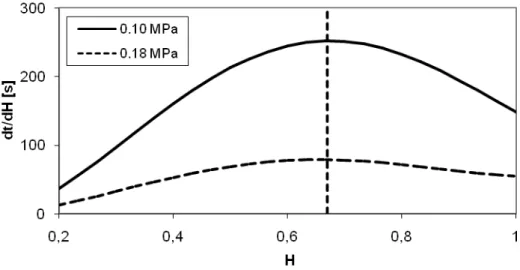
Figures 6 and 7 show the results of the experimental tests in terms of t-H and (dt /dH)-H curves. For the PbSn60 alloy the H*-value is equal to 0.67 at a temperature of 298K and at pressures of 0.10 and 0.18 MPa. Relatively to the geometry of the adopted die, the results show an H*-value higher than 0.628, which represents in the analytical modelling the limit value for a superplastic behaviour.
Fig. 7. PbSn60 alloy: experimental tests results in terms of (dt/dH)-H curve; the H*-value is equal to 0.67 at a temperature of 298K and at pressures of 0.10 and 0.18 MPa
IV.CONCLUSION
This work intends to establish, by means of analytical modelling, a practical definition of the superplastic behaviour by using the results of the free bulging of sheet metal instead of the results of the traditional tensile test.
The analytical model presented allows to identify the value of H (defined H*) corresponding to the maximum value of dt/dH. The results of the analytical model (in terms of H*) are independent from the die geometry and the sheet but only dependent on the value of the strain rate sensitivity index, m. However, this result can represent, at first approximation, a practical limit to establish the superplastic behaviour of a sheet metal. From the analytical model, for m=0.3, the H* value is equal to 0.628. For the PbSn60 alloy the H*-value is equal to 0.67 at a temperature of 298K and at forming pressure of 0.10 and 0.18 MPa.
REFERENCES
[1] J. Pilling and N. Ridley, Superplasticity in Cristalline Solids, The Institute of Metals, 1989. [2] C.H. Hamilton, Superplasticity, AGARD LS 168, 1989, pp. 2.1-2.23.
[3] N. Ridley, Metals for superplastic forming, in: Superplastic forming of advanced metallic materials, G. Giuliano, Ed., Cambridge, UK, Woodhead Publishing Limited, pp. 3-33, 2011.
[4] N. Chandra, “Constitutive behaviour of superplastic materials”, Int. J. Non Linear Mech. vol. 37, pp. 461-484, 2002. [5] R. Pearce, Superplasticity, AGARD LS 168, 1989, pp. 1.1-1.24.
[6] F. Jovane, “An approximate analysis of the superplastic forming of a thin circular diaphragm”, Int. J. Mech. Sci. vol. 10, pp. 403-427, 1968.
[7] G. Giovinco, G. Giuliano and G. Testa, “Forming apparatus to investigate the effect of temperature on the superplastic behaviour of alloys”, in AIP Conf. Proc. vol. 1252, pp. 304-311, 2010.
[8] G. Giuliano, L. Carrino and S. Franchitti, “Formability of superplastic PbSn60 alloy “, Mater. Lett. vol. 59, pp. 2156-2158, 2005. [9] G. Giuliano, “Analysis of forming limit diagram for superplastic materials”, Int. J. Adv. Manuf. Tech. vol. 31, 3-4, pp. 244-246, 2006. [10] L. Carrino, G. Giuliano and S. Franchitti, “Modelling the free forming of superplastic PbSn60 at constant pressure”, J. Mater. Process.
Tech. vol. 177 pp. 95-97, 2006.