Pregnancy recurrence in adolescents in Southern Brazil
MARIZA ZANCHI1*, RAÚL ANDRÉS MENDOZA-SASSI2, MARILYN RITADA SILVA3, SHEYLLA GORGESDE ALMEIDA3, LISIANE ORTIZ TEIXEIRA1,
CARLA VITOLA GONÇALVES2
1PhD Student, Health Science Graduate Program, Faculdade de Medicina da Universidade Federal do Rio Grande (Famed-FURG), Rio Grande, RS, Brazil 2PhD, Associate Professor, Famed-FURG, Rio Grande, RS, Brazil
3Medical Student, Famed-FURG, Rio Grande, RS, Brazil
SUMMARY
Study conducted by the Health Science Graduate Program, Universidade Federal do Rio Grande (Famed-FURG), Rio Grande, RS, Brazil
Article received: 11/25/2016
Accepted for publication: 1/3/2017
*Correspondence:
Address: Rua General Osório, s/n Rio Grande, RS – Brazil Postal code: 96203-900 [email protected]
Funding: The 2010 Perinatal Study was funded by the CNPq. The present study was funded by Universidade Federal do Rio Grande.
http://dx.doi.org/10.1590/1806-9282.63.07.628
Objective: To determine the pregnancy recurrence among adolescents and
young people in a city located in the extreme south of Brazil and to identify associated factors.
Method: One hundred and twelve (112) women participated, having delivered
their children in 2010, while adolescents. The sample was stratified in two stages, being the first a census of the whole population of the city and the second a convenience sample. For statistical analysis, Pearson Chi-square test was used, with a significance level of 5%.
Results: The recurrence rate was 53.6%, with an average of 28.6 months. At the
time of delivery, in 2010, recurrence was significantly associated with level of education (p=0.044) as well as not being in school (p=0.036). In 2014, the factors associated were level of education (p<0.001), transcript of grades (p=0.030) and income (p=0.030).
Conclusion: Recurrence of teenage pregnancy represents a lack of importance
given to formal education, a fact that mitigates the opportunities and hinders insertion in the labor market, creating a cycle of social inequality. Multidisciplinary efforts involving schools, health services and the youth in educational activities are thus vital, aiming at critical thinking to transform reality.
Keywords: sexual behaviour, pregnancy in adolescence, recurrence.
I
NTRODUCTIONPregnancy in adolescence can cause serious health prob-lems affecting both the mother and the newborn1
includ-ing maternal death, abortion, preterm labor and low birth weight infants.2-4 According to the World Health
Organi-zation (WHO), 16 million adolescents between the ages of 16 and 19 and 2 million under the age of 15 have a living child each year. There was a decline in the percent-age of live births to adolescent mothers in Brazil between 2000 and 2011 (23.5 and 19.2%, respectively).5
Neverthe-less, the percentage is still high and the situation is more serious when there is recurrence of pregnancy in a period equal to or lesser than 24 months, called rapid recurrent pregnancy (RRP), associated with increased maternal and infant morbidity and mortality.6-8
Studies in South Africa and the United States have found recurrent pregnancy rates in adolescents ranging from 17.64 to approximately 30%,2,9,10 respectively.
Investi-gations conducted in Brazil have determined rates varying from 3.78 to 29%11 depending on the region being analyzed.
According to the literature, predictors of recurrence of teenage pregnancy include depression,12 families with
low socioeconomic status, families with many members, adolescents with limited family support and low educa-tional level.8 In addition to these factors, a family history
of recurrence in pregnancy also plays a key role.8,13
Recurrence of pregnancy can influence the future of the adolescents and their children. In this context, our study aimed to determine the rate of recurrent pregnan-cy in adolescents of a municipality in Southern Brazil and to identify associated factors.
M
ETHODGrande.” This population-based survey involved interviews of all women who gave birth to their children in this mu-nicipality in 2010, totaling 2,446 mothers in the munici-pality of Rio Grande, which has a human development index of 0.746 and the 4th highest gross domestic product
(GDP) in the state.14
Our study had a prospective and longitudinal design. In the first phase, all the women who gave birth in 2010, who were between the ages of 10 and 19 years and lived in the urban area were included. As a follow-up, these moth-ers were re-interviewed in their homes four years later, in 2014, at an age of up to 24 years.15 Those who did not
ex-perience motherhood (either because they were not respon-sible for raising the child or due to the death of the baby) and those who did not live in Rio Grande were excluded.
At baseline, in 2010, the data were collected by means of a semi-structured questionnaire with questions about demographic characteristics, formal education, occupa-tion, reproductive history and life habits of the mothers, socioeconomic status, housing and sanitation conditions, and use of health services. The pregnant adolescents were identified from self-reported information and confirmed by the entry of the babies, data in the hospital’s birth registry book, with interview conducted within 48 hours after delivery.
The second questionnaire applied in 2014 was also semi-structured and repeated the same questions. The interviewers contacted the mothers by telephone to sched-ule the visit. When the contact was not successful, they were actively tracked at the addresses provided at the time of delivery in 2010, in the vicinity of those addresses, and in the records of the Medical and Statistical Archive Ser-vice (SAME). The interviews were conducted from July to December 2014, at the participants’ homes. The outcome was pregnancy recurrence, defined as the birth of an-other child or children, with gestational age greater than 20 weeks and birth weight greater or equal to 500 g, and the number of recurrences.
The independent variables of the first stage of the study were: age in full years, later categorized as up to 16 and 17 years or older; self-reported skin color, categorized as white, black or other; marital status during pregnancy, categorized as with or without partner; years of formal education, cat-egorized as up to seven years and more than eight; if the participant was enrolled in school when she became preg-nant; if she stopped studying during pregnancy; education at the end of pregnancy, categorized as continued to study, did not study at the time or stopped studying; the per capita income at the date of delivery, categorized as less than or equal to a minimum wage and more than a
mini-mum wage; if the participant worked before getting preg-nant; and variables containing prenatal, labor and newborn weight data. In the second stage, the same socioeconomic variables were collected, except for age, which in 2014 was categorized as up to 20 or 21 years or older.
The sample size was calculated using the Epi Info 6.04®16 statistics software. For an estimated 40%17
preg-nancy recurrence rate, with a 10% variation and 95% con-fidence interval, in a total pregnant population estimated at 2,395, the minimum number required is 101 partici-pants. At this number, 10% was added to compensate for any losses. Thus, the minimum number of subjects re-quired to assess recurrence was 111 participants.
The data previously collected from 2010, already coded, were entered into a database created using Epi Info 6.04®16 software. The 2014 questionnaires were coded and
entered in the same database, being typed twice in reverse order and independently. Subsequent data cleaning was performed to identify coding errors.
Data analysis was carried out using SPSS software version 20®.18 Pearson’s Chi-square test, Student’s t-test
and Linear Trend test were used, adopting a p-value < 0.05 of a two-tailed test. The multivariate analysis was per-formed using non-conditional logistic regression, calcu-lating the prevalence ratio (PR) and its respective 95% confidence intervals. Adjusted analysis was performed according to a three-level hierarchical analysis model defined by the researchers.19 The first, more distal level
comprised the demographic variables of the adolescent. At the second level, the variables of school status, income
and work during pregnancy were included. At the third level, the most proximal, variables related to prenatal care were included. The variables were selected for the final model using the backward method. At each level, only the variables with a p≤0.20 value were maintained, in order to evaluate the possibility of negative confusion. The p-value to establish a significance level was 0.05 for two-tailed tests.
The 2010 Perinatal survey was approved by the Research Ethics Committee (CEPAS) of the Federal University of Rio Grande (FURG), Opinion no. 117/2009, and the CEPAS of Santa Casa de Misericórdia Charitable Association of Rio Grande, Opinion no. 09/2009. The 2014 survey was approved by the CEPAS/FURG, Opinion no. 90/2011.
R
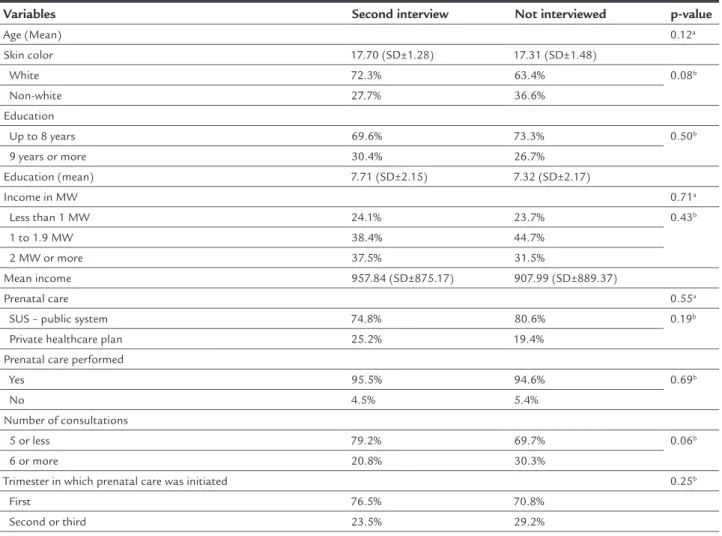
ESULTSrefused to participate in the study and 27 (6.1%) were excluded. It should be noted that, according to the data collected in 2010, there was no significant statistical dif-ference regarding socioeconomic and prenatal factors among re-interviewed and non-interviewed mothers in the present study (Table 1).
The pregnancy recurrence rate was 53.6% (60/112). The mean recurrence time was 28.7 months (SD±12.7), and two years after the first birth, half of these adolescents (30/60) were pregnant again, while after three years, the rate increased to 80% (46/60).
Regarding the characteristics of the adolescents ob-tained in the perinatal study of 2010, it is observed that the sample was predominantly formed by women over 17 years of age at delivery (81.2%), with skin color self-report-ed as white (70.5 %), and who livself-report-ed with a partner during
pregnancy (68.8%). The age of the child’s father ranged from 16 to 45 years (mean of 23.2 years, SD±5.1). Regard-ing education, 60 women (53.6%) studied seven years or less, most did not study when they became pregnant (56.2%) and of the 49 women who studied, 27 (55.1%) stopped studying. After analyzing these variables simul-taneously, we observed that almost five out of six par-ticipants (80.4%) were no longer studying or interrupted their studies. The majority of the participants (57.7%) had income equal to or less than one minimum wage. We found a predominance (69.6%) of young women who did not perform paid work at the time of delivery. The age of the mother of the participant when their first child was born ranged from 13 to 32 years (mean of 19.4 years and SD±4.2). We found that 95.5% of the women had prenatal care, 77.4% of them started in the first trimester,
TABLE 1 Comparison of socioeconomic and prenatal factors among adolescent mothers interviewed a second time and those not interviewed for the study “Recurrence in gestation and associated factors in adolescents in Southern Brazil,” according to data provided in 2010.
Variables Second interview Not interviewed p-value
Age (Mean) 0.12a
Skin color 17.70 (SD±1.28) 17.31 (SD±1.48)
White 72.3% 63.4% 0.08b
Non-white 27.7% 36.6%
Education
Up to 8 years 69.6% 73.3% 0.50b
9 years or more 30.4% 26.7% Education (mean) 7.71 (SD±2.15) 7.32 (SD±2.17)
Income in MW 0.71a
Less than 1 MW 24.1% 23.7% 0.43b
1 to 1.9 MW 38.4% 44.7%
2 MW or more 37.5% 31.5%
Mean income 957.84 (SD±875.17) 907.99 (SD±889.37)
Prenatal care 0.55a
SUS – public system 74.8% 80.6% 0.19b
Private healthcare plan 25.2% 19.4% Prenatal care performed
Yes 95.5% 94.6% 0.69b
No 4.5% 5.4%
Number of consultations
5 or less 79.2% 69.7% 0.06b
6 or more 20.8% 30.3%
Trimester in which prenatal care was initiated 0.25b
First 76.5% 70.8%
Second or third 23.5% 29.2%
with a mean of 2.7 months (SD±1.1) of pregnancy and 7.7 (SD±2.5) medical consultations, on average. According to Takeda’s criteria, prenatal care was considered adequate in 80 (76.2%) of the participants. Vaginal delivery was the most prevalent (54.5%), and the mean weight of the new-born was 3.0 kg.
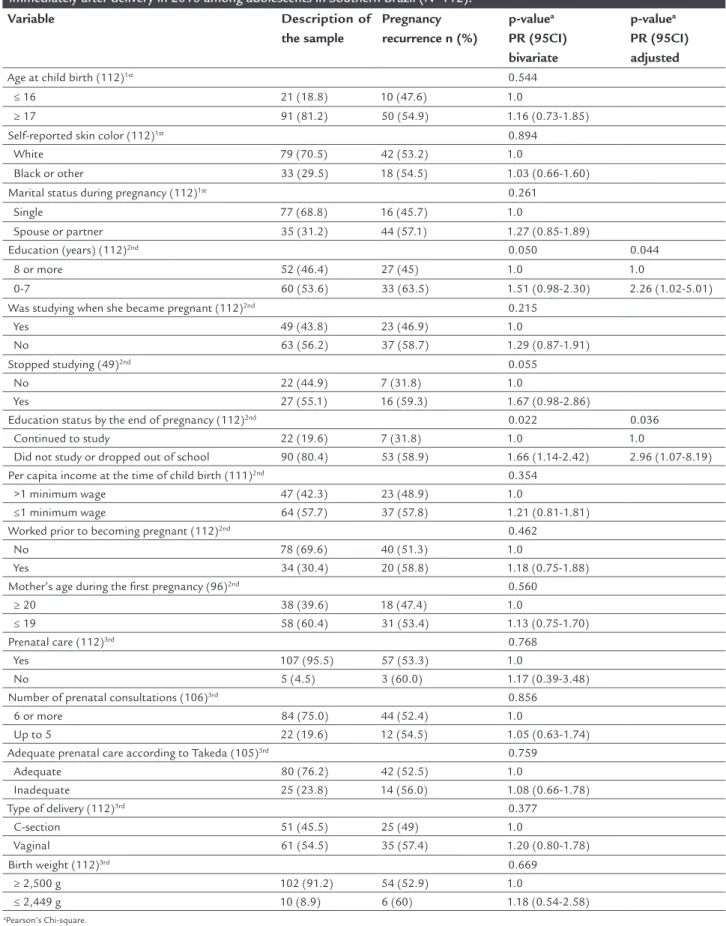
In Table 2, after the adjusted analysis, it is clear that adolescents with seven years or less of formal education presented twice the risk of conceiving again than those with a longer education (PR 2.26; 95CI 1.02-5.01), where-as those who did not study before becoming pregnant or who left school during pregnancy had a three times great-er risk of a new pregnancy compared to those who nevgreat-er left school (PR 2.96; 95CI 1.07-8.19).
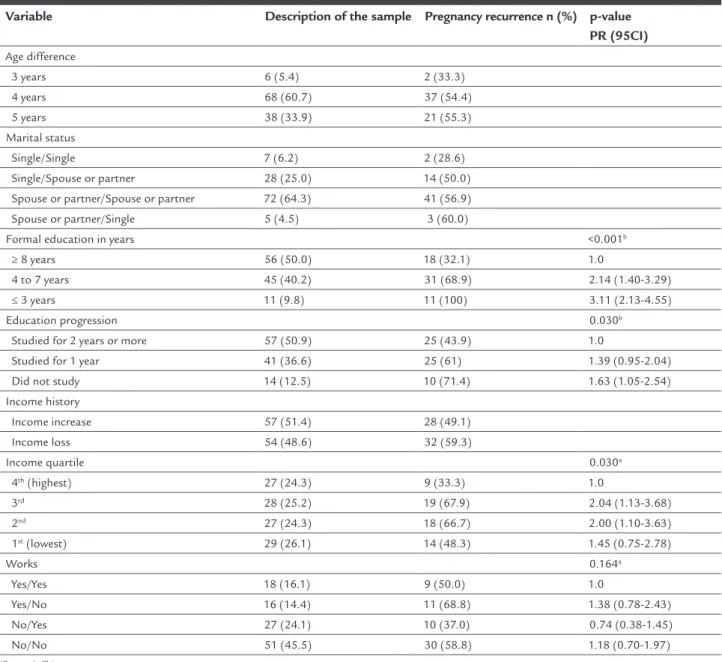
The data in Table 3 refer to the characteristics of par-ticipants after the second interview in 2014. In 2014, the mean age was 22 years with SD±1.53. As for marital status, 89.3% have a spouse or partner who is the father of the child in 59.8% of cases. The proportion of women with a per capita income less than a minimum wage increased to 82.1% over the four years of follow-up. The proportion of participants who did not perform paid work fell to 59.9%. Young mothers who had 4 to 7 years of education in 2014 had a two-fold increased risk of another preg-nancy, whereas participants with three years or less of study had a three-fold higher risk compared to mothers who studied for 8 years or more. After the adjusted anal-ysis for demographic data (age and color) and socioeco-nomic status (income), we found that, for each year stud-ied, there is a 16% protection against a new pregnancy (PR 0.84; 95CI 0.79-0.88 and p-value<0.001). Participants classified in the 2nd and 3rd quartiles of income had two
times greater risk of new pregnancy compared to women of the highest income quartile.
D
ISCUSSIONThe recurrence of gestation in adolescents presents contrasts in different regions of the world.8 The recurrence rate in
our study, 53.6%, is higher than the 31.5% (58/193) found in a study conducted in the United States with adolescents aged 13 to 19 years who were interviewed immediately after delivery.12 Mphastswe et al.,4 while investigating 341
South African adolescents aged 13 to 19 who were in the postpartum period, found that 60 (17.6%) of these women had had recurrent pregnancies after a minimum of 12 months and a maximum of 60 months. In Brazil, Silva et al.11 analyzed all the statements of liveborn children of
adolescents between 10 and 19 years old, in the city of Rio de Janeiro in 2005, and found that 29.1% (3,542/12,168) of these births were the result of recurrent pregnancy.
Our study evaluated the recurrence of pregnancy in adolescents over a four-year period, unlike most studies, which include two-year periods.2,6,8,20,21 Thus, it is possible
to affirm that most of the studies only evaluate rates of RRP. It is estimated that between 10 and 50% of adoles-cents become pregnant again 24 months after a previous birth.12 In our sample, the mean time to a new pregnancy
was 28.9 months, with an RRP rate of 26.8% (30/112). This value is similar to the 25.9% (120/464) found by Nery et al.20 in young mothers aged between 17 and 22 years
in the city of Teresina (capital of the state of Piauí) and the 35.4% (62/175) detected by Nery et al.21 in five
mu-nicipalities in the state’s countryside. A study with data from the declarations of live births in the city of Rio de Janeiro, for the year 2002, identified an RRP rate of 5.2% (809/15,636) in adolescents aged between 10 and 19 years.8
On the other hand, a study conducted in the United States with adolescents aged 15 to 19 found an RRP rate of 67.1% (89/133).2 It is important to note that, in our study, the
longer investigation allowed us to find twice as many pregnancy recurrences as we would have if follow-up was limited to two years. In three years of analysis, this rate increased from 50 to 80%. Thus, we hypothesize that the minimum interval of two years between pregnancies is not adequate for the adolescents, requiring a longer study time to investigate the recurrence of gestation in youth.
In relation to the characteristics collected in the year 2010, school dropout was significantly associated with recurrence of pregnancy. This is corroborated by other studies that point to formal education as the main factor associated with recurrence of pregnancy or lack there-of.8,11,20,21 A study conducted in the United States with
193 adolescents between the ages of 13 and 19 years found that 77% of the girls had not finished high school.12
Sim-ilar to these data, our study showed that 75% of the ado-lescents with recurrence had up to eight years of study in the previous pregnancy. It was also observed that adoles-cents who did not study or stopped studying at the end of gestation were three times more likely to have a recur-rent pregnancy compared to adolescents who remained studying. With the responsibilities of motherhood arising, many adolescents dropped out of school after getting pregnant.21 Thus, it is possible to assume that young
people who drop out of school early do not present the autonomy necessary to avoid a recurrent pregnancy. In addition, the lack of academic aspirations can be one of the factors causing school dropout and, indirectly, the recurrence of pregnancy in adolescents.10
TABLE 2 Analysis of factors associated with recurrence of pregnancy up to 2014 in relation to variables collected immediately after delivery in 2010 among adolescents in Southern Brazil (N=112).
Variable Description of
the sample
Pregnancy recurrence n (%)
p-valuea
PR (95CI) bivariate
p-valuea
PR (95CI) adjusted
Age at child birth (112)1st 0.544
≤ 16 21 (18.8) 10 (47.6) 1.0
≥ 17 91 (81.2) 50 (54.9) 1.16 (0.73-1.85) Self-reported skin color (112)1st 0.894
White 79 (70.5) 42 (53.2) 1.0
Black or other 33 (29.5) 18 (54.5) 1.03 (0.66-1.60) Marital status during pregnancy (112)1st 0.261
Single 77 (68.8) 16 (45.7) 1.0
Spouse or partner 35 (31.2) 44 (57.1) 1.27 (0.85-1.89)
Education (years) (112)2nd 0.050 0.044
8 or more 52 (46.4) 27 (45) 1.0 1.0
0-7 60 (53.6) 33 (63.5) 1.51 (0.98-2.30) 2.26 (1.02-5.01) Was studying when she became pregnant (112)2nd 0.215
Yes 49 (43.8) 23 (46.9) 1.0
No 63 (56.2) 37 (58.7) 1.29 (0.87-1.91) Stopped studying (49)2nd 0.055
No 22 (44.9) 7 (31.8) 1.0
Yes 27 (55.1) 16 (59.3) 1.67 (0.98-2.86)
Education status by the end of pregnancy (112)2nd 0.022 0.036
Continued to study 22 (19.6) 7 (31.8) 1.0 1.0
Did not study or dropped out of school 90 (80.4) 53 (58.9) 1.66 (1.14-2.42) 2.96 (1.07-8.19) Per capita income at the time of child birth (111)2nd 0.354
>1 minimum wage 47 (42.3) 23 (48.9) 1.0
≤1 minimum wage 64 (57.7) 37 (57.8) 1.21 (0.81-1.81) Worked prior to becoming pregnant (112)2nd 0.462
No 78 (69.6) 40 (51.3) 1.0
Yes 34 (30.4) 20 (58.8) 1.18 (0.75-1.88) Mother’s age during the irst pregnancy (96)2nd 0.560
≥ 20 38 (39.6) 18 (47.4) 1.0
≤ 19 58 (60.4) 31 (53.4) 1.13 (0.75-1.70) Prenatal care (112)3rd 0.768
Yes 107 (95.5) 57 (53.3) 1.0
No 5 (4.5) 3 (60.0) 1.17 (0.39-3.48) Number of prenatal consultations (106)3rd 0.856
6 or more 84 (75.0) 44 (52.4) 1.0
Up to 5 22 (19.6) 12 (54.5) 1.05 (0.63-1.74) Adequate prenatal care according to Takeda (105)3rd 0.759
Adequate 80 (76.2) 42 (52.5) 1.0
Inadequate 25 (23.8) 14 (56.0) 1.08 (0.66-1.78) Type of delivery (112)3rd 0.377
C-section 51 (45.5) 25 (49) 1.0
Vaginal 61 (54.5) 35 (57.4) 1.20 (0.80-1.78) Birth weight (112)3rd 0.669
≥ 2,500 g 102 (91.2) 54 (52.9) 1.0
≤ 2,449 g 10 (8.9) 6 (60) 1.18 (0.54-2.58)
aPearson’s Chi-square.
Minimum wage in 2010: BRL 511.00.
TABLE 3 Analysis of factors associated with recurrence of pregnancy up to 2014 in relation to variables collected over four years of study among adolescents in Southern Brazil (N=112).
Variable Description of the sample Pregnancy recurrence n (%) p-value
PR (95CI)
Age difference
3 years 6 (5.4) 2 (33.3) 4 years 68 (60.7) 37 (54.4) 5 years 38 (33.9) 21 (55.3) Marital status
Single/Single 7 (6.2) 2 (28.6) Single/Spouse or partner 28 (25.0) 14 (50.0) Spouse or partner/Spouse or partner 72 (64.3) 41 (56.9) Spouse or partner/Single 5 (4.5) 3 (60.0)
Formal education in years <0.001b
≥ 8 years 56 (50.0) 18 (32.1) 1.0
4 to 7 years 45 (40.2) 31 (68.9) 2.14 (1.40-3.29) ≤ 3 years 11 (9.8) 11 (100) 3.11 (2.13-4.55)
Education progression 0.030b
Studied for 2 years or more 57 (50.9) 25 (43.9) 1.0
Studied for 1 year 41 (36.6) 25 (61) 1.39 (0.95-2.04) Did not study 14 (12.5) 10 (71.4) 1.63 (1.05-2.54) Income history
Income increase 57 (51.4) 28 (49.1) Income loss 54 (48.6) 32 (59.3)
Income quartile 0.030a
4th (highest) 27 (24.3) 9 (33.3) 1.0
3rd 28 (25.2) 19 (67.9) 2.04 (1.13-3.68)
2nd 27 (24.3) 18 (66.7) 2.00 (1.10-3.63)
1st (lowest) 29 (26.1) 14 (48.3) 1.45 (0.75-2.78)
Works 0.164a
Yes/Yes 18 (16.1) 9 (50.0) 1.0
Yes/No 16 (14.4) 11 (68.8) 1.38 (0.78-2.43) No/Yes 27 (24.1) 10 (37.0) 0.74 (0.38-1.45) No/No 51 (45.5) 30 (58.8) 1.18 (0.70-1.97)
aPearson’s Chi-square. bLinear Trend test.
Minimum wage in 2014: BRL 788.00.
with recurrence of pregnancy. As mentioned above, low formal education is a risk factor for recurrent teenage preg-nancy.8 Similarly to our investigation, Silva et al.,11 after
analyzing the pregnancy rate in 12,168 adolescents in the city of Rio de Janeiro, also found a linear trend between education and the number of recurrences, so that girls with less education were more likely to have recurrent pregnan-cies. Therefore, formal education is presented as the main variable to solve the social problem of teenage pregnancy.21
Our research has shown that every additional year of study in a girl’s life provides increased protection against recurrence of pregnancy. This finding is in agreement with
the scientific literature that assumes that the longer the girls continue to study, the more topics related to sexual-ity are addressed, allowing their empowerment regarding contraceptive methods.8 In addition, it was not only the
years of study that influenced the rate of recurrence, but also school progression in those four years. The more years of study these girls have after delivery, the lower the risk of recurrence, reinforcing the hypothesis that continuing to study is imperative to avoid new pregnancies.
Similarly to other studies,21,22 the recurrence of
belong-ing to the second and third income quartiles are twice as likely to have recurrence compared to the young women classified in the highest quartile. However, these data are contradictory, since the increase in expenses after the birth of a second child increases the pressure for increasing income. One possible explanation for this is the fact that young women from lower socioeconom-ic backgrounds may desire family stability that they associate with pregnancy as an alternative to the absence of other projects.23
The fact that formal education (or lack of it) is clearly associated with recurrence reinforces this proposition. In our study, 56.2% of the analyzed group was no longer in school when they became pregnant, and 57.7% had stud-ied for eight years or less, suggesting that school really is the first barrier against teenage pregnancy. Legally, pregnant adolescents have the support of Law No. 6,202 of 1975, which stipulates that from the eighth month on, or before that, depending on medical orders, these girls have a right to be home-schooled, being assured a rest period before and after delivery without interfering with their final ex-ams.24 Thus, school and teachers should provide
condi-tions to ensure the continuation of studies of pregnant adolescents in accordance with the legislation, as well as strengthen the discussion about consequences of a recur-rent pregnancy.
In addition to the family and school, health profes-sionals also have a responsibility to address this issue with adolescents and fail to do so. In our study, 79% of these girls had more than six medical visits during prenatal care, with a mean of 7.7. Health professionals need to recognize moments such as puerperal and pediatric con-sultations and children’s immunization days as oppor-tunities for comprehensive care, debating and instructing these young women about the importance of studying and working, as well as discussing contraception. Health workers can help reduce recurrent teenage pregnancy because they have more interaction with the community, so they are essential in identifying vulnerable, low-income youth who are not studying or working. These profes-sionals have the opportunity to focus their actions and their dialogues on contraception according to the reality of life of these young women.
Limitations of the study included difficulties in trac-ing participants due to address changes and/or loss of contact by the researchers, which may result in selection bias. Although telephone contact is a simple and virtu-ally universal form of access, it is common to change numbers, not to mention incorrect numbers or blocked line, which is a problem faced in several studies.22,25
Fi-nally, the sample size calculation was performed only for recurrent pregnancy rate, so that non-significant associations may be a result of the lack of statistical power of the sample. Nevertheless, it is important to highlight that the recurrent pregnancy rate was higher than that described in other articles that also had this limitation,21,22 highlighting the epidemiological
impor-tance of this data.
Despite the above limitations, we can conclude that recurrence of pregnancy in adolescence and youth rep-resents the low value given to formal education, a fact that mitigates the experience of opportunities and hin-ders insertion in the labor market, creating a cycle of social inequality. It is imperative to join multidisciplinary efforts in schools and health services, including young people in educational actions aimed at favoring critical thinking to transform reality.
R
ESUMORecorrência de gestação em adolescentes do extremo sul do Brasil
Objetivo: Determinar a recorrência de gravidez em
ado-lescentes de um município no extremo sul do Brasil e identificar os fatores associados.
Método: Participaram 112 mulheres que tiveram filho em
2010, quando eram adolescentes. A amostra foi estudada em dois estágios, sendo no primeiro por meio de um cen-so do município e no segundo por uma seleção de conve-niência. Para análise estatística, foi utilizado o teste Qui--quadrado de Pearson com nível de significância de 5%.
Resultados: A taxa de recorrência de gravidez
encontra-da foi de 53,6% com tempo médio de 28,6 meses. No mo-mento do parto, em 2010, estiveram significativamente associados à recorrência a escolaridade (p=0,044) e o fato de não estar estudando (p=0,036). Em 2014, foram a es-colaridade (p<0,001), o histórico escolar (p=0,030) e a renda (p=0,030).
Conclusão: A recorrência de gravidez na adolescência
representa a pouca valorização da educação formal, o que mitiga a vivência de oportunidades e dificulta a inserção no mercado de trabalho, criando um ciclo de desigualda-de social. É imprescindível unir esforços multidisciplina-res nas escolas e nos serviços de saúde, em conjunto com os jovens, em ações educativas que visem a uma relação crítica reflexiva transformadora da realidade.
Palavras-chave: comportamento sexual, gravidez na
R
EFERENCES1. Whitaker R, Hendry M, Aslam R, Booth A, Carter B, Charles JM, et al. Intervention Now to Eliminate Repeat Unintended Pregnancy in Teenagers (INTERRUPT): a systematic review of intervention effectiveness and cost effectiveness, and qualitative and realist synthesis of implementation factors and user engagement. Health Technol Assess. 2016; 20(16):1-214. 2. Gemmill A, Lindberg LD. Short interpregnancy intervals in the United
States. Obstet Gynecol. 2013; 122(1):64-71.
3. World Health Organization (WHO). Pregnant adolescents: delivering on global promises of hope. Geneva: WHO Document Production Services; 2006.
4. Mphatswe W, Maise H, Sebitloane M. Prevalence of repeat pregnancies and associated factors among teenagers in Kwa Zulu-Natal, South Africa. Int J Gynecol Obstet. 2016; 133(2):152-5.
5. Vaz RF, Monteiro DLM, Rodrigues NCP. Trends of teenage pregnancy in Brazil, 2000-2011. Rev Assoc Med Bras. 2016; 62(4):330-5.
6. Finigan-Carr NM, Murray KW, O’Connor JM, Rushovich BR, Dixon DA, Barth RP. Preventing rapid repeat pregnancy and promoting positive parenting among young mothers in foster care. Soc Work Public Health. 2015; 30(1):1-17.
7. Cha S, Chapman DA, Wan W, Burton CW, Masho SW. Discordant pregnancy intentions in couples and rapid repeat pregnancy. Am J Obstet Gynecol. 2016; 214(4):494.e1-12.
8. Vieira CL, Flores PV, de Camargo KR, Pinheiro RS, Cabral CS, Aguiar FP, et al. Rapid repeat pregnancy in Brazilian adolescents: interaction between maternal schooling and age. J Pediatr Adolesc Gynecol. 2016; 29(4):382-5. 9. Damle LF, Gohari AC, McEvoy AK, Desale SY, Gomez-Lobo V. Early initiation of postpartum contraception: does it decrease rapid repeat pregnancy in adolescents? J Pediatr Adolesc Gynecol. 2015; 28(1):57-62.
10. Nerlander LM, Callaghan WM, Smith RA, Barfield WD. Short interpregnancy interval associated with preterm birth in US adolescents. Matern Child Health J. 2015; 19(4):850-8.
11. Silva KSD, Rozenberg R, Bonan C, Chuva VCC, Costa SFD, Gomes MASM. Gravidez recorrente na adolescência e vulnerabilidade social no Rio de Janeiro (RJ, Brasil): uma análise de dados do Sistema de Nascidos Vivos. Ciênc Saúde Coletiva. 2011; 16(5):2485-93.
12. Anderson CA, Pierce L. Depressive symptoms and violence exposure: contributors to repeat pregnancies among adolescents. J Perinat Educ. 2015; 24(4):225-38.
13. Conroy KN, Engelhart TG, Martins Y, Huntington NL, Snyder AF, Coletti KD, et al. The enigma of rapid repeat pregnancy: a qualitative study of teen mothers. J Pediatr Adolesc Gynecol. 2016; 29(3):312-7.
14. Brasil. Instituto Brasileiro De Geografia E Estatística (IBGE). Rio Grande do Sul – Rio Grande [cited 2016 Apr 19]. Available from: http://cidades.ibge. gov.br/xtras/perfil.php?codmun=431560.
15. World Health Organization (WHO). Young People’s Health - a Challenge for Society. Report of a WHO Study Group on Young People and Health for All. Technical Report Series 731. Geneva: WHO Document Production Services; 1986.
16. Epi-info. Version 6.04. Atlanta: Centers for Disease Control and Prevention (CDC); 2001.
17. OMS – Organização Mundial da Saúde. Nossas prioridades: Adolescentes. Brasília: UNICEF; 2011.
18. IBM SPSS Statistics for Windows. Version 20. Armonk (NY): IBM Corp; 2011.
19. Victora CG, Huttly SR, Fuchs SC, Olinto MT. The role of conceptual frameworks in epidemiological analysis: a hierarchical approach. Int J Epidemiol. 1997; 26(1):224-7.
20. Nery IS, Mendonça RCM, Gomes IS, Fernandes ACN, Oliveira DC. Reincidência da gravidez em adolescentes de Teresina, PI, Brasil. Rev Bras Enferm. 2011; 64(1):31-7.
21. Nery IS, Gomes KRO, Barros IC, Gomes IS, Fernandes ACN, Viana LMM. Fatores associados à reincidência de gravidez após gestação na adolescência no Piauí, Brasil. Epidemiol Serv Saúde. 2015; 24(4):671-80.
22. Silva AAA, Coutinho IC, Katz L, Souza ASR. Fatores associados à recorrência da gravidez na adolescência em uma maternidade escola: estudo caso-controle. Cad Saúde Pública. 2013; 29(3):496-506.
23. Dias ACG, Patias ND, Fiorin PC, Dellatorre MZ. O significado da maternidade na adolescência para novas gestantes. RBHCS. 2011; 3(6):153-67. 24. Brasil. Lei Nº 6.202 de 17 de abril de 1975. Lei de direitos da estudante
gestante. Diário Oficial da União 1975; 17 abr.