Lung hyperinlation by mechanical ventilation
versus isolated tracheal aspiration in the bronchial
hygiene of patients undergoing mechanical
ventilation
INTRODUCTION
Mechanical ventilation (MV) aims to reverse or prevent respiratory muscle fatigue, reduce muscular work and consumption of oxygen and maintain gas exchange. MV also thereby reduces respiratory distress and allows speciic treatments to be applied.(1)
Patients are subject not only to the beneits of this support but also to various risk factors, such as the development of mechanical ventilation-associated pneumonia (VAP).(2) VAP is one of the main factors contributing to increases in mortality, length of stay in the intensive care unit (ICU), overall hospitalization time and health-related costs.(2,3)
Tracheal intubation, immobility imposed on the patient for sedation and general weakness with diminished cough efectiveness reduce mucociliary transport and promote the retention of secretions in the airway.(2,4) Lung secretion Crisiela Brum Assmann1, Paulo José Cardoso
Vieira2, Fernanda Kutchak2,3, Marcelo de Mello Rieder1,2, Soraia Genebra Ibrahim Forgiarini1, Luiz Alberto Forgiarini Junior1
1. Centro Universitário Metodista - IPA - Porto Alegre (RS), Brazil.
2. Hospital Cristo Redentor - Porto Alegre (RS), Brazil.
3. Universidade do Vale dos Sinos - Porto Alegre (RS), Brazil.
Objective: To determine the eicacy of lung hyperinlation maneuvers via a mechanical ventilator compared to isolated tracheal aspiration for removing secretions, normalizing hemodynamics and improving lung mechanics in patients on mechanical ventilation.
Methods: his was a randomized crossover clinical trial including patients admitted to the intensive care unit and on mechanical ventilation for more than 48 hours. Patients were randomized to receive either isolated tracheal aspiration (Control Group) or lung hyperinlation by mechanical ventilator (MVH Group). Hemodynamic and mechanical respiratory parameters were measured along with the amount of aspirated secretions.
Results: A total of 50 patients were included. he mean age of the patients
Conflicts of interest: None.
Submitted on November 6, 2015 Accepted on January 25, 2016
Corresponding author:
Luiz Alberto Forgiarini Junior Centro Universitário Metodista - IPA Rua Coronel Joaquim Pedro Salgado, 80 - Rio Branco
Zip code: 90420-060 - Porto Alegre (RS), Brazil E-mail: [email protected]
Responsible editor: Carmen Valente Barbas
Hiperinsulação pulmonar com ventilador mecânico versus
aspiração traqueal isolada na higiene brônquica de pacientes
submetidos à ventilação mecânica
ABSTRACT
Keywords: Respiration, artiicial; Suction; Pulmonary ventilation; Intensive care units
was 44.7 ± 21.6 years, and 31 were male. Compared to the Control Group, the MVH Group showed greater aspirated secretion amount (3.9g versus 6.4g, p = 0.0001), variation in mean dynamic compliance (-1.3 ± 2.3 versus -2.9 ± 2.3; p = 0.008), and expired tidal volume (-0.7 ± 0.0 versus -54.1 ± 38.8, p = 0.0001) as well as a signiicant decrease in peak inspiratory pressure (0.2 ± 0.1 versus 2.5 ± 0.1; p = 0.001).
Conclusion: In the studied
sample, the MVH technique led to a greater amount of aspirated secretions, signiicant increases in dynamic compliance and expired tidal volume and a signiicant reduction in peak inspiratory pressure.
buildup can cause increased airway resistance and partial or total airway obstruction, with consequent alveolar hypoventilation and the development of atelectasis and hypoxemia and increased efort needed to breathe.(5,6) he care of these patients includes tracheal aspiration, which is used to facilitate the removal of secretions from the airway. However, when applied alone, tracheal aspiration can be inefective and may clear only a small portion of the airway.(7)
here are some physical therapy techniques aimed
at bronchial hygiene and that thus prevent bronchial
obstruction by secretion buildup. Among these techniques are the use of positive pressure devices, including lung
hyperinlation using a mechanical ventilator (MVH).(8)
his technique consists of the administration of high tidal volumes, either by progressively increasing support pressure
until a peak pressure of 40cmH2O is achieved in the
airway or by increasing positive end-expiratory pressure
(PEEP).(9) MVH promotes the expansion of collapsed
alveoli, increasing air low to areas with atelectasis through collateral channels and surfactant renewal in the alveoli. his technique also aims to increase the elastic potential of lung recoil and peak expiratory low, resulting in the mobilization of lung secretions from the periphery of the lungs to more central regions.(9-11)
he objective of this study was to determine the eicacy of lung hyperinlation maneuvers using a mechanical ventilator compared to isolated tracheal aspiration for removing secretions, normalizing hemodynamics and improving lung mechanics in patients on mechanical ventilation.
METHODS
his was a randomized crossover clinical trial developed in the ICU of the Hospital Cristo Redentor, which belongs
to the Grupo Hospitalar Conceição in Porto Alegre (RS),
Brazil. he study was approved by the Centro Universitário Metodista (IPA) Research Ethics Committee under protocol number 1,048,322. All the responsible parties for the participating patients signed a free and informed consent form.
From May to September 2015, all ICU patients who were on MV for more than 48 hours without a diagnosis of
VAP and with PEEP ≤ 10cmH2O and who had undergone
aspiration 2 hours before application of the protocol and were hemodynamically stable (mean arterial pressure ≥ 60 and ≤ 120mmHg) were included in the study. Patients with contraindications for increased positive pressure were excluded, such as those with undrained pneumothorax
and hemothorax or subcutaneous emphysema, those with
peak pressure > 40cmH2O and neurosurgical patients.
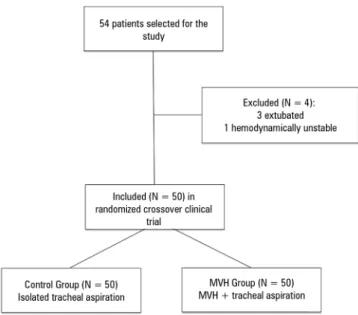
hus, 54 patients were initially included in the study; 4 were then excluded, 3 due to being extubated before the conclusion of the protocol and 1 due to hemodynamic instability (Figure 1).
Figure 1 - Flowchart of patients included in the study. MVH - lung hyperinflation by mechanical ventilation.
All 50 patients who met the inclusion criteria were evaluated and randomized into groups receiving isolated tracheal aspiration (Control Group) or lung hyperinlation by mechanical ventilation (MVH Group). Randomization was performed using blocks of sealed envelopes allocating each patient to the irst technique to be performed. After 24 hours, the patient underwent the other technique; thus, all patients underwent both techniques.
Aspiration was performed 2 hours before the patient underwent each technique to equate the groups in relation to secretion volumes. To this end, patients were placed in the supine position with the head elevated to 30º and were subjected to aspiration on a single occasion (probe number
12; MarkMed®
Ind e Com. Ltda, São Paulo, Brazil) with a
vacuum adjusted to a pressure of -40cmH2O.
he patients randomized to the Control Group were ventilated for 1 minute with a fraction of inspired oxygen
(FiO2) of 100%. Each patient was then removed from
the ventilator and subjected to three rounds of aspiration, each lasting 15 seconds. he aspirated secretions were stored in a collection bottle (Intermedical®
Setmed, São Paulo, Brazil). Changes in hemodynamic and lung parameters were recorded prior to the application of the technique and immediately after the aspirations.
Patients randomized to the MVH Group were placed in the supine position with the head elevated to 30º. In ventilatory pressure mode, inspiratory pressure was
increased by 10cmH2O. In volume ventilation mode, the
ideal tidal volume of each patient was calculated, and the tidal volume was consequently increased by 50% for a 10-minute period while ensuring that the peak inspiratory
pressure (PIP) did not exceed 40cmH2O. he patients
were subjected to aspiration, and secretions were collected in the same manner as for the Control Group patients.
Before and immediately after the application of each technique, lung and hemodynamic parameters were evaluated. In both groups, the aspirate was weighed in the same manner by a blinded operator using a high-precision balance (E.clear, Origin: PCR, Import: Bravo Brasil Com. Imp. Exp. Ltd.).
Hemodynamic parameters such as heart rate, respiratory rate, mean arterial pressure and peripheral oxygen saturation were recorded using a multiparameter
monitor (Ininity®
Kappa, Dräger, Germany). Respiratory function was evaluated before and after the techniques were applied by measuring PIP, expired tidal volume (ETV) and dynamic compliance (Cdyn). he delta values (Δ) were calculated as the diference between the initial and inal lung hemodynamic parameters.
Statistical analysis
All continuous data are presented as means and standard deviations, and categorical data are presented as absolute values and percent frequencies. Normality was evaluated using the Shapiro-Wilk test. Student’s t-test for paired measures was used to compare groups, and intergroup
comparisons were performed using Student’s t-test for
independent measures. All data were stored and analyzed using the Statistical Package for the Social Sciences (SPSS) for Windows, version 17.0, and a signiicance level of 0.05 was adopted.
RESULTS
he study included 50 individuals who were treated between May and September 2015. here was a predominance of male patients. he patients’ mean age was 44.7 ± 21.6 years, and the predominant pathology was traumatic brain injury (Table 1).
Table 1 - Clinical characteristics of the sample
Variable N = 50
Age (years) 44.7 ± 21.6
Male 31 (62)
Conditions
Brain injury 8 (16)
Burn 6 (12)
Stab wound 5 (10)
Subarachnoid hemorrhage 7 (14)
Fracture 4 (8)
Stroke 4 (8)
Brain tumor 3 (6)
Intracerebral hemorrhage 3 (6)
Others* 10 (20)
* Others - septic shock, focal trauma, acute myocardial infarction, intra-abdominal organ trauma, hydrocephalus and sensory loss, head trauma, firearm injury and diffuse paresis. The results are expressed as the mean ± standard deviation or as number (%).
Figure 2 - Amounts of aspirated secretions in the Control and MVH Groups, * p < 0.0001 (aspiration 3.9 ± 2.6 and MVH 6.4 ± 2.6). MVH - lung hyperinflation by mechanical ventilation.
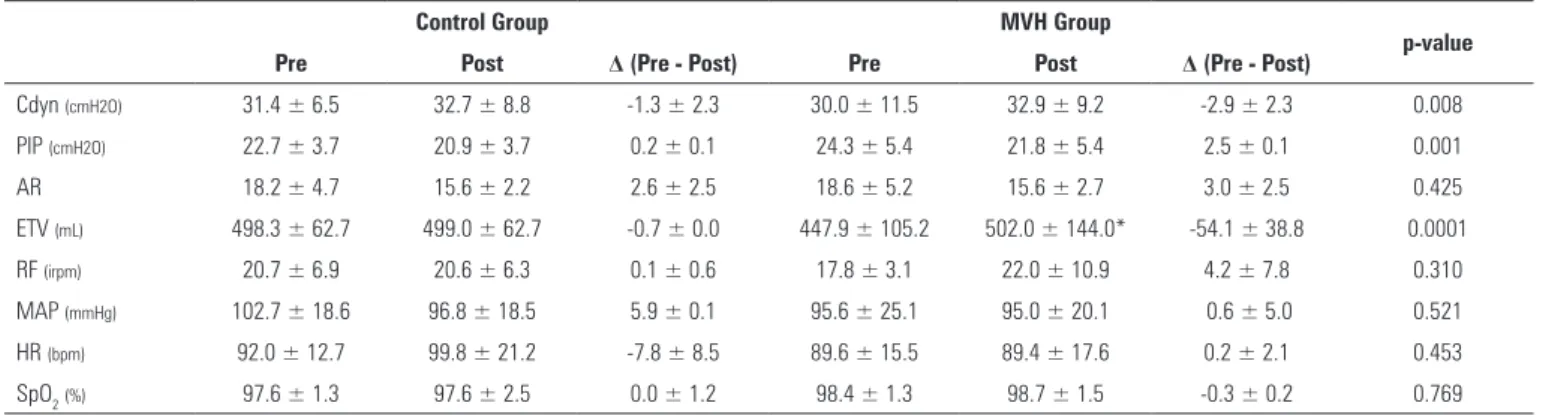
Signiicant diferences in hemodynamic variables were observed between the Control Group and the MVH Group. here were signiicant increases in Cdyn and ETV in the MVH Group compared to the Control Group. In the MVH Group, ETV also increased signiicantly immediately after the intervention compared to the period before the intervention.
here was a signiicant reduction in PIP variation in the MVH Group compared to the controls. No other variations in the analyzed parameters difered signiicantly between the groups (Table 2).
Table 2 - Comparison of variations in hemodynamic and lung parameters in the sample
Control Group MVH Group
p-value Pre Post Δ (Pre - Post) Pre Post Δ (Pre - Post)
Cdyn (cmH2O) 31.4 ± 6.5 32.7 ± 8.8 -1.3 ± 2.3 30.0 ± 11.5 32.9 ± 9.2 -2.9 ± 2.3 0.008
PIP (cmH2O) 22.7 ± 3.7 20.9 ± 3.7 0.2 ± 0.1 24.3 ± 5.4 21.8 ± 5.4 2.5 ± 0.1 0.001
AR 18.2 ± 4.7 15.6 ± 2.2 2.6 ± 2.5 18.6 ± 5.2 15.6 ± 2.7 3.0 ± 2.5 0.425
ETV (mL) 498.3 ± 62.7 499.0 ± 62.7 -0.7 ± 0.0 447.9 ± 105.2 502.0 ± 144.0* -54.1 ± 38.8 0.0001
RF (irpm) 20.7 ± 6.9 20.6 ± 6.3 0.1 ± 0.6 17.8 ± 3.1 22.0 ± 10.9 4.2 ± 7.8 0.310
MAP (mmHg) 102.7 ± 18.6 96.8 ± 18.5 5.9 ± 0.1 95.6 ± 25.1 95.0 ± 20.1 0.6 ± 5.0 0.521
HR (bpm) 92.0 ± 12.7 99.8 ± 21.2 -7.8 ± 8.5 89.6 ± 15.5 89.4 ± 17.6 0.2 ± 2.1 0.453
SpO2(%) 97.6 ± 1.3 97.6 ± 2.5 0.0 ± 1.2 98.4 ± 1.3 98.7 ± 1.5 -0.3 ± 0.2 0.769
MVH - lung hyperinflation by mechanical ventilation; Cdyn - dynamic compliance; PIP - peak inspiratory pressure; AR - airway resistance; ETV - expired tidal volume; RF - respiratory frequency; MAP - mean arterial pressure; HR - heart rate; SpO2 - peripheral oxygen saturation. * p = 0.03.
DISCUSSION
In this study, the use of MVH by applying increased
support pressure of 10cmH2O or 50% tidal volume over
a period of 10 minutes resulted in increases in Cdyn and ETV and a reduction in PIP. his technique also led to greater aspiration of secretions compared with the Control Group.
he male gender was predominant (62% of the sample). his inding corroborates published reports addressing the
proiles of patients admitted to Brazilian ICU.(12) Among
the conditions encountered, head injuries were found in 38% of the sample, which is explained by the study site being a trauma reference hospital. his inding is similar to that of an ICU with the same clinical proile.(13)
Studies show that the lung hyperinlation technique in mechanically ventilated critically ill patients provides increased secretion removal, re-expansion of atelectatic areas and improved lung compliance and oxygenation.(14,15) his technique can be performed either by the manual hyperinlation technique (delivering a higher base tidal
volume and a peak airway pressure of up to 40cmH2O
using a manual resuscitator) or by MVH (changing the ventilation parameters on the mechanical ventilator). he ideal tidal volume for each patient should be calculated assuming 6mL/kg of predicted weight, and to ensure a protective ventilatory strategy, this value should be re-evaluated according to the individual’s clinical evolution. Physical therapy techniques that involve high tidal volumes should apply a maximum airway pressure
of 40cmH2O to avoid barotrauma.(16,17) It is important
to note that the present study is one of the few in the literature to compare the MVH technique in isolation with tracheal aspiration; reports of associated techniques in such a procedure are common.(8,9)
In this study, the MVH technique increased ETV, Cdyn, and the volume of aspirated secretions compared to the Control Group. In a randomized crossover clinical trial with 34 patients on MV that compared isolated aspiration to MVH combined with the chest compression maneuver, the latter produced a greater amount of aspirated secretions, tidal volume (VT) and Cdyn compared with
isolated aspiration.(9) Lemes et al. compared MVH in
the lateral decubitus position to tracheal aspiration in the same position in 30 mechanically ventilated patients and found a greater amount of aspirated secretions and increased lung compliance in the former group. he increase in lung compliance is related to the re-expansion of collapsed alveoli, resulting in lung hyperinlation, which better distributes airlow.(8)
he increase in ETV that was demonstrated after application of the MVH technique may be related to the increase in airway pressure, which consequently generates increased lung volume. he increased ETV may also be the result of secretion removal, which reduces airway resistance and hence increases lung volume.(5,8)
he signiicant increase in Cdyn in the MVH Group observed in this study is supported by the literature(8,9,16) and may result from the opening of collapsed lung units.
he use of this technique was evaluated by Dennis et al., who conducted a prospective study evaluating the prevalence of MVH use by physical therapists in Australian ICU. Only 35% of the ICU used MVH, and the leading cause of non-use of the technique was a lack of training and knowledge. An important point is that MVH was applied by professionals in both spontaneous and controlled ventilation modes, similar to this study.(18)
patients. heir indings revealed no signiicant diference between the techniques in terms of volume of aspirated secretions, indicating that MVH has the same eicacy and safety as manual hyperinlation but has the advantage that the ventilator is not disconnected during execution
of the technique.(15) Another advantage of MVH over
manual hyperinlation is the possibility of maintaining PEEP levels; the literature shows that for displacement of secretions from the distal to central airways, the peak expiratory low should be 10% higher than the peak inspiratory low. MVH can also prevent contamination associated with disconnecting the ventilator circuit from
the patient. hus, in cases of increased PEEP and FiO2,
MVH should be preferentially applied over the manual hyperinlation technique.(14,18)
CONCLUSION
Lung hyperinlation using a ventilator as opposed to isolated tracheal aspiration in mechanically ventilated patients resulted in an increased amount of aspirated secretions. Following application of this technique, signiicant increases in expired tidal volume and dynamic compliance were recorded along with a signiicant decrease in peak inspiratory pressure.
Objetivo: Determinar a eicácia da manobra de hiperinsu-lação pulmonar com o ventilador mecânico, em comparação à aspiração traqueal isolada, para remover secreções, normalizar a hemodinâmica e melhorar a mecânica pulmonar em pacientes em ventilação mecânica.
Métodos: Ensaio clínico randomizado cruzado incluindo pacientes em ventilação mecânica por mais de 48 horas internados na unidade de terapia intensiva. Os pacientes foram randomizados para receber a aspiração traqueal isolada (Grupo Controle) e hiperinsulação pulmonar por meio do ventilador mecânico (Grupo HVM). Mensuraram-se parâmetros hemodinâmicos e de mecânica respiratória, assim como a quantidade de secreção aspirada.
Resultados: Foram incluídos 50 pacientes. A média de idade dos pacientes foi de 44,7 ± 21,6 anos, sendo 31 do sexo masculino. O Grupo HVM apresentou maior quantidade de secreção aspirada (3,9g versus 6,4g; p = 0,0001), variação na média da complacência dinâmica (-1,3 ± 2,3 versus -2,9 ± 2,3; p = 0,008), volume corrente expirado (-0,7 ± 0,0 versus
-54,1 ± 38,8; p = 0,0001) e diminuição signiicativa da pressão inspiratória de pico (0,2 ± 0,1 versus 2,5 ± 0,1; p = 0,001), em comparação com o Grupo Controle.
Conclusão: Na amostra estudada, a técnica de HVM apre-sentou maior quantidade de secreção aspirada, aumento signi-icativo da complacência dinâmica e volume corrente expirado, além de diminuição signiicativa da pressão de pico inspiratória.
RESUMO
Descritores: Respiração artiicial; Sucção; Ventilação pul-monar; Unidades de terapia intensiva
REFERENCES
1. Carvalho CR, Toufen Junior C, Franca SA. III Consenso Brasileiro de Ventilação Mecânica. Ventilação mecânica: princípios, análise gráfica e modalidades ventilatórias. J Bras Pneumol. 2007;33(Supl 2):S54-70. 2. Oliveira J, Zagalo C, Cavaco-Silva P. Prevention of ventilator-associated
pneumonia. Rev Port Pneumol. 2014;20(3):152-61.
3. Mietto C, Pinciroli R, Patel N, Berra L. Ventilator associated pneumonia: evolving definitions and preventive strategies. Respir Care. 2013;58(6):990-1007.
4. França EE, Ferrari F, Fernandes P, Cavalcanti R, Duarte A, Martinez PB, et al. Fisioterapia em pacientes críticos adultos: recomendações do Departamento de Fisioterapia da Associação de Medicina Brasileira. Rev Bras Ter Intensiva. 2012;24(1):6-22.
5. Dias CM, Siqueira TM, Faccio TR, Gontijo LC, Salge JA, Volpe MS. Efetividade e segurança da técnica de higiene brônquica: hiperinsuflação manual com compressão torácica. Rev Bras Ter Intensiva. 2011;23(2):190-8.
6. Paulus F, Binnekade JM, Vroom MB, Schultz MJ. Benefits and risks of manual hyperinflation in intubated and mechanically ventilated intensive care unit patients: a systematic review. Crit Care. 2012;16(4): R145.
7. Jelic S, Cunningham JA, Factor P. Clinical review: airway hygiene in the intensive care unit. Crit Care. 2008;12(2):209.
8. Lemes DA, Zin WA, Guimaraes FS. Hyperinflation using pressure support ventilation improves secretion clearance and respiratory mechanics in ventilated patients with pulmonary infection: a randomised crossover trial. Aust J Physiother. 2009;55(4):249-54.
9. Naue WS, Forgiarini LA, Dias AS, Vieira SR. Compressão torácica com incremento da pressão em ventilação com pressão de suporte: efeitos na remoção de secreções, hemodinâmica e mecânica pulmonar em pacientes em ventilação mecânica. J Bras Pneumol. 2014;40(1):55-60. 10. Andrade C, Rodrigues EA, França EE, Assis FM, Araújo IM, Barreto RM, et
al. Análise comparativa de duas técnicas de hipersuflação mecânica com o ventilador: volume X pressão controlada. Rev Bras Fisioter. 2012;16(N Supl):470.
11. Lemes DA, Guimarães FS. O uso da hiperinsuflação como recurso fisioterapêutico em unidade de terapia intensiva. Rev Bras Ter Intensiva. 2007;19(2):221-5.
13. Feitoza DS, Freitas MC, Silveira RE. Traumatismo crânio-encefálico: diagnósticos de enfermagem a vítimas atendidas em UTI. Rev Eletrônica Enferm. 2004;6(2). Disponível em: https://www.fen.ufg.br/fen_revista/ revista6_2/tce.html
14. Ortiz TA, Forti G, Volpe MS, Carvalho CR, Amato MB, Tucci MR. Estudo experimental sobre a eficiência e segurança da manobra de hiperinsuflação manual como técnica de remoção de secreção. J Bras Pneumol. 2013;39(2):205-13.
15. Dennis D, Jacob W, Budgeon C. Ventilator versus manual hyperinflation in clearing sputum in ventilated intensive care unit patients. Anaesth Intensive Care. 2012;40(1):142-9.
16. Berney S, Haines K, Denehy L. Physioterapy in critical care in Australia. Cardiopulm Phys Ther J. 2012;23(1):19-25.
17. Barbas CS, Isola AM, Farias AM, Cavalcanti AB, Gama AM, Duarte AC, et al. Recomendações brasileiras de ventilação mecânica 2013. Parte I. Rev Bras Ter Intensiva. 2014;26(2):89-121.