Pain assessment during blood collection from
sedated and mechanically ventilated children
INTRODUCTION
he association between pain and negative physiological, emotional and psychological symptoms is well established.(1) he myths that children do not
feel pain in a similar manner to adults and that pain does not cause problematic consequences prevail,(2) despite the evidence of pain perception beginning at
the gestational period.(3)
For an adequate pain management, an appropriate assessment is necessary. Pain in children is underestimated due to a lack of adequate assessment tools based on diferent developmental stages and clinical conditions and the fear of oversedation, respiratory depression, addiction or unfamiliarity with use of sedative and analgesic agents in children.(4)
In pediatric intensive care units (PICU), pain assessment is diicult, particularly in sedated patients under mechanical ventilation. It is often not possible to distinguish between pain and anxiety, even though both must Layra Viviane Rodrigues Pinto Dantas1,2,
Thiago Silveira Pinto Dantas2, Valter Joviniano Santana-Filho3, Isabela Freire Azevedo-Santos1, Josimari Melo DeSantana3
1. Postgraduate Program in Health Sciences, Universidade Federal de Sergipe - Aracaju (SE), Brazil.
2. Faculdade Estácio de Sergipe - Aracaju (SE), Brazil.
3. Department of Physical Therapy, Universidade Federal de Sergipe - Aracaju (SE), Brazil.
Objective: his study assessed pain and observed physiological parameters in sedated and mechanically ventilated children during a routine procedure.
Methods: his observational study
was performed in a pediatric intensive care unit. hirty-ive children between 1 month and 12 years of age were assessed before, during, and ive minutes after an arterial blood collection for gas analysis (painful procedure). Face, Legs, Activity, Cry and Consolability scale was used to assess pain. In addition, patients’ heart rate, respiratory rate, peripheral saturation of oxygen and blood pressure (diastolic and systolic) were recorded. COMFORT-B scale was applied before the pain and physiological parameter
Conflicts of interest: None.
Submitted on October 10, 2015 Accepted on January 8, 2016
Corresponding author:
Josimari Melo DeSantana Laboratório de Pesquisa em Neurociência/LAPENE
Hospital Universitário, Universidade Federal de Sergipe
Rua Cláudio Batista, s/n.
Zip code: 49060-100 - Aracaju (SE), Brazil E-mail: [email protected]
Responsible editor: Jefferson Pedro Piva
Avaliação da dor durante coleta de sangue em crianças sedadas e
submetidas à ventilação mecânica
ABSTRACT
Keywords: Pain measurement;
Respiration, artiicial; Intensive care units, pediatric; Child; Child, preschool assessments to verify sedation level of the subjects.
Results: here was an increase in Face, Legs, Activity, Cry and Consolability score (p = 0.0001) during painful stimuli. here was an increase in heart rate (p = 0.03), respiratory rate (p = 0.001) and diastolic blood pressure (p = 0.006) due to pain caused by the routine procedure.
Conclusions: his study suggests
that assessments of pain using standard scales, such as Face, Legs, Activity, Cry and Consolability score, and other physiological parameters should be consistently executed to optimize pain management in pediatric intensive care units.
be treated at the same time. Mechanically ventilated newborns and children are exposed to acute illnesses. he PICU environment can produce anxiety and pain caused by routine procedures, such as tracheal suctioning, arterial blood collection and venipuncture.(5) However,
sedoanalgesia is not an adequate treatment(6) because of
the diiculty in measuring pain with the scales developed and validated for this population. In addition, a lack of clinical knowledge, insuicient studies and unknown side efects caused by opioids make efective pain control an unusual practice in the PICU.
Face, Legs, Activity, Cry and Consolability (FLACC) behavioral scale was developed to reduce the existing barriers in the measurement of pain in children. his scale is considered easy to apply and shows excellent validity and reliability when used to demonstrate a change in pain scores before and after analgesic medicine administration in children.(7-12)
his scale was previously used in sedated and mechanically ventilated children on two occasions: Modiied FLACC and COMFORT-B scales were used to analyze psychometrical properties in the Swedish population,(11) and pain was measured by nurses during
endotracheal suction.(12) However, no published studies
have used the original FLACC scale to assess pain in children unable to self-report during other routine PICU procedures. hus, this study assessed pain and measured physiological parameters in pediatric patients sedated and mechanically ventilated during a routine PICU procedure (arterial blood collection for gas analysis).
METHODS
his descriptive and observational study was performed in the PICU at the Hospital de Urgências de Sergipe in Aracaju, Sergipe, Brazil. After approval by the
Universidade Federal de Sergipe Ethics Committee (CAAE: 6139.0.000.107-10), patients’ legal conservators were informed about the aims of the study, and signed consent forms were obtained for all participants.
Participants were chosen from patients admitted to the PICU based on inclusion/exclusion criteria. Children under sedation and mechanical ventilation (assisted-control mode) between 1 month and 12 years of age were included. Victims of trauma with a level
lower than 8 on Glasgow coma scale and patients with drug-induced neuromuscular blockade were excluded. All subjects were recruited prior to an arterial blood collection for gas analysis. his invasive sample collection technique is routinely performed to monitor mechanically ventilated patients. he blood draw was performed using a 1mL syringe with a subcutaneous needle and no local anesthetics. he amount of blood collected varied between 0.5 and 1mL.
he COMFORT-B scale(13) was used to verify the
sedation level. Based on this scale, patients can be classiied as “excessively sedated” (score between 6 and 10), “sedated” (scores between 11 and 22) and “insuiciently sedated” (scores higher than 23). In this study, only patients considered “sedated” were included.
After establishing the sedation level, pain and physiological parameters were assessed by a single investigator at three diferent time points: immediately before the arterial blood collection for gas analysis (TPre), during the routine procedure (T0) and ive minutes after the procedure (T5).
he FLACC scale(10) was used to measure pain. Each of
the ive categories used in this assessment is scored from 0 to 2 with a total score ranging from 0 to 10. A score of “0” is considered as relaxed or comfortable, “1 - 3” represents mild discomfort, “4 - 6” represents moderate pain and “7 - 10” signiies severe pain and/or discomfort. he cardiac monitor Dash 4000 was used to monitor the respiratory rate (RR), heart rate (HR), peripheral oxygen saturation (SpO2) and blood pressure (BP) of the children.
Statistical analysis
he software Statistical Package for the Social Science (SPSS) version 19.0 was used for statistical analysis. he Shapiro-Wilk test was used to verify data normality. Quantitative data are presented as the mean and standard deviation (parametric) or as the median and 25th and
75th percentile (non-parametric). Categorical data are
represented as the frequency or total count.
and Bonferroni post-hoc tests adjusted for conidence intervals (95%CI).
Cronbach’s alpha was calculated to analyze intra-rater reliability across the three assessments completed by a single investigator. A p-value ≤ 0.05 was considered statistically signiicant, the power was set at 0.80, and all tests were two-tailed.
RESULTS
hirty-ive patients with a mean age of 5 months (p25 = 3 months and p75 = 19 months) were assessed. he frequency of males and females was 60% and 40%, respectively. he main diagnoses included seven patients (20%) with pneumonia, 6 patients (17.1%) with acute respiratory insuiciency, 5 patients (14.3%) with sepsis and 4 patients (11.4%) with congenital heart disease.
Midazolam was the most frequently used drug for sedoanalgesia (77.1%), followed by fentanyl (65.7%), phenytoin and phenobarbital (14.3% each). All study participants were considered sedated (n = 35) with a COMFORT-B score between 11 and 22 (median = 13, p25 = 12 and p75 = 15). None of the subjects were excessively or insuiciently sedated during the assessment. Only 3 (8.6%) children received analgesic medication prior to the painful procedure.
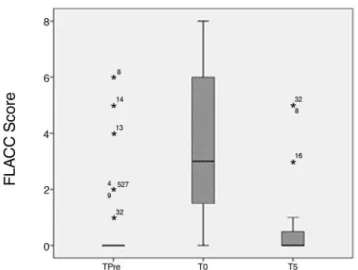
he FLACC scores varied from 0 to 6 with means of 0 (TPre), 3 (T0) and 0 (T5). During blood collection (T0), the pain intensity was signiicantly higher than before the procedure (TPre moment) and ive minutes after the procedure (T5) (p = 0.0001). However, no diference was observed between the pain intensities recorded at TPre and T5 (Figure 1 and Table 1).
Approximately 83% of the patients presented with a painful perception during blood collection (T0) that varied from a small level of discomfort to an intense pain (Figure 2). An intra-rater reliability analysis for a single investigator between time points resulted in a Cronbach’s alpha value of 0.706.
With regards to the assessed physiological parameters, HR was signiicantly higher immediately after the painful stimulus (T0) when compared with the other time points (p = 0.03; Table 1). Similarly, the mean respiratory rate was also signiicantly higher after the painful stimulus (T0) when compared with the other time points (p = 0.0001; Table 1). here was no diference in the SpO2 levels between time points (p = 0.4) (Table 1).
Table 1 - Face, Legs, Activity, Cry and Consolability scores and physiological parameters from three assessments
Variables TPre T0 T5 p value
FLACC* 0 (0; 0) 3 (1; 6) 0 (0; 1) 0.0001
HR† 133.9 ± 28.6 143.1 ± 28.5 134.8 ± 26.1 0.03
RR† 34.0 ± 10.0 37 ± 10.0 33 ± 8.0 0.001
SpO2† 96.7 ± 3.5 96.2 ± 3.7 97.2 ± 3.0 0.4
SBP† 97.6 ± 20.2 102.4 ± 27.8 98.2 ± 24.9 0.45 DBP† 56.3 ± 15.8 63.4 ± 19.4 61 ± 16.8 0.006
TPre - prior to the painful procedure; T0 - during the painful procedure; T5 - five minutes after the painful procedure; FLACC - Face, Legs, Activity, Cry and Consolability scale; HR - heart rate; RR - respiratory rate; SpO2 - peripheral oxygen saturation; SBP - systolic blood pressure; DBP - diastolic blood pressure. Data are represented as the mean, p25 and p75. * Friedman test; † repeated-measures ANOVA.
Figure 1 - Face, Legs, Activity, Cry and Consolability scores from three assessments: before the painful procedure, during the painful procedure, and 5 minutes after the painful procedure. The values are shown as the median and percentile. FLACC - Face, Legs, Activity, Cry and Consolability scale; TPre - before the painful procedure, T0 - during the painful procedure; T5 - 5 minutes after the painful procedure. * p < 0.05 between T0-TPre and
T0-T5 (Friedman’s test followed by Dunn’s post-hoc test).
he systolic blood pressure (SBP) showed a homogenous distribution across the three assessments (p = 0.45). he diastolic blood pressure (DBP) was signiicantly higher at T0 (p = 0.006). he DBP at T5 what higher than at TPre (4.7 ± 2.1); however, the diference was not statistically signiicant (p = 0.09).
DISCUSSION
Pain assessment in sedated and mechanically ventilated pediatric patients using validated tools is considered important for clinical practice. he necessity for a speciic pain scale in the PICU was evidenced in the present study. In our study, the FLACC scale was chosen because of its large applicability to a wide range of ages within the pediatric population. In accordance with previous studies, the FLACC scale is efective as a pain assessment tool for use by hospital units (e.g., oncology and trauma) in children less than 3 years old.(14) In addition, this tool is
valid and reliable for the assessment of postoperative pain assessment in children and teenagers (from 4 to 18 years old) with cognitive impairment.(15)
Our results showed a signiicant variation in FLACC scores during an arterial blood collection for gas analysis from mechanically ventilated and sedated children. hese data suggest that despite the use of sedoanalgesia and an adequate COMFORT-B sedation score, patients exhibited a FLACC score ranging from mild discomfort to moderate pain. Similarly, Babl et al.(16) studied the importance of
nebulization with lidocaine for reducing pain intensity during nasogastric tube insertion in children. his group observed that the FLACC scores were higher during this procedure and that the lidocaine group (local anesthesia) had lower scores when compared with the control group.
In addition to intubation, other painful procedures are performed in the PICU without analgesia. hese methods have been reported in previous studies(4,17-21) and
are routinely observed in intensive care units, especially in patients under sedation, due to the completely erroneous impression that the patient does not feel pain. Indeed, we clearly observed that behavioral and physiological parameters changed when a painful stimulus was applied to our subjects.
Based on our indings, the FLACC scale can be used to measure pain in sedated and mechanically ventilated children with high reliability (Cronbach’s alpha = 0.706).
hese indings are in accordance with previous FLACC assessments collected from children and adolescents in Brazil (Cronbach alfa = 0.76).(10) Similarly, Voepel-Lewis(22)
tested the reliability and validity of this scale in critically ill adults and children unable to self-report pain (intubated or with cognitive impairment) and reported a Cronbach’s alpha of 0.882. Darnell et al.(23) and Babl et al.(16) reported
that the FLACC scale is a valid and reliable assessment tool for pain in the pediatric population and pain related to procedures in children at pre-verbal and verbal ages.
In conjunction with the variation in FLACC scores, we observed an abrupt increase in RR and HR during the painful procedure. Aïssaoui et al.(24) also observed
a signiicant increase in HR (10%) and BP during painful procedures in patients sedated and mechanically ventilated. Additionally, Weissman et al.(25) reported
that HR is frequently used as a physiological parameter for harmful events and as a complementary measure to detect autonomous nervous system conditions during painful procedures. In contrast, Pereira et al.(26) observed
a decrease in HR during and one minute after a painful procedure (venipuncture and alcohol rubbing on the dorsum of the hand) in newborns in intensive care units. Notably, a subsequent increase in HR at 5 minutes after the procedure was observed by Pereira et al. Our study indicated that the HR returned to baseline by this time (ive minutes after the painful procedure).
Changes in peripheral oxygen saturation (SpO2) levels were not found in this study, and thus cannot be considered as a valid parameter for the direct assessment of pain in mechanically ventilated children. In contrast, two previous studies(12,26) observed a consistent and acute
decrease in oxygen saturation levels during(12) and right
after(26) a painful procedure. hese data suggest that
saturation levels are a valid parameter for pain assessment in newborns and children. However, these studies also highlight that SpO2 levels may have a low speciicity because it can be changed by other non-painful causes in these subjects.
In our study, the SBP was maintained with no signiicant changes. Unlike other physiological parameters, the DBP increased during the painful stimulus and remained high ive minutes after the procedure. Jeitziner et al.(27) observed an increase in SBP during a painful
performed with the application of analgesics in critically ill subjects. In addition, the DBP increased during the painful procedure, but this increase could be counteracted with the application of analgesics.(27) Miranda et al.(28)
demonstrated similar results in postoperative cardiac patients. However, unlike our study, this group found no signiicant correlation between SBP, DBP and pain.
Acute pain has a biological purpose, including signaling that an organic injury has occurred and stimulating the sympathetic nervous system to evoke physiological responses, such as an increase in HR, BP and RR.(12,29)
hus, we expected an increase in the SBP and DBP of our patients. Partly conirming our indings, Buttner and Finke(29) airmed that physiological parameters, such as
HR, RR and blood pressure, have little discriminating power to the detect postoperative analgesia need in newborns, infants and young children.
Johansson and Kokinsky(11) proved inter-observer
reliability and the construct validity of the Swedish COMFORT-B and modiied FLACC scales (with changes in “cry” item) by detected a decrease in pain intensity after morphine administration in postoperative children. Furthermore, Sönmez and Kuğuoğlu(12) demonstrated
the importance of pain control and sedation by detecting lower FLACC and Wong-Baker Faces scores in subjects who received analgesia and a bolus of sedatives during endotracheal suctioning when compared with patients who did not receive pain management. In accordance with our indings, these studies show that pain and sedation assessments can be used in conjunction to improve pain management in the PICU.
CONCLUSION
We conclude that mechanically ventilated and sedated children feel pain, as demonstrated by the Face, Legs, Activity, Cry and Consolability scale. Our study shows that this scale is reliable for measuring pain in children who are intubated and unable to self-report. High pain intensity scores and changes in heart rate, respiratory rate and diastolic blood pressure during an arterial blood collection for gas analysis conirm our hypothesis. hus, pain should be assessed in a multidimensional approach by incorporating physiological parameters, which separately are nonspeciic, with objective measurements based on standardized scales that provide information on individual pain responses.
Healthcare professionals often assume that sedation is an adequate routine practice that provides efective pain control; however, a child´s inability to verbally express discomfort does not mean that pain is not being experienced. hus, this study aims to alert health professionals to the importance of appropriately assessing pain in children, especially in patients for whom it is diicult to verbally expressing painful sensations.
Authors’ contributions
LV Dantas and TS Dantas conceived and designed the study, collected and analyzed the data and drafted the original manuscript. V Santana-Filho and IF Azevedo-Santos contributed to the data analysis and reviewed the manuscript. JM DeSantana helped conceive and design the study, contributed to the data analysis and reviewed the manuscript. All authors approved the inal version of the manuscript.
Objetivo: Avaliar a dor e observar parâmetros isiológicos em crianças sedadas e submetidas à ventilação mecânica durante um procedimento de rotina.
Métodos: Estudo observacional realizado em uma
unidade de terapia intensiva pediátrica. Foram avaliadas 35 crianças, com idades entre 1 mês e 12 anos, em três momentos distintos: antes, durante e 5 minutos após coleta de sangue arterial para análise gasométrica (procedimento doloroso). Utilizou-se a Escala Face, Legs, Activity, Cry and Consolability
para avaliação da dor e foram registradas a frequência cardíaca, frequência respiratória, saturação periférica de oxigênio e pressão arterial (sistólica e diastólica). O nível
escala Comfort-B, aplicada antes da mensuração da dor e da avaliação dos parâmetros isiológicos.
Resultados: Durante os estímulos dolorosos, ocorreu
aumento do escore da Escala Face, Legs, Activity, Cry and
Consolability (p = 0,0001). Houve também aumento da
frequência cardíaca (p = 0,03), da frequência respiratória (p = 0,001) e da pressão arterial diastólica (p = 0,006) em razão da dor causada pelo procedimento de rotina.
Conclusões: Avaliação da dor com uso de escalas padrão, como a Escala Face, Legs, Activity, Cry and Consolability, e ob-servação de parâmetros isiológicos, deve ser realizada rotineira-mente para melhorar o manejo da dor nas unidades de terapia intensiva pediátricas.
REFERENCES
1. Stevens BJ, Abbott LK, Yamada J, Harrison D, Stinson J, Taddio A, Barwick M, Latimer M, Scott SD, Rashotte J, Campbell F, Finley GA; CIHR Team in Children’s Pain. Epidemiology and management of painful procedures in children in Canadian hospitals. CMAJ. 2011;183(7):E403-10.
2. Menezes MS, Gozzani JL. Postoperative analgesia in pediatric patients: comparative study among local anesthetics, opioids and non-steroidal anti-inflammatory drugs. Rev Bras Anestesiol. 2002;52(2):175-84. 3. Breña Escobar D. Protocolo para el manejo del dolor en Pediatría. Rev
Medica Electron. 2009;31(1).
4. Zempsky WT, Cravero JP; American Academy of Pediatrics Committee on Pediatric Emergency Medicine and Section on Anesthesiology and Pain Medicine. Relief of pain and anxiety in pediatric patients in emergency medical systems. Pediatrics. 2004;114(5):1348-56.
5. Schweickert WD, Kress JP. Strategies to optimize analgesia and sedation. Crit Care. 2008;12 Suppl 3:S6. Review.
6. Mencía SB, López-Herce JC, Freddi N. Analgesia and sedation in children: practical approach for the most frequent situations. J Pediatr (Rio J). 2007;83(2 Suppl):S71-82.
7. Willis MH, Merkel SI, Voepel-Lewis T, Malviya S. FLACC Behavioral Pain Assessment Scale: a comparison with the child’s self-report. Pediatr Nurs. 2003;29(3):195-8.
8. Suraseranivongse S, Santawat U, Kraiprasit K, Petcharatana S, Prakkamodom S, Muntraporn N. Cross-validation of a composite pain scale preschool children within 24 hours of surgery. Br J Anaesth. 2001;87(3):400-5.
9. Silva FC, Thuler LC. Cross-cultural adaptation and translation of two pain assessment tools in children and adolescents. J Pediatr (Rio J). 2008;84(4):344-9.
10. da Silva FC, Santos Thuler LC, de Leon-Casasola OA. Validity and reliability of two pain assessment tools in Brazilian children and adolescents. J Clin Nurs. 2011;20(13-14):1842-8.
11. Johansson M, Kokinsky E. The COMFORT behavioural scale and the modified FLACC scale in paediatric intensive care. Nurs Crit Care. 2009;14(3)122-30.
12. Sönmez Düzkaya D, Kuğuoğlu S. Assessment of pain during endotracheal suction in the pediatric intensive care unit. Pain Manag Nurs. 2015;16(1):11-9. 13. Amoretti CF, Rodrigues GO, Carvalho PR, Trotta Ede A. Validation of
sedation scores in mechanically ventilated children admitted to a tertiary pediatric intensive care unit. Rev Bras Ter Intensiva. 2008;20(4):325-30. 14. Merkel S, Voepel-Lewis T, Malviya S. Pain assessment in infants and young
children: the FLACC scale. Am J Nurs. 2002;102(10):55-8.
15. Voepl-Lewis T, Merkel S, Tait AR, Trzcinka A, Malviya S. The reliability and validity of the Face, Legs, Activity, Cry, Consolability observational tool as a measure of pain in children with cognitive impairment. Anesth Analg. 2002;95(5):1224-9, table of contents.
16. Babl, FE, Goldfinch C, Mandrawa C, Crellin D, O’Sullivan R, Donath S. Does nebulized lidocaine reduce the pain and distress of nasogastric tube insertion in young children? A randomized, double-blind, placebo-controlled trial. Pediatrics. 2009;123(6):1548-55.
17. Gorchynski J, McLaughlin T. The routine utilization of procedural pain management for pediatric lumbar punctures: are we there yet? J Clin Med Res. 2011;3(4):164-7.
18. Ellis JA, Ootoova A, Blouin R, Rowley B, Taylor M, Decourtney C, et al. Establishing the psychometric properties and preferences for the Northern Pain Scale. Int J Circumpolar Health. 2011;70(3):274-85.
19. Chermont AG, Guinsburg R, Balda RC, Kopelman BI. O que os pediatras conhecem sobre avaliação e tratamento da dor no recém-nascido? J Pediatr (Rio J). 2003;79(3):265-72.
20. Nascimento Júnior P, Módolo NS, Rodrigues Júnior GR. Analgesia pós-operatória para crianças com menos de 1 ano. Análise retrospectiva. Rev Bras Anestesiol. 2002;52(6):739-46.
21. Sapolnik R, Almeida P, Souza M. Memória da dor em crianças oncológicas. Ped Mod. 2009;45(4):146-54.
22. Voepel-Lewis T, Zanotti J, Dammeyer JA, Merkel S. Reliability and validity of the face, legs, activity, cry, consolability behavioral tool in assessing acute pain in critically ill patients. Am J Crit Care. 2010;19(1):55-61; quiz 62.
23. Darnell CM, Thompson J, Stromberg D, Roy L, Sheeran P. Effect of low-dose naloxone infusion on fentanyl requirements in critically ill children. Pediatrics. 2008;121(5):e1363-71.
24. Aïssaoui Y, Zeggwagh AA, Zekraoui A, Abidi K, Abouqal R. Validation of a behavioral pain scale in critically ill, sedated, and mechanically ventilated patients. Anesth Analg. 2005;101(5):1470-6.
25. Weissman A, Aranovitch M, Blazer S, Zimmer EZ. Heel-lancing in newborns: behavioral and spectral analysis assessment of pain control methods. Pediatrics. 2009;124(5):e921-6.
26. Pereira AL, Guinsburg R, de Almeida MF, Monteiro AC, dos Santos AM, Kopelman BI. Validity of behavioral and physiologic parameters for acute pain assessment of term newborn infants. Sao Paulo Med J. 1999;117(2):72-80.
27. Jeitziner MM, Schwendimann R, Hamers JP, Rohrer O, Hantikainen V, Jakob SM. Assessment of pain in sedated and mechanically ventilated patients: an observational study. Acta Anaesthesiol Scand. 2012;56(5):645-54. 28. Miranda AF, Silva LF, Caetano JA, de Sousa AC, Almeida PC. [Evaluation of
pain intensity and vital signs in the cardiac surgery postoperative period]. Rev Esc Enferm USP. 2011;45(2):327-33. Portuguese.