Influence of the Elastomeric Polypropylene Addition on the
Properties of Commercial Metallocenic Polypropylene
Maria de Fátima V. Marques*, Mariana Poloponsky, Érica Gervasoni Chaves
Instituto de Macromoléculas Professora Eloisa Mano, Universidade Federal do Rio de Janeiro, C.P. 68525, 21945-970 Rio de Janeiro - RJ, Brasil
Received: February 2, 2001; September 10, 2001
Polypropylene with special properties can be obtained by metallocenic catalysts. These catalytic systems represent the beginning of a new age in polyolefins technology. In this work, the influence of the addition of a syndiotactic polypropylene (s-PP) on the processability and mechanical properties of a commercial isotactic polypropylene (i-PP) obtained by metallocenic catalysts was evaluated. Increasing addition of s-PP promoted better processability, with an increase in the impact strength and a decrease in the stress at break. A reduction of the crystallinity in the polymeric blends was verified. The more significant influence of the s-PP addition was observed for the mi-PP, compared to the ZNi-PP.
Keywords: metallocene, syndiotactic polypropylene, polyolefin blends, polypropylene blends
1. Introduction
Polymer blends are now regarded as an economical alternative to the development of new polymers. Materials with improved end use properties can be obtained by blend-ing polymers with different molecular characteristics. In the case of polyolefins, they are immiscible since small differences in the shape of the molecules give rise to unfavorable intermolecular forces. Further immiscibility arises as the polyolefins crystallize into different crystall domains1.
While having a number of valuable properties and economic benefits, polypropylene homopolymer exhibits a poor impact resistance, mainly at low temperatures. This fact is due to its relatively high glass transition temperature (Tg)2-4.
The improvement of some of these properties is typi-cally achieved by blending polypropylene to other poly-mers or with reinforcing fillers. More specifically, polypropylene with improved impact strength has been produced by the addition of an amorphous material, a poorly crystallized material or an elastomer, as EPDM, for example5-9.
It is known that the development of metallocene lysts activated by methylaluminoxane affords a high cata-lyst activity, excellent stereoregularity and comonomer distribution, leading to polyolefins that are inaccessible through conventional heterogeneous Ziegler-Natta cata-lysts, materials of large industrial interests10-11.
Some authors have studied blends of metallocenic polypropylene with different stereorregularity. Mulhaupt
et al12 investigated the behavior of syndiotactic and
isotac-tic PP blends, concluding that they are phase separated. Silvestri and Sgazi13 concluded that high molecular weight
atactic polypropylene (a-PP) was partially miscible with syndiotactic and immiscible with isotactic polypropylene, but the degree of tacticity of the components and the blend composition can also affect miscibility.
Considering the importance of the metallocene technol-ogy and all the potential of propylene based materials in the world market, the aim of this work was to evaluate the influence of the addition of a syndiotactic polypropylene (ms-PP) with low syndiotaticity and having elastomeric characteristics, produced with a metallocene catalyst sys-tem on the processing energy, mechanical properties and crystallinity degree of a commercial metallocenic isotactic polypropylene (mi-PP).
2. Experimental
2.1. Materials and General Procedures
A syndiotactic polypropylene (ms-PP) synthesized with the catalyst system Et(Flu)(Cp)ZrCl2
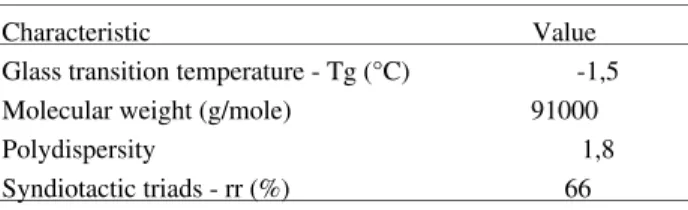
/methylalumi-noxane (MAO) and a commercial metallocenic polypropylene supplied by Targor (mi-PP) were used for the blends preparation. Tables 1 and 2 show some 2.1.1. Characteristics of these materials
In order to synthesize the ms-PP, all operations were performed under nitrogen by using conventional Schlenk techniques. Methylaluminoxane (MAO) 10 wt% toluene solution was kindly supplied by WITCO and used as co-catalyst without purification. Research grade propylene supplied by POLIBRASIL S.A. and nitrogen were treated
Materials Research, Vol. 4, No. 4, 251-254, 2001. © 2001
e-mail: [email protected]
through columns of molecular sieve 3 Å and cupper cata-lyst. Toluene was distilled over sodium/benzophenone, under nitrogen.
2.1.1. Catalysts synthesis
The complex Et(Flu)(Cp)ZrCl2 were synthesized
ac-cording to conventional techniques described in the litera-ture14-16.
2.1.2 Polymerizations
A set of polymerization experiments were carried out in a 0.5 L Buchi glass autoclave (solution polymerizations with 100 mL of toluene and continuous monomer feed) at constant pressure for 1 h. Metallocene (0.005 mmole) and half of the MAO used (total MAO content = 10 mmole) were prior contacted for 10 min in toluene solution and then added to the monomer/solvent/MAO mixture. The polym-erization was quenched with HCl 5% ethanol solution. The polymer was separated by filtration, washed and dried under reduced pressure at 50 °C to a constant weight.
Polymerization conditions: -temperature: 40, 60, 80 °C -monomer pressure: 1, 2, 3 bar
-aluminum/zirconium molar ratio: 500, 1250, 2000 The results of this study were published elsewhere17. After characterization, one of these ms-PP was selected for the polymeric blends preparation. This polymer was syn-thesized at 40 °C, 3 bar of monomer pressure and an aluminum/zirconium molar ratio of 2000, exhibiting an elastomeric behavior.
2.1.3 Polymer characterization
Polymer average molecular weight and molecular weight distribution were obtained by SEC (Exclusion Size Chromatography) with a Waters 150 cv Instuments at 135 °C, 1, 2, 4 - trichlorobenzene as eluent, and a calibra-tion curve prepared with monodisperse polystyrene stand-ards.
The glass transition temperature was determined on a Perkin Elmer Differential Scanning Calorimeter DSC 7, using a heating rate of 20 °C/min in the temperature range from -30 to 220 °C under nitrogen. The heating cycle was performed twice, but only the results of the second scan are reported.
13C-NMR spectra was recorded and measured on a
Brucker NMR 300 spectrometer operating at 300 MHz. Sample solution was prepared by dissolving 10 mg of polymer in CDCl3. A total of 851 transients were
accumu-lated for the spectrum with 20 s delay between pulses.
2.1.4. Blends preparation
Polymer blends were prepared by melt mixing in a HAAKE Rheocord Mixer 9000, coupled with a mixer chamber, in a proportion of 100:0; 85:15 and 70:30/mi-PP:ms-PP.
Processing conditions Rotor speed: 80 rpm Time of processing: 8 min
Temperature of processing: 170 °C
2.1.5. Testing procedure
The energy necessary to process the blends was calcu-lated by using the Haake Rheometer data. The specific energy required to process the materials at a given tempera-ture and shear rate was obtained by multiplying the integral of the area under the blending torque curve, as a function of time, by the speed of mixing the material, per gram of processed material, as described at the equation bellow18-20:
W =
2 π n
∫
M dtt1
t2
g (1)
where n = rotor speed; M = torque, t1 = initial time; t2 = final
time of processing
For mechanical properties measurements, the samples were prepared in a hydraulic press (Carver - model C) by compression-molding at 190 °C and 30 kgf/cm2, for 7 min. Tensile tests were carried out on an Instron Tensile Tester - Series IX - automated machine (model 4204), following ASTM D638. Impact tests were carried out on a H.20 Plastics Impact Machine(Izod-type), adapted from ASTM D 256.
The Differential Scanning Calorimetry analysis of the blends were carried out in a Perkin Elmer equipment, model DSC7, under the following conditions:
Heat flow: 20 °C/min
Temperature range: 50-200 °C Atmosphere: N2
For comparative effect we have placed on Tables 3 and 4 data8 related to the blends prepared using a commercial Ziegler-Natta isotactic polypropylene (ZN-iPP) mixed with the same ms-PP as in this study.
Table 1. Some characteristics of the ms-PP selected for blends prepara-tion.
Characteristic Value
Glass transition temperature - Tg (°C) -1,5
Molecular weight (g/mole) 91000
Polydispersity 1,8
Syndiotactic triads - rr (%) 66
Table 2. Some characteristics of the commercial metallocenic polypropylene (mi-PP) and Ziegler-Natta polypropylene (ZN-iPP) used for blends preparation.
Characteristic mi-PP ZN-iPP
Melting flow index - MFI (g/10 min) 75 15.4 Molecular weight (g/mole) 148000 430000
Melting temperature (°C) 150 164
Polidispersity ~2 9.2
3. Results and Discussion
The results of DSC analysis showed that the synthe-sized syndiotactic polypropylene presented no melting temperature. In spite of that, as reported in the litera-ture21,22, s-PP typically presents more chain entanglements, which could provide physical restriction to chain slippage, resulting in the elastomeric characteristics of the studied polymer.
Figure 1 shows the 13C-NMR spectrum of the synthe-sized syndiotactic polypropylene used to prepare the poly-mer blends. In this case a significant amount of isotactic triads can be observed, in spite of using a syndiospecific catalyst. It is believed that this is the reason of the elas-tomeric behavior observed in this polymer, whose micro-structure contains blocks of syndiotactic PP and isotactic PP, as well as atactic errors of monomer insertion.
The stereoerrors could be explained by the mechanism shown in the Fig. 2. The rule for the mechanism with metallocenic catalysts is through the pathway A: after the chain migratory monomer insertion, the opposite coordina-tion site for the next incoming monomer performs the syndiotactic propylene insertion. On the other hand, path-way B is an occasional skipped reaction in which, after the migratory monomer insertion, the active site isomerizes and the same coordination site is now free for the future monomer molecule, resulting in an isotactic regulation. At specific polymerization conditions, the rate constant of active site isomerization is near the rate constant of propa-gation and blocks of isotactic PP were formed.
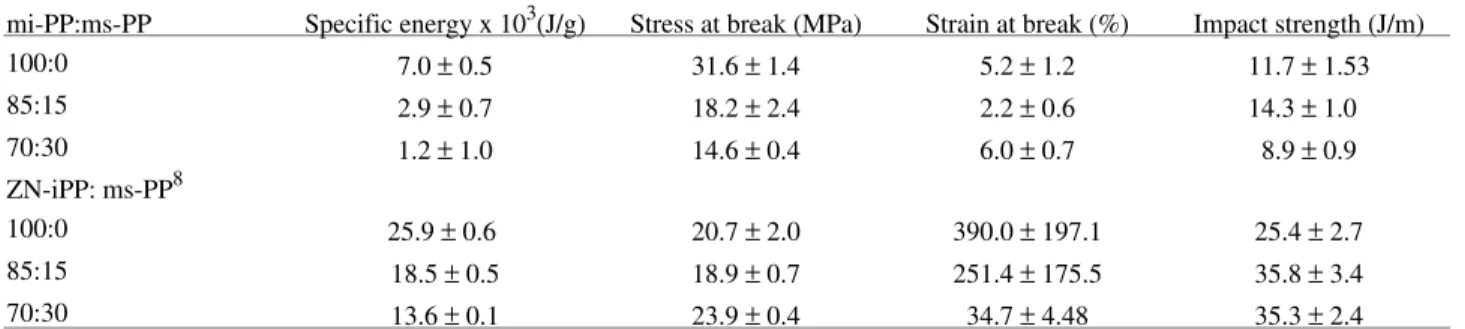
The influence of the ms-PP addition on the processabil-ity and on the mechanical properties can be seen from the results in Table 3. From the table, it was observed that the
specific energy decreased with the addition of the metalo-cenic s-PP, probably due to the lower shear forces involved when the blends were being processed, indicating im-proved processability.
Considering the stress at break, the values decreased slightly with the total amount of 30% of ms-PP, but the values for the strain at break did not show a clear tendency. It was described in the literature3 that this behavior is a result of the components imiscibility and the formation of a two-phases structure. The flowand fracture process are accelerated by the material immiscibility.
Considering the impact strength, a maximum value was achieved with the addition of 15% ms-PP to the resin, and a further addition of this polymer did not improve this property. When a material undergoes an impact force, microfissures are developed until its fracture. When elas-tomeric low dimension particles are uniformly distributed
Vol. 4, No. 4, 2001 Elastomeric Polypropylene Addition on the Properties of Commercial Metallocenic Polypropylene 253
Table 3. Influence of ms-PP addition on the processability and mechanical properties of metallocenic mi-PP.
mi-PP:ms-PP Specific energy x 103(J/g) Stress at break (MPa) Strain at break (%) Impact strength (J/m)
100:0 7.0 ± 0.5 31.6 ± 1.4 5.2 ± 1.2 11.7 ± 1.53
85:15 2.9 ± 0.7 18.2 ± 2.4 2.2 ± 0.6 14.3 ± 1.0
70:30 1.2 ± 1.0 14.6 ± 0.4 6.0 ± 0.7 8.9 ± 0.9
ZN-iPP: ms-PP8
100:0 25.9 ± 0.6 20.7 ± 2.0 390.0 ± 197.1 25.4 ± 2.7
85:15 18.5 ± 0.5 18.9 ± 0.7 251.4 ± 175.5 35.8 ± 3.4
70:30 13.6 ± 0.1 23.9 ± 0.4 34.7 ± 4.48 35.3 ± 2.4
Table 4. Influence of metallocenic s-PP addition on the crystallinity of i-PP.
mi-PP:ms-PP Melting enthalpy
∆Hf (J/g)
Melting temperature Tm (oC)
Crystallization enthalpy
∆Hc (J/g)
Crystallization temperature Tc (°C)
Crystallinity Xc (%)
100:0 99 150 -94 119 47
85:15 89 149 -85 119 43
70:30 69 145 -65 104 33
ZN-iPP: ms-PP8
100:0 75 164 -92 111 36
85:15 67 162 -82 109 32
70:30 58 160 -66 109 28
in the PP matrix, the probability that this small particle to find the microfissures occurs to be higher, avoiding their propagation and therefore improving the impact strength.
Table 4 shows the results from the DSC analysis. As can be seen, the crystallinity of the blends decreased, as a result of lowering the melting enthalpy. This indicates that the presence of the ms-PP changed the matrix PP crystallinity by lowering the crystal size, without signifi-cant modifications in the crystal morphology. It was ob-served some variation in the Tm only for the addition of 30% of ms-PP.
As strength properties are strongly dependent on the crystallinity of the PP matrix, these results can be correlated to the decreasing in the stress strength.
In spite of the great difference between the charac-teristics of both i-PP studied (see Table 2), some considera-tions can be done. As expected, the processing energy of mi-PP is very low compared to the one of ZNi-PP consid-ering their difference in the molecular weight. Therefore, it can be speculated that the influence of ms-PP addition in mi-PP is much stronger because of its narrower polydisper-sity.
Stress at break of pure mi-PP is much higher than that of ZN- iPP because of the lower crystallization rate of the former polymer, which promote an unidimensional chain orientation during the process, increasing this property. On the other hand, strain at break is rather low in mi-PP, since no crystallinity can be induced when the sample is submit-ted to stress. Regarding the impact strength an improve-ment for both blends can be observed when 15% of ms-PP was added.
Melting temperature of mi-PP is lower than that of ZNi-PP, since in the first polymer the same monomer insertion errors exists virtually in all polymer chains, which cause crystal defects. The addition of ms-PP did not vary considerably the melting temperature in both cases. This
fact possibly indicates the existence of some phase segre-gation between the i-PPs and the ms-PP studied.
4. Conclusions
The results obtained for mechanical properties sug-gested that the blends presented two phase morphology when metallocenic s-PP is added to the commercial mi-PP and ZNi-PP.
The blends present lower specific energy, indicating better processability by the addition of s-PP, with improve-ment in the impact strength. Therefore, materials with a good balance between mechanical properties and proc-essability could be achieved by blending polypropylenes of different microstructure.
Acklowledgments
WITCO, Ipiranga Petroquímica, RHAE/CNPq, FAPERJ, Polo de Xistoquímica/UFRJ.
References
1. Shanks, R.A.; Li, J.; Yu, L. Polymer, v. 41p. 2133-2139, 2000. 2. Moore, E.P. Jr. Polypropylene Handbook, Hanser Publisher,
Mu-nich Vienna New York, 1996.
3. Mark, H.F.; Gaylord, N.G. Propylene Polymers. In: Mark, H.M.; Bikales, N.M.; Gaylord, N.G., eds., Encyclopedia of Polymer Sci-ence and Technology, Interscience, v. 11, p. 597-618, 1965. 4. Mears, S. Polymers - Structure and Bulk Properties, 3 ed., London:
D. Van Nostrand Company, 1967.
5. da Silva, A.L.N.; Rocha, M.C.G.; Coutinho, F.M.B.; Bretas, R.; Scuracchio, C. Polymer Testing, v. 19, p. 363-371, 2000. 6. Khare, A.R.; Westphal, S.P.; Ling, M.T.K.; Qin, C.; Woo, L.
Thermochimica Acta, v. 155, p. 357-358, 2000.
7. Ramanujam, A.; Kim, K.J.; Kyu, T. Polymer, v. 41, p. 5375-5383, 2000.
8. Chaves, E.G.; Marques, M.F.V. ANTEC, v. 3, p. 3582-3585, 2000. 9. Seki, M.; Yamauchi, S.; Matsushita, Y. Journal of Physics and
Chemistry of Solids, v. 60, p. 1333-1336, 1999.
10. Fink, G.; Mulhaupt, R.; Brintzinger, H.H. Ziegler Catalysts - Recent Scientific Innovations and Technological Improvements, Springer-Verlag, New York, 1995.
11. Benedikt, G.M.; Goodall, B.L. MetalloceneCatalysed Polymers -Materials, Properties, Processing & Markets, Plastic Design Li-brary, New York, 1998.
12. Thomann, R., Kressler, J.; Setz, S.; Wang, C.; Mulhaupt, R. Poly-mer, v. 37, p. 2627-2635, 1996.
13. Silvestri, R.; Sgarzi, P. Polymer, v. 39, p. 5871-5880, 1998. 14. Wild, F.R.W.P.; Zzsolnai, L.; Huttner, G.; Brintzinger, H.H.J.
Or-ganomet. Chem., n. 232, p. 233-247, 1982.
15. Samuel, E.; Rausch, M.D.J. Am. Chem. Soc., v. 19, p. 6263-6267, 1973.
16. Bravakis, A.M.; Bailey, L.E.; Pigeon, M.; Collins, S. Macromole-cules, v. 31, p. 1000-1009, 1998.
17. Chaves, E.G.; Marques, M.F.V. European Polymer Journal, v. 37, p. 1175-1180, 2001.
18. Liu, N.C.; Xiu, H.Q.; Baker, W.E. Polymer, v. 34, p. 4680-4690, 1993.
19. Liu, N.C.; Baker, W.E. Polymer, v. 35, p. 988-994, 1994. 20. Chen, C.; Lai, F.S. Polymer Engineering and Science, v. 34, p.
472-476, 1994.
21. Razavi, A. Comptes Rendus De L’Academie Des Sciences Paris, Série Iic, Chemistry, v. 3, p. 315-325, 2000.
22. Uehara, H.; Yamazaki, Y.; Kanamoto, T. Polymer, v. 37, p. 57-64, 1996.
Figure 2. Polymerization mechanism.