ASSOCIATION BETWEEN NURSING STUDENTS’ ACADEMIC AND
SOCIODEMOGRAPHIC CHARACTERISTICS AND STRESS
Susan Bublitz1, Laura de Azevedo Guido2, Luis Felipe Dias Lopes3, Etiane de Oliveira Freitas4
1 Doctoral student, Nursing Post Graduation Program (PPGENF), Universidade Federal de Santa Maria (UFSM). Nurse, Hospital
Universitário de Santa Maria (HUSM). Santa Maria, Rio Grande do Sul, Brazil. E-mail: [email protected]
2Ph.D. in Nursing. Professor, PPGENF/UFSM. Santa Maria, Rio Grande do Sul, Brazil. E-mail: [email protected]
3 Ph.D. in Production Engineering. Professor, Department of Administration Sciences UFSM. Santa Maria, Rio Grande do Sul, Brazil. E-mail: [email protected]
4 Doctoral student, PPGENF/UFSM. Santa Maria, Rio Grande do Sul, Brazil. E-mail: [email protected]
ABSTRACT: This study was aimed at investigating the association between the stress levels of nursing students and their sociodemographic and academic characteristics. This quantitative, analytical and cross-sectional study was conducted in four Brazilian higher education Institutions. Data were collected from April 2011 to March 2012, using a sociodemographic and academic tool form for the students and the Assessment of Stress Among Nursing Students. 705 students participated and the results showed a predominance of medium stress levels, followed by high stress levels. Statistically signiicant differences were found for stress and age group, institution type (public/ private), work activity, satisfaction with the course and if the student had ever thought of dropping out of the course. This study showed that education is assessed as a stressor and that there is an association between the nursing students’ characteristics and the stress level. DESCRIPTORS: Nursing. Students, nursing. Higher education institutions. Education, higher. Stress, psychological.
ASSOCIAÇÃO ENTRE ESTRESSE E CARACTERÍSTICAS
SOCIODEMOGRÁFICAS E ACADÊMICAS DE ESTUDANTES DE
ENFERMAGEM
RESUMO: Objetivou-se veriicar a associação entre estresse de discentes de enfermagem e as características sociodemográicas e acadêmicas dos mesmos. Trata-se de um estudo quantitativo, analítico e transversal, desenvolvido em quatro instituições de ensino superior brasileiras. A coleta dos dados ocorreu entre abril de 2011 a março de 2012, por meio de um formulário sociodemográico e acadêmico dos discentes e um instrumento para Avaliação de Estresse em Estudantes de Enfermagem. Participaram 705 acadêmicos, com predomínio destes em médio nível de estresse, seguido pelo alto nível de estresse. Quanto às associações, veriicou-se diferenças estatísticas signiicativas entre estresse e as variáveis: faixa etária, tipo de instituição (pública/privada), atividade de trabalho, satisfação com o curso e se já pensou em desistir do curso. Esse estudo permitiu considerar que a formação acadêmica é avaliada como estressora e existe associação entre nível de estresse e as características dos discentes de enfermagem.
DESCRITORES: Enfermagem. Estudantes de enfermagem. Instituições de ensino superior. Educação superior. Estresse psicológico.
ASOCIACIÓN ENTRE ESTRÉS Y CARACTERÍSTICAS
SOCIODEMOGRÁFICAS Y ACADÉMICAS DE ESTUDIANTES DE
ENFERMERÍA
RESUMEN: Este estudio tuvo como objetivo investigar la asociación entre el estrés de los estudiantes de enfermería y las características sociodemográicas y académicas. Estudio cuantitativo, analítico y transversal realizado en cuatro instituciones de educación superior de Brasil. Los datos se recolectaron entre abril de 2011 y marzo de 2012, a través de una encuesta socio-demográica y académica entre los estudiantes, y el instrumento de Evaluación del Estrés en Estudiantes de Enfermería. Participaron 705 estudiantes, de los cuales hubo un predominio de nivel medio de estrés, seguido por un alto nivel de estrés. En cuanto a las asociaciones, se encontraron diferencias estadísticas signiicativas entre el estrés y las variables: edad, el tipo de institución (pública/privada), actividad laboral, satisfacción con la carrera y el pensamiento acerca de renunciar a la misma. Este estudio nos permite considerar que la educación es evaluada como estresante y hay asociación entre el nivel de estrés y las características de los estudiantes de enfermería.
INTRODUCTION
According to the interactionism model, stress is deined as any circumstance that threatens or is perceived to threaten one’s well-being and thereby tax one’s coping abilities.1 Stress on different health-care workers has been studied,2-4 including nurses. Nursing has been considered stressful due to the particularities of its work process.4
However, some studies have shown that the professional training of nurses has been identiied as stressful by university students,5-7 who have to
administer personal and social life, the requirements of the university where they study and the prepara -tion for their professional career.8 In addition, the transition from academic to professional life is a period that involves important personal decisions such as where and when to start the professional career and when to start a family and assume inan -cial responsibilities.9
Stress occurs in the academic environment when the student assesses the demand as being greater than the resources he has.10 Stress on stu-dents can affect their well-being, capacity of concen -tration and memorization, academic performance and interfere in interpersonal relationships.11,12
Stress interferes on the quality of the teaching-learning process of nursing students, and its occur-rence can be related to the students’ academic and sociodemographic aspects.13 It is therefore important to verify the association between these aspects and stress in order to minimize it and think of ways in which to face it. The following question is asked: “Is there an association between stress and the academic and sociodemographic characteristics of nursing students?”
The objective of this study was to verify the association between stress among nursing students and their academic and sociodemographic charac-teristics.
METHOD
This was quantitative, analytical and cross-sectional study developed with nursing students in four higher education institutions in the southern and southeastern regions of Brazil.
The study population consisted of students regularly enrolled in Nursing Graduation Courses, aged 18 years or older. The exclusion criteria were the following: special or exchange students; students not enrolled in the professional cycle disciplines; students who had not concluded the syllabus due
to exceeding the time limits for each course at the time the data were collected, and students who participated as investigators in this study.
The academic and sociodemographic data were collected using a form that included the fol -lowing variables: sex, age group, residential status, sports practice, leisure activities, work activity, satisfaction with the course and if the student had ever thought of dropping out of the course. The in -strument used was the Assessment of Stress Among Nursing Students (AEEE, Avaliação de Estresse em Estudantes de Enfermagem), prepared and validated in 2009.13
The AEEE is formed by 30 items and each item is assessed using a Likert scale with variable values from zero to three and positive values, i.e., the high -er the score the great-er the stress levels. The items are distributed into six domains: “Practical Activ -ity Performance”, “Professional Communication”, “Time Management”, “Environment”, “Professional Education” and “Theoretical Activity”.
Students were instructed to score zero for “I do not experience this situation”, number one for “I do not feel stress”, number two for “I feel a little stressed with the situation” and number three for “I feel very stressed with the situation”.
Score standardization was required because the total sum of the values attributed by the student for each domain was not directly compatible as the domains were formed by a different number of items. The values obtained for each one of the 30 items were added and the sum was divided by the number of items responded, excluding the number of items identiied by zero to obtain the stress level per students. Items identiied by zero were deined in the AEEE as “I do not experience this situation”. The result minus 1 was multiplied by 50. To verify the level of stress presented by each individual in each domain, the sum of the values given to the items was divided by the number of items in the domain, excluding the number of zeros. The result minus 1 was multiplied by 50.
The stress level was classiied using tertiles. After these measurements were calculated, the pa -rameter for student classiication was deined using the standardized score, ranging from 0 to 100%, where the values from 0.00% to 33.33% represented a low stress level; 33.34%-66.67% represented a medium stress level and 66.68%-100% represented a high stress level.
collection was from April 2011 to March 2012. Data were collected in the classrooms, at a time previ -ously scheduled with the lecturers, from subjects who accepted to participate in the research and with the consent from the Nursing Course Coordination of each IES. The students were given the choice of completing the instruments at the scheduled time or to schedule another time to deliver them. Stu -dents who were not in the classroom at the time of collection were subsequently asked to participate in the Study.
The database was prepared using Excel for Windows (Ofice 2007) spreadsheets, using the Statistical Analysis System (SAS, version 9.01) and Statistica (version 7.1) programs. Pearson’s chi-square test was used to verify the association between the sociodemographic characteristics and the stress level. Data were considered statistically signiicant when p<0.05, with a 95% conidence interval.
This study is part of a project entitled “Stress, coping, burnout, depressive symptoms and hardi -ness in nursing students and teachers,” with interim collection and analysis in 2011 and 2012. This project was registered and approved by the Research Eth -ics Committee, with number 0380.0.243.000-10. An amendment to widen data collection to other insti -tutions was subsequently requested and approved. In accordance with the Regulatory Guidelines and Standards for Research Involving Human Beings (Resolution N. 466/2012), the participants received an Informed Consent Form (ICF) which was signed after it had been read and the investigators had exposed and provided clariication on the nature of the study.14
RESULTS
There were 958 nursing students enrolled in the four courses under investigation. Admission criteria application excluded 161 nursing students, and 802 students were eligible to participate in the study. However, 52 students did not accept to par -ticipate and 45 did not return the study instruments. Thus, the study access population was formed by 705 students, which represents 87.90% of the study population. Of the total, 51.63% of the students were from private institutions and 48.37% were from public institutions, which showed equal subject distribution regarding type of institution.
The analysis of the internal consistency of the AEEE items yielded Cronbach’s alpha, 0.889. The alpha values for the domains were the following: 0.757, for “Practical Activity Performance”; 0.757, for “Professional Communication”; 0.675, for “Time Management”; 0.732, for “Environment”; 0.769, for “Professional Education”; and 0.627, for “Theo -retical Activities”. These results were considered satisfactory since values over 0.6 show that the instrument’s internal consistency is appropriate.15
Regarding sociodemographic characteristics, female students were the majority (84.54%), in the 20-24 year old range (50%), single (76.88%) and childless (83.12%). Regarding residential status, 76.42% lived with relatives.
Regarding stress level, it was observed that 15.10% of the nursing students have high stress levels, 74.47% have medium stress levels and 9.93% have low stress levels.
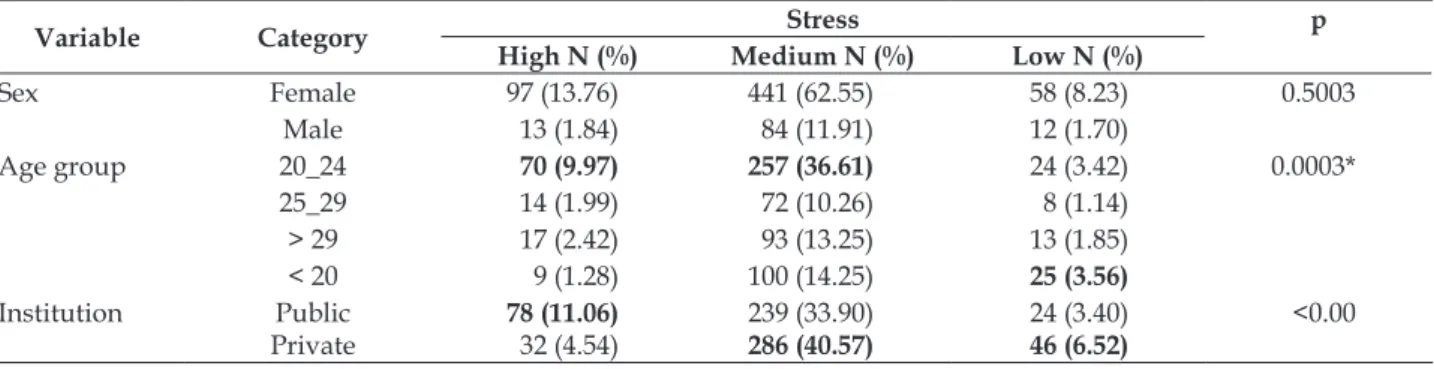
Table 1 shows the association between the sociodemographic variables and the students’ stress levels.
Table 1 - Association between sex and age group, with nursing students’ stress level, Santa Maria-RS, 2014. (N=705)
Variable Category Stress p
High N (%) Medium N (%) Low N (%)
Sex Female 97 (13.76) 441 (62.55) 58 (8.23) 0.5003
Male 13 (1.84) 84 (11.91) 12 (1.70)
Age group 20_24 70 (9.97) 257 (36.61) 24 (3.42) 0.0003*
25_29 14 (1.99) 72 (10.26) 8 (1.14)
> 29 17 (2.42) 93 (13.25) 13 (1.85)
< 20 9 (1.28) 100 (14.25) 25 (3.56)
Institution Public
Private 78 (11.06)32 (4.54) 239 (33.90)286 (40.57)
24 (3.40)
46 (6.52)
<0.00
Among the students, 75.64% did not practice sports, 60.53% practiced leisure activities and 74.25% of the students did not work. Regarding satisfaction with the course, 89.84% said they were satisied and
36.79% had already thought of dropping out. Table 2 shows the association between the stress levels in the other sociodemographic variables for the nursing students.
Table 2 – Association between stress level of nursing students with the practice of sports, leisure activity, work activity, satisfaction and intention of dropping out of the course, Santa Maria-RS 2014. (N=705)
Variable Category Stress p
High N (%) Medium N (%) Low N (%)
Sports Yes 19 (2.71) 136 (19.37) 16 (2.28) 0.1425
No 91 (12.96) 386 (54.99) 54 (7.69)
Leisure Yes 63 (9.21) 314 (45.91) 37 (5.41) 0.5996
No 43 (6.29) 197 (28.80) 30 (4.39)
Works Yes
No
17 (2.42)
93 (13.23)
148 (21.05)
375 (53.34)
16 (2.28)
54 (7.68)
0.0167*
Satisfaction Yes 90 (12.88) 471 (67.38) 67 (9.59) 0.0024*
No 20 (2.28) 49 (7.01) 2 (0.29)
Drop out Yes
No
55 (7.81)
55 (7.81) 192 (27.27)332 (47.16)
12 (1.70)
58 (8.24)
<.0001*
* Statistically signiicant difference (p<0.05) *Yes and no represent whether the students practiced sports or not, practiced leisure activities are not, had work ties or not; was satisied with the course or not and whether they had already thought of dropping out of the course or not.
It can be observed in table 2 that there was a statistically signiicant difference between stress and the following variables: work activity, satisfac -tion with the course and whether the student had already thought of dropping out of the course. Medium stress levels predominated among stu -dents who had not thought of dropping out of the course, who did not work and who were satisied with the course.
DISCUSSION
Certain investigators highlight that some academic and sociodemographic characteristics of nursing students can inluence their stress levels.13
However, in this study no statistically signii -cant differences (p=0.5003) were found between sex and stress level. Although nursing is historically characterized as a profession with a predominance of females, in this study was not possible to state that women are more stressed than men. These data were different from the data in a study performed with 1617 university students in Turkey, in which the greatest stress scores were identiied among female students.8 In other studies, it was observed that women can be more susceptible to stress than men, since they can be more spontaneous in ad
-mitting stress or actually suffer more stress than men.8,16 The fact that female students have pre -dominated in this study can have contributed for the non-appearance of the statistically signiicant difference between the sexes.
Regarding the age group associated to stress, there were significant differences (p=0.0003), and there was a predominance of students aged 20-24 years, with medium stress levels (36.61%), followed by high stress levels (9.97%). A similar result was shown in the study developed with university students in Turkey, in which medium stress levels were observed in students aged 20-26 years.8 These data can be related to the possibility of students this age feeling insecure regarding the requirements of professional education and of the profession they have chosen.17-18 Furthermore,
during the period of professional education, the student is faced with a new environment that is often quite different and distant from his contexts, where the need to adapt to new academic require -ments and obligations can contribute to increase their stress levels.13
levels. These data can be related to the percentage of private institutions students who work (39.67%), which is higher than the number of public institu -tion students who work (10.88%). Students can ind it dificult to manage time and they assess this situation as a stressor, since conciliating stud-ies with working activitstud-ies includes the following: having little time to be with relatives, for leisure and to rest, lacking social interactions and spend -ing time prepar-ing to deliver the extracurricular requirements.7,13
No statistically signiicant differences were found in the comparison of the variables sports practice and leisure activities with stress, p=0.1425 and p=0.5996 respectively. These data corroborated a study developed with workers from large com -panies that also veriied there was no relationship between physical and leisure activity and stress.19
Nevertheless, these indings are different from other studies which have shown that people who practice physical activities have a greater tendency to show lower stress levels.20-21
A statistically signiicant difference was ob -served regarding work and stress level (p=0.0167) and individuals who did not work presented me -dium stress levels (53.34%). It should be empha -sized that the students who dedicated themselves exclusively to the studies i.e. who did not work, were encouraged to participate in research groups, extension projects, monitoring, events and refresher courses. This may have inluenced stress assessment by these students.7
There was also statistically signiicant differ -ence between satisfaction with the course and stress level (p=0.0024), and students who were satisied presented medium stress levels (67.38%). These data differed from other studies, which identiied that students satisied with their courses presented lower stress scores than those were not satisied.8,22 These authors believe that stress resulting from dis -satisfaction with the course can be a reason for the early interruption of academic education.
In this context, when the students were asked if they had already thought of dropping out of the course and this was associated to stress, a signiicant difference was observed (p=<0001). Nevertheless, a medium stress level was predominant in the students who did not think of dropping out of the course (47.16%).
Because of this, academic nursing education can be evaluated as stressful by the students. The need to help teachers and students to administer
these stressful factors and start their professional career with less distress is important.
Understanding the stress level according to the various academic and sociodemographic variables of the nursing students can encourage proposals for changes aimed at reducing stress levels in nursing students and to permit a deeper knowledge of the students’ characteristics and the main stressors.
CONCLUSIONS
The majority of nursing students presented medium stress levels, followed by high stress levels. This inding is similar to that of other studies and deserves attention from the parties involved in the teaching-learning process of nursing students since high levels of stress can interfere negatively in the process and in the students’ health.
Regarding the associations, statistically significant differences between stress and the following variables were observed: age group, type of institution (public/private): work activ -ity, satisfaction with the course and whether the student has already thought of dropping out of the course. Once the academic and sociodemo-graphic characteristics of the nursing students and their stress levels are known, one can contribute to propose measures that minimize the effects of stress on these individuals. Moreover, once stress is minimized it is expected that students will have improved academic performance, less distress and more satisfaction by the time they enter the work market since the experiences the students had dur -ing their academic education are similar to those they face and professional life.
A limitation to this study is that few stud -ies have been done on the theme, which made data comparison dificult. In addition, the results found cannot be generalized since the study was developed with four IES in two Brazilian regions. It is suggested that studies should be performed in different regions of the country in order to have a more ample data comparison.
REFERENCES
1. Lazarus RS, Folkman S. Estresse, appraisal, and
coping. New York (US): Springer; 1984.
2. Silva MCM, Gomes ARS. Stress ocupacional em
proissionais de saúde: um estudo com médicos e
enfermeiros portugueses. Estud Psicol [Internet].
2009 [cited 2014 Jun 20]; 14(3):239-48. Available from: http://www.scielo.br/pdf/epsic/v14n3/a08v14n3.
3. Santos AFO, Cardoso CL. Profissionais de saúde
mental: manifestação de stress e burnout. Estud Psicol (Campinas) [Internet]. 2010 [cited 2014 Jun 20]; 27(1). Available from: http://www.scielo.br/pdf/estpsi/ v27n1/v27n1a08.pdf
4. Guido LA, Silva RM, Goulart CT, Kleinübing RE,
Umann J. Stress and coping among surgical unit nurses of a teaching hospital. Rev Rene. 2012; 13(2):428-36.
5. Burnard P, Edwards D, Bennett K, Thaibah H, Tothova V, Baldacchino D, et al. A comparative, longitudinal study of stress in student nurses in ive countries: Albania, Brunei, the Czech Republic, Malta and Wales. Nurse Educ Hoje. 2008; 28(2):134-45.
6. Hsiao YC, Chien LY, Wu LY, Chiang CM, Huangs SY. Spiritual health, clinical practice stress, depressive tendency and health-promoting behaviours among nursing students. J Adv Nurs. 2010; 66(7):1612-22. 7. Bublitz S, Freitas EO, Kirchhof RS, Lopes LFD, Guido
LA. Estressores entre acadêmicos de enfermagem de uma universidade pública. Rev Enferm UERJ [Internet]. 2012 [cited 2014 Jun 10]; 20(esp.2):739-45. Available from: http://www.e-publicacoes. uerj.br/index.php/enfermagemuerj/article/ view/5992/4301
8. Bayram N, Bilgel N. The prevalence and
socio-demographic correlations of depression, anxiety and stress among a group of university students. Soc Psychiatry Psychiatr Epidemiol. 2008; 43:667-72. 9. Moreira DP, Furegato ARF. Stress and depression
among students of the last semester in two nursing courses. Rev Latino-Am Enfermagem [Internet]. 2013 [cited 2014 Jun 15]; 21(Spec):155-62. Available from: http://www.scielo.br/pdf/rlae/v21nspe/pt_20.pdf 10. Musso LB, Vargas BA, Torres MB, Canto MJC del, Meléndez CG, Balloqui MFK, et al. Fatores derivados dos laboratórios intra-hospitalares que provocam estresse nos estudantes de enfermagem. Rev Latino-Am Enfermagem [Internet]. 2008 [cited 2014 Jun 15]; 16. Available from: http://www.scielo.br/pdf/rlae/ v16n5/pt_02.pdf
11. Amr A, El-Gilany AH, El-Moafee H, Salama L, Jimenez
C. Stress among Mansoura (Egypt) baccalaureate
nursing students. Pan African Medical J [Internet]. 2011 [cited 2014 Jun 20]; 8(26). Available from: http://www.panafrican-med-journal.com/content/ article/8/26/full/
12. Benavente SBT, Costa ALS. Respostas isiológicas e
emocionais ao estresse em estudantes de enfermagem:
revisão integrativa da literatura cientíica. Acta Paul Enferm. 2011; 24(4): 571-6.
13. Costa ALS, Polak C. Construção e validação de
instrumento para avaliação de estresse em estudantes de enfermagem (AEEE). Rev Esc Enferm USP. 2009; 4: 1017-26.
14. Ministério da Saúde (BR). Conselho Nacional de
Saúde. Diretrizes e normas regulamentadoras de pesquisa em seres humanos. Resolução Nº 466, de 12 de dezembro de 2012. Brasília, 2012.
15. Malhotra NK. Pesquisa de marketing: uma orientação aplicada. 3ª ed. Porto Alegre (RS): Bookman; 2001. 16. Torquato JA, Goulart AG, Vicentin P, Correa U.
Avaliação do estresse em estudantes universitários. Inter Science Place [Internet]. 2010 [cited 2014 May 28]; 14:140-54. Available from: http://www.
interscienceplace.org/interscienceplace/article/
view/112/171
17. Freitas EO, Bublitz S, Neves ET, Guido LA. Sociodemographic and academic proile of nursing students of a public university. Rev Enferm UFPE on line [Internet]. 2012 [cited 2014 Mai 28]; 6(10):915-23. Available from: http://www.revista.ufpe.br/ revistaenfermagem/index.php/revista/article/ view/3183/pdf_1537
18. Bublitz S, Guido LA, Kirchhof RS, Neves ET, Lopes
LFD. Peril sociodemográico e acadêmico de discentes de enfermagem de quatro instituições brasileiras. Rev Gaúcha Enferm [Internet]. 2015 [cited 2015 Apr 20]; 36(1):77-83. Available from: http://www.seer. ufrgs.br/RevistaGauchadeEnfermagem/article/ viewFile/48836/33325
19. Farah BQ, Barros MVG, Júnior JCF, Ritti-Dias RM, Lima RA, Barbosa JPAS, et al. Percepção de estresse: associação com a prática de atividades físicas no lazer e comportamentos sedentários em trabalhadores da indústria. Rev Bras Educ Fís Esporte [Internet]. 2013 [cited 2014 May 20]; 27(2). Available from: http:// www.scielo.br/pdf/rbefe/v27n2/a07v27n2.pdf 20. Jonsdottir IH, Rodjer L, Hadzibajramovic E, Borjesson
M, Ahlborg GJ. A prospective study of leisure-time physical activity and mental health in Swedish health care workers and social insurance oficers. Prev Med. 2010; 51: 373-7.
21. He SB, Tang WG, Tang WJ, Kao XL, Zhang CG, Wong
22. Faro A. Estresse e estressores na pós-graduação: estudo com mestrandos e doutorandos no Brasil.
Psicol: Teor Pesq [Internet]. 2013 [cited 2014 May 28];
29(1):51-60. Available from: http://www.scielo.br/ pdf/ptp/v29n1/07.pdf
Correspondece: Susan Bublitz Rua: Floriano Peixoto, 1385, ap. 705 A 97015-373-Santa Maria, RS, Brazil E-mail: [email protected]