Volume 2012, Article ID 609106,8pages doi:10.1155/2012/609106
Research Article
Evidence of Competition Between Two
Canopy Ant Species: Is Aggressive Behavior Innate or
Shaped by a Competitive Environment?
N ´adia Barbosa do Esp´ırito Santo,
1, 2S´ervio Pontes Ribeiro,
3and Juliane Floriano Santos Lopes
11Programa de P´os-Graduac¸˜ao em Comportamento e Biologia Animal, Universidade Federal de Juiz de Fora,
Campus Universit´ario Martelos, 36036-330 Juiz de Fora, MG, Brazil
2Programa de P´os-Graduac¸˜ao em Ecologia, Universidade Estadual de Campinas, 13083-970 Campinas, SP, Brazil
3Departamento de Biodiversidade, Evoluc¸˜ao e Meio Ambiente, Programa de P´os-Graduac¸˜ao em Ecologia de Biomas Tropicais,
Universidade Federal de Ouro Preto, Campus Morro do Cruzeiro, 35400-000 Ouro Preto, MG, Brazil
Correspondence should be addressed to N´adia Barbosa do Esp´ırito Santo,[email protected]
Received 1 June 2011; Accepted 4 July 2011
Academic Editor: Jonathan D. Majer
Copyright © 2012 N´adia Barbosa do Esp´ırito Santo et al. This is an open access article distributed under the Creative Commons Attribution License, which permits unrestricted use, distribution, and reproduction in any medium, provided the original work is properly cited.
Competition occurs in all ecological communities, although it has not always been experimentally tested as a structuring force in the distribution of species. We tested the hypothesis that the aggressiveness exhibited byCamponotus rufipeschanges according to the pressures of a competitive environment. This is a dominant species in the montane forest of the Itacolomi State Park, Brazil, whereCamponotus sericeiventrisdoes not occur. Using bait traps in a field site where both species occur, (“Juiz de Fora” site) we showed thatC. sericeiventriswas able to removeC. rufipesworkers at the same bait. In the laboratory, we used dyadic encounters to test workers from both species taken from colonies found in areas where both occur and where onlyC. rufipeswas found.
Camponotus rufipesfrom Itacolomi fought significantly less and was killed during the first few minutes in 60% of the events. On
the other hand, the workers that co-existed withC. sericeiventrisin the field were more aggressive, but less efficient fighters than the latter. This investigation demonstrated existence of competition betweenC. rufipesandC. sericeiventris, and also the lower aggressiveness ofC. rufipes’individuals that did not co-exist in the field withC. sericeiventris.
1. Introduction
The importance of competition for structuring ecological communities is a matter for debate, and it has been exten-sively researched in ant assemblages [1]. Exploitation and interference competition in ants involve mutual aggression, which can frequently be observed, often resulting in injuries, death, and the avoidance of one colony by another [1]. The more similar are the species’ morphology and niche breadths, the stronger is the competition [2,3]. Species co-existence is possible when there are diversified strategies for resource usage, namely, time partitioning, feeding-source differentiation, or nesting locations [1, 3]. On the other hand, competition causes hierarchical dominance amongst
the species through the use of aggression, food source exclusion, and different foraging strategies [4,5]. Dominant ant species can influence the occurrence of other species and play a major role in ant assemblage structuring, in which they generate distribution patterns and a mosaic-like species co-existence, especially in forest canopies [6–9].
2 Psyche
Camponotus (Myrmothrix) rufipes (Fabricius, 1775) is normally associated with ecotones between forests and open vegetation and is rarely found in great quantities in the canopy of lowland forests [12–18]. However, in the State Park of Itacolomi, a montane forest ecosystem in the borders between the Brazilian Cerrado and the Atlantic rainforest, this species is the most frequent member of this genus in the canopy [18]. In this particular forest the potential com-petitor, Camponotus (Myrmepomis) sericeiventris (Gu´erin-Men´eville, 1838), which has a similar body size and uses the same kinds of food and nesting sites, was absent, unlike in the other areas of Atlantic rainforest and in most other Neotropical arboreal ecosystems [19]. On the contrary ofC. rufipes, the latter is mostly frequent and dominant in the upper canopy [19,20].
The present work investigates the degree of C. rufipes
aggressiveness in contrasting competitive environments by means of direct observation in field and laboratory. We tested the hypothesis that C. rufipes shows different behaviours depending on the nature of the competitive environment. The prediction is that levels of aggressiveness of C. rufipes
vary in response to presence or absence of competition from
C. sericeiventris.
2. Methods
2.1. Field Experiments. Observations were carried out at two locations in the Atlantic rainforest. The first was Itacolomi State Park (Itacolomi), Minas Gerais State (20◦22′30′′S and
43◦32′30′′W), between 1000–1300 metres above sea level,
within an area of 7.543 hectares, and belonging to the Espinhac¸o Mountain Range, which has a tropical montane climate, with rainfall varying from 1000 to 1500 mm per year and the temperatures between 4◦C and 33◦C [21];
The second was the campus of the Federal University of Juiz de Fora (UFJF) (21◦46′47′′S and 43◦22′24′′W), at 818
metres above sea level, also with a well-defined rainy and dry seasons, an annual average temperature of 19.3◦C, and
a annual precipitation of 1500 mm [22]. Both species, C. rufipesandC. sericeiventris, were encountered at the UFJF campus, but onlyC. rufipeswas found in Itacolomi.
At Itacolomi, three trees were selected because of the high foraging activity of previously observedC. rufipesants [18]. At the UFJF Campus, three trees were also selected in a territorial border where bothC. rufipesandC. sericeiventris
coexisted: in two of the trees there was an intense foraging byC. rufipesants, due to the existence of nests closer than 10 metres to their trunk; in the third, there was aC. sericeiventris
nest. The experiments were conducted during the months of October and November 2007.
Observations were made on one tree per day, thus in 3 days all trees were observed. Afterwards, two new rounds of observations, following the same order, were executed. Hence, in 9 days all trees were observed three times, with 2 days intervals between each observation. As the experiment was conducted within a short and continuous time interval, no relevant change in weather conditions was noticed. On the trunks of each of these trees a paper towel with attractant bait made of sardines (10 g) and honey (1 : 1; g : g) was
placed. The behavioural recordings started with the arrival of the firstC. rufipesant in Itacolomi, whereas at the UFJF Campus it started when the firstC. rufipesorC. sericeiventris
appeared. From that moment on, we used the sequential sampling method [23]. For 4 hours, during five minutes at 10-minute intervals, all ant behaviours were recorded. These recordings include not only the behaviour of the two species in focus but also that of all the other species that appeared. Hence, this experiment was composed of six behavioural recordings per tree, constituting 18 repetitions, that provided 288 records. The observed behavioural acts were then divided into three categories: action, reaction, and nonaggressive.
Access to the tree crowns was achieved by tree-trunk climbing, either with or without a rope, and using safety equipment (see Ribeiro et al. [24]). Contingency tables were created to analyse species superiority in aggressiveness for both action and reaction types of behaviour. The analyses were done using Chi-square at a 5% significance level.
2.2. Laboratory Experiments. Experimental dyadic encoun-ters were manipulated betweenC. rufipesandC. sericeiventris
workers from different colonies collected in both Itacolomi and UFJF. Approximately 70 workers of C. rufipes from an Itacolomi colony were collected. Meanwhile, 50 workers of this species, along with 50 workers of C. sericeiventris, were collected from UFJF in an area where they coexisted. These collected ants were kept in a lidded plastic containers (12 cm×9 cm) with a cotton ball soaked in water-diluted
honey and remained isolated (at 25◦C and 70% humidity)
for 24 hours before performing the experiment. During this period, the samples were exposed to similar stress of collecting and travelling, and subsequent resting in the laboratory. The resting period and the experiments took place at the Myrmecology Laboratory of UFJF during the months of December 2007 and January 2008.
At each dyadic encounter, two ants of the same caste were placed in an arena (6 cm diameter) with Fluon at the edges to prevent their escape. To relieve the stress of transferring, the ants were separated by a partition in the arena for 10 minutes. Afterwards, the partition was removed, and their behaviour was registered during 5 minutes (ad libitum [23]). The observed behavioural acts were divided into three categories: action, reaction, and nonaggressive.
We manipulated six types of encounters (Table 1) and each one was repeated 10 times. After each repetition, the experimental arena was cleaned with alcohol 50% to eliminate any ant odour, so as to not interfere with the results of the next repetition. For the repetitions involving ants of the same species, the individuals were marked on the pronotum with nontoxic ink using an Edding 750 pen [25].
Aggression was calculated according to a modified index of aggressiveness from Errard and Hefetz [26]. The assigned values represent degrees of aggressiveness: 0 = “touched
antennae and retreated”, 1 = “on alert and charged”, 2 =
“bite”, 3=“torsioned gaster” and 4=“fight”. The resulting
Table1: Dyadic encounters occurring at the laboratory of the Federal University of Juiz de Fora (UFJF) for all treatments and species
involved.
Treatment Species
1 ControlC. rufipesItacolomi C. rufipesItacolomi×C. rufipesItacolomi
2 ControlC. rufipesUFJF C. rufipesUFJF×C. rufipesUFJF
3 ControlC. sericeiventrisUFJF C. sericeiventrisUFJF×C. sericeiventrisUFJF
4 Neighbours C. rufipesUFJF×C. sericeiventrisUFJF
5 Same species C. rufipesUFJF×C. rufipesItacolomi
6 Different species C. rufipesItacolomi×C. sericeiventrisUFJF
Itacolomi=Itacolomi State Park; UFJF=Campus of the Federal University of Juiz de Fora.
Table2: Student-Newman-Keuls (H =77.1648) comparisions for each treatment of dyadic encounters listed inTable 1(significativeP
-values in evidence).
1 2 3 4 5 6
Control
C. rufipes
Itacolomi
Control
C. rufipesUFJF
Control
C. sericeiventris
UFJF
Neighbours Same species Different species
1 ControlC.
rufipesItacolomi — 0.0031∗ 0.7043 <0.0001∗ <0.0001∗ 0.4172
2 rufipesControlUFJFC. — 0.0008∗ 0.0344 0.0355 0.0002∗
3
ControlC. sericeiventris
UFJF
— <0.0001∗ <0.0001∗ 0.6659
4 Neighbours — 0.9891 <0.0001∗
5 Same species — <0.0001∗
6 Different species —
Itacolomi: Itacolomi State Park; UFJF: Campus of the Federal University of Juiz de Fora.
the State Forestry Institute, and it followed university’s ethic requirements for experiments with alive animals.
3. Results
3.1. Field Experiments. Nine morphospecies of ants were reg-istered in experiments conducted in the Itacolomi State Park and 12 in the UFJF Campus. Fourteen types of behaviours were registered with the bait. The behaviour exhibited by the ants is categorized and described inTable 3.
The most frequent behaviours for the ants in the two experimental sites were “quietly feeding” and “exploring the surroundings” (Table 4). When observing interactive behaviour in Itacolomi,C. rufipeswas the species that most engaged in the aggressive actions of “charge” and “bite” (χ2
=88.3,P <0.001).Myrmelachista sp.1 was the one that
most engaged the reactions of “flee” and “gaster torsion” (χ2
=15.65,P <0.05) (Figure 1). For all the other species
together, only two registers were recorded for the “charge” behaviour, while the “avoid”, “flee”, and “retreat” were the most frequent ones (χ2
=15.65,P < 0.05), suggesting that
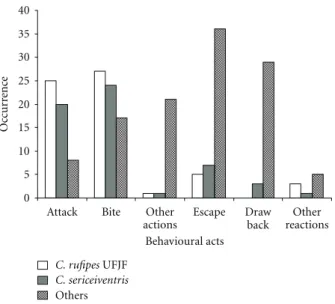
they were submissive to the aggressiveness ofC. rufipes. In UFJF campus, C. rufipes and C. sericeiventris fre-quently showed aggressive behaviour through the actions of “charge” and “bite” (χ2
=45.78,P <0.05) with no statistical
difference between these species in terms of the amount of these acts performed (χ2
=3.43,P > 0.05). All other
mor-phospecies showed significantly more defensive behaviour, especially “retreat” and “flee” reactions (χ2
=18.9,P <0.05)
(Figure 2).
When comparing behaviour ofC. rufipesworkers from the two sites, the UFJF individuals bit more than the Itacolomi individuals, which showed more of “avoid” aggres-sors act (χ2
=19.34,P <0.05) (Figure 3). Concerning
reac-tion behaviours, theC. rufipesfrom the UFJF colony tended to “retreat”, especially in the presence of C. sericeiventris
(χ2
=23.9,P <0.05) (Figure 2).
3.2. Laboratory Experiments. Fifteen types of behaviours were registered in the laboratory, which are categorized and described inTable 3. According to the calculated aggressive-ness index, the more aggressive encounters were between
C. rufipes workers from the two areas and between C. rufipes from Itacolomi andC. sericeiventris, thus, between workers whose colonies are far apart from each other
(Figure 4). Colony workers had an average agonistic response
significantly larger than that observed between themselves in the control experiment (Table 2).
4 Psyche
Table3: Description of behavioral acts displayed by the ants on Itacolomi State Park (Itacolomi) and the Campus of Federal University
of Juiz de Fora (UFJF) during field experiments (∗∗) and laboratory experiments (dyadic encounters) occurring at the lab of the Federal
University of Juiz de Fora (∗).
Action Reaction Nonaggressive
Charge—an ant approaches the other with its mandible open
(∗∗) Remain on the bait—after any types of
the listed actions, the ant remains in the area, eating the bait
(∗∗) Quietly eating—when an ant is
standing still, only eating the bait
Bite—grips part of the body of another individual with its mandibles
(∗∗) Flee—after any types of these actions it
flees not only from the area, but also from the bait
(∗∗) Food transport—the individual carries
part of the bait to the colony
Espontaneous gaster torsion—the ant curls its abdomen to emits formic acid
(∗∗) Retreat—after the mentioned actions,
it retreats from the other individual, but does not leave the bait and eats it
Autogrooming—cleaning itself
Avoid—when perceiving the proximity of another individual, the first moves away, avoiding the encounter
Defensive gaster torsion—after these actions, it exhibits aggressive behaviour by curling its abdomen to emit formic acid
Trophallaxis—exchange of regurgitated liquid from one individual directly into the crop of the other
(∗) Antennal touching—an ant exchanges
antennal touches with the other for identification
Fight—after mentioned actions, it grabs the other individual with its jaws and emits formic acid
Exploring the surroundings—walking around, touching its antennae on the whole extension of the paper where the bait was placed
(∗) On alert—an ant stands still with its
head and antenna raised, and with its gaster torsed in the posterior-anterior position ready to emit formic acid, if necessary
(∗) Bite—grips part of the body of another
individual with its mandibles in response to any action act
(∗) Trying to escape—the ant stays on the
border of the arena, trying to climb its wall
(∗) Charge—the ant advances in the
direction of the other with its mandible open ready to bite back
(∗) Only in lab experiments; (∗∗) Only in field experiments.
minutes (mostly in seconds) in the encounters between
C. rufipes from Itacolomi and C. sericeiventris. (Kruskal-Wallis, Student-Newman-Keuls=23.12,P <0.035). For the
remaining 30%,C. rufipeskilledC. sericeiventrisin one case, and two other times there were fights without deaths.
Unlike the encounters with the neighbouringC. rufipes
andC. sericeiventrisfrom UFJF, the fight lasted longer and all the repetitions severally resulted in death; 60% of theC. sericeiventrisand 40% of theC. rufipesdied. It is worth noting that whenC. rufipeswere killed, the trial was faster than when it was not killed. Finally, in the treatment betweenC. rufipes
from the two studied sites, the ants from the Itacolomi colony died in half of the repetitions without causing a single death among the ants from UFJF (Table 1).
4. Discussion
4.1. Field Experiments. Regardless of the advantage of aggres-siveness, high costs of competing may mean that its selective advantage is only sustainable if associated with the minimiza-tion of conflicts. An evidence is that the behaviours most frequently exhibited by all ants species from both sites were “quietly feeding” and “exploring the surroundings”. Accord-ing to ethograms found in the literature, the most common behavioural acts are into the categories of grooming, feeding, and exploring surroundings [19,27–29].
Likewise, the “dear enemy” hypothesis [30] predicts that ant species are capable of recognizing and discriminating their neighbours (species/individuals), and then they are
normally more aggressive with the “foreigners”, saving energy by avoiding unnecessary conflicts with species or colonies with which they have already defined their boundaries [31,
32]. The species that live together adjust to the habitat and share resources, while foreigners may threaten this balance [30]. In addition, the constant contact among all coexisting ants followed by autogrooming results in a common Gestalt odour, that decreases the aggressiveness among all the species that share the same space [4]. Finally, for canopy ants, it has been reported that various species have the habit of foraging over great distances, presenting familiarity with the place, and tolerating the presence of neighbour species [33].
Both experiments suggest that these species tend to have a territory which is aggressively protected, and thus are able to dominate numerically in the canopies. Both species seem to have defensive behavior across the complete territory, instead of only at the nest or some particular feeding resource, as aggressive actions have been observed everywhere in the studied forest (pers.obs.) and have been corroborated experimentally. The dominant position could be taken byC. rufipeswhereC. sericeiventrisdoes not occur, while in the presence of the latter,C. rufipesmay still keep high abundance (mainly by combining foraging in different habitats, such as the canopy and in the litter) and codominate the assemblage.
yc
h
e
5
Table4: Occurrence of behaviours for the morphospecies of ants in the Itacolomi State Park (Itacolomi) and the Campus of Federal University of Juiz de Fora (UFJF) during field
experiments.
Local Esp´ecie Quietly
eating
Exploring the
surroundings Autogrooming
Food
transport Charge Bite
Espontaneous
torsion gaster Avoid
Remain on the
bait
Flee Retreat Fight Trofalaxis
UFJF Acromyrmex
sp.1 100% 0% 0% 0% 0% 0% 0% 0% 0% 0% 0% 0% 0%
UFJF C. rufipes 42% 21% 14% 0% 9% 10% 0% 0% 1% 0% 2% 0% 0%
UFJF C.
sericeiventris 69% 8% 12% 0% 4% 4% 0% 0% 0% 1% 1% 0% 1%
UFJF Camponotus
sp.5 82% 8% 2% 0% 0% 0% 0% 1% 0% 3% 3% 0% 0%
UFJF Camponotus
sp.6 41% 19% 5% 0% 0% 0% 0% 0% 0% 27% 3% 5% 0%
UFJF Camponotussp.7 50% 8% 7% 0% 2% 1% 0% 7% 0% 9% 15% 2% 0%
UFJF Camponotus
sp.8 100% 0% 0% 0% 0% 0% 0% 0% 0% 0% 0% 0% 0%
UFJF Cephalotessp.2 100% 0% 0% 0% 0% 0% 0% 0% 0% 0% 0% 0% 0%
UFJF Crematogaster
sp.1 98% 2% 0% 0% 0% 0% 0% 0% 0% 0% 0% 0% 0%
UFJF Pheidolesp.2 75% 23% 0% 1% 0% 1% 0% 0% 0% 0% 0% 0% 0%
UFJF Pseudomyrmex
sp.2 69% 15% 3% 0% 3% 1% 0% 4% 0% 1% 5% 0% 0%
UFJF Solenopsissp.1 100% 0% 0% 0% 0% 0% 0% 0% 0% 0% 0% 0% 0%
Itacolomi C. rufipes 29% 40% 14% 4% 6% 3% 0% 4% 0% 0% 0% — —
Itacolomi Camponotus
sp.4 86% 7% 0% 0% 0% 0% 0% 0% 0% 0% 7% — —
Itacolomi Camponotus
sp.2 76% 6% 12% 0% 0% 0% 0% 0% 0% 6% 0% — —
Itacolomi Camponotus
sp.3 50% 17% 33% 0% 0% 0% 0% 0% 0% 0% 0% — —
Itacolomi Camponotus
sp.1 65% 22% 8% 0% 1% 0% 0% 3% 0% 0% 0% — —
Itacolomi Cephalotes
sp.1 80% 20% 0% 0% 0% 0% 0% 0% 0% 0% 0% — —
Itacolomi Myrmelachista
sp.1 95% 4% 0% 0% 0% 0% 0% 0% 0% 1% 0% — —
Itacolomi Pheidolesp.1 100% 0% 0% 0% 0% 0% 0% 0% 0% 0% 0% — —
Itacolomi Pseudomyrmex
6 Psyche 0 5 10 15 20 25 30
Attack Bite Other
actions
Escape Retreat Other
reactions Behavioural acts Myrmelachistasp.1 Others Oc cur re nc e
C. rufipesItacolomi
Figure 1: Action and reaction behavioural occurrences for C.
rufipes,Myrmelachistasp.1 ants, and other morphospecies
assem-blages during field experiments in the Itacolomi State Park (Ita-colomi). The “other actions” and “other reactions” are grouped together because of their low frequency.
0 5 10 15 20 25 30 35 40
Attack Bite Other
actions Escape Draw back Other reactions Behavioural acts Oc cur re nc e
C. rufipesUFJF
C. sericeiventris
Others
Figure 2: Action and reaction behavioural occurrences for C.
rufipes, C. sericeiventris, and other morphospecies (grouped
together) during field experiments at the Campus of Federal University of Juiz de Fora. The “other actions” and “other reactions” behaviours are grouped together because of their low frequency.
expelled by the dominant species, but avoiding interactive aggressive behaviour. In this study, the genera Cephalotes
andPseudomyrmex, along with some species ofCamponotus
(C. crassus and three nonidentified Camponotus species) exhibited this type of behaviour. The opportunistic or cowardly behaviour was previously recorded by Cephalotes pusillusin Byk and Del-Claro [34], as the species was never
0 5 10 15 20 25 30
Attack Bite Other
actions
Escape Retreat Other
reactions Behavioural acts Oc cur re nc e
C. rufipesUFJF
C. rufipesItacolomi
Figure3: Action and reaction behavioural occurrences for theC.
rufipescolonies at the Itacolomi State Park (Itacolomi) and campus
of Federal University of Juiz de Fora (UFJF) during field experi-ments. The “other actions” and “other reactions” behaviours are grouped together because of their low frequency.
Treatments 0 0.5 1 1.5 2 2.5 3 3.5 4 4.5 5 A gg ressi vi ty inde x c a a c c b C o nt ro l C. rufipes It ac o lo m i C o nt ro l C. ru fipes UFJF Con tr o l C. se ri ce iv en tr is UFJF Di ff er ent sp ecies C. ru fipes UFJF C. se ri ce iv en tr is It ac o lo m i× Same species C. ru fipes UFJF It ac olomi × N eig hbors C. se ri ce iv en tr is UFJF C. ru fipes UJUF ×
Figure4: Aggressiveness index (mean and standard deviation) for
each treatment of laboratory experiments (dyadic encounters) in which “control” is the manipulation with individuals from the same colony and species; “different species” betweenC. rufipesfrom Itacolomi State Park (Itacolomi) andC. sericeiventrisfrom Campus of Federal University of Juiz de Fora (UFJF); “same species” between
C. rufipesfrom both Itacolomi and UFJF; “neighbours” betweenC.
rufipesandC. sericeiventrisfrom UFJF.
observed attacking any insect, contrary to what is expected for a plan-ant-herbivore system.
since baits were an energetic, unpredictable, and sufficiently abundant food source, it was possible for various species to eat at the same time without the need to expel or attack the others. Most of natural resources available ought to result in a tougher competitive environment than the one we manipulated.
4.2. Laboratory Experiments. Camponotus rufipesandC. seri-ceiventriswere able to recognize individuals of their colony and to differentiate them from other colonies and species. ForC. rufipes,this capacity has already been registered [35]. Most importantly, the present experiment measured the aggressiveness between these species, which was high for
C. sericeiventris, but also stronger for those individuals of
C. rufipesthat coexisted in the field withC. sericeniventris, compared with the Itacolomi’s individuals. Since Itacolomi’s ants have grown without any substantial competition in nature, they become pacifists.
Similar results were previously described for other sys-tems. Lucas [36] observed three species ofPachycondyla(P. villosa, P. inversa, andP. subversa) during dyadic encounters and found out that they were able to recognize members of the same colony, of the same species and of different species, increasing aggressiveness in the same order. ForC. rufipesat UFJF, there was no differentiation of aggressiveness between intra- and interspecific encounters, which means that their defensive behaviour against C. sericeiventris or a potential invader colony of their own species was similar and may reflect their establishment in a hostile environment.
Combative behaviours are widely described in the myrmecological literature. In the laboratory, Oecophylla longinoda(a dominant arboreal genera) was observed while fighting for its territory with two foreign individuals that entered simultaneously the arena [37]. This species was also observed in its natural habitat fighting and excluding other ant colonies in Africa. Similar results were encountered for
Oecophylla smaragdina in Australia [38, 39]. De Vita [40] measured the aggressiveness of Pogonomyrmex californicus
populations in their natural habitat and observed that 81% of the encounters resulted in some type of aggression and, in some cases, led to the death of the individuals. In addition, there was evidence that ants of the same species from different colonies showed aggression against each other. Aggression was also shown against potential competitors of another species, which resulted in fights or death in all repetitions.
The lack of aggressiveness from Itacolomi’s C. rufipes
corroborates the assumption that aggressive behaviour is more likely learned than inherited, especially since the same species (C. rufipesfrom UFJF) that coexists with competitors presents a greater level of aggressiveness and a greater capacity to fight with foreign species of the same size (C. rufipesfrom Itacolomi). Also, the data from the encounters amongC. rufipesfrom Itacolomi andC. sericeiventrisshow thatC. rufipesfrom Itacolomi was almost always attacked and killed. On the other hand, when the encounters were between
C. rufipes and C. sericeiventris that coexisted in the same area (UFJF), the battles were more evensided, registering 40% of the deaths for workers of C. rufipes and 60% for
C. sericeiventris. In these cases, the aggressiveness index was higher; the ants fought for a longer time before one of them died. In the field experiments, there was no occurrence of a fight to death between C. rufipes and C. sericeiventris,
as had occurred in the dyadic encounters. Nevertheless, a transposing experiment is needed to confirm whether such aggressiveness would be learnt or, otherwise, whether there could be aC. rufipes“pacifist genotype”.
As generally observed in the field for all species, these two codominant species also avoid combative behaviour, in accordance with the prediction that a strategy of decreasing costs of combat is of great importance in behavioural evo-lution. This mutual avoidance during the field experiments could also be related to the abundance of food that the bait represents, which implies in no dispute. However, the dominant species was bothered by the presence of other species when they were encountered feeding at the same place in the bait. On the other hand, in the dyadic encounters in a small arena and with no escape route, the ants had no alternative other than to dispute that small space by attacking and killing the other individual.
In conclusion, direct contacts seem to be avoided be-tweenC. rufipesandC. sericeiventris, as is expected, since they are two species with similar feeding habits, nesting location, foraging strategy, and body dimensions. However,C. rufipes
species from Itacolomi does not have a great fighting capacity, very likely because it does not coexist with any other similar competitor, showing that behavioural plasticity will always favour the cost-saving behaviour, namely avoiding conflict.
Acknowledgments
The authors thank Jacques H. C. Delabie, F´abio Prezoto, and Nath´ercia Esp´ırito Santo for original paper revision; IEF, the State Institute of Forestry and the administration of Itacolomi State Park for providing permits and logistical facilities for the work. They thank FAPEMIG for financial support and Universidade Federal de Juiz de Fora for a masters grant. S´ervio Pontes Ribeiro is a researcher funded by CNPq.
References
[1] B. H¨olldobler and E. O. Wilson,The Ants, The Belknap Press of Harvard University Press, Cambridge, Mass, USA, 1990. [2] R. H. Macarthur and R. Levins, “The limiting similarity,
convergence, and divergence of coexisting species,”American
Naturalist, vol. 101, pp. 377–385, 1967.
[3] N. J. Gotelli and A. M. Ellison, “Assembly rules for New England ant assemblages,”Oikos, vol. 99, no. 3, pp. 591–599, 2002.
[4] E. O. Wilson,The Insect Societies, Harvard University Press, Cambridge, Mass, USA, 1971.
[5] D. W. Davidson, “Resource discovery versus resource domina-tion in ants: a funcdomina-tional mechanism for breaking the
trade-off,”Ecological Entomology, vol. 23, no. 4, pp. 484–490, 1998.
8 Psyche
[7] D. Leston, “The ant mosaic, tropical tree crops and the limiting of pests and diseases,”Pest Articles and News Summaries, vol. 19, pp. 311–341, 1973.
[8] D. Leston, “A neotropical ant mosaic,”Annals of the
Entomo-logical Society of America, vol. 71, pp. 649–653, 1978.
[9] J. D. Majer, J. H. C. Delabie, and M. R. B. Smith, “Arboreal ant community patterns in Brazilian cocoa farms,”Biotropica, vol. 26, no. 1, pp. 73–83, 1994.
[10] B. H¨olldobler and C. J. Lumsden, “Territorial strategies in ants,”Science, vol. 210, no. 4471, pp. 732–739, 1980.
[11] R. Savolainen and K. Vepsalainen, “A competition hierarchy among boreal ants: impact on resource partitioning and community structure,”Oikos, vol. 51, no. 2, pp. 135–155, 1988. [12] K. Del-Claro and P. S. Oliveira, “Ant-homoptera interactions in a neotropical savanna: the honeydew-producing
treehop-per,Guayaquila xiphias(Membracidae), and its associated ant
fauna onDidymopanax vinosum(Araliaceae),”Biotropica, vol. 31, no. 1, pp. 135–144, 1999.
[13] M. R. Orr, D. L. Dahlsten, and W. W. Benson, “Ecological interactions among ants in the genusLinepithema, their phor-id parasitophor-ids, and ant competitors,”Ecological Entomology, vol. 28, no. 2, pp. 203–210, 2003.
[14] R. C. Fonseca and E. Diehl, “Riqueza de formigas (Hymen-optera: Formicidae) epig´eicas em povoamentos deEucalyptus
spp. (Myrtaceae) de diferentes idades no Rio Grande do Sul, Brasil,”Revista Brasileira de Entomologia, vol. 48, pp. 95–100, 2004.
[15] E. F. O. Peternelli, T. M. C. Della Lucia, and S. V. Martins, “Esp´ecies de formigas que interagem com sementes deMabea
fistuliferaMart. (Euphorbiaceae),”Revista ´Arvore, vol. 28, pp.
733–738, 2004.
[16] J. A. Lutinski and F. R. M. Garcia, “An´alise faun´ıstica de Formi-cidae (Hymenoptera: Apocrita) em ecossistema degradado no munic´ıpio de Chapec ´o, Santa Catarina,”Biotemas, vol. 18, pp. 73–86, 2005.
[17] M. S. Santos, J. N. C. Louzada, N. Dias, R. Zanetti, J. H. C. Delabie, and I. C. Nascimento, “Litter ants richness (Hymenoptera, Formicidae) in remnants of a semi-deciduous forest in the Atlantic rain forest, Alto do Rio Grande region, Minas Gerais, Brazil,”Iheringia, vol. 96, no. 1, pp. 95–101, 2006.
[18] N. B. Esp´ırito Santo,Assembl´eia de formigas do Parque Estadual do Itacolomi (MG) e relac¸˜oes intra- e interespec´ıficas entre
esp´ecies dominantes, M.S. thesis, P ´os-Graduac¸˜ao em
Com-portamento e Biologia Animal/Departamento de Biologia Animal/Universidade Federal de Juiz de Fora, 2008.
[19] M. Yamamoto and K. Del-Claro, “Natural history and forag-ing behavior of the carpenter antCamponotus sericeiventris
Gu´erin, 1838 (Formicinae, Campotonini) in the Brazilian tropical savanna,”Acta Ethologica, vol. 11, no. 2, pp. 55–65, 2008.
[20] R. I. Campos, J. P. Scares, R. P. Martins, and S. P. Ribeiro, “Effect of habitat structure on ant assemblages (Hymenoptera: Formicidae) associated to two pioneer tree species,” Sociobiol-ogy, vol. 47, no. 3, pp. 721–738, 2006.
[21] M. A. G. Fujaco,Influˆencia dos diferentes tipos de substrato e geomorfologia na distribuic¸˜ao espacial e arquitetˆonica do gˆenero
Eremanthusno Parque Estadual do Itacolomi, Ouro Preto/MG, M.S. thesis, P ´os-Graduac¸˜ao em Evoluc¸˜ao Crustal e Recursos Naturais/Departamento de Geologia/Universidade Federal de Ouro Preto, 2007.
[22] “Banco de dados clim´aticos do Brasil—Embrapa Monitora-mento por Sat´elite e Esalq—USP,” 2007,http://www.bdclima .cnpm.embrapa.br/resultados/.
[23] J. Altmann, “Observational study of behavior: sampling meth-ods,”Behaviour, vol. 49, no. 3-4, pp. 227–267, 1974.
[24] S. P. Ribeiro, J. P. Soares, R. I. Campos, and R. P. Martins, “Insect herbivores species associated to pioneer tree species: contrasting within forest and ecotone canopy habitats,”
Revista Brasileira de Zoociˆencias, vol. 10, pp. 237–248, 2008.
[25] J. F. S. Lopes, W. O. H. Hughes, R. S. Camargo, and L. C. Forti, “Larval isolation and brood care inAcromyrmexleaf-cutting ants,”Insectes Sociaux, vol. 52, no. 4, pp. 333–338, 2005. [26] C. Errard and A. Hefetz, “Label familiarity and discriminatory
ability of ants reared in mixed groups,”Insectes Sociaux, vol. 44, no. 3, pp. 189–198, 1997.
[27] J. C. Santos and K. Del-Claro, “Ecology and behaviour of the weaver antCamponotus (Myrmobrachys) senex,”Journal of
Natural History, vol. 43, no. 23-24, pp. 1423–1435, 2009.
[28] C. R. Ferreira Brand˜ao, “Sequential ethograms along colony development ofOdontomachus affinisGu´erin (Hymenoptera, Formicidae, Ponerinae),”Insectes Sociaux, vol. 30, no. 2, pp. 193–203, 1983.
[29] J. C. Santos, M. Yamamoto, F. R. Oliveira, and K. Del-Claro, “Behavioral repertory of the weaver antCamponotus
(Myrmo-brachys) senex(Hymenoptera: Formicidae),”Sociobiology, vol.
46, no. 1, pp. 27–37, 2005.
[30] E. O. Wilson,Sociobiology, Belknap Press of Harvard Univer-sity Press, Cambridge, Mass, USA, 1975.
[31] T. A. Langen, F. Tripet, and P. Nonacs, “The red and the black: habituation and the dear-enemy phenomenon in two desert
Pheidoleants,”Behavioral Ecology and Sociobiology, vol. 48, no.
4, pp. 285–292, 2000.
[32] T. Delsinne, Y. Roisin, and M. Leponce, “Spatial and temporal foraging overlaps in a Chacoan ground-foraging ant assem-blage,”Journal of Arid Environments, vol. 71, no. 1, pp. 29–44, 2007.
[33] C. R. Carroll and D. H. Janzen, “Ecology of foraging by ants,”
Annual Review of Ecology and Systematics, vol. 4, pp. 231–257,
1973.
[34] J. Byk and K. Del-Claro, “Nectar- and pollen-gathering Cephalotes ants provide no protection against herbivory: a new manipulative experiment to test ant protective capabili-ties,”Acta Ethologica, vol. 13, no. 1, pp. 33–38, 2010.
[35] K. Jaff´e and C. S´anchez, “On the nestmate-recognition system and territorial marking behaviour in the ant Camponotus rufipes,”Insectes Sociaux, vol. 31, no. 3, pp. 302–315, 1984. [36] C. Lucas, Etude des bases chimiques et comportamentales de´
la formation du “visa” colonial chez les Pon´erines du genre
Pachycondyla, Th`ese Docteur, Biologie du Comportement, Universit`e Paris XI, Paris, France, 2002.
[37] B. H¨olldobler and E. O. Wilson, “The multiple recruitment systems of the african weaver ant Oecophylla longinoda
(Latreille) (Hymenoptera: Formicidae),” Behavioral Ecology
and Sociobiology, vol. 3, no. 1, pp. 19–60, 1978.
[38] B. H¨olldobler, “Territoriality among Oecophylla,” National
Geographic Society Research Reports, vol. 1977, pp. 369–372,
1979.
[39] B. H¨olldobler, “Territorial behavior in the green tree ant
(Oecophylla smaragdina),” Biotropica, vol. 15, pp. 241–250,
1983.
Submit your manuscripts at
http://www.hindawi.com
Hindawi Publishing Corporation
http://www.hindawi.com Volume 2014 Anatomy
Research International
Peptides
Hindawi Publishing Corporation
http://www.hindawi.com Volume 2014
Hindawi Publishing Corporation http://www.hindawi.com
International Journal of
Volume 2014
Zoology
Hindawi Publishing Corporation
http://www.hindawi.com Volume 2014 Molecular Biology International
Genomics
International Journal of
Hindawi Publishing Corporation
http://www.hindawi.com Volume 2014
The Scientific
World Journal
Hindawi Publishing Corporation
http://www.hindawi.com Volume 2014
Hindawi Publishing Corporation
http://www.hindawi.com Volume 2014
Bioinformatics
Advances inMarine Biology
Journal ofHindawi Publishing Corporation
http://www.hindawi.com Volume 2014
Hindawi Publishing Corporation
http://www.hindawi.com Volume 2014
Signal Transduction
Journal ofHindawi Publishing Corporation
http://www.hindawi.com Volume 2014 BioMed
Research International
Evolutionary Biology
International Journal of
Hindawi Publishing Corporation
http://www.hindawi.com Volume 2014
Hindawi Publishing Corporation
http://www.hindawi.com Volume 2014
Biochemistry Research International
Archaea
Hindawi Publishing Corporation
http://www.hindawi.com Volume 2014 Hindawi Publishing Corporation
http://www.hindawi.com Volume 2014 Genetics
Research International
Hindawi Publishing Corporation
http://www.hindawi.com Volume 2014
Advances in
Virology
Hindawi Publishing Corporation http://www.hindawi.com
Nucleic Acids
Journal ofVolume 2014
Stem Cells
International
Hindawi Publishing Corporation
http://www.hindawi.com Volume 2014
Hindawi Publishing Corporation
http://www.hindawi.com Volume 2014
Enzyme
Research
Hindawi Publishing Corporation
http://www.hindawi.com Volume 2014