Article
ISSN 0102-695X http://dx.doi.org/10.1590/S0102-695X2012005000031 Received 24 Aug 2011 Accepted 7 Oct 2011 Available online 8 Mar 2012
Lívia de Paulo Pereira,
1Kaira Emanuella S. da Silva,
2Racquel
O. da Silva,
1Ana Maria S. Assreuy,
*,1Maria G. Pereira
1,21Instituto Superior de Ciências Biomédicas, Universidade Estadual do Ceará, Brazil,
2Faculdade de Educação, Ciências e Letras do Sertão Central, Universidade Estadual do Ceará, Brazil.
Abstract: Azadirachta indica A. Juss., Meliaceae, or Indian neem is a plant used
to treat inlammatory disorders. Total polysaccharide (TPL) and FI (fractioned
by ion exchange chromatography) from the seed tegument of A. indica were evaluated in models of acute inflammation (paw edema/peritonitis) using Wistar rats. Paw edema (measured by hydroplethysmometry) was induced s.c.
by λ-carrageenan (300 μg), histamine (100 μg), serotonin (20 μg), compound 48/80 (10 μg), prostaglandin (PGE2 30 μg) or L-arginine (15 μg). Peritonitis
(analyzed for leukocyte counts/protein dosage) was induced i.p. by carrageenan (500 mg) or N-formyl-methionyl-leucyl-phenylalanine (fMLP 50 ng). Animals
were treated i.v. with TPL (1 mg/kg) or FI (0.01, 0.1, 1 mg/kg) 30 min before
stimuli. FI toxicity (at 0.1 mg/kg, i.v. for seven days) was analyzed by the
variation of body/organ mass and hematological/biochemical parameters. TPL
extraction yielded 1.3%; FI, presenting high carbohydrate and low protein content, at 0.1 mg/kg inhibited paw edema induced by carrageenan (77%),
serotonin (54%), PGE2 (69%) and nitric oxide (73%), and the peritonitis
elicited by carrageenan (48%) or fMLP (67%), being well tolerated by animals.
FI exhibited potent anti-inflammatory activity, revealing to be important active component in traditionally prepared remedies to treat inflammatory states.
Keywords: anti-inflammatory Azadirachta indica plant polysaccharide seed tegument.
Introduction
Azadirachta indica A. Juss., Meliaceae, is a medicinal plant known as Indian neem or lilac, Persian lilac or margosa tree, originated from Asia, but worldwide cultivated. In Brazil, neem or nim is well adapted in the northeast Caatinga biome being largely recognized by its repellent and insecticide properties causing no environment pollution (Martinez, 2002). In folk medicine, oil seeds, bark and leaf extracts have been used to treat gastrointestinal, analgesic and inlammatory disorders. Experimental data demonstrated immunomodulator and anti-inl ammatory activities of bark and leave extracts and also antipyretic and anti-inl ammatory effects of oil seeds (Arora et al., 2011; Biswas et al., 2002).
Many compounds have been isolated from the oil seeds (mixture of tetranortripterpenes) and barks
(polysaccharides) of A. indica. Although studies have
described anti-inl ammatory effect of polysaccharide extracts (Biswas et al., 2002), little has identii ed the bioactive components. Based on previous knowledge of
A. indica constituents and their occurrence in traditional
medicinal preparations, this study evaluated the effects
of isolated polysaccharide fractions of A. indica seed
tegument in models of inl ammation in vivo.
Materials and Methods
Plant material
Azadirachta indica A. Juss., Meliaceae, was collected in Quixadá, Ceará-Brazil, identii ed by Ms. Vaneicia dos S. Gomes (State University of Ceara) and excicata deposited in the Prisco Bezerra herbarium of Federal University of Ceará (voucher nº 46084).
Extraction and isolation of polysaccharides from A.
indica seed tegument
- procedure repeated twice. The insoluble portion was extracted (three times) with 0.1 M NaOH (1:50 w/v, 97 ºC) and centrifuged (2496 x g; r.t.). The alkaline
polysaccharide extracts were pooled, neutralized in 1 M HCl, precipitated with 4 volumes of absolute EtOH (~800 mL) and re-centrifuged. Supernatant was dialyzed
against running water for 72 h, centrifuged (2496 x g; r.t.)
and the inal supernatant (Total Polysaccharides-TPL) was lyophilized (Yoon et al., 2002).
Ten milligrams of TPL, dissolved in 20 mL of H20 (1:2, w/v), was applied to ion exchange
chromatography (DEAE-cellulose), equilibrated and washed with distilled water for removal of neutral polysaccharides, being the acidic polysaccharides eluted (60 mL/h) with NaCl (0.25-1 M). TPL and major polysaccharide fractions were dialyzed and further lyophilized. Content of carbohydrate (Dubois et al., 1956), uronic acid (Dische, 1947) and protein
(Bradford et al., 1976) were assessed using D-galactose,
D-galacturonic acid and BSA as respective standards.
Animals
Wistar rats (150-200 g) were maintained at 25 oC,
under a 12/12 h light/dark cycle, with free access of food and water. Protocols were approved by the Institutional Animal Care and Use Committee of the State University of Ceará-UECE (09204632-0) in accordance with the Guide for the Care and Use of Laboratory Animals of the US Department of Health and Human Services (NIH publication n° 85-23, revised 1985).
Inlammation models
Paw edema
Paw edema was induced by subcutaneous (s.c.)
injection of λ-carrageenan or dextran (300 μg), histamine (100 μg), serotonin (20 μg), compound 48/80 (10 μg), prostaglandin (PGE2 30 μg) or L-arginine (15 μg/paw).
Control animals were treated 15 min prior to injection of
the inhibitor of nitric oxide synthase L-NAME (30 mg/
kg, i.v.) or 30 min prior to injection of the antagonist of
serotonin receptor methisergide (5 mg/kg, i.p.). Edema
was measured by plethysmometry (Panlab-LE-7500) before (zero time) and at ½, 1, 2-6 h thereafter and calculated by the difference in paw volume displacement (mL) or by the trapezoid method expressed as area under curves-AUC (arbitrary units) (Landucci et al., 1995).
Animals were treated i.v. (0.1 mL/100 g body weight)
with TPL (1 mg/kg), FI (0.01, 0.1, 1 mg/kg) or saline 30 min prior administration of logistic agents.
Peritonitis
Peritonitis was induced i.p. with carrageenan
(500 mg) or N-formyl-methionyl-leucyl-phenylalanine
(fMLP 50 ng). Animals were euthanized 4 h later and peritoneal luid harvested with 10 mL saline (5 IU heparin) for total and differential leukocyte counts (neutrophils, eosinophils, mast cells and mononuclear cells) (Souza & Ferreira, 1985) and protein leakage (Bradford, 1976).
Animals received FI (0.1 mg/kg, i.v.) or saline 30 min
before stimuli.
Toxicity assay
Rats were weighted before and after i.v.
treatment with F1 (0.1 mg/kg) or saline during seven days. Peripheral blood was collected for hematological and biochemical analysis from anesthetized animals via
intramuscular (i.m.) injection of ketamine (90 mg/kg)
and xylazine (10 mg/kg). Animals were euthanized by cervical dislocation for remotion and weighting of heart, spleen, kidney, stomach and liver (expressed as g wet weight/100 g body mass).
Statistical analysis
Data are presented as mean±SEM of animals (n=6-7) and analyzed by ANOVA and Bonferroni’s test.
p<0.05 was considered signiicant.
Results and Discussion
Total Polysaccharides extraction yielded 1.3% of dry material, containing 54% carbohydrate, 4% protein and 51% uronic acid. TPL ion exchange chromatography (DEAE-cellulose) provided three major fractions (FI, FII, FIII) eluted at 0.25, 0.5 and 1.0 M NaCl, respectively (Figure 1). FI showed the best yield (40%) and highest carbohydrate (54%) and uronic acid (31%) contents, but low levels of protein (3%) (Table 1). Both polysaccharide extraction and fractioning were shown to be eficient, considering the low content of protein contaminants and high content of carbohydrate and uronic acid, an important feature of plant cell walls (Drozdova & Bubenchikov, 2005).
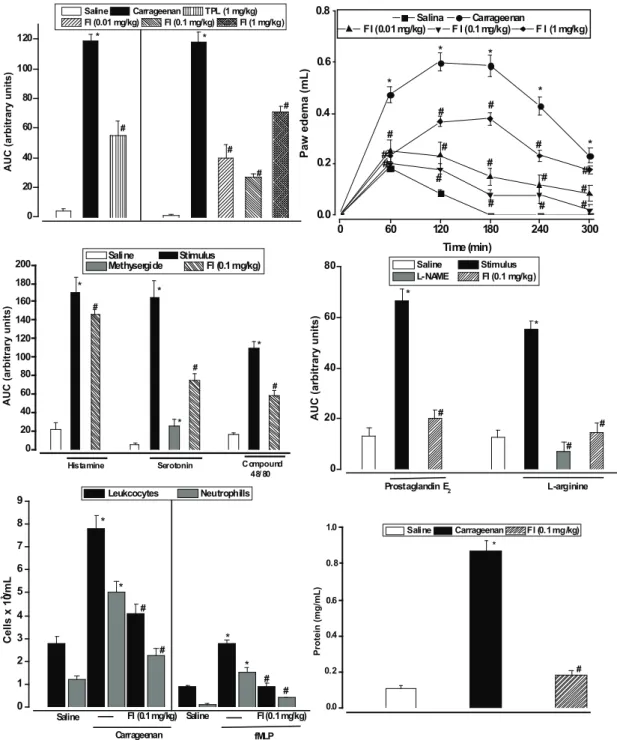
was obtained at 0.1 mg/kg (27.00±2.50 AUC) about 77% compared to the control carrageenan (118.02±6.50 AUC) (Figure 2A). Paw edema induced by carrageenan is characterized by protein leakage in the irst two hours, synthesis of initial phase (histamine, serotonin, bradykinin) and late phase (nitric oxide, prostaglandins) inlammatory mediators and neutrophil iniltrate (Di Rosa et al., 1971). On the other hand, dextran induces an osmotic edema followed by protein extravasation without neutrophil iniltrate (Lo et al., 1982).
Figure 1. TPL ion exchange chromatography. TPL (10 mg) were dissolved in 20 mL distilled water and applied to
DEAE-cellulose (9.8 x 2.0 cm). Resin was washed with water and the
acidic polysaccharide fractions eluted (60 mL/h) with a linear NaCl (- - -) gradient. Carbohydrates (♦) were assayed by Dubois
(1956).
Table 1. Yield and chemical analysis of A. indica
polysaccharide fractions. Polysaccharide
fractions
aYield (%)
bCarbohydrate (%)
cProtein (%)
dUronic
acid (%)
FI 40 54 3 31
FII 31 37 2 31
FIII 13 3 0.3 5
aFI, FII and FIII (10 mg); bDubois (1956); cBradford (1976); dDische (1947)
FI (0.1 mg/kg) did not alter the paw edema elicited by histamine (169.3±17.89; FI 146.8±4.41 AUC), but eficiently reduced that of serotonin (165.3±17.89; FI 74.7±7.82 AUC) in 54% and that of compound 48/80 (109.4±7.36; FI 59.1±4.33 AUC) in 46% (Figure 2C). Besides, pre-treatment of animals with methysergide inhibited the edema elicited by serotonin in 84% (25.5±6.9 AUC) (Figure 2C). Our data indicates that FI did not antagonize histamine receptors, but could stabilize mast cell membranes, preventing the release of its content (histamine and serotonin) stimulated by compound 48/80 (Brito et al., 2007). This data is supported in literature, showing that polysaccharide fractions of aerial parts of
Viola odorata and Malva pusilla plants presented
anti-inlammatory activity (Drozdova & Bubenchikov, 2005).
Also, polysaccharide fractions of Orbihnya phalerata
fruit and Cyrtopodium cardiochilum pseudobulbs reduced
plasma leakage in rats (Pereira da Silva & Paz Parente, 2001; Barreto & Parente, 2006).
FI (0.1 mg/kg) reduced in 69% the paw-edema elicited by PGE2 (66.5±4.56; FI 20.25±2.94 AUC) and in
73% that of L-arginine (55.2±3.49; FI 14.5±3.90 AUC),
a substrate of nitric oxide (NO) generation. Additionally,
pre-treatment of animals with L-NAME inhibited in
84% (7.0±4.1 AUC) the edema elicited with L-arginine (Figure 2D). Based on the biphasic nature of carrageenan-induced edema and in the late inhibitory effect of FI, the polysaccharide possibly causes better interference with late-phase mediators. In this line, plant extracts of Trichilia dregeana (Jäger et al., 1996), Cryptocarya latifolia, Euclea natalensis, Felicia muricata, Mohria caffrorum (McGaw et al., 1997) and Culcasia scandens (Okoli & Akah, 2004) show anti-inlammatory activity, inhibiting PGE2 release. Moreover, nimbidin, the major
active principle of A. indica oil seed inhibits NO and
PGE2 from rat peritoneal macrophages stimulated with
lipopolysccharide (Kaur et al., 2004).
As showed in the paw edema model, FI effectively inhibited the effect of late-phase inlammatory mediators involved in cell events. In fact, FI (0.1 mg/kg) reduced the number of total leukocyte migration in 67% when stimulated with fMLP (2.74±0.15; FI 0.89±0.13
x 103) and in 48% when stimulated with carrageenan
(7.79±0.03; FI 4.07±0.04 x 10³) (Figure 2E). Neutrophils
were the most reduced cells, about 75%, when stimulated with fMLP (1.50±0.20; FI 0.37±0.02 x 10³) and about
55% when stimulated with carrageenan (5.01±0.03; FI
4.07±0.04 x 10³) (Figure 2E). It is well known that in
acute inlammatory responses the neutrophil rolling/ adhesion along endothelium is a result of direct (fMLP) or indirect activation (carrageenan), via resident cells, that culminate in chemotactic release of mediators (Ribeiro et al., 1997). Thus, FI may be interfering in both pathways. Accordingly, pectic polysaccharide fractions from aerial
parts of Comarum palustre (Popov et al., 2005) and the
acidic polysaccharide from lower-heads of Cyrtopodium cardiochilum (Barreto & Parente, 2006) were shown to inhibit cell migration. Further, FI (±0.03 x 10³) reduced vascular leakage elicited by carrageenan (0.9±0.06 x 10³ mg/mL) in 81% (Figure 2F), corroborating the initial phase action of FI in the model of paw edema. This inding stretches the role of FI in inlammatory vascular events, as described for polysaccharide fractions of
Orbignya phalerata mesocarp (Pereira da Silva & Paz Parente, 2001).
and kidney (0.93±0.03; control 0.80±0.03). Alanine and aspartate transaminases (ALT; AST), creatinine, albumin and globulin levels were not affected, but urea levels increased. The number of circulating lymphocytes were
also raised (Table 2), which could be accredited in part to the immunomodulatory action of plant polysaccharides (Arora et al., 2011).
0 20 40 60 80 100 120 # # # # *
AUC (arbitrary units)
Saline Carrageenan TPL (1 mg/kg) FI (0.01 mg/kg) FI (0.1 mg/kg) FI (1 mg/kg)
*
0 60 120 180 240 300 0,0 0,2 0,4 0,6 0,8 0.0 0.2 0.4 0.6 # # # # # # # # # # # # # # * * * *
Paw edema (mL)
Time (min)
Salina Carrageenan
F I (0.01 mg/kg) F I (0.1 mg/kg) F I (1 mg/kg)
* # 0.8 0 20 40 60 80 L-arginine Prostaglandin E2
# #
#
*
AUC (arbitrary units)
Saline Stimulus L-NAME FI (0.1 mg/kg)
* 0 1 2 3 4 5 6 7 8 9 # # # * * * fMLP Carrageenan Saline
Saline FI (0.1 mg/kg) FI (0.1 mg/kg)
Cells x 10
3 /mL
Leukcocytes Neutrophills
* # 0,0 0,2 0,4 0,6 0,8 1,0 # 0.0 0.2 0.4 0.6 0.8 Protein (mg/mL)
Saline Carrageenan FI (0.1 mg/kg)
1.0 * 0 20 40 60 80 100 120 140 160 180 200 Compound 48/ 80 Serotonin # # * * * #
AUC (arbitrary units)
Saline Stimulus Methysergide FI (0.1 mg/kg)
*
Histamine
Figure 2. Anti-inflammatory effect. TPL (1 mg/kg) or FI (0.01, 0.1 and 1 mg/kg) was injected i.v. 30 min before s.c. edema
induction with A. carrageenan (300 μg); B. histamine (100 μg), serotonin (20 μg) or compound 48/80 (10 μg); C. PGE2 (30
μg) or L-arginine (15 μg; s.c.) in animals pre-treated or not 15 min prior L-NAME (30 mg/kg, i.v.) or before i.p. peritonitis
induction with D. carrageenan (500 μg) or F. fMLP (50 ng); E. protein leakage induced with carrageenan (500 μg). Controls received saline (0.9%). Edema was measured at ½, 1, 2-6 h and peritonitis at 4 h after stimuli. Mean±SEM. (n=6). ANOVA
In conclusion, TPL and FI fractioned from A. indica seed tegument exhibited potent anti-inlammatory
activity, interfering not only in vascular, but especially in cellular inlammatory events, involving serotonin, PGE2 and NO. These polysaccharides could be revealed
as important active components in traditionally prepared remedies to treat inlammatory diseases.
Acknowledgements
Authors are grateful to Ms. Vaneicia dos S. Gomes, who identiied the plant species and Gabriela F. O. Marques-Domingos for laboratory technical support. This research was funding by Brazilian grants from CNPq, CAPES and FUNCAP. AMS Assreuy is senior investigator of CNPq.
References
Arora N, Koul A, Bansal MP 2011. Chemopreventive activity of Azadirachta indica on two-stage skin carcinogenesis in murine model. Phytother Res 25: 408-416.
Barreto DW, Parente JP 2006. Chemical properties and biological activity of a polysaccharide from Cyrtopodium cardiochilum. Carbohydr Polymer 64: 287-291.
Biswas K, Chattopadhyay I, Banerjee RK, Bandyopadhyay U
2002. Biological activities and medicinal properties of Neem (Azadirachta indica). Curr Sci India 82: 1336-1345.
Bradford MM 1976. A rapid and sensitive method for the
quantitation of microgram quanties of protein utilizing
the principle of protein-dye binding. Anal Biochem 72: 248-254.
Brito FA, Lima LA, Ramos MF, Nakamura MJ,
Cavalher-Machado SC, Siani AC, Henriques MG, Sampaio AL
2007. Pharmacological study of anti-allergic activity of
Syzygium cumini (L.) Skeels. Braz J Med Biol Res 40: 105-115.
Dische Z 1947. A speciic color reaction for glucuronic acid. J Biol Chem 171: 725-730.
Di Rosa M, Giroud JP, Willoughby DA 1971. Studies on the mediators of the acute inlammatory response induced
in rats in different sites by carrageenan and turpentine.
J Pathol 104: 15-29.
Drozdova IL, Bubenchikov RA 2005. Composition and anti-inlammatory activity of polysaccharide complexes
extracted from sweet violet and low mallow. Pharm Chem J 39: 29-32.
Dubois M, Gilles KA, Hamilton JK, Rebers PA, Smith F 1956.
Colorimetric method for determination of sugars and related substances. Anal Chem 28: 350-356.
Jäger AK, Hutchings A, Van Staden J 1996. Screening of Zulu medicinal plants for prostaglandin-synthesis inhibitors.
J Ethnopharmacol 52: 95-100.
Kaur G, Sarwar M, Athar M 2004. Nimbidin suppresses
functions of macrophages and neutrophils: Relevance
to its anti-inlammatory mechanisms. Phythother Res 18: 419-424.
Landucci ECT, Antunes E, Donato JL, Faro R, Hyslop S, Marangoni S, Oliveira B, Cirino G, De Nucci G 1995.
Inhibition of carrageenin-induced rat paw oedema by crotapotin, a polypeptide complexed with phospholipase A2. Br J Pharmacol 114: 578-583.
Lo TN, Almeida AP, Beaven MA. 1982. Dextran and carrageenan evoke different inlammatory responses in rat with respect to composition of iniltrates and effect
of indomethacin. J Pharmacol Exp Ther 221: 261-267. Martinez SS 2002. O Nim - Azadirachta indica. In: Natureza, Table 2. Biochemical and hematological parameters of animals treated with Azadirachta indica polyssacharide.
bParameters
aTreatment (100 µL/100 g)
Saline FI (0.1 mg/kg)
ALT ( U/l ) c33.85±2.14 b33.85±1.01
AST ( U/l ) 79.0±3.7 72.85±4.58
Urea (mg/dl ) 46.42±3.14 60.42±2.01*
Creatinine (mg/dl) 0.46±0.01 0.48 ± 0.02
Total protein (mg/dl) 5.91 ± 0.10 5.78±0.14
Hematocrit (%) 45.35±0.87 43.4±0.45
Hemoglobin (g/dl) 14.65±0.37 14.65±0.14
Erythrocytes (106/µl) 7.56±0.19 7.33 ±0.08
Platelets (10³/µl) 846.0±62.04 975.71±38.38
Lymphocytes (%) 22.14±2.19 78±2.21*
Monocytes (%) 2.57±0.48 2.28 ±0.18
Eosinophils (%) 1±0 1.42±0.29
aRats were treated daily in single doses with FI (0.1 mg/kg) or saline (0.9%) during 7 days; bAnalysis of biochemical and hematological parameters
Usos Mútiplos, Produção. IAPAR, Londrina: Paraná,
Brazil, p. 142.
McGaw LJ, Anna J, Van Staden J 1997. Prostaglandins synthesis
inhibitory activity in Zulu, Xhosa and Sotho medicinal plants. Phytother Res 11: 113-117.
Pereira da Silva B, Paz Parente J 2001. An anti-inlammatory
and immunomodulatory polysaccharide from Orbignya phalerata. Fitoterapia 72: 887-893.
Popov SV, Popova GY, Ovodova RG, Ovodov YS 2005. Anti-inlammatory activity of the pectic polysaccharide from Comarum palustre. Fitoterapia 72: 281-287.
Okoli CO, Akah PA 2004. Mechanisms of the anti-inlammatory
activity of the leaf extracts of Culcasia scandens P. Beauv (Araceae). Pharmacol Biochem Behav 79: 473-481.
Ribeiro RA, Souza-Filho MVP, Souza MHLP, Oliveira SHP,
Costa CHS, Cunha FQ, Ferreira SHP 1997. Role of resident mast cells and macrophages in the neutrophil
migration induced by LTB4, fMLP and C5a des arg. Int Arch Allergy Immunol 112: 27-35.
Souza GEP, Ferreira SH 1985. Blockade by antimacrophage
serum of the migration of PMN neutrophils into the
inlamed peritoneal cavity. Agents Actions 17: 97-103.
Yoon SJ, Pereira MS, Pavão MSG, Hwang JK, Pyun YR, Mourão PAS 2002. The medicinal plant Porana volubilis contains polysaccharides with anticoagulant activity mediated by heparin cofactor II. Thromb Res 106: 51-58.
*Correspondence
Ana Maria Sampaio Assreuy
Instituto Superior de Ciências Biomédicas, Universidade Estadual do Ceará
Av. Parajana, 1700, Campus do Itaperi, 60.714.242
Fortaleza-CE, Brazil